
Outstanding checks refer to checks that have been:
A.Written, recorded, sent to payees, and received and paid by the bank.
B.Written and not yet recorded in the company books.
C.Held as blank checks.
D.Written, recorded on the company books, sent to the customer, but have not yet been
paid by the bank.
E.Issued by the bank.
A responsibility accounting performance report reports:
A.Only actual costs.
B.Only budgeted costs.
C.Both actual costs and budgeted costs.
D.Only direct costs.
E.Only indirect costs.
Which of the following factors is least likely to be considered in preparing a sales
budget?
A.Plant capacity.

B.General economic and industry conditions.
C.Past sales volume.
D.The capital expenditures budget.
E.Proposed selling expenses, such as advertising.
The accounting principle that requires revenue to be reported when earned is the:
A.Matching principle.
B.Revenue recognition principle.
C.Time period principle.
D.Accrual reporting principle.
E.Going-concern principle.
A balance column ledger account is:
A.An account entered on the balance sheet.
B.An account with debit and credit columns for posting entries and another column for
showing the balance of the account after each entry is posted.
C.Another name for the withdrawals account.
D.An account used to record the transfers of assets from a business to its owner.

E.A simple form of account that is widely used in accounting to illustrate the debits and
credits required in recording a transaction.
When two clerks share the same cash register it is a violation of which internal control
principle?
A.Establish responsibilities.
B.Maintain adequate records.
C.Insure assets.
D.Bond key employees.
E.Apply technological controls.
A company had $9,000,000 in net income for the year. Its net sales were $13,200,000
for the same period. Calculate its profit margin.
A.17.5%.
B.28.0%.
C.62.5%.
D.160.0%.
E.68.2%

Expenses:
A.Increase equity.
B.Are gross increases in equity from a company’s earning activity.
C.Are the costs of assets or services used to earn revenues.
D.Occur when equity exceeds revenue.
E.Are creditors claims on assets.
A company entered into the following transactions. Match each transaction with the
appropriate journal.
a. Sales journal
b. Purchases journal
c. Cash receipts journal
d. Cash disbursements journal
e. General journal
1) A customer returned a $250 item purchased on account.
2) Purchased a display rack on account for $4,700.

3) Borrowed $5,000 cash from the bank.
4) Recorded depreciation on store equipment of $4,000.
5) Recorded cash sales of $14,700.
6) Paid $65,000 cash in wages and salaries.
7) Paid a utility bill for $3,400 cash.
8) Purchased $1,590 of store supplies on account.
9) Purchased merchandise on account, $2,700.
10) Returned defective inventory purchased on account, $2,900.
Retained earnings:
A.Generally consists of a company’s cumulative net income less any net losses and
dividends declared since its inception.
B.Can only be appropriated by setting aside a cash fund.
C.Represent an amount of cash available to pay shareholders.
D.Are never adjusted for anything other than net income or dividends.
E.All of these.
If budgeted beginning inventory is $8,300, budgeted ending inventory is $9,400, and
budgeted cost of goods sold is $10,260, budgeted purchases should be:
A.$ 860
B.$ 1,100
C.$ 1,960
D.$ 9,160
E.$11,360
On a bank reconciliation, an unrecorded debit memorandum for printing checks is:
A.Noted as a memorandum only.
B.Added to the book balance of cash.
C.Deducted from the book balance of cash.
D.Added to the bank balance of cash.
E.Deducted from the bank balance of cash.
A corporation was formed on January 1. The corporate charter authorized 100,000
shares of $10 par value common stock. During the first month of operation, the

corporation issued 300 shares to its attorneys in payment of a $5,000 charge for
drawing up the articles of incorporation. The entry to record this transaction would
include:
A.A debit to Organization Expenses for $3,000.
B.A debit to Organization Expenses for $5,000.
C.A credit to Common Stock for $5,000.
D.A credit to Paid-in Capital in Excess of Par Value, Common Stock for $5,000.
E.A debit to Paid-in Capital in Excess of Par Value, Common Stock for $2,000.
Expenses that are not easily associated with a specific department, and which are
incurred for the benefit of more than one department, are:
A.Fixed expenses.
B.Indirect expenses.
C.Direct expenses.
D.Uncontrollable expenses.
E.Variable expenses.
To determine the production budget for an accounting period, consideration is given to
the:
A.Budgeted ending inventory.
B.Budgeted beginning inventory.
C.Budgeted sales.
D.Budgeted overhead.
E.A, B and C.
Recording employee expenses for employers may involve:
A.Liabilities to individual employees.
B.Liabilities to federal and state governments.
C.Liabilities to insurance companies.
D.Liabilities to labor unions.
E.All of these.
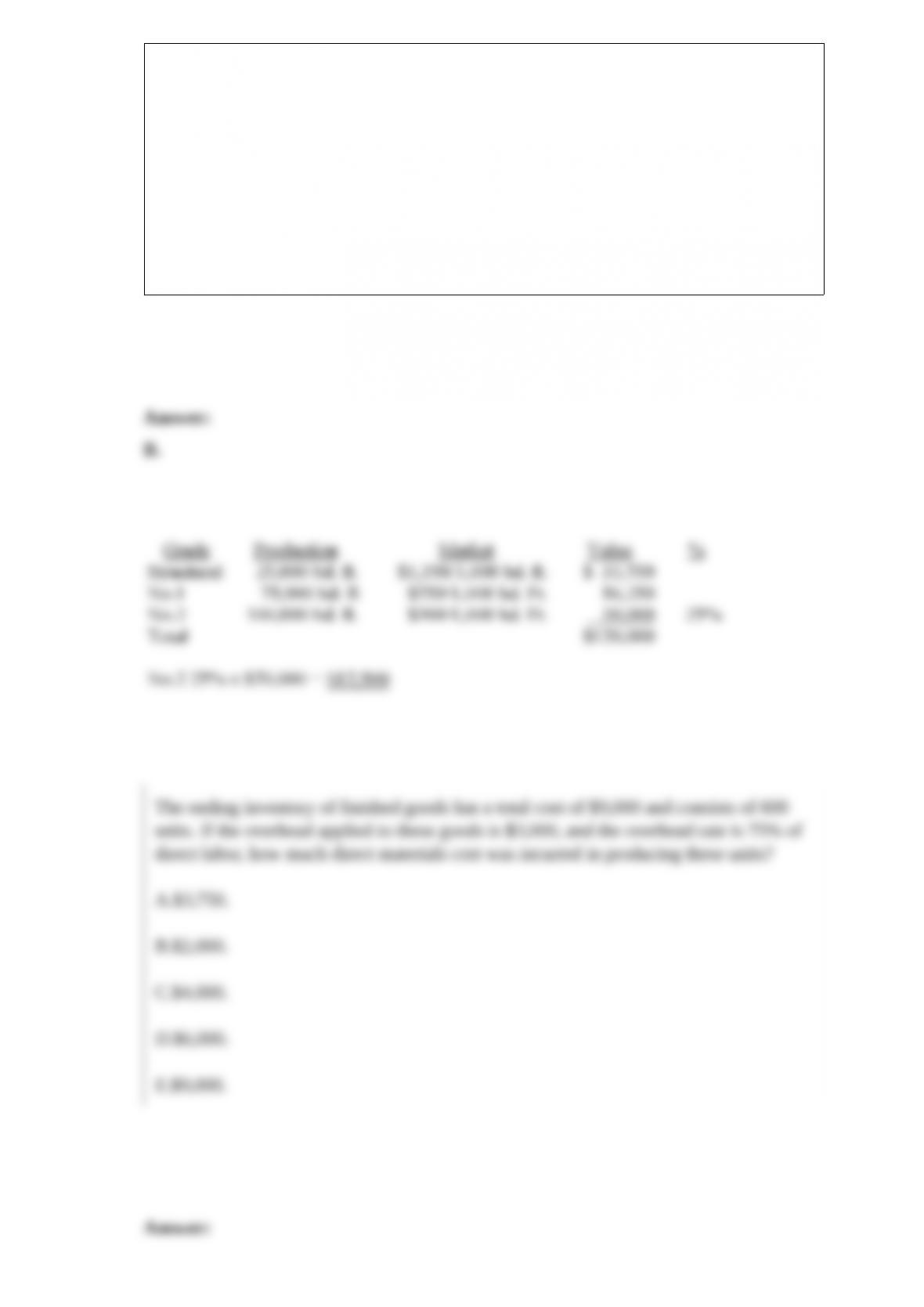
A sawmill paid $70,000 for logs that produced 200,000 board feet of lumber in 3
different grades and amounts as follows:
How much of the $70,000 joint cost should be allocated to No. 2 Common?
A.$ 0.
B.$17,500.
C.$23,333.
D.$35,000.
E.$70,000.
A plan showing the units of goods to be sold and the revenue to be derived from sales,
that is the usual starting point in the budgeting process, is called the:
A.Operating budget.
B.Business plan.
C.Income statement budget.
D.Merchandise purchases budget.
E.Sales budget.
Which of the following statements is incorrect?
A.Higher financial leverage involves higher risk.
B.Risk is higher if a company has more liabilities.
C.Risk is higher if a company has higher assets.
D.The debt ratio is one measure of financial risk.
E.Lower financial leverage involves lower risk.
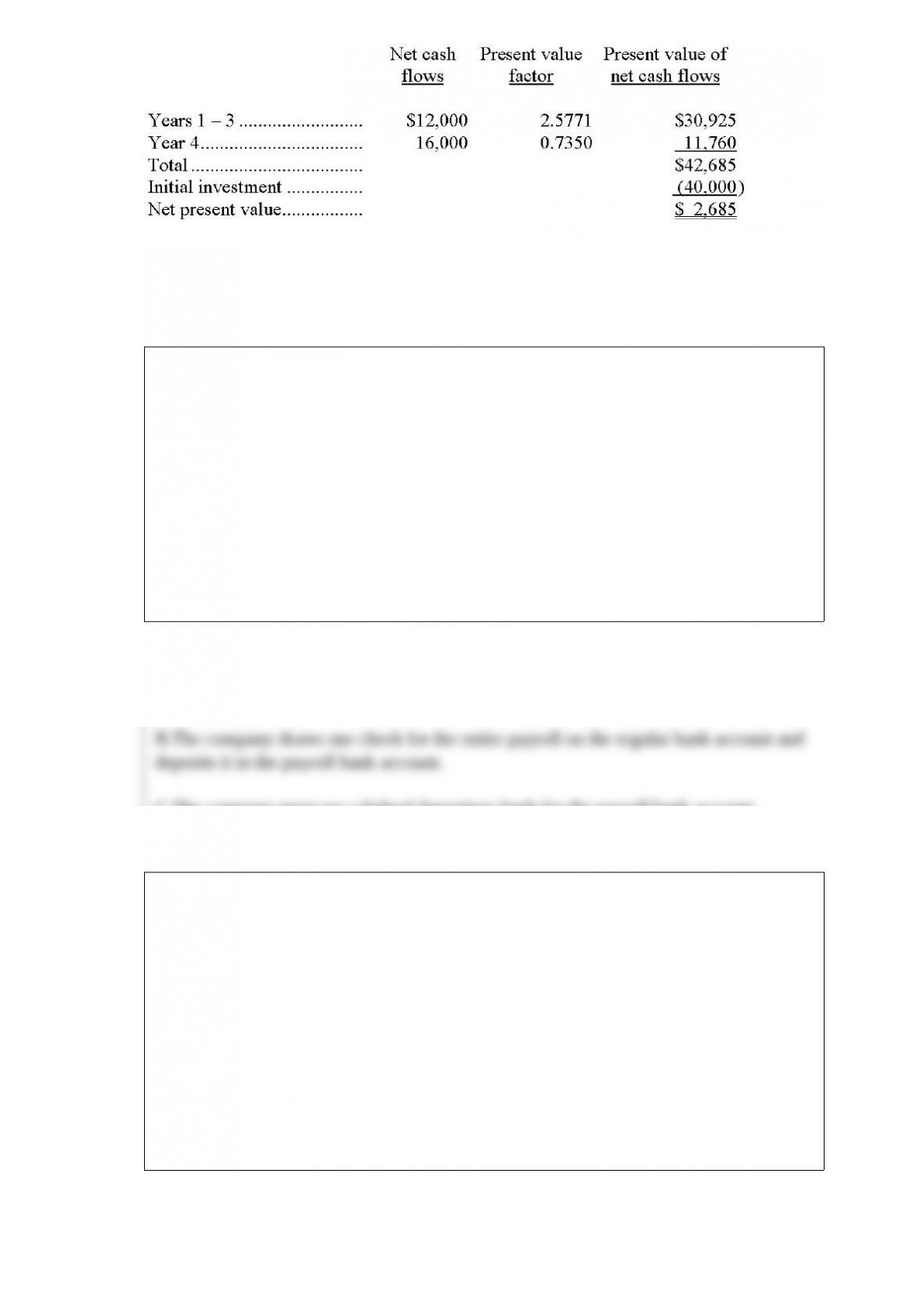
The following present value factors are provided for use in this problem:
Norman Co. wants to purchase a machine for $40,000, but needs to earn an 8% return.
The expected year-end net cash flows are $12,000 in each of the first three years, and
$16,000 in the fourth year. What is the machine’s net present value (round to the nearest
whole dollar)?
A.$(9,075).
B.$2,685.
C.$42,685.
D.$(28,240).
E.$52,000.
If a company uses a special payroll bank account:
A.The company does not need to issue paychecks.
B.The company draws one check for the entire payroll on the regular bank account and
deposits it in the payroll bank account.
C.The company must use a federal depository bank for the payroll bank account.
D.There is no need for a payroll register.
E.There is no need to issue W-2’s.

A disadvantage of using the payback period to compare investment alternatives is that:
A.It ignores cash flows beyond the payback period.
B.It includes the time value of money.
C.It cannot be used when cash flows are not uniform.
D.It cannot be used if a company records depreciation.
E.It cannot be used to compare investments with different initial investments.
During a recent fiscal year, Dawson Company reported pretax income of $125,000, a
contribution margin ratio of 25% and total contribution margin of $400,000. Total
variable costs must have been:
A.$1,100,000.
B.$1,200,000.
C.$500,000.
D.$1,600,000.
E.$2,100,000.
When all of the authorized shares have the same rights and characteristics, the stock is
called
A.Preferred stock.
B.Common stock.
C.Par value stock.
D.Stated value stock.
E.No-par value stock.
Joseph Co. has three products A, B, and C, and its fixed costs are $69,000. The sales
mix for its products are 3 units of A, 4 units of B, and 1 unit of C. Information about the
three products follows:
(a) Calculate the company’s break-even point in composite units and sales dollars.
(b) Calculate the number of units of each individual product to be sold at the break-even
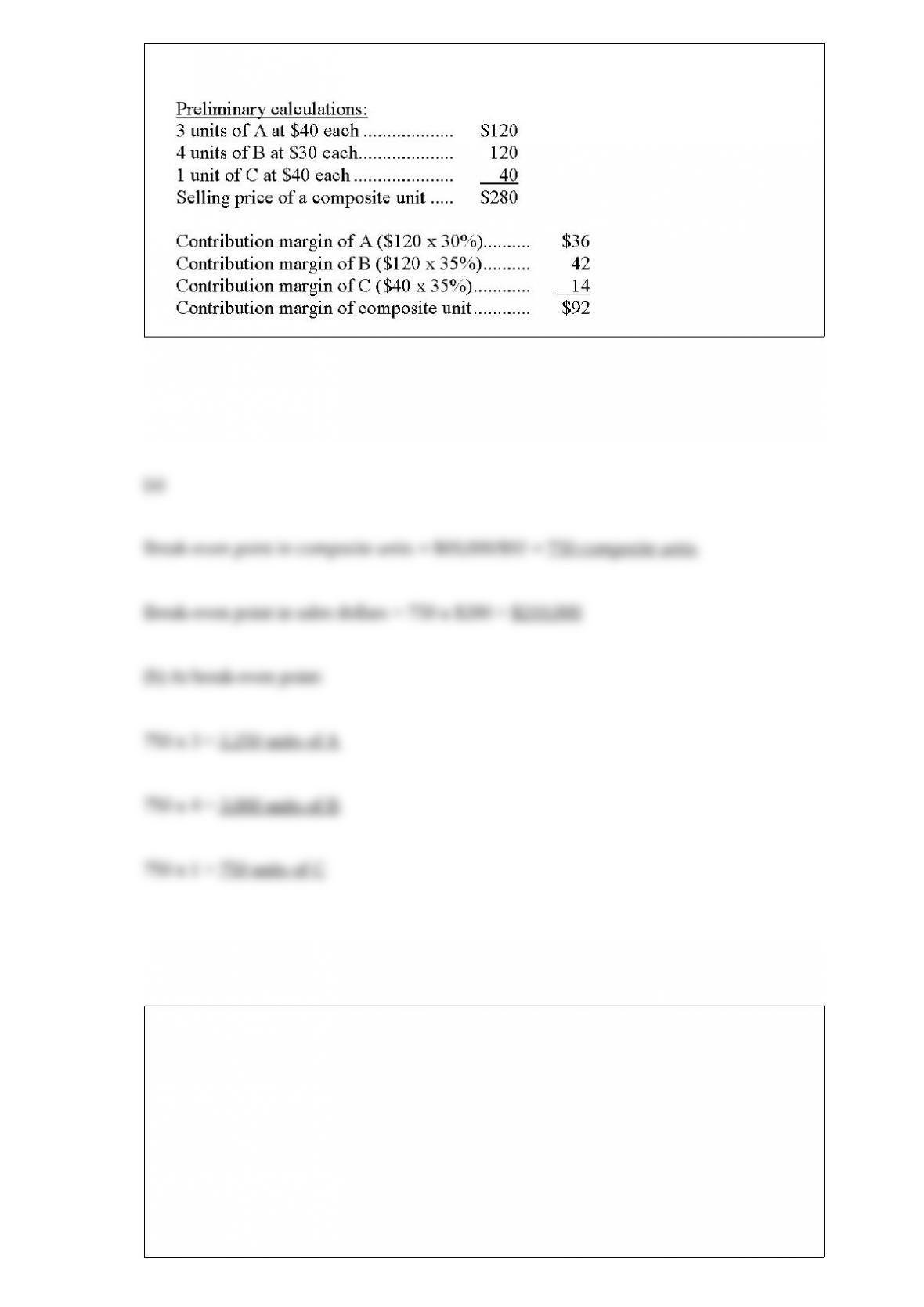
point.
Preparing a master budget is usually the responsibility of:
A.The company CEO.
B.The marketing department.
C.A budget committee.
D.The chief financial officer.

E.Lower level management.
Preferred stock is often issued:
A.To initiate or increase financial leverage.
B.To prevent dilution of common stock.
C.To appeal to investors who believe that common stock is too risky.
D.To boost the return earned by common shareholders.
E.All of these.
A product sells for $30 per unit and has variable costs of $18 per unit. The fixed costs
are $720,000. If the variable costs per unit were to decrease to $15 per unit and fixed
costs increase to $900,000, and the selling price does not change, break-even point in
units would:
A.Increase by 20,000.
B.Equal 6,000.
C.Increase by 6,000.
D.Decrease by 20,000.
E.Not change.
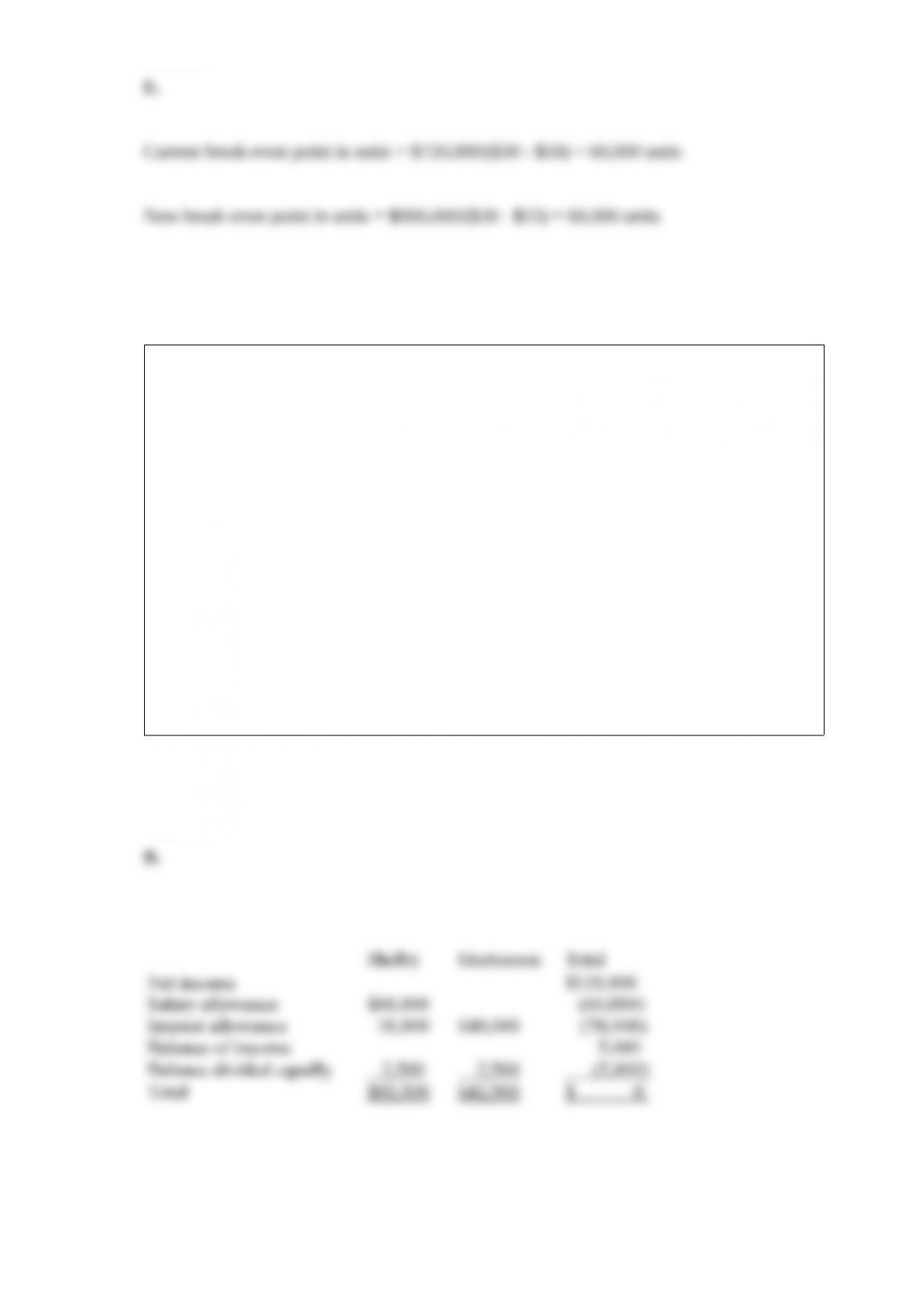
Shelby and Mortonson formed a partnership with capital contributions of $300,000 and
$400,000, respectively. Their partnership agreement calls for Shelby to receive a
$60,000 per year salary. Also, each partner is to receive an interest allowance equal to
10% of a partner’s beginning capital investments. The remaining income or loss is to be
divided equally. If the net income for the current year is $135,000, then Shelby and
Mortonson’s respective shares are:
A.$67,500; $67,500.
B.$92,500; $42,500.
C.$57,857; $77,143.
D.$90,000; $40,000.
E.$35,000; $100,000.
A process cost summary involves computations and analysis at four sequential steps.
These are (1) _________ (2) _____________, (3) _______________, and (4)
______________.
The ____________________ of a note is the day the principle plus interest of a note
must be repaid.
Kelley Company and Mason Company each have sales of $200,000 and costs of
$140,000. Kelley Company’s costs consist of $40,000 fixed and $100,000 variable,
while Mason Company’s costs consist of $100,000 fixed and $40,000 variable. Which
company will suffer the greatest decline in profits if sales volume declines by 15%?
How is the profit margin calculated? Discuss its use in analyzing a company’s
performance.
A company’s post-closing trial balance has a debit total of $475,000 and a credit total of
$457,000. This indicates that __________________________.
In accounting, the rule that requires that assets, services, and liabilities be recorded
initially at the cash or cash-equivalent value of what was given up or of the item
received is called ______________________________.

To write off an uncollectible account receivable when the allowance method of
accounting for uncollectible accounts is used, a company should debit
_______________________ and credit accounts receivable.
___________________ are costs incurred to produce or purchase two or more products
at the same time.
For a manufacturer, the cost of goods sold can be computed by adding the beginning
finished goods inventory to ________________________ and then subtracting the
ending finished goods inventory.
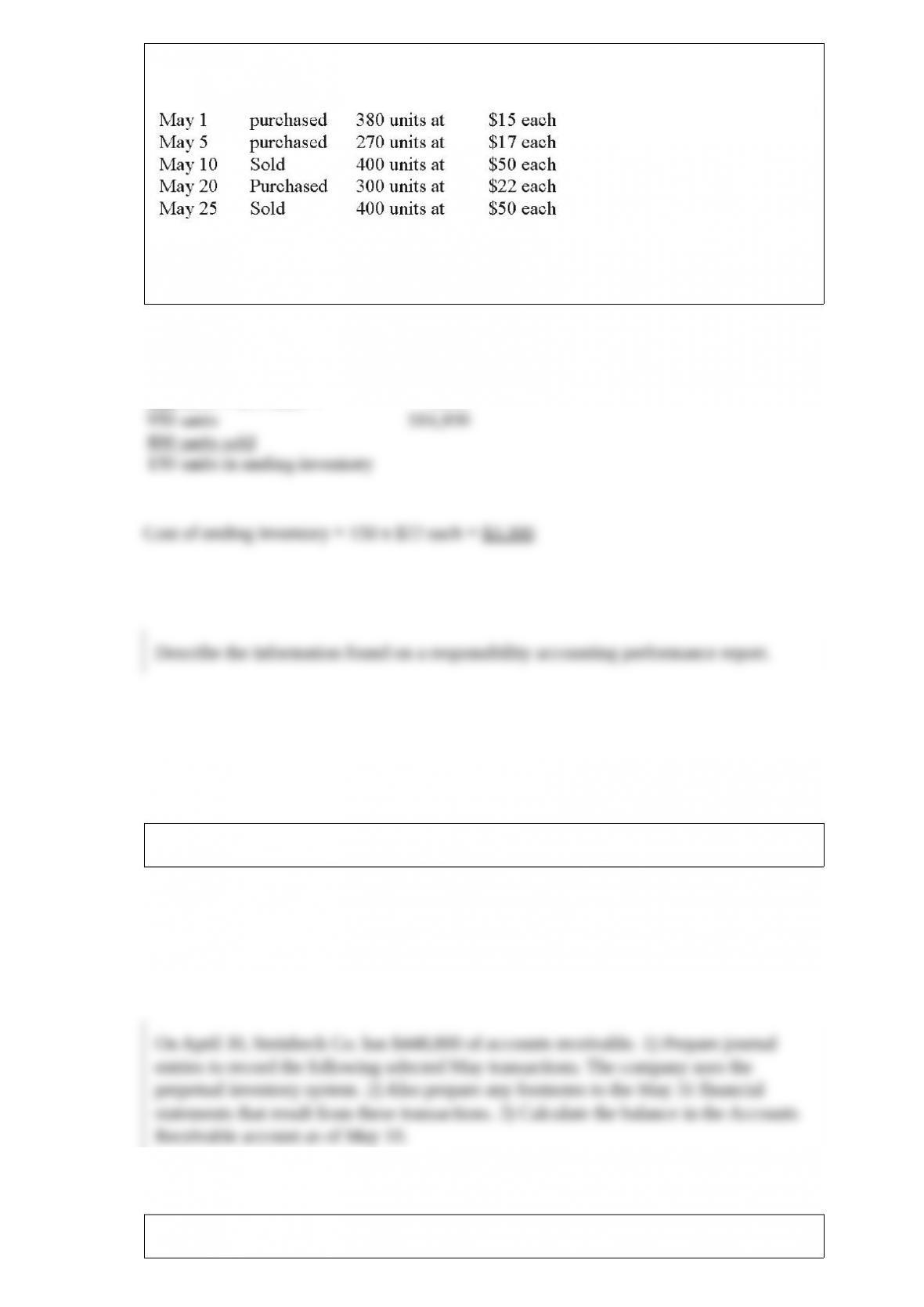
A company made the following merchandise purchases and sales during the month of
May:
There was no beginning inventory. If the company uses the FIFO periodic inventory
method, what would be the cost of the ending inventory?
Describe the information found on a responsibility accounting performance report.
On April 30, Steinbeck Co. has $448,800 of accounts receivable. 1) Prepare journal
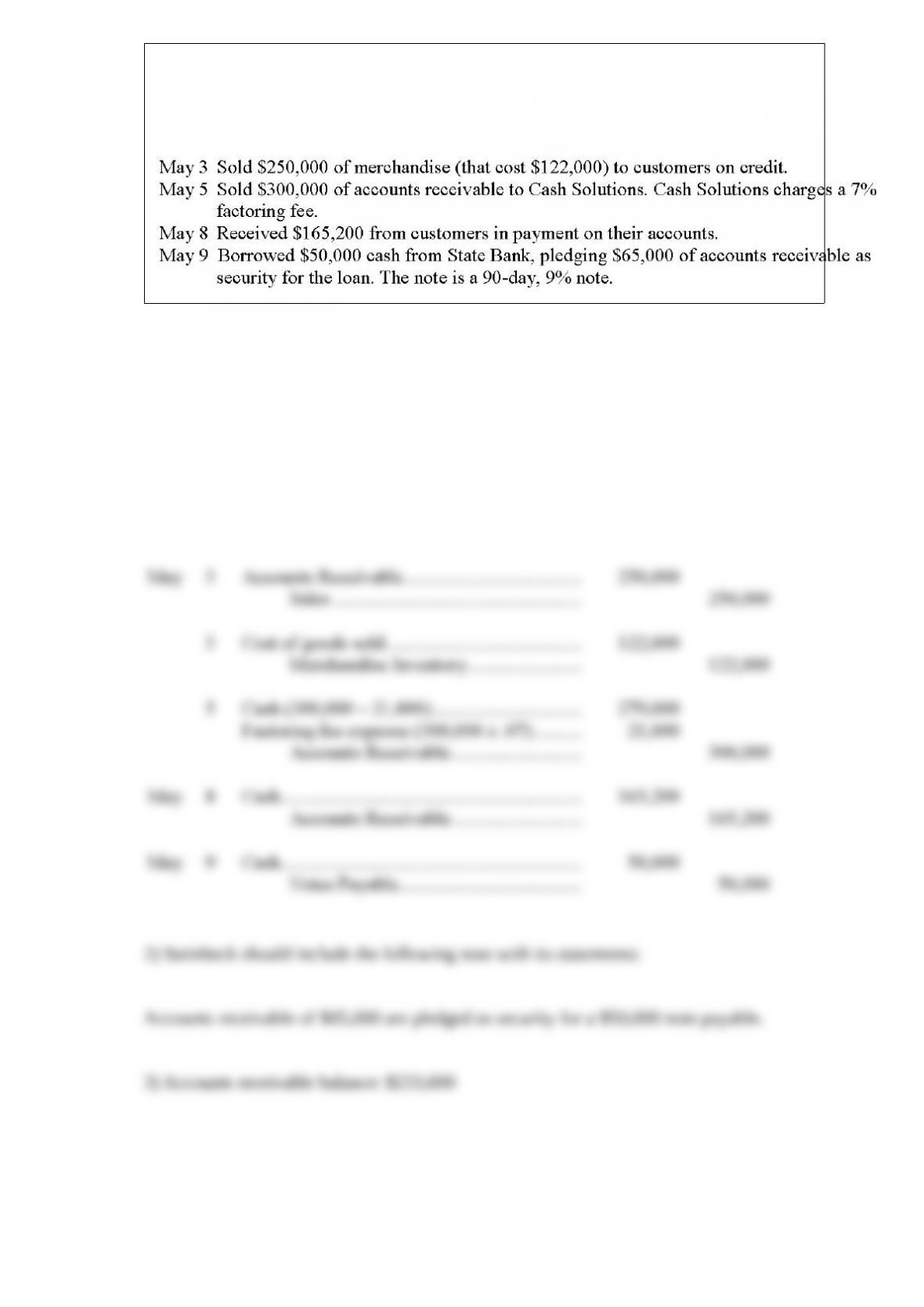
entries to record the following selected May transactions. The company uses the
perpetual inventory system. 2) Also prepare any footnotes to the May 31 financial
statements that result from these transactions. 3) Calculate the balance in the Accounts
Receivable account as of May 10.