
In rare cases, auditors have been held liable for criminal acts. A criminal conviction
against an auditor can result only when it is demonstrated that the auditor
A) was negligent.
B) was grossly negligent.
C) intended to deceive or harm others.
D) caused a financial loss to an innocent third party.
PA has set audit risk at 2% and determined that inherent risk is 60%. What is the level
of targeted audit assurance?
A) 2%
B) 40%
C) 98%
D) 60%
The inherent risks of programming errors with resulting data loss increases when
A) packaged software is used that has to be updated every year.
B) complex configurations such as ERP at multiple locations are used.

C) functional systems are used (such as separate systems for sales and payroll).
D) sequential file systems are used rather than database management systems.
The overall objective in the audit of the sales and collection cycle is to evaluate whether
A) the sales account and the accounts receivable account are free of errors.
B) the sales account and the accounts receivable account are free of material errors.
C) the sales account and the accounts receivable account are presented fairly in
accordance with an applicable financial reporting framework.
D) the account balances affected by the cycle are fairly presented in accordance with an
applicable financial reporting framework.
If there is an error in wage rates, such errors can typically escalate into material
amounts. What characteristic of the human resources and payroll cycle causes this?
A) many repeated transactions
B) the presence of independent verification
C) the use of outsourcing organizations for payroll
D) an error in the starting cheque number in a cheque run

There are many elements of quality control at the firm level. Which element does
“policies in place should include use of second or independent partner review, technical
review, documentation, and compliance with quality control processes” belong to?
A) engagement performance
B) engagement quality control review
C) documentation
D) general human resource policies
What is the best way to prevent potential alteration, deletion or addition of cancelled
cheques, duplicate deposit slips or other documents provided with the bank statement?
Have the
A) bank statements provided unopened to an independent reconciler.
B) person responsible for recording cash receipts does the bank reconciliation.
C) signing officer(s) review the bank reconciliation.
D) bank statements are provided to the accounts payable supervisor.

After the items for confirmation have been selected, the auditor must maintain control
of the confirmations until
A) the names are provided to client’s personnel to type the envelopes.
B) the sealed envelopes are provided to client’s personnel to be mailed.
C) the responses are received by the client with the return mail.
D) they are returned by the debtor to the auditor.
The Ultramares doctrine is that ordinary negligence is insufficient for liability of
auditors to third parties because of the lack of privity of contract between the third party
and the auditor. What type of behaviour on the part of an auditor would result in
liability to more general third parties according to this doctrine?
A) conducting an audit engagement when a review engagement had been contracted
B) completing work in accordance with a contract that was signed with the client
C) deliberate misstatement of the financial statements by management remaining
undetected
D) fraud or constructive fraud with respect to the working papers
Because of the lack of available evidence, it is usually difficult for an auditor to
discover if an employee records more time on his or her time card than actually worked.
One procedure is to reconcile the total hours
A) paid this period with a previous period.
B) paid according to the payroll records with an independent record of the total hours
worked, such as those maintained by production control.
C) worked this period with a previous period.
D) worked according to the summary payroll report with the total hours worked as
recorded on the time card for the period.
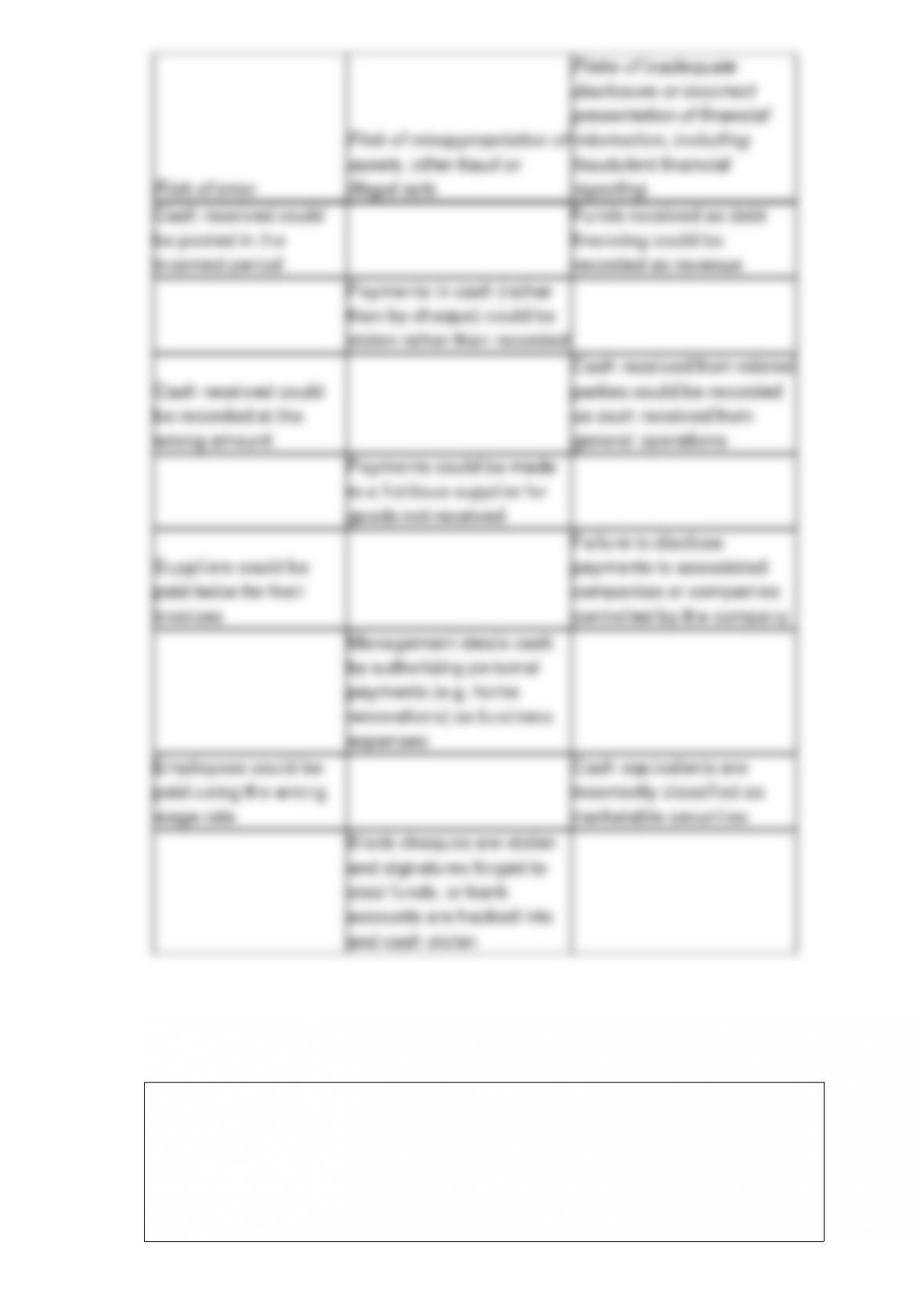
A) Distinguish between (i) risks of error, (ii) risks of fraud, and (iii) risks of inadequate
presentation or disclosure of financial information.
B) For each of the three types of risks described in (A), provide three examples of
major risks of error or fraud in the cash cycle.
The Sarbanes-Oxley Act of 2002 made it a felony to
A) destroy or create documents to impede a federal investigation.
B) have internal control weaknesses.

C) have a significant internal control weakness.
D) engage in transactions with related parties.
Helen found that the expense reports were not properly approved while the senior
accounts payable clerk was on vacation in July. Helen decided to perform a test of
control on the authorization of expense reports for all the months except for July which
she will test substantively. Helen is allowed to do this because
A) the authorized expense reports for July are not material.
B) it would not be cost beneficial to test the entire population substantively.
C) the authorizations for the month of July are not representative of the population as a
whole.
D) compensating controls exist in the payroll reconciliation process.
Canadian PAs are required to have controls in place to identify and track suspicious
transactions and comply with the reporting requirements of the Proceeds of Crime and
Terrorist Financing Act. This Act requires PAs to report to FINTRAC any
A) cash payment of $10,000 or more.
B) cash payment of $100,000 or more.
C) transaction of $1,000 or more from clients suspected of being terrorists.

D) cash payment to a related party.
According to the profession’s ethical standards, an auditor would be considered
independent in which of the following instances? The
A) auditor’s chequing account, which is fully insured by CDIC, is held at a client
financial institution.
B) client comprises 75% of the auditor’s fees.
C) auditor does not have enough employees to meet the client’s reporting deadline.
D) client owes the auditor fees for two consecutive annual audits.
There will be heavy emphasis on tests of controls when
A) controls are ineffective and assessed control risk is high.
B) controls are effective and assessed control risk is low.
C) the auditor is doing a “fraud audit.”
D) it is a first-year audit.

Estimated unpaid obligations for services or benefits that have been received prior to
the balance sheet date are classified as
A) accounts payable.
B) accrued liabilities.
C) miscellaneous assets.
D) unearned revenues.
When systematic sample selection is used, the first item is selected randomly and all
other items are selected automatically. If the characteristic of interest is not distributed
randomly in the population, the systematic selection creates the possibility of
A) bias.
B) abnormal frequency distribution.
C) judgmental intervention in the process.
D) selecting mostly larger dollar items.

Why might the decisions about materiality and risks be different for the internal auditor
than for the external auditor when conducting an audit of a system?
A) the auditors are applying different skills during the conduct of the audit
B) external auditors have different expectations with respect to quality control
C) internal auditors will focus only on the potential for dollar errors internally
D) external users may have different needs than management
Mafah Distribution Limited has requested that the audited financial statements be
completed by January 5, five days after the December 31 year end. This means that the
auditor will be unable to verify subsequent payments on accounts receivable and will be
unable to determine whether accounts payable have been set up correctly. What type of
audit report should Mafah receive if the auditor is unable to use alternative procedures
for these two audit areas?
A) Disclaimer
B) Adverse
C) Qualified
D) Unqualified

The audit procedures for the subsequent events review can be divided into two
categories: (1) procedures normally integrated as a part of the verification of year-end
account balances, and (2) those performed specifically for the purpose of discovering
subsequent events. Which of the following procedures are in category 2?
A) Examine subsequent-period sales and purchases transactions to determine whether
the cutoff is accurate.
B) Correspond with lawyers.
C) Test the collectability of accounts receivable by reviewing subsequent period cash
receipts.
D) Compare the subsequent period purchase price of inventory with the recorded cost
as a test of lower-of-cost-or-market valuation.
Management safeguards assets by
A) having the internal auditors conduct periodic counts of physical assets.
B) controlling access and by comparison of physical items to records.
C) requiring the external auditors to do surprise audits.
D) having management sign a management representation letter.
The client has presented all required financial statements with the exception of the

statement of cash flows. The auditor has completed the audit and is satisfied that
everything, with the exception of the missing statement, is presented fairly. As a result,
the auditor would likely issue
A) a qualified opinion.
B) an unqualified opinion.
C) a disclaimer of opinion.
D) either an unqualified or qualified opinion.
A public accountant observes his client’s physical inventory count on December 31.
There are eight inventory-taking teams, and a tag system is used. The public
accountant’s observation normally may be expected to result in detection of which of
the following inventory errors?
A) The inventory takers forgot to count all the items in one room of the warehouse.
B) An error is made in the count of one inventory item.
C) Some of the items included in the inventory had been received on consignment.
D) The inventory omits items on consignment to wholesalers.
The auditor has decided that there is a risk of material misstatement with respect to
sales revenue. Which of the following audit tests should the auditor use to quantify the
potential error?
A) discuss the process used to assign credit limits with the sales manager and the
controller
B) send external confirmations to customers with accounts receivable balances
C) determine whether all sales tested have a supporting customer purchase order
D) determine whether all sales tested have a matching bill of lading
A) Discuss each of the six steps in applying materiality in an audit, and identify the
audit phase(s) in which each step is performed.
B) Discuss the three main factors that affect an auditor’s preliminary judgment about
materiality.
An example of general computer control systems that provide reasonable assurance of
authorization of application systems is
A) operations and information systems support.
B) systems, acquisition, development and maintenance controls.
C) organization and management controls.
D) application system control procedures.

Which of the following procedures might be useful in discovering a contingent liability
for a lawsuit that management is intentionally neglecting to disclose?
A) Inquiries (orally and in writing) of management
B) Analyze legal expense and review invoices and statements from outside legal
counsel
C) Review current and previous years’ Canada Revenue Agency correspondence
D) Obtain a letter of representation from management that it is not aware of any
undisclosed contingent liabilities
Joan has been the payroll supervisor at York Distribution Company (YDC) for ten
years. She has never missed a payroll and Farah, the owner of the company is delighted
with her conscientiousness and knowledge. This is particularly important, as Farah
spends a lot of time on the road drumming up new business, and needs competent
personnel back at the office.
There are two accounting personnel at the office, a receptionist, five shipping and
receiving personnel, and thirty sales people employed by YDC. Office and
shipping/receiving personnel are paid a salary, while the sales people are paid a monthly
base salary plus a percentage of their sales, calculated quarterly. The base salary is low,
at $20,000, with a 2% commission, calculated based upon sales less any bad debts
written off related to their customers.
Joan prints off the sales by customer every month, and uses this information to calculate
commission. She then prepares the payroll cheques and gives them to Farah, who signs
them and gives them to the sales staff at the monthly sales meeting. The cheques are
written against a payroll imprest bank account, kept at a balance of $1,000. This
account is not reconciled, as the staff are very overworked with the increasing volume
of business handled by the company.
Required:
A) Identify control weaknesses and their impact, and provide recommendations for
improvement.
B) What is the impact of the control weaknesses upon your audit approach?
Which of the following presentation and disclosure related audit objectives does not
have a parallel audit objective for both the transaction related audit objectives and
balance-related audit objectives?
A) allocation
B) classification
C) understandability
D) rights and obligations
The internal control objective to determine that “existing acquisition transactions are
recorded” describes the objective of
A) occurrence.
B) classification.
C) completeness.
D) accuracy.

The most important part of the observation of inventory is determining whether
A) the inventory-takers are qualified.
B) the physical count is being taken in accordance with the client’s instructions.
C) the counts are accurate.
D) obsolete inventory has been identified.
The most authoritative requirements for public accountants performing financial
statement audits in Canada are the
A) standards used by the client.
B) industry specific standards.
C) CICA handbook requirements.
D) assurance guidelines.
An auditor is conducting the audit of the financial statements of a retail department
store. The auditor is aware that he must obtain sufficient appropriate evidence with
respect to various audit assertions associated with management assertions and thus with
material financial statement amounts.

The following is a list of specific audit procedures the accountant plans to perform:
1. Send negative external confirmation requests to a large sample of the store’s
customers with balances due on account at year end.
2. Perform test counts of goods on hand during the company’s normal physical
inventory taking, one month prior to the year end.
3. Examine receiving reports dated prior to the year end which have not been matched
to vendor’s invoices.
4. Review paid invoices and supporting documents for amounts classified as repair and
maintenance expense for large or unusual items.
5. Examine audited financial statements of several foreign companies in which the
client owns shares, and which are being held as temporary investments.
Required:
For each of the five audit procedures listed, describe only the PRIMARY management
assertion being tested, the PRIMARY audit assertion being tested, and the quality of
evidence (high, medium, low) obtained, explaining WHY the evidence is the quality
level you specify.
Identify three analytical procedures commonly used when auditing accounts in the
inventory and distribution cycle.
We discuss four types of auditors: public accountants, government auditors, Canada
Revenue Agency auditors and internal auditors. Briefly describe the work and
responsibilities of each type.
Discuss the differences and similarities between the roles of accountants and auditors.
What additional expertise must an auditor possess beyond that of an accountant?
Identify the characteristics that working papers should have. For each characteristic,
briefly explain why it is important.
Discuss the purposes of tests of controls and tests of details of balances. Give an
example of each.
Frederic is an account manager at a large Canadian bank. Frederic has to decide if the
bank will make a loan to Frost Corp, a snow removal company. Further, Frederic has to
decide how much they will lend to Frost and at what rate.
Assuming that Frederic makes the loan, what factors will he use to decide the rate of
interest? What factors are impacted by auditing and how?
You are conducting the audit of Files R Us Inc. (FRI), a family-owned business that
manufactures a variety of different types of wooden and metal file cabinets. In business
for over twenty years, FRI has a reputation for providing high quality products on time
or even ahead of schedule. FRI does not sell to the public, but only to fine furniture
stores and to a variety of office supply chains.
As of the current year end, the company has a total of $6.3 million in assets. Inventory
information is as follows:
Raw materials (metals and supplies) $ 400,000
Raw materials (wood products) 450,000
Work in progress 1,350,000
Finished goods 250,000
$2,450,000
Finished goods consists of:
Material 48%
Direct labour 22
Overhead 30
100%
File cabinet production is intensely competitive, primarily due to imports from Asia and
Mexico. To help manage costs, FRI uses a job-order, standard cost system. Standard
costs are assessed quarterly. Each job is costed and compared to standard. Inventory is
counted only at the end of the year. There is no perpetual inventory system.
Due to problems with raw material quality and new staff, losses have been incurred in
the last six months of the year. Your review of last year’s audit file indicated that there
were numerous inventory adjustments required last year.
Required:
Using the audit risk model, assess the risks associated with the audit of inventory.
Define “assurance engagements.”
Knowledge of the client’s industry and external environment can be obtained in
different ways. Discuss some of the ways that this knowledge can be obtained.
You are a senior at a PA firm and this is your junior’s first day. He would like you to
explain to him what are the different types of audit tests that should be performed over
the course of an audit to obtain sufficient and appropriate audit evidence. Further,
please indicate to which component of audit risk the type of test is linked.
There are 14 steps to audit sampling, divided into four sections: plan the sample, select
the sample, perform the audit procedures, and evaluate the results. Discuss each of the
steps that comprise the “plan the sample” section for attribute sampling.
State five specific balance-related audit objectives for accounts payable and, for each
objective, describe one common test of details of balances.
Samru has been assigned the sales cycle as part of an audit team. He will be evaluating
several key controls in the sales cycle and conducting tests of detail for accounts
receivable.
Samru has been told to look at 15 customers with respect to the credit limit approval
process (a test of control). Then, he has been told to use dual purpose tests for the rest
of his testing.
Required:
Explain the relationship between tests of controls, dual purpose tests and tests of details.
A financial statement audit typically consists of three sections. Identify each of the three
sections of an audit and discuss the major activities performed by the auditor in each
section.