
Discontinuing a segment or product may not be the best choice when the segment is
contributing to fixed expenses.
Answer:
Of the two methods of accounting for uncollectible receivables, the allowance method
provides in advance for uncollectible receivables.
Answer:
Standards are set for only direct labor and direct materials.
Answer:
If a company uses average costing instead of FIFO they will still get the same unit
costs.

Answer:
A company can use comparisons of its financial data to the data of other companies and
industry values to evaluate its position.
Answer:
Only managers are encouraged to submit capital investment proposals because they
know the processes and are able to match investments with long-term goals.
Answer:
Conversion costs consist of product costs and period costs.

Answer:
The ratio of the market price per share of common stock on a specific date to the annual
earnings per share is referred to as the price-earnings ratio.
Answer:
The computations involved in the net present value method of analyzing capital
investment proposals are more involved than those for the average rate of return
method.
Answer:
Vertical analysis compares each item in a financial statement with a total amount from
the same statement.
Answer:

Investment in Bonds are reported on the balance sheet at lower of cost or market.
Answer:
Activity-based costing provides more accurate and useful cost data than traditional
systems.
Answer:
The salary allocation to partners used in dividing net income would also appear as
salary expense on the partnership income statement.
Answer:

If a building is appraised for $85,000, offered for sale at $90,000, and the buyer pays
$80,000 cash for it, the buyer would record the building at $85,000.
Answer:
The form of the balance sheet in which assets, liabilities, and owner’s equity are
presented in a downward sequence is called the report form.
Answer:
Cost of Merchandise Sold is often the largest expense on a merchandising company
income statement.
Answer:

Specialized journals are books of original entry.
Answer:
The Sarbanes-Oxley Act prohibits CPAs from providing nonaudit investment banking
services.
Answer:
When using the direct write-off method off accounting for uncollectible receivables, the
account Allowance for Doubtful Accounts is debited when a specific account is
determined to be uncollectible.
Answer:
If the underapplied factory overhead amount is material, it is transferred to Cost of
Goods Sold at the end of the fiscal year.

Answer:
Unsold consigned merchandise should be included in the consignee’s inventory.
Answer:
A prior period adjustment should be reported as an adjustment to the retained earnings
balance at the beginning of the period in which the adjustment was made.
Answer:
All income statement accounts will be closed at the end of the period.
Answer:

The cash budget summarizes future plans for acquisition of fixed assets.
Answer:
The production budget is the starting point for preparation of the direct labor cost
budget.
Answer:
In the merchandising income statement, sales will be reduced by sales discounts and
sales returns and allowances to arrive at net sales.
Answer:

Regardless of the depreciation method, the amount that will be depreciated during the
life of the asset will be the same.
Answer:
When land is purchased to construct a new building, the cost of removing any structures
on the land should be charged to the building account.
Answer:
A report analyzing the dollar savings of purchasing new equipment to speed up the
production process is a managerial accounting report.
Answer:
The budgeted volume of production is normally computed as the sum of (1) the
expected sales volume and (2) the desired ending inventory.
Answer:
Explain the meaning of:
(a) the objectivity concept and
(b) the unit of measure concept
Answer:
Expenditures for research and development are generally recorded as
A.current operating expenses
B.assets and amortized over their estimated useful life
C.assets and amortized over 40 years

D.current assets
Answer:
The St. Augustine Corporation originally budgeted for $360,000 of fixed overhead at
100% production capacity. Production was budgeted to be 12,000 units. The standard
hours for production were 5 hours per unit. The variable overhead rate was $3 per hour.
Actual fixed overhead was $360,000 and actual variable overhead was $170,000.
Actual production was 11,700 units.
Compute the factory overhead controllable variance.
A.$9,000F
B.$9,000U
C.$5,500F
D.$5,500U
Answer:
Sabas Company has 20,000 shares of $100 par, 2% cumulative preferred stock and
100,000 shares of $50 par common stock. The following amounts were distributed as
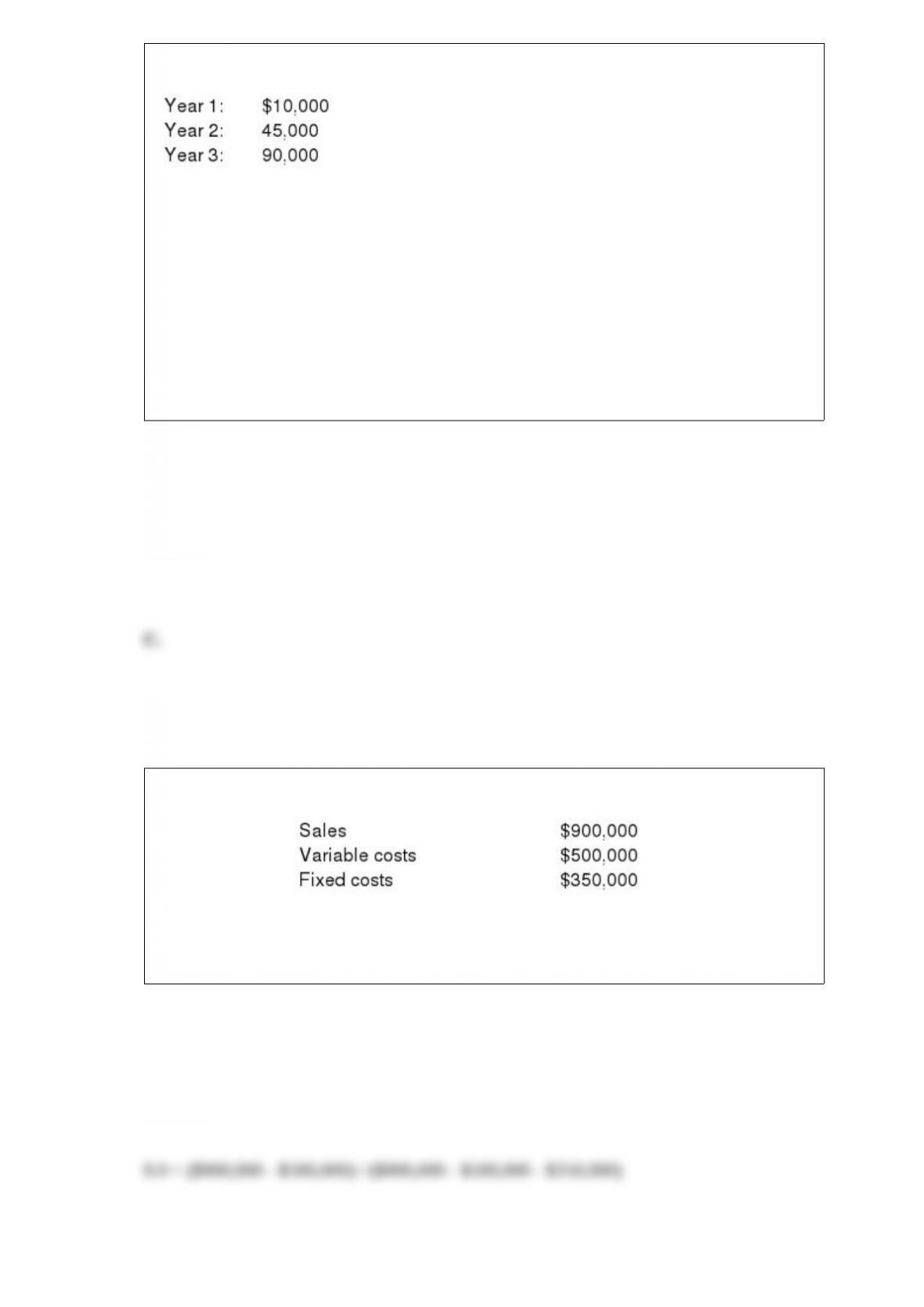
dividends:
Determine the dividends per share for preferred and common stock for the first year.
A.$0.50 and $0.10
B.$0.00 and $0.10
C.$0.50 and $0.00
D.$2.00 and $0.00
Answer:
The Keith Company reports the following data.
Determine Keith Company’s operating leverage.
Answer:

The primary advantages of the average rate of return method are its ease of computation
and the fact that:
A.it is especially useful to managers whose primary concern is liquidity
B.there is less possibility of loss from changes in economic conditions and
obsolescence when the commitment is short-term
C.it emphasizes the amount of income earned over the life of the proposal
D.rankings of proposals are necessary
Answer:
Adjusting entries always include
A.only income statement accounts.
B.only balance sheet accounts.
C.the cash account.
D.at least one income statement account and one balance sheet account.
Answer:

The classification and normal balance of the drawing account is
A.an expense with a credit balance
B.an expense with a debit balance
C.a liability with a credit balance
D.owner’s equity with a debit balance
Answer:
The Weber Company purchased a mining site for $1,750,000 on July 1, 2014. The
company expects to mine ore for the next 10 years and anticipates that a total of
400,000 tons will be recovered. The estimated residual value of the property is
$150,000. During 2014 the company extracted 6,500 tons of ore. The depletion expense
for 2014 is
A.$17,500
B.$16,000
C.$26,000
D.$15,000
Answer:

Identify the following as a Fixed Asset (FA), or Intangible Asset (IA), or Natural
Resource (NR), or Neither (N)
(a) computer
(b) patent
(c) oil reserve
(d) goodwill
(e) U. S. Treasury note
(f) land used for employee parking
(g) gold mine
Answer:
Under the corporate form of business organization
A.ownership rights are easily transferred.
B.a stockholder is personally liable for the debts of the corporation.
C.stockholders’ acts can bind the corporation even though the stockholders have not
been appointed as agents of the corporation.
D.stockholders wishing to sell their corporation shares must get the approval of other

stockholders.
Answer:
The process of rewriting the information from the journal into the ledger is called
A.sliding
B.transposing
C.journalizing
D.posting
Answer:
Production and sales estimates for June are as follows:
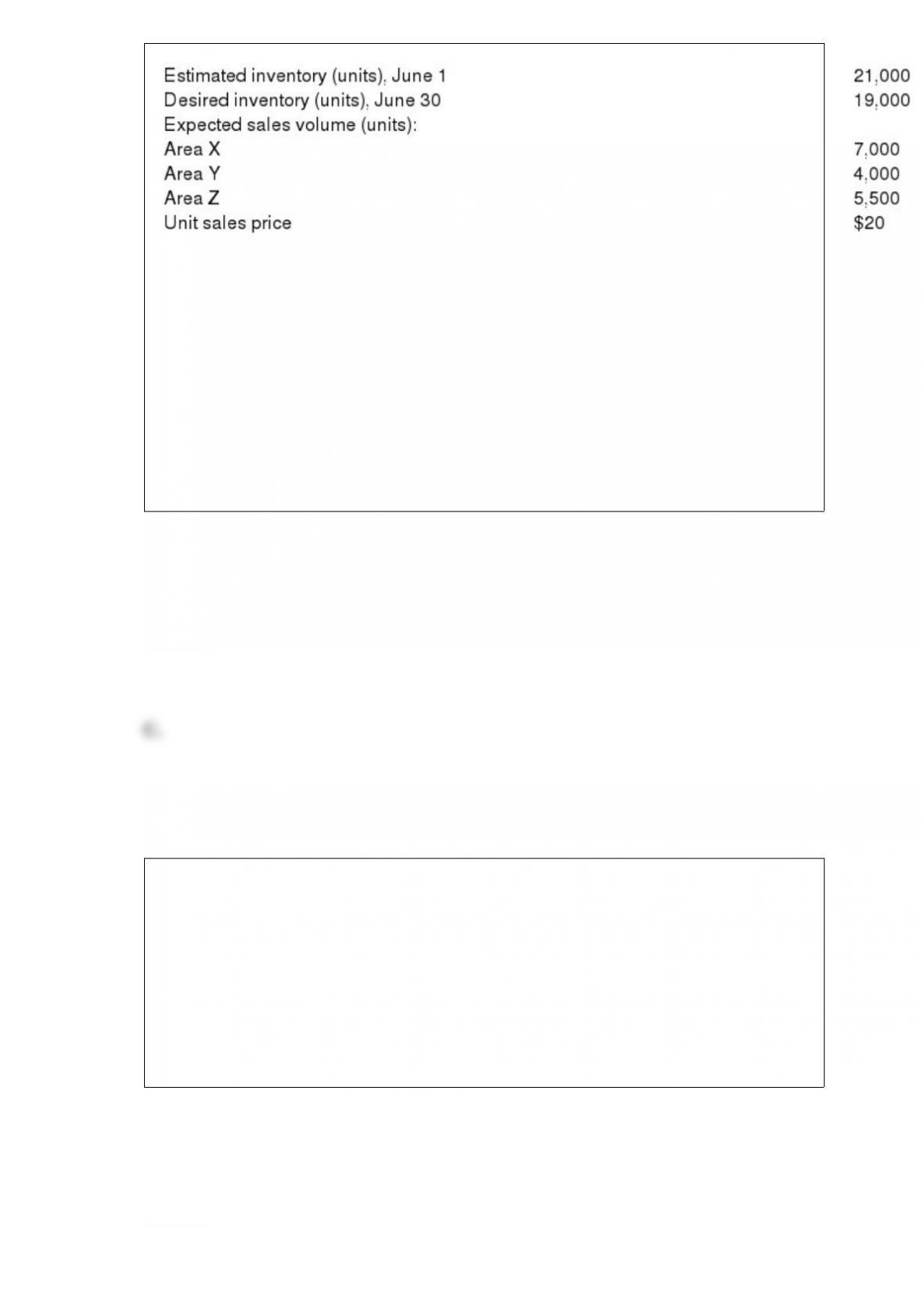
The number of units expected to be manufactured in June is:
A.10,000
B.11,500
C.14,500
D.12,500
Answer:
Which of the following is not true regarding depreciation?
A.Depreciation allocates the cost of a fixed asset over its estimated life.
B.Depreciation expense reflects the decrease in market value each year.
C.Depreciation is an allocation not a valuation method.
D.Depreciation expense does not measure changes in market value.
Answer:

On the statement of cash flows, the cash flows from investing activities section would
include
A.receipts from the issuance of capital stock
B.payments for dividends
C.payments for retirement of bonds payable
D.receipts from the sale of investments
Answer:
Current assets are usually listed in order
A.of the due date
B.of the size
C.alphabetically
D.of liquidity
Answer:

Singer and McMann are partners in a business. Singer’s original capital was $40,000
and McMann’s was $60,000. They agree to salaries of $12,000 and $18,000 for Singer
and McMann respectively and 10% interest on original capital. If they agree to share
remaining profits and losses on a 3:2 ratio, what will Singer’s share of the income be if
the income for the year was $15,000?
A.$9,000
B.$2,400
C.$1,000
D.$5,600
Answer:
In performing a vertical analysis, the base for cost of goods sold is
A.total selling expenses.
B.net sales.
C.total expenses.
D.gross profit.
Answer:
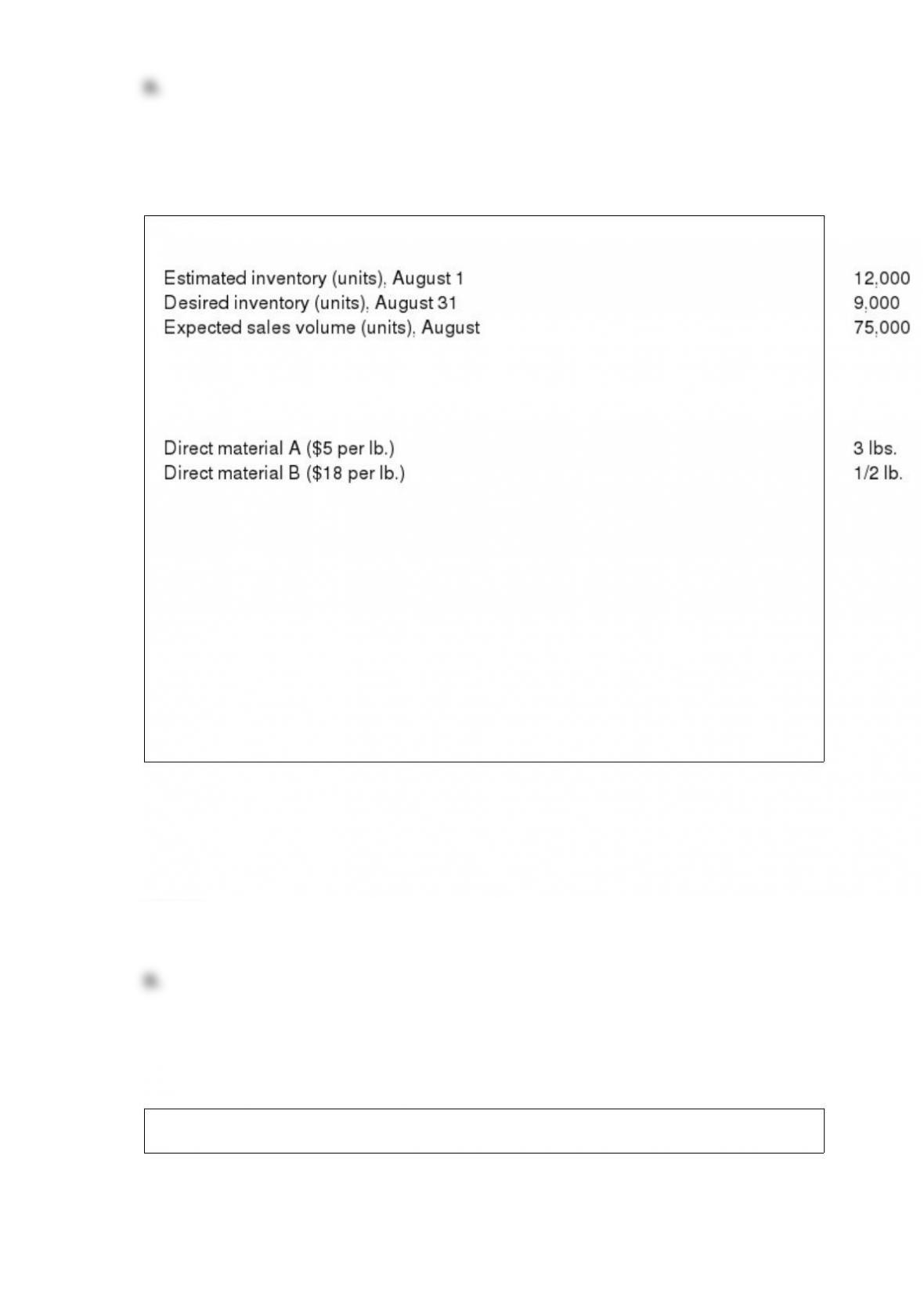
Production estimates for August are as follows:
For each unit produced, the direct materials requirements are as follows:
The number of pounds of materials A and B required for August production is:
A.216,000 lbs. of A; 72,000 lbs. of B
B.216,000 lbs. of A; 36,000 lbs. of B
C.225,000 lbs. of A; 37,500 lbs. of B
D.234,000 lbs. of A; 39,000 lbs. of B
Answer:
Using the following information, what is the amount of cost of merchandise sold?
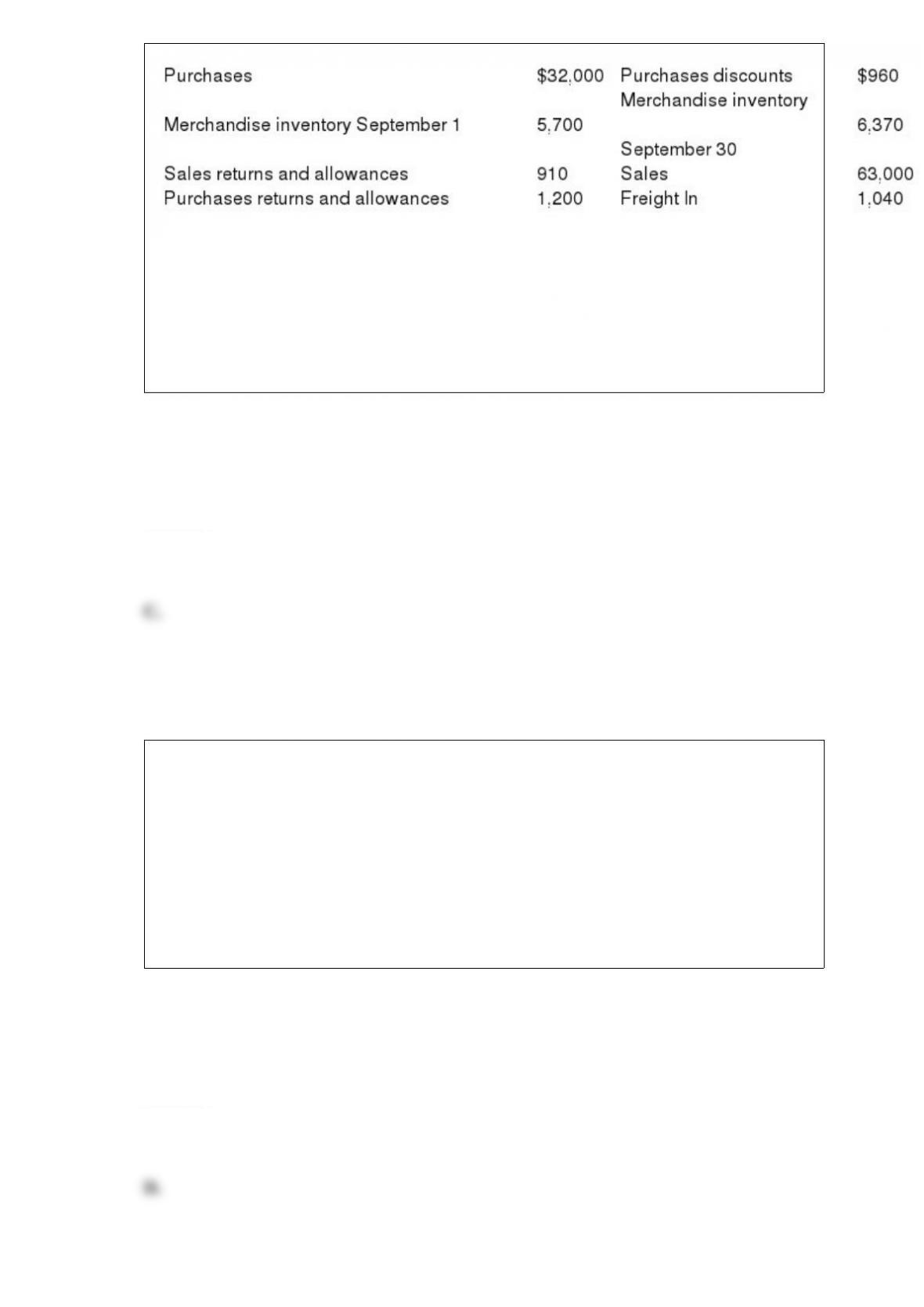
A.$26,900
B.$20,530
C.$30,210
D.$28,130
Answer:
When a work sheet is complete, the adjustment columns should have
A.total credits greater than total debits if a net income was earned
B.total debits greater than total credits if a net loss was incurred
C.total debits greater than total credits if a net income was earned
D.total debits equal total credits
Answer:
Which statement below is not a determinate in calculating the amount of federal income
taxes withheld from an individuals pay?
A.filing status
B.types of earnings
C.gross pay
D.number of exemptions
Answer:
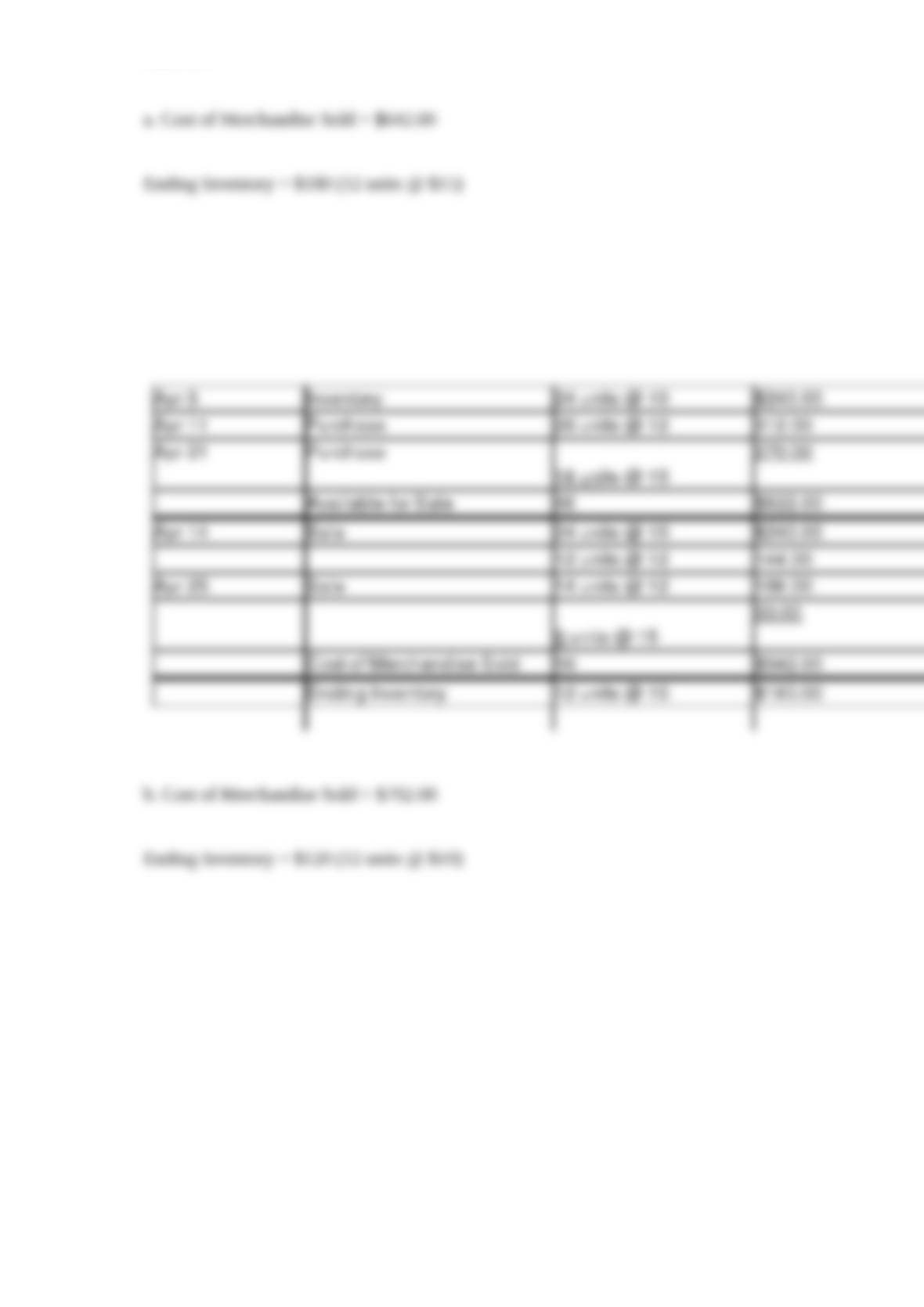
Beginning inventory, purchases and sales data for T-shirts are as follows:
Assuming the business maintains a periodic inventory system, calculate the cost of
merchandise sold and ending inventory under the following assumptions:
a. FIFO
b. LIFO
c. Average cost (round cost of merchandise sold and ending inventory to the nearest
dollar)
Answer:
The owner’s equity will be reduced by all of the following accounts except:
A.Revenues
B.Expenses

C.Drawing account
D.All are true.
Answer:
A $300,000 bond was redeemed at 104 when the carrying value of the bond was
$315,000. The entry to record the redemption would include a
A.loss on bond redemption of $3,000.
B.gain on bond redemption of $3,000.
C.gain on bond redemption of $4,000.
D.loss on bond redemption of $4,000.
Answer:
The following is a list of costs incurred by several business organizations:
(a) Telephone cable for a telephone company.
(b) Subscription to a health club for executives.

(c) Salary of the Director of Internal Auditing.
(d) Long-distance telephone bill for calls made by salespersons.
(e) Carrying cases for a manufacturer of video camcorders.
(f) Cotton for a textile manufacturer of blue jeans.
(g) Bandages for the emergency room of a hospital.
(h) Cost of company holiday party.
(i) Electricity used to operate factory machinery.
(j) State unemployment compensation taxes for factory workers.
(k) Gloves for factory machine operators.
(l) Fees paid for lawn service for office grounds.
(m) Salary of secretary to vice-president of finance.
(n) Salary of secretary to vice-president of marketing.
(o) Production supervisor’s salary.
(p) Engine oil for manufacturer and distributor of motorcycles.
(q) Oil lubricants for factory plant and equipment.
(r) Cost of a radio commercial.
(s) Depreciation on factory equipment.
(t) Wages of check-out clerk in company-owned retail outlet.
(u) Maintenance and repair costs for factory equipment.
(v) Depreciation on office equipment.
(w) Bonuses paid to salespersons.
(x) Insurance on factory building.
(y) Training for accounting personnel on use of microcomputer.
(z) Steel for a construction contractor.
Classify each of the preceding costs as product costs or period costs. For those costs
classified as product costs, indicate whether the product cost is a direct materials cost,
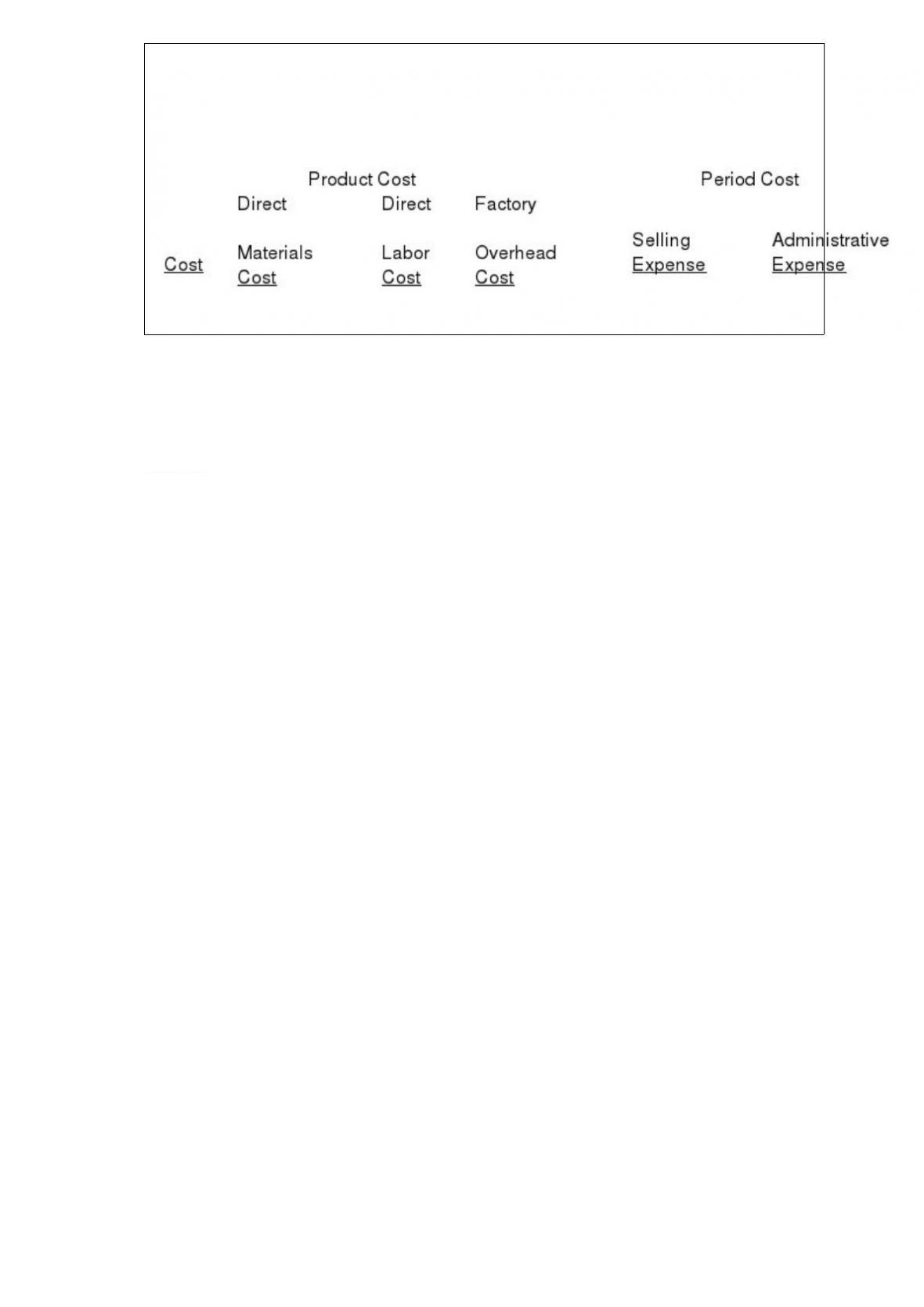
direct labor cost, or factory overhead cost. For those costs classified as period costs,
indicate whether the period cost is a selling expense or an administrative expense. Use
the following tabular headings for preparing your answer. Place an X in the appropriate
column.
Answer:
Some of the more common subsidiary ledgers are:
A.Accounts Payable, Accounts Receivable, and Owner’s Equity subsidiary ledgers.
B.Accounts Receivable and Accounts Payable subsidiary ledgers.
C.Accounts Receivable, Accounts Payable, Cash, Checking, Petty Cash, and Owner’s
Equity subsidiary ledgers.
D.Cash and Owner’s Equity subsidiary ledgers.
Answer:
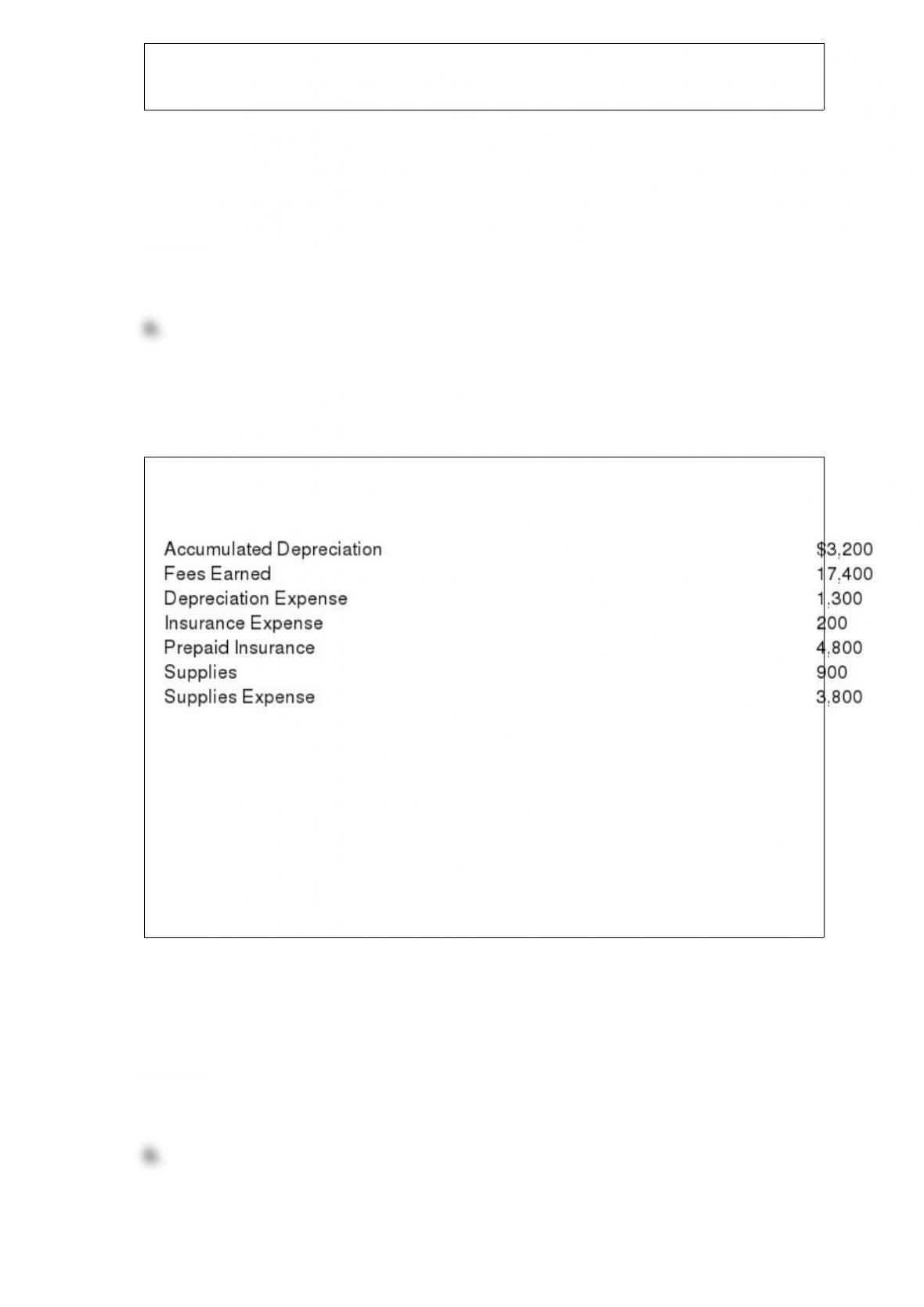
The following accounts were taken from the Adjusted Trial Balance columns of the
work sheet:
Net income for the period is
A.$3,200
B.$12,100
C.$17,400
D.$8,900
Answer:

For March, sales revenue is $1,000,000; sales commissions are 5% of sales; the sales
manager’s salary is $80,000; advertising expenses are $75,000; shipping expenses total
1% of sales; and miscellaneous selling expenses are $2,100 plus 1% of sales. Total
selling expenses for the month of March are:
A.$227,100
B.$215,000
C.$217,100
D.$152,100
Answer:
Managerial accounting
A.is prepared according to GAAP.
B.is prepared according to management needs.
C.is prepared periodically only.
D.is related to the entire business entity only.
Answer:
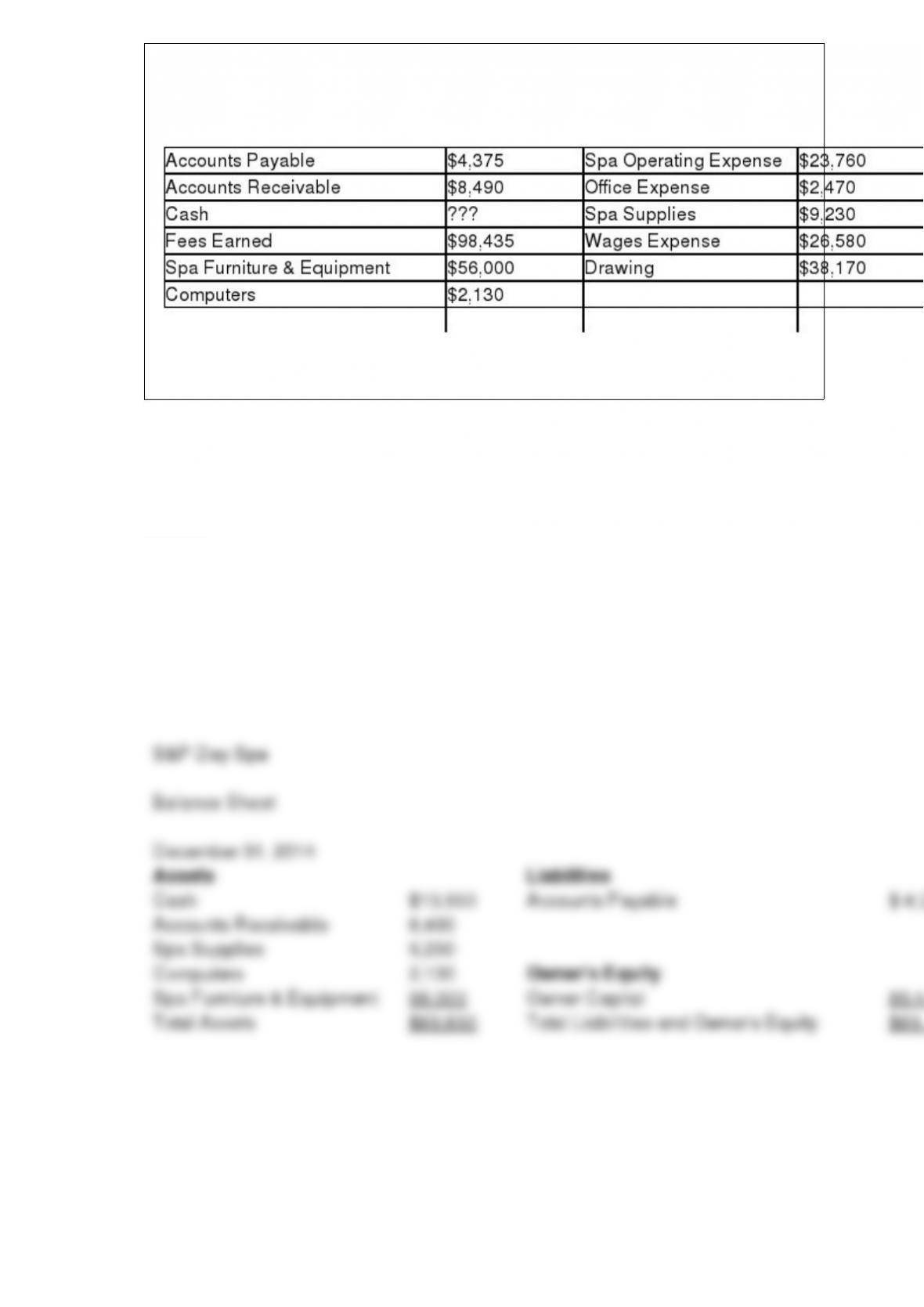
The assets and liabilities of S&P Day Spa at December 31, 2014 and its revenue and
expenses for the year are listed below. The capital of the owner was $68,000 at January
1, 2014. The owner invested an additional $10,000 during the year.
Prepare a balance sheet for the year ended December 31, 2014.
Answer:
Describe the items which should be covered in a partnership agreement.
Answer:
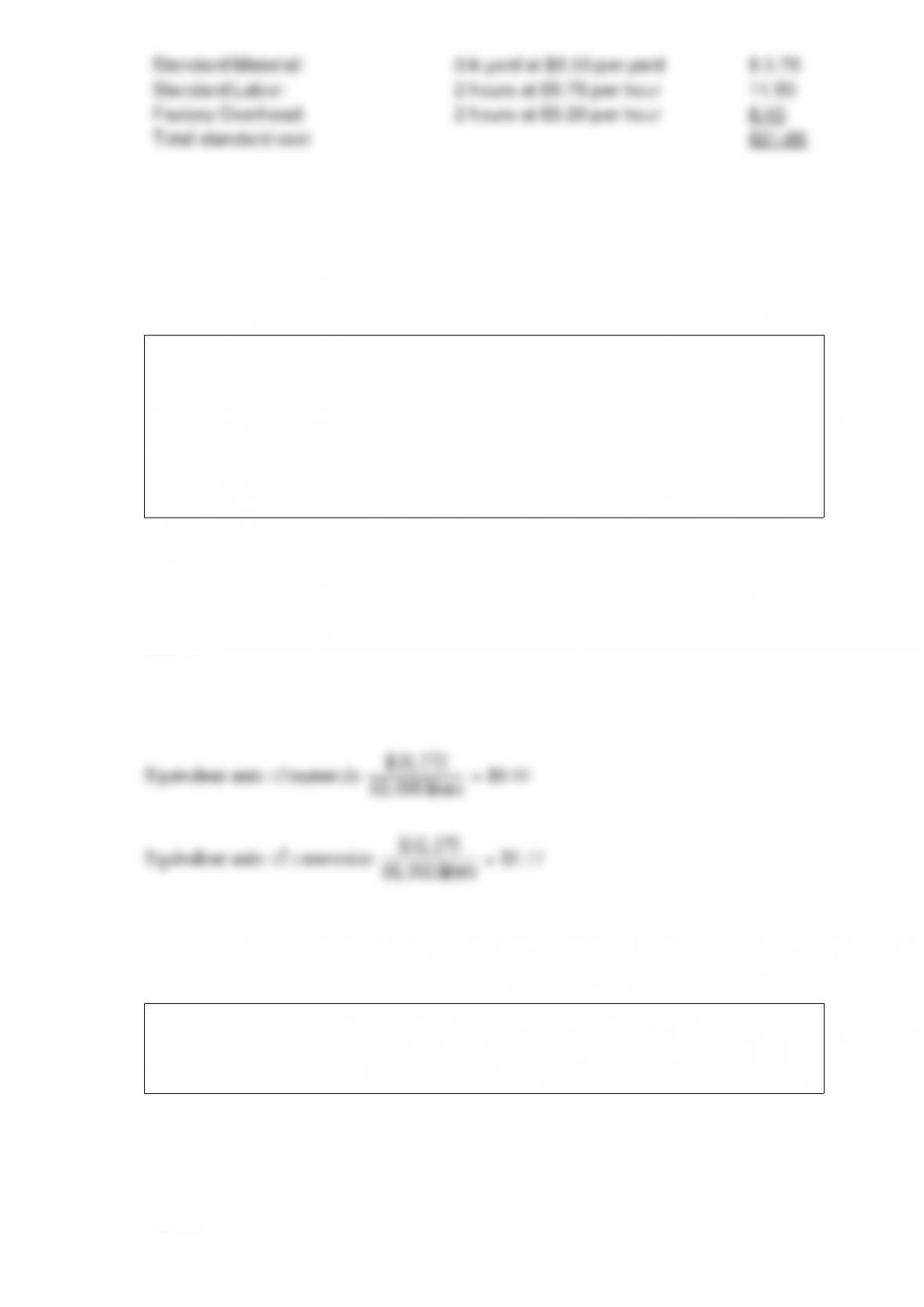
Compute the standard cost for one hat, based on the following standards for each hat:
Answer:
The cost of direct materials transferred into the Bottling Department of the Mountain
Springs Water Company is $28,072. The conversion cost for the period in the Bottling
Department is $10,275. The total equivalent units for direct materials and conversion
are 63,800 and 68,500 respectively. Determine the direct materials and conversion cost
per equivalent unit.
Round answers to nearest cent.
Answer:
On November 1st Nikle Company made a cash payment of $200,000 on a note payable
that was generated in the purchase of a building and land plot. Write the journal entry
for this payment in the space below.
Answer:
The Trumpet Company produced 8,700 units of a product that required 3.25 standard
hours per unit. The standard fixed overhead cost per unit is $1.20 per hour at 29,000
hours, which is 100% of normal capacity. Determine the fixed factory overhead volume
variance.
Answer:
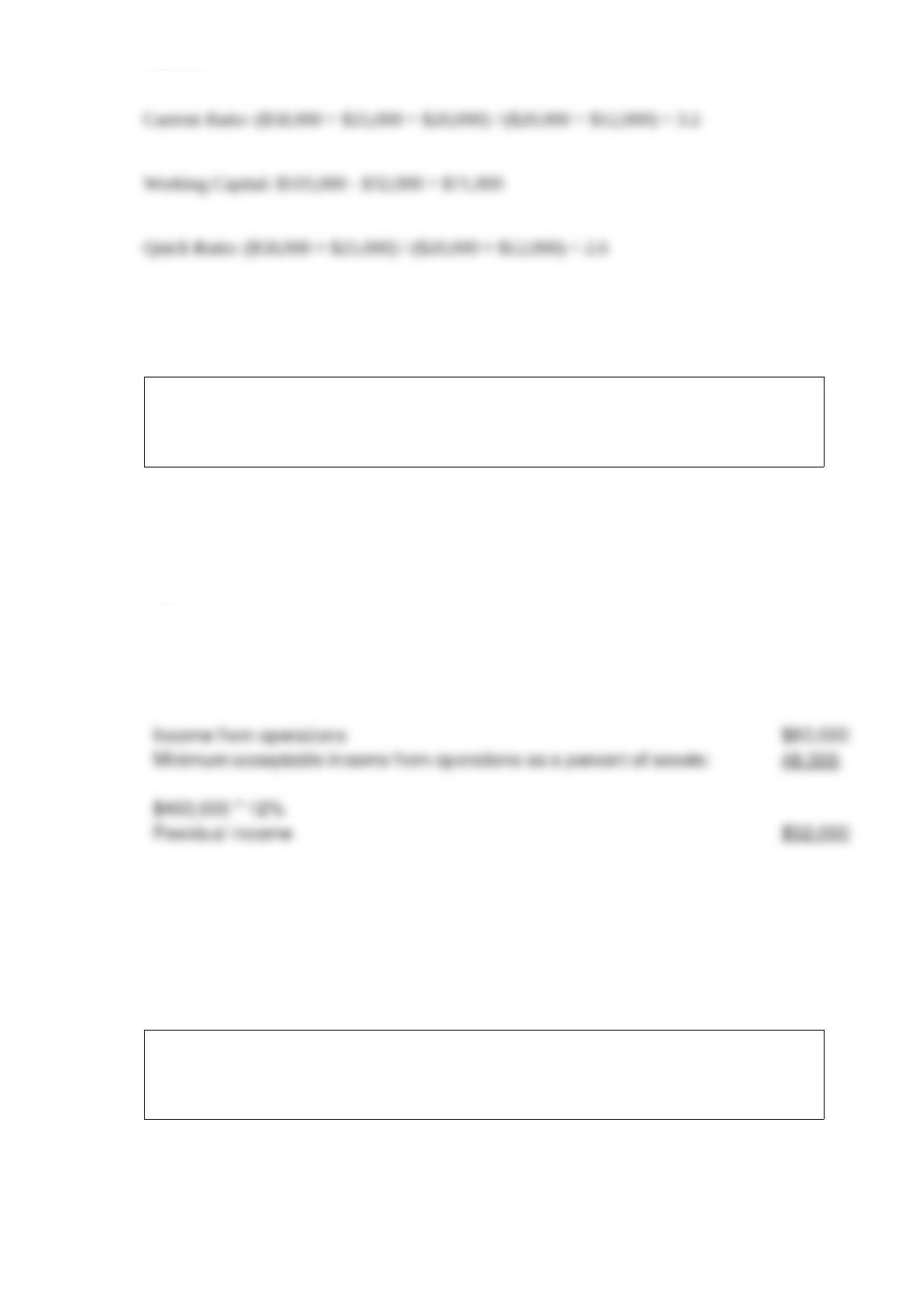
The Core Company had the following assets and liabilities as of December 31, 2012:
Calculate: Current Ratio, Working Capital and Quick Ratio
Answer:
The Magnolia Company Division A has income from operations of $80,000 and assets
of $400,000. The minimum acceptable rate of return on assets is 12%. What is the
residual income for the division?
Answer:
Roseland Design borrowed $700,000 on a 90-day note from CorpOne Funding
Company. CorpOne discounts the note at 8%. (Assume a 360-day year is used for
interest calculations.)
Answer:
The income statement for Dodson Corporation reported net income of $22,400 for the
year ended December 31, 2012 before considering the following:
During the year the company purchased available-for-sale securities. At year end, the
fair value of the investment portfolio was $2,100 more than cost.
The balance of retained earnings was $83,000 on December 31, 2011. Dobson
Corporation paid $9,000 in cash dividends in 2012. Calculate the balance of retained
earnings on December 31, 2012.
Answer:
On April 10, a company acquired land in exchange for 1,000 shares of $20 par common
stock with a current market price of $73. Journalize this transaction.
Answer:
There are only four legal structures to form and operate a business.
Answer:
Warmfeet manufactures comforters. Assume the estimated inventories on January 1,
2012, for finished goods, work in process, and materials were $51,000, $28,000 and
$33,000 respectively. Also assume the desired inventories on December 31, 2012, for
finished goods, work in process, and materials were $48,000, $35,000 and $29,000
respectively. Direct material purchases were $555,000. Direct labor was $252,000 for
the year. Factory overhead was $176,000. Prepare a cost of goods sold budget for
Warmfeet, Inc.
Answer:
At the end of the current year, $3,700 fees have been earned but have not been billed to
clients. Journalize the adjusting entry to record the accrued fees.
Answer:
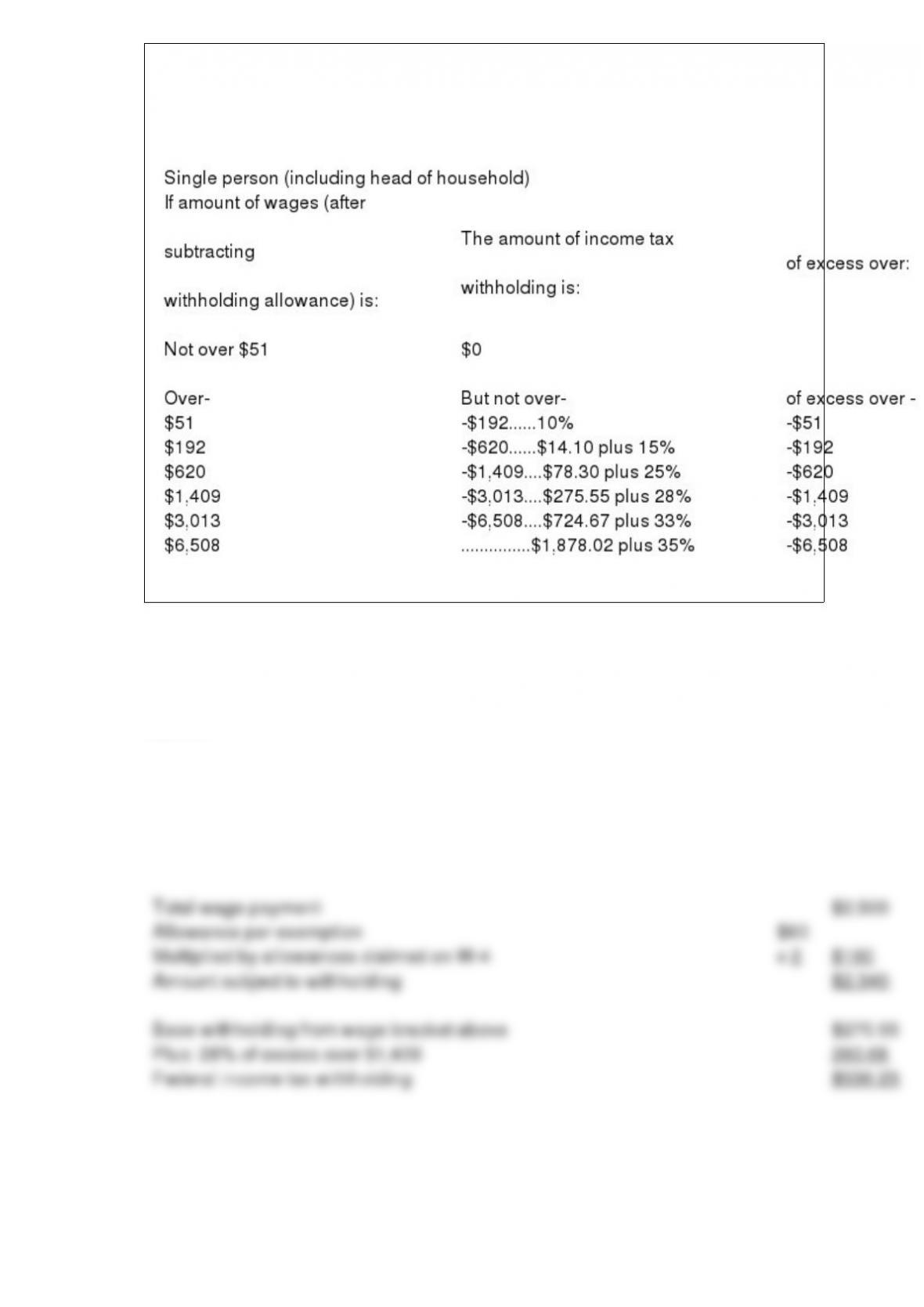
John Woods’ weekly gross earnings for the present week were $2,500. Woods has two
exemptions. Using $80 value for each exemption, what is Woods’ federal income tax
withholding?
Answer:
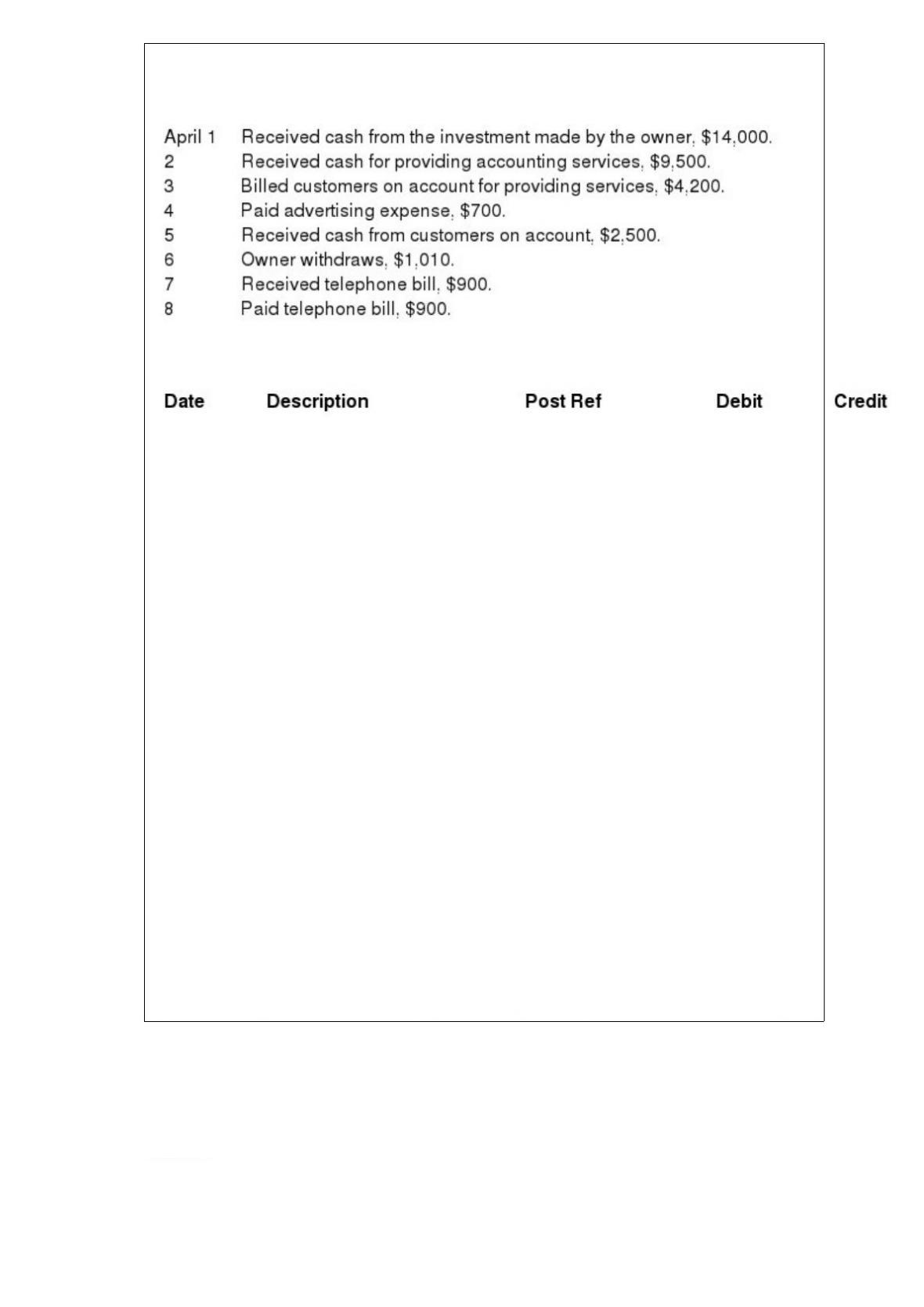
Journalize the following selected transactions for April 2011 in a two-column journal.
Journal entry explanations may be omitted.
Answer:
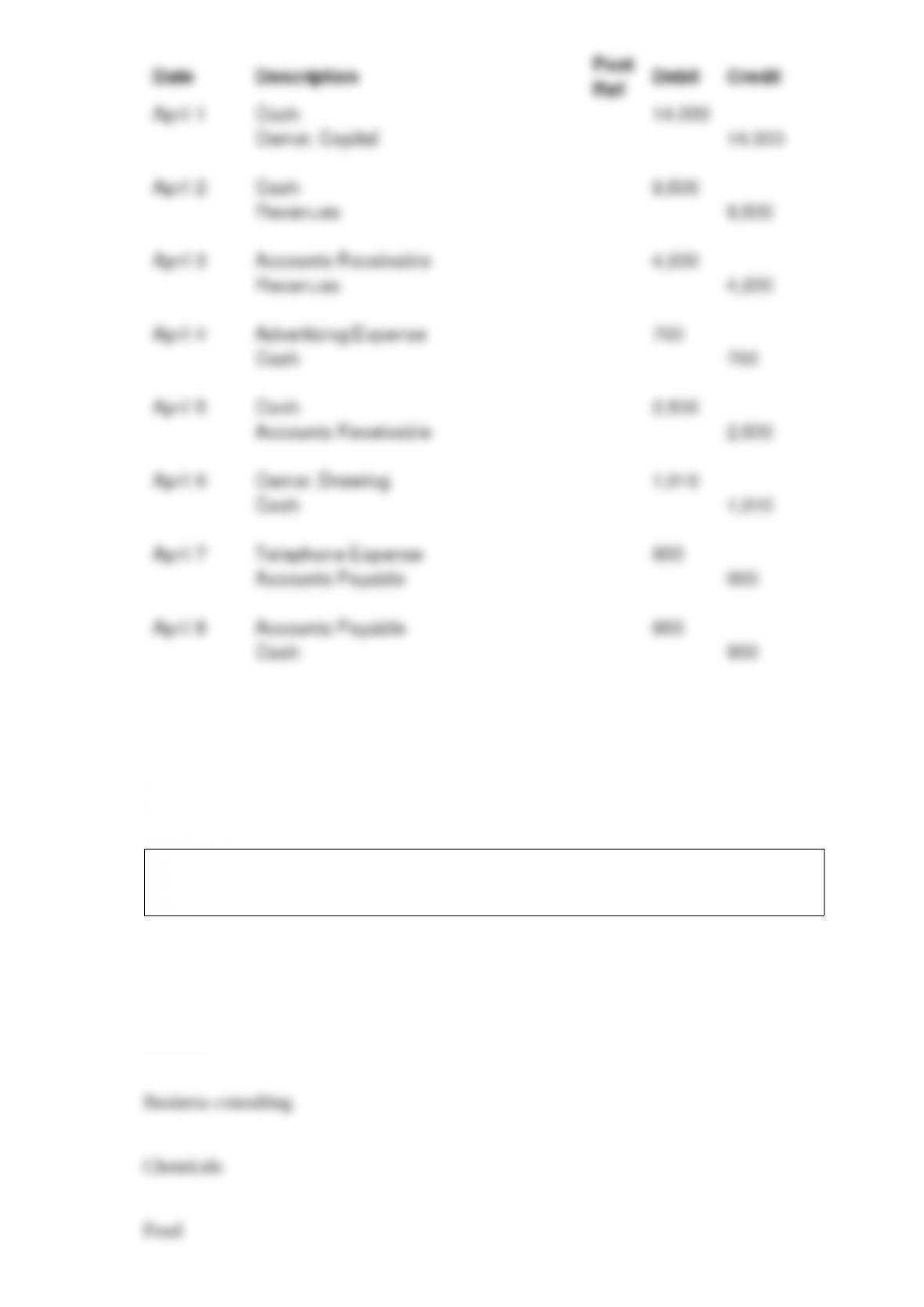
Which of the following industries would normally use job order costing systems and
which would normally use process costing systems?
Answer:
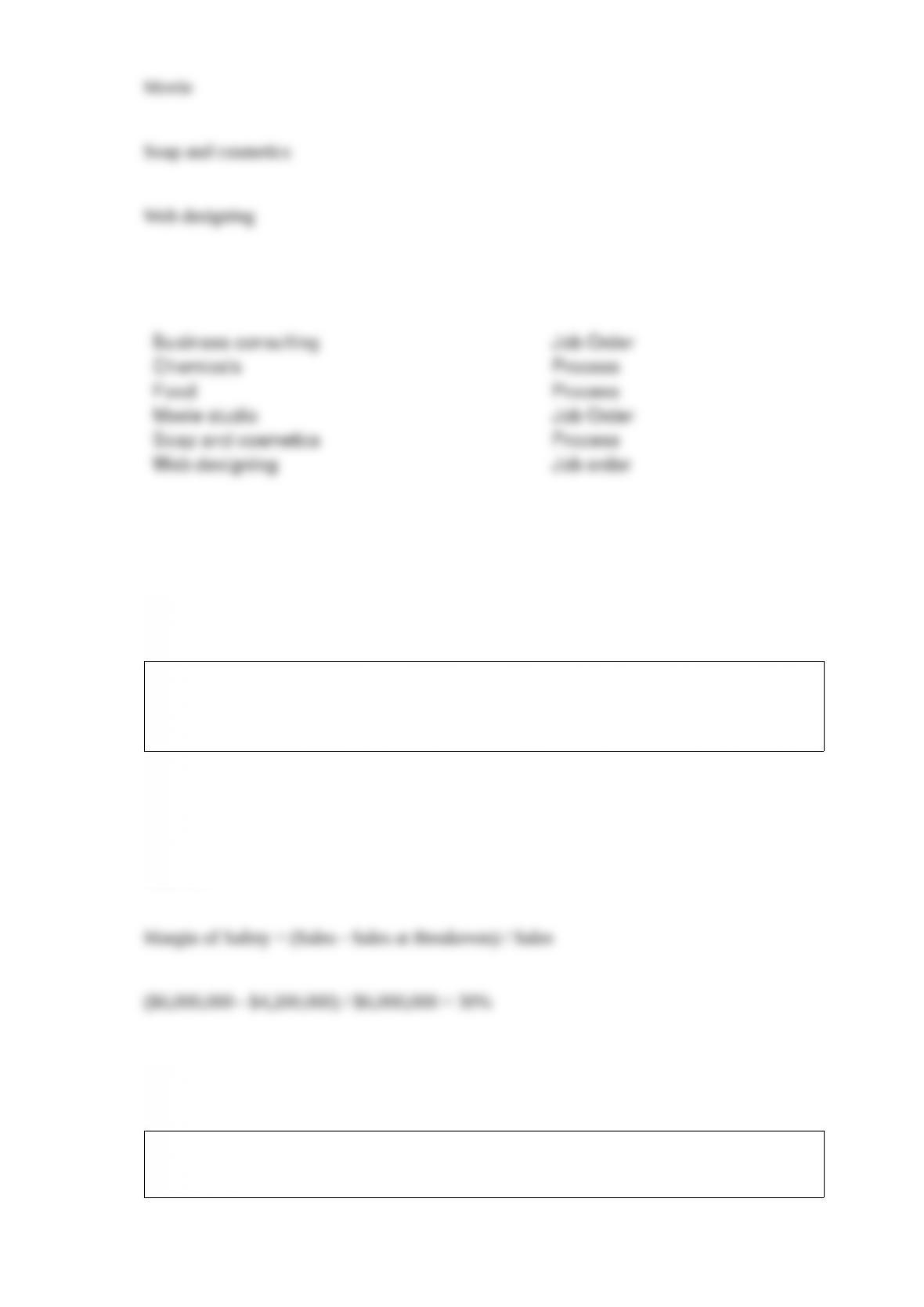
If a business had a capacity of $10,000,000 of sales, actual sales of $6,000,000,
break-even sales of $4,200,000, fixed costs of $1,800,000, and variable costs of 60% of
sales, what is the margin of safety expressed as a percentage of sales?
Answer:
Using the lower of cost or market, what should the total inventory value be for the
following items:
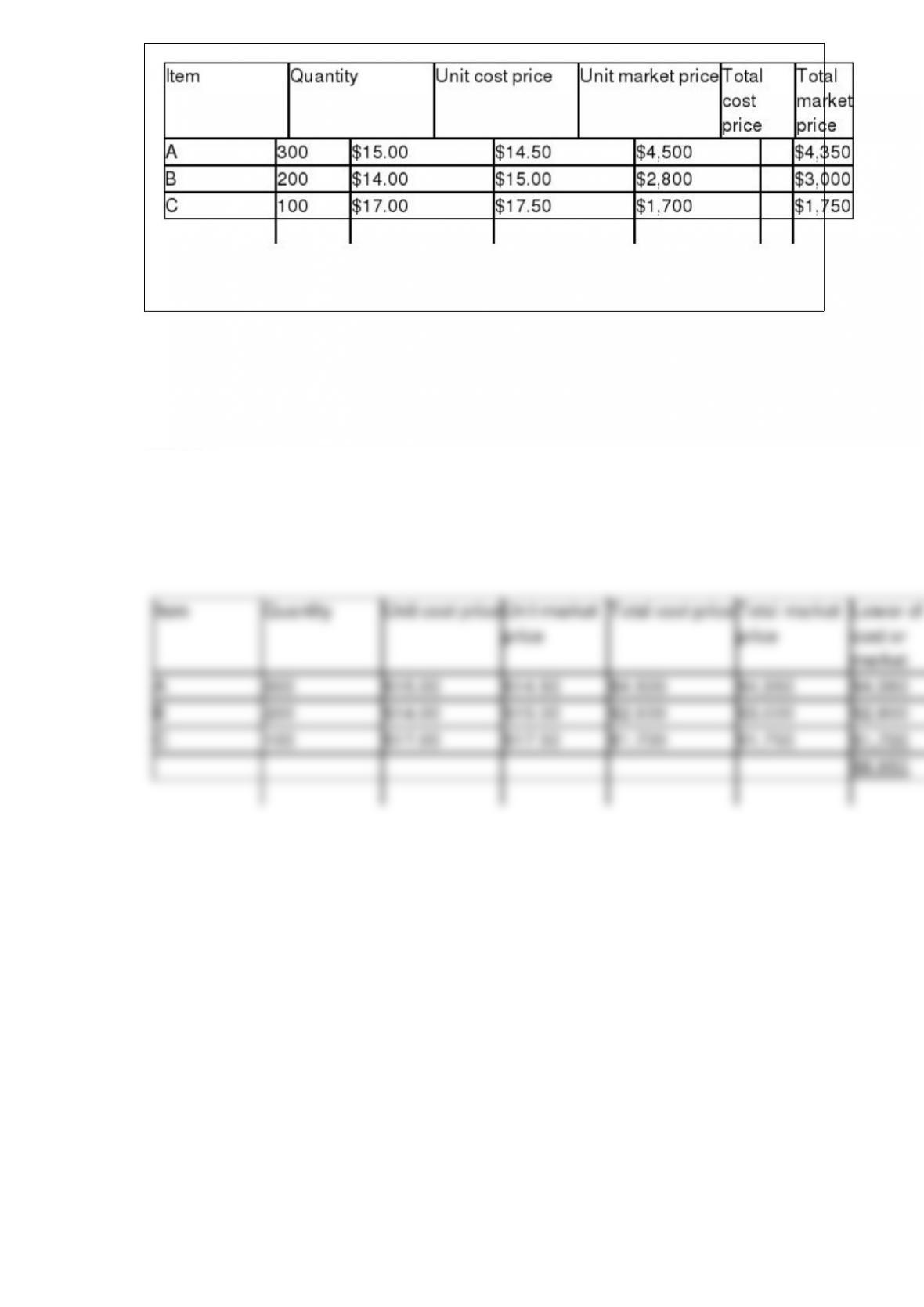
Apply the lower-of-cost-or-market method to inventory as a whole.
Answer: