1) Suppliers play a key role in the success of target costing.
2) Global competition led to the development of international quality standards such as
ISO 9000 Standards.
3) Smoothing is a form of earnings management.
4) In general, service companies are ideal candidates for activity-based costing.
5) Properly chosen nonfinancial measures anticipate and help to explain financial
results in an organization.
6) Traditional cost systems are likely to overcost complex products with lower
production volume.
7) When the operating budget is used as a control device, managers are more likely to
be motivated to budget higher sales than actually anticipated.
8) Financial measures identify what is wrong with an organization, not simply provide a
signal that something needs attention.
9) Budgets can be prepared for any time period, but are usually developed for one year.
10) For the process of control to have meaning, the organization must be able to
identify and correct out-of-control situations.
11) Practical capacity is used as the numerator for activity cost driver calculations to
avoid distortions caused by the assignment of excess capacity costs to the products.
12) Key performance indicator scorecards will typically use common measures, such as
customer satisfaction, process quality, cost, and employee satisfaction and morale,.
13) People react when they are being measured, and they react to the measurements..
14) Authoritative budgeting occurs when a superior simply tells subordinates what their
budget will be.
15) After conducting a market research study, Stewart Manufacturing decided to
produce a new interior door to complement its exterior door line. It is estimated that the
new interior door can be sold at a target price of $120. The annual target sales volume
for interior doors is 20,000. Stewart has a 20% expected return on sales target.
What are target sales revenues?
A) $1,920,000
B) $4,000,000
C) $2,400,000
D) None of the above is correct.
16) Discretionary expenditures:
A) are usually planned for first
B) are amounts paid for the use of flexible resources
C) are not determined by the organization’s level of production
D) increase in amount during periods of greater activity
17) Jim’s 5-year-old Hyundai Elantra requires repairs estimated at $3,000 to make it
roadworthy again. His friend, Julie, suggested that he should buy a 5-year-old used
Honda Civic instead for $3,000 cash. Julie estimated the following costs for the two
cars:
The cost(s) NOT relevant for this decision is(are):
A) the acquisition cost of the Hyundai Elantra
B) the acquisition cost of the Honda Civic
C) the repairs to the Hyundai Elantra
D) the annual operating costs of the Honda Civic
18) Blitzer Enterprises has identified three cost pools and three corresponding cost
drivers to allocate overhead costs. The following estimates are provided for the coming
year:
The accounting records show the Gergen Job consumed the following resources:
Using the three cost pools to allocate overhead costs, what is the total amount of
overhead costs to be allocated to the Gergen Job?
A) $1,434
B) $1,400
C) $1,350
D) $1,074
19) Talladega Industries, Inc., (TII) developed the following standard costs for direct
material and direct labor for one of their major products, the 10-gallon plastic container.
During August, TII produced and sold 10,000 containers using 980 pounds of direct
materials at an average cost per pound of $32 and 500 direct labor hours at an average
wage of $15.25 per hour.
August’s direct material quantity variance was:
A) $1,960 unfavorable
B) $600 favorable
C) $1,360 favorable
D) None of the above is correct
20) The BEST description of participative budgeting is that:
A) lower-level managers and employees initially prepare the budget
B) managers and employees at many levels are involved with the budgeting process
C) the budget is prepared by the top managers
D) top management sets figures for all operating activities and these amounts are not
negotiable
21) If Fair Engineering Company purchases 10,000 QE767 parts from the outside
supplier per month, then its monthly operating income will:
A) decrease by $2,000
B) increase by $30,000
C) decrease by $16,000
D) decrease by $58,000
22) Aggregate planning:
A) determines the projected financial statements
B) compares the sales plan with the demand forecast
C) assesses the feasibility of the proposed production plan
D) provides a detailed production schedule for all product lines
23) The implementation of just-in-time production results in all of the following
EXCEPT:
A) decreased cycle times
B) reduced amount of waste
C) a slower pace for employees
D) structural changes
24) Unit-level cost drivers in traditional cost systems distort product costs because they:
A) assume that all overhead activities affect all products
B) recognize specific activities that are required to produce a product
C) do not consistently record costs
D) fail to measure the correct amount of total costs for all products
25) The relevance of information in a MACS includes providing all of the following
EXCEPT:
A) the most accurate information possible
B) a global framework that can be applied uniquely to each division or unit
C) feedback on performance measures in a timely fashion
D) different costing methods for each division
26) A national company manufactures a line of modern furniture. Information MOST
useful to the employee who assembles the furniture includes:
A) a daily report comparing the actual time it took to assemble a piece of furniture to
the standard time allowed
B) a monthly report on the proportion of furniture pieces assembled with defects
C) the number of furniture pieces sold this month
D) revenue per employee
27) EJL Herbal Remedies sells several products for an average price of $17 per unit.
Average variable costs per unit are as follows:
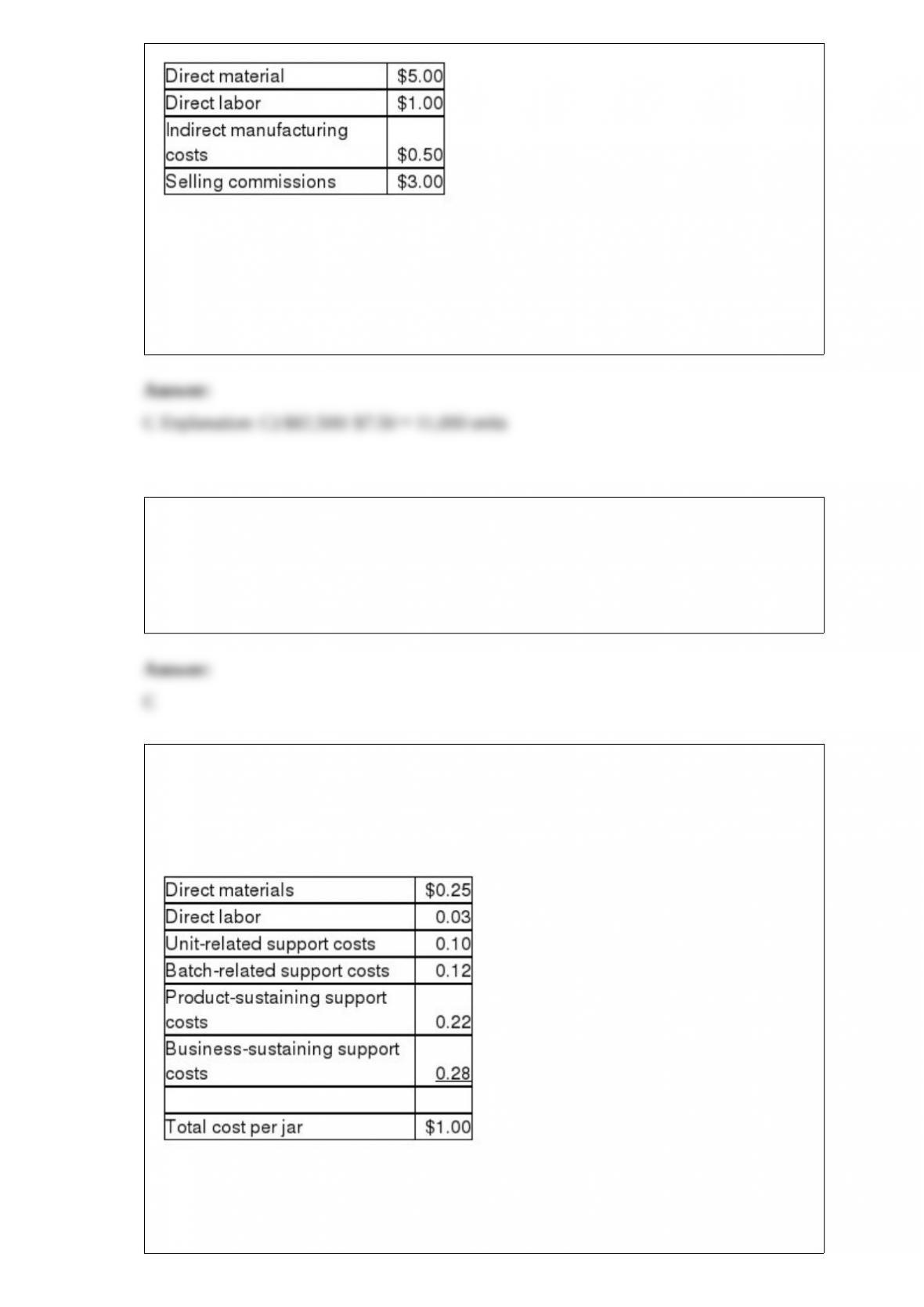
EJL’s annual fixed costs total $82,500.
The number of units that EJL must sell each year to break even is:
A) 4,853 units
B) 7,857 units
C) 11,000 units
D) 13,000 units
28) Value engineering may result in all of the following EXCEPT:
A) improved product design
B) changes in materials specifications
C) increases in the quantity of nonvalue-added cost drivers
D) the evaluation of all business functions within the value chain
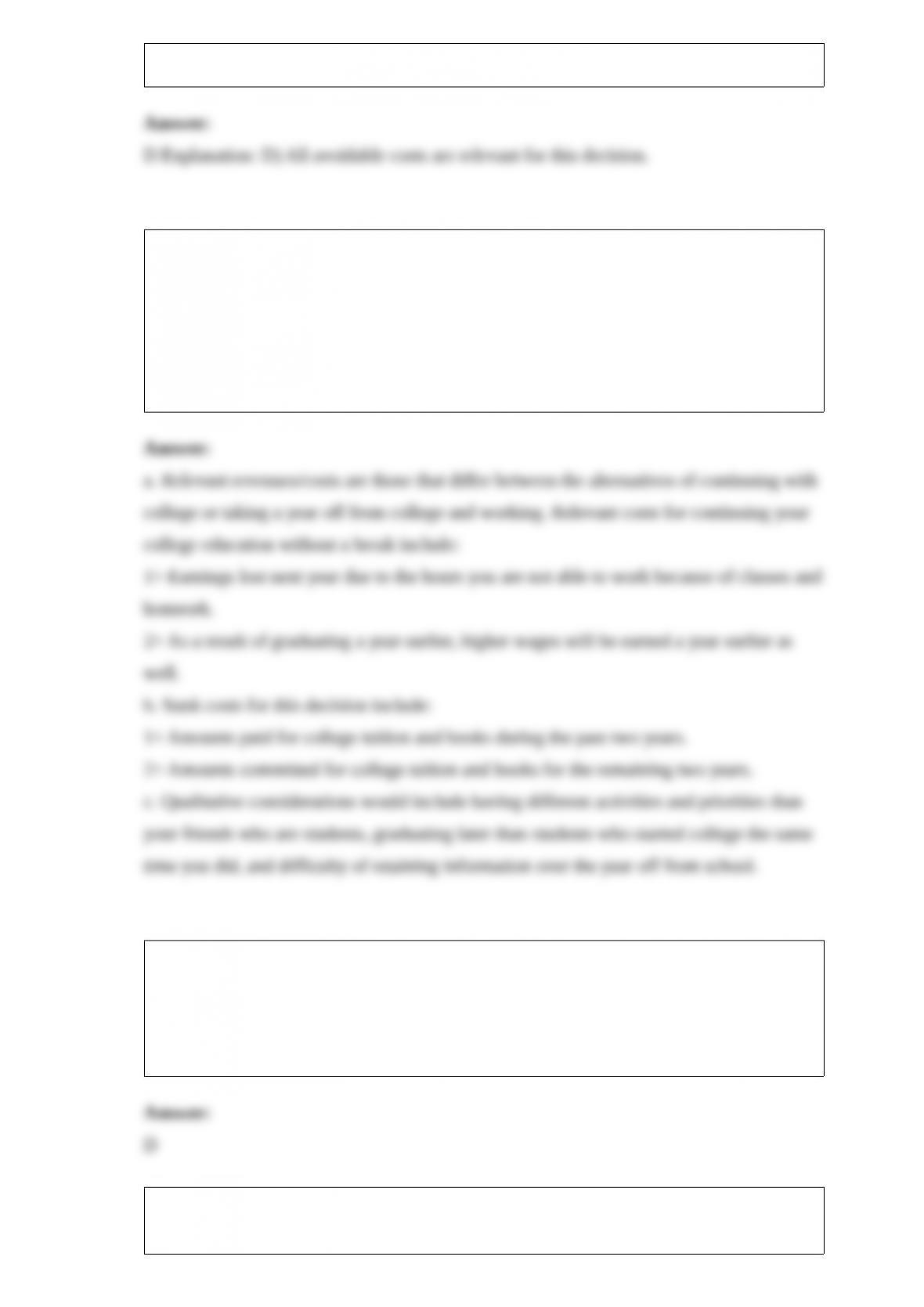
29) Melodee’s Preserves currently makes jams and jellies and a variety of decorative
jars used for packaging. An outside supplier has offered to supply all of the needed
decorative jars. For this make-or-buy decision, a cost analysis revealed the following
avoidable unit costs for the decorative jars:
The relevant cost per jar is:
A) $0.28 per jar
B) $0.38 per jar
C) $0.72 per jar
D) $1.00 per jar
30) Assume you are a sophomore in college and are committed to earning an
undergraduate degree. Your current decision is whether to finish college in four
consecutive years or take a year off and work for some extra cash.
a. Identify at least two revenues or costs that are relevant to making this decision.
Explain why each is relevant.
b. Identify at least two costs that would be considered sunk costs for this decision.
c. Comment on at least one qualitative consideration for this decision.
31) To help maintain goal congruence, organizations use:
A) preventative control
B) monitoring
C) results control
D) All of the above are correct
32) Which of the following statements about activity-based costing is NOT true?
A) ABC is useful for allocating marketing and distribution costs

B) ABC is more likely to result in major differences from traditional costing systems if
the firm manufactures only one product rather than multiple products
C) ABC seeks to distinguish batch-related, product-sustaining, and business-sustaining
costs, especially when they are not proportionate to one another
D) ABC differs from traditional costing systems in that products are not
cross-subsidized
33) In zero-based budgeting:
A) the prior year’s budgeted amounts or actual results are used to build the new
operating budget
B) the budget is prepared by the top managers
C) managers must justify each item within the operating budget as if it were a new
budget item
D) the budget is updated every month
34) Each cost pool:
A) utilizes a separate cost driver rate
B) is a subset of total labor costs
C) can be associated with several normal levels of activity
D) All of the above are correct
35) The major reason for using practical capacity as the denominator for activity driver
calculations is to:
A) avoid distortions induced by the assignment of unused capacity costs to the products
produced or customer served
B) simplify the calculations of the activity cost drivers
C) reduce the cost of unused capacity
D) place less emphasis on the cost of unused capacity
36) L&M Manufacturing produces a single product that sells for $16. Variable (flexible)
costs per unit equal $11.20. The company expects the total fixed (capacity-related) costs
to be $7,200 for the next month at the projected sales level of 20,000 units. In an
attempt to improve performance, management is considering a number of alternative
actions. Each situation is to be evaluated separately.
Suppose that L&M Manufacturing’s management believes that a $1,600 increase in the
monthly advertising expense will result in a considerable increase in sales. How much
must sales increase in a month to justify this additional expenditure?
A) 200 units
B) 334 units
C) 500 units
D) None of the above is correct
37) In compensation plans, gain sharing:
A) treats employees as owners and all receive corporate dividends
B) applies to a group of employees within an organization
C) is generally based on individual performance
D) provides feedback on an annual basis
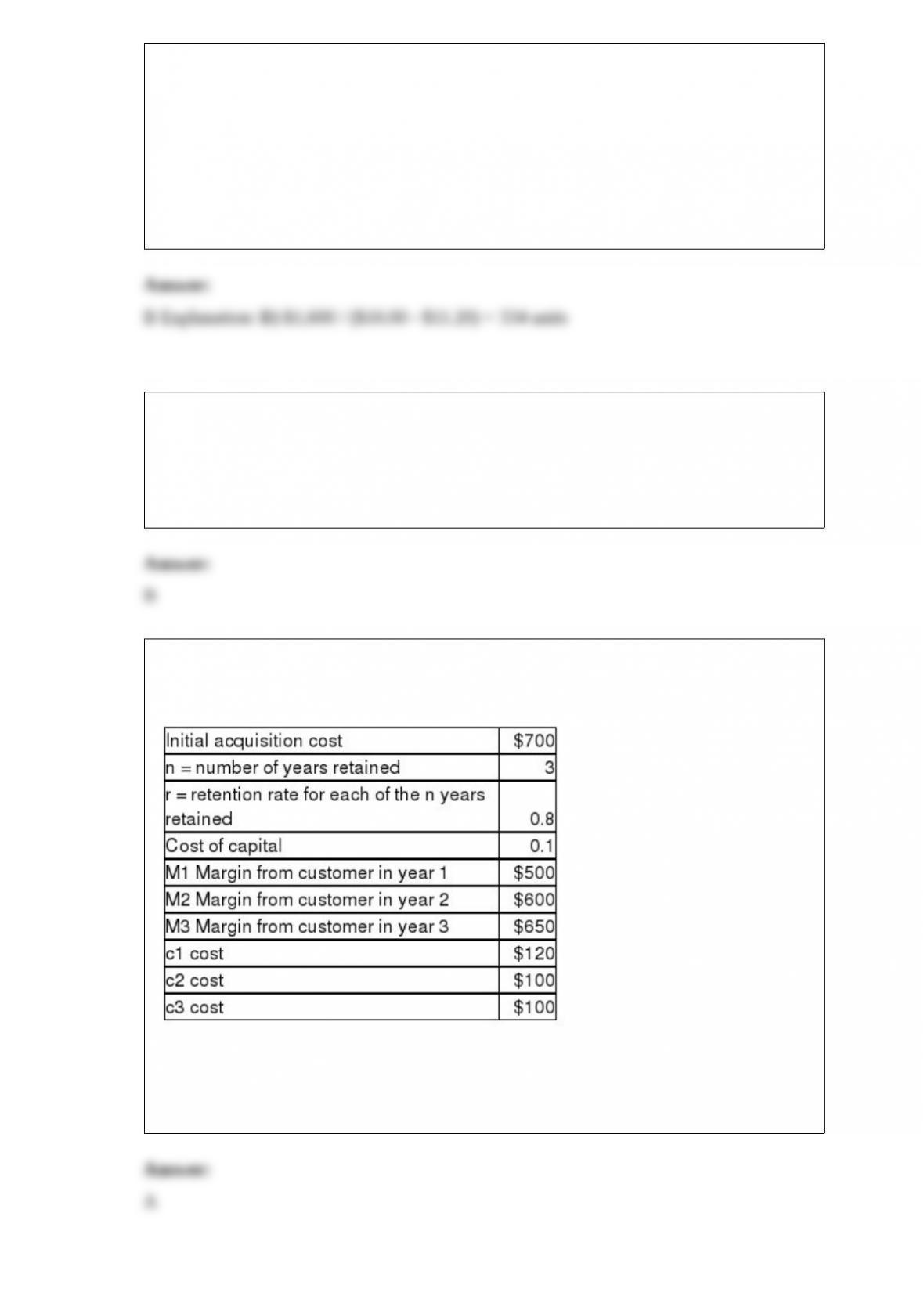
38) What is the customer lifetime value of customer Emma Stone for the first three
years of the customer relationship?
A) $2,080.00
B) $940.49
C) $1,380.00
D) $240.49

39) Process costing should be used to assign costs to products when:
A) the units produced are similar
B) the units produced are dissimilar
C) the calculation of unit costs requires the averaging of all manufacturing costs over
all units produced
D) Either A or C are present
40) The person MOST likely to use management accounting information is a(n):
A) banker evaluating a credit application
B) shareholder evaluating a stock investment
C) governmental taxing authority
D) assembly department supervisor