The tax benefit of a net operating loss carried back two years represents a current
receivable for income tax to be refunded.
Transactions that represent noncash investing and financing activities must be reported
in the statement of cash flows or in disclosure notes.
Changes in the estimates involved in depreciation, depletion, and amortization require
retroactive restatement of financial statements.
Current year stock dividends and splits require retroactive restatement of EPS for all
prior years presented in comparative financial statements.
Under current GAAP, fair value is used to measure the components of all nonmonetary
exchanges.
Component depreciation, required under International Financial Reporting Standards
(IFRS), is allowed but rarely used by U.S. companies.
The same revenue recognition requirements always apply to franchise arrangements
that apply to other selling arrangements.
Under the equity method of accounting for a stock investment, cash dividends received
are considered a reduction of the investee’s net assets.
Which of the following would not be accounted for using the retrospective approach?
a. A change from LIFO to FIFO inventory costing.
b. A change from average cost to FIFO inventory costing.
c. A change in depreciation methods.
d. A change from the full cost method in the oil industry.
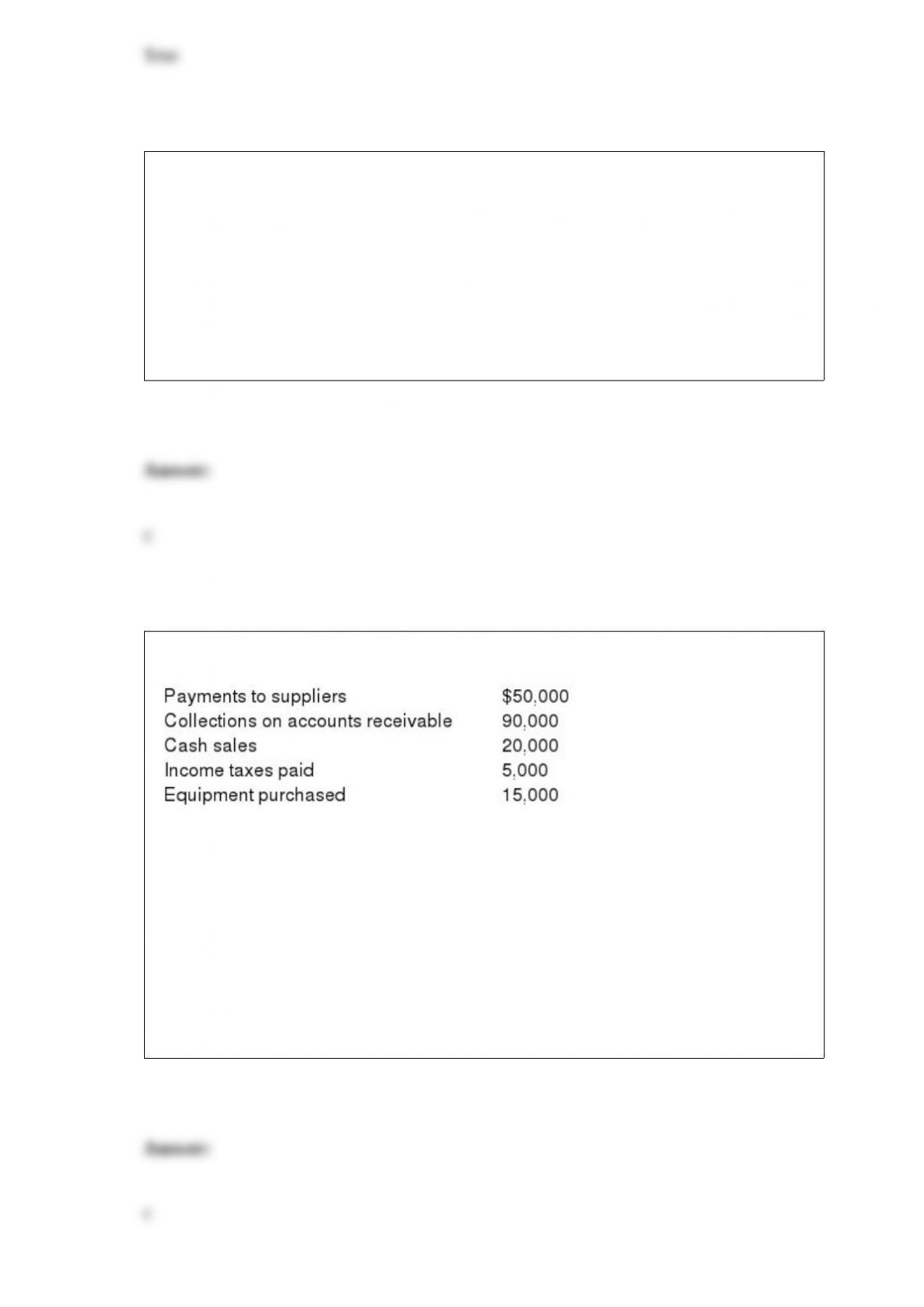
Freeman Company’s accounting records include the following information:
What is the amount of net cash provided by operating activities indicated by these
transactions?
a. $40,000.
b. $45,000.
c. $55,000.
d. $60,000.
When a property dividend is declared, the reduction in retained earnings is for:
a. The book value of the property on the date of declaration.
b. The book value of the property on the date of distribution.
c. The fair value of the property on the date of distribution.
d. The fair value of the property on the date of declaration.
A company that prepares its financial statements according to International Financial
Reporting Standards can use each of the following inventory valuation methods except:
a. Average cost.
b. FIFO.
c. LIFO.
d. All of these methods can be used.

When treasury stock is purchased for an amount greater than its par value, what is the
effect on total shareholders’ equity?
a. Increase.
b. Decrease.
c. No effect.
d. Cannot tell from the given information.
Details of each class of stock must be reported:
a. On the face of the balance sheet only.
b. In disclosure notes only.
c. On the face of the balance sheet or in disclosure notes.
d. On the face of the balance sheet and in disclosure notes.
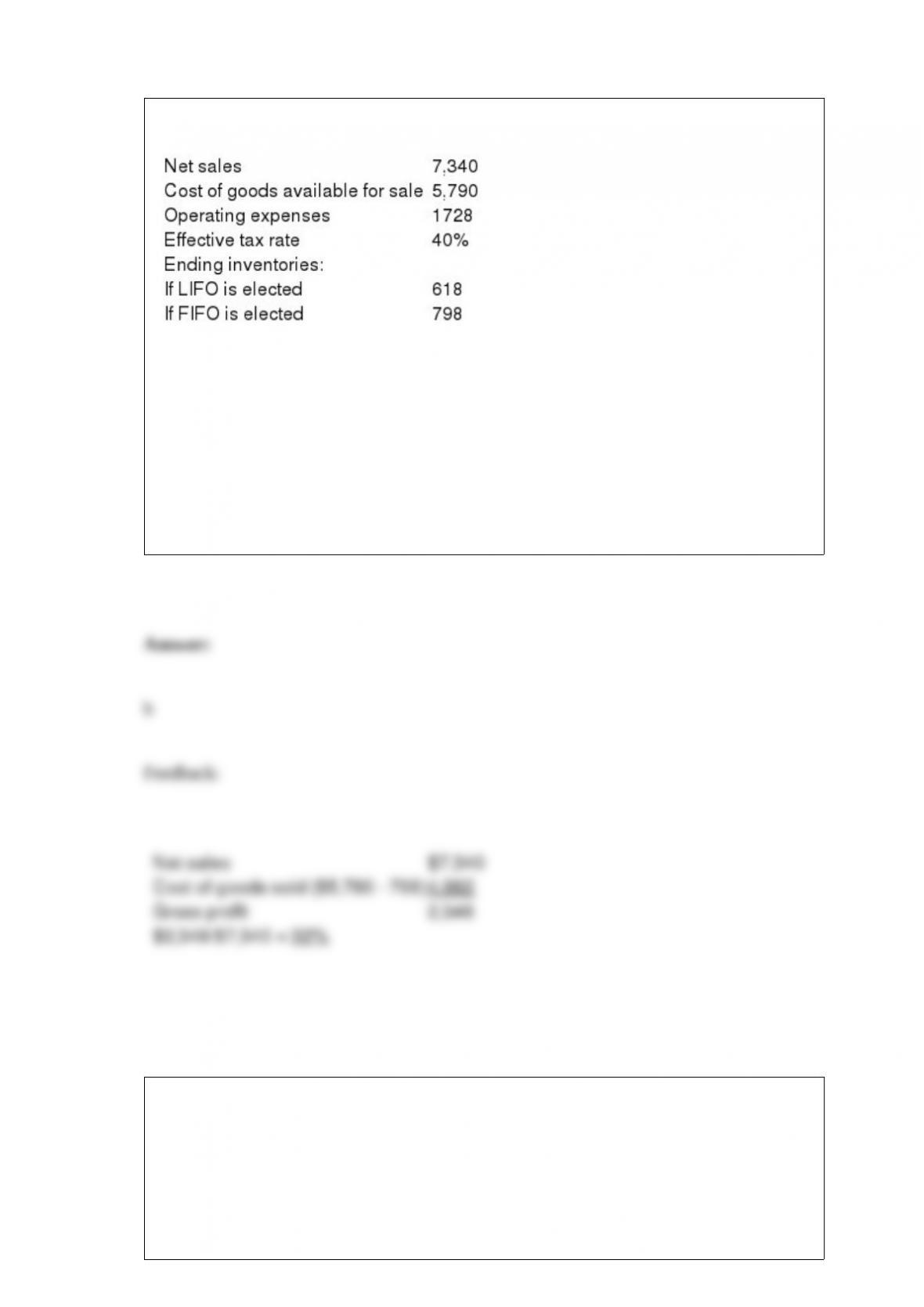
Nueva Company reported the following pretax data for its first year of operations.
What is Nueva’s gross profit ratio (rounded) if it elects FIFO?
a. 30%.
b. 32%.
c. 10.7%.
d. 60%.
The balance in retained earnings at the end of the year is determined by retained
earnings at the beginning of the year:
a. Plus revenues, minus liabilities.
b. Plus accruals, minus deferrals.

c. Plus net income, minus dividends.
d. Plus assets, minus liabilities.
Companies should report the cumulative effect of an accounting change in the income
statement:
a. In the quarter in which the change is made.
b. In the annual financial statements only.
c. In the first quarter of the fiscal year in which the change is made.
d. Never.
Dyckman Dealers has an investment in Thomas Corporation that Dyckman accounts for
as a trading security. Thomas Corporation shares are publicly traded on the New York
Stock Exchange, and the prevailing price on that exchange indicates that Dyckman’s
investment is worth $20,000. However, Dyckman management believes that the stock
market is generally overvalued, and their analysis of the Thomas investment suggests to
them that it is worth $18,000. Dyckman should carry the Thomas investment on its
balance sheet at:
a. $20,000.
b. $18,000.
c. Either $18,000 or $20,000, as either are defensible valuations.
d. $19,000, the midpoint of Dyckman’s range of reasonably likely valuations of

Thomas.
Land was acquired in 2016 for a future building site at a cost of $40,000. The assessed
valuation for tax purposes is $27,000, a qualified appraiser placed its value at $48,000,
and a recent firm offer for the land was for a cash payment of $46,000. The land should
be reported in the financial statements at:
a. $40,000.
b. $27,000.
c. $46,000.
d. $48,000.
Of the four criteria for a capital lease, which two are not applied if the lease begins
during the final quarter of the asset’s useful life?
a. The 75% test and the bargain purchase option.
b. The 90% test and the 75% test.
c. The 90% test is the only one to which this applies.
d. The bargain purchase and the passage of title criteria.
B Corp. has an employee benefit plan for compensated absences that gives each
employee 10 paid vacation days and 10 paid sick days. Both vacation and sick days can
be carried over indefinitely. Employees can elect to receive payment in lieu of vacation
days; however, no payment is given for sick days not taken. At December 31, 2016, B’s
unadjusted balance of liability for compensated absences was $42,000. B estimated that
there were 300 total vacation days and 150 sick days available at December 31, 2016.
B’s employees earn an average of $200 per day. In its December 31, 2016, balance
sheet, what amount of liability for compensated absences is B required to report?
a. $ 60,000.
b. $ 84,000.
c. $ 90,000.
d. $144,000.
If the options have a vesting period of five years, what would be the balance in
“Paid-in Capital-Stock Options” three years after the grant date?
Pastore Inc. granted options for 1 million shares of its $1 par common stock at the
beginning of the current year. The exercise price is $35 per share, which was also the
market value of the stock on the grant date. The fair value of the options was estimated
at $8 per option.
a. A credit of $4.8 million.
b. A credit of $16.2 million.
c. A debit of $4.8 million.
d. A debit of $16.2 million.
Listed below are five terms followed by a list of phrases that describe or characterize
each of the terms. Match each phrase with the number for the most correct term.
Krogstad Corporation bought 1,000 shares of Cole Inc. for $90 per share plus a
brokerage fee of $1,800. Three months later, the shares were sold for $110 per share.
The brokerage fee on the sale was $2,200.
Required:
(1.) Prepare the appropriate journal entry to record the purchase of the stock.
(2.) Prepare the appropriate journal entry to record the sale of the stock.
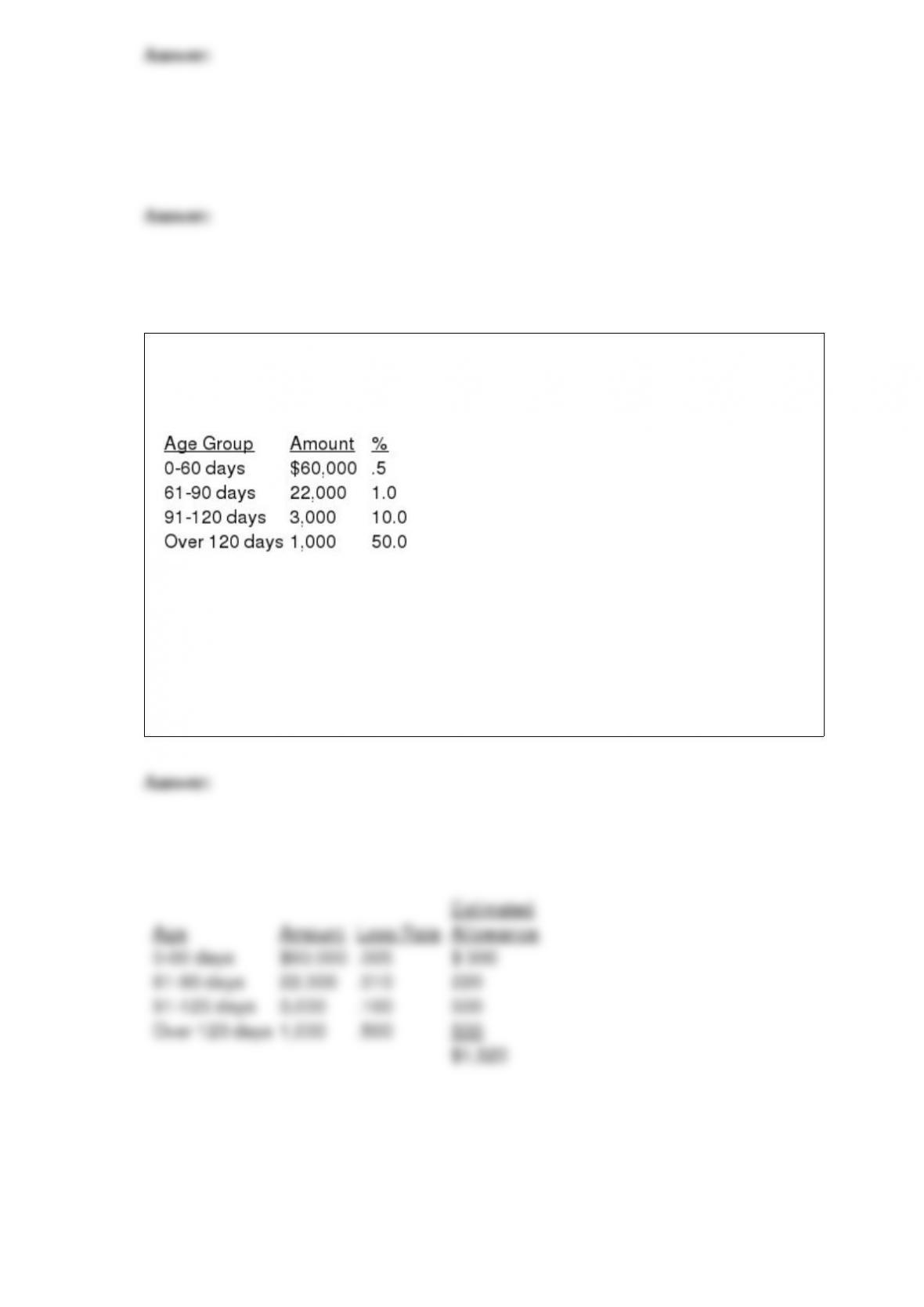
A summary of Klugman Company’s December 31, 2016, accounts receivable aging
schedule is presented below along with the estimated percent uncollectible for each age
group:
The allowance for uncollectible accounts had a balance of $1,400 on January 1, 2016.
During the year, bad debts of $750 were written off.
Required:
Prepare all journal entries for 2016 with respect to bad debts and the allowance for
uncollectible accounts.
In early December of 2016, Blue Corp. purchased $40,000 of Yellow Company
common stock, which constitutes less than 3% of Yellow’s outstanding shares. Blue
accounts for the Yellow investment as available for sale. By December 31, 2016, the
value of the Yellow investment had fallen to $30,000, and Blue recorded an unrealized
loss. By December 31, 2017, the value of the Yellow investment had fallen to $15,000,
and Blue determined that it can no longer assert that it has both the intent and ability to
hold the shares long enough for their fair value to recover, so Blue recorded an OTT
impairment. By December 31, 2018, fair value had recovered to $20,000. Prepare
appropriate entry(s) at December 31, 2016, and indicate how the scenario will affect net
income, OCI, and comprehensive income.
Sugarland Industries reported a net income of $750,750 on December 31, 2016. At the
beginning of the year, the company had 500,000 common shares outstanding. On April
1, the company sold 27,000 shares for cash. On August 31, the company issued 48,000
additional shares as part of a merger.
Required:
Compute Sugarland’s net income that would produce a basic EPS of $2.00 per share for
2016.
Identify and define the three classifications prescribed by GAAP regarding accounting
for contingencies to identify the range of possibilities for the likelihood of a confirming
event for contingent liabilities. Describe the accounting action to be taken for each
term.
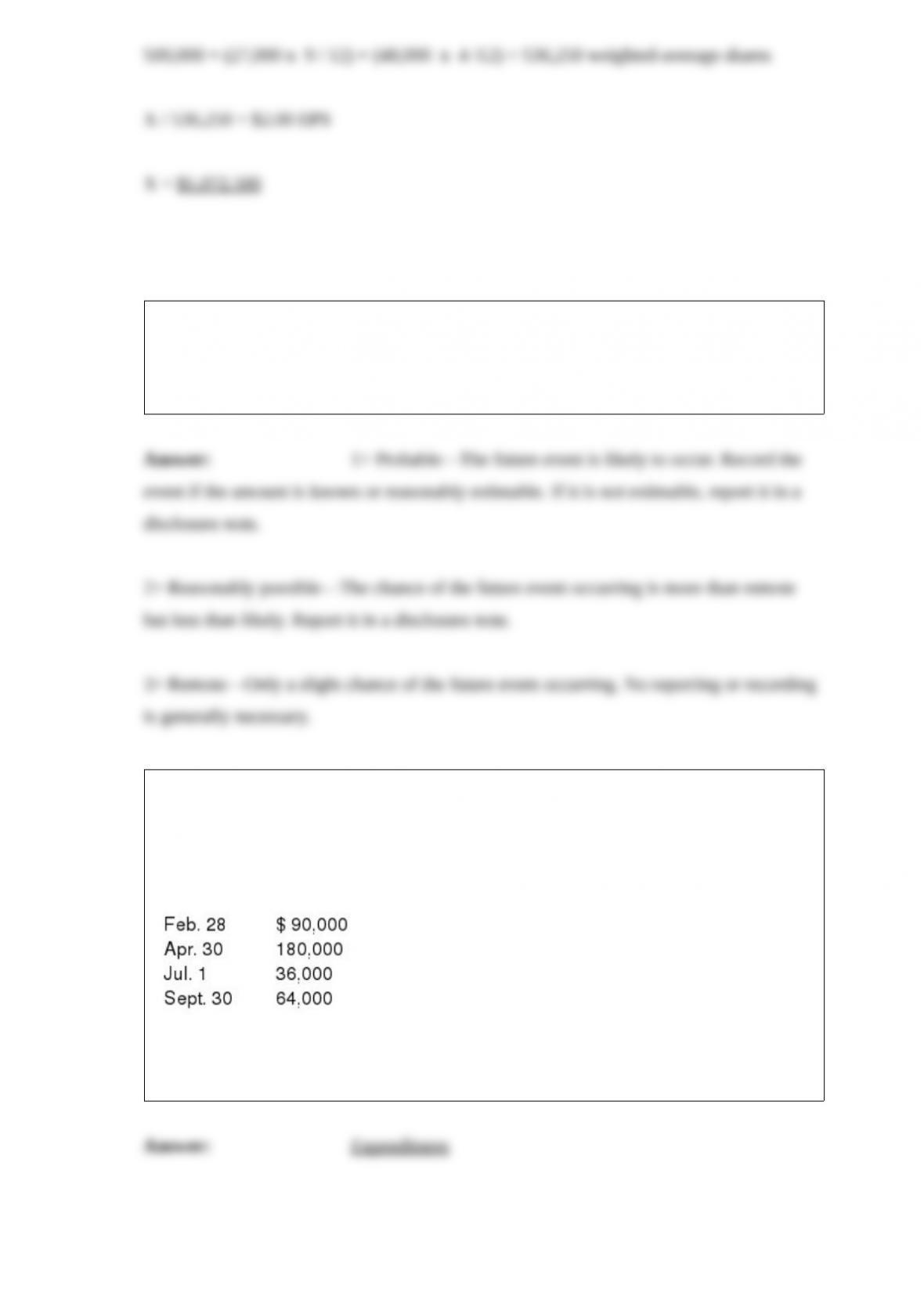
Montgomery Industries spent $600,000 in 2015 on a construction project to build a
library. Montgomery also capitalized $30,000 of interest on the project in 2015.
Montgomery financed 100% of the construction with a 10% construction loan. The
project was completed on September 30, 2016. Additional expenditures in 2016 were as
follows:
Required:
Determine the completed cost of the library. Show supporting computations.

To revalue assets:
Retained earnings 210
Inventory 210
Land 10
Retained earnings 10
To eliminate a portion of the deficit against available additional paid-in capital:
Additional paid-in capital 120
Retained earnings 120
To eliminate the remainder of the deficit against common stock:
Common stock 480
Retained earnings 480