Which of the following statements regarding shrinkage is notTRUE?
A. Perpetual inventory systems can help managers detect shrinkage.
B. Shrinkage is another term for inventory loss due to theft, error, or fraud.
C. Shrinkage is detected by comparing the balance in the inventory ledger account and
the results of the physical inventory count.
D. It is easier to detect shrinkage in a periodic inventory system than in a perpetual
inventory system.
Answer:
Bonds that are backed by a company’s assets are called secured bonds.
Answer:
A liability for dividends is recorded on the date of record.
Answer:
Impairment occurs when the estimated future cash flows from a long-lived asset fall
below its book value.
Answer:
Accumulated depreciation is classified as an expense.
Answer:

The following activities occurred during the current year, 2013, for the Maverick Law
Firm.
– On February 1, 2013, received cash of $5,000 from clients in payment of their
accounts from 2012.
– In 2013, received cash of $13,000 for law services rendered in
– At the end of 2013, billed customers $4,000 for services rendered in This amount was
unpaid as of the end of the year.
– In November of 2013, received cash of $2,000 from clients as a deposit on law
services to be performed in 2014.
Which of the following statements isTRUE about the activities for Maverick Law Firm
for 2013?
A. If Accounts receivable prior to February 1, 2013 was $25,000, the amount of
Accounts Receivable to be reported on the Balance Sheet at December 31, 2013 will be
$24,000.
B. The $2,000 received from clients for law services to be performed next year will be
reported as revenue on the Income Statement this year since cash was received.
C. The $4,000 billed to clients for services rendered this year and unpaid as of
December 31 will be reported on the Balance Sheet at December 31 as Accounts
Payable.
D. The $5,000 received this year from clients in payment of their accounts will be
reported on the Income Statement of 2013 as Revenue.
Answer:
Multiple-step income statements separate core results from peripheral results.
Answer:
Which of the following statements isTRUE?
A. Transactions are analyzed from the standpoint of the owners.
B. All business activities are considered accounting transactions.
C. The transaction amount is determined for each exchange based on the cost of the
items given and received.
D. A business needs journal entries only to show how transactions affect the balance
sheet.
Answer:
The company uses up $5,000 of an existing asset. The company adjusts its accounts
accordingly. Which of the following is aTRUE statement?
A. This is an accrual adjustment.
B. This is a closing adjustment.
C. This is a deferral adjustment.
D. This is an unethical adjustment.
Answer:
Which of the following statements is notTRUE about accounts payable?
A. It is credited when merchandise is purchased on account.
B. It is credited for transportation charges paid.
C. It is debited when payment is made on account.
D. It is debited when merchandise is returned by the purchaser.
Answer:
A gain or loss from selling equipment is reported under cash flows from operating
activities using the direct method.
Answer:
A declining fixed asset turnover ratio can actually be caused by acquiring additional
assets in the current period in preparation for greater future sales.
Answer:
The statement of cash flows explains the difference between the beginning and ending
balances of cash and cash equivalents.
Answer:
Interest revenue from notes receivable is reported on a multiple step income statement
as a part of Income from Operations.
Answer:
Accounts payable, notes payable and wages payable are examples of liabilities.
Answer:
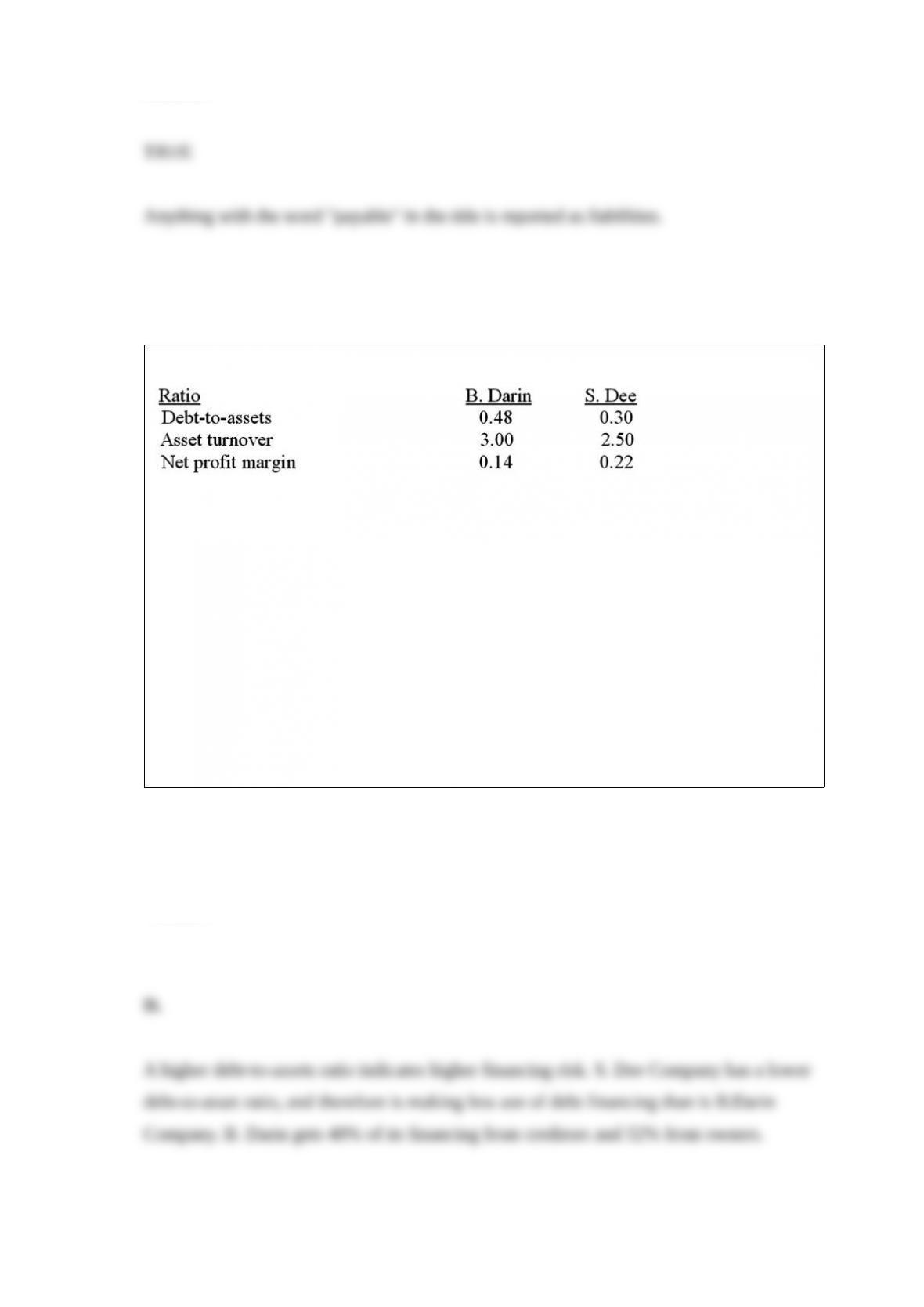
Which of the following isTRUE concerning debt financing by these two companies?
A. S. Dee’s financing risk is greater than B. Darin’s financing risk.
S. Dee Company is relying more heavily on debt financing than B.Darin Company.
B. Since the net profit margin ratio is higher for S. Dee, that company must be utilizing
less debt financing than B. Darin Company.
C. B. Darin Company is relying more heavily on equity financing than S. Dee Company
D. B. Darin’s investors provide 52% of its financing.
Answer:

Which of the following is notTRUE about the Income Statement?
A. Amounts received from customers for services performed in the current month
would be revenues on the income statement.
B. Costs incurred in the current month but not paid as of the end of the month would be
expenses on the income statement for the current month.
C. Amounts received from customers in payment of their accounts arising from service
in the prior period would be revenues in the income statement for the current period.
D. Amounts received from customer as deposits for services to be rendered next month
will not be recorded as revenues on the income statement for the current month.
Answer:
A company purchased money market funds with cash during the current year. Choose
the statement that isTRUE:
A. This transaction will result in a decrease in cash from operating activities.
B. This transaction will result in a decrease in cash from investing activities.
C. This transaction will result in a decrease in cash from financing activities.
D. This transaction will not cause a change in cash from operating, investing, or
financing activities.
Answer:
Which of the following is notTRUE concerning requirements of when a company
should recognize revenue?
A. When delivery has occurred or services have been provided (rendered).
B. When the price is fixed or determinable.
C. When there is persuasive evidence of an arrangement for customer payment and
collection is reasonably assured.
D. When cash has been received for services rendered.
Answer:
Purrfect Pets had $6,000 of supplies at the end of October. During November, the
company bought $2,000 of supplies. At the end of November, the company had $1,000
of supplies remaining. Which of the following statements is notTRUE?
A. During November, the company used $7,000 of supplies.
B. Supplies should be reported at $1,000 on the balance sheet.
C. An expense should be debited for $7,000 in November.
D. An asset should be debited for $1,000 in November.
Answer:
The amount charged for a good or service provided to a customer on account is
recorded only after the payment is received.
Answer:
How many of the following statements regarding posting and classification areTRUE?
A. Posting journal entries involves copying the dollar amounts from the ledger into the
journal.
B. If a $100 debit is erroneously posted to an account as a $100 credit, the accounts will
be out of balance by $100.
C. If a $5,000 liability is misclassified as stockholders’ equity then the accounting
equation will still balance.
D. If a purchase of supplies on account for $100 is recorded with a debit to supplies of
$10 and a credit to accounts payable for $10, the accounting equation will not balance.
Answer:
Which one of the following statements isTRUE?
A. Liquidity refers to a company’s ability to pay its current and long-term debts.
B. A company is always considered a serious credit risk if its quick ratio is below one.
C. All other things being equal, the existence of a line of credit enhances the ability of a
company to meet its short-term obligations.
D. Liquid assets include all current assets.
Answer:
Which of the following is normallyTRUE?
A. Assets have debit balances and liabilities have credit balances.
B. Assets and liabilities have credit balances.
C. Assets have credit balances and liabilities have debit balances.
D. Assets and liabilities have debit balances.
Answer:
Which of the following statements regarding the balance sheet isTRUE?
A. Any item on a balance sheet labeled payable is a liability of that company.
B. Current Assets are listed on the balance sheet in alphabetical order.
C. Assets + Liabilities = Equity
D. It lists all the accounts and their debit and credit balances.
Answer:
When the net cash flows from operating, investing, and financing activities are
combined to arrive at the overall net change in cash, a net decrease in cash is subtracted
from the beginning cash balance to calculate the ending cash balance.
Answer:
The local branch of the Universal Bank System (UBS) receives money from depositors
and lends it to borrowers. Which of the following would beTRUE about UBS’s
financial statements?
A. UBS reports deposits as assets and loans as liabilities.
B. UBS reports both deposits and loans as assets.
C. UBS reports deposits as liabilities and loans as assets.
D. UBS reports both deposits and loans as liabilities.
Answer:
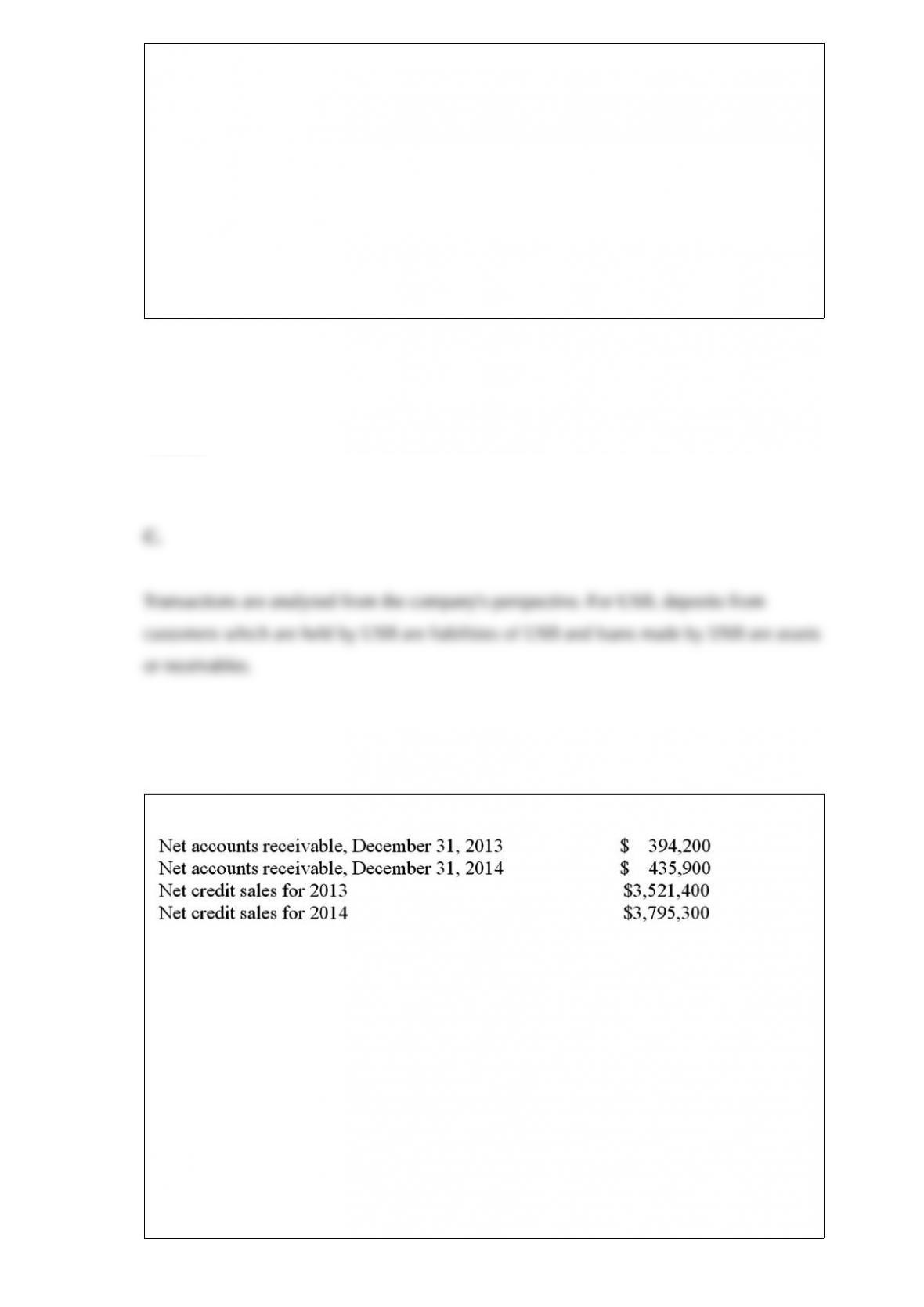
Use the information above to answer the following question. If the company changes its
credit granting policies and begins granting credit to less creditworthy customers, which
of the following statements isTRUE regarding the likely effect on the receivables
turnover ratio and the days to collect measure?
A. The receivables turnover ratio will decrease and days to collect will increase.
B. The receivables turnover ratio will increase and days to collect will increase.
C. The receivables turnover ratio will decrease and days to collect will decrease.
D. The receivables turnover ratio will not change and days to collect will decrease.
Answer:
Which of the following statements is notTRUE concerning the independent external
audit?
A. The SEC requires all publicly traded companies to have their internal controls
audited by external auditors.
B. Many privately owned companies have their financial statements audited at the
request of lenders.
C. The goal of the external audit is to detect material misstatements.
D. The auditors are required to check every transaction in order to provide assurance to
financial statement users.
Answer:

Your company buys 500 pairs of socks at $3 each (including other purchasing costs
such as transportation) and sells them for $5 each.
Use the information above to answer the following question. Which of the following
statements isTRUE?
A. The sales revenue is $2,500.
B. The gross profit is $2,500.
C. The cost of goods sold is $2,500.
D. The net income is $2,500.
Answer:
A company sells 1 million shares of common stock with a par value of $0.02 for $15 a
share. To record the transaction, the company would:
A. debit Cash for $20,000 and credit Common Stock for $20,000.
B. debit Cash for $15 million and credit Common Stock for $15 million.
C. debit Cash for $15 million, credit Common Stock for $20,000 and credit Additional
Paid-in Capital for $14,980,000.
D. debit Cash for $20,000, debit Capital Receivable for $14,980,000, credit Common
Stock for $20,000 and credit Additional Paid-in Capital for $14,980,000.

Answer:
Which of the following journal entries would decrease stockholders’ equity?
A. Debiting Prepaid Insurance and crediting Cash.
B. Debiting Unearned Revenue and crediting Revenue.
C. Debiting Supplies and crediting Accounts Payable.
D. Debiting Insurance Expense and crediting Cash.
Answer:
Which of the following would not be associated with an expense?
A. Using supplies.
B. Paying off an account payable.
C. Paying for electricity used by production equipment during the current period.
D. Paying daily wages for production workers.
Answer:
Liabilities on the balance sheet would include which of the following?
A. Accounts payable, notes payable and contributed capital
B. Accounts receivable, supplies expense and retained earnings
C. Accounts payable, notes payable and wages payable
D. Contributed capital, retained earnings and notes payable
Answer:
Travis County Bank agrees to lend Backyard Corporation $200,000 on January 1.
Backyard signs a $200,000, 4%, 9-month note. Interest is due at maturity on September
30. The fiscal year ends June 30.
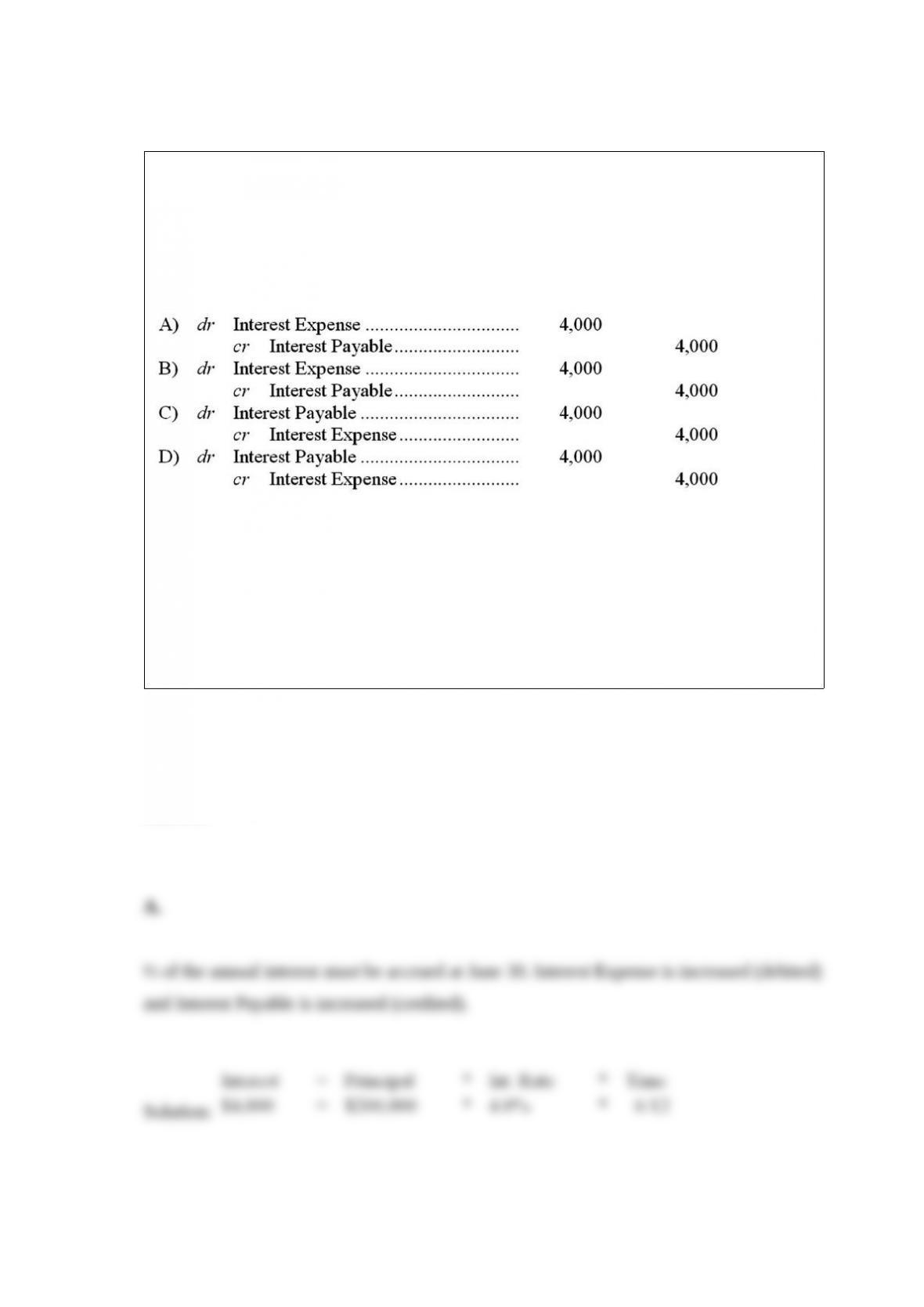
Use the information above to answer the following question. What adjusting entry
should Backyard make on June 30 before preparing its annual financial statements?
A. Option A
B. Option B
C. Option C
D. Option D
Answer:
When merchandise is sold, the cost of the merchandise is removed from inventory and
reported on a multistep the income statement as
A. Inventory expense.
B. Cost of goods sold.
C. General & administrative expenses.
D. Non-operating expenses.
Answer:
The following items are taken from the adjusted trial balance prepared as of December
31, 2013. All accounts have normal balances.
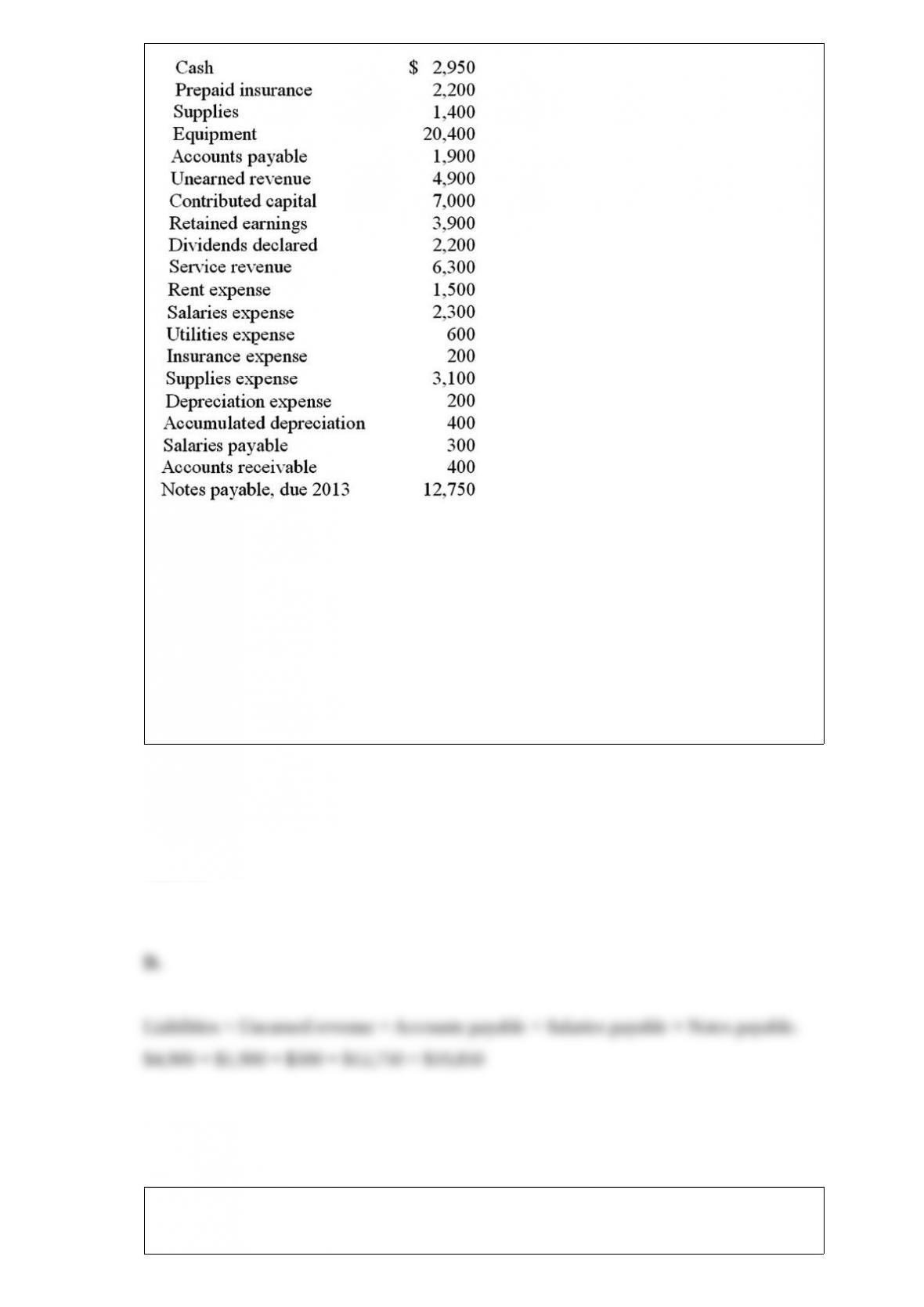
Total Liabilities on the Balance Sheet at December 31, 2013 are:
A. $19,550.
B. $14,950.
C. $15,350.
D. $19,850.
Answer:
Alphabet Company, which uses the periodic inventory method, buys different letters for
resale. It buys A thru G in January at $4 per letter. In February, it buys H thru L at $6
per letter. It buys M thru R in March at $7 per letter. It sells A, D, E, H, J and N in
April.
The specific identification method would probably be most appropriate for which of the
following goods?
A. Boxes of brass 4-inch drywall screws at Home Depot.
B. Bottles of suntan lotion in Wal-Mart’s central warehouse.
C. Sets of tires at the Goodyear plant.
D. Diamond necklaces at a Tiffany & Co. jewelry store.
Answer:
Your company lent a customer $5,000 to satisfy the customer’s overdue accounts
receivable. The loan is for one year at an annual interest rate of 5%. Six months later
the customer repays the principal and interest. The principal part of the repayment
should be recorded as a:
A. debit to Cash and credit to Notes Receivable.
B. debit to Notes Receivable and credit to Accounts Receivable.
C. debit to Cash and credit to Accounts Receivable.
D. debit to Notes Receivable and credit to Cash.
Answer:
Which of the following situations would cause the balance per bank to be more than the
balance per books?
A. Deposits in transit.
B. Service charges.
C. Outstanding checks.
D. Checks from customers returned as NSF.
Answer:
On average, 5% of credit sales has been uncollectible in the past. At the end of the year,
the balance of accounts receivable is $100,000 and the allowance for doubtful accounts
has an unadjusted credit balance of $500. Net credit sales during the year were
$150,000. Using the percentage of credit sales method, the estimated bad debt expense
would be:
A. $5,000.
B. $7,000.
C. $7,500.
D. $8,000
Answer:
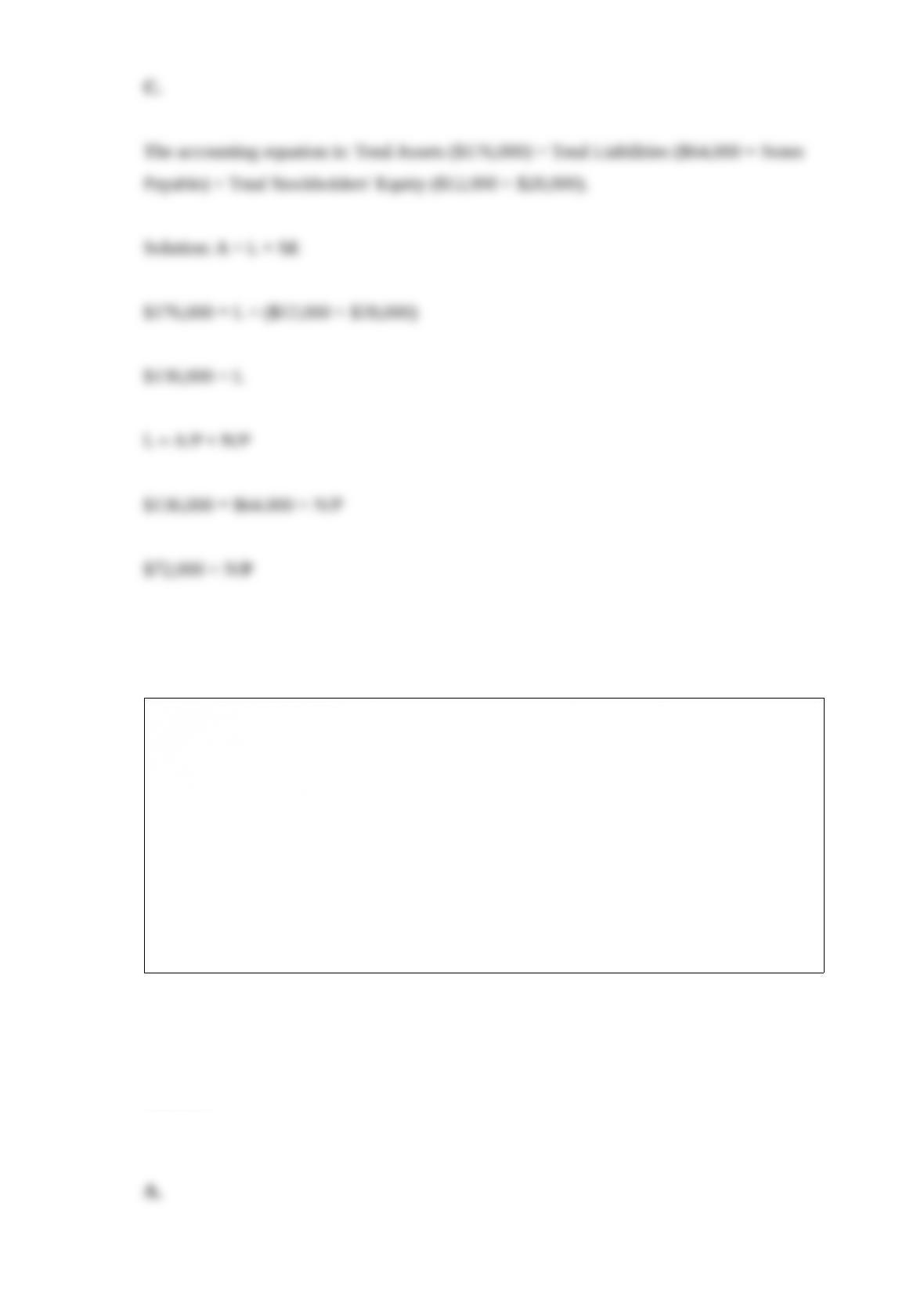
A company’s balance sheet contained the following information:
Assume Notes Payable is the only other item on the balance sheet. Notes Payable must
equal
A. $200,000.
B. $8,000.
C. $72,000.
D. $344,000.
Answer:
The separate entity assumption means:
A. a company’s financial statements reflect only the business activities of that company.
B. each separate owner’s finances must be revealed in the financial statements.
C. each separate entity that has a claim on a company’s assets must be shown in the
financial statements.
D. if the business is a sole proprietorship, the owners’ personal activities are included in
the company’s financial statements.
Answer:
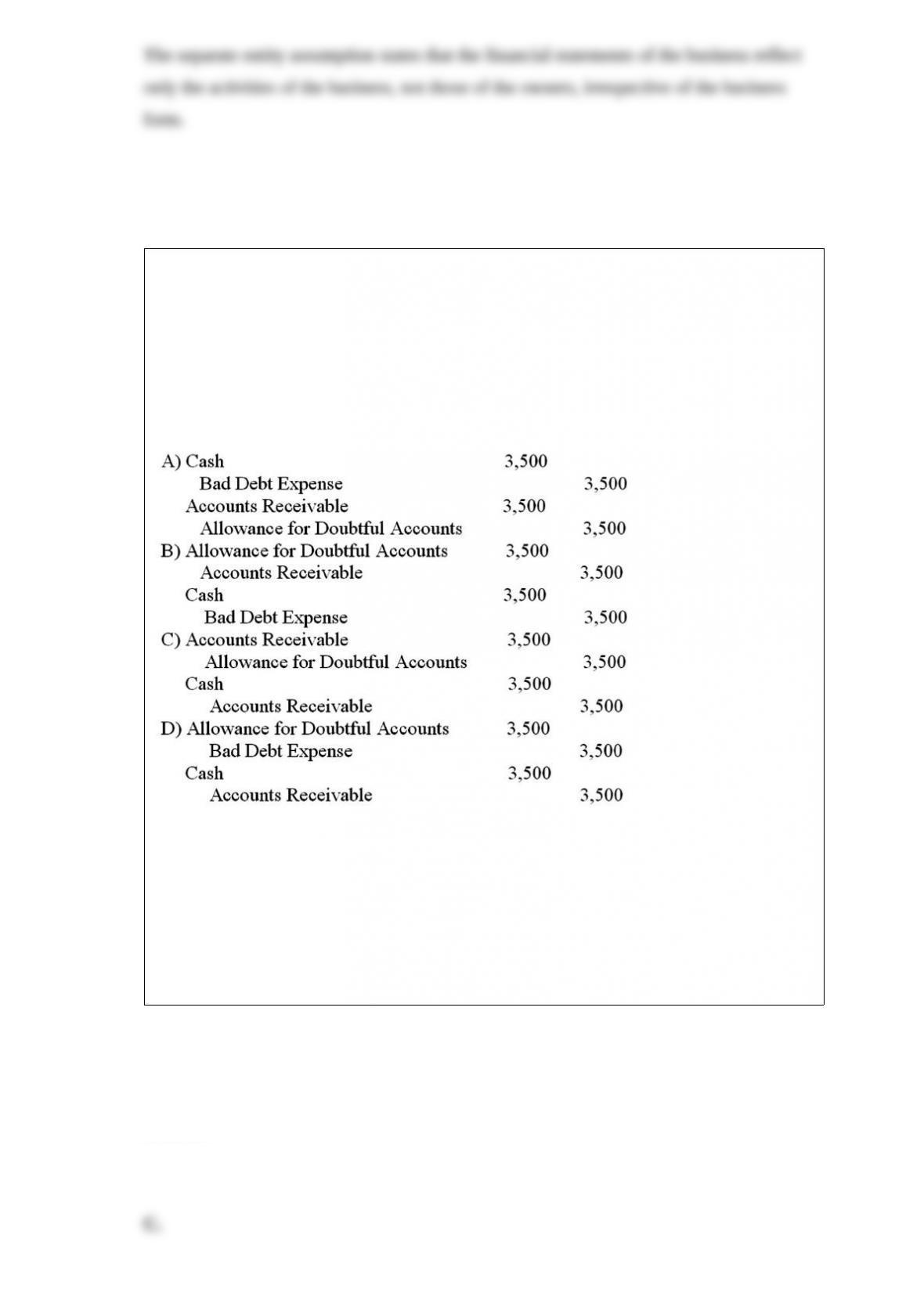
Klatu Company uses the allowance method to account for uncollectible accounts. On
May 1, Klatu wrote off a $3,500 accounts receivable as uncollectible because the
customer had filed bankruptcy. On May 29, Klatu unexpectedly received the $3,500
from the customer.
Use the information above to answer the following question. The required entry(ies) on
May 29 to record the recovery is:
A. Option A
B. Option B
C. Option C
D. Option D
Answer:
If an analyst wants to examine a company’s current ability to generate income, which of
the following would best be considered?
A. Liquidity.
B. Market share.
C. Profitability.
D. Solvency.
Answer:
Conservatism means:
A. not underestimating asset values.
B. not overestimating liabilities.
C. using the least optimistic measurement when faced with uncertainty about the
reported amounts of assets and liabilities.
D. always recording an asset at the amount it originally cost.
Answer:
E. Choudhury Company’s price/earnings ratio is 15.3. Its closest competitor, Bhatt, Inc.
has a P/E ratio of 9.4. Which of the following would not be a valid conclusion to draw
from a comparison of the two companies’ P/E ratios?
A. E. Choudhury Company’s stock is overpriced.
B. Investors believe E. Choudhury Co. has a brighter future than Bhatt, Inc.
C. E. Choudhury Company has been more profitable than Bhatt, Inc.
D. The stock price of E. Choudhury Company has been bid up due to rumors of a
merger.
Answer:
The repayment of the principal of a loan which had been used to finance the purchase
of equipment should be reported on the statement of cash flows as a

A. cash outflow from investing activities.
B. cash outflow from operating activities.
C. cash outflow from financing activities.
D. noncash transaction in a supplemental disclosure.
Answer:
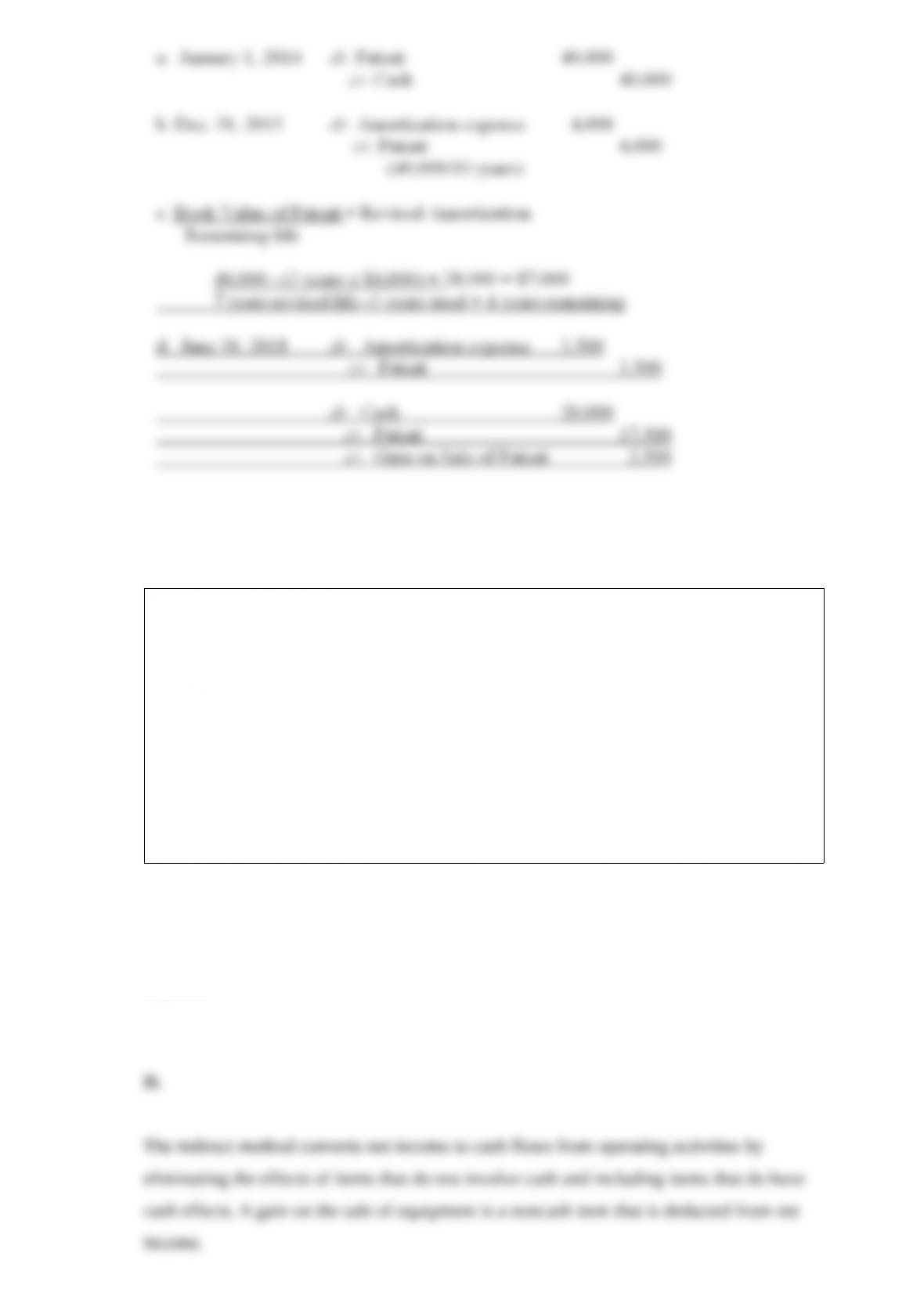
Martinez, Inc. acquired a patent on January 1, 2014 for $40,000 cash. The patent was
estimated to have a useful life of 10 years. At the end of 2016 it appeared that the total
useful life would be only 7 years and the amortization rate was revised accordingly. On
June 30, 2018, the patent was sold for $20,000.
a. Prepare the journal entry to record the acquisition of the patent on January 1, 2014.
b. Prepare the journal entry to record the annual amortization for
c. Compute the amount of amortization that would be recorded in 2017.
d. Record the sale of the patent on June 30, 2018.
Answer:
Which of the following would not be added to net income in calculating cash flows
from operating activities on a statement of cash flows prepared using the indirect
method?
A. Amortization expense.
B. A decrease in accounts receivable.
C. An increase in wages payable.
D. A gain on the sale of equipment.
Answer:
Which of the following would be in the raw materials inventory of a company making
cheese?
A. Milk and cream used to make the cheese.
B. Cheese that has been made but is curing before being ready to sell.
C. Cured cheese that is waiting to be shipped to retailers.
D. Partially processed cheese.
Answer:
Which of the following would a company be most likely to overstate if the company
was trying to mislead potential external investors or creditors?
A. Accounts Receivable
B. Notes Payable
C. Salaries Expense
D. Accounts Payable
Answer:
Public corporations:
A. are businesses owned by two or more people, each of whom is personally liable for
the debts of the business.
B. are businesses whose stock is bought and sold on a stock exchange.
C. are businesses whose stock is bought and sold privately.
D. are businesses where stock is not used as evidence of ownership.
Answer:
Which of the following trial balances are used as a source for preparing the income
statement?
A. Unadjusted trial balance.
B. Pre-adjusted trial balance.
C. Adjusted trial balance.
D. Post-closing trial balance.
Answer:
Which one of the following events would not require a journal entry on a corporation’s
books?
A. 2-for-1 stock split
B. 100% stock dividend
C. 2% stock dividend
D. $1 per share cash dividend
Answer:
The three main types of business activities measured by financial statements are:
A. selling goods, selling services, and obtaining financing.
B. operating activities, investing activities, and financing activities.
C. hiring, producing, and advertising.
D. generating revenues, paying expenses, and paying dividends.
Answer:
Which of the following is an operating activity?
A. Repaying a bank loan.
B. Paying a dividend to owners.
C. Purchasing a new building.
D. Paying for inventory to be offered for sale.
Answer:
Under the direct write-off method, the estimated amount of bad debts is debited to
which account?
A. Bad Debt Expense.
B. Allowance for Doubtful Accounts.
C. Accounts Receivable.
D. Bad debts are not estimated under the direct write-off method.
Answer:
If a company attempts to artificially inflate current sales and net income by shipping
goods that have not been ordered, we would expect that the receivables turnover ratio
will:
A. increase and the days-to-collect will increase, all other things being equal.
B. increase and the days-to-collect will decrease, all other things being equal.
C. decrease and the days-to-collect will decrease, all other things being equal.
D. decrease and the days-to-collect will increase, all other things being equal.
Answer:
A company issues 100,000 shares of preferred stock for $40 a share. The stock has
fixed annual dividend rate of 5% and a par value of $3 per share. Preferred stockholders
can anticipate receiving a dividend of:
A. $5,000 each year.
B. $15,000 each year.
C. 5% of net income each year.
D. $3 per share.
Answer:
Generally accepted accounting principles (GAAP) were (are) established by:
A. an Italian monk in 1494.
B. the U.S. Congress in 1933.
C. the PCAOB in 2004.
D. the FASB on an ongoing basis.
Answer:
Revenues
A. decrease assets.
B. increase stockholders’ equity.
C. increase liabilities.
D. decrease expenses.

Answer:
The Buddy Burger Corporation owes $1.5 million to the Texas Wholesale Meat
Company from whom Buddy Burger buys its burger meat. Which account would Buddy
Burger use to report the amount owed?
A. Cash
B. Accounts Payable
C. Notes Payable
D. Accounts Receivable
Answer:
A corporate charter specifies that the company may sell up to 20 million shares of
stock. The company sells 12 million shares to investors and later buys back 3 million
shares. The number of issued shares after these transactions have been accounted for is:
A. 12 million shares.
B. 9 million shares.
C. 10 million shares.
D. 17 million shares.
Answer:
In which of the following organizational forms are the owners not taxed on the business
profits?
A. Sole proprietorships.
B. Partnerships.
C. Corporations.
D. Public partnerships.
Answer: