
Hogan Company had the following account balances for 2013:
Hogan reported net income of $300,000 for 2013. Assuming no other changes in current
account balances, what is the amount of net cash provided by operating activities for
2013 reported in the statement of cash flows? A. $291,000.
B. $290,000.
C. $281,000.
D. $301,000.
Answer:
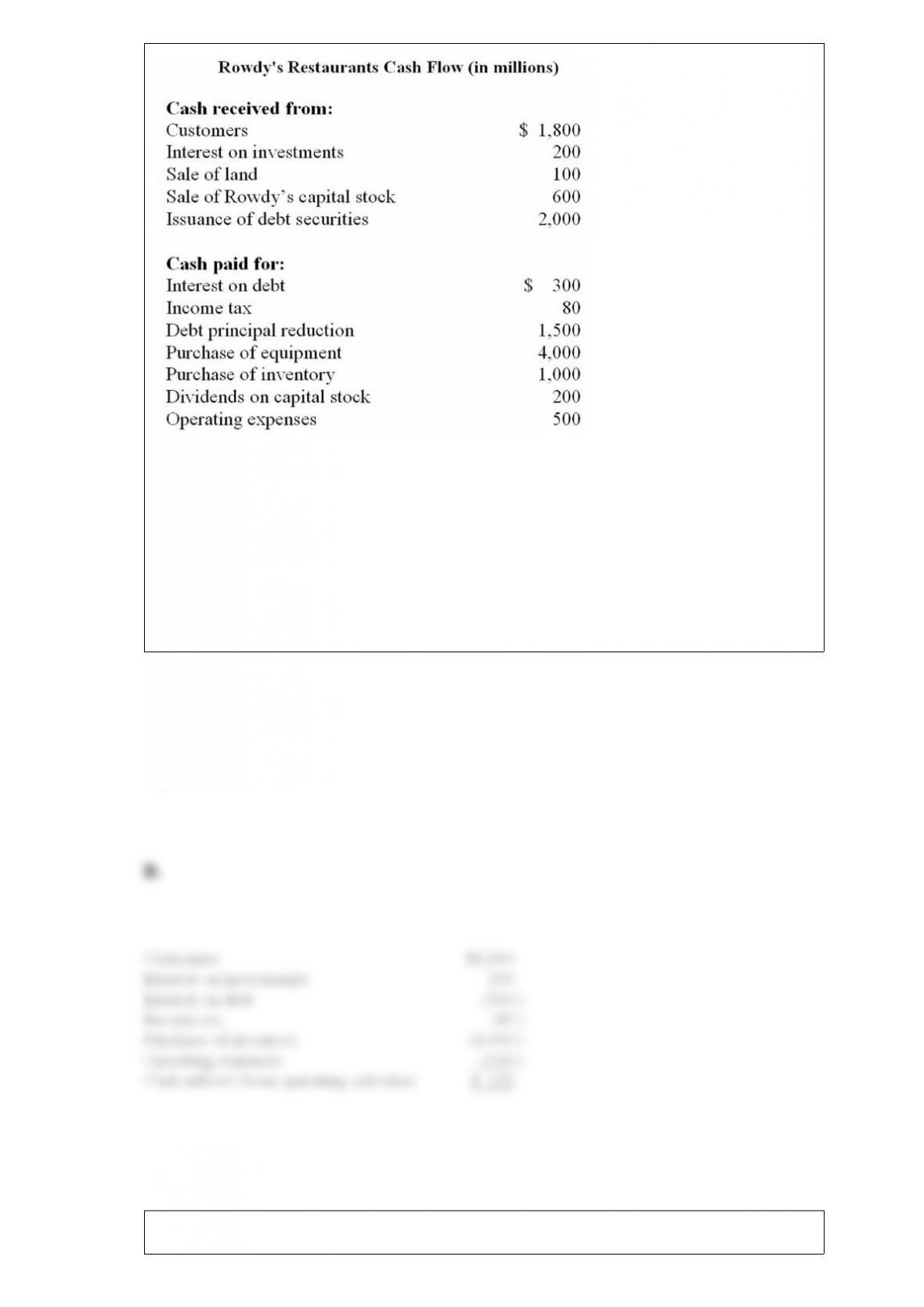
Rowdy’s would report net cash inflows (outflows) from operating activities in the
amount of: A. $(80).
B. $120.
C. $200.
D. $420.
Answer:
Discount-Mart issued ten thousand $1,000 bonds on January 1, 2013. The bonds have a
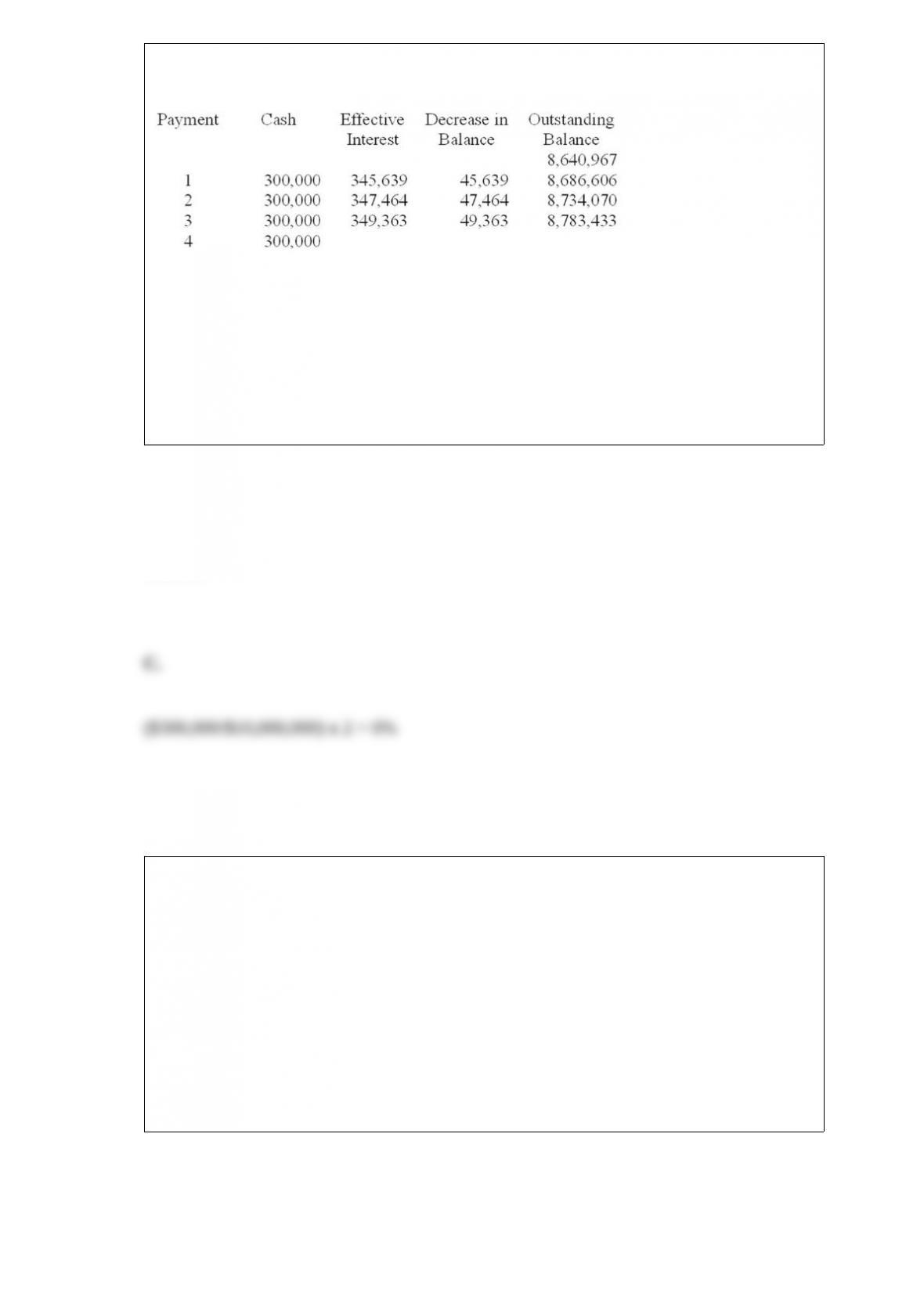
10-year term and pay interest semiannually. This is the partial bond amortization
schedule for the bonds.
What is the stated annual rate of interest on the bonds? A. 3%.
B. 4%.
C. 6%.
D. 8%.
Answer:
Prunedale Co. uses a periodic inventory system. Beginning inventory on January 1 was
understated by $30,000, and its ending inventory on December 31 was understated by
$17,000. In addition, a purchase of merchandise costing $20,000 was incorrectly
recorded as a $2,000 purchase. None of these errors were discovered until the next year.
As a result, Prunedale’s cost of goods sold for this year was: A. Overstated by $31,000.
B. Overstated by $5,000.
C. Understated by $31,000.
D. Understated by $48,000.

Answer:
The cost recovery method of accounting for long-term contracts under IFRS is
sometimes referred to as the: A. “Sales-neutral approach.”
B. “Completed contract method.”
C. “Multi-step approach.”
D. “Zero profit method.”
Answer:
Basic and diluted earnings per share data is required to be reported: A. In disclosure
notes to the financial statements.
B. Only if it adds to the relevance of the income statement.
C. In the summary section of the annual report.

D. On the face of the income statement.
Answer:
Which of the following is reported as an operating activity in the statement of cash
flows? A. The purchase of long-lived assets.
B. The acquisition of treasury stock.
C. The retirement of bonds.
D. The payment of prepaid insurance.
Answer:
The Racquet Store (RS) sells franchise agreements in which it charges an up-front fee
of $50,000 for assistance in setting up a store, and then a monthly fee of $1,000 for
national advertising and administrative assistance. Steffi Hingis signs a franchise
agreement with RS.
Assume that Steffi paid the $50,000 in cash when she signed the agreement. RS can
recognize revenue associated with the $50,000: A. When Steffi signs the agreement and
pays the cash.
B. As soon as RS has assisted Steffi in setting up the store.

C. Gradually as RS provides advertising and administration services.
D. None of the other answers is correct
Answer:
A deferred tax asset represents a:A. Future income tax benefit.
B. Future cash collection.
C. Future tax refund.
D. Future amount of money to be paid out.
Answer:
On June 30, 2013, Blair Industries had outstanding $80 million of 8% convertible bonds
that mature on June 30, 2014. Interest is payable each year on June 30 and December
31. The bonds are convertible into 6 million shares of $10 par common stock. At June
30, 2013, the unamortized balance in the discount on bonds payable account was $4
million. On June 30, 2013, half the bonds were converted when Blair’s common stock
had a market price of $30 per share. When recording the conversion, Blair should credit

paid-in capital-excess of par: A. $6 million.
B. $8 million.
C. $10 million.
D. $12 million.
Answer:
Before considering a net operating loss carryforward of $80 million, Fama Corporation
reported $200 million of pretax accounting and taxable income in the current year. The
income tax rate for all previous years was 40%. On January 1 of the current year, a new
tax law was enacted, reducing the rate to 30% effective immediately. Fama’s income tax
payable for the current year would be: A. $48 million.
B. $28 million.
C. $60 million.
D. $36 million.
Answer:

If the lessee expects to obtain title to leased property due to a bargain purchase option
or passage of title at the end of the lease term: A. The lessee ignores any residual value
for the leased property.
B. The lessor ignores any residual value for the leased property.
C. The lessee adds the present value of the residual value to the amount recorded for the
lease.
D. The lessor will always charge a higher annual lease rate.
Answer:
A company failed to report the $600,000 additional liability for its underfunded pension
plan. Its tax rate is 30%. As result of this error, retained earnings would be: A.
Unaffected.
B. Overstated by $600,000.
C. Overstated by $420,000.
D. Overstated by $180,000.
Answer:

C Co. reported a retained earnings balance of $200,000 at December 31, 2012. In
September 2013, C determined that insurance premiums of $30,000 for the three-year
period beginning January 1, 2012, had been paid and fully expensed in 2012. C has a
30% income tax rate. What amount should C report as adjusted beginning retained
earnings in its 2013 statement of retained earnings? A. $210,000.
B. $214,000.
C. $220,000.
D. $221,000.
Answer:

Selected information from Large Corporation’s accounting records and financial
statements for 2013 is as follows ($ in millions):
Large prepares its financial statements in accordance with IFRS. In its statement of cash
flows, Large most likely reports net cash outflows from investing activities of: A. $18
million.
B. $28 million.
C. $38 million.
D. $68 million.
Answer:
Flyaway Travel Company reported net income for 2013 in the amount of $90,000.
During 2013, Flyaway declared and paid $2,125 in cash dividends on its nonconvertible
preferred stock. Flyaway also paid $10,000 cash dividends on its common stock.
Flyaway had 40,000 common shares outstanding from January 1 until 10,000 new
shares were sold for cash on April 1, 2013. What is 2013 basic earnings per share? A.
$1.85.
B. $1.64.
C. $1.76.
D. None of these is correct.
Answer:

The information below pertains to Mondavi Corporation:
(a.) For the current year temporary differences existed between the financial statement
carrying amounts and the tax basis of the following:
(b.) No temporary differences existed at the beginning of the year.
(c.) Pretax accounting income was $300,000,000 and taxable income was $120,000,000
for the year and the tax rate is 40%.
Required:
Prepare one journal entry to record the tax provision for the current year. Provide
supporting computations.
Answer:
The main issue in the debate over accounting for employee stock options was: A.Which
employees should receive options.
B.The amount of compensation expense that a company should recognize.
C.How many options should be granted to key executives.

D.The tax consequences of employee stock options.
Answer:
Listed below are five terms followed by a list of phrases that describe or characterize
each of the terms. Match each phrase with the most correct term. 1) Amortize net
loss-AOCI
2) Delayed recognition in earnings
3) Projected benefit obligation
4) Plan assets
5) Vested benefit obligation
A. Excess over 10% of the larger of plan assets or PBO
B. Gain on from revised expectation of return plan assets
C. Future compensation levels estimated
D. Not contingent on continued employment
E. Increased by employer contributions
Answer:

According to generally accepted accounting principles, accounting for postretirement
benefits other than pensions must adhere to the: A. Accrual basis of accounting.
B. Cash basis of accounting.
C. Modified accrual basis.
D. Modified cash basis.
Answer:
Asset retirement obligations: A. Increase the balance in the related asset account.
B. Are measured at fair value in the balance sheet.
C. Are liabilities associated with the restoration of a long-term asset.
D. All of the above are correct.
Answer:
Which of the following would never require reporting deferred tax assets or deferred
tax liabilities? A. Depreciation on equipment.
B. Accrual of warranty expense.

C. Life insurance premiums for the payer’s benefit.
D. Rent revenue received in advance.
Answer:
Lundholm Company purchased a machine for $100,000 on January 1, 2011. Lundholm
depreciates machines of this type by the straight-line method over a 10-year period
using no salvage value. Due to a change in sales patterns, on January 1, 2013,
management determines the useful life of the machine to be a total of five years. What
amount should Lundholm record for depreciation expense for 2013? The tax rate is
40%. A. $20,000.
B. $16,000.
C. $17,778.
D. $26,667.
Answer:

Sanjeev enters into a contract offering uncertain consideration. The contract pays him
$1,000/month for six months of continuous consulting services. In addition, there is a
60% chance the contract will pay an additional $2,000, and a 40% chance the contract
will pay an additional $3,000, depending on the outcome of the consulting contract.
Sanjeev estimates uncertain consideration using the probability-weighted amount. What
is the amount of revenue Sanjeev would recognize for the first month of the contract?
A. $0.
B. $1,000.
C. $1,333.
D. $1,400.
Answer:
Under International Financial Reporting Standards, research expenditures are: A.
Expensed in the period incurred.
B. Expensed in the period they are determined to be unsuccessful.
C. Capitalized if certain criteria are met.
D. Expensed if unsuccessful, capitalized if successful.
Answer:

Listed below are five terms followed by a list of phrases that describe or characterize
each of the terms. Match each phrase with the most correct term by placing the letter
designating that term in the space provided. 1) Prior service cost
2) Noncontributory pension plan
3) Contribution to pension fund
4) Pension expense
5) The PBO exceeds plan assets
A. All funding is provided by the employer
B. A financing decision.
C. Reduced by return on assets
D. A shareholders’ equity account
E. Reported as a net pension liability
Answer:
During 2013, P Company discovered that the ending inventories reported on its
financial statements were incorrect by the following amounts:
2011 $120,000 understated
2012 150,000 overstated
P uses the periodic inventory system to ascertain year-end quantities that are converted
to dollar amounts using the FIFO cost method. Prior to any adjustments for these errors
and ignoring income taxes, P’s retained earnings at January 1, 2013, would be:A.
Correct.
B. $30,000 overstated.

C. $150,000 overstated.
D. $270,000 overstated.
Answer:
Oregon Co.’s employees are eligible for retirement with benefits at the end of the year
in which both age 60 is attained and they have completed 35 years of service. The
benefits provide 15 years reimbursement for health care services of $20,000 annually,
beginning one year from the date of retirement.
Ralph Young was hired at the beginning of 1977 by Oregon after turning age 22 and is
expected to retire at the end of 2015 (age 60). The discount rate is 4%. The plan is
unfunded.
The PV of an ordinary annuity of $1 where n = 15 and i = 4% is 11.11839.
The PV of $1 where n = 2 and i = 4% is 0.92456
What is the present value of Ralph’s net benefits as of his expected retirement date,
rounded to the nearest dollar? A. $166,580.
B. $222,368.
C. $300,000.
D. None of the above is correct.
Answer:
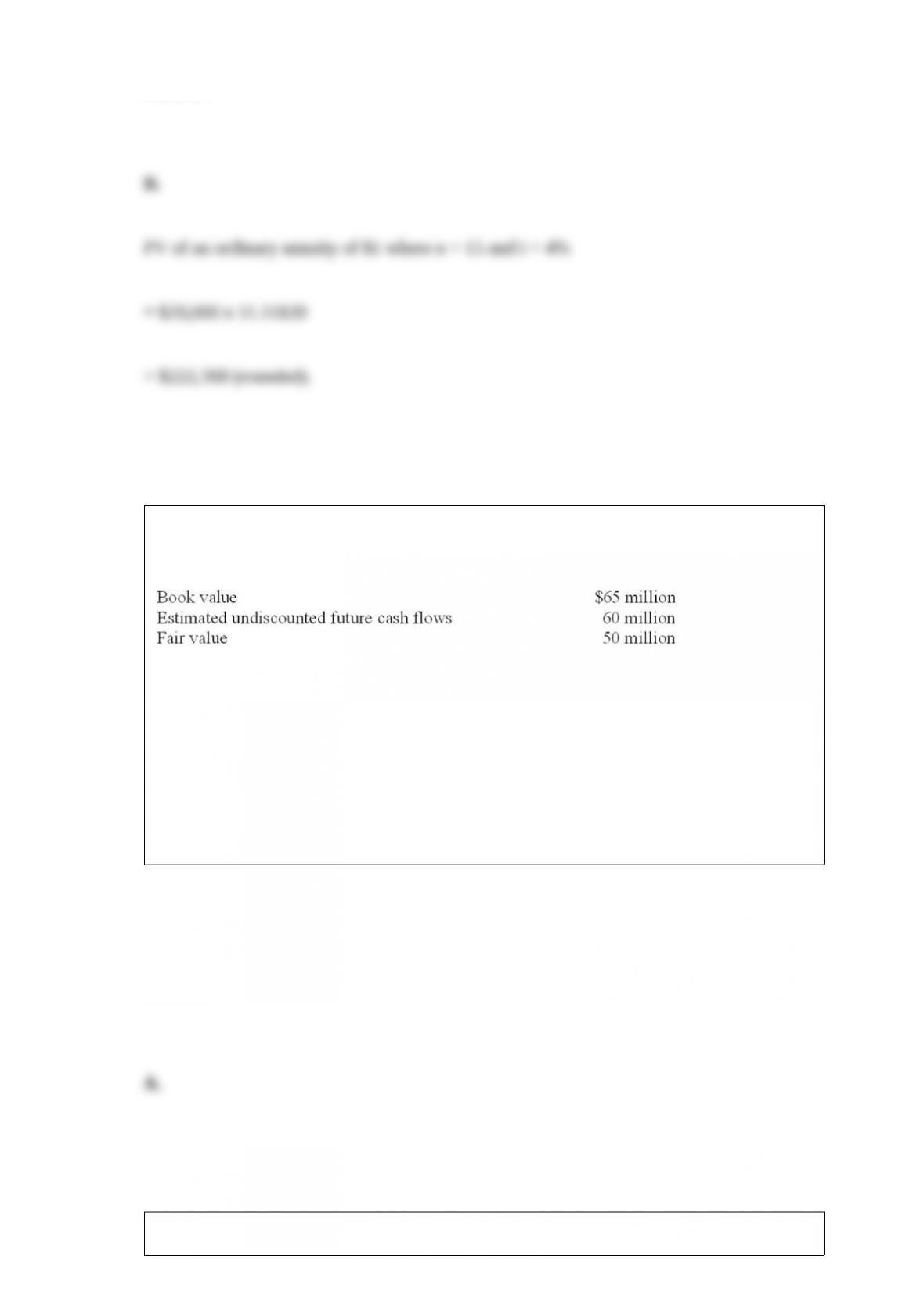
At the end of its 2013 fiscal year, a triggering event caused Janero Corporation to
perform an impairment test for one of its manufacturing facilities. The following
information is available:
The manufacturing facility is: A. Impaired because its book value exceeds undiscounted
future cash flows.
B. Not impaired because its book value exceeds undiscounted future cash flows.
C. Not impaired because it continues to produce revenue.
D. Impaired because its book value exceeds fair value.
Answer:
Listed below are 5 terms followed by a list of phrases that describe or characterize the

terms. Match each phrase with the correct term. 1)Accounts receivable
2)Operating cycle
3)Prepaid expenses
4)Adverse opinion
5)Working capital
A. Insurance premiums paid in advance.
B. Due to substantial reporting errors, qualified opinion is not appropriate.
C. Converting cash to inventory to receivables to cash.
D. Current assets minus current liabilities.
E. Due from customers in the ordinary course of business.
Answer:
Zero-coupon bonds: A. Offer a return in the form of a deep discount off the face value.
B. Result in zero interest expense for the issuer.
C. Result in zero interest revenue for the investor.
D. Are reported as shareholders’ equity by the issuer.
Answer:

When a tenant makes an end-of-period adjusting entry credit to the “Prepaid rent”
account: A. (S)he usually debits cash.
B. (S)he usually debits an expense account.
C. (S)he debits a liability account.
D. (S)he does none of the above.
Answer:
The following footnote appeared in a recent annual report to stockholders of Starbucks
Corporation: “Initial nonrefundable development fees required under licensing
agreements are recognized upon substantial performance of services for new market
business development activities, such as initial business, real estate, and store
development planning, as well as providing operational materials and functional
training courses for opening new licensed retail markets. Additional store licensing fees
are recognized when new licensed stores are opened.”
Briefly explain why Starbucks recognizes this type of revenue as it does.
Answer:
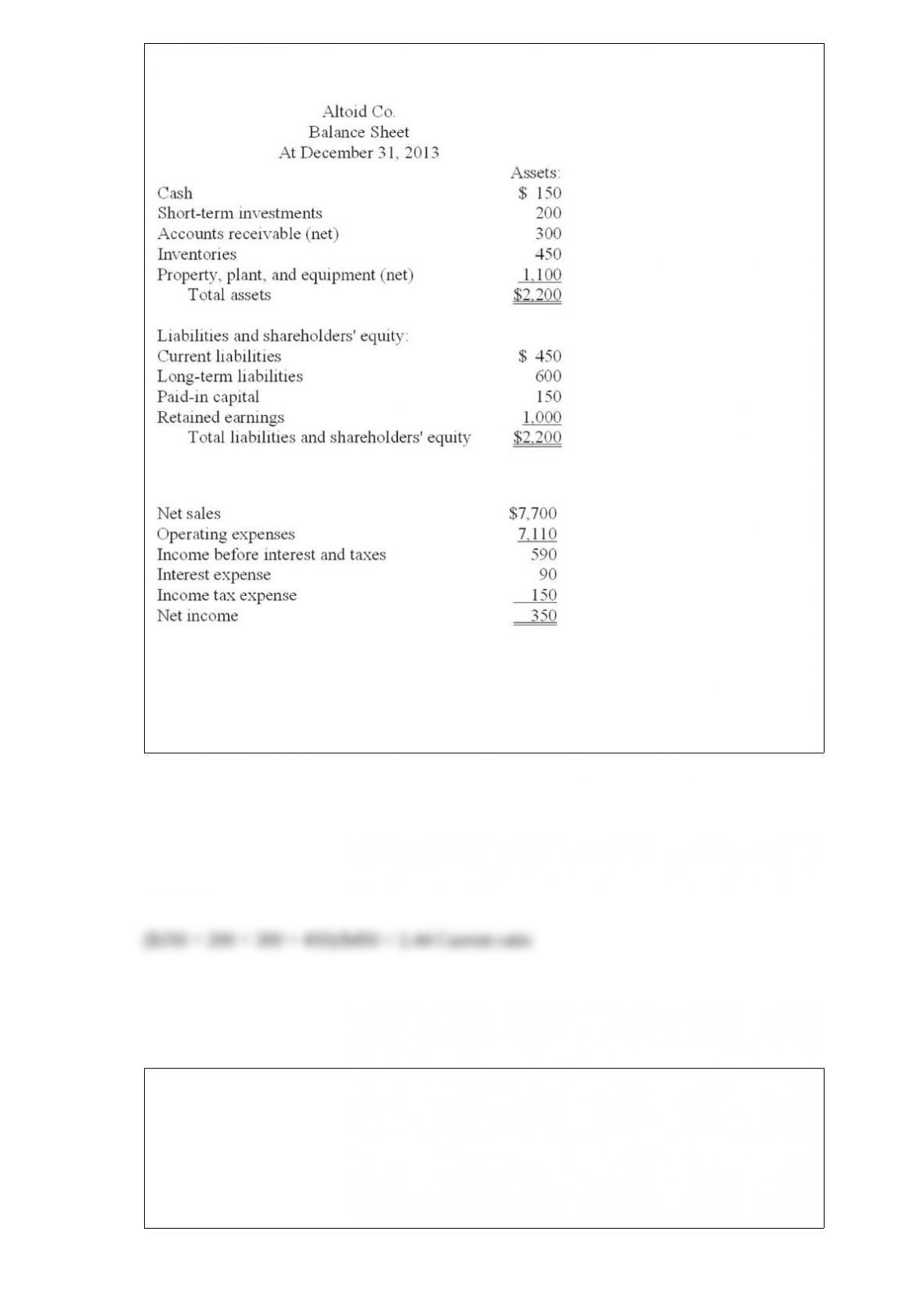
The balance sheet for Altoid Co. is shown below.
Selected 2013 income statement information for Altoid Co. includes:
Required:
Compute the following financial statement ratios for 2013:
Altoid Co.’s current ratio. Round your answer to two decimal places.
Answer:
Big Bear Company deals in distressed properties and makes high-risk sales. In 2012,
the company sold for $250,000 a piece of property that cost $150,000. The cost
recovery method was appropriately used. Collections on the sale were: $80,000 in 2012,
$120,000 in 2013, and $50,000 in 2014.
Required: Prepare journal entries to record the sale, cash collections, and recognition
of gross profit (if appropriate) in 2012, 2013, and
Answer:
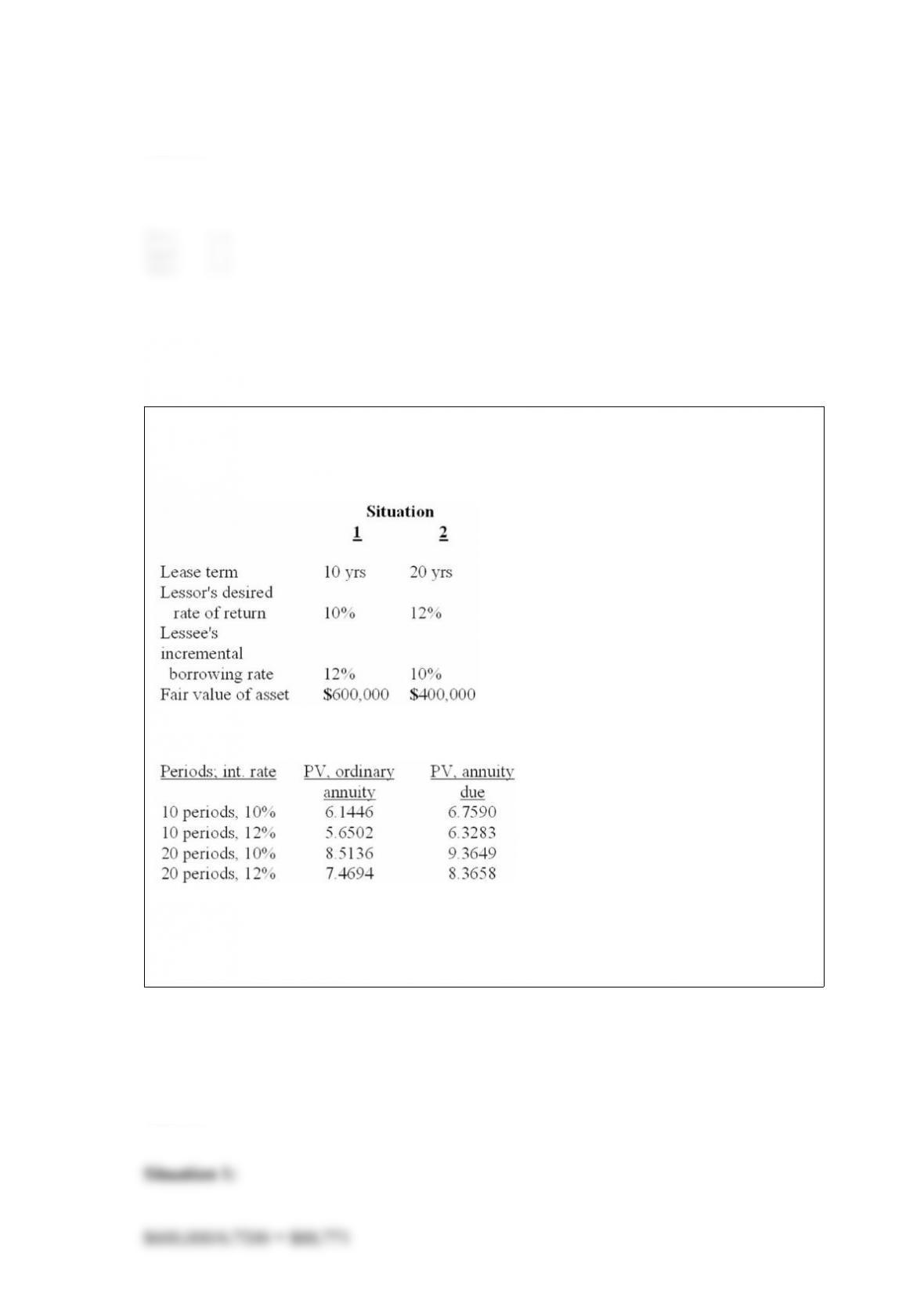
Each of the independent situations below describes a capital lease in which annual lease
payments are payable at the beginning of each year. The lessee is aware of the lessor’s
implicit interest rate.
For convenience, here are some table values:
Required:
For each situation determine the amount of the annual lease payment, as calculated by
the lessor.
Answer:

On January 1, 2013, American Corporation purchased 25% of the outstanding voting
shares of Short Supplies common stock for $210,000 cash. On that date, Short’s book
value and fair value were both $840,000. The equity method is deemed appropriate for
this investment. Short’s net income reported on December 31, 2013, was $80,000.
During 2013, Short also paid cash dividends in the amount of $24,000.
Required:
Compute the amount that would be reported for the investment on American
Corporation’s financial statements at December 31, 2013.
Answer:
Lugar Company purchased a piece of machinery for $30,000 on January 1, 2011, and
has been depreciating the machine using the sum-of-the-years’-digits method based on a
five-year estimated useful life and no salvage value. On January 1, 2013, Lugar decided
to switch to the straight-line method of depreciation. The salvage value is still zero and
the estimated useful life is changed to a total of six years from the date of purchase.
Ignore income taxes.
Required:
(1) Prepare the appropriate journal entry, if any, to record the accounting change.
(2) Prepare the journal entry to record depreciation for 2013.
Answer:
In the following question, inventory errors are noted for 2013. Assume that the errors
are not discovered until 2012, and that the company uses a periodic inventory system.
Indicate the effect of the error, if any, on the accounts noted in the columns, using the
following code:
U = Understated; O = Overstated; NE = No effect
Answer:

Ford Inc. exchanged land and $7,500 cash for material handling equipment. The land
had a book value of $75,000 and a fair value of $105,000. Assume the exchange has
commercial substance.
Required:
Prepare the journal entry to record the exchange.
Answer:
The condensed balance sheet and income statement for Marjoram Company are
presented below.

Compute the times interest earned ratio for Marjoram Company. Round your answer to
two decimal places.
Answer:
In its 20X4 annual report to shareholders, Maytag Corporation included the following
disclosures in its income statement and related footnotes:
CONSOLIDATED STATEMENTS OF INCOME
Special Charges and Loss on Securities
During the fourth quarter of 20X4, the Company recorded special charges and loss on
securities totaling $17.0 million, or $13.5 million after-tax. Special charges of $9.8
million, or $6.2 million after-tax, were associated with a salaried workforce reduction
of approximately 250 employees. Cash expenditures for 20X4 related to this charge
were $3.7 million. Loss on securities of $7.2 million resulted from the write-down of
the remaining investment in a privately held Internet-related company.
During the fourth quarter of 20X3, the Company recorded special charges and loss on
securities totaling $57.5 million, or $36.5 million after-tax. Special charges of $39.9
million, or $25.3 million after-tax, were associated with terminated product initiatives,
asset write-downs, and executive severance costs related to management changes. Loss
on securities of $17.6 million, or $11.2 million after-tax, resulted from a lower market

valuation of securities of TurboChef Technologies, Inc., and investments in privately
held Internet-related Companies .. The loss on securities charge of $17.6 million was
noncash.
Required:
Discuss the possible rationale behind the losses on securities reported by Maytag in
20X3 and 20X4.
Answer:
Bencorp issues a $90,000, 6-month, noninterest-bearing note that the bank discounted
at a 10% discount rate.
Required:
1) Prepare the appropriate journal entry to record the issuance of the note.
2) Determine the effective interest rate.
Answer:

In 2011, Quasar Ltd. acquired all of the common stock of Penlight Laser for $124
million. The fair value of Penlight’s identifiable tangible and intangible assets totaled
$205 million, and the fair value of liabilities assumed by Quasar was $95 million.
Quasar performed a required goodwill impairment test at the end of its fiscal year ended
December 31, 2013. Management has provided the following information:
Required:
1) Determine the amount of goodwill that resulted from the Penlight acquisition.
2) Determine the amount of goodwill impairment loss that Quasar should recognize at
the end of 2013, if any.
3) If an impairment loss is required, prepare the journal entry to record the loss.
Answer:
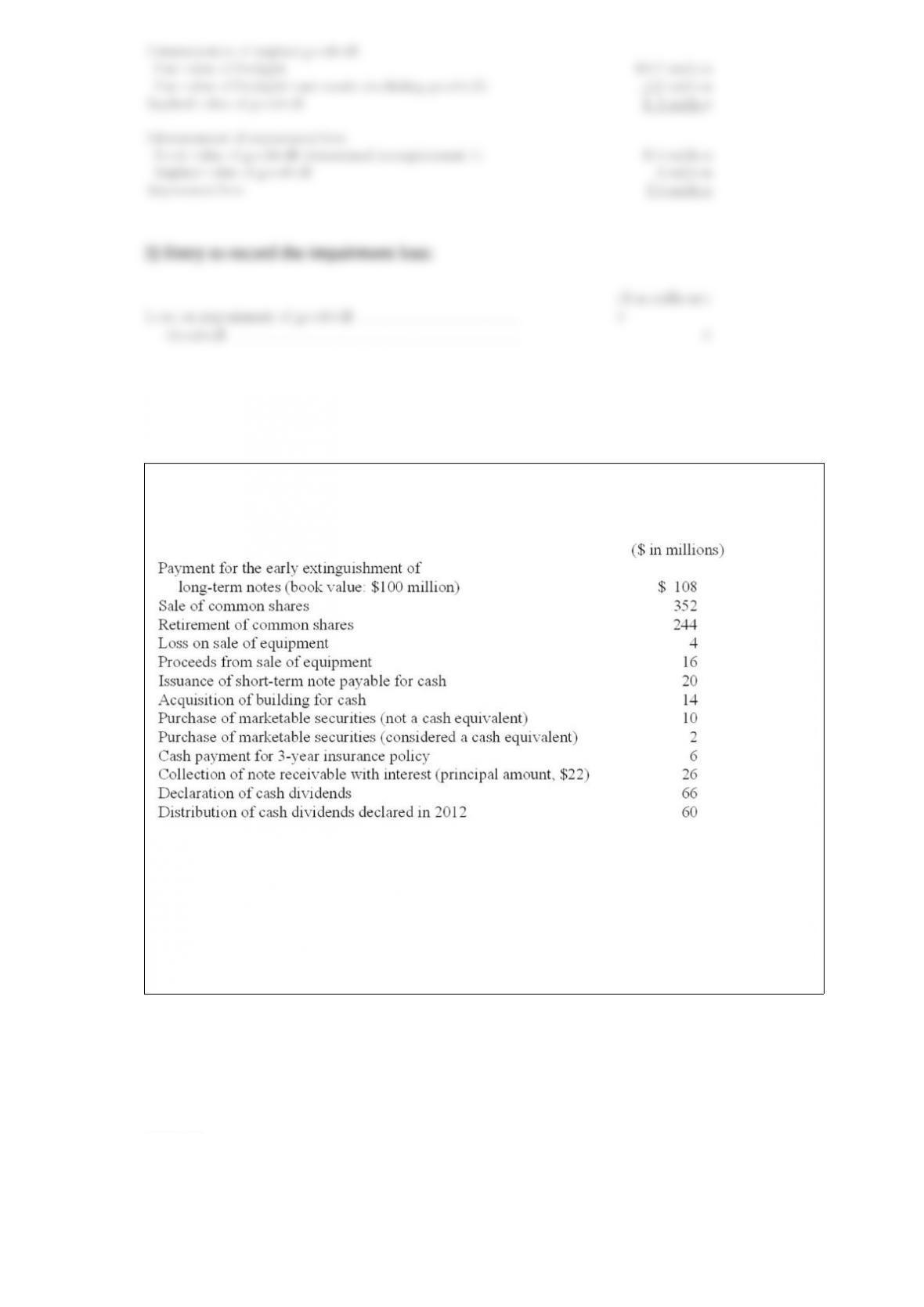
In preparation for developing its statement of cash flows for the year ended December
31, 2013, Millennium Solutions, Inc., collected the following information:
Required:
1) In Millennium’s statement of cash flows, what were net cash inflows (or outflows)
from investing activities for 2013?
2) In Millennium’s statement of cash flows, what were net cash inflows (or outflows)
from financing activities for 2013?
Answer:

Briefly explain the differences between U.S. GAAP and International Financial
Reporting Standards in accounting for research and development expenditures other
than software development costs.
Answer:
Pension plans typically require some minimum period of employment before benefits
vest. What is the 1974 federal law governing vesting (as well as other aspects of
pensions)? What are the vesting rules?
Answer: