1) The master budget process usually ends with:
A.The production budget.
B.The sales budget.
C.The selling expense budget.
D.The budgeted balance sheet.
E.The overhead budget.
2) Ultimate Sportswear has $100,000 of 8% noncumulative, nonparticipating, preferred
stock outstanding. Ultimate Sportswear also has $500,000 of common stock
outstanding. In the company’s first year of operation, no dividends were paid. During
the second year, the company paid cash dividends of $30,000. This dividend should be
distributed as follows:
A.$8,000 preferred; $22,000 common.
B.$16,000 preferred; $14,000 common.
C.$7,500 preferred; $22,500 common.
D.$15,000 preferred; $15,000 common.
E.$0 preferred; $30,000 common.
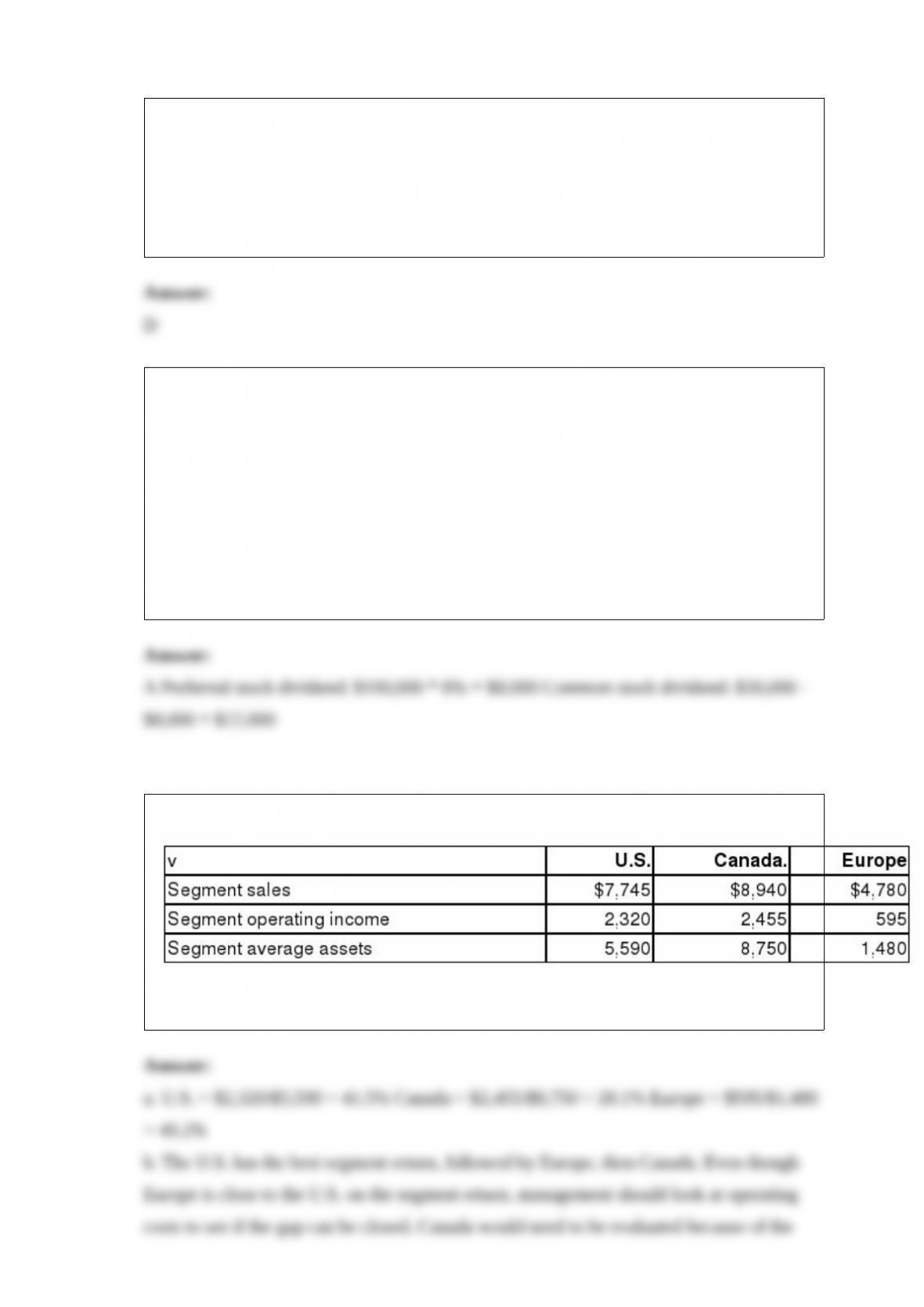
3) The following information is available for Napa, Inc. (all amounts are in millions):
a. Determine the segment return on assets for each geographic segment.
b. Comment on the results. How do the segments compare with respect to profitability?
4) On its December 31, 2014, balance sheet, Calgary Industries reports equipment of
$370,000 and accumulated depreciation of $74,000. During 2015, the company plans to
purchase additional equipment costing $80,000 and expects depreciation expense of
$30,000. Additionally, it plans to dispose of equipment that originally cost $42,000 and
had accumulated depreciation of $5,600. The balances for equipment and accumulated
depreciation, respectively, on the December 31, 2015 budgeted balance sheet are:
A.$328,000; $74,000.
B.$450,000; $98,400.
C.$450,000; $104,000.
D.$408,000; $104,000.
E.$408,000; $98,400.
5) Which of the following accounts could not be classified as a current liability?
A.Unearned revenues.
B.Accounts payable.
C.Notes payable (due in 11 months).
D.Current portion of long-term note payable.
E.Notes payable (due in 5 years).

6) On February 15, Jewel Company buys 7,000 shares of Marcelo Corp. common stock
at $28.53 per share plus a brokerage fee of $400. The stock is classified as
available-for-sale securities. On March 15, Marcelo Corp. declares a dividend of $1.15
per share payable to stockholders of record on April 15. Jewel Company received the
dividend on April 15 and ultimately sells half of the Marcelo Corp. stock on November
17 of the current year for $29.30 per share less a brokerage fee of $250. The journal
entry to record the sale of the 3,500 shares of stock on November 17 is:
A.Debit Cash $102,300; credit Long-Term Investments-AFS $99,855; credit Gain on
Sale of Long-Term Investments $2,445.
B.Debit Cash $102,550; credit Long-Term Investments-Trading $99,855; debit Gain on
Sale of Long-Term Investments $2,645.
C.Debit Cash $102,550; credit Long-Term Investments-AFS $100,055; credit Gain on
Sale of Long-Term Investments $2,495.
D.Debit Cash $102,300; credit Long-Term Investments-AFS $100,055; credit Gain on
Sale of Long-Term Investments $2,245.
E.Debit Cash $102,550; credit Long-Term Investments-Trading $99,855; credit Gain on
Sale of Long-Term Investments $2,645.
7) A cost that cannot be avoided or changed because it arises from a past decision, and
is irrelevant to future decisions, is called a(n):
A.Uncontrollable cost.
B.Incremental cost.
C.Opportunity cost.
D.Out-of-pocket cost.
E.Sunk cost.
8) Total manufacturing costs incurred during the year do not include:
A.Direct materials used.
B.Factory supplies used.
C.Work in Process inventory, beginning balance.
D.Direct labor.
E.Depreciation of factory machinery.
9) Yeats Corporation’s sales in Year 1 were $396,000 and in Year 2 were $380,000.
Using Year 1 as the base year, the percentage change for Year 2 compared to the base
year is:
A.104%.
B.100%.
C.4%.
D.96%.
E.4.2%.
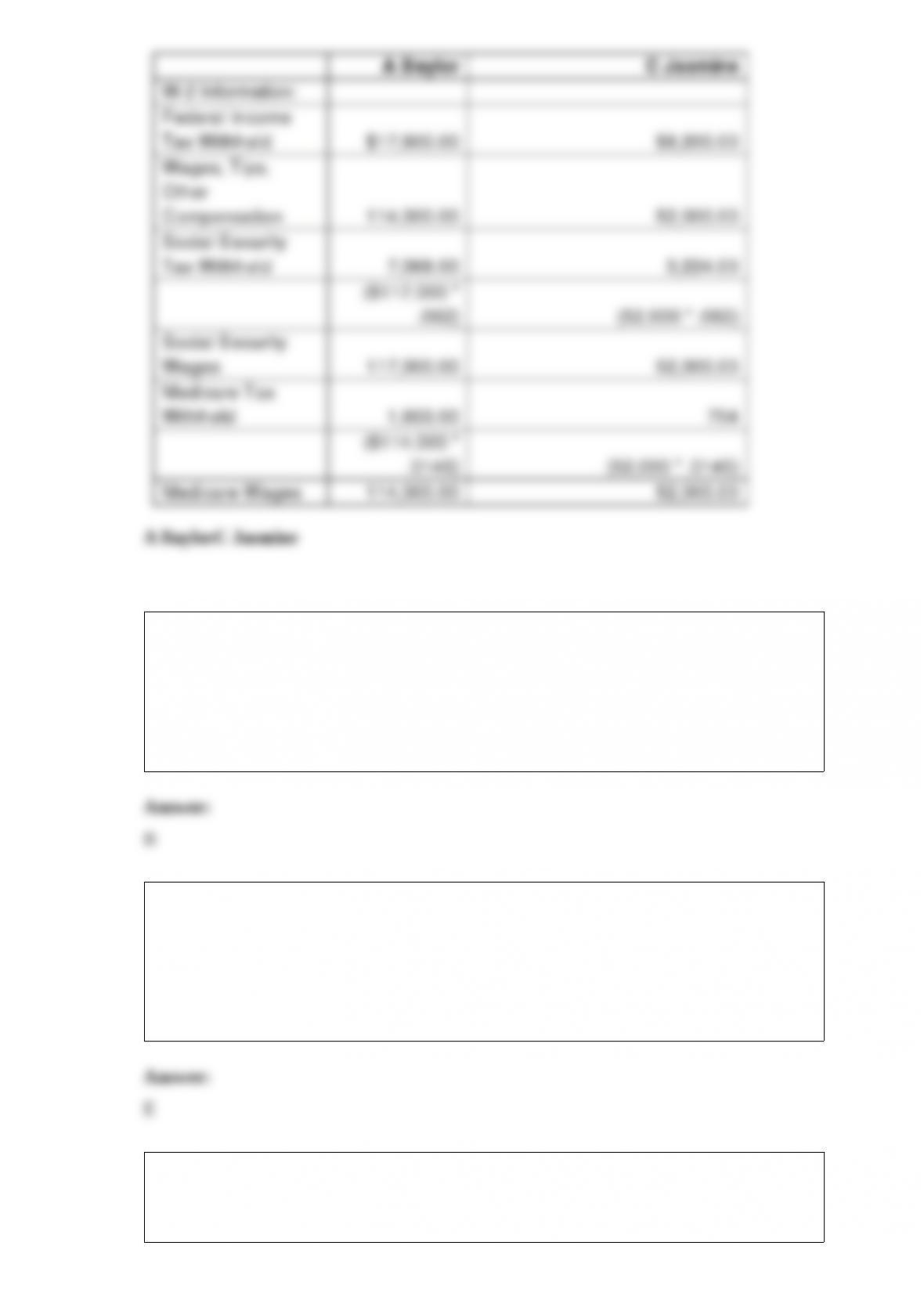
10) A company’s employer payroll tax rates are 0.6% for federal unemployment taxes,
5.4% for state unemployment taxes, 6.2% for FICA social security taxes on earnings up
to $117,000, and 1.45% for FICA Medicare taxes on all earnings. Compute the W-2
Wage and Tax Statement information required below for the following employees:
11) Costs that are capitalized as inventory when they are incurred are called:
A.Period costs.
B.Product costs.
C.General costs.
D.Administrative costs.
E.Fixed costs.
12) A disadvantage of bond financing is:
A.Bonds do not affect owners’ control.
B.Interest on bonds is tax deductible.
C.Bonds can increase return on equity.
D.It allows firms to trade on the equity.
E.Bonds pay periodic interest and the repayment of par value at maturity.
13) The following data has been collected about Keller Company’s stockholders’ equity
accounts:
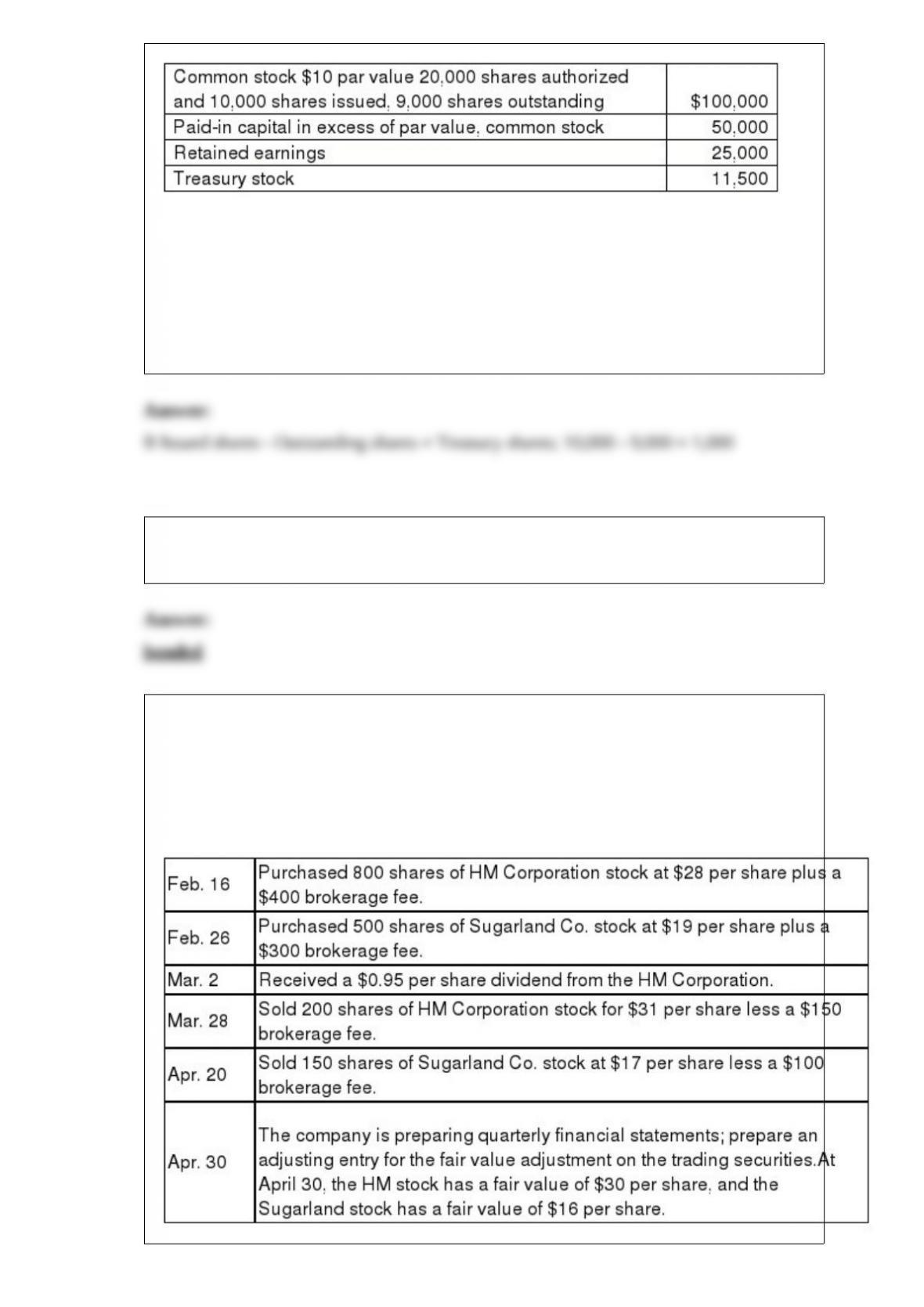
Assuming the treasury shares were all purchased at the same price, the number of
shares of treasury stock is:
A.1,150.
B.1,000.
C.575.
D.11,000.
E.21,000.
14) When a company purchases an insurance policy against losses from theft by an
employee, that employee is ________________.
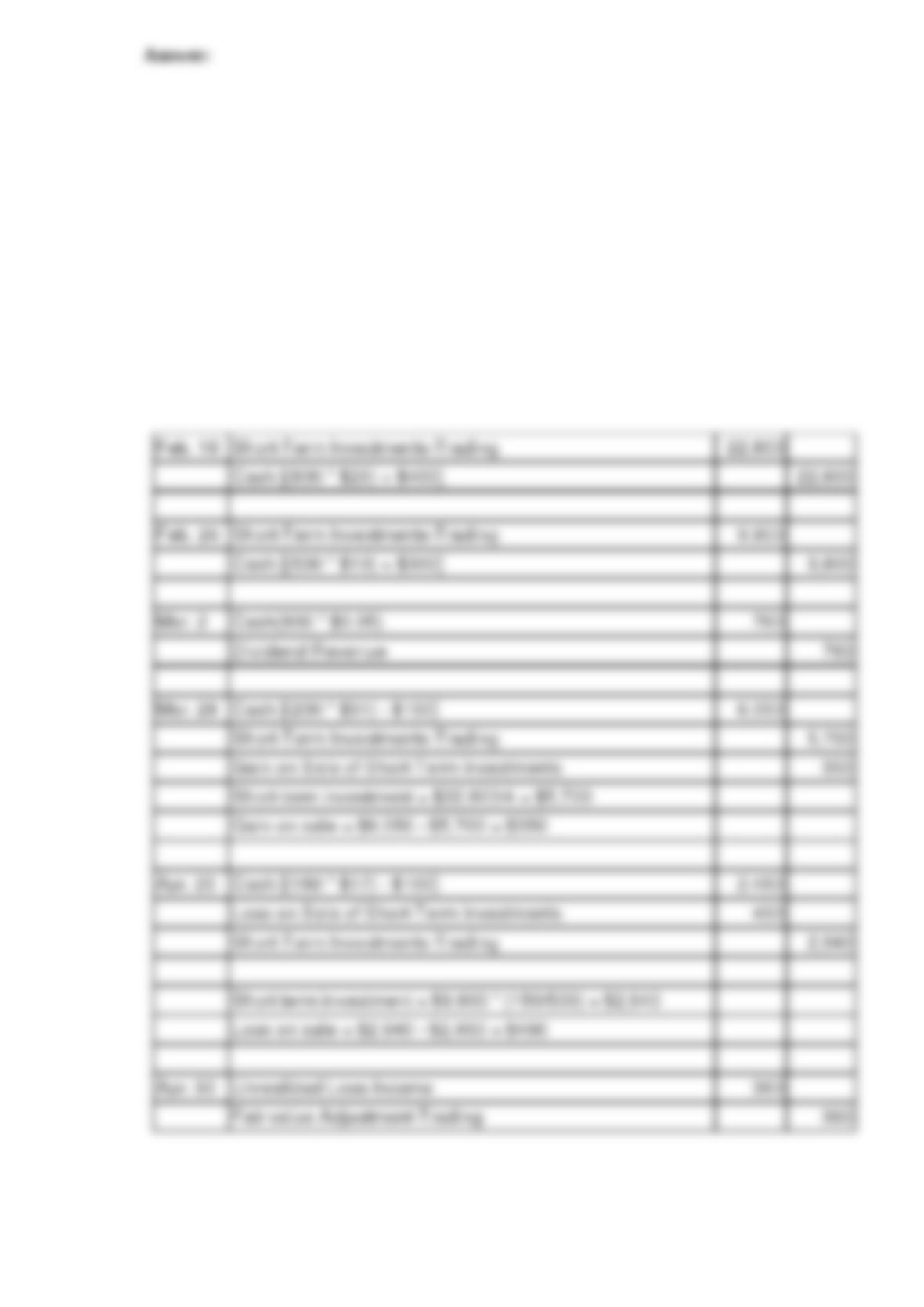
15) Mire Corporation had the following transactions involving investments in trading
securities during the year. Prior to these transactions, Mire had never had any
investments in trading securities. Prepare the required general journal entries to record
these transactions.
16) A corporation had current year net income of $237,500. It paid preferred dividends
of $40,000 cash and had 480,000 weighted-average shares of common stock
outstanding. Calculate the corporation’s earnings per share.
17) A corporation paid a cash dividend of $0.85 per share during the current year. It had
1,550,000 common shares outstanding at year-end, its current year earnings per share
was $3.45, and the stock’s year-end market price was $10.63 per share. Calculate the
company’s dividend yield.
18) At least one partner having a debit balance in his/her capital account at the point of
the final distribution of cash is known as a _________________________.
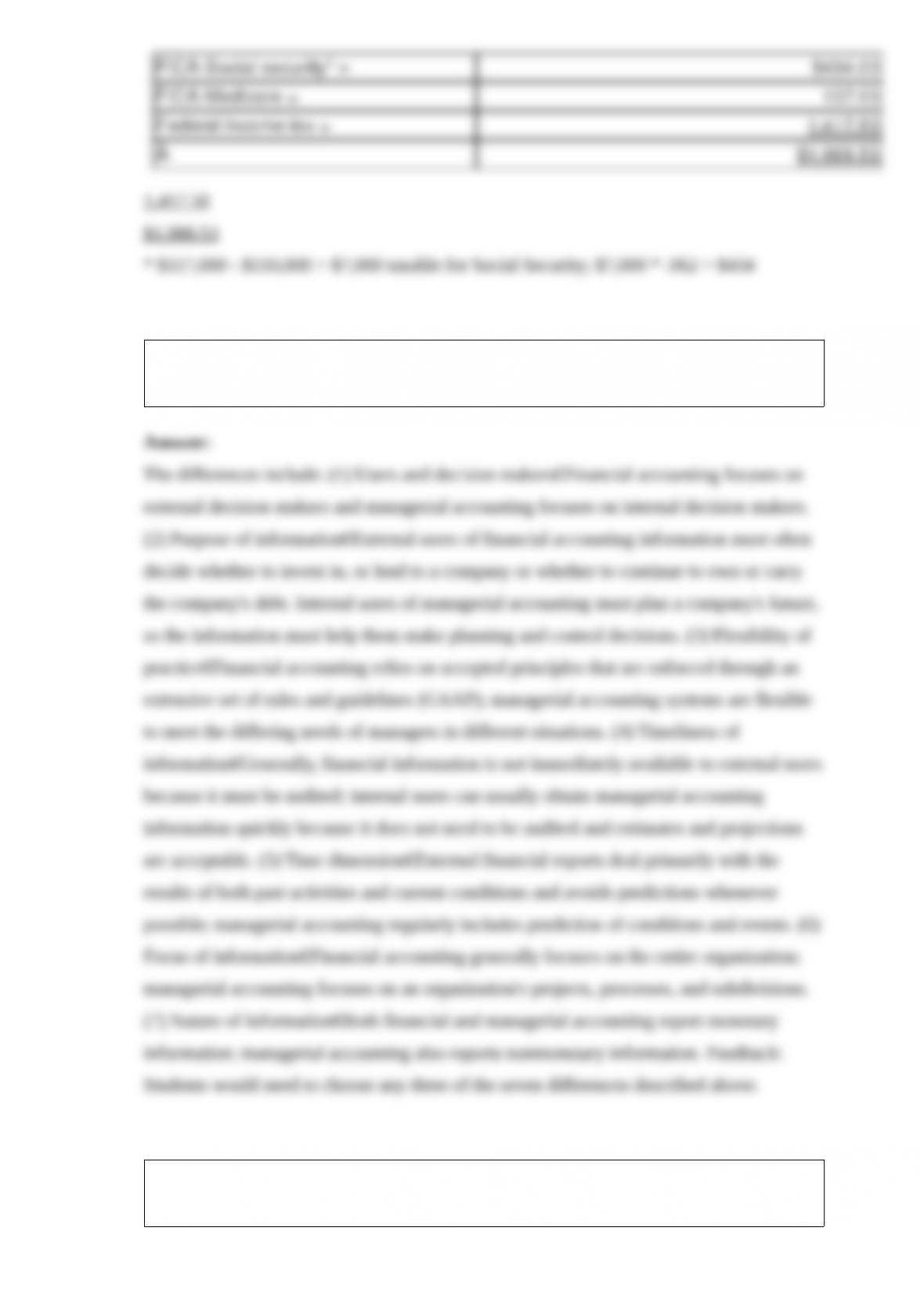
19) An employee earns $9,450 for the current period. The cumulative earnings of
previous pay periods is $110,000. Social security tax applies to the first $117,000 of
employee earnings. Calculate the total and individual amounts to be withheld for social
security (6.2%), Medicare (1.45%) and federal income tax (15%).
20) There are many differences between financial and managerial accounting. Identify
and explain at least three of these differences.
21) The difference between the amount borrowed and the amount repaid is referred to
as _______________.