
1) coaster manufactures and sells logging equipment. due to the nature of its business,
coaster is unable to reliably predict bad debts. during 2012, coaster sold equipment
costing $3,600,000 for $5,400,000. the terms of the sale were 20% down, with equal
payments due quarterly over the next 3 years. all payments for 2012 were made on
schedule. round answers to two places.
assuming that coaster uses the cost-recovery method of accounting for its installment
sales, what amount of realized gross profit will coaster report in its income statement
for the year ended december 31, 2013?
a.$0
b.$ 360,000
c.$ 475,200
d.$1,440,000
2) sun inc. factors $3,000,000 of its accounts receivables without recourse for a finance
charge of 5%. the finance company retains an amount equal to 10% of the accounts
receivable for possible adjustments. sun estimates the fair value of the recourse liability
at $115,000. what would be recorded as a gain (loss) on the transfer of receivables?
a.loss of $150,000
b.gain of $265,000
c.loss of $565,000
d.loss of $115,000
3) on july 1, 2012, nall co. issued 2,500 shares of its $10 par common stock and 5,000
shares of its $10 par convertible preferred stock for a lump sum of $140,000. at this
date nall’s common stock was selling for $24 per share and the convertible preferred
stock for $18 per share. the amount of the proceeds allocated to nall’s preferred stock
should be
a.$70,000
b.$84,000
c.$90,000
d.$77,000
4) a machine cost $360,000, has annual depreciation of $60,000, and has accumulated
depreciation of $270,000 on december 31, 2012. on april 1, 2013, when the machine
has a fair value of $82,500, it is exchanged for a machine with a fair value of $405,000
and the proper amount of cash is paid. the exchange lacked commercial substance.
the new machine should be recorded at
a.$322,500
b.$367,500
c.$397,500
d.$405,000
5) for a nonmonetary exchange of plant assets, accounting recognition should not be
given to
a.a loss when the exchange has no commercial substance
b.a gain when the exchange has commercial substance
c.part of a gain when the exchange has no commercial substance and cash is paid (cash
paid/received is less than 25% of the fair value of the exchange)
d.part of a gain when the exchange has no commercial substance and cash is received
(cash paid or received is less than 25% of the fair value of the exchange)
6) napier co. provided the following information on selected transactions during 2013:
proceeds from issuing bonds1,000,000purchases of inventory1,900,000purchases of
treasury stock300,000loans made to affiliated corporations700,000dividends paid to
preferred stockholders200,000proceeds from issuing preferred stock800,000proceeds
from sale of equipment100,000
the net cash provided (used) by investing activities during 2013 is
a.$100,000
b.$(600,000)
c.$(1,100,000)
d.$(2,500,000)
7) mitchell corporation prepared the following reconciliation for its first year of
operations:
the temporary difference will reverse evenly over the next two years at an enacted tax
rate of 40%. the enacted tax rate for 2013 is 35%.
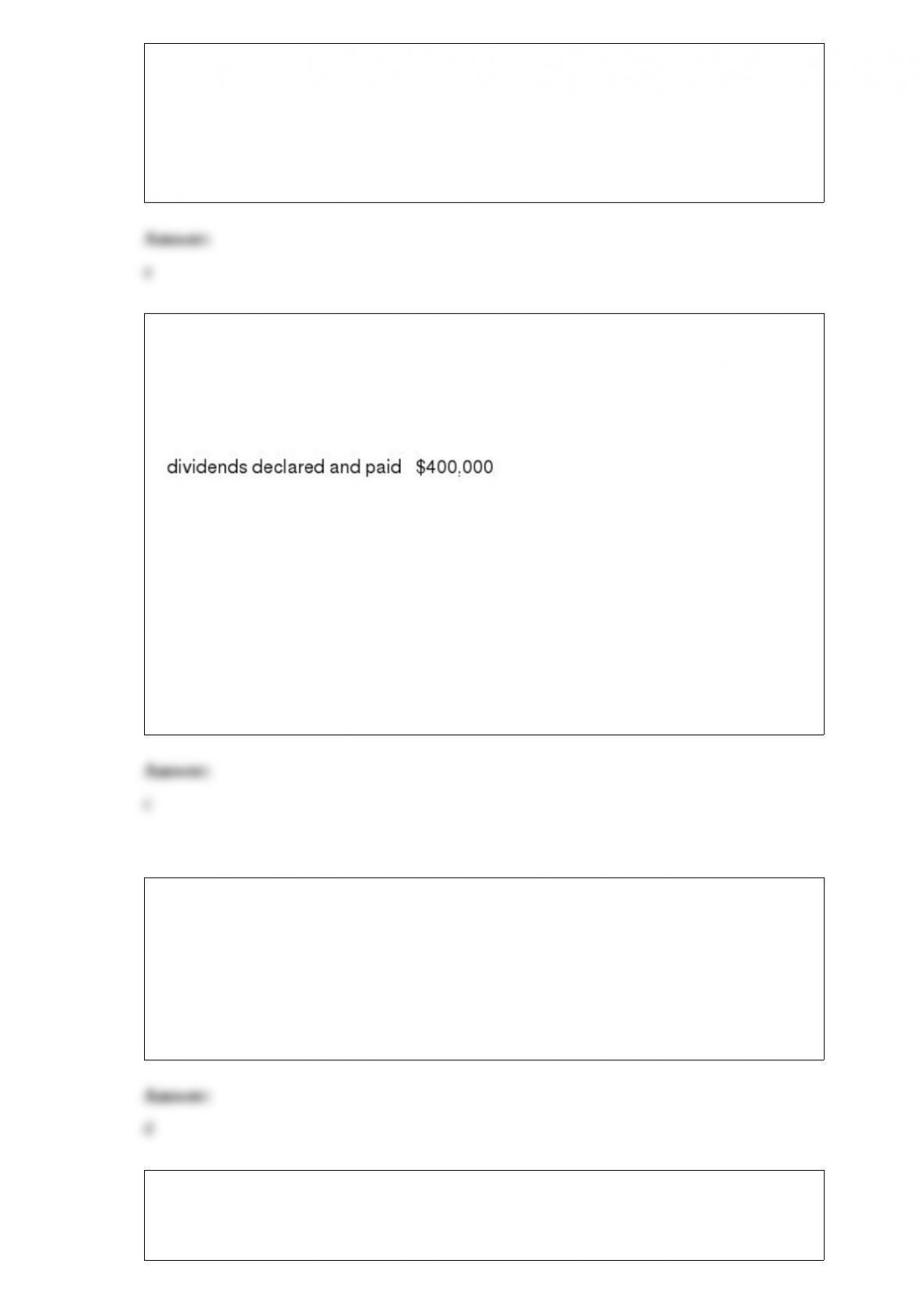
what amount should be reported in its 2013 income statement as the deferred portion of
income tax expense?
a.$50,000 debit
b.$90,000 debit
c.$50,000 credit
d.$70,000 credit
8) haystack, inc. owns 30% of the outstanding stock of hallmark, inc. and accordingly
uses the equity method to account for its investment. the stock was purchased on
january 1, 2013 for $780,000. during the year ended december 31, 2013, hallmark, inc.
reported the following:
net income 2,400,000
haystack, inc. uses the fifo method for costing its inventories, while hallmark, inc. uses
the lifo method to conform with other companies in its industry. haystack, inc.
determines that if hallmark, inc. had used the fifo method, its income would have been
$350,000 higher during 2013. what is the balance in the investment in hallmark, inc.
that will be reported on haystack, inc.s balance sheet at december 31, 2013 assuming
haystack, inc. follows ifrs for its external financial reporting?
a.$1,725,000
b.$1,380,000
c.$1,485,000
d.$1,275,000
9) tipson corporation will invest $15,000 every january 1st for the next six years (2012
2017). if linton will earn 12% on the investment, what amount will be in the investment
fund on december 31, 2017?
a.$61,671
b.$69,072
c.$121,728
d.$136,335
10) the single-step income statement emphasizes
a.the gross profit figure
b.total revenues and total expenses
c.extraordinary items and accounting changes more than these are emphasized in the
multiple-step income statement
d.the various components of income from continuing operations
11) in situations where there is a rapid turnover, an inventory method which produces a
balance sheet valuation similar to the first-in, first-out method is
a.average cost
b.base stock
c.joint cost
d.prime cost
12) the issuer of a 5% common stock dividend to common stockholders preferably
should transfer from retained earnings to contributed capital an amount equal to the
a.fair value of the shares issued
b.book value of the shares issued
c.minimum legal requirements
d.par or stated value of the shares issued
13) a graph is set up with “yearly depreciation expense” on the vertical axis and “time”
on the horizontal axis. assuming linear relationships, how would the graphs for
straight-line and sum-of-the-years’-digits depreciation, respectively, be drawn?
a.vertically and sloping down to the right
b.vertically and sloping up to the right
c.horizontally and sloping down to the right
d.horizontally and sloping up to the right
14) jordan co. purchased ten-year, 10% bonds that pay interest semiannually. the bonds
are sold to yield 8%. one step in calculating the issue price of the bonds is to multiply
the principal by the table value for
a.10 periods and 10% from the present value of 1 table
b.10 periods and 8% from the present value of 1 table
c.20 periods and 5% from the present value of 1 table
d.20 periods and 4% from the present value of 1 table
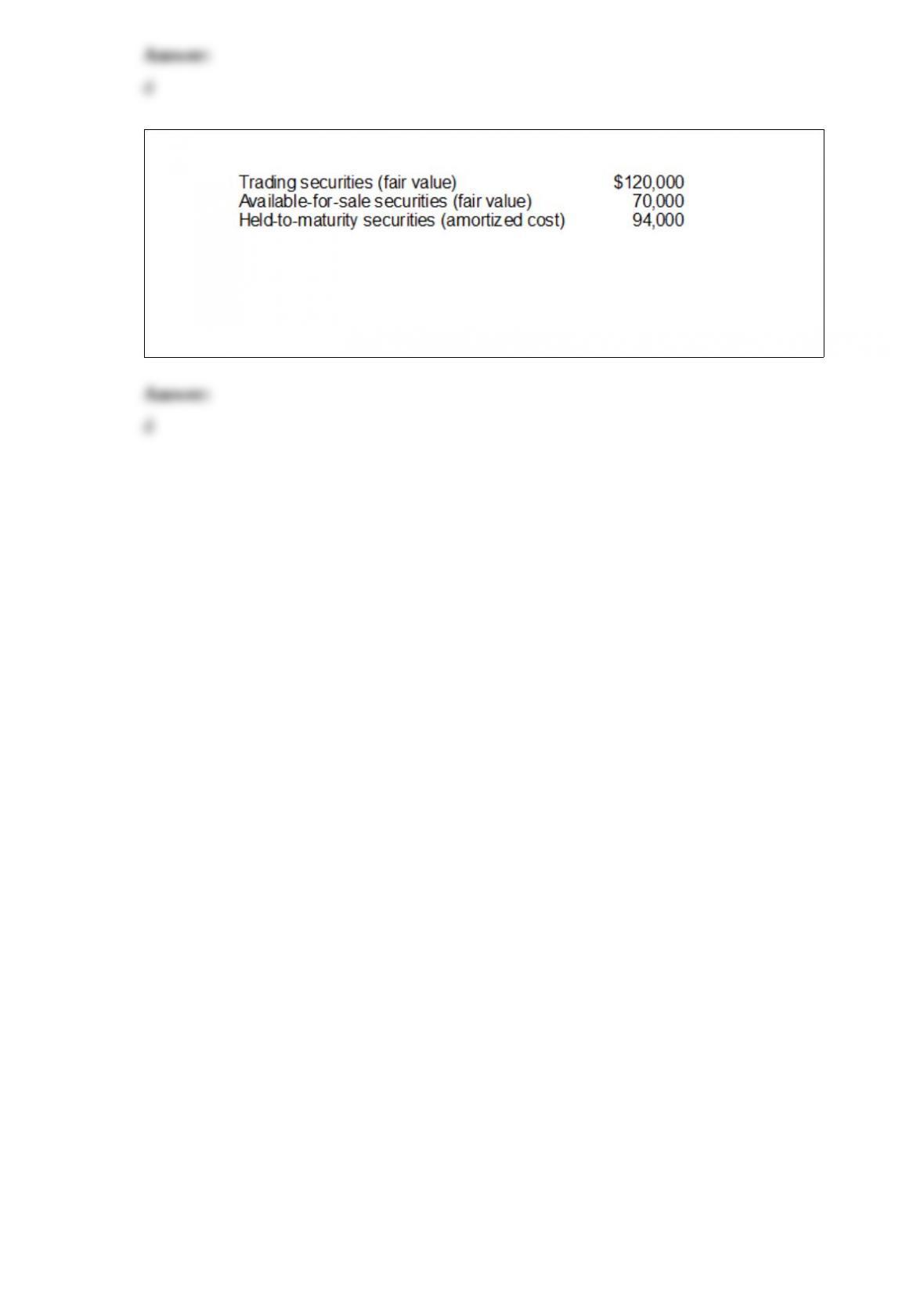
15) kohler company owns the following investments:
kohler will report securities in its long-term investments section of
a.exactly $190,000
b.exactly $214,000
c.exactly $284,000
d.$164,000 or an amount less than $164,000, depending on the circumstances