
PA firm has been auditing Big Manufacturing Company (BMC) for several years. Last
year, BMC converted its inventory and purchasing systems to a new system effective
December 31, the date of the year end. To their horror, the PA firm discovered at the
beginning of the current error that there was a cut-off error in the accounts payable
system of $25 million dollars LAST YEAR. Neither the client nor the firm had detected
that the purchases of December 31 had been omitted from the old computer system
transaction processing and had been recorded only in the new computer system,
understating last year’s expenses. Last year’s financial statements have been restated and
the error disclosed in the notes to both last year’s and this year’s financial statements.
What type of audit opinion will BMC receive this year?
A) Qualified
B) Disclaimer
C) Adverse
D) Unqualified
You generally consider your audit client’s management to be honest. However, they do
have a bias towards wanting to understate their income to lower income taxes. How
would this bias be implemented in the audit risk model?
A) reduce audit risk and reduce inherent risk
B) increase audit risk and reduce inherent risk
C) reduce audit risk and increase inherent risk
D) increase audit risk and increase inherent risk

An important consideration in evaluating the fairness of the amounts accrued for
vacation pay, sick pay, and other benefits is the
A) consistent accrual of these liabilities relative to those of the preceding year.
B) actual expense incurred for the prior period.
C) amount expended to date in the current period.
D) profitability of the client which will enable these liabilities to be met.
Thermos Inc. is having its financial statements audited by Pilott & Levy, a PA firm.
Leon Levy is the auditor in charge of the audit. The accountable party in this assurance
engagement is
A) Leon Levy.
B) Pilott & Levy.
C) management of Thermos Inc.
D) the board of directors of Thermos Inc.
If from last year to the current year’s audit, inherent risk has stayed constant, but control
risk is higher (it is more likely that controls do not detect material errors), what is the

likely effect on detection risk? Detection risk will
A) increase.
B) decrease.
C) stay the same.
D) need less documentation.
If all other factors specified in a sampling plan remain constant, changing the estimated
population exception rate (EPER) from 2% to 4% would cause the required sample size
to
A) increase.
B) remain the same.
C) decrease.
D) become indeterminate.
It is management’s responsibility to select the accounting policies that are used in the
preparation of the financial statements. What is the auditor’s responsibility with respect
to these accounting policies?
A) approve the accounting policies that are used, so that an opinion can be stated on the

fairness of the financial statements
B) evaluate the appropriateness of the accounting policies that are used and of the
associated estimates made
C) tell management which accounting policies should be selected, so that accurate
estimates can be made for year end adjustments
D) recalculate the estimates that are used for the accounting policies (such as bad debt
allowance and warranty expenses)
One of the purposes of developing a client risk profile is to assist the auditor in
A) developing the pertinent audit procedures for tests of internal controls.
B) assessing the client’s business risk.
C) locating related parties that need to be disclosed.
D) deciding whether fraud or illegal acts have taken place.
The extent and the scope of the audits conducted by Auditors General are determined
by
A) legislation in the Auditor General’s jurisdiction.
B) audit partner planning audit program development.

C) the Auditor General and his/her staff.
D) the financial statement auditors of the client.
A PA firm can experience high levels of business risk if the audit firm
A) does a poor job on preparing client risk profiles.
B) pays its employees wages that are not in line with the market.
C) has clients that do not pay their bills, or experiences significant litigation.
D) has a generous vacation policy for its staff.
The sample exception rate equals the number of
A) exceptions in the population divided by the sample size.
B) items in the population multiplied by the number of exceptions in the sample.
C) exceptions in the sample divided by the sample size.
D) exceptions in the population divided by the population size.
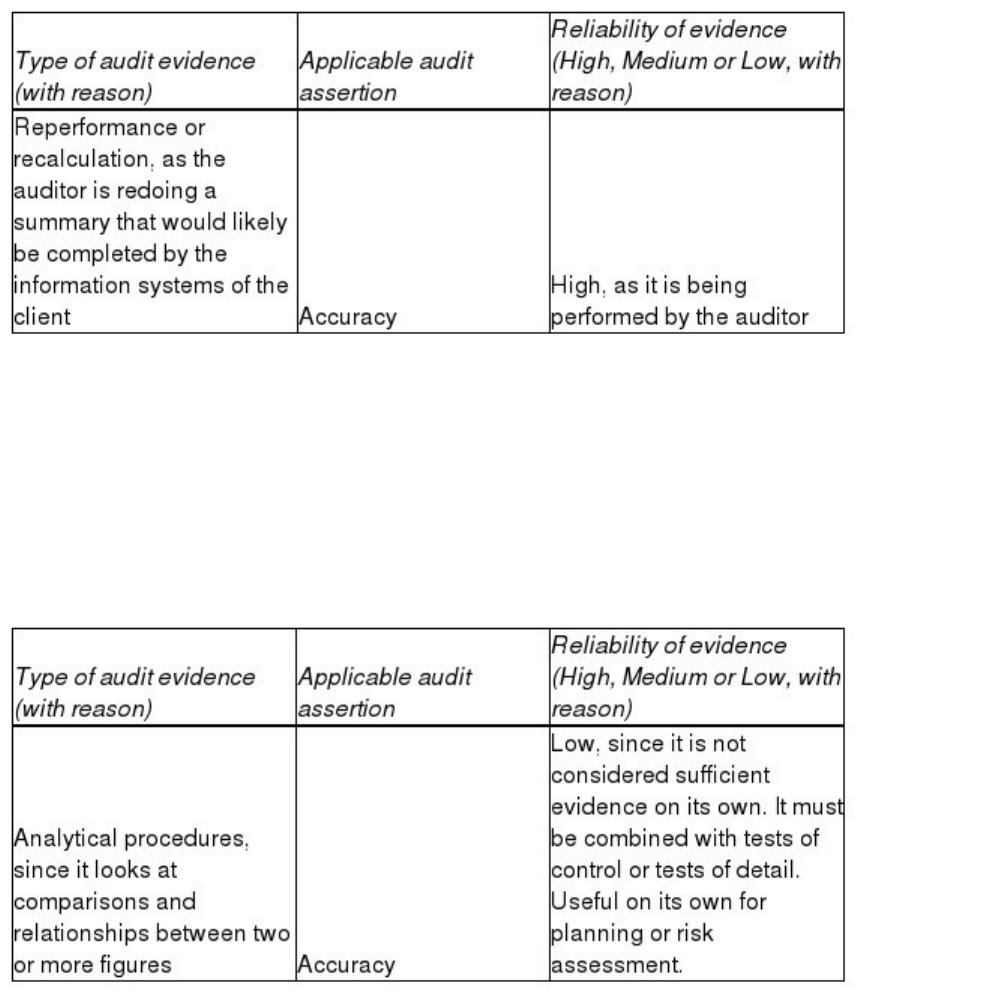
For each of the following audit procedures, state and describe the type of audit
evidence, state the audit assertion that it applies to, and describe the reliability of the
evidence (with reasons).
A) Watch staff scan products and enter cash received.
B) Reconcile daily cash drawer receipts (cash, debit card sales, credit card sales) with
daily sales for one week.
C) Calculate daily gross profit and gross profit by product line.
D) Account for a sequence of sales documents.

Dishware Distribution Limited uses average costing to cost its inventory. It keeps a
perpetual inventory file that is linked to its sales systems. It orders inventory in for
specific customers as needed, and traditionally has a slow time just before its year end.
Accordingly, inventory at the yearend is about $2,000, while materiality is about
$30,000. How should the auditor approach the audit of physical inventory?
A) exclude testing of physical inventory from the audit program
B) use attribute sampling to select a sample of items to count
C) use dollar unit sampling to select a sample of items to count
D) count only those items that have a dollar value in excess of $100
Which of the following is an important purpose of an organizational code of ethics and
the associated processes to ensure adherence?
A) make sure that there are no fraudulent or illegal transactions at the company
B) train employees in acceptable conduct at the organization

C) keep unethical employees from acting out unacceptable behaviour
D) provide a powerful signal of acceptable organizational conduct
Four different engagements that the auditor can complete are: compilation,
bookkeeping, audit and review. Rank these engagements with respect to the level of
assurance provided from highest assurance level to lowest assurance level.
A) audit, review, compilation, bookkeeping
B) audit, compilation, review, bookkeeping
C) review, audit, compilation, bookkeeping
D) review, audit, bookkeeping, compilation
Otto decided to outsource the payroll function to Magna Plus. The controller of Otto
should still
A) recalculate the payroll and its remittance to ensure accuracy.
B) review and authorize each individual payments to employees.
C) review the payroll journal and compare the total hours worked with the payroll time
records.

D) inquire with the manager of Magna Plus if they suspect any unusual transaction.
Individuals who accept fees (or property), should they know or be willfully blind to the
fact that the property was obtained illegally can be charged with money laundering, a
criminal offence. Which of the following techniques will help a PA prevent such
charges?
A) ensure that the financial statements are in accordance with an acceptable reporting
framework
B) require that clients carefully document the sources of their funds.
C) carefully assess management integrity.
D) obtain a detailed letter of representation from management confirming the sources of
their funds.
In connection with the examination of financial statements, an auditor could be
responsible for failure to detect a material fraud if
A) statistical sampling techniques were not used on the audit engagement.
B) the auditor planned the work in a hasty and ineffective manner.
C) accountants performing important parts of the work failed to discover a close
relationship between the treasurer and the cashier.

D) the fraud was perpetrated by one client employee, who circumvented the existing
internal controls.
There are many elements of quality control at the firm level. Which element does
“adequate hiring policies (and documentation of their implementation) that ensure
competence and integrity of personnel should be in place” belong to?
A) leadership and responsibilities within the firm
B) independence
C) general human resource policies
D) extent of professional development
ABC Company has requested PA to prepare prospective financial information to assist
with the acquisition of a bank loan. The prospective financial information is being
prepared using management’s best estimate of future sales and expenses. The type of
information being prepared is a(n)
A) forecast.
B) projection.
C) prospective financial statement.
D) prospectus.

When auditing contingent liabilities, the primary objective at the initial stage of the
tests is to determine
A) the materiality of any liability.
B) what constitutes adequate disclosure of the liability.
C) the likelihood of the liability.
D) the existence of the liability.
A common inventory observation procedure is to select a random sample of tag
numbers and identify the tag with that number attached to the actual inventory. The
audit objective being achieved by this procedure is
A) inventory as recorded on tags exists (existence).
B) existing inventory is counted and tagged (completeness).
C) inventory is counted accurately (accuracy).
D) inventory is classified correctly (classification).

The auditor would like to test the existence and accuracy of the transfer of goods from
the raw materials storeroom to the manufacturing assembly lines. Which of the
following audit procedures should be used?
A) conduct a variance analysis of the costs associated with manufacturing, looking for
gross profit fluctuations
B) account for a sequence of raw material requisitions, examining details and looking
for proper approvals
C) look at overtime records to determine the amount and timing of overtime hours used
in the manufacturing process
D) inquire of the inventory custodian with respect to procedures used to transfer raw
materials to the production line
When a misstatement in the financial statements exists but is unlikely to affect the
decisions of a reasonable user, it would be appropriate to issue
A) an unqualified opinion.
B) a qualified opinion.
C) a disclaimer of opinion.
D) an adverse opinion.

Which one of the following would be a signal as to possible problems with
management integrity?
A) reliance on debt rather than equity for financing permanent assets
B) rotation of holidays in the supervisory area over a period of months
C) rapidly declining profits or increasing losses over a period of years
D) frequent disagreements with regulators and the Canada Revenue Agency
Tests of details for notes payable interest expense and accrued interest can frequently be
eliminated when
A) tests of controls are conducted over authorization and recording procedures.
B) notes are issued by a person independent of the accounting department.
C) the notes payable schedule indicates that all notes have been repaid.
D) results of analytical review are favourable.

A) Assuming the client’s internal controls are adequate, describe how the auditor can
verify proper cutoff of sales transactions.
B) Describe how the auditor tests the rights objective for accounts receivable.
In order to assess if a company is a going concern, the auditor can calculate which of
the following ratios during the audit planning and compare with previous years and
successful companies in the industry?
A) debt to equity ratio
B) accounts receivable turnover ratio
C) percent of interest expense to sales
D) inventory turnover ratio

The auditor must verify whether the physical counts were correctly summarized, the
inventory quantities and prices were correctly extended, and the extended inventory
was correctly footed. These tests are called
A) price tests.
B) compilation tests.
C) cost tests.
D) mechanical tests.
The auditor has selected a sequence of 200 payroll cheques to verify the numerical
continuity of the cheque numbers. What type of sampling is the auditor doing?
A) haphazard
B) systematic
C) directed
D) block
Your client is not using either ASPE or IFRS. Instead, it is using current value
accounting with no use of historical cost, because your client is in a country with about
50% inflation per year. Local legislation requires that all resident organizations use
current value accounting. How do these events affect the independent auditors report?

The auditor would
A) issue a standard unqualified auditor’s report.
B) use an Emphasis of Matter paragraph to explain that the financial statements are
prepared in accordance with local legislation.
C) use an Other Matter paragraph to explain that the financial statements are prepared
in accordance with local legislation.
D) state in the opinion paragraph that the financial statements were prepared in
accordance with the local legislation.