
Audit sampling is commonly used for which type of audit evidence?
A. Reperformance.
B. Analytical procedures.
C. Inquiry.
D. Observation.
The tolerable deviation rate for a test of controls is generally
A. lower than the expected rate of deviations in the related accounting records.
B. higher than the expected rate of deviations in the related accounting records.
C. identical to the expected rate of deviations in the related accounting records.
D. unrelated to the expected rate of deviations in the related accounting records.
When engaged to compile the financial statements of a nonpublic entity, an accountant
is required to possess a level of knowledge of the entity’s accounting principles and
practices. This requirement most likely will include obtaining a general understanding
of the
A. stated qualifications of the entity’s accounting personnel.
B. design of the entity’s internal controls placed in operation.
C. risk factors relating to misstatements arising from illegal acts.

D. internal control awareness of the entity’s senior management.
Footing is an example of
A. Recalculation.
B. Confirmation.
C. Inquiries.
D. Analytical procedures.
An interbank transfer schedule
A. is another name for the proof of cash.
B. helps the auditor test for kiting.
C. is on a standard bank confirmation.
D. is used to examine entity bank reconciliations.

Trust Service principles cover
A. hardware design.
B. confidentiality.
C. software design.
D. physical protection of computer systems.
Under the liability provisions of Section 11 of the Securities Act of 1933, a CPA may be
liable to any purchaser of a security for certifying materially misstated financial
statements that are included in the security’s registration statement. Under Section 11, a
CPA usually will not be liable to the purchaser
A. if there is contributory negligence on the part of the purchaser.
B. if the CPA can prove due diligence.
C. unless the purchaser can prove privity with the CPA.
D. unless the purchaser can prove scienter on the part of the CPA.
Which of the following statements is true regarding the performance of an assurance
service on information systems reliability by a CPA?
A. The CPA is not permitted to provide any other services for the entity if he or she is to

perform the service.
B. The service will require the CPA to apply all of the attestation and auditing
standards.
C. The service provides information regarding whether the information system provides
reliable information for internal operating decisions.
D. Performing the service will not require the collection of evidence.
An auditor who accepts an audit engagement and does not possess expertise with
respect to the business entity’s industry, should
A. Engage financial experts familiar with the nature of the business entity.
B. Obtain a knowledge of matters that relate to the nature of the entity’s business.
C. Refer a substantial portion of the audit to another CPA, who will act as the principal
auditor.
D. First inform management that an unqualified opinion cannot be issued.
As opposed to a manual control, an automated control
A. Can never be circumvented.
B. Should function consistently in the absence of program changes.
C. Need not be tested by the auditor.

D. Must be tested using the same techniques as a manual control.
In obtaining an understanding of an entity’s internal control in a financial statement
audit of a nonpublic company, an auditor is not obligated to
A. Determine whether the control activities have been placed in operation.
B. Perform procedures to understand the design of the internal control policies.
C. Document the understanding of the entity’s internal control components.
D. Search for significant deficiencies in the operation of the internal control.
Which of the following types of documentary evidence should the auditor consider to
be the most reliable?
A. A sales invoice issued by the entity and supported by a delivery receipt from an
outside trucker.
B. Confirmation of an account payable balance mailed by and returned directly to the
auditor.
C. A check issued by the company and bearing the payee’s endorsement that is included
with the bank statement mailed directly to the auditor.
D. A working paper prepared by the entity’s controller and reviewed by the entity’s
treasurer.

An entity’s physical count of inventories was lower than the inventory quantities shown
in its perpetual records. This situation could be the result of the failure to record
A. sales.
B. sales returns.
C. purchases.
D. purchase discounts.
Inquiry of the entity’s personnel and analytical procedures are the primary bases for the
issuance of a(n)
A. compilation report on financial statements for a nonpublic company in its first year
of operations.
B. auditor’s report on financial statements supplemented with price-level information.
C. review report on comparative financial statements for a nonpublic company in its
second year of operations.
D. management advisory report prepared at the request of the entity’s audit committee.
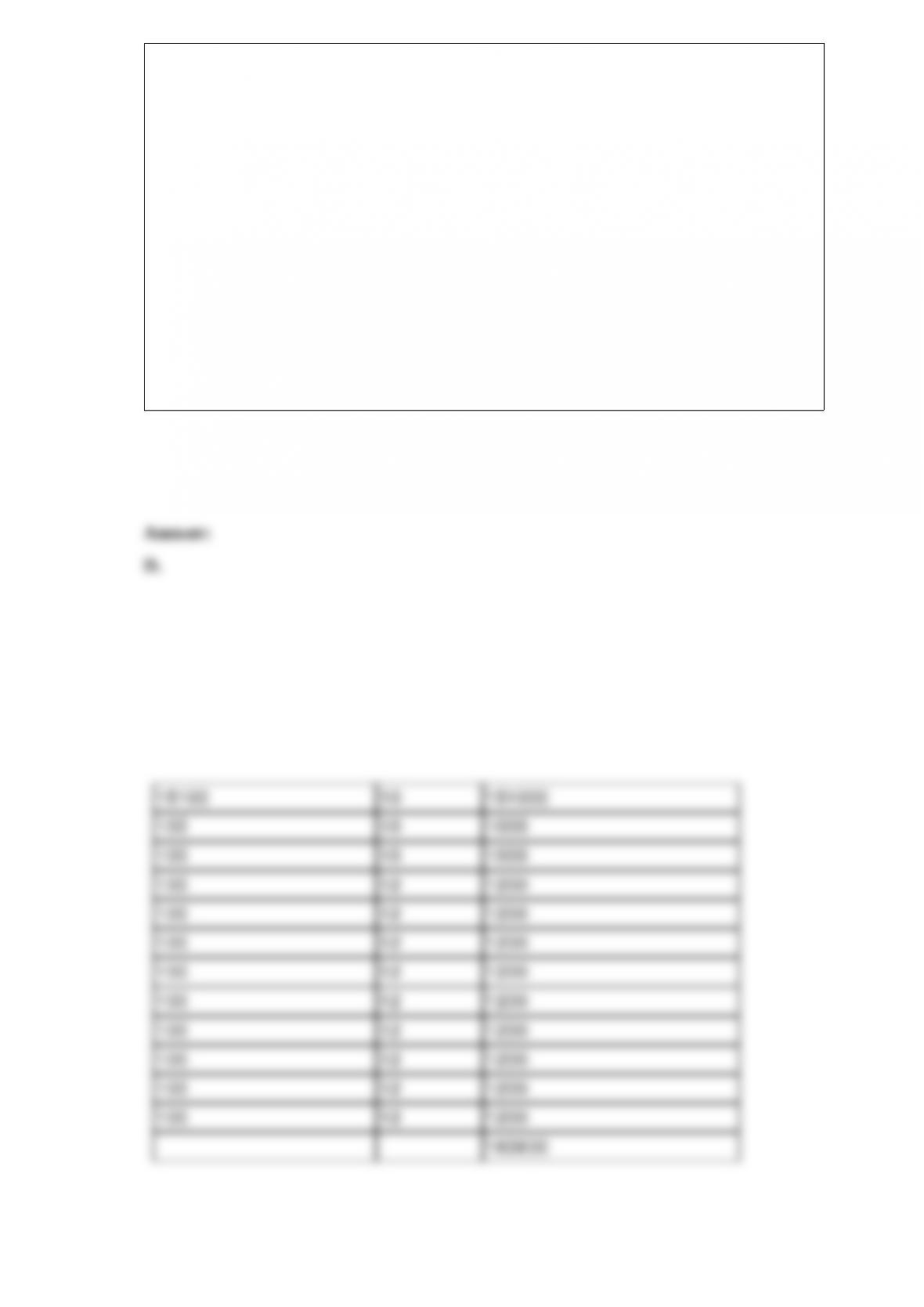
A not-for-profit organization published a monthly magazine that had 15,000 subscribers
on January 1, 2013. The number of subscribers increased steadily throughout the year
and at December 31, 2013, there were 16,200 subscribers. The annual magazine
subscription cost was $10 on January 1, 2013 and was increased to $12 for new
members on April 1, 2013. Subscriptions are paid in full at the beginning of the member
term. An auditor should expect that the revenue from subscriptions for the year ended
December 31, 2013, would be approximately
A. $179,400.
B. $171,600.
C. $164,400.
D. $163,800.

Which of the following most likely would give the most assurance concerning the
valuation assertion for accounts receivable?
A. Tracing amounts in the subsidiary ledger to details on shipping documents.
B. Comparing receivable turnover ratios to industry statistics for reasonableness.
C. Inquiring about receivables pledged under loan agreements.
D. Assessing the allowance for uncollectible accounts for reasonableness.
Which of the following internal control objectives is likely to be a larger concern in the
audit of the payroll cycle?
A. Payroll transactions are properly disclosed.
B. Recorded payroll transactions are valid.
C. Payroll transactions are recorded in the appropriate time period.
D. All payroll transactions have been recorded.
In establishing the existence and ownership of a long-term investment in stock of a
publicly traded company, an auditor should inspect the securities or
A. correspond with the investee company to verify the number of shares owned.
B. inspect the audited financial statements of the investee company.
C. confirm the number of shares owned that are held by an independent custodian.

D. determine that the investment is carried at the lower-of-cost-or-market.
An entity engaged a CPA to determine whether the entity’s websites meet defined
criteria for standard business practices and controls over transaction integrity and
information protection. In performing this engagement, the CPA should comply with
the provisions of
A. Statements on Assurance Standards.
B. Statements on Standards for Attestation Engagements.
C. Statements on Standards for Management Consulting Services.
D. Statements on Auditing Standards.
Which of the following is one of the better auditing techniques that might be used by an
auditor to detect kiting between intercompany banks?
A. Review the composition of authenticated deposit slips.
B. Review subsequent bank statements received directly from the banks.
C. Prepare a schedule of bank transfers.
D. Prepare year-end bank reconciliations.

Key Co. plans to present comparative financial statements for the years ended
December 31, 2012 and 2013, respectively. Smith, CPA, audited Key’s financial
statements for both years and plans to report on the comparative financial statements on
May 1, 2014. Key’s current management team was not present until January 1, 2013.
What period of time should be covered by Key’s management representation letter?
A. January 1, 2012 through December 31, 2013.
B. January 1, 2012 through May 1, 2014.
C. January 1, 2013 through December 31, 2013.
D. January 1, 2013 through May 1, 2014.
When tracing a sample of shipping documents from throughout the year to the details of
the sales invoices and to the sales journal and customers’ accounts receivable subsidiary
ledger, the auditor is testing the _____________ assertion.
A. classification
B. cutoff
C. existence
D. completeness

The PCAOB’s definition of internal control over financial reporting specifically
mentions all of the following control activities except:
A. The maintenance of asset records.
B. The segregation of duties.
C. The authorization by management of receipts and expenditures.
D. The safeguarding of assets.
When an entity moves into a significant new line of business, all of the following
increase except:
A. Client risk.
B. Acceptable audit risk.
C. Risk of material misstatement.
D. Entity business risk.
The risk of material misstatement differs from detection risk in that it
A. Arises from the misapplication of auditing procedures.
B. May be assessed in either quantitative or qualitative terms.
C. Exists independently of the actions of the auditor.

D. Can be changed at the auditor’s discretion.
A normal audit procedure is to analyze the current year’s repairs and maintenance
accounts to provide evidence in support of the audit proposition that
A. expenditures for fixed assets have been recorded in the proper period.
B. capital expenditures have been properly authorized.
C. Non-capitalizable expenditures have been properly expensed.
D. expenditures for fixed assets have been capitalized.
Which of the following is the most important consideration of an auditor when
examining the stockholders’ equity section of an entity’s balance sheet?
A. Changes in the capital stock account are verified by an independent stock transfer
agent.
B. Stock dividends and/or stock splits during the year under audit were approved by the
stockholders.
C. Stock dividends are capitalized at par or stated value on the dividend declaration
date.
D. Entries in the capital stock account can be traced to a resolution in the minutes of the
board of directors’ meetings.

The auditor is most likely to seek information from the plant manager with respect to
the
A. adequacy of the provision for uncollectible accounts.
B. appropriateness of physical inventory observation procedures.
C. existence of obsolete machinery.
D. deferral or procurement of certain necessary insurance coverage.
Which of the following internal controls most likely would reduce the risk of diversion
of customer receipts by an entity’s employees?
A. A bank lockbox system.
B. Prenumbered remittance advices.
C. Monthly bank reconciliations.
D. Daily deposit of cash receipts.

During an examination of a public company, the auditor should obtain written
confirmation regarding bond transactions from the
A. bond broker.
B. entity’s attorney.
C. internal auditors.
D. trustee.
A CPA auditing an electric utility wishes to determine whether all customers are being
billed. The CPA’s best direction of test is from the
A. meter department records to the billing (sales) register.
B. billing (sales) register to the meter department records.
C. accounts receivable ledger to the billing (sales) register.
D. billing (sales) register to the accounts receivable ledger.
Match each term below with its definition as provided by the AICPA Rules of Conduct.
1)Holding out
2)Attest engagement
3)Practice of public accounting

4)Professional services
5)Partner
6)Client
a) A proprietor, part owner, or any individual who assumes the risks and benefits of firm
ownership or who is otherwise held out by the firm to be the equivalent of any of the
aforementioned
b) The performance for a client by a member or a member’s firm while holding out as
CPA(s) of the professional services of accounting, tax, personal financial planning,
litigation support services, and those professional services for which standards are
promulgated by bodies designated by Council
c) Examples include financial statement audits, reviews, and examinations of
prospective financial information
d) All services performed by member while holding out as a CPA
e) Any action initiated by a member that informs others of his or her status as a CPA or
AICPA-accredited specialist
f) Any person or entity, other than the member’s employer, that engages a member or a
member’s firm to perform professional services
The basic purpose of a financial statement audit is to
A. Detect fraud.
B. Examine individual transactions so that the auditor may certify as to their validity.
C. Provide assurance regarding whether the auditee’s financial statements are fairly
stated.
D. Assure the consistent application of correct accounting procedures.

Which of the following could test the assertion of cutoff for payroll-related liabilities?
A. Compare items in accrued payroll taxes to the supporting payroll tax return.
B. Search for unrecorded liabilities.
C. Examine payroll tax returns to determine that the expense was recorded in the proper
period.
D. Review payroll liabilities for proper classification as short-or long-term.
Which of the following statements would an auditor most likely add to the negative
form of confirmations of accounts receivable to encourage timely consideration by the
recipient?
A. “This is not a request for payment; remittances should not be sent to our auditors in
the enclosed envelope.”
B. “Report any differences on the enclosed statement directly to our auditors; no reply
is necessary if this amount agrees with your records.”
C. “If you do not report any differences within 15 days, it will be assumed that this
statement is correct.”
D. “The following invoices have been selected for confirmation and represent amounts
that are overdue.”