Standards can be used in a job-order costing system if the products manufactured are
similar in nature.
It is necessary for an organization to define its processes before attempting to establish
relationships among company activities.
Both accountants and economists view variable costs as linear in nature.
Absorption costing is commonly used for external reporting.
The decision concerning which assets to acquire to achieve an organization’s objectives
is an investing decision.
Financial accounting is most concerned with meeting the needs of external users.
Project funding is an investing decision.
Activity-based costing is appropriate for a company that has high overhead costs that
are not proportional to unit volumes of individual products.
When using a market-based transfer price, a decision must be made how price disputes
will be handled.
If actual overhead exceeds applied overhead, factory overhead is said to be
overapplied.
In an actual job-order costing system, factory overhead is assigned to a job on a
periodic basis.
Total fixed costs vary inversely with levels of production.
Asset turnover measures the effective use of assets relative to revenue production.
The amount of raw material purchased in a period may be different than the amount of
material used that period because
A. the number of units sold may be different from the number of units produced.
B. finished goods inventory may fluctuate during the period.
C. the raw material inventory may increase/decrease during the period.
D. companies often pay for material in the period after it is purchased.
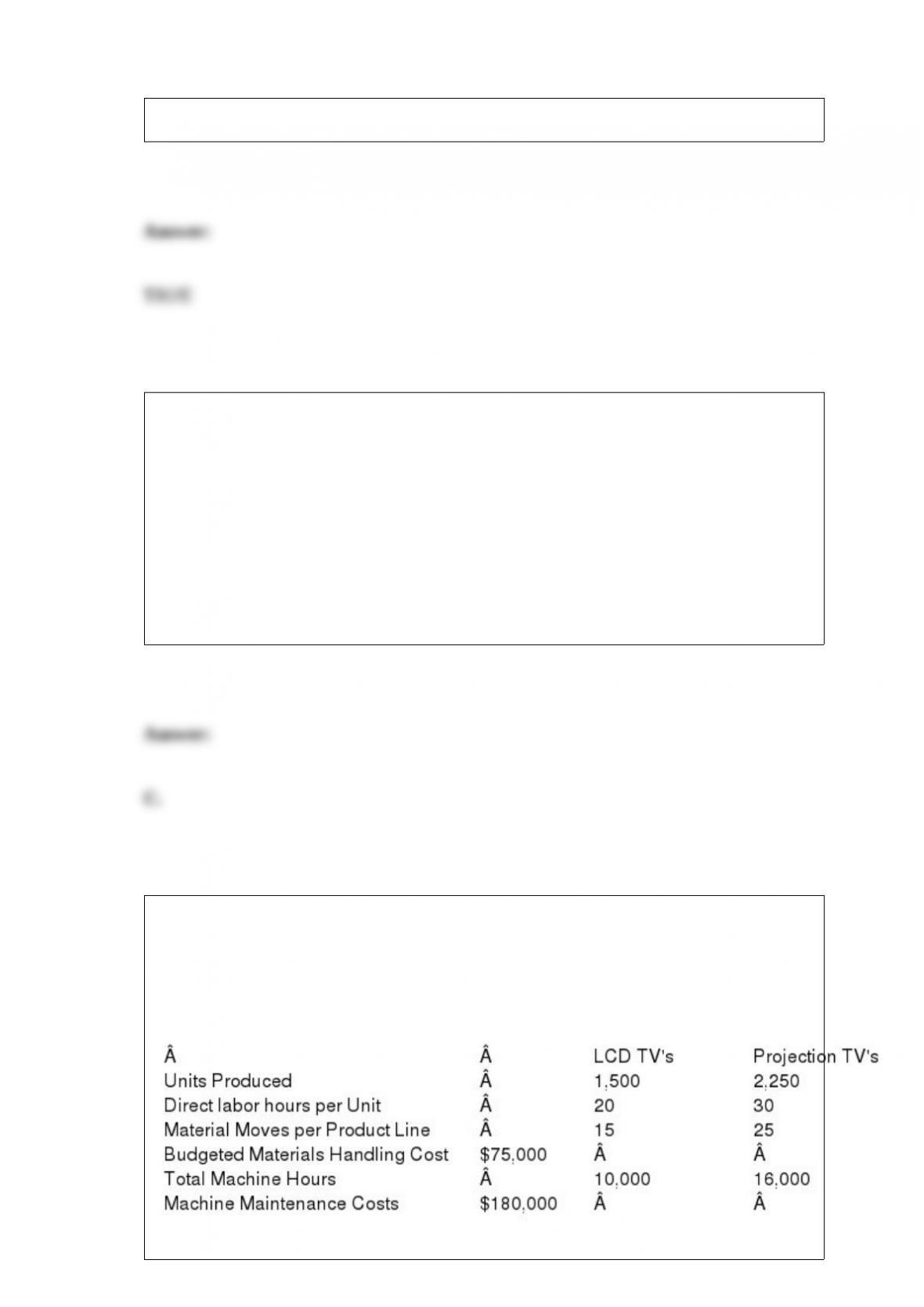
Ultimate Vision Corporation
Ultimate Vision Corporation has two product lines: LCD televisions and projection
televisions. The company has budgeted the following production and overhead costs for
the upcoming year:
Refer to Ultimate Vision Corporation. If the company uses an activity-based costing

(ABC) system to allocate factory overhead, the machine maintenance cost allocated to
LCD TVs would be:
A. $51,923
B. $55,385
C. $69,231
D. $72,000
By-products are
A. items resulting from a joint process that have no further value.
B. not sufficient alone, in terms of sales value, for management to justify undertaking
the joint process.
C. also known as scrap.
D. the primary reason management undertook the production process.
With respect to fixed costs, CVP analysis assumes total fixed costs
A. per unit remain constant as volume changes.
B. remain constant from one period to the next.
C. vary directly with volume.

D. remain constant across changes in volume.
The ____ would not affect the economic order quantity.
A. company’s weighted average cost of capital
B. cost of purchase requisition forms
C. cost of insuring inventory
D. cost of a stockout
Which of the following does not create a specific price level change?
A. change in production technology
B. change in the rate of inflation
C. changes due to supply and demand
D. changes in the number of competing suppliers
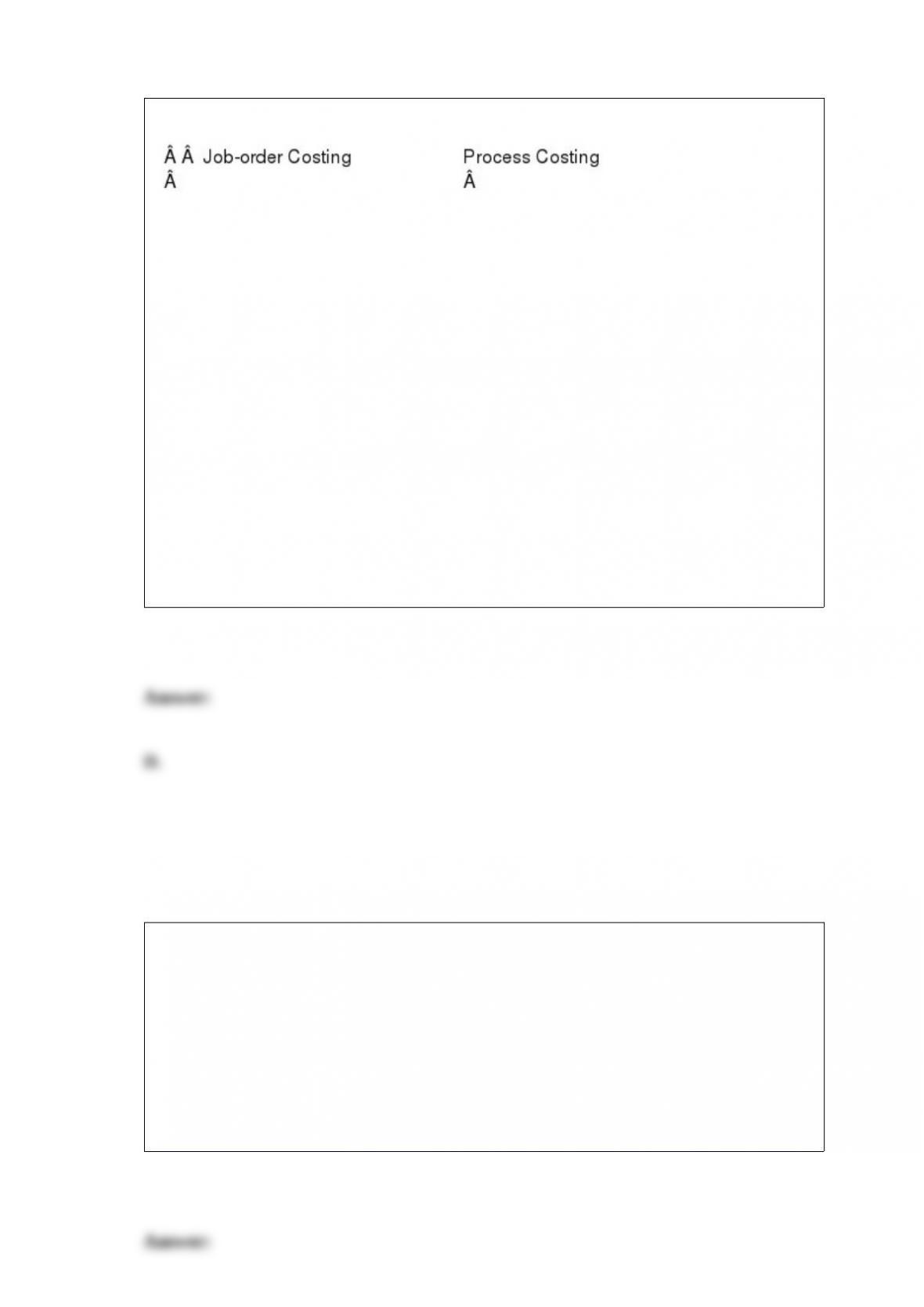
job-order costing and process costing have which of the following characteristics?
A. homogeneous products heterogeneous products
and large quantities and small quantities
B. homogeneous products heterogeneous products
and small quantities and large quantities
C. heterogeneous products homogeneous products
and large quantities and large quantities
D. heterogeneous products homogeneous products
and small quantities and large quantities
Waste created by a production process is
A. accounted for in the same manner as defective units.
B. accounted for as an abnormal loss.
C. material that can be sold as an irregular product.
D. discarded rather than sold.

Equivalent units of production are equal to the
A. units completed by a production department in the period.
B. number of units worked on during the period by a production department.
C. number of whole units that could have been completed if all work of the period had
been used to produce whole units.
D. identifiable units existing at the end of the period in a production department.
The ISO 9000 standards
A. indicate which companies’ products are better than those of competitors.
B. allow management to decide how to meet the standards for quality assurance.
C. include specific directives about product design, material procurement, and
environmental responsibilities.
D. compose a program of quality assurance under which companies are registered by
the International Organizational for Standardization.
A process in which an end product or service is examined using reverse engineering is
referred to as ___________________________________.
The underlying set of assumptions about an organization and the goals, processes, and
values that its members share is referred to as ______________________________.
Discuss some of the factors that could motivate an organization to implement activity
based costing.
Some of the motivational factors are:
1> Number and diversity of products or services produced–The greater the number of
products manufactured as well as the diversity, the greater need there is for a costing
system that can accurately assign overhead costs to products and services.
Organizations have a need to know how much their products and services really cost
where they can price these goods and services accordingly.
2> Diversity and different degrees of support services used for different products. The
degree of support service may differ from the complexity of the product; with a
traditional costing system, these costs may be misallocated.
3> Extent to which common processes are used–In many organizations, more than one
product may require the same process. Traditional costing systems allocate these costs
based upon volume of production. However, this may not be the actual way in which
resources are used.
4> Effectiveness of current cost allocation methods–Cost allocation methods should
reflect changes in products or processes. However, many organizations fail to take these
changes into account, and have costing systems that no longer accurately measure costs
of products or services.
5> Rate of growth of period costs–If an organization has an increase of costs that are
being expensed as they are incurred (such as R&D costs), these costs should be
measured by the system and allocated to the products to which they are related. This
may violate GAAP for external reporting purposes, but the information provided by
ABC is useful for internal planning.
Costs incurred to correct defects in products prior to shipment are referred to as
________________________________________.
Garfield Company
Garfield Company applies overhead based on direct labor hours and has the following
available for the current month:
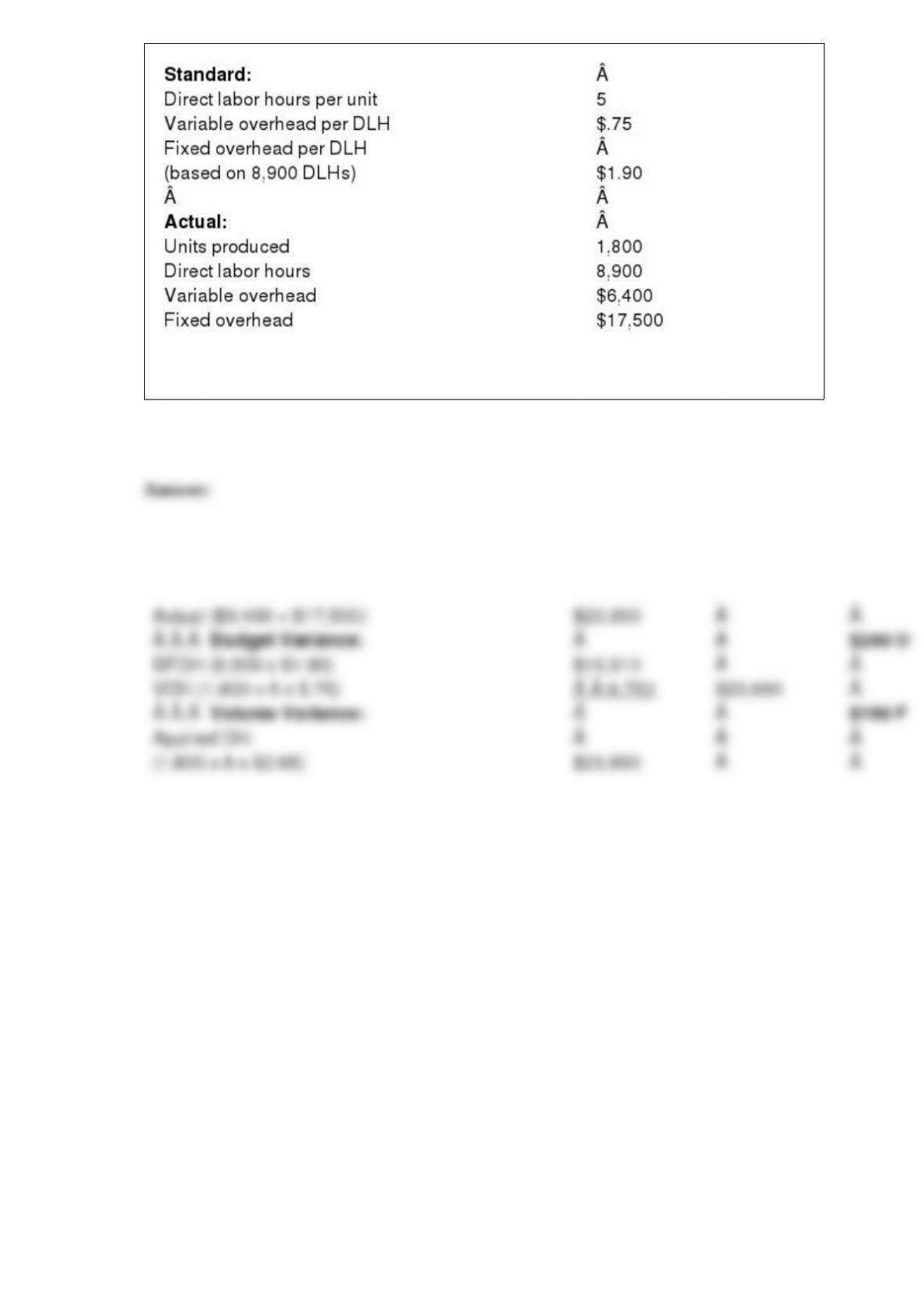
Refer to Garfield Company. Compute all the appropriate variances using the
two-variance approach.