1) Federal laws prohibit the selling of accounts receivables to factors.
2) A profit center generates revenue, incurs costs, and has the authority to make
significant investing decisions.
3) Hybrid systems contain features of both process and job order operations.
4) Bond interest paid by a corporation is an expense, whereas dividends paid are not an
expense of the corporation.
5) If obsolete or damaged goods can be sold, they will be included in inventory at their
original cost.
6) An advantage of bond financing is that issuing bonds does not affect owner control.
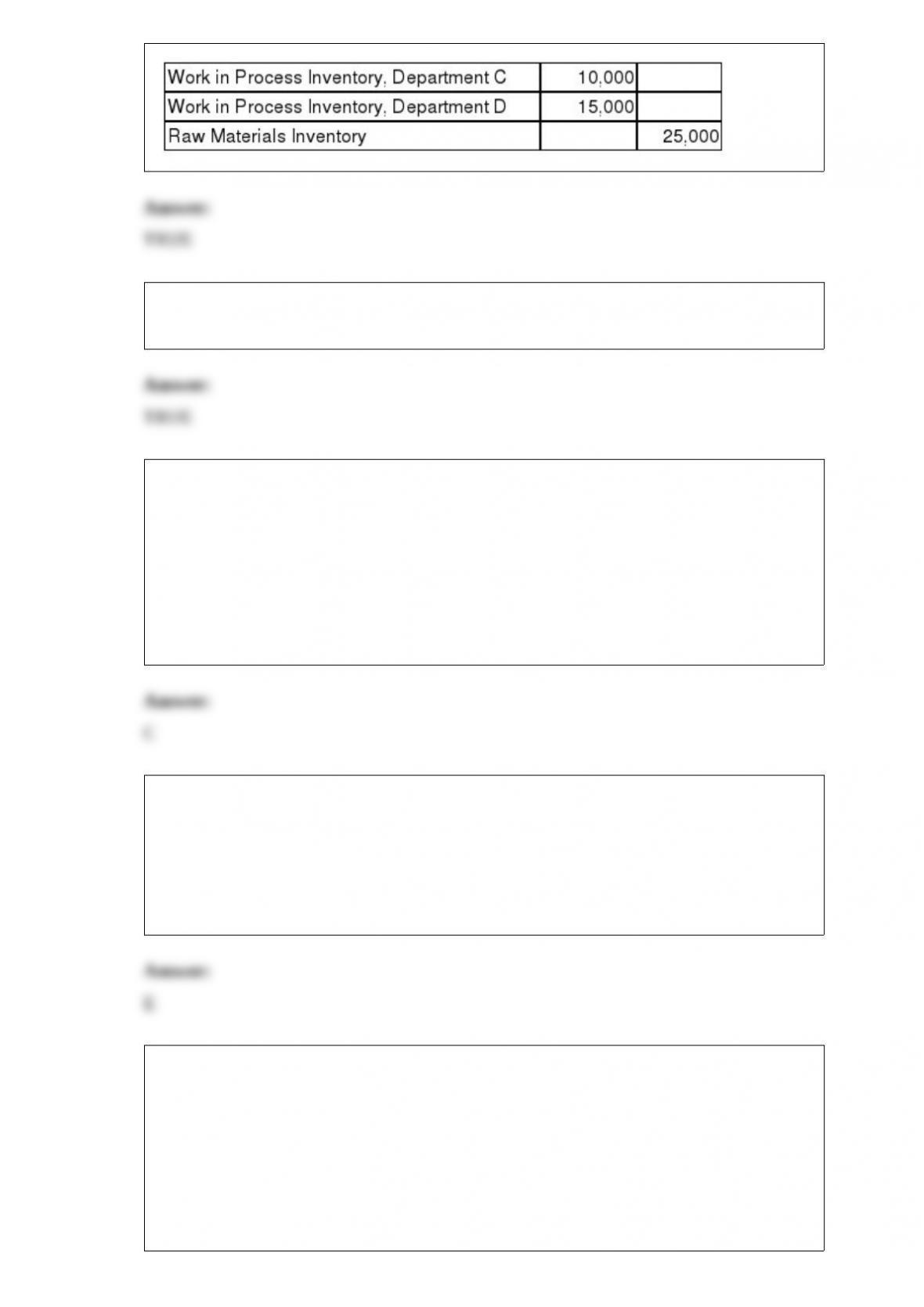
7) If Department C uses $10,000 of direct materials and Department D uses $15,000 of
direct materials, the following journal entry would be recorded by the process costing
system:
8) When using a plantwide overhead rate method to assign overhead costs, the cost
object is always the unit of product.
9) If the assets of a company increase by $55,000 during the year and its liabilities
increase by $25,000 during the same year, then the change in equity of the company
during the year must have been:
A.An increase of $80,000.
B.A decrease of $80,000.
C.An increase of $30,000.
D.A decrease of $30,000.
E.An increase of $25,000.
10) Advantages of a partnership include:
A.Limited life.
B.Mutual agency.
C.Unlimited liability.
D.Co-ownership of property.
E.Voluntary association.
11) Cantrell Company is required by law to collect and remit sales taxes to the state. If
Cantrell has $8,000 of cash sales that are subject to an 8% sales tax, what is the journal
entry to record the cash sales?
A.Debit Cash $8,000; credit Sales $7,360; credit Sales Taxes Payable $640.
B.Debit Sales Taxes Payable $640; debit Cash $7,360; credit Sales $8,000.
C.Debit Cash $8,000; credit Sales $8,000; and record the taxes when paid.
D.Debit Cash $8,640; credit Sales $8,000; credit Sales Taxes Payable $640.
E.Debit Accounts Receivable $8,640; credit Sales $8,000; credit Sales Taxes Payable

$640.
12) Which of the following statements regarding accounting information systems is not
true?
A.Accounting information systems consist of people, records, methods, and equipment.
B.Accounting information systems are more important than ever to decision makers.
C.Accounting information systems cannot improve on a company’s competitive edge.
D.Accounting information systems are designed to provide output including financial,
managerial, and tax reports.
E.Accounting information systems are designed to capture information about a
company’s transactions.
13) The Luna Manufacturing Company has the following job cost sheets on file. They
represent jobs that have been worked on during September of the current year. This
table summarizes information provided on each sheet:
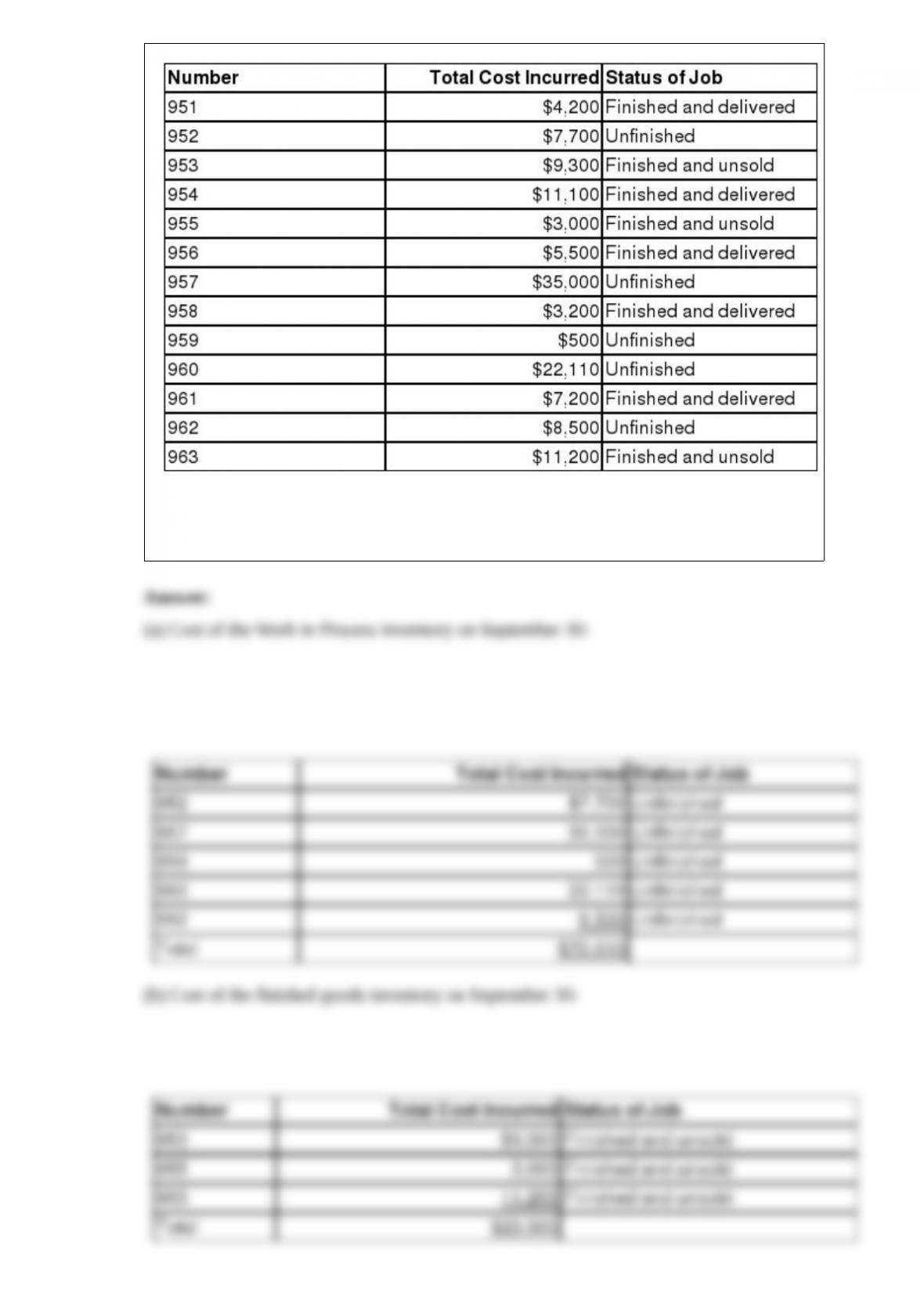
(a) What is the cost of the Work in Process inventory on September 30?
(b) What is the cost of the finished goods inventory on September 30?
(c) What is the cost of goods sold for the month of September?
14) Which of the following factors is least likely to be considered in preparing a sales
budget?
A.Business capacity.
B.Forecasted economic and market conditions.
C.Prediction of unit sales.
D.The capital expenditures budget.
E.Proposed selling expenses, such as advertising.
15) A company uses the aging of accounts receivable method to estimate its bad debts
expense. On December 31 of the current year an aging analysis of accounts receivable
revealed the following:
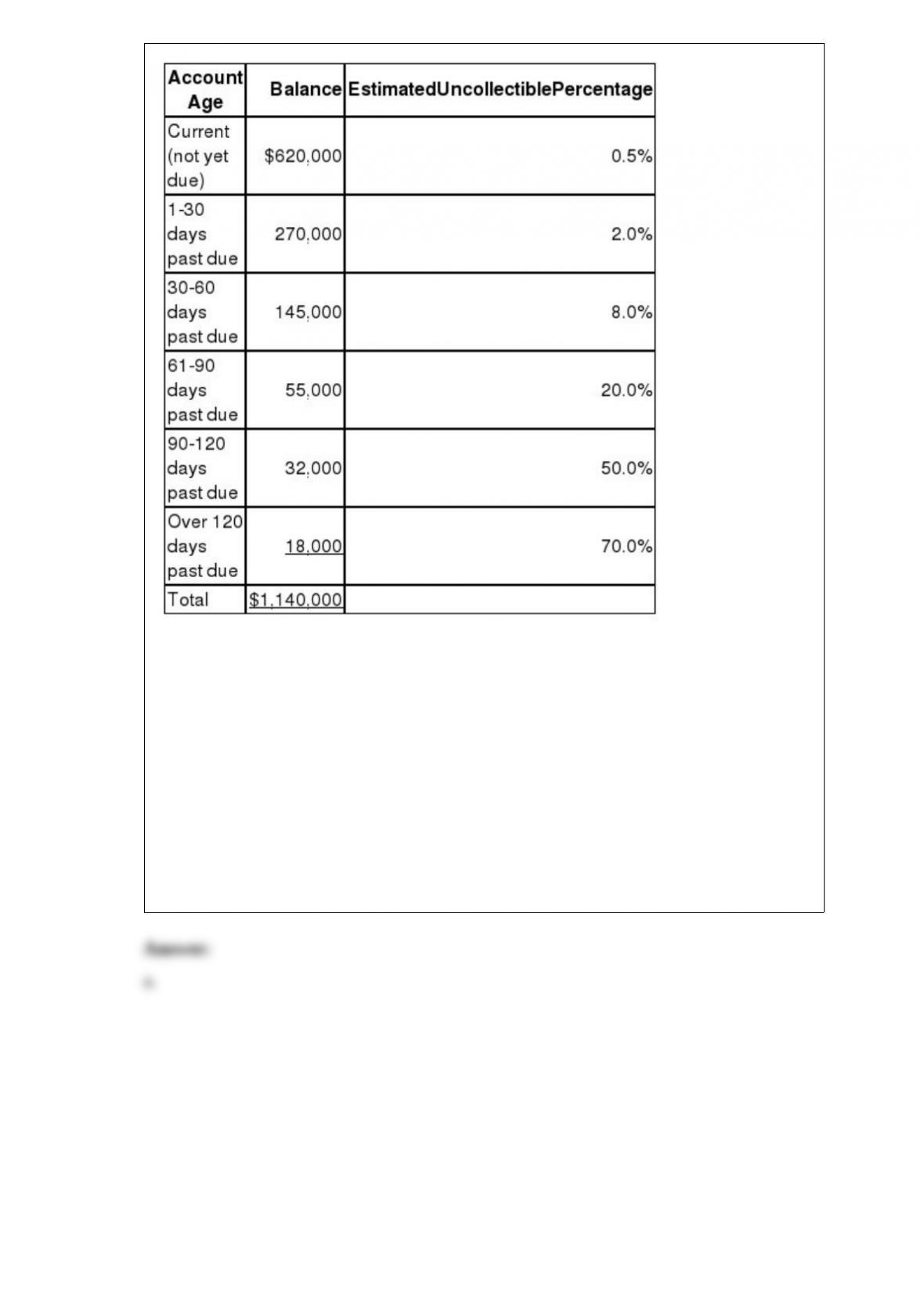
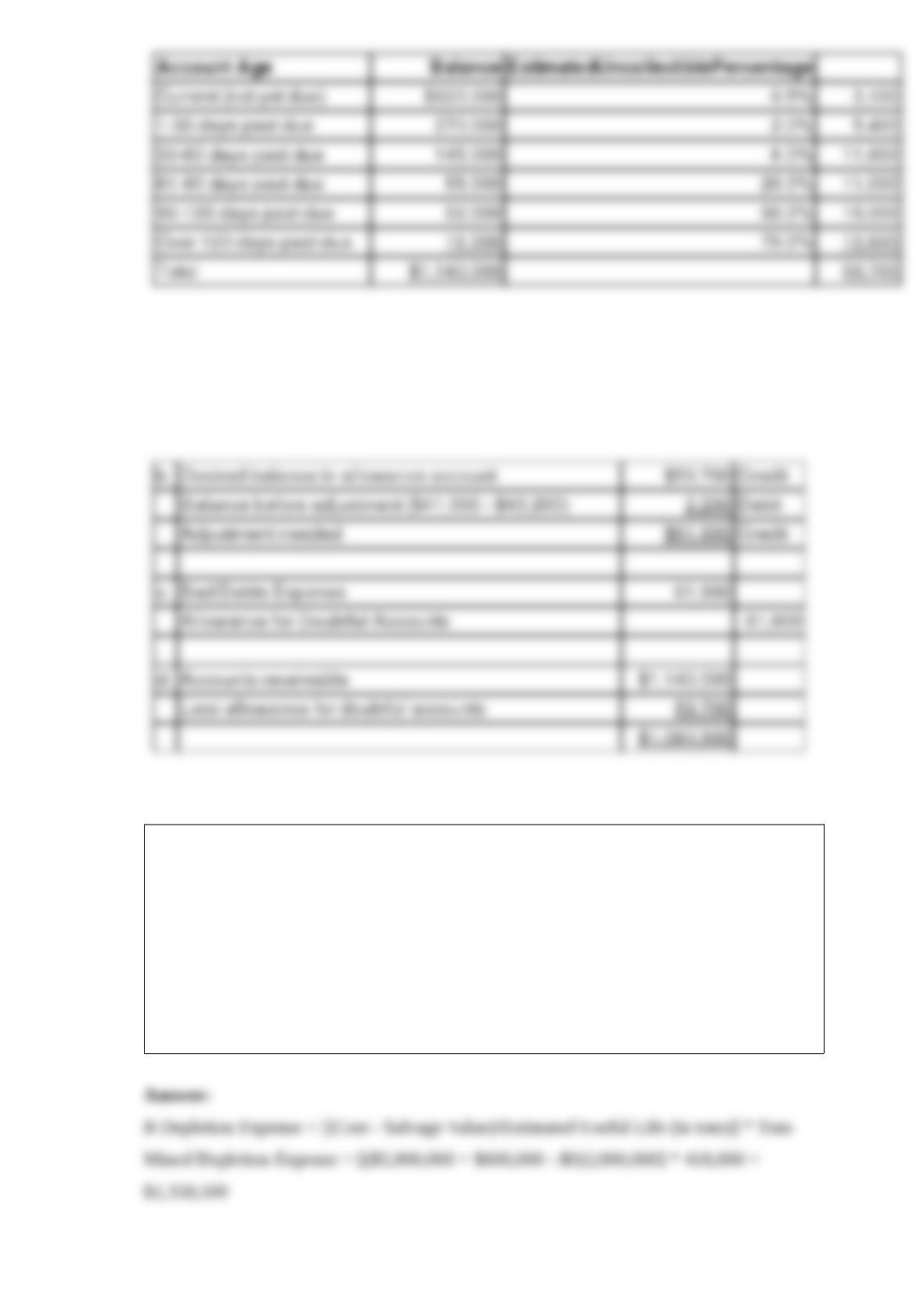
Required:
a. Calculate the amount of the Allowance for Doubtful Accounts that should be reported
on the current year-end balance sheet.
b. Calculate the amount of the Bad Debts Expense that should be reported on the
current year’s income statement, assuming that the balance of the Allowance for
Doubtful Accounts on January 1 of the current year was $41,000 and that accounts
receivable written off during the current year totaled $43,200.
c. Prepare the adjusting entry to record bad debts expense on December 31 of the
current year.
d. Show how Accounts Receivable will appear on the current year-end balance sheet as
of December 31.
16) Fortune Drilling Company acquires a mineral deposit at a cost of $5,900,000. It
incurs additional costs of $600,000 to access the deposit, which is estimated to contain
2,000,000 tons and is expected to take 5 years to extract. Compute the depletion
expense for the first year assuming 418,000 tons were mined.
A.$1,233,100.
B.$1,358,500.
C.$1,300,000.
D.$1,180,000.
E.$1,280,000.
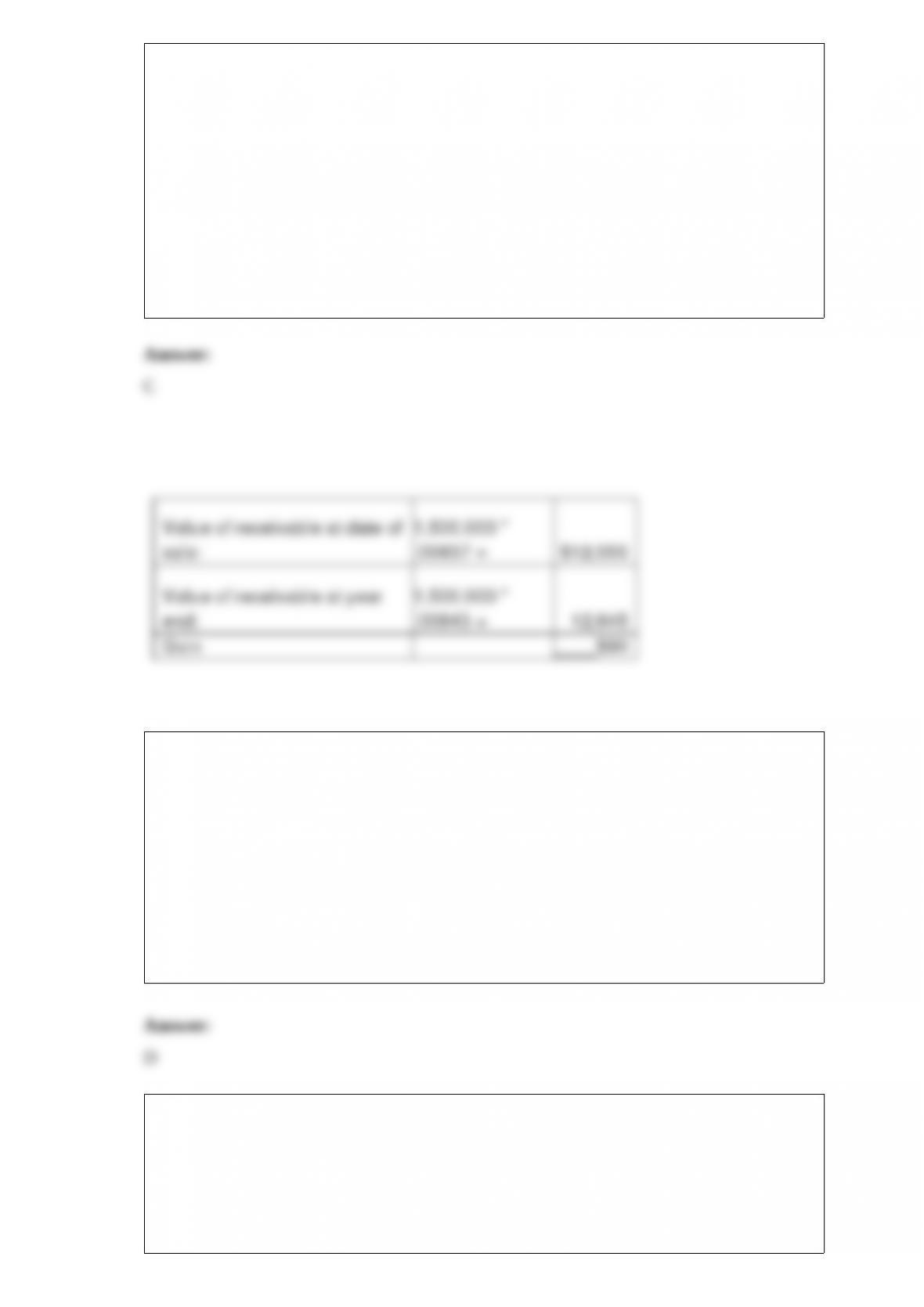
17) On November 12, Higgins, Inc., a U.S. Company, sold merchandise on credit to
Kagomeof Japan at a price of 1,500,000 yen. The exchange rate was $0.00837 per yen
on the date of sale. On December 31, when Higgins prepared its financial statements,
the exchange rate was $0.00843. Kagomepaid in full on January 12, when the exchange
rate was $0.00861. On December 31, Higgins should prepare the following journal
entry:
A.Debit Sales $90; credit Foreign Exchange Gain $90.
B.Debit Foreign Exchange Loss $90; credit Sales $90.
C.Debit Accounts Receivable-Kagome $90; credit Foreign Exchange Gain $90.
D.Debit Foreign Exchange Loss $90; Accounts Receivable-Kagome $90.
E.No journal entry is required until the amount is collected.
18) During August, Boxer Company sells $356,000 in merchandise that has a one year
warranty. Experience shows that warranty expenses average about 5% of the selling
price. The warranty liability account has a credit balance of $12,800 before adjustment.
Customers returned merchandise for warranty repairs during the month that used
$9,400 in parts for repairs. The entry to record the customer warranty repairs is:
A.Debit Warranty Expense $17,800; credit Estimated Warranty Liability $17,800.
B.Debit Warranty Expense $9,400; credit Estimated Warranty Liability $9,400.
C.Debit Warranty Expense $14,400; credit Estimated Warranty Liability $14,400.
D.Debit Estimated Warranty Liability $9,400; credit Parts Inventory $9,400.
E.Debit Estimated Warranty Liability $17,800; credit Parts Inventory $17,800.
19) The accounting equation for Ying Company shows a decrease in its assets and a
decrease in its equity. Which of the following transactions could have caused that
effect?
A.Cash was received from providing services to a customer.
B.The company paid an amount due on credit.
C.Equipment was purchased for cash.
D.A utility bill was received for the current month, to be paid in the following month.
E.Advertising expense for the month was paid in cash.
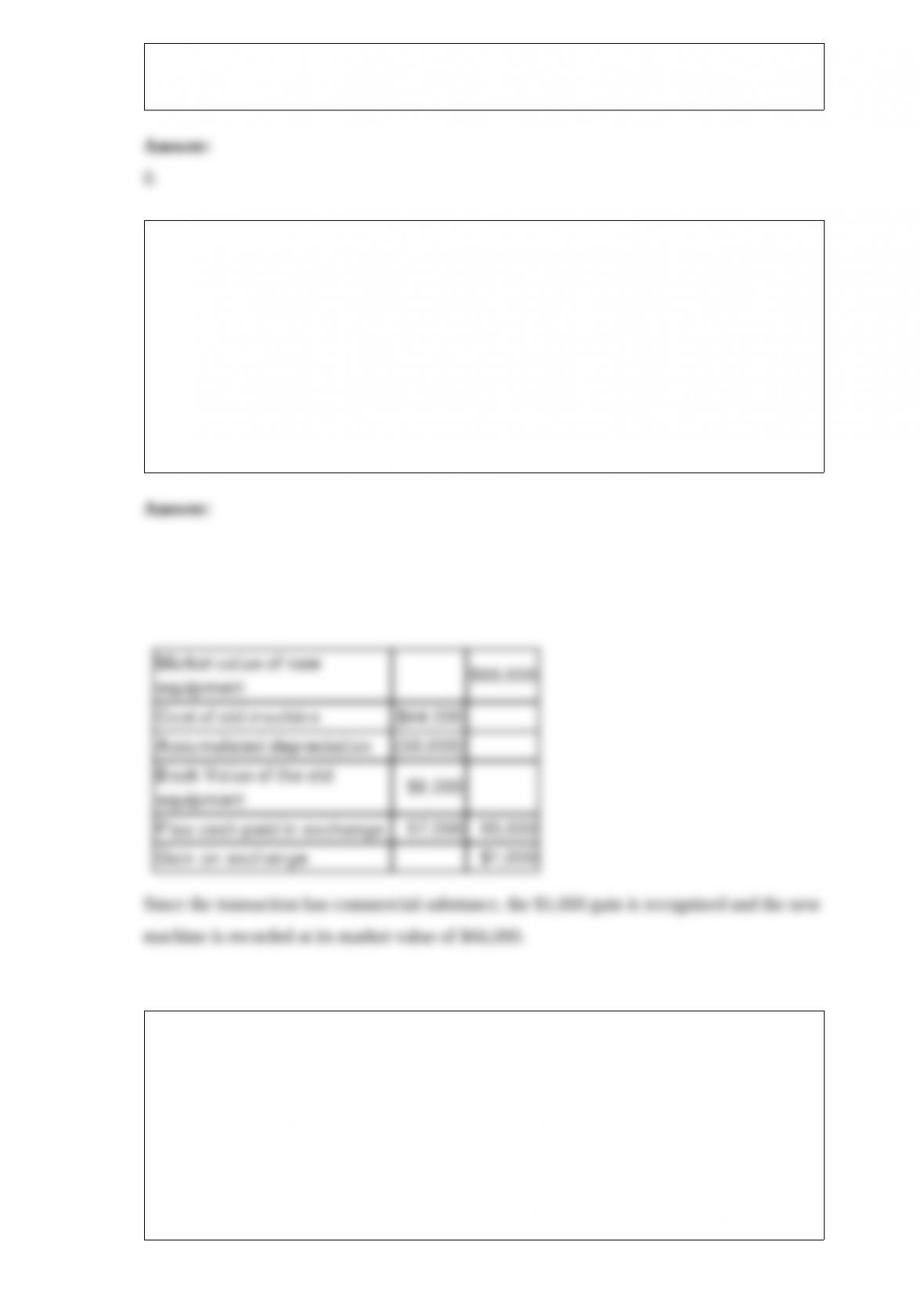
20) A company purchased equipment valued at $66,000. It traded in old equipment for a
$9,000 trade-in allowance and the company paid $57,000 cash with the trade-in. The
old equipment cost $44,000 and had accumulated depreciation of $36,000. This
transaction has commercial substance. What is the recorded value of the new
equipment?
A.$8,000.
B.$9,000.
C.$57,000.
D.$65,000.
E.$66,000.
21) Wilturner Company incurs $74,000 of labor related directly to the product in the
Assembly Department, $23,000 of labor not directly related to the product but related to
the Assembly Department as a whole, and $10,000 of labor for services that help
production in both the Assembly and Finishing departments. The amount of direct labor
and factory overhead respectively are:
A.$74,000 and $33,000.
B.$97,000 and $10,000.
C.$84,000 and $23,000.
D.$107,000 and $0.

E.$74,000 and $10,000.
22) A challenge in calculating the total costs and expenses of a department is:
A.Determining the gross profit ratio.
B.Assigning direct costs to the department.
C.Allocating indirect expenses to the department.
D.Determining the amount of sales of the department.
E.Determining the direct expenses of the department.
23) An adjusting entry was made on year-end December 31 to accrue salary expense of
$1,200. Which of the following entries would be prepared to record the $3,000 payment
of salaries in January of the following year?
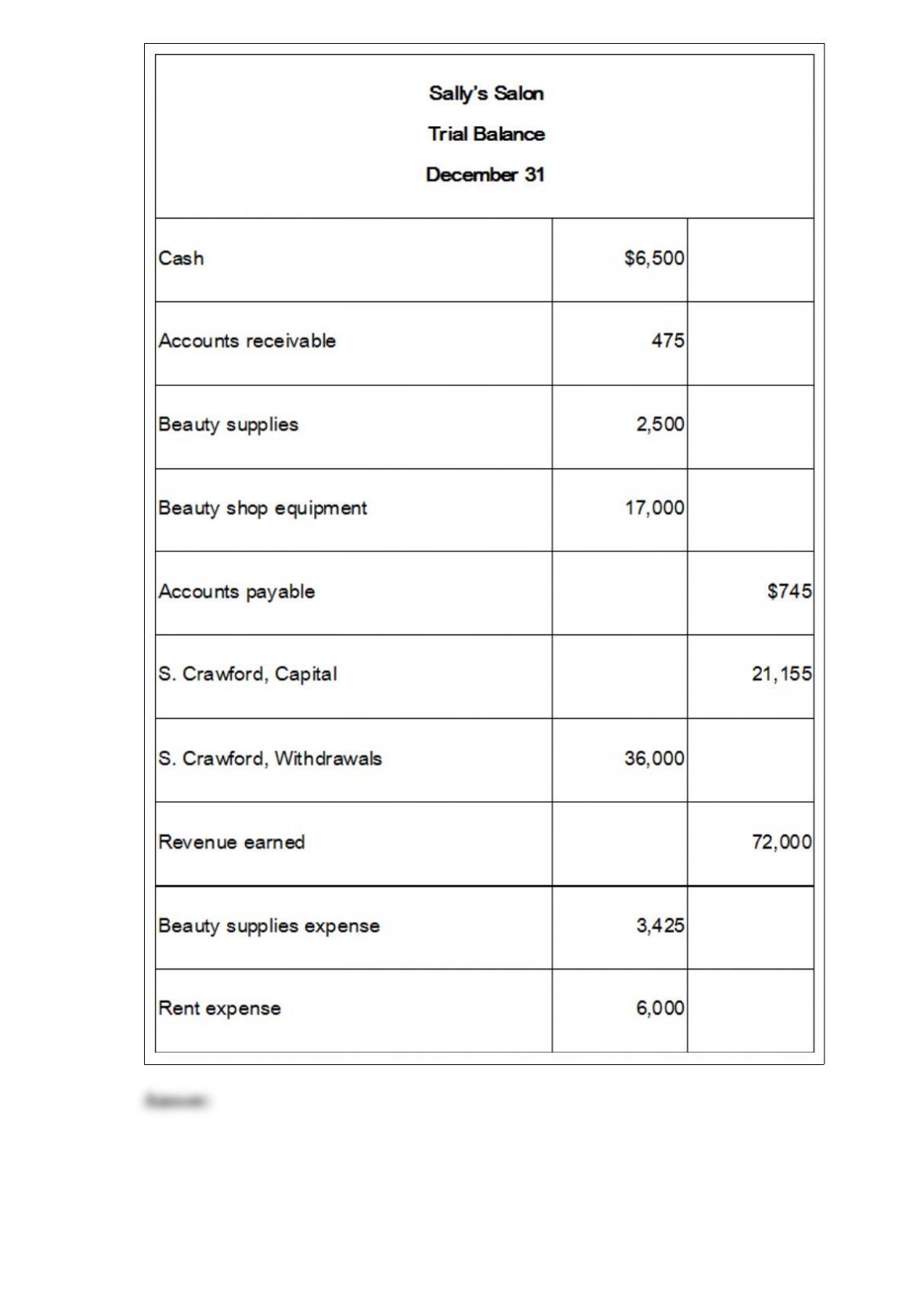
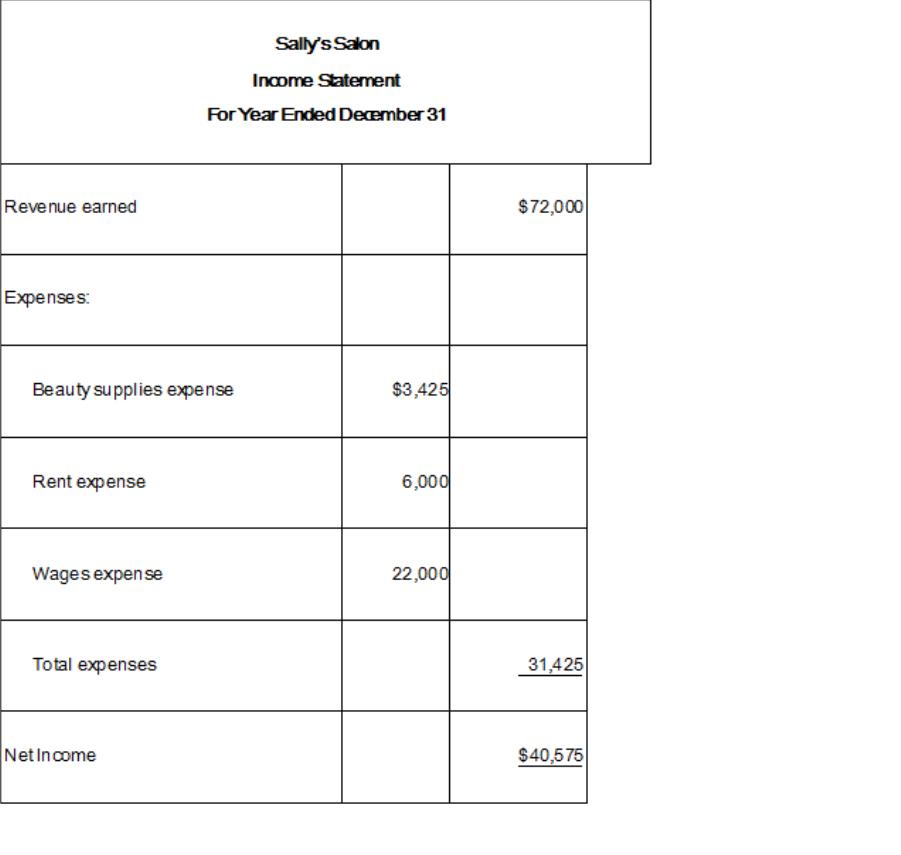
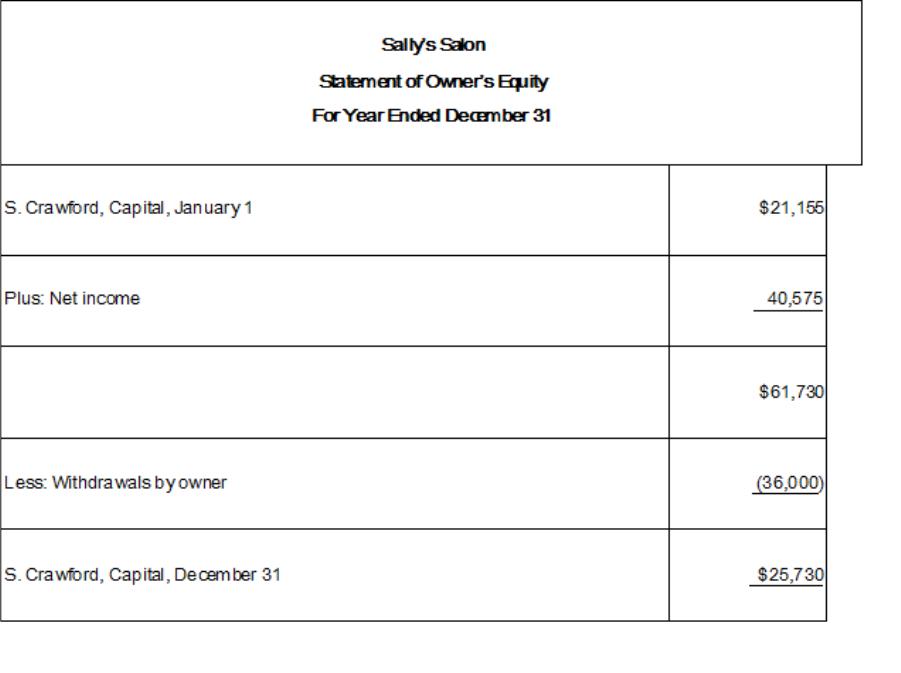
24) Based on the following trial balance for Sally€s Salon, prepare an income
statement, statement of owner€s equity, and a balance sheet. Sally Crawford made no
additional investments in the company during the year.
25) In a manufacturing operation with two process departments (1 and 2), the flow of
costs would proceed from Work in Process, Department #1 to ________________.
26) The master budget process nearly always begins with the preparation of the
___________________ and usually finishes with the preparation of the
______________________, the ________________, and the
______________________.
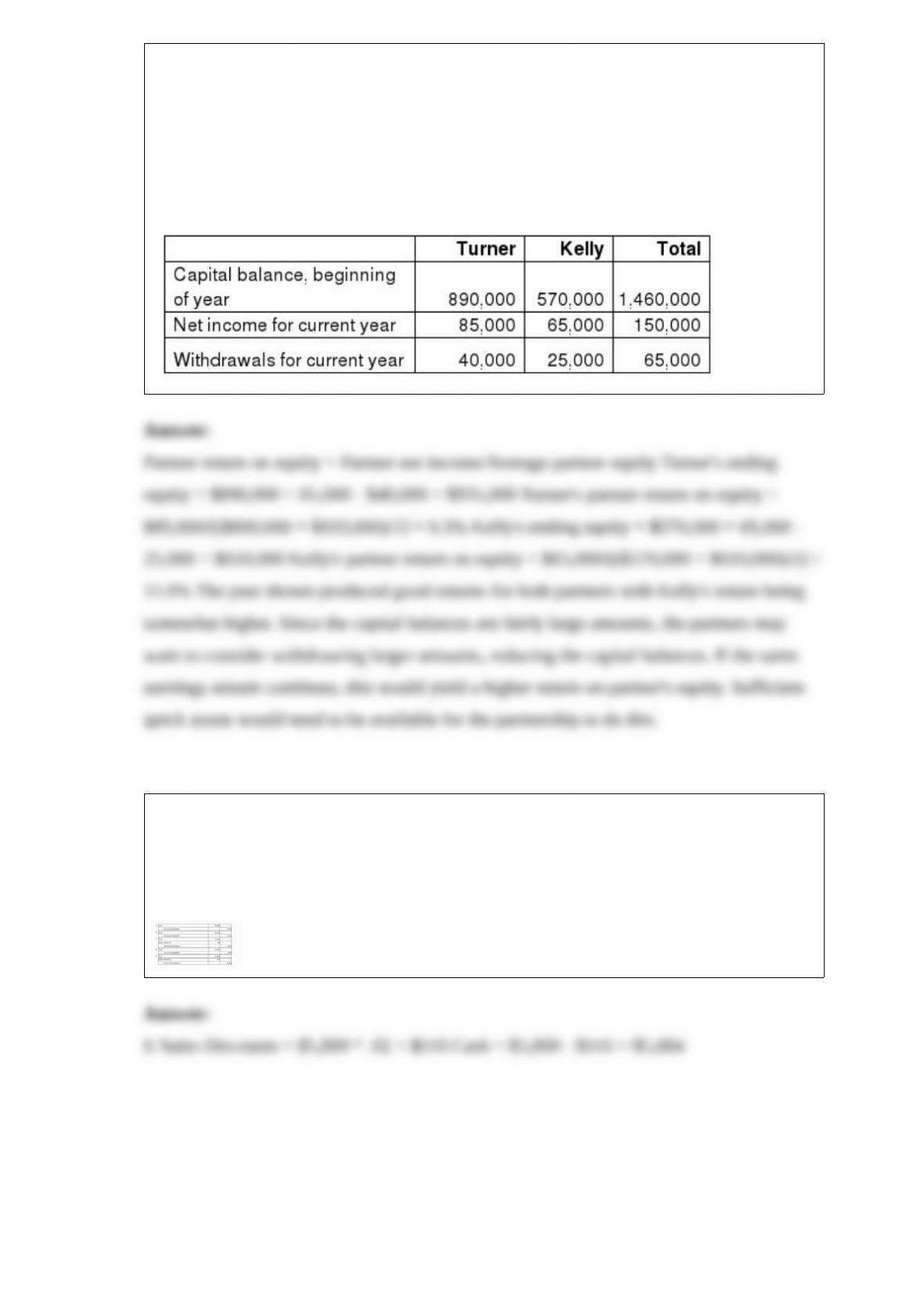
27) Cinema Products LP is organized as a limited partnership that sells movie props.
Information related to capital balances is given below. Compute the partner return on
equity for each limited partner. How would each partner evaluate the success of the
partnership? What would you recommend the partners do with respect to additional
investments or withdrawals?
TurnerKellyTotal
28) On September 12, Vander Company sold merchandise in the amount of $5,800 to
Jepson Company, with credit terms of 2/10, n/30. The cost of the items sold is $4,000.
Vander uses the periodic inventory system. Jepson pays the invoice on September 18,
and takes the appropriate discount. The journal entry that Vander makes on September
18 is: