1) Fixed costs remain constant at $400,000 per month. During high-output months
variable costs are $320,000, and during low-output months variable costs are $80,000.
What are the respective high and low indirect-cost rates if budgeted professional
labor-hours are 16,000 for high-output months and 4,000 for low-output months?
A) $45.00 per hour; $120.00 per hour
B) $45.00 per hour; $45.00 per hour
C) $25.00 per hour; $20.00 per hour
D) $56.20 per hour; $120.00 per hour
2) What is the economic order quantity for Vision?
A) 457 lenses
B) 328 lenses
C) 266 lenses
D) 161 lenses
3) Work-in-process inventory would normally include ________.
A) direct materials in stock and awaiting use in the manufacturing process
B) goods partially worked on but not yet fully completed
C) goods fully completed but not yet sold
D) goods returned after being sold to be re-worked on further improvements and quality
4) The Cybertronics Corporation reported the following information for its Cyclotron
Division:
Income is defined as operating income.
What is the Cyclotron Division’s investment turnover ratio?
A) 2.00
B) 3.33
C) 2.50
D) 0.80
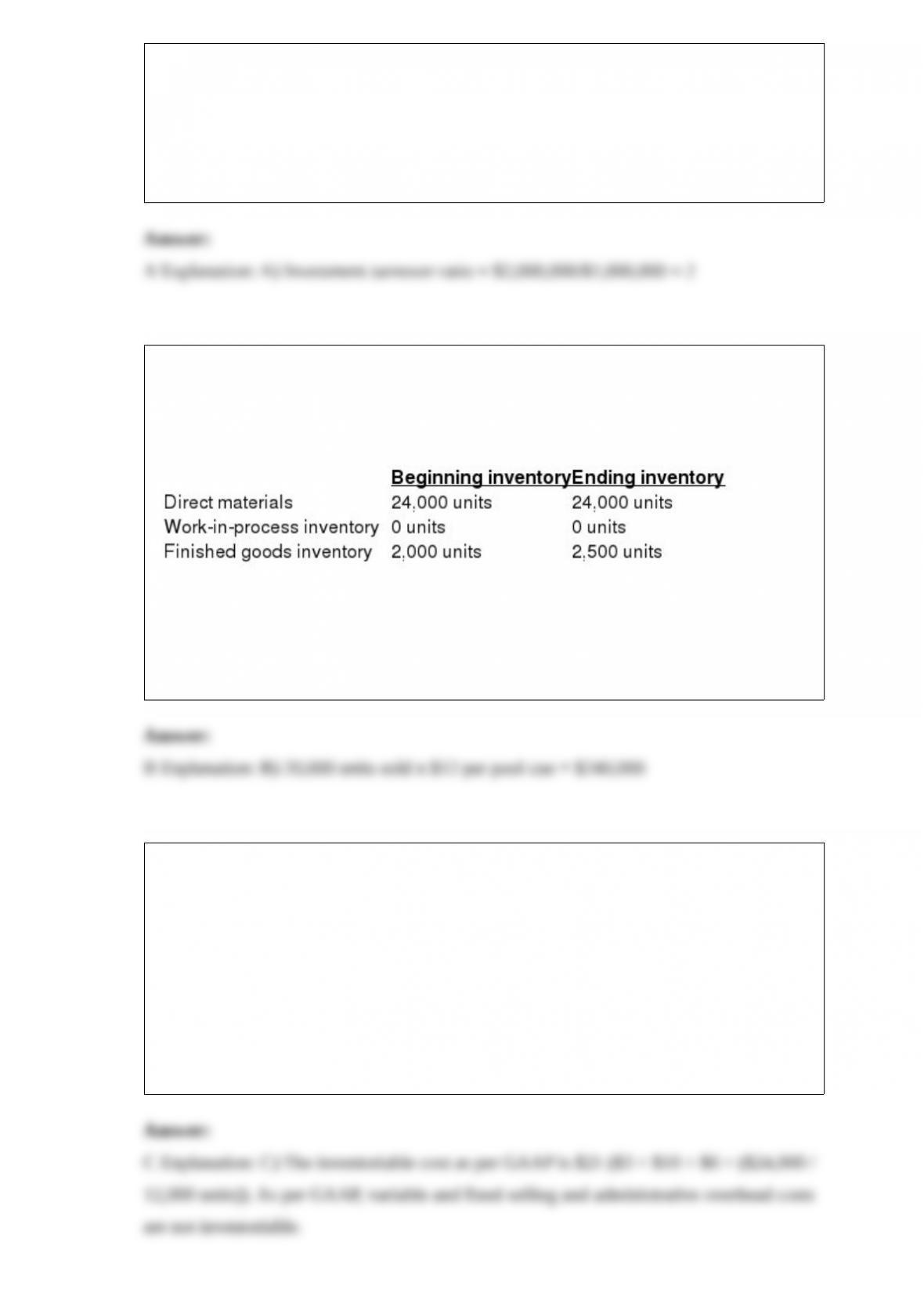
5) Kason, Inc., expects to sell 20,000 pool cues for $12.00 each. Direct materials costs
are $2.00, direct manufacturing labor is $4.00, and manufacturing overhead is $0.80 per
pool cue. The following inventory levels apply to 2016:
On the 2016 budgeted income statement, what amount will be reported for sales?
A) $246,000
B) $240,000
C) $312,000
D) $318,000
6) Juan Sugita Manufacturing expects to produce and sell 12,000 units of Big, its only
product, for $20 each. Direct material cost is $3 per unit, direct labor cost is $10 per
unit, and variable manufacturing overhead is $6 per unit. Fixed manufacturing overhead
is $24,000 in total. Variable selling and administrative expenses are $1 per unit, and
fixed selling and administrative costs are $3,000 in total. According to generally
accepted accounting principles, inventoriable cost per unit of Big would be ________.
A) $13.00 per unit
B) $14.00 per unit
C) $21.00 per unit
D) $18.50 per unit
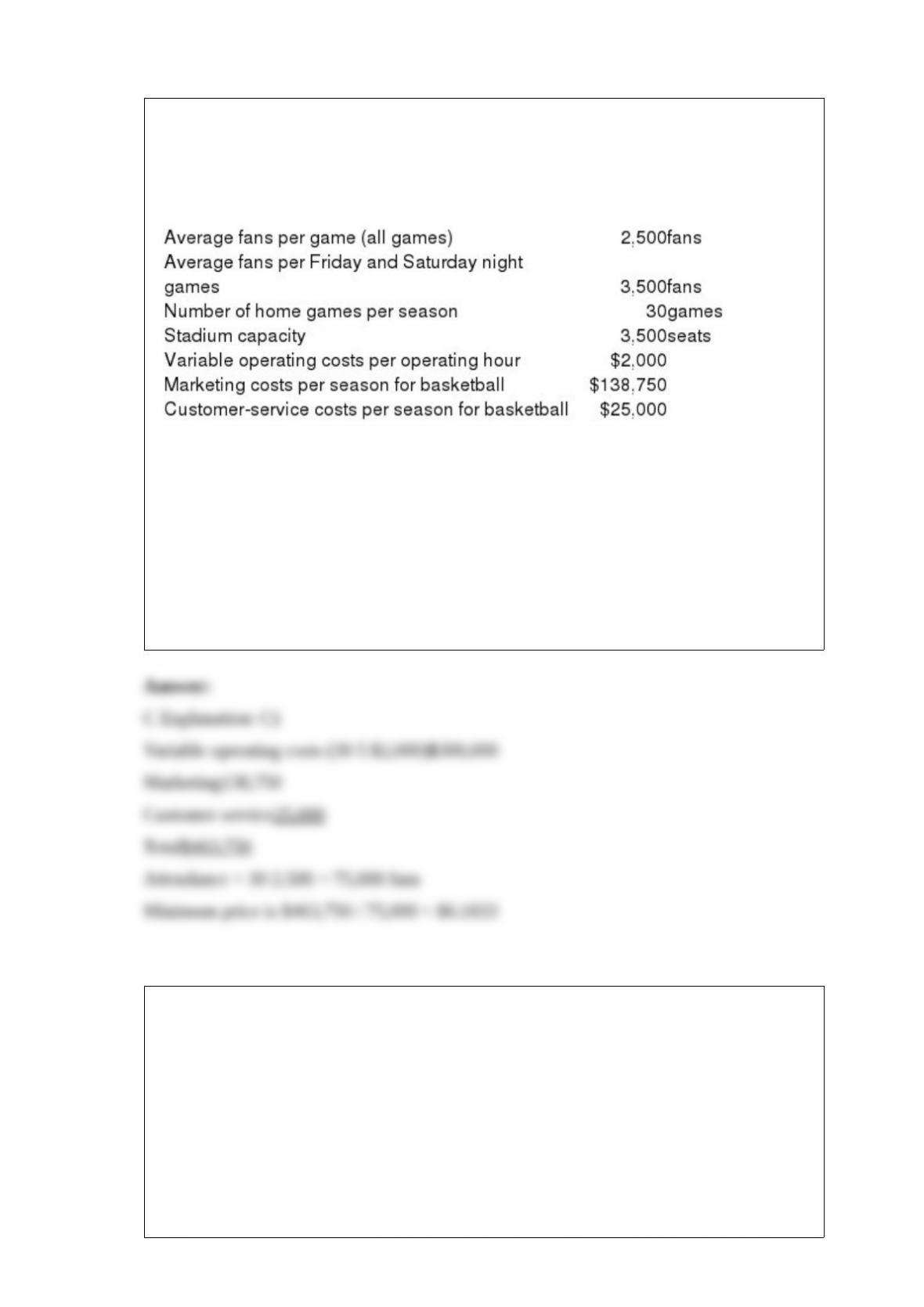
7) The Maize Eagles are evaluating ticket prices for its basketball games. Studies show
that Friday and Saturday night games average more than twice the number of fans
compared to other days. The following information pertains to the stadium’s normal
operations per season:
The stadium is open for 5 operating hours on each day a game is played. All employees
work by the hour except for the administrators. A maximum of one game is played per
day and each fan has only one ticket per game.
The stadium authority wants to charge more for games on Friday and Saturday. What is
the minimum price that should be charged for peak attendance nights?
A) $4.40
B) $8.60
C) $6.19
D) $171.45
8) Plish Company manufactures only one type of washing machine and has two
divisions, the Compressor Division, and the Fabrication Division. The Compressor
Division manufactures compressors for the Fabrication Division, which completes the
washing machine and sells it to retailers. The Compressor Division ‘sells” compressors
to the Fabrication Division. The market price for the Fabrication Division to purchase a
compressor is $40.00. (Ignore changes in inventory.) The fixed costs for the
Compressor Division are assumed to be the same over the range of 5,000-10,000 units.
The fixed costs for the Fabrication Division are assumed to be $7.50 per unit at 10,000
units.
Compressor’s costs per compressor are:
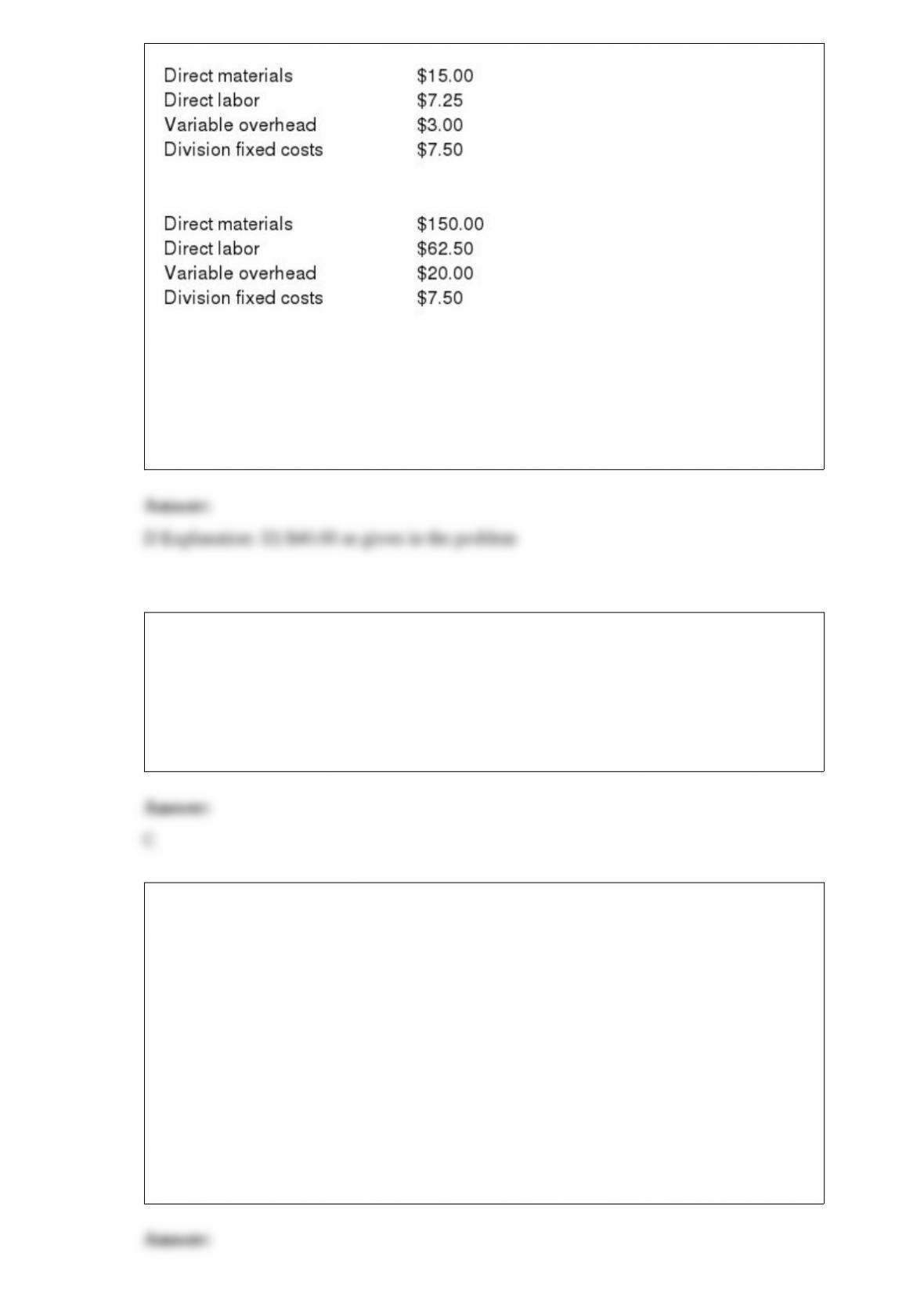
Fabrication’s costs per completed air conditioner are:
What is the market-based transfer price per compressor from the Compressor Division
to the Fabrication Division?
A) $17.00
B) $27.25
C) $34.75
D) $40.00
9) Costs expensed on the income statement in the accounting period incurred are called
________.
A) direct costs
B) indirect costs
C) period costs
D) inventoriable costs
10) Strategic Analysis of Profitability of Ransham Company:
Income Statement Amounts in 2014 Revenue and Cost Effects of Growth
Component in 2015 Revenue and Cost Effects of Price-Recovery Component in
2015 Cost Effect of Productivity Component in 2015 Income Statement Amounts
in 2015
Revenues ($) 34,000 10,000 F 1,000 U (b) (e)
Costs 23,500 (a) 500 U (c) 26,100
Operating income 10,500 5,500 F 1,500 U 2,400 F (d)
What is the revenue effect of the productivity component (b)?
A) $0
B) $2,400 U
C) $900 F
D) $2,400 F
11) Which of the following is the mathematical expression for the budgeted fixed
overhead cost per unit of cost allocation base?
A) Budgeted fixed overhead cost per unit of cost allocation base = Actual total costs in
fixed overhead cost pool / Budgeted total quantity of cost allocation base
B) Budgeted fixed overhead cost per unit of cost allocation base = Budgeted total costs
in fixed overhead cost pool / Budgeted total quantity of cost allocation base
C) Budgeted fixed overhead cost per unit of cost allocation base = Actual total costs in
fixed overhead cost pool / Actual total quantity of cost allocation base
D) Budgeted fixed overhead cost per unit of cost allocation base = Budgeted total costs
in fixed overhead cost pool / Actual total quantity of cost allocation base
12) Without financial quality measures, ________.
A) customer satisfaction and employee satisfaction cannot be measured
B) the short-run effectiveness of nonfinancial quality measures is questionable
C) cost-benefit analysis is not possible
D) quality problems might not be identified until it is too late
13) The drawback of the constant gross-margin percentage NRV method in joint costing
is that ________.
A) it recognizes that profits are derived from the costs incurred after splitoff
B) it assumes the profit margin to be identical across all products
C) it attempts to approximate the sales values at splitoff by subtracting from final
selling prices the separable costs incurred after the splitoff point
D) it ignores the separable costs of further processing
14) Which of the following statements best defines manufacturing cycle time in a JIT
production system?
A) the time from when raw materials is received until it becomes a finished good
B) the time from when an order is received until it becomes a finished good
C) the time from when raw materials is received until it is delivered to the customers
D) the time from when an order is received until it is delivered to the customers
15) Sales-mix variance = $250,000 (F), sales-volume variance = $4,50,000 (U),
flexible-budget variance = $200,000(F), market-size variance = $30,000(U), calculate
the sales-quantity variance.
A) $170,000 (U)
B) $200,000 (U)
C) $30,000 (U)
D) $700,000 (U)
16) In a company with low operating leverage, ________.
A) fixed costs are more than the contribution margin
B) contribution margin and operating income are inversely related
C) there is a higher possibility of net loss than a higher-leveraged firm
D) less risk is assumed than in a highly leveraged firm
17) While calculating the costs of products and services, a standard costing system
________.
A) allocates overhead costs on the basis of the actual overhead-cost rates
B) uses standard costs to determine the cost of products
C) does not keep track of overhead cost
D) traces direct costs to output by multiplying the standard prices or rates by the actual
quantities
18) Which of the following costs is inventoried when using variable costing?
A) rent on factory building
B) electricity consumed in manufacturing process
C) sales commission paid on each sale
D) advertising costs incurred for the product