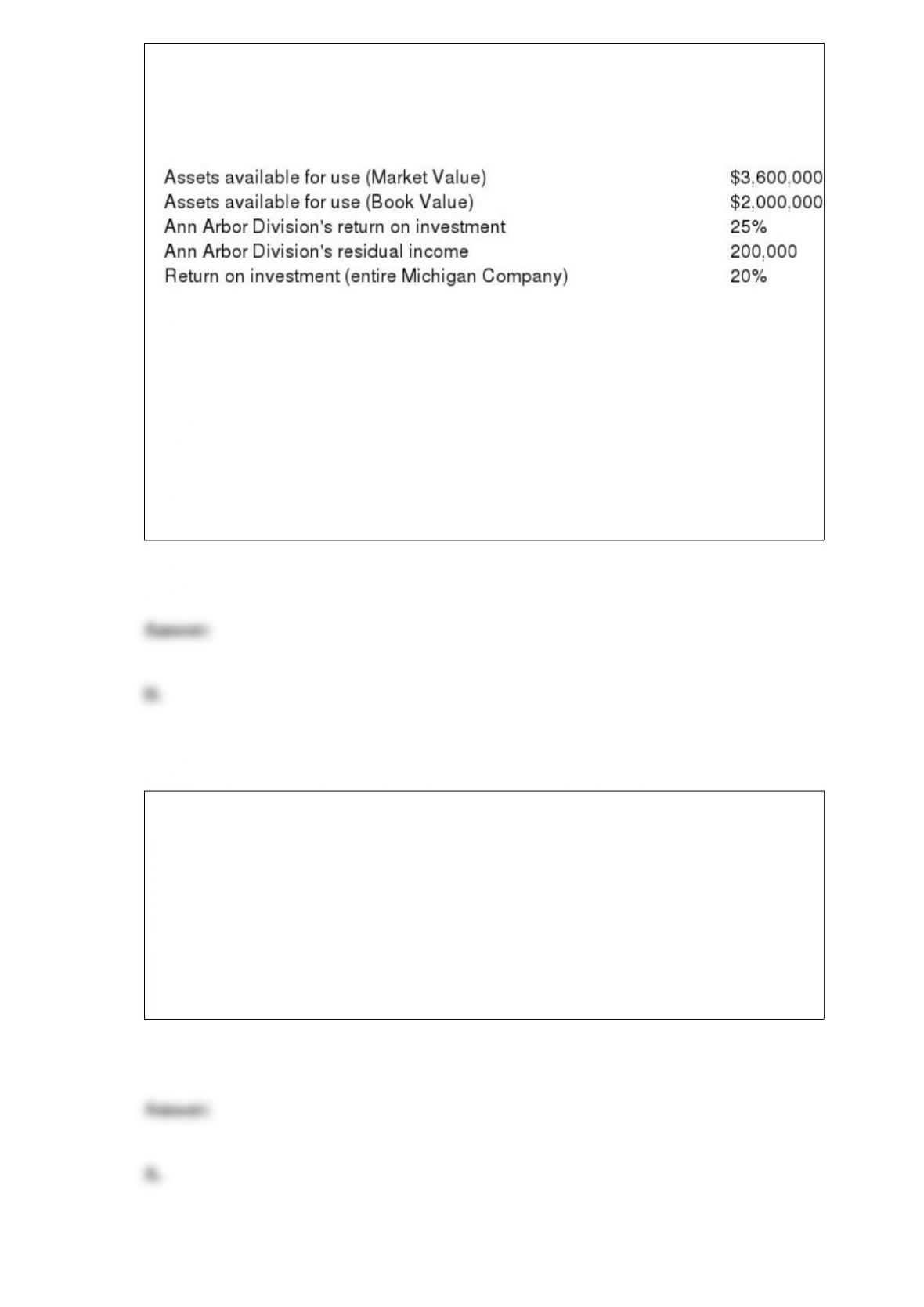
Michigan Company
Ann Arbor Division of the Michigan Company has the following statistics for its most
recent operations:
Refer to Michigan Company. Compute EVA assuming the cost of capital is 10% and the
tax rate is 40%.
A. $ 90,000
B. $ 150,000
C. $0
D. $ (60,000)
The estimated maximum potential activity for a specified time is:
A. theoretical capacity
B. practical capacity
C. normal capacity
D. expected capacity

Companies have often produced significant amounts of excess inventory because of
A. variable overhead allocation methodologies.
B. fixed overhead allocation methodologies.
C. variable and fixed overhead allocation methodologies.
D. the financial accounting requirement to expense research and development as
incurred.
In deciding whether an organization will keep an old machine or purchase a new
machine, a manager would ignore the
A. estimated disposal value of the old machine.
B. acquisition cost of the old machine.
C. operating costs of the new machine.
D. estimated disposal value of the new machine.
Which of the following statements is false? The cost of rework on defective units, if
A. abnormal, should be assigned to a loss account.
B. normal and if actual costs are used, should be assigned to material, labor and
overhead costs of the good production.
C. normal and if standard costs are used, should be considered when developing the

overhead application rate.
D. abnormal, should be prorated among Work In Process, Finished Goods, and Cost of
Goods Sold.
Sullivan Company
Sullivan Company is preparing its Manufacturing Overhead budget for the second
quarter of the year. Budgeted variable factory overhead is $3.00 per unit produced;
budgeted fixed factory overhead is $75,000 per month, with $16,000 of this amount
being factory depreciation.
Refer to Sullivan Company. If the budgeted production for May is 5,000 units, then the
total budgeted factory overhead per unit:
A. $15
B. $18
C. $20
D. $22
A small manufacturing company recently stated its sales goal for a period was
$100,000. At this level of activity, its budgeted expenses were $80,000. Its actual sales
were $100,000, but its actual expenses were $85,000. This company operated
A. effectively and efficiently.
B. neither effectively nor efficiently.

C. effectively but not efficiently.
D. efficiently but not effectively.
An increase in direct fixed costs could reduce all of the following except
A. product line contribution margin.
B. product line segment margin.
C. product line operating income.
D. corporate net income.
Assume actual output exceeds the level of output in the original budget. Costs in
which of the following categories will exceed the original budget?
A. total variable costs
B. committed fixed costs
C. discretionary fixed costs
D. all of the above

Industrial Solutions Company
Industrial Solutions Company produces three products from the same process that has
joint processing costs of $4,100. Products R, S, and T are produced in the following
quantities: 250 gallons, 400 gallons, and 750 gallons. Industrial Solutions Company
also incurred advertising costs of $60,000. The ad was used to run sales for all three
products. The three products occupy floor space in the following ratio: 5:4:9. (Round all
answers to the nearest dollar.)
Refer to Industrial Solutions Company. Using gallons as the physical measurement,
what amount of joint processing cost is allocated to Product T?
A. $2,196
B. $732
C. $1,367
D. $1,171
A company producing which of the following would be most likely to use a price
standard for material?
A. furniture
B. NFL-logo jackets
C. custom-made picture frames
D. none of the above
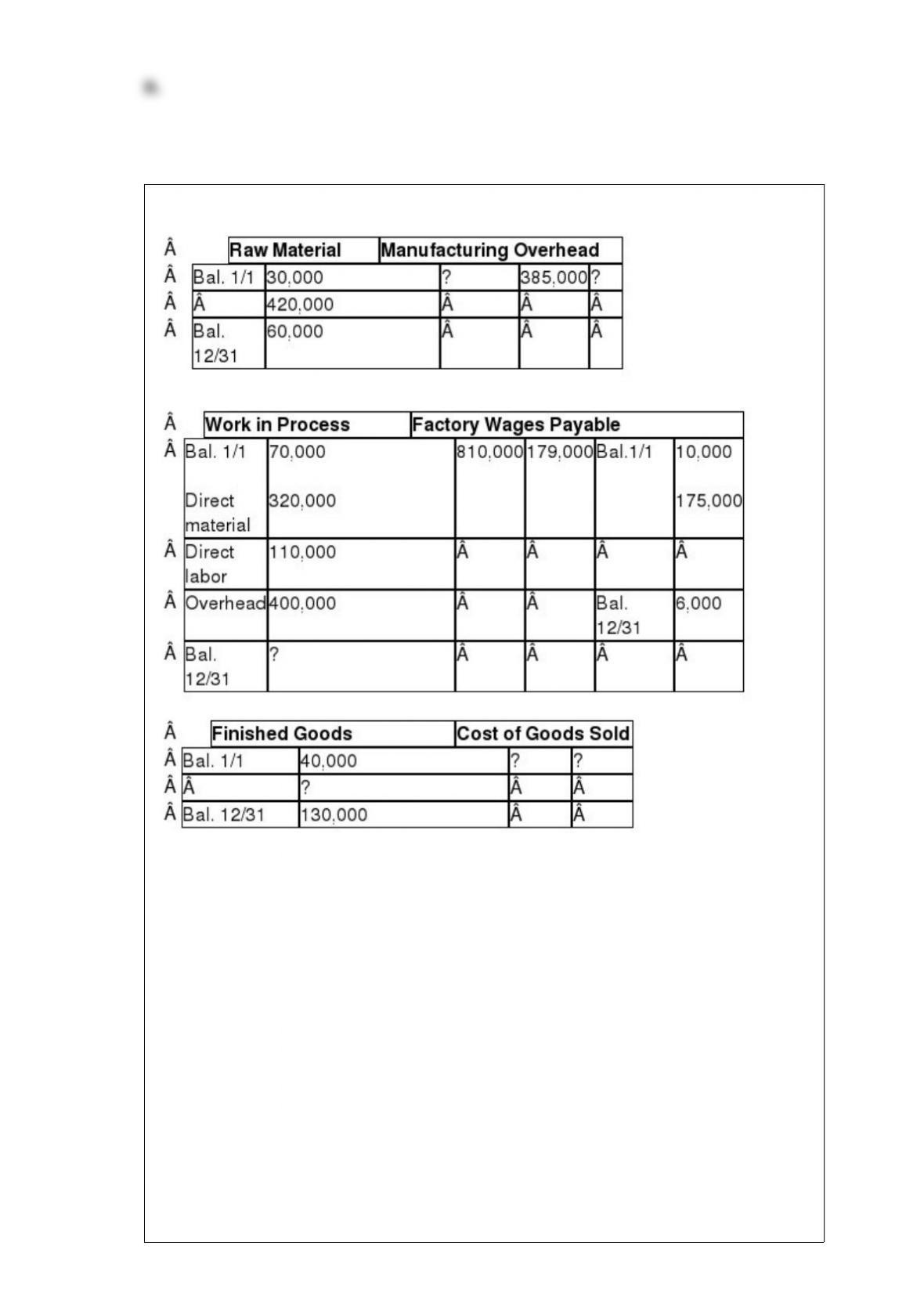
The Lakeview Corporation had the following account balances:
Required:
a. What was the cost of raw material put into production during the year?
b. How much of the material from question 1 consisted of indirect material?
c. How much of the factory labor cost for the year consisted of indirect labor?
d. What was the cost of goods manufactured for the year?
e. What was the cost of goods sold for the year (before considering under- or
overapplied overhead)?
f. If overhead is applied to production on the basis of direct material, what rate was in
effect during the year?
g. Was manufacturing overhead under- or overapplied? By how much?
h. Compute the ending balance in the Work in Process Inventory account. Assume that
this balance consists entirely of goods started during the year. If $32,000 of this balance
is direct material cost, how much of it is direct labor cost? Manufacturing overhead
cost?
Knowing specific job costs enables managers to effectively perform which of the
following tasks?
A. estimate costs of future jobs.
B. establish realistic job selling prices.
C. evaluate job performance.
D. all answers are correct.
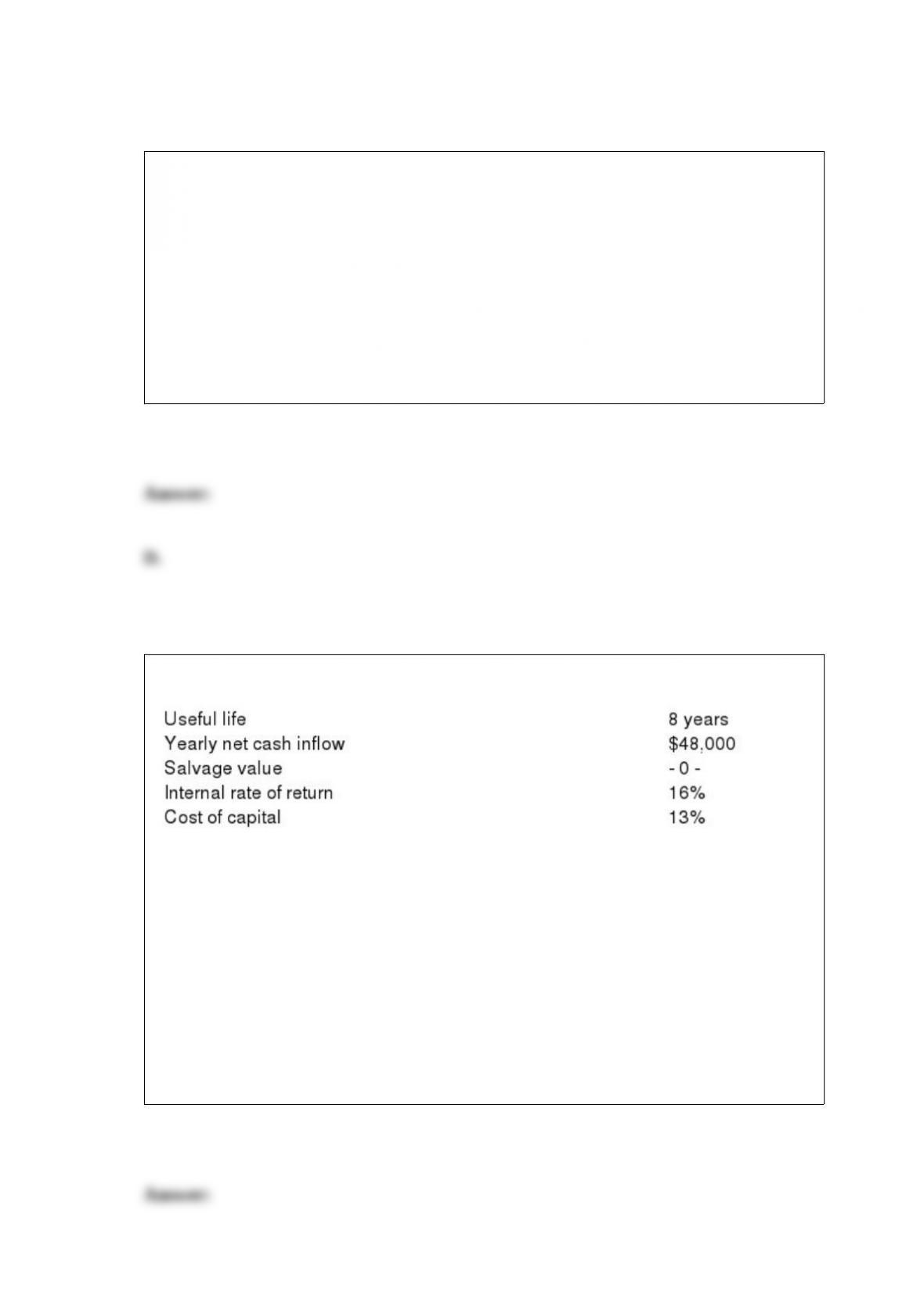
Lynch Corporation bought a piece of machinery. Selected data is presented below:
Present value tables or a financial calculator are required.
The initial cost of the machinery was
A. $201,496
B. $208,493
C. $215,390
D. $230,342

____ focuses only on factors that change from one course of action to another.
A. Incremental analysis
B. Margin of safety
C. Operating leverage
D. A break-even chart
Which of the following tells management “when” to order?
A. safety stock level
B. order point
C. the economic order quantity
D. the Pareto inventory analysis