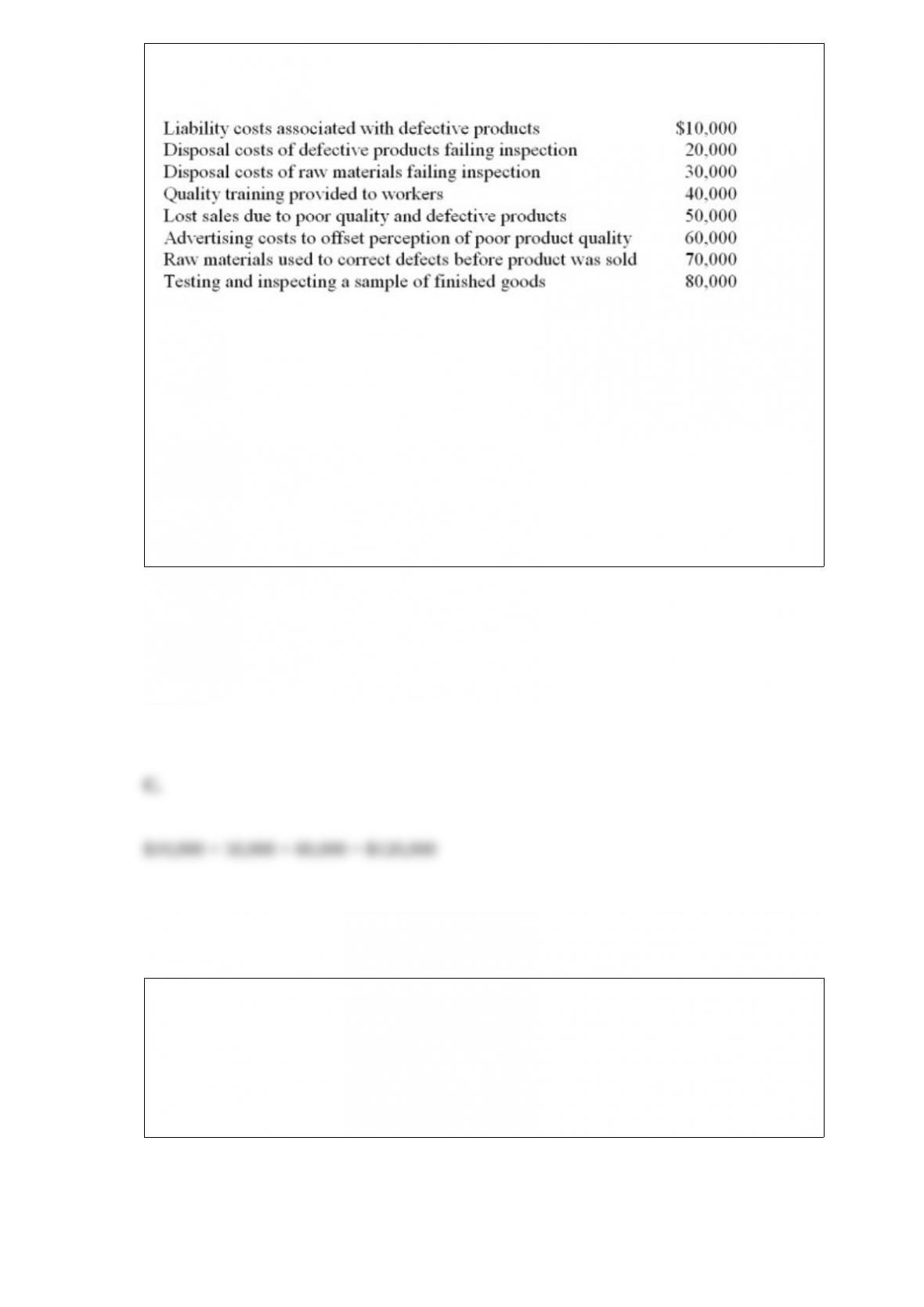
QC Enterprises quality control report for August contains the following items.
What would be the total of the external failure costs on the August quality control
report for QC Enterprises?
A. $70,000
B. $110,000
C. $120,000
D. $140,000
Answer:
The Update Company does not maintain backup documents for its computer files. In
June, some of the current data were lost, and you have been asked to help reconstruct
the data. The following beginning balances on June 1 are known:
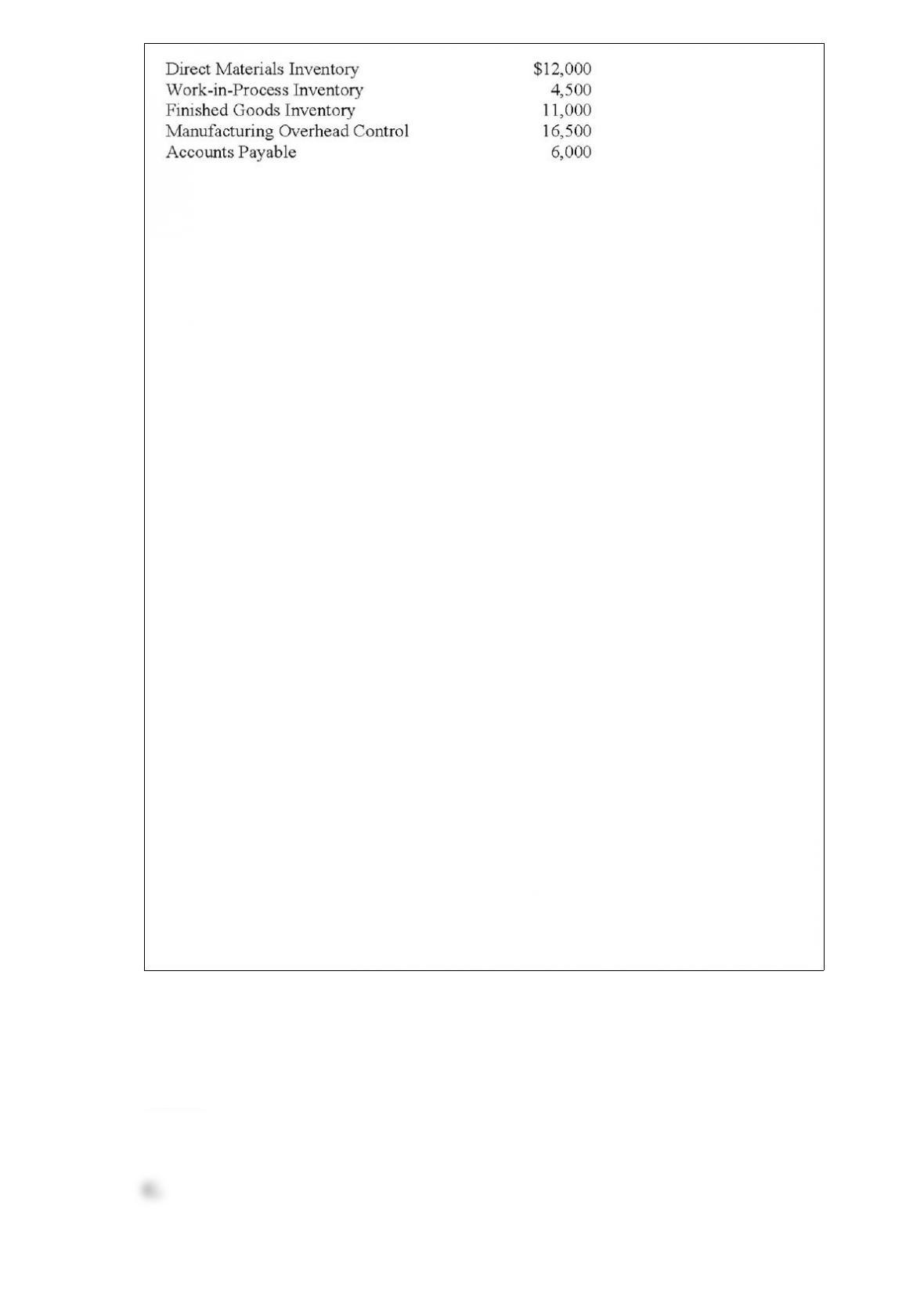
Reviewing old documents and interviewing selected employees have generated the
following additional information:
The production superintendent’s job cost sheets indicated that materials of $2,600 were
included in the June 30 Work-in-Process Inventory. Also, 300 direct labor hours had
been paid at $6.00 per hour for the jobs in process on June 30.
The Accounts Payable account is only for direct material purchases. The clerk
remembers clearly that the balance in the Accounts Payable on June 30 was $8,000. An
analysis of canceled checks indicated payments of $40,000 were made to suppliers
during June.
Payroll records indicate that 5,200 direct labor hours were recorded for June. It was
verified that there were no variations in pay rates among employees during June.
Records at the warehouse indicate that the Finished Goods Inventory totaled $16,000 on
June 30.
Another record kept manually indicates that the Cost of Goods Sold in June totaled
$84,000.
The predetermined overhead rate was based on an estimated 60,000 direct labor hours
for the year and an estimated $180,000 in manufacturing overhead costs.
What is the amount of direct materials purchased during June?
A. $38,000
B. $40,000
C. $42,000
D. $43,000
Answer:
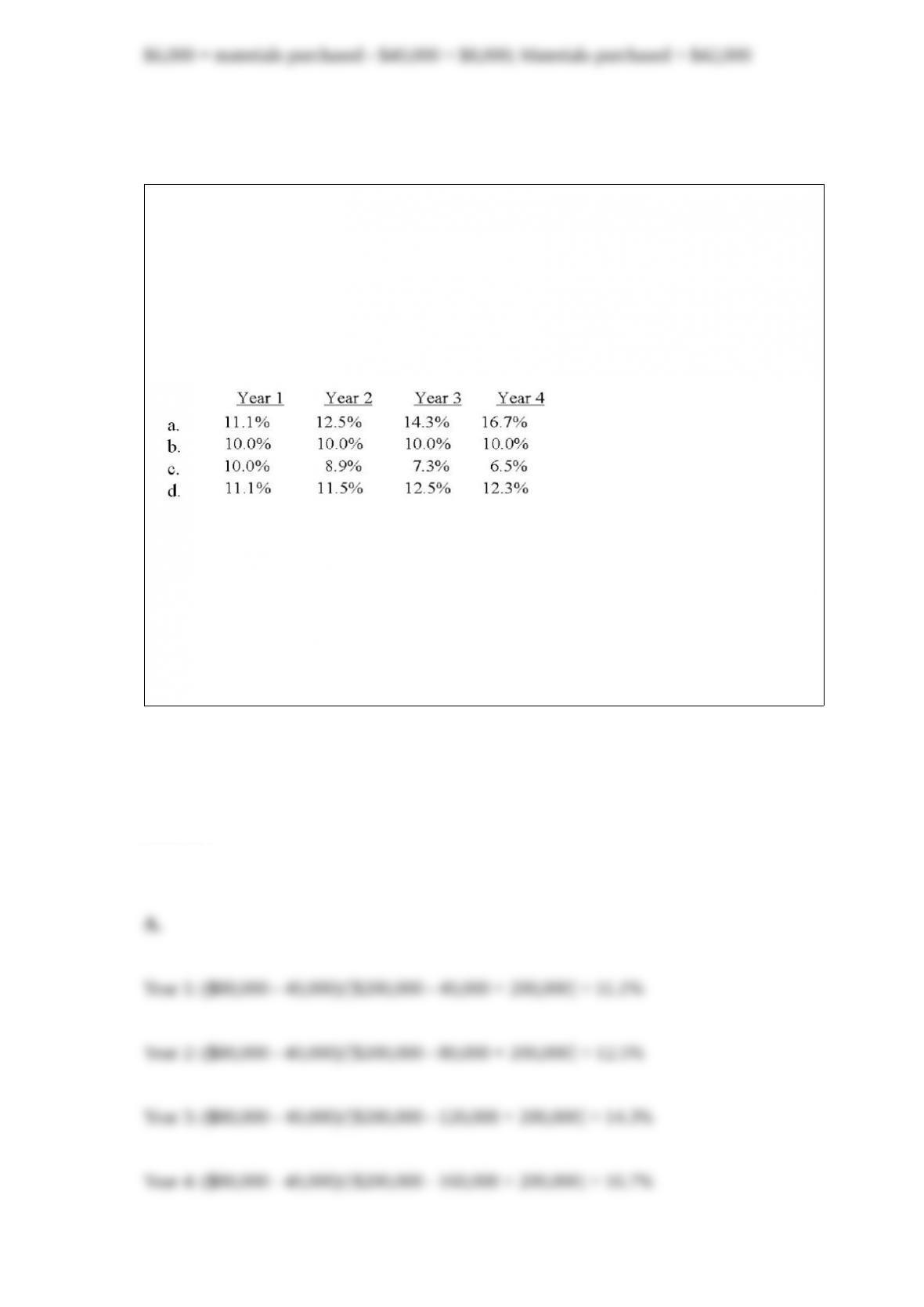
A company purchased assets costing $200,000 which will be depreciated over 5-years
using straight-line depreciation and no salvage value. The company also purchased land
and other assets, which are not depreciable at a cost of $200,000. It is estimated that in
5-years, the value of these assets will be unchanged. Assume that annual cash profits
are $80,000 and, for return on investment (ROI) calculations, the company uses
end-of-year asset values.
What is the ROI for each year using net book value?
A. a
B. b
C. c
D. d
Answer:
Multinational firms often face conflicting pressures when developing transfer pricing
policies. Tax avoidance results when
A. inflated transfer prices are used to reduce the profits of divisions in high tax-rate
countries.
B. inflated transfer prices are used to reduce the profits of divisions in low tax-rate
countries.
C. cost-based transfer prices are used instead of market transfer prices in high tax-rate
countries.
D. cost-based transfer prices are used instead of negotiated market transfer prices in low
tax-rate countries.
Answer:
The practice of setting prices highest when the quantity demanded for the product
approaches capacity:
A. predatory pricing
B. target pricing
C. peak-load pricing
D. price fixing

Answer:
Which of the following responsibility centers is affected by the use of market-based
transfer prices?
A. cost center.
B. profit center.
C. revenue center.
D. production center.
Answer:
The operations of Blink Corporation are divided into the Will Division and the Aloy
Division. Projections for the next year are as follows:
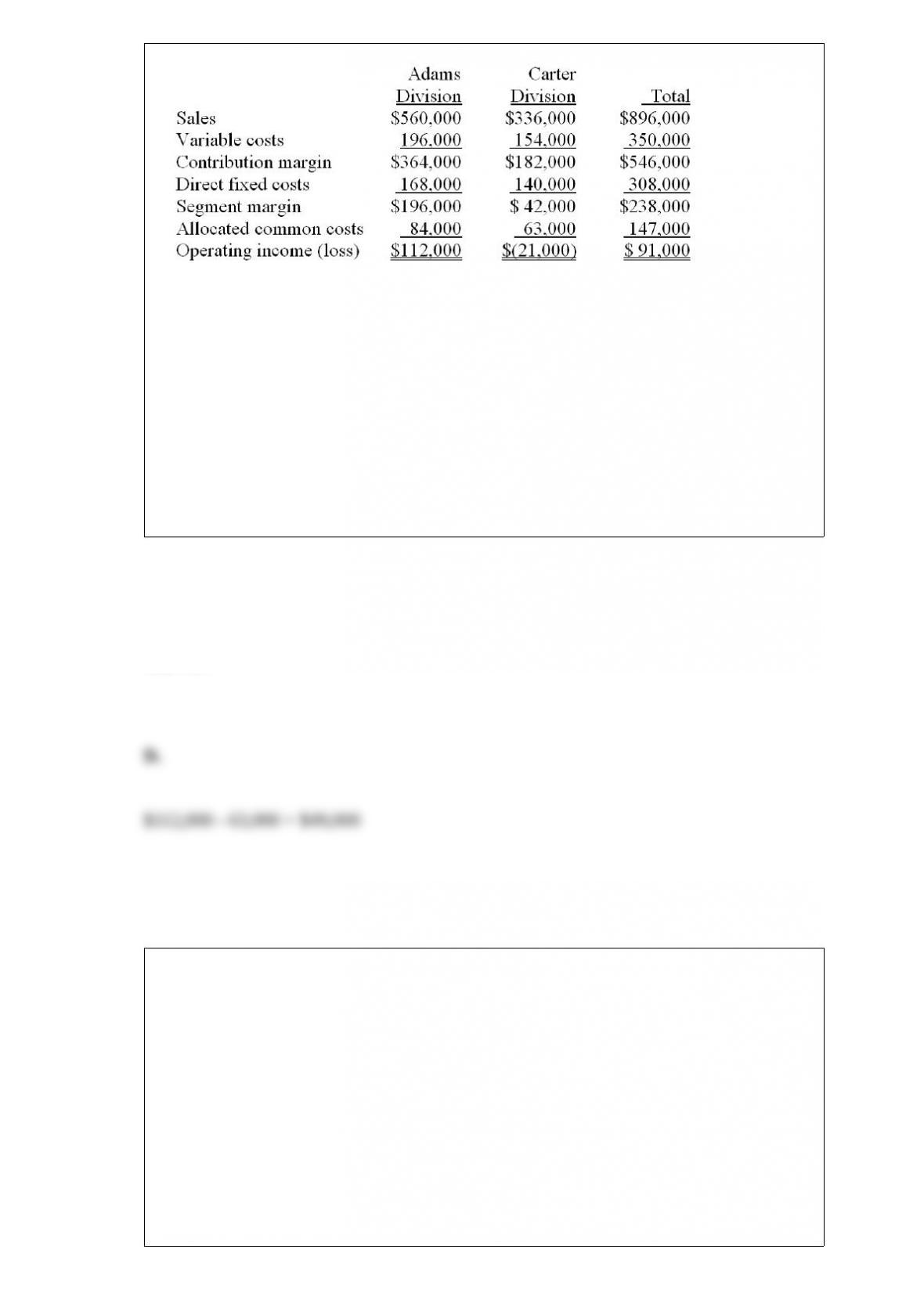
Operating income for Blink Corporation as a whole if the Carter Division were dropped
would be
A. $133,000
B. $112,000
C. $91,000
D. $49,000
Answer:
Rosebud Manufacturing uses actual costing. The following events took place during
the current year:
(1) Purchased $95,000 in direct materials.
(2) Incurred labor costs as follows: (a) direct, $56,000 and (b) indirect, $13,600.
(3) Other manufacturing overhead was $107,000, excluding indirect labor.
(4) Transferred 80% of the materials to the manufacturing assembly line.
(5) Completed 65% of the Work-in-Process during the year.
(6) Sold 85% of the completed goods.
(7) There were no beginning inventories.
Required:
(a) Determine the ending Direct Materials Inventory balance.
(b) Determine the ending Work-in-Process Inventory balance.
(c) Determine the ending Finished Goods Inventory balance.
(d) Determine the Cost of Goods Manufactured.
Answer:
Maple Lake Company is preparing its annual profit plan. As part of its analysis of the
cost of its purchasing activity, management estimates that the $250,000 for purchasing
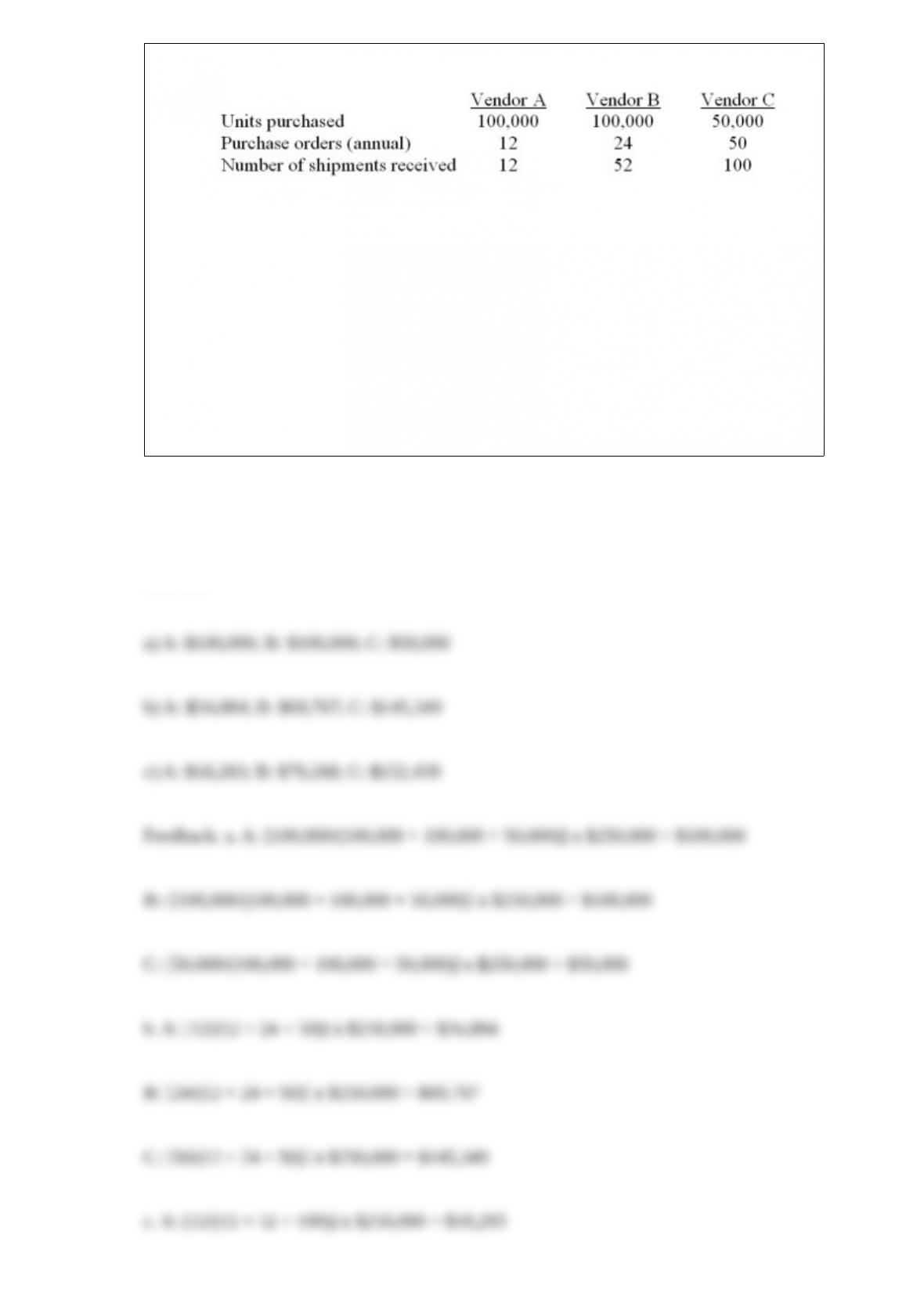
support should be assigned to the individual vendors from the information given as
follows:
Required:
a) Prepare a schedule to allocate the purchasing costs to the three vendors, assuming
Maple Lake uses units purchased to compute activity-based costs?
b) Prepare a schedule to allocate the purchasing costs to the three vendors, assuming
Maple Lake uses purchases orders to compute activity-based costs?
c) Prepare a schedule to allocate the purchasing costs to the three vendors, assuming
Maple Lake uses number of shipments to compute activity-based costs?
Answer:

Cruises, Inc., operates two divisions: (1) a management division that owns and
manages cruise ships in the Florida Keys and (2) a repair division that operates a dry
dock in Marble Sand Florida. The repair division works on company ships, as well as
other large-hull ships.
The repair division has an estimated variable cost of $28.50 per labor-hour. The repair
division has a backlog of work for outside ships. They charge $48.00 per hour for labor,
which is standard for this type of work. The management division complained that it
could hire its own repair workers for $30.00 per hour, including leasing an adequate
work area.
If the repair division had idle capacity, what is the minimum transfer price that the
repair division should obtain?
A. $28.50
B. $30.00
C. $39.00
D. $46.50
E. $48.00
Answer:
Flowers and Flowers, Inc., has two divisions. Division A has an investment base of
$750,000 and produces (and sells) 100,000 units of Eyne at a market price of $10.00
per unit. Variable costs total $3.50 per unit, and fixed charges are $4.00 per unit (based
on a capacity of 120,000 units). Division B wants to purchase 25,000 units of Eyne
from Division A. However, Division B is only willing to pay $6.75 per unit.
What is the minimum transfer price for the 25,000 unit order that Division A would
accept if it wishes to maintain its pre-order contribution?
A. $3.50
B. $4.00
C. $4.80
D. $6.00
Answer:
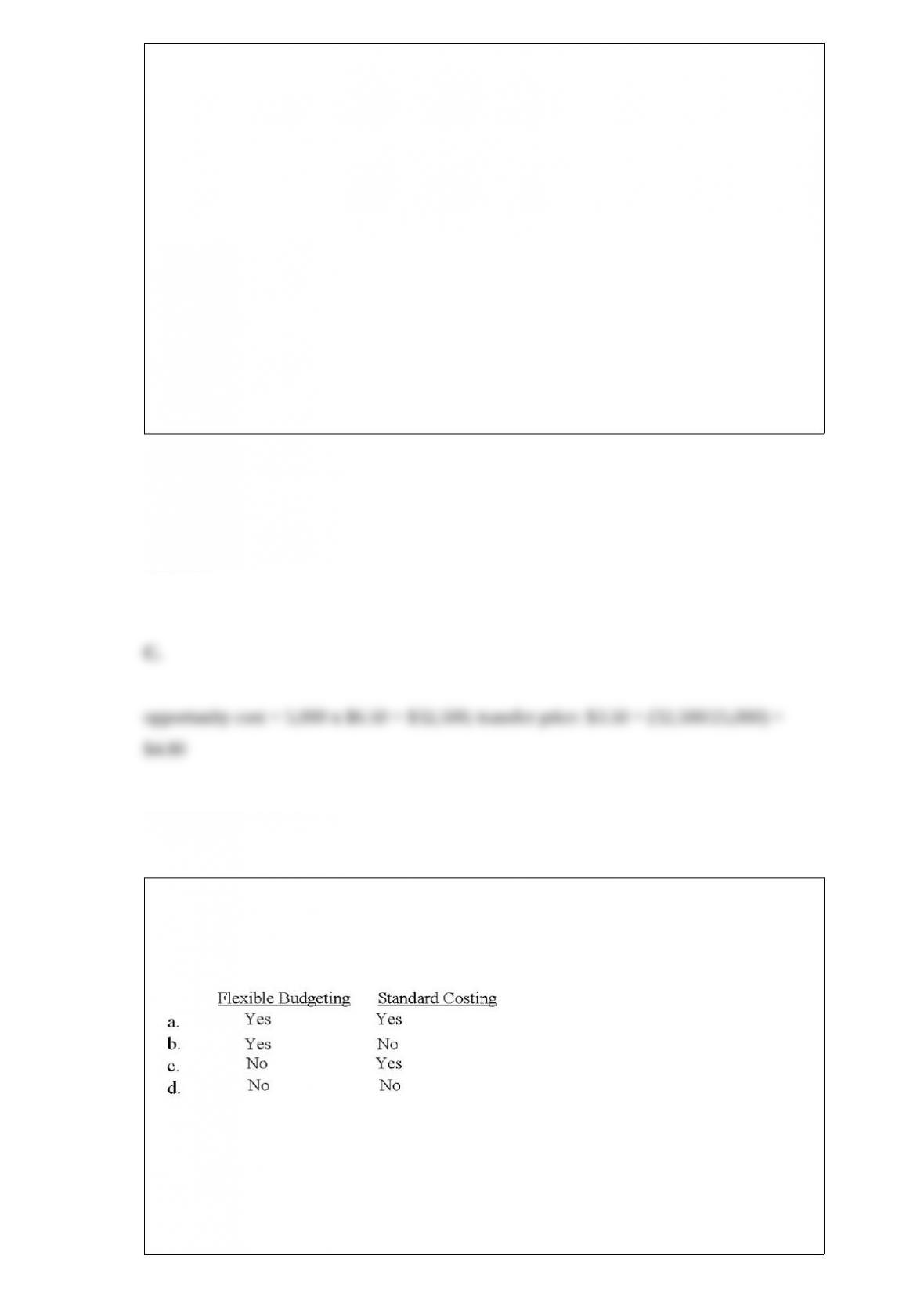
When a manager is concerned with monitoring total cost, total revenue, and net profit
conditioned upon the level of productivity, an accountant should normally recommend
(CPA adapted)
A. a
B. b
C. c
D. d
Answer:
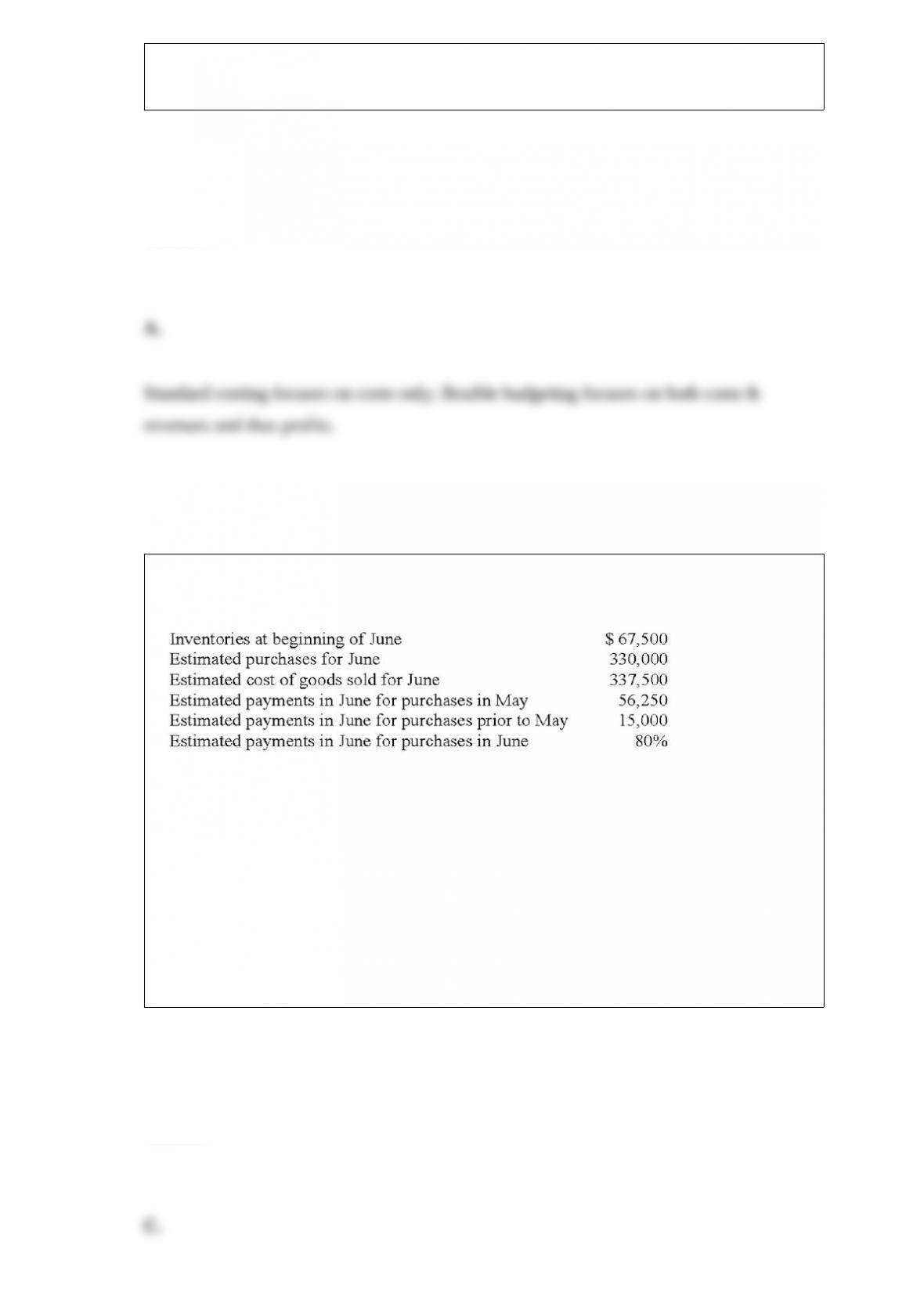
The Jack Company is preparing its cash budget for the month of June. The following
information is available concerning its inventories:
What are the estimated cash disbursements for inventories in June?
A. $264,000.
B. $320,250.
C. $335,250.
D. $341,250.
Answer:
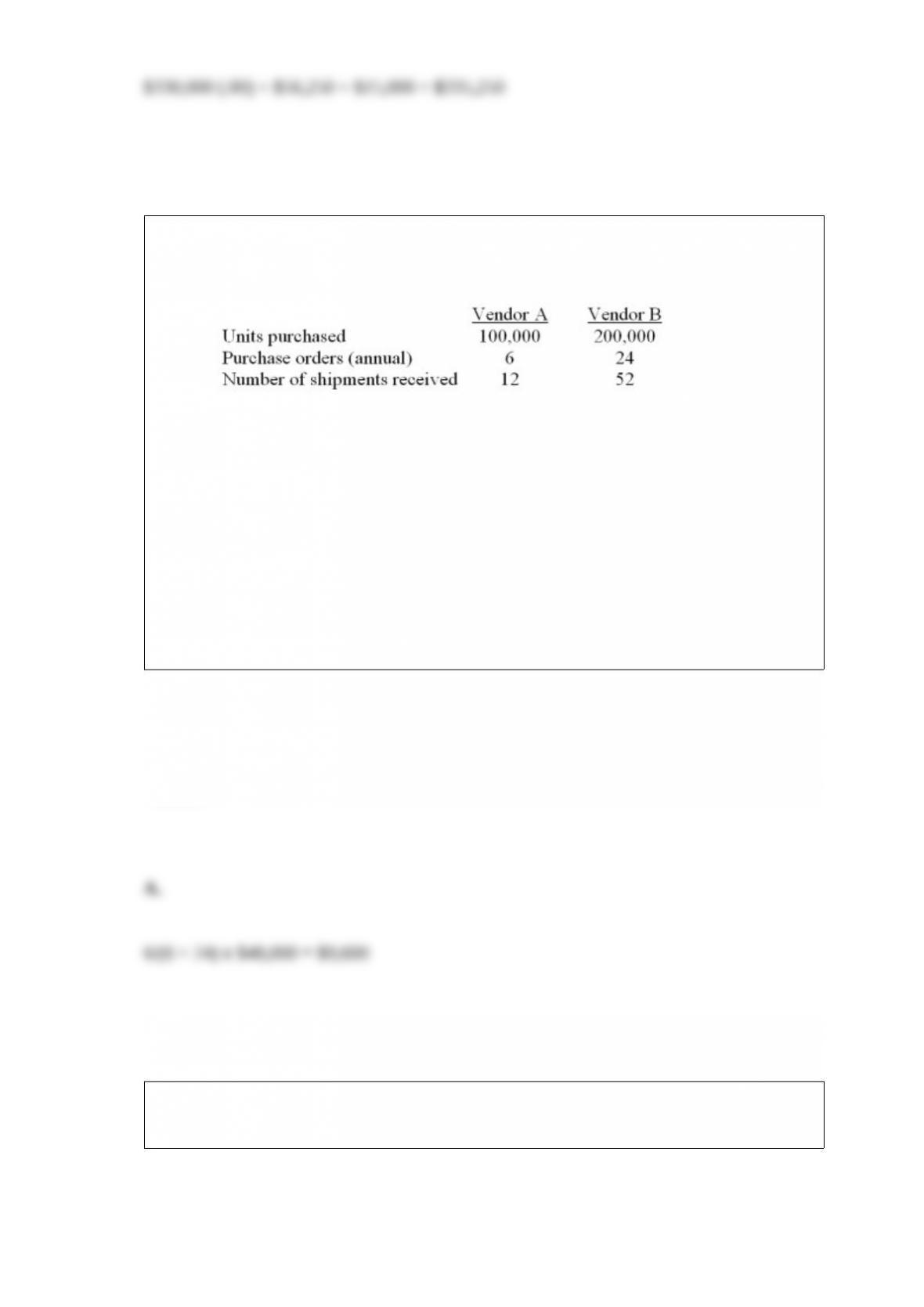
Rogers Company is preparing its annual profit plan. As part of its analysis of the cost
of its purchasing activity, management estimates that the $48,000 for purchasing
support should be assigned to the individual vendors from the information given as
follows:
What is the amount of the purchasing costs that should be allocated to Vendor A
assuming Rogers uses purchases orders to compute activity-based costs?
A. $9,600
B. $16,000
C. $32,000
D. $38,400
Answer:
The XYZ Company had the following expectations for the year:
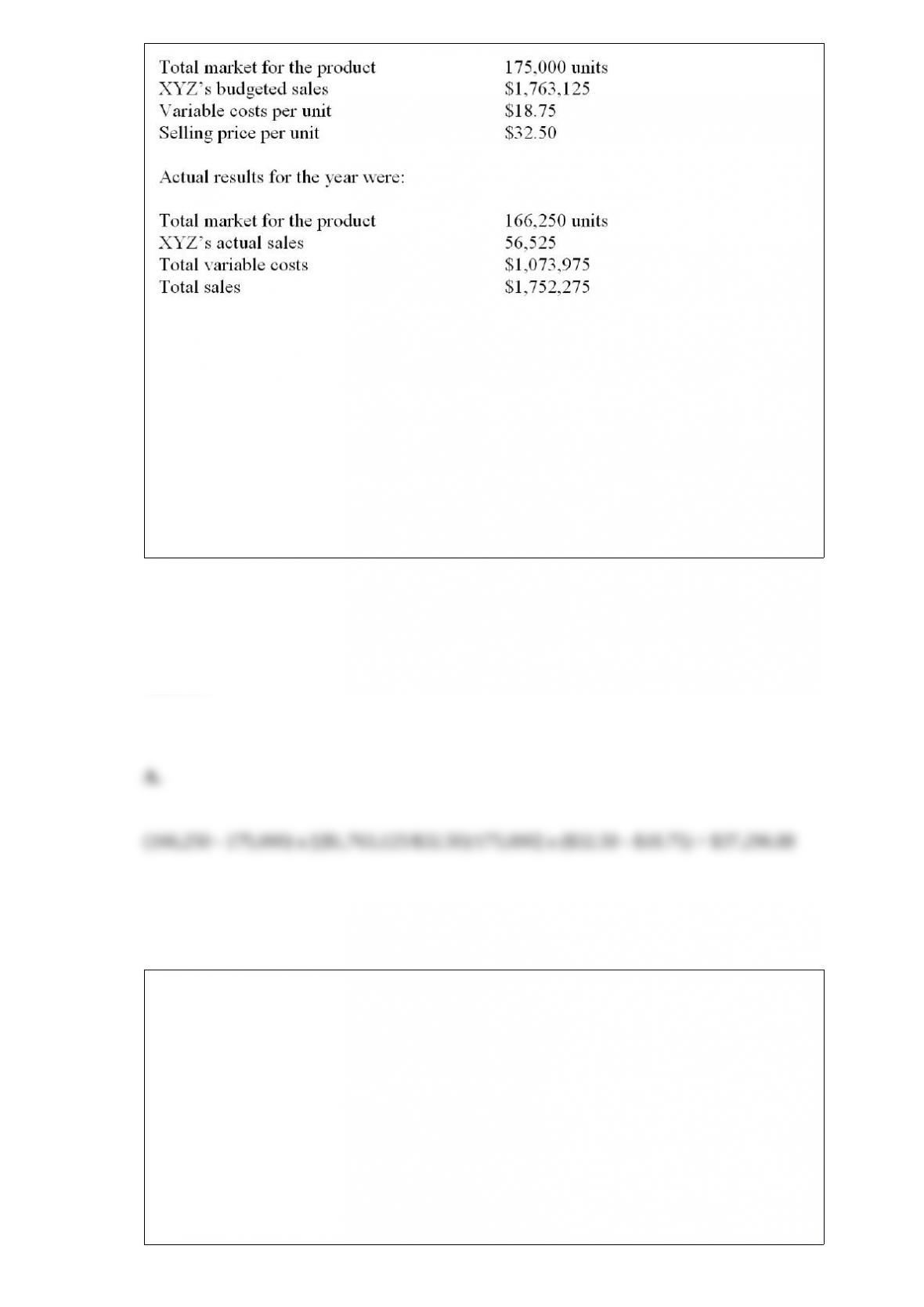
What is XYZ’s market share variance?
A. $37,296.88
B. $40,906.25
C. $35,700.00
D. $32,550.00
Answer:
For the past five years, the RS Company has produced and sold electronic magnets to
chemistry labs throughout the United States. Recently, a strong competitor has entered
the market and RS is considering whether it should continue to produce and sell the
electronic magnets. The following information has been gathered to assist management
in their decision:
A) The machinery used to produce the magnet was purchased five-years ago for
$500,000.
B) Four of the employees who produce magnets would be reassigned to the magnifying
glass division.

C) The space now used to produce the magnets would be used to eliminate the need to
rent warehouse space.
D) Sales volume (units) is estimated to drop by 50% once the competitor becomes fully
operational.
Which of the items listed above is (are) relevant to the decision to continue the
production and sale of the electronic magnets?
A. A and C.
B. B and C.
C. C and D.
D. A, B, and D.
E. B, C, and D.
Answer:
Which of the following statements regarding differential costs is (are) true?
(A) The full cost fallacy occurs when a decision-maker includes fixed manufacturing
overhead in the product’s cost.
(B) When deciding whether or not to accept a special order, a decision-maker should
focus on differential costs instead of full costs.
A. Only A.
B. Only B.
C. Neither A nor B is false.
D. Both A and B are true.
Answer:
Employee involvement is important in an effective performance measurement system
because it
A. increases the employee’s commitment to the organization and its objectives.
B. decreases the employee’s reliance on financial performance measures.
C. increases the likelihood that goal congruence problems will occur.
D. decreases the chances of an unfavorable manufacturing cycle time.
Answer:
The amount of materials to be purchased during the budget period is equal to budgeted
A. total production needs plus units in the beginning materials inventory minus the
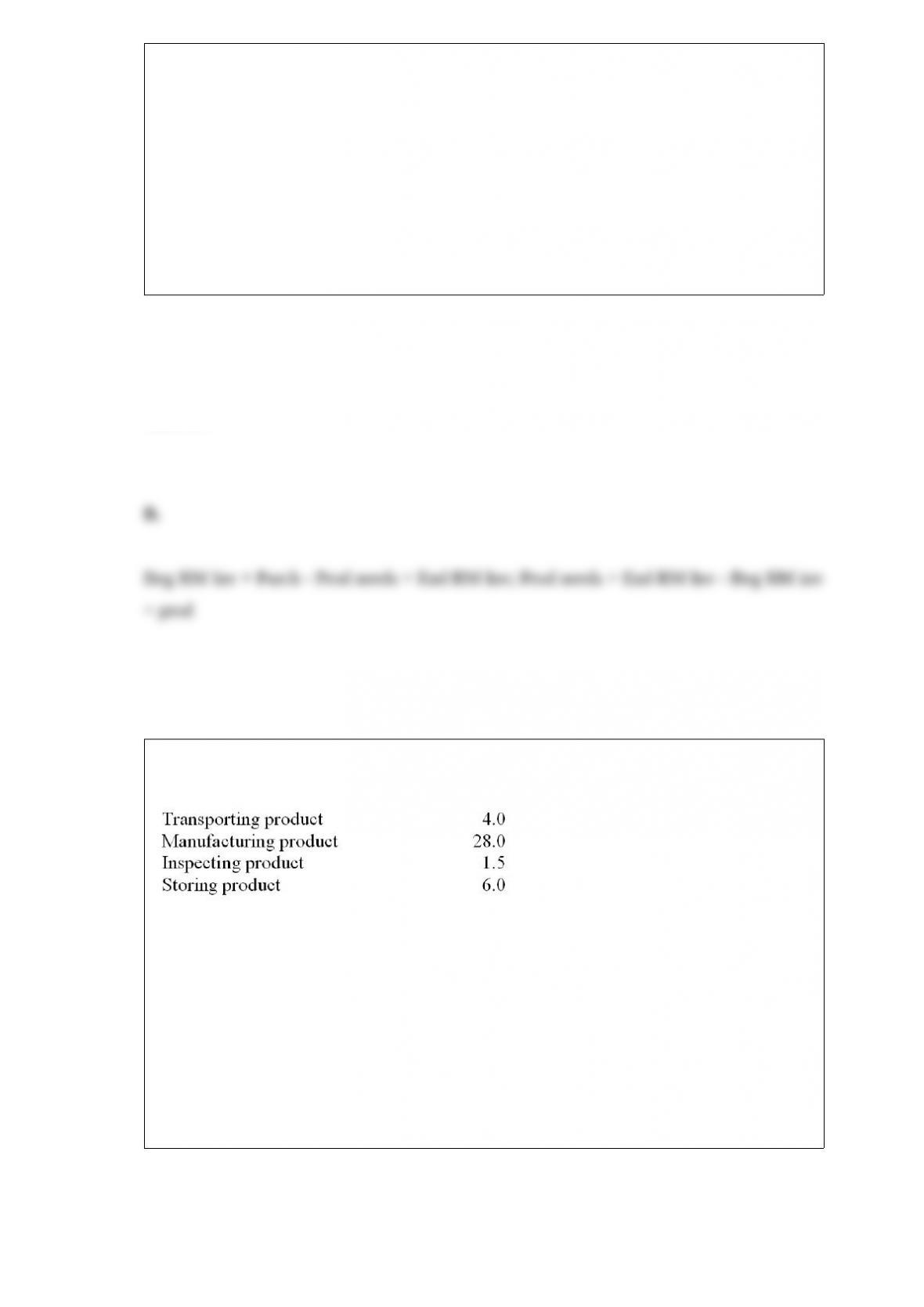
units in the ending materials inventory.
B. total production needs plus units in the ending materials inventory minus the units in
the beginning materials inventory.
C. units to be produced plus units in the beginning materials inventory minus the units
in the ending materials inventory.
D. units to be produced plus units in the ending materials inventory minus the units in
the beginning materials inventory.
Answer:
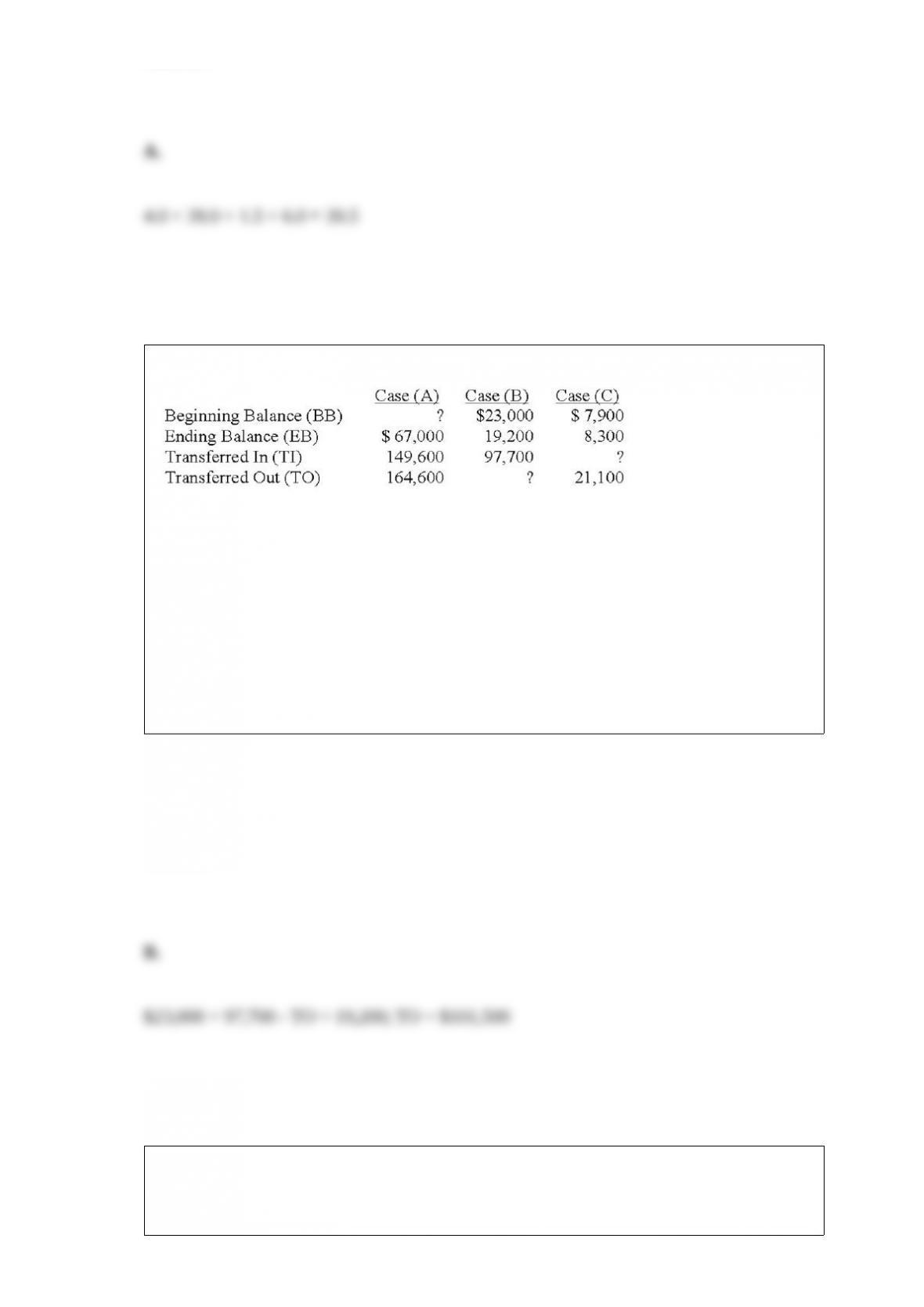
The QRT Company collected the following information (in days):
What is the manufacturing cycle time?
A. 39.5 days
B. 34.0 days
C. 32.0 days
D. 10.0 days
Answer:
For Case (B) above, what is the amount Transferred Out (TO)?
A. $93,900
B. $101,500
C. $116,900
D. $120,700
Answer:
The operations of Hurley Corporation are divided into the Northern Division and the
Eastern Division. Projections for the next year are as follows:
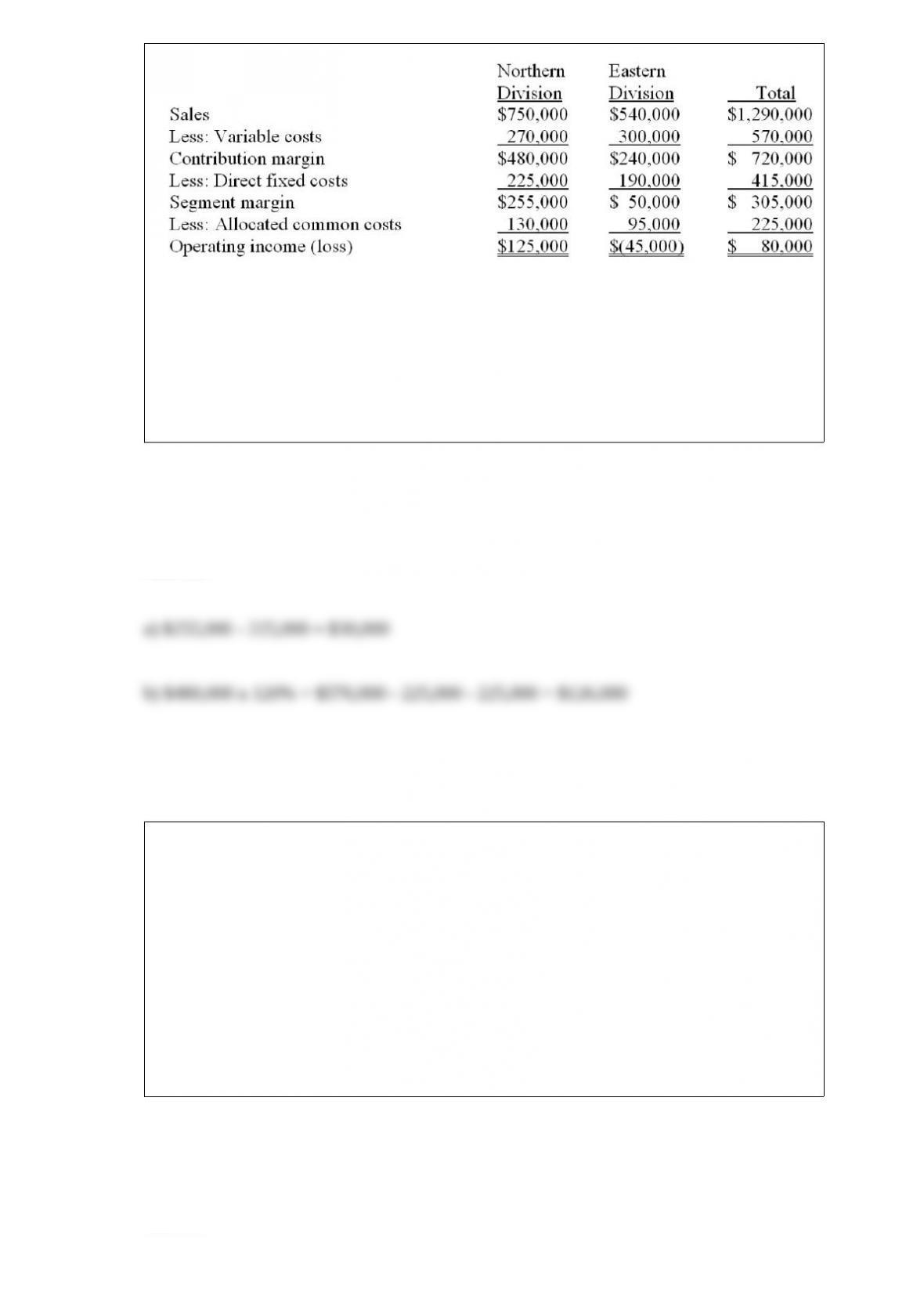
a)Operating income for Hurley Corporation, as a whole, if the Eastern Division were
dropped would be:
b) If Eastern Division is dropped, Northern’s sales will increase by 20%. What will
Hurley Corporation’s operating income be?
Answer:
The Najacht Division of the Rassbach Company has a return on investment (ROI) of
12%, sales of $200,000, and an asset turnover of 2.0. What was Najacht’s operating
income?
A. $6,000
B. $12,000
C. $24,000
D. $48,000
Answer:
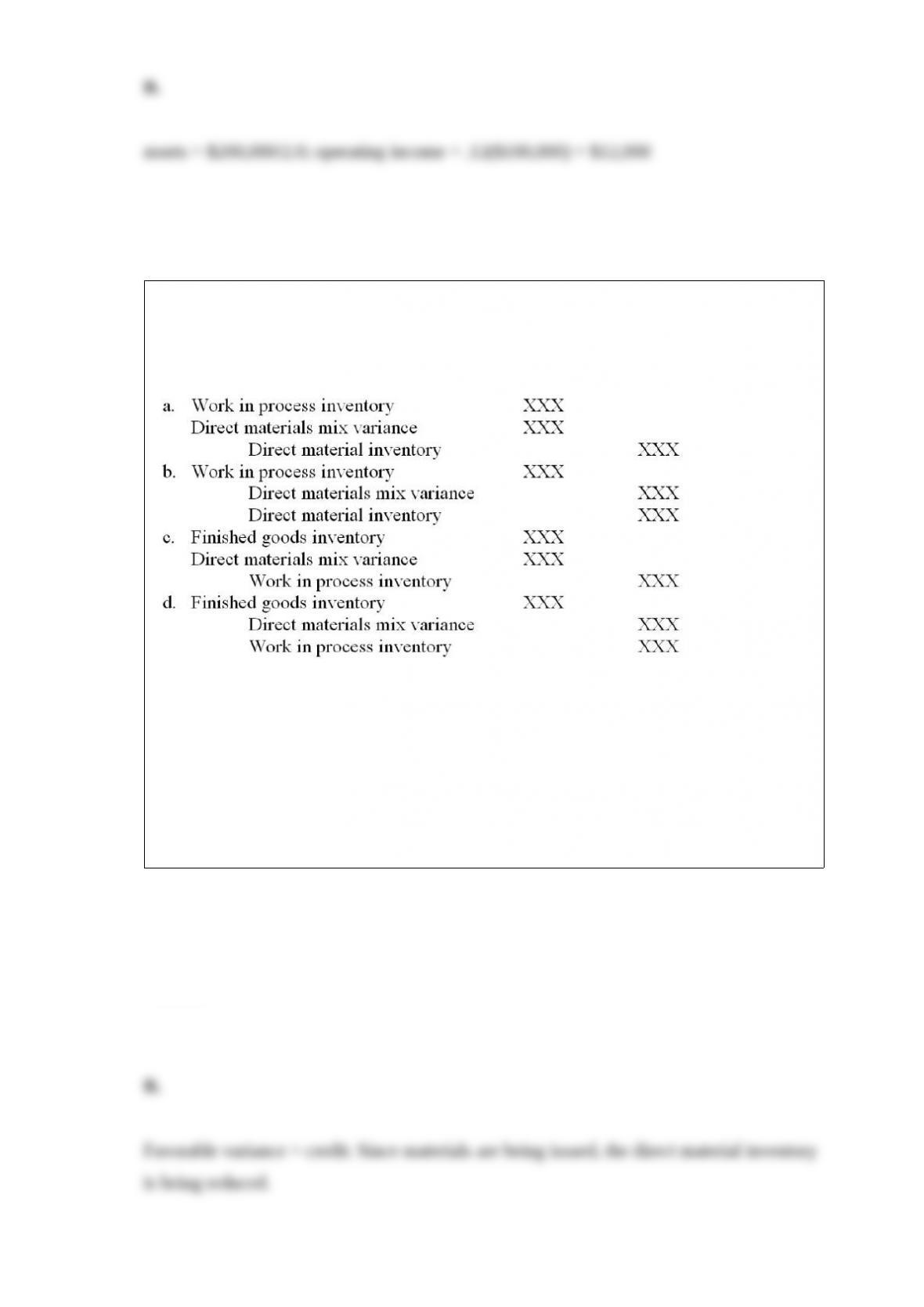
What is the correct journal entry to record a favorable materials mix variance assuming
all material variances are recognized when the direct materials are issued to production?
A. a
B. b
C. c
D. d
Answer:

Which of the following balanced scorecard perspectives focuses on quality and process
improvement?
A. Financial
B. Customer
C. Internal Business Process
D. Learning and growth
Answer:
A system that provides information about the costs of processes, products, and services
used and produced by an organization is a
A. continuous flow process.
B. cost management system.
C. two-stage allocation system.
D. operations cost.
Answer:
A system that mass-produces a single, homogenous output in a continuous process is:
A. continuous flow process.
B. cost management system.
C. two-stage allocation system.
D. operations cost.
Answer:
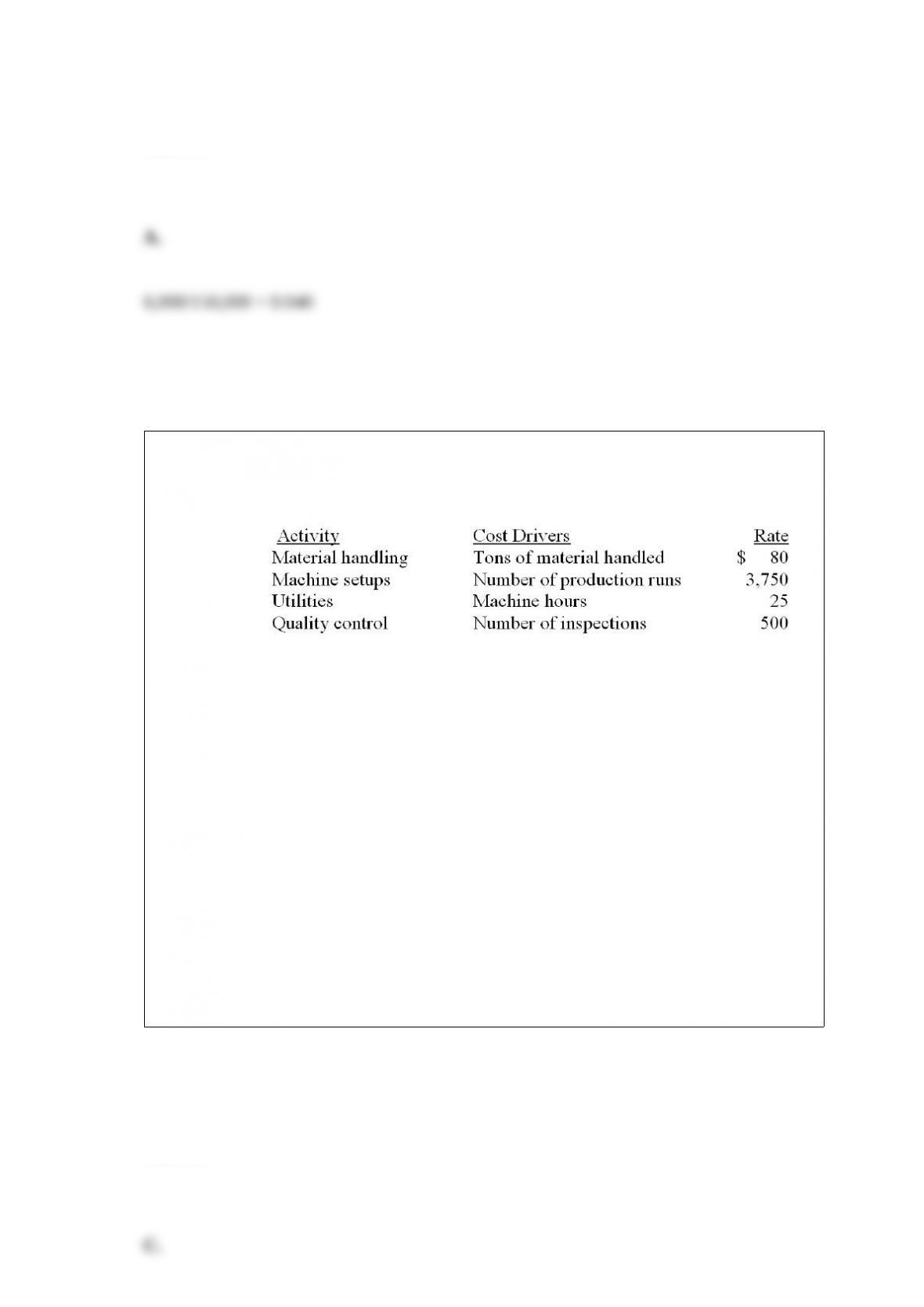
The Cascade Machining Co has the following information for last year
The partial productivity for metal is
A. 0.040
B. 0.080
C. 12.500
D. 25.000
Answer:
The LMN Company recently switched to activity-based costing (ABC) from the
department allocation method. The department method allocated overhead costs at a
rate of $60 per machine hour. The cost accountant for Department XZ has gathered the
following data:
During April, LMN purchased and used $100,000 of direct materials at $20 per ton.
There were eight (8) production runs using a total of 12,000 machine hours in April.
The manager of Department XZ needed 12 inspections. Actual overhead costs totaled
$820,000 for the month.
How much overhead costs were applied to the Work-in-Process Inventory during April
using activity-based costing?
A. $536,000
B. $720,000
C. $736,000
D. $820,000
Answer:
Which of the following is an example of an internal failure cost?
A. Training employees to improve quality.
B. Designing products to reduce production problems.
C. Correcting product defects before they are sold.
D. Inspecting the production process as it occurs.
Answer: