If earnings per share (EPS) decreases, it must mean that the company’s net income has
fallen.
A net profit margin of 15.4% means that the company used 84.6 cents of each sales
dollar to cover costs and expenses.
When preparing the operating activities section of the statement of cash flows using the
indirect method, accumulated depreciation is added to net income in the operating
section.
General Motors (GM) signs a new labor agreement that its workers will receive a 5%
wage increase next year. This transaction affects GM’s financial statements in the
current year.
Factoring refers to an arrangement in which a company sells its receivables to another
company and receives cash immediately.
If a company reports net income on the income statement, then the statement of cash
flows will report the same amount as cash flows from operating activities for the period.
If the receivables turnover ratio rises significantly, the increase may be a signal that the
company is extending credit to high-risk borrowers or allowing an overly generous
repayment schedule.
When the periodic inventory system is in use, the choice of an inventory costing
method usually has no impact on gross profit or cost of goods sold.
Which of the following would not be included in the cash and cash equivalents amount
reported on the balance sheet?
A) Money market funds
B) Checking accounts
C) Treasury bills
D) Notes receivable due in 90 days
When the direct method is used to determine the cash flows from operating activities,
other operating expenses are converted into cash outflows by:
A) adding changes in prepaid expenses and accrued liabilities to other expenses.
B) subtracting increases in prepaid expenses and subtracting decreases in accrued
liabilities from other expenses.
C) adding increases in prepaid expenses and adding decreases in accrued liabilities to
other expenses.
D) subtracting changes in prepaid expenses and accrued liabilities from other expenses.
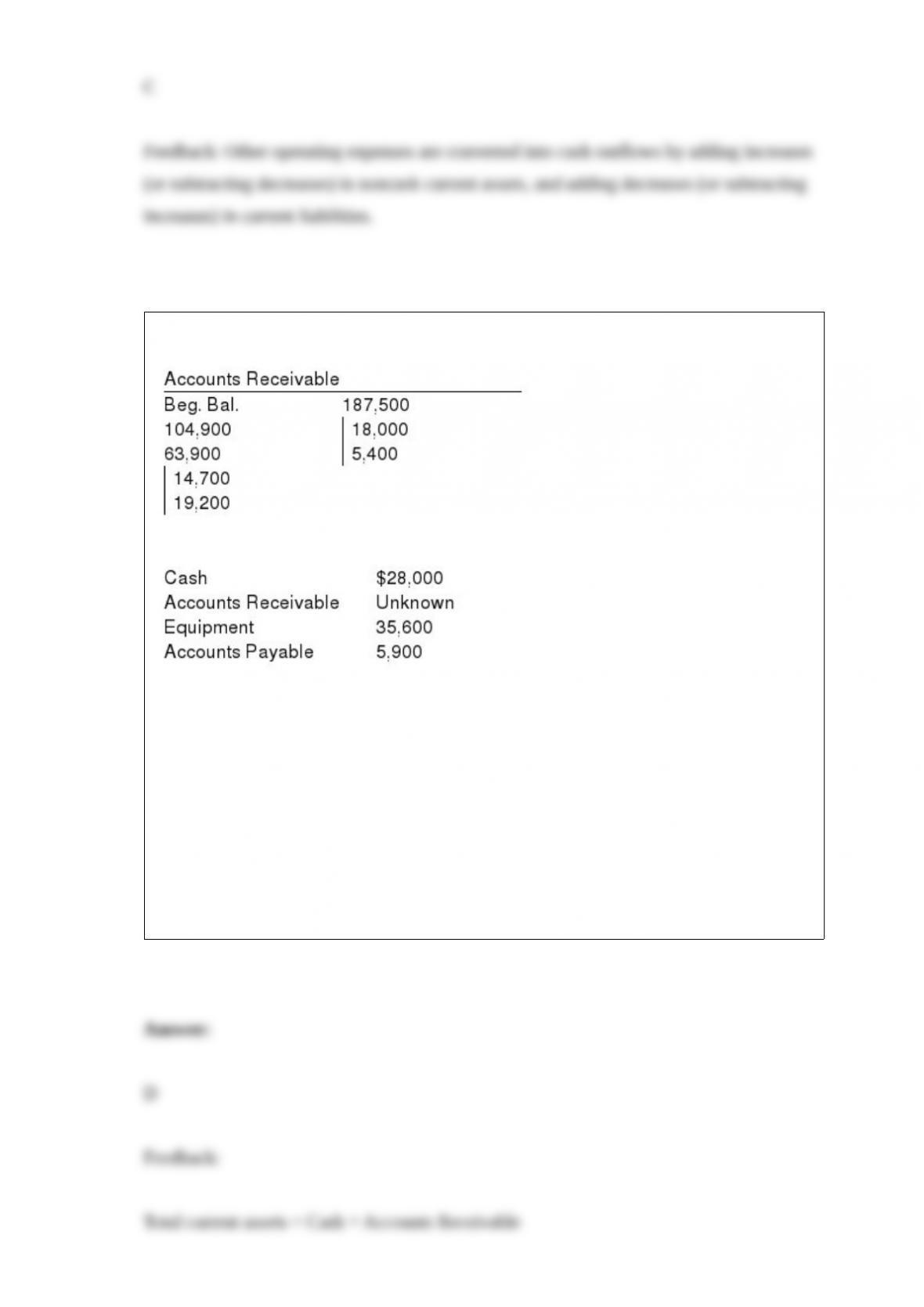
T-account:
Partial list of account balances at the end of the year:
Use the information above to answer the following question. The amount of total
current assets that will be reported on the company ‘s balance sheet at the end of the
year is:
A) $362,600.
B) $368,500.
C) $139,500.
D) $327,000.

Eaton Electronics uses a periodic inventory system. On March 31, Eaton has two
plasma TVs on hand at a cost of $1,500 each (serial numbers 11534892 and 11534894).
In April, the company purchases four more identical TVs from Toshiba for $1,450 each
(serial numbers 11542631 through 11542634). In May, the company purchases five
more identical TVs for $1,600 each (serial numbers 11550964 through 11550968). In
June, Eaton sells two of these TVs (serial numbers 11534894 and 11542631). There
were no additional purchases or sales during the remainder of the year.
Use the information above to answer the following question. Eaton Electronics reports
$3,000 as the cost of goods sold. Eaton Electronics is using the:
A) specific identification method.
B) LIFO method.
C) FIFO method.
D) weighted average cost method.
On October 1, Robertson Company sold inventory in the amount of $5,800 to Alberta,
with credit terms of 2/10, n/30. The cost of the items sold is $4,000. Robertson uses the
periodic inventory system. On October 4, Alberta returns some of the inventory. The
selling price of the inventory is $500 and the cost of the inventory returned is $350.
What journal entry (entries) will be recorded by Robertson October 4?
A) Debit Sales Returns & Allowances and credit Accounts Receivable for $500; debit
Inventory and credit Cost of Goods Sold for $350
B) Debit Sales Returns & Allowances and credit Accounts Receivable for $500
C) Debit Accounts Receivable and credit Sales Returns & Allowances for $500
D) Debit Accounts Receivable and credit Sales Returns & Allowances for $500; debit
Cost of Goods Sold and credit Inventory for $350
Use the information above to answer the following question. The gross profit
percentage for the current year rounded to the nearest whole percent is closest to:
A) 24%.
B) 76%.
C) 60%.
D) 31%.
If a company returns an item to a supplier, the supplier will record the return as:
A) a sales return.
B) shrinkage.
C) a sales discount.
D) a purchase return.
Your business purchased an investment security on April 1 that will pay $90 interest on
June 30. Which of the following adjusting entries would be made on April 30?
A) Debit Interest Receivable and credit Interest Revenue for $90
B) Debit Interest Revenue and credit Interest Receivable for $30
C) Debit Interest Receivable and credit Interest Revenue for $30
D) Debit Interest Revenue and credit Interest Receivable for $90
To determine whether generally accepted accounting principles (GAAP) were followed
in the preparation of financial statements, an examination of:
A) tax documents would be performed by the IRS.
B) the company’s accounting records would be performed by the SEC.
C) the financial statements and related documents would be performed by an
independent auditor.
D) the financial statements and related documents would be performed by the FASB.
A contingent liability is:
A) always a specific amount.
B) an obligation arising from the purchase of goods or services on credit.
C) an obligation not requiring a future payment.
D) a potential obligation that depends on a future event.
Operating activities include:
A) interest paid on a bank loan
B) the buying or selling of land, buildings, equipment, and other long-term investments.
C) the repayment of loan proceeds to the bank.
D) obtaining a bank loan to cover the payment of wages, rent and other operating costs.
When a trial balance is prepared, a contra-account appears immediately:
A) before the account it offsets but in the opposite column.
B) after the account it offsets and in the same column.
C) after the account it offsets but in the opposite column.
D) before the account it offsets and in the same column.