1) In recent years, fixed costs have decreased as a proportion of total manufacturing
costs.
2) A primary purpose of an organization’s code of ethics is to encourage behavior that is
consistent with the company’s ethical and cultural norms.
3) Governments are frequent users of cost reimbursement contracts.
4) A company with sales of $100,000, variable costs of $70,000, and fixed costs of
$50,000 will reach its break-even point if sales are increased by $20,000.
5) Avoidable costs are eliminated when a product is outsourced.
6) In traditional costing, the company attempts to achieve a particular cost target.
7) Many companies trace marketing, sales, distribution, and administration costs to
customers to accurately measure customer profitability.
8) Under kaizen costing, cost reduction targets are set and applied monthly and
continuous improvement (kaizen) methods are applied all year long to meet targets.
9) Management accounting information is sometimes predictive and forward looking.
10) As much as 80-85% of a product’s total life costs are the result of decisions made in
the research development and engineering cycle of the product’s life.
11) Ethics is a discipline that focuses on the investigation of standards of conduct and
moral judgment.
12) Financial control involves the use of financial measures to assess organizational and
management performance.
13) Management accounting innovations are usually developed by academics.
14) Specialized engineering drawings of products, product quality specifications and
quality control testing, inventoried raw materials, and material control systems are
examples of activities that equate to greater overhead costs.
15) The learning and growth perspective addresses what employee capabilities,
information systems, and organizational capabilities we need to continually improve.
16) Bid prices and costs that are relevant for regular orders are the same costs that are
relevant for one-time-only special orders.
17) A weekly report comparing machine time used to available machine time is
information LEAST useful to:
A) a front-line employee
B) the manager of operations
C) the chief executive officer
D) the accounting department
18) The 80/20 rule:
A) finds that 80% of revenues are generated by the top 20% of the customers
B) finds that 80% of profits are generated by the top 20% of the customers
C) can be graphed as the whale curve
D) finds that 80% of costs are generated by 20% of the customers
19) The pricing waterfall:
A) charts the multiple sources of revenue by customer
B) charts multiple list prices offered to different customers
C) charts the multiple revenue leaks from list price caused by allowances and discounts
D) charts multiple types of customer costs
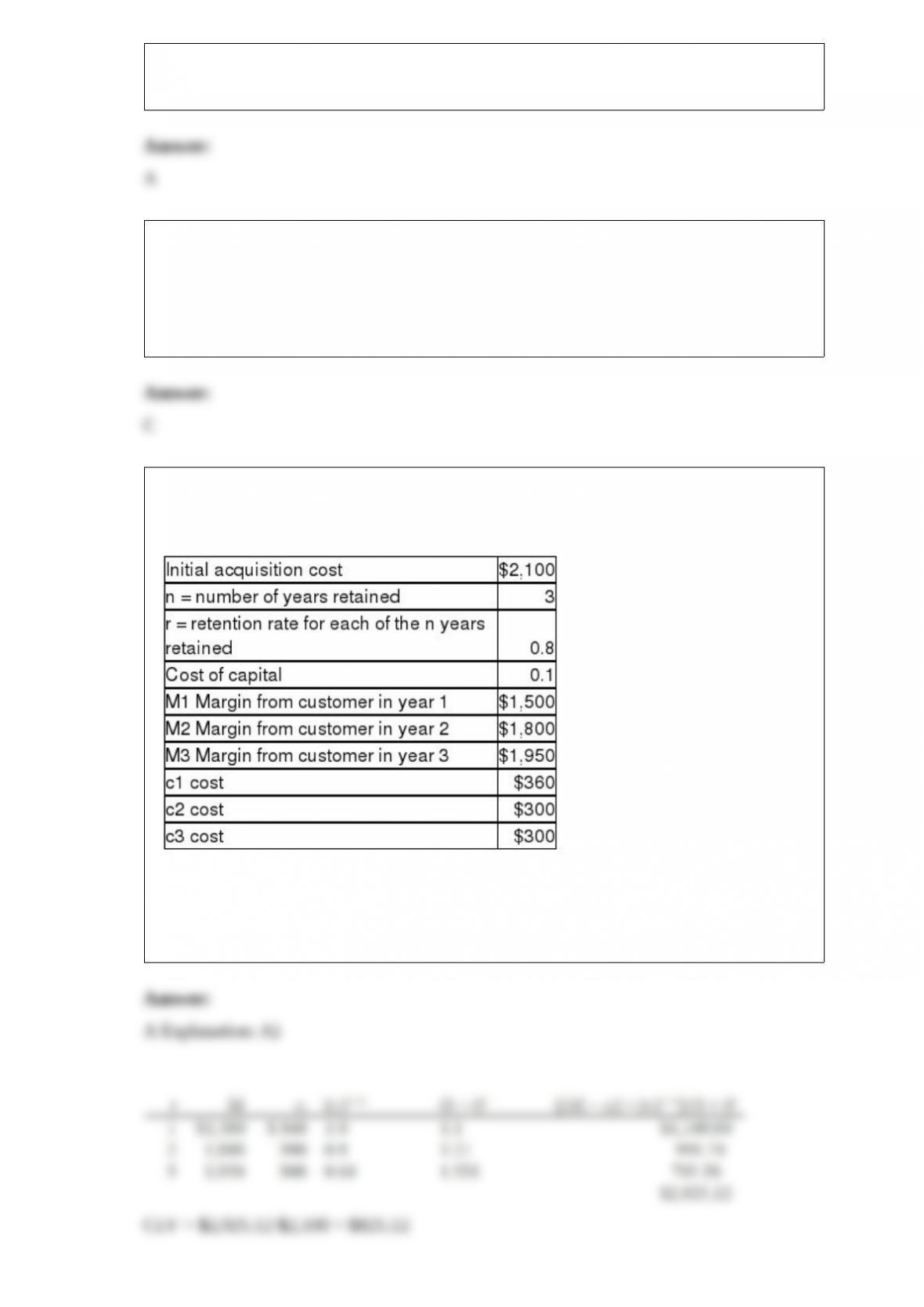
20) What is the customer lifetime value of customer W. Harrelson for the first three
years of the customer relationship?
A) $825.12
B) $2,925.12
C) $6,390.00
D) $4,190.00
21) These questions refer to flexible budget variance formulas with the following
descriptions for the variables: A = Actual; P = Price; Q = Quantity; S = Standard.
The best label for the formula [(AP) (AQ) – (SP) (SQ)] is the:
A) materials quantity variance
B) materials price variance
C) total cost variance for materials
D) labor efficiency variance
22) In 2011, SSPC Company has sales of 8,000 units at $10 each, variable costs totaling
$20,000, and fixed costs of $30,000. In 2008, the company expects annual insurance
costs to increase by $4,000 to $9,000.
Required:
a. Calculate operating income and the breakeven point in units for 2011 .
b. Calculate the breakeven point in units for 2012 .
23) Low cost to serve customers:
A) have low order quantities
B) have large amounts of post sales support
C) order standard products
D) have customized delivery
24) ________ involve(s) a joint decision-making process in which all parties agree
about setting the budget targets.
A) The pseudo-participation
B) Budgeting games
C) Budget slack
D) The participation method
25) Depreciation on factory equipment is best characterized as
A) direct costs
B) fixed manufacturing overhead
C) variable overhead
D) period costs
26) Which one of the following statements is FALSE?
A) In a job order costing system, individual jobs use different quantities of production
resources
B) In a process-costing system, each unit uses approximately the same amount of
resources
C) An organization that manufactures several types of cereal would use a job order
costing system
D) A corporation whose sole business activity is processing the customer deposits of
several banks would use a process-costing system
27) Logical cost allocation bases for overhead costs include:
A) cubic feet of packages moved to measure distribution activity
B) machine hours to measure setup activity
C) direct manufacturing labor hours to measure product designing activity
D) All of the above are correct
28) After conducting a market research study, Stewart Manufacturing decided to
produce a new interior door to complement its exterior door line. It is estimated that the
new interior door can be sold at a target price of $120. The annual target sales volume
for interior doors is 20,000. Stewart has a 20% expected return on sales target.
What is the target cost?
A) $1,800,000
B) $1,920,000
C) $2,520,000
D) $2,016,000
29) A time-driven ABC system:
A) is difficult to update
B) is time-consuming, expensive and often inaccurate
C) requires that only two parameters be updated
D) is based on theoretical capacity
30) All of the following equations represent return on investment (ROI) EXCEPT:
A) efficiency productivity
B) operating income / investment
C) return on sales inventory turnover
D) (operating income / sales) (sales / investment)
31) The ________ provides the foundation for the materials purchasing plan.
A) inventory policy
B) sales plan
C) production plan
D) capital spending plan
32) Apple Valley Corporation uses a job order cost system and has two production
departments, A and B. Budgeted manufacturing costs for the year are:
The actual material and labor costs charged to Job #432 are as follows:
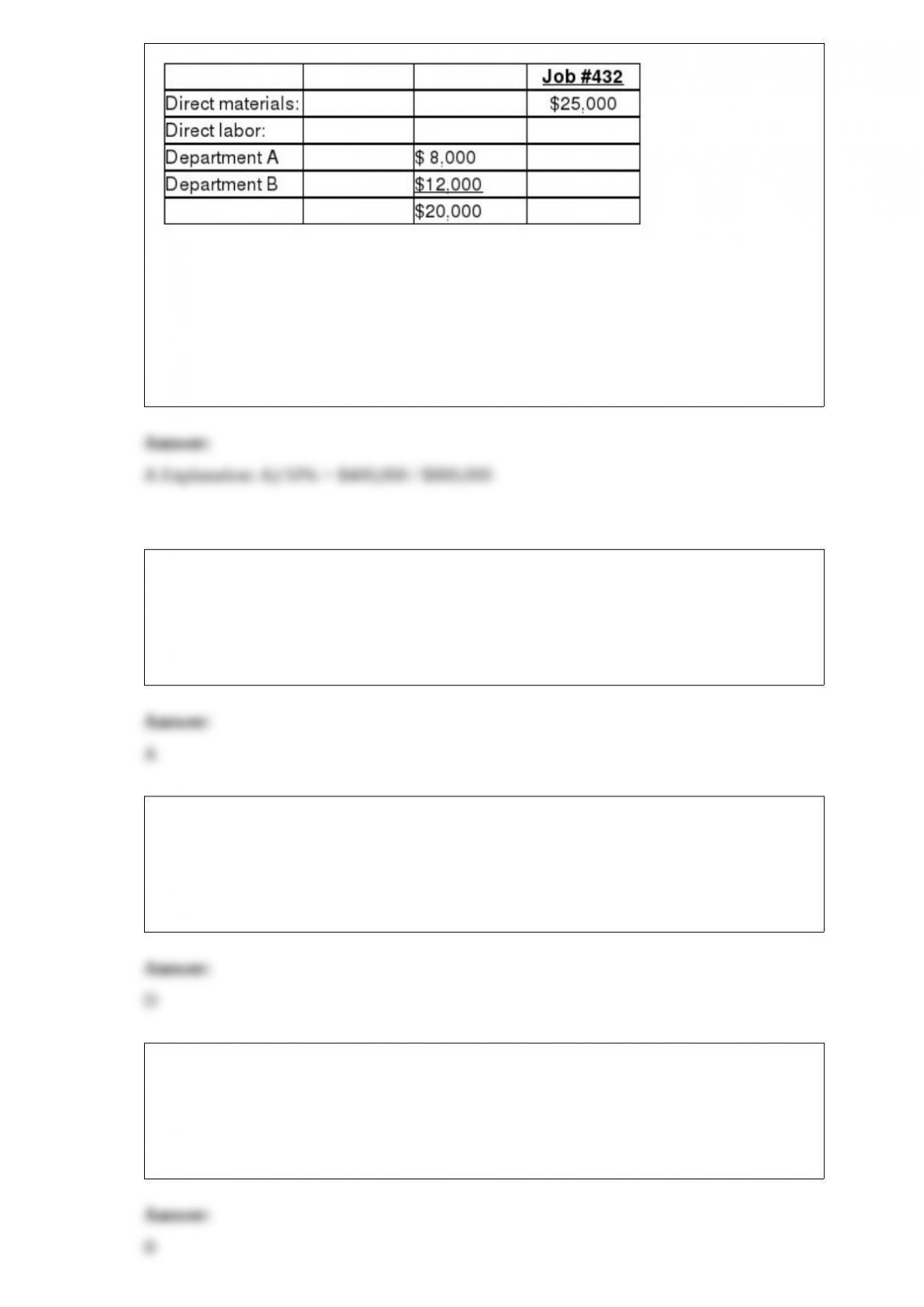
Apple Valley applies manufacturing overhead costs to jobs on the basis of direct labor
cost using departmental rates determined at the beginning of the year.
For Department B, the manufacturing overhead cost driver rate is:
A) 50% of direct labor costs
B) 80% of direct labor costs
C) 100% of direct labor costs
D) 200% of direct labor costs
33) All of the following are examples of extrinsic rewards for compensation EXCEPT:
A) job satisfaction
B) stock options
C) a cash bonus
D) recognition in the company newsletter
34) The Hawthorne study revealed that:
A) individuals alter their behavior when they know they are being studied
B) groups alter their behavior when they know they are being studied
C) People react when they are being measured
D) All of the above are correct
35) Fixed costs depend on:
A) the amount of resources used
B) the amount of resources acquired
C) the volume of production
D) the volume of sales
36) ________ starts with the estimated product costs and next determines the estimated
selling price.
A) Standard costing
B) Target costing
C) Kaizen costing
D) Traditional costing
37) Establishing a base price for producing and delivering a standard quantity of each
standard product is an example of:
A) process improvements
B) activity based pricing
C) managing relationships
D) the pricing waterfall
38) In ________, the plant is organized into areas where all machines used to
manufacture a group of similar products are close to each other.
A) a process layout
B) a product layout
C) cellular manufacturing
D) just-in-time production
39) An organization develops a code of ethics PRIMARILY because:
A) the code allows for punishment of those who do not follow organizational ethical
standards
B) it helps reduce ethical conflict by avoiding ambiguity and misunderstanding
C) the management accounting department finds it helpful
D) it is required by law
40) Vander Belt Manufacturing, Inc., is considering reorganizing its plant into
manufacturing cells. The following estimates have been prepared to evaluate the
benefits from the reorganization:
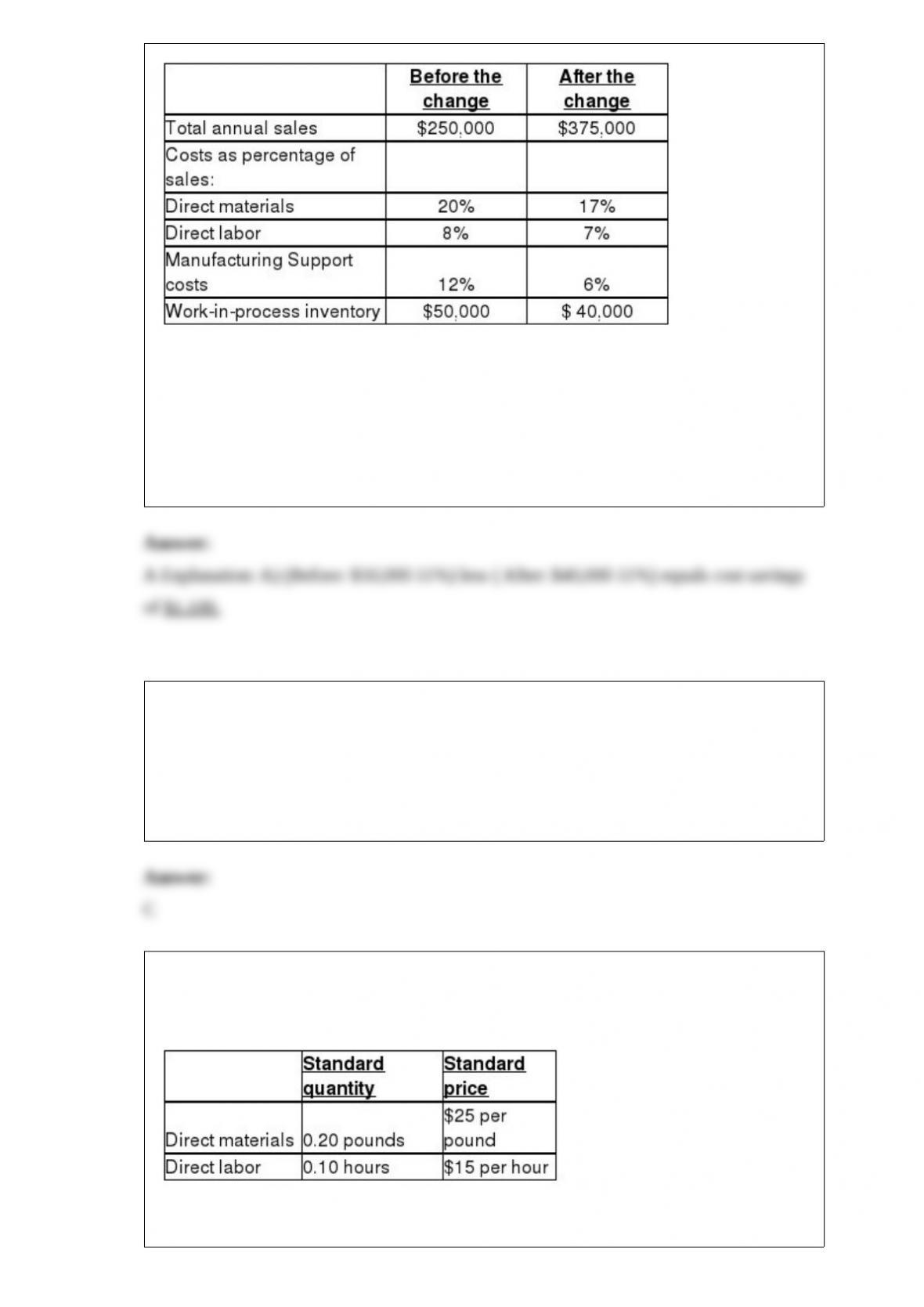
Inventory carrying costs are estimated to be 11% per year.
As a result of the layout reorganization, reduced levels of work-in-process inventory are
projected to decrease inventory carrying costs annually by:
A) $ 1,100
B) $ 3,750
C) $ 4,400
D) $5,500
41) Relevant costs of a make-or-buy decision for a part include all of the following
EXCEPT:
A) fixed salaries that will not be incurred if the part is outsourced
B) current direct material costs of the part
C) special machinery for the part that has no resale value
D) material-handling costs that can be eliminated if the part is outsourced
42) Community Manufacturing Inc. developed the following standard costs for direct
material and direct labor for one of their major products, the 30-gallon heavy-duty
plastic container.
During May, Community produced and sold 10,000 containers using 2,200 pounds of
direct materials at an average cost per pound of $24 and 1,050 direct labor hours at an
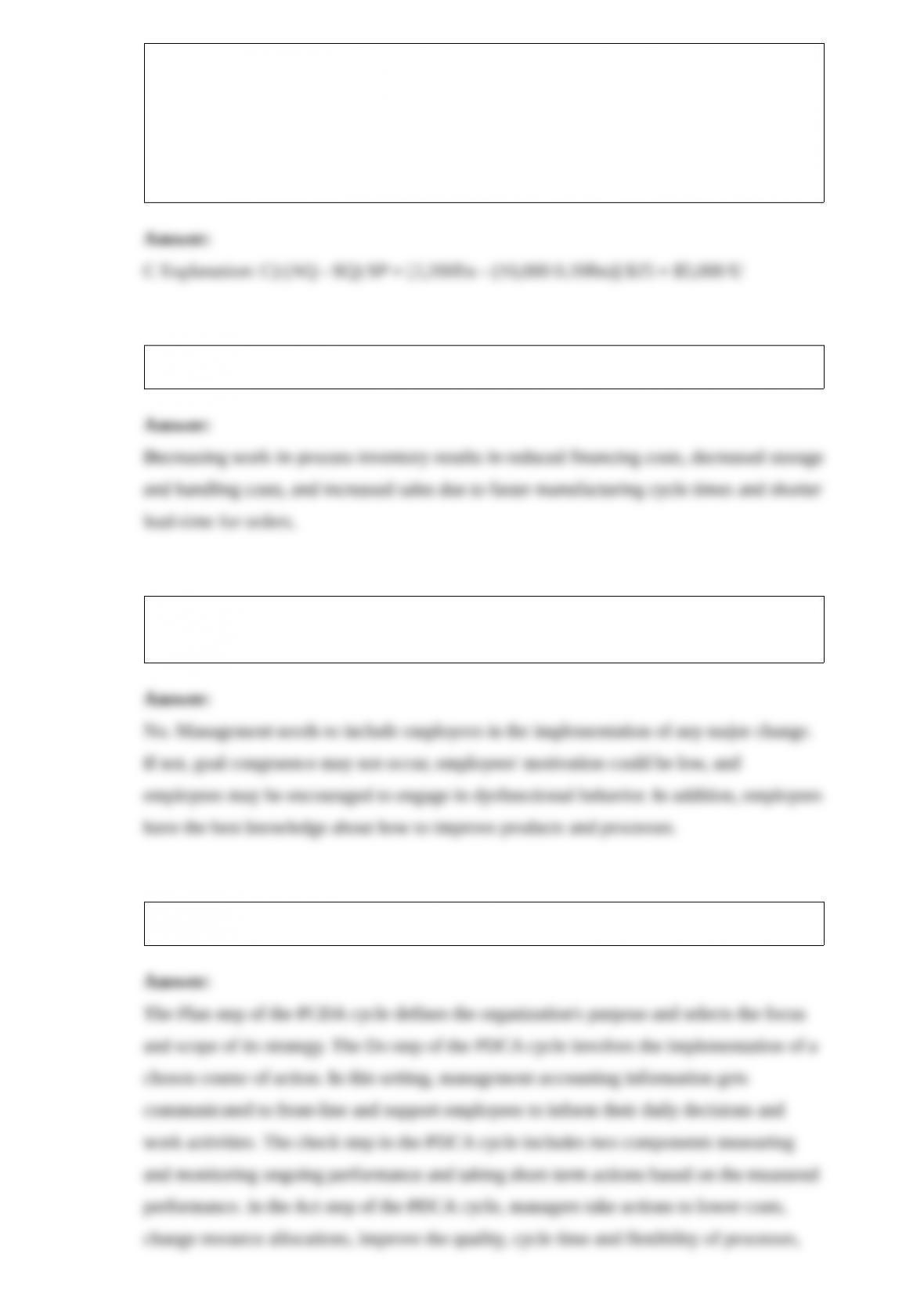
average wage of $14.75 per hour.
May’s direct material quantity variance was:
A) $2,800 unfavorable
B) $2,200 favorable
C) $5,000 unfavorable
D) None of the above is correct
43) Discuss cost reductions that can result from reducing work-in-process inventory.
44) Should management implement a new management accounting and control system
without consulting employees? Why or why not?
45) Describe the steps in the PDCA cycle.
46) Explain the differences between a process layout, a product layout, and cellular
manufacturing.
47) A division reports a 24.5% ROI, a 9.6% return on sales, and a 2.55 asset turnover
ratio. How can the manager of this division determine whether these results are
favorable or not?
48) Explain why more than one cost pool usually results in more realistic overhead cost
estimates.
49) Compute the customer lifetime value of Customer 222 based on the data below for
the first six years of the customer relationship. Costs (ct) were incurred to promote
customer retention at a rate of 0.8 in years 1 through 6 .
Initial acquisition cost $2,400
n = number of years retained 6
r = retention rate 0.8
Cost of capital 0.1
Mt = margin from customer in year t
M1 $1,000
M2 1,200
M3 1,300
M4 1,400
M5 1,500
M6 1,600
c1 240
c2 200
c3 200
c4 200
c5 160
c6 160
50) The markup rate on a job bid sheet includes amounts for certain items. Discuss
these items.