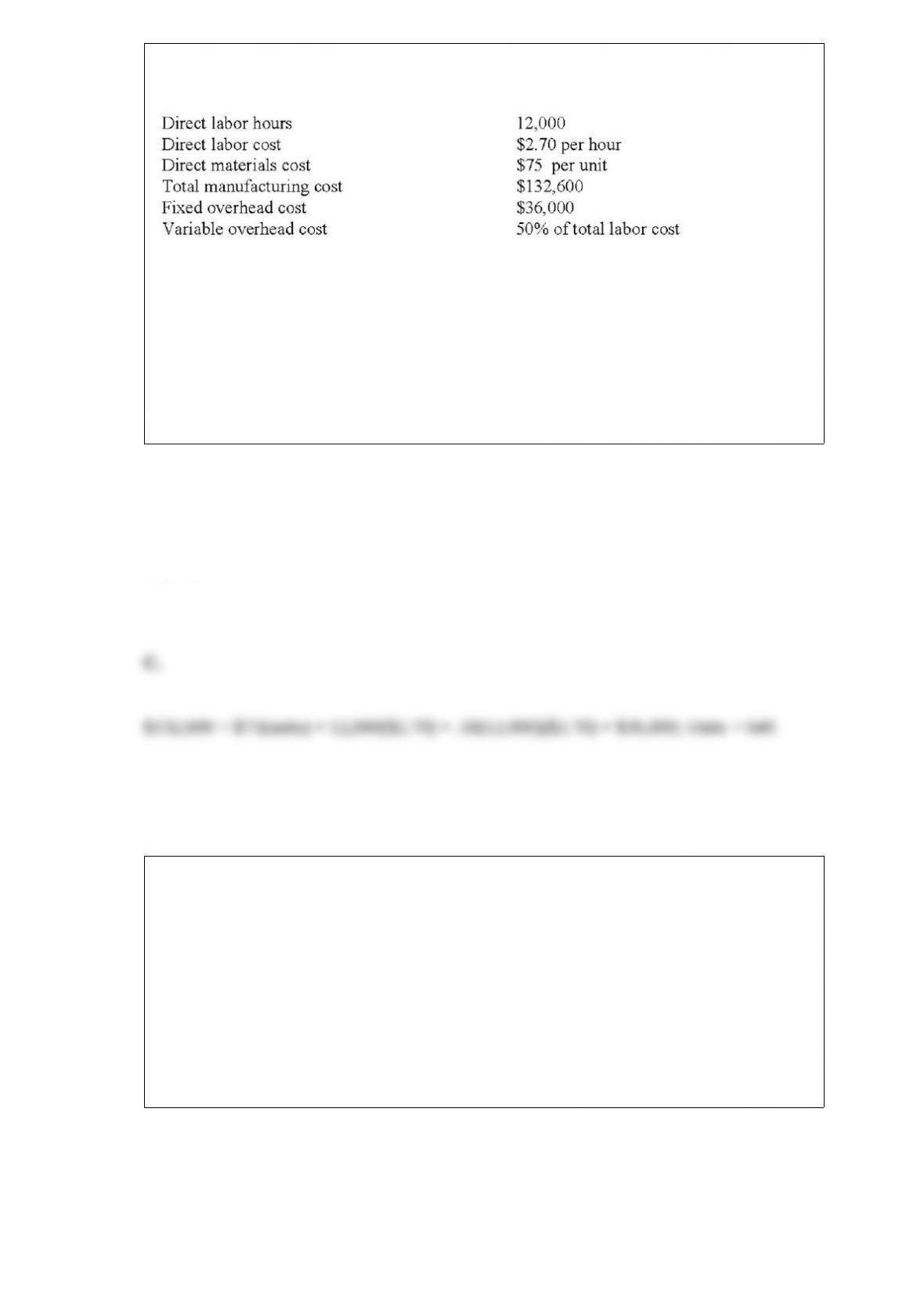
Given the following information, compute the total number of units for the period.
A. 360
B. 432
C. 640
D. 840
Answer:
Using beginning balances for the investment base in computing return on investment
(ROI) might encourage managers to acquire assets
A. early in the year and dispose of assets late in the year.
B. early in the year and dispose of assets early in the year.
C. late in the year and dispose of assets late in the year.
D. late in the year and dispose of assets early in the year.
Answer:

Which of the following best distinguishes an opportunity cost from an outlay cost?
A. Opportunity costs are recorded, whereas outlay costs are not.
B. Outlay costs are speculative in nature, whereas opportunity costs are easily traceable
to products.
C. Opportunity costs have very little utility in practical applications, whereas outlay
costs are always relevant.
D. Opportunity costs are sacrifices from foregone alternative uses of resources, whereas
outlay costs are cash outflows.
Answer:
Examples of pressures that can lead to financial fraud do not include
A. unrealistic budgets.
B. inappropriate bonus plans.
C. overemphasis on long-term results.
D. overemphasis on short-term results.
Answer:
Complex jobs that take multiple time periods and require the work of many different
departments, divisions, or subcontractors are called
A. clients.
B. projects.
C. customers.
D. contracts.
E. vendors.
Answer:
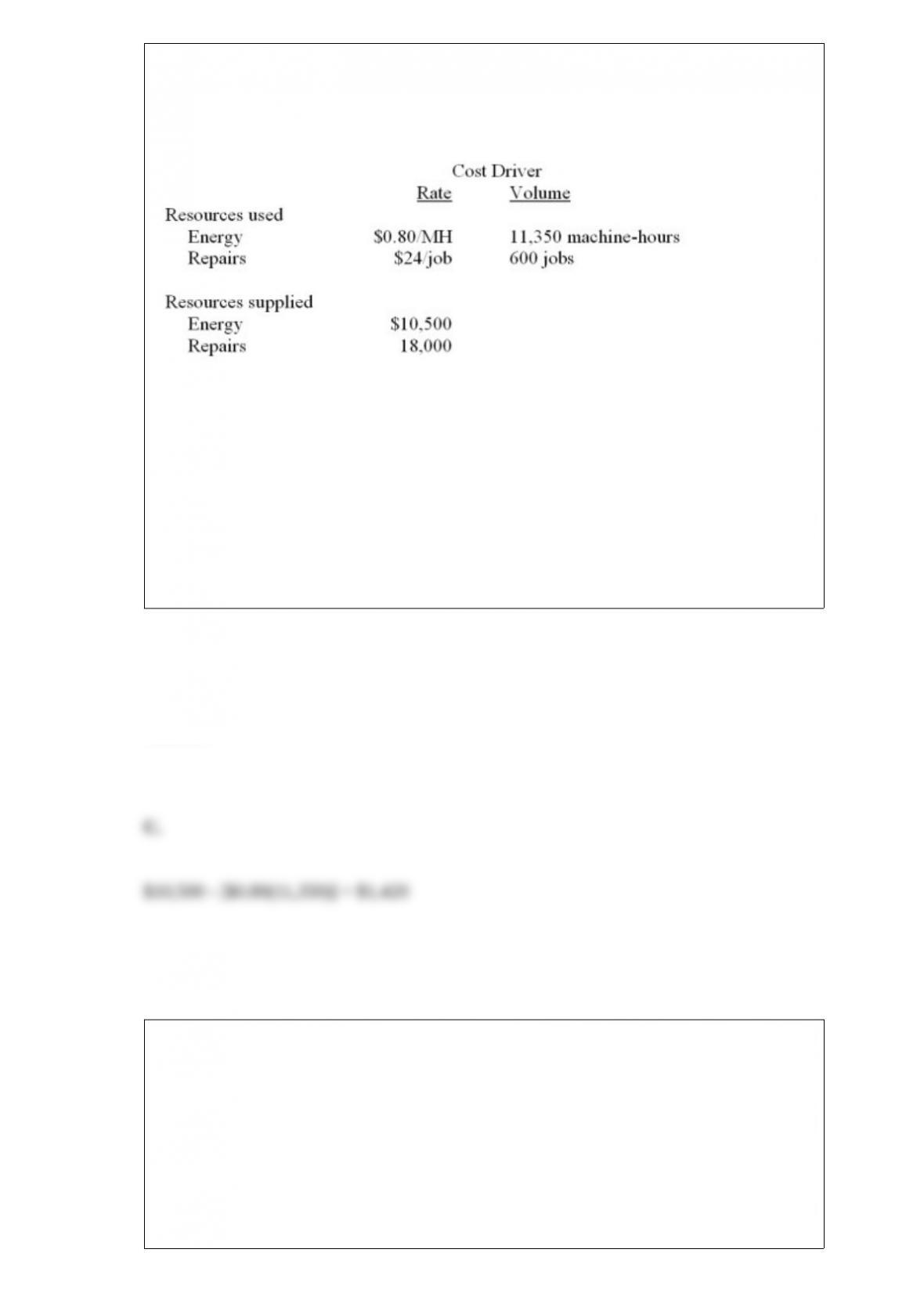
Lemaire Products reports the following information about resources. At the beginning
of the year, Lemaire estimated it would spend $8,000 for energy and $12,000 for
repairs.
Compute unused resource capacity for energy for Lemaire Products.
A. $8,000
B. $1,080
C. $1,420
D. $2,500
Answer:
Which of the following factors should not be considered when deciding whether to
investigate a variance?
A. Absolute or relative magnitude of the variance
B. Trend or pattern of the variance over time
C. Chance that an “out-of-control” situation can be corrected
D. Cost of investigating the underlying production process
E. Whether the variance is favorable or unfavorable
Answer:
If two service departments service the same number of departments, which service
department’s costs should be allocated first when using the step method?
A. The service department that provides the most service to other service departments.
B. The service department that provides the most service to the user departments.
C. The service department with the least cost.
D. The service department that provides the least service to other service departments.
E. The service department that provides the least service to the user departments.
Answer:
The process of first allocating costs to intermediate cost pools and then to the
individual cost objects using different allocation bases is:
A. continuous flow process.
B. cost management system.
C. two-stage allocation system.
D. operations cost.
Answer:
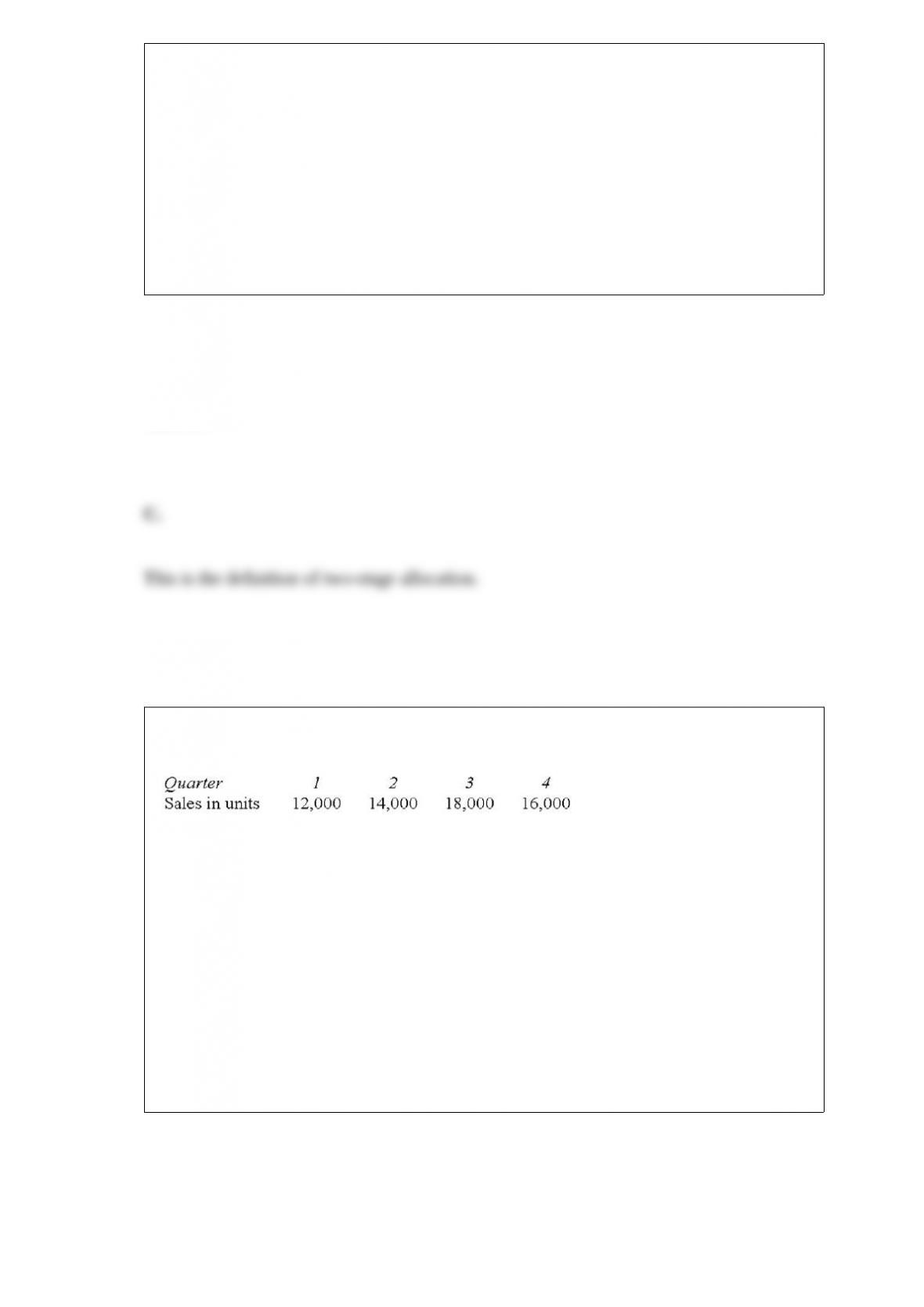
The Waverly Company has budgeted sales for the year as follows:
The ending inventory of finished goods for each quarter should equal 25% of the next
quarter’s budgeted sales in units. The finished goods inventory at the start of the year is
3,000 units. Scheduled production for the third quarter is (in units)
A. 17,500 units.
B. 18,500 units.
C. 18,000 units.
D. 16,500 units.
Answer:
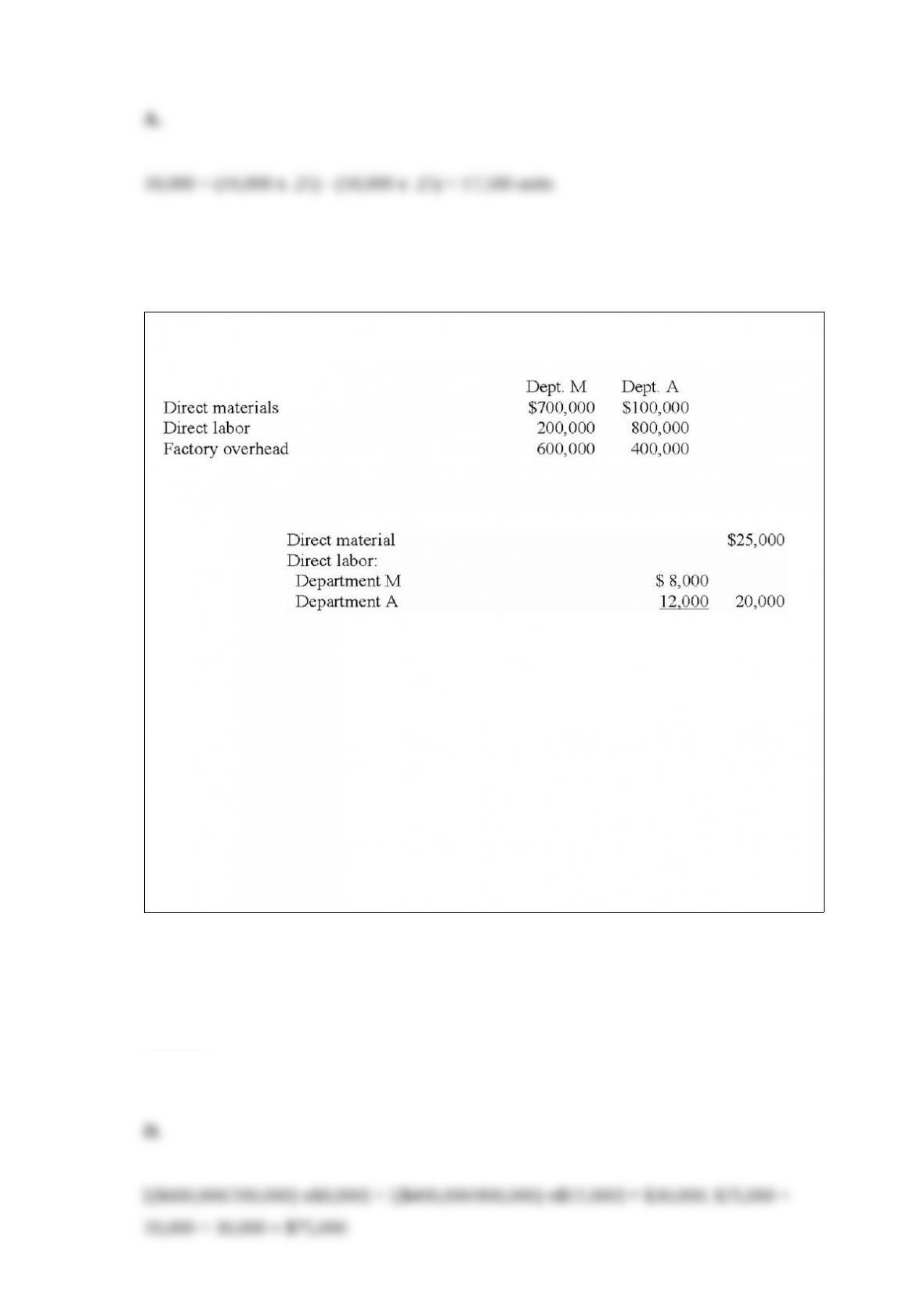
Tillman Corporation uses job costing and has two production departments, M and A.
Budgeted manufacturing costs for the year are as follows:
The actual direct material and direct labor costs charged to Job. No. 432 during the year
were as follows:
Tillman applies manufacturing overhead to production orders on the basis of direct
labor cost using departmental rates predetermined at the beginning of the year based on
the annual budget. The total cost associated with Job. No. 432 for the year should be
A. $50,000.
B. $55,000.
C. $65,000.
D. $75,000.
Answer:
Beattie Company completed and transferred out 2,300 units in May 2008. There were
200 units in the Work-in-Process Inventory on May 31, 2008, 30% complete as to
conversion costs and 100% complete as to materials. The month’s charges for
conversion costs and material costs were $9,440 and $6,250, respectively. There was no
beginning inventory on May 1, 2008. What is the cost of the work transferred-out
during May?
A. $8,510
B. $14,950
C. $15,690
D. $16,250
Answer:
Which of the following statements is (are) true?
(A) Theoretical capacity is the long-run expected volume based on reasonably
attainable working conditions.
(B) The cost of excess capacity is allocated to individual cost objects using the cost
driver rate.
A. Only A is true.
B. Only B is true.
C. Both A and B are true.
D. Neither A nor B is true.
Answer:
A company has high winter demand and low summer demand for its services. The cost
of the unused summer capacity should be allocated
A. to an account called Idle Capacity.
B. evenly to all customers.
C. only to the winter customers.
D. only to the summer customers.
Answer:
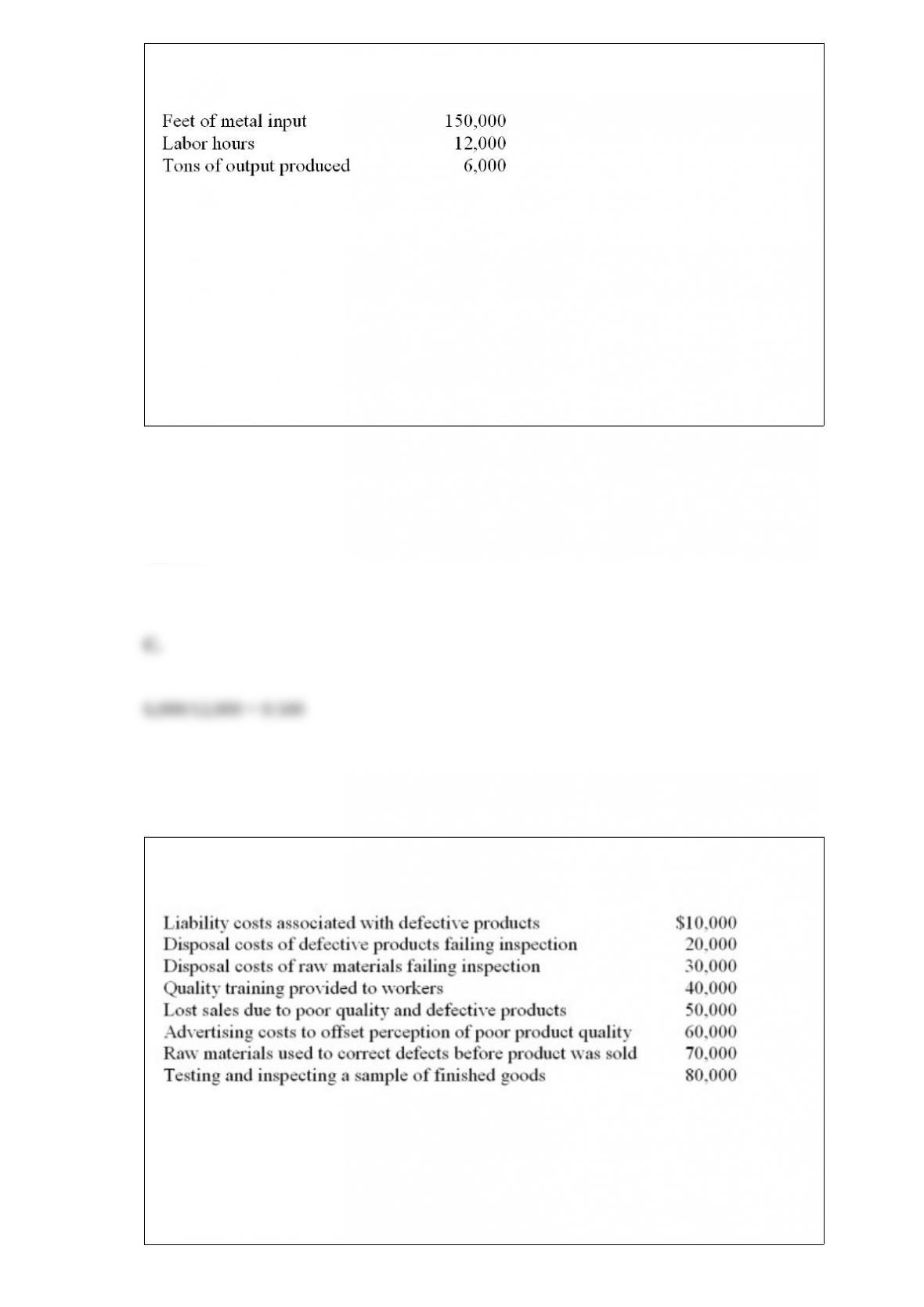
The Cascade Machining Co has the following information for last year
The partial productivity for labor is
A. 12.500
B. 2.000
C. 0.500
D. 0.120
Answer:
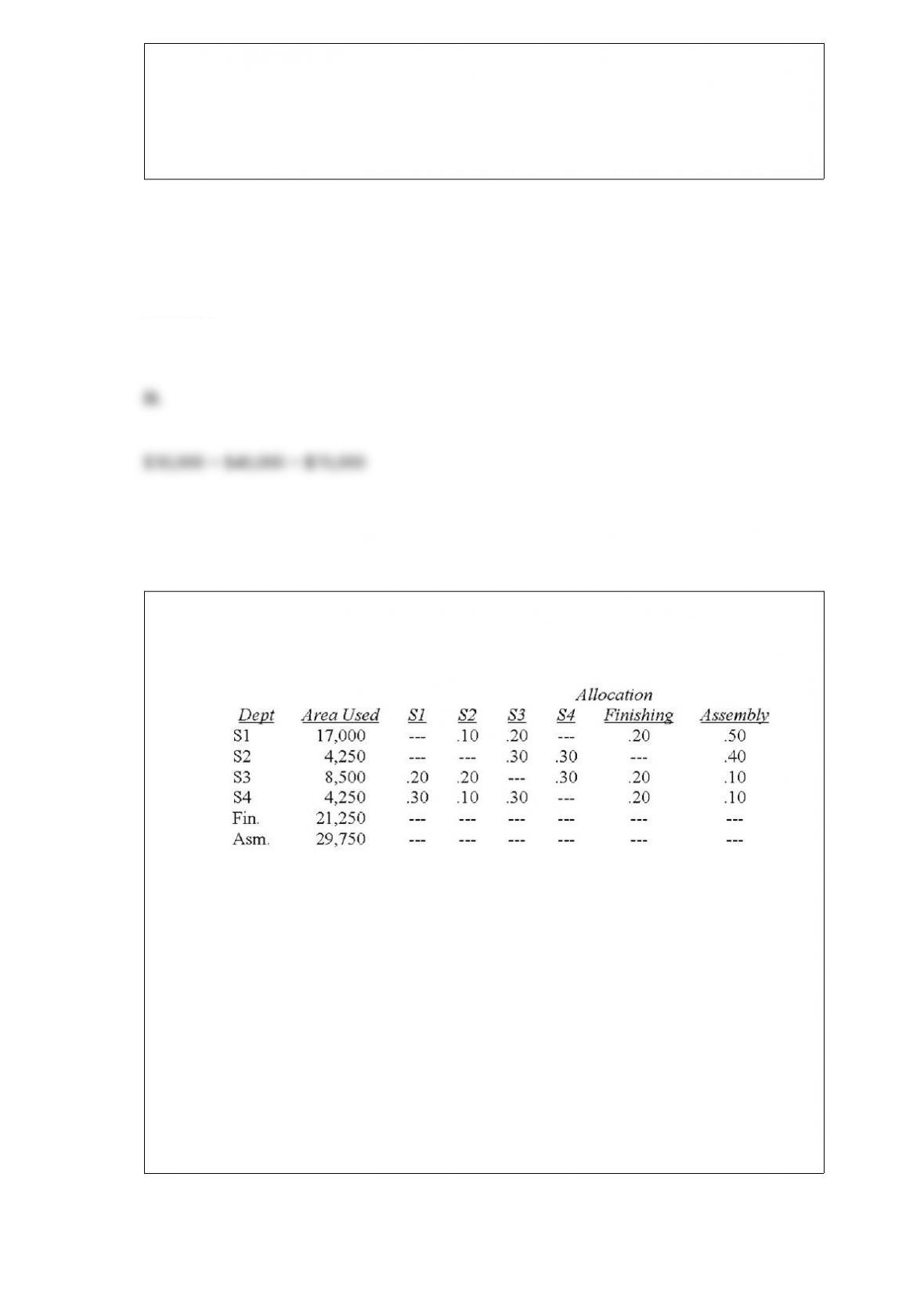
QC Enterprises quality control report for August contains the following items.
What would be the total of the prevention costs on the August quality control report for
QC Enterprises?
A. $180,000
B. $120,000
C. $90,000
D. $70,000
Answer:
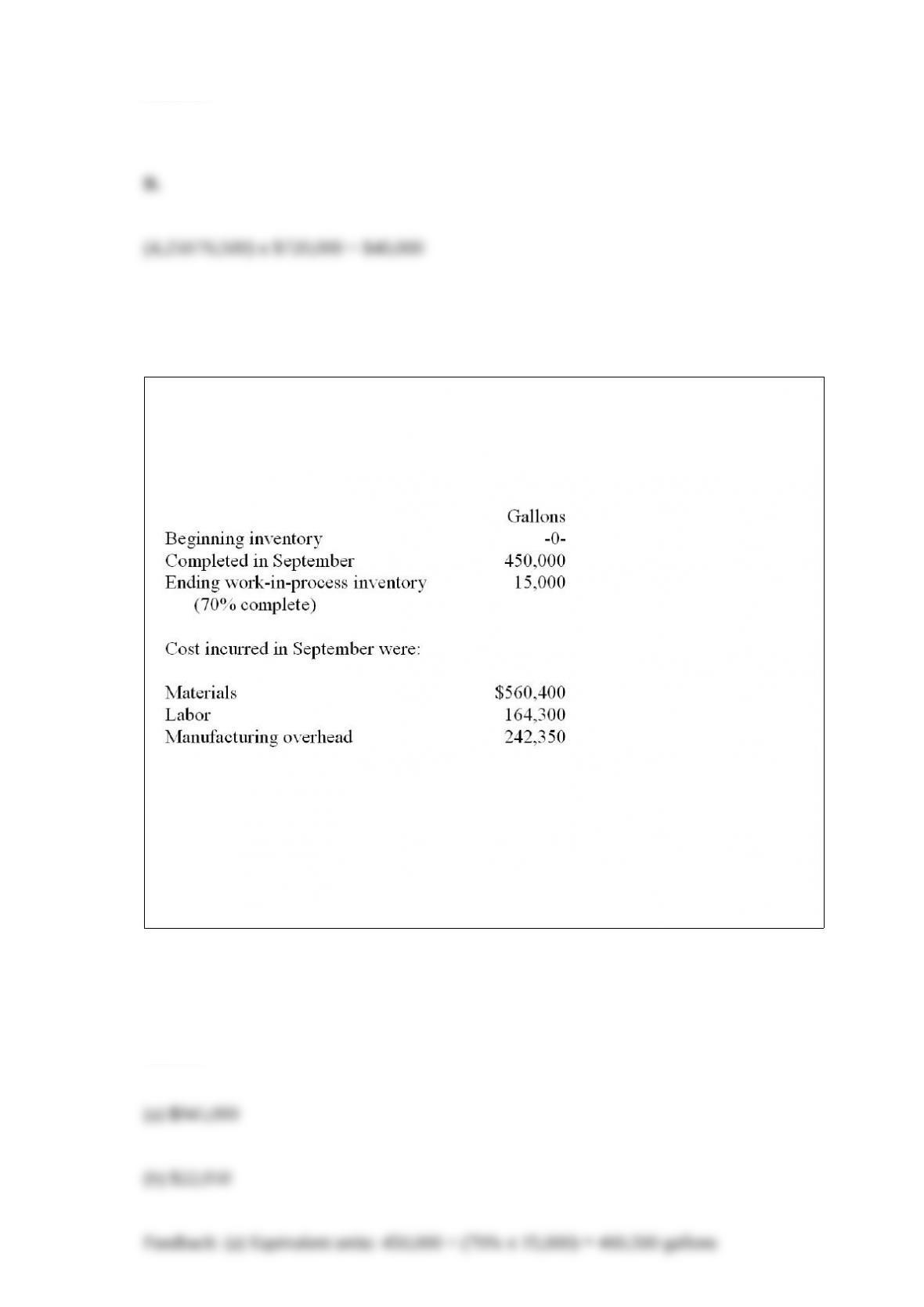
The Emery Construction Company occupies 85,000 square feet for construction of
mobile homes. There are two manufacturing departments, finishing and assembly, and
four service departments labeled S1, S2, S3 and S4. Information relevant to Emery is as
follows:
Rent paid for the area used is $720,000
How much rent would be charged to S4 using the step method of allocation and a
S3-S4-S1-S2 sequence for the allocations?
A. $36,000
B. $40,000
C. $54,000
D. $90,000
Answer:
Roswell Refiners restarted operations on September 1 after a 3 month shutdown. There
were no beginning inventories. The following operations data are available for
September and the one product the company refines:
All production at Roswell is sold immediately.
Required:
(a) Compute cost of goods sold for September.
(b) What is the value of the work-in-process inventory on September 30?
Answer:
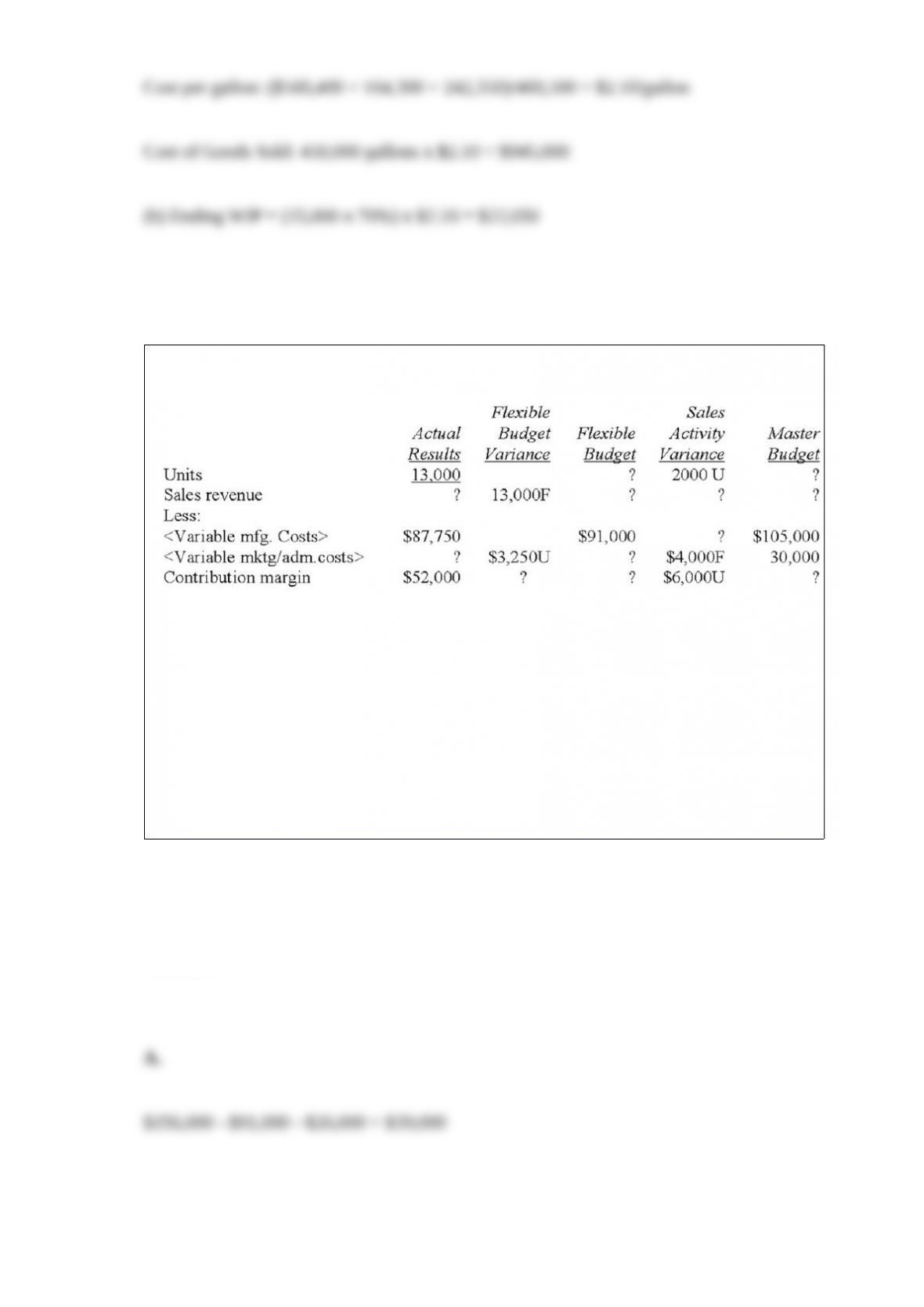
What is the flexible budget contribution margin?
A. $39,000.
B. $45,000.
C. $52,000.
D. $58,000.
Answer:
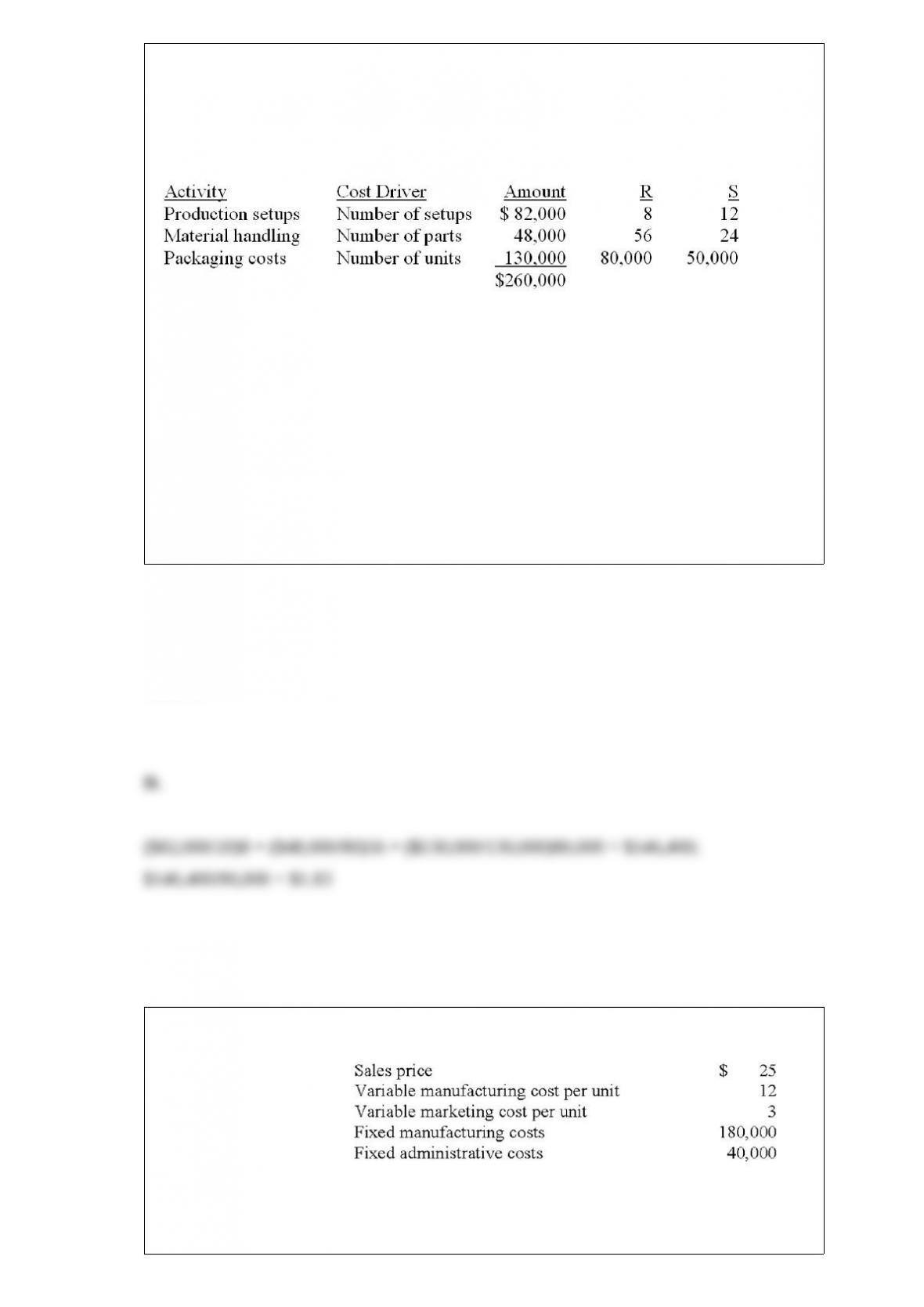
RS Company manufactures and distributes two products, R and S. Overhead costs are
currently allocated using the number of units produced as the allocation base. The
controller has recommended changing to an activity-based costing (ABC) system. She
has collected the following information:
What is the total overhead per unit allocated to Product R using activity-based costing
(ABC)?
A. $2.60
B. $2.27
C. $2.00
D. $1.83
Answer:
You have been provided with the following information regarding the ALG
Manufacturing Company:
This information is based on forecasted sales of 25,000 units.
Required:
(a) What are the expected operating profits for the upcoming year?
(b) What is the break-even point in units?
(c) What is the break-even point in dollars?
(d) If $80,000 of operating profits is desired, how many units must be sold?
(e) How much in sales dollars is required to generate an operating profit of $75,000?
Answer:
Which cost estimation method does not use the company’s cost information as its
primary source of information about the relationship between total costs and activity
levels?
A. scattergraph
B. high-low
C. account analysis
D. regression analysis
E. engineering estimates
Answer:
A disadvantage of the high-low method of cost analysis is that it
A. typically results in totally inaccurate cost formula.
B. is too time consuming to apply.
C. uses only two data points, which may not be representative of normal conditions.
D. relies totally on the judgment of the person performing the cost analysis.
Answer:
The Muskego National Bank is considering either a bankwide overhead rate or
department overhead rates to allocate $250,000 of indirect costs. The bankwide rate
could be based on either direct labor hours (DLH) or the number of loans processed.
The departmental rates would be based on direct labor hours for Consumer Loans and a
dual rate based on direct labor hours and the number of loans processed for Commercial
Loans. The following information was gathered for the upcoming period:
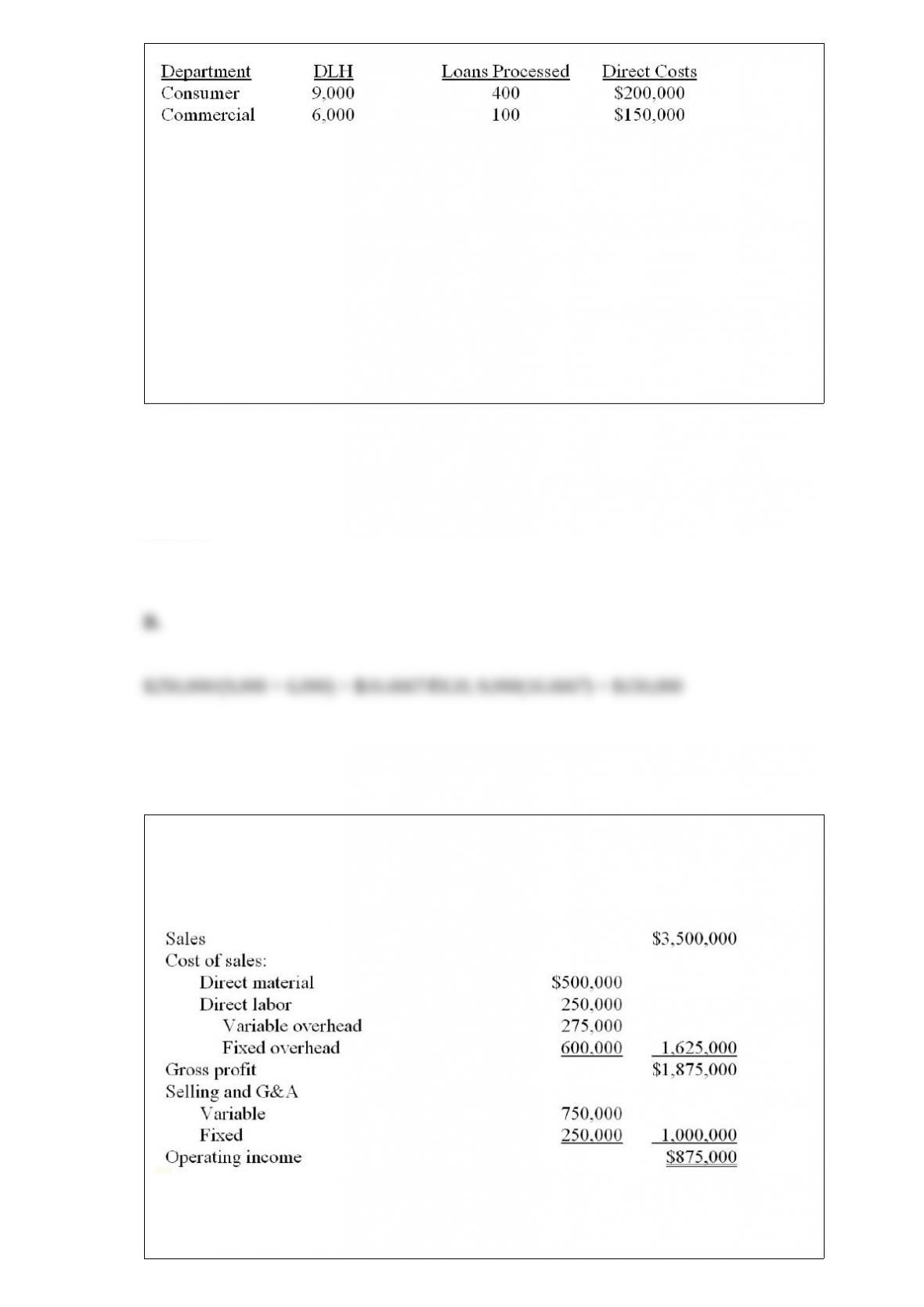
If Muskego uses a bankwide rate based on direct labor hours, what would be the
indirect costs allocated to the Consumer Department?
A. $100,000
B. $150,000
C. $250,000
D. $350,000
Answer:
Misa Corporation manufactures circuit boards and is in the process of preparing next
year’s budget. The pro forma income statement for the current year is presented below.
For the coming year, the management of Misa Corporation anticipates a 5 percent
decrease in sales, a 10 percent increase in all variable costs, and a $45,000 increase in
fixed expenses.
The operating profit for next year would be
A. $477,500.
B. $492,500.
C. $552,500.
D. $831,250.
Answer:
Cost drivers are (CMA adapted)
A. activities that cause costs to increase as the activity increases.
B. accounting techniques and practices used to control costs.
C. accounting reimbursements used to evaluate whether performance is proceeding
according to plan.
D. a mechanical basis, such as machine hours, computer time, or factory square
footage, used to assign costs to activities.
Answer:
Pittsville produces a paint solvent. Production of 400,000 pounds was started in
February, 350,000 pounds were completed. Material costs were $260,130 for the month
while conversion costs were $312,620. There was no beginning work-in-process; the
ending work-in-process was 90% complete.
(a) What is the total cost of the product that was completed and transferred to finished
goods?
(b) What is the value of the ending work-in-process?
Answer:
The sales mix variance would be
A. favorable when a company sells relatively fewer of the products that have
contribution margins lower than average.
B. favorable when a company sells relatively more of the products that have
contribution margins higher than average.

C. unfavorable when a company sells relatively fewer of the products that have selling
prices higher than average.
D. unfavorable when a company sells more of the products that have selling prices
lower than average.
Answer:
Which of the following documents is used as the basis for posting to the direct
materials section of the job cost sheet?
A. Purchase requisition.
B. Materials requisition.
C. Receiving report.
D. Purchase order.
E. Time card.
Answer:
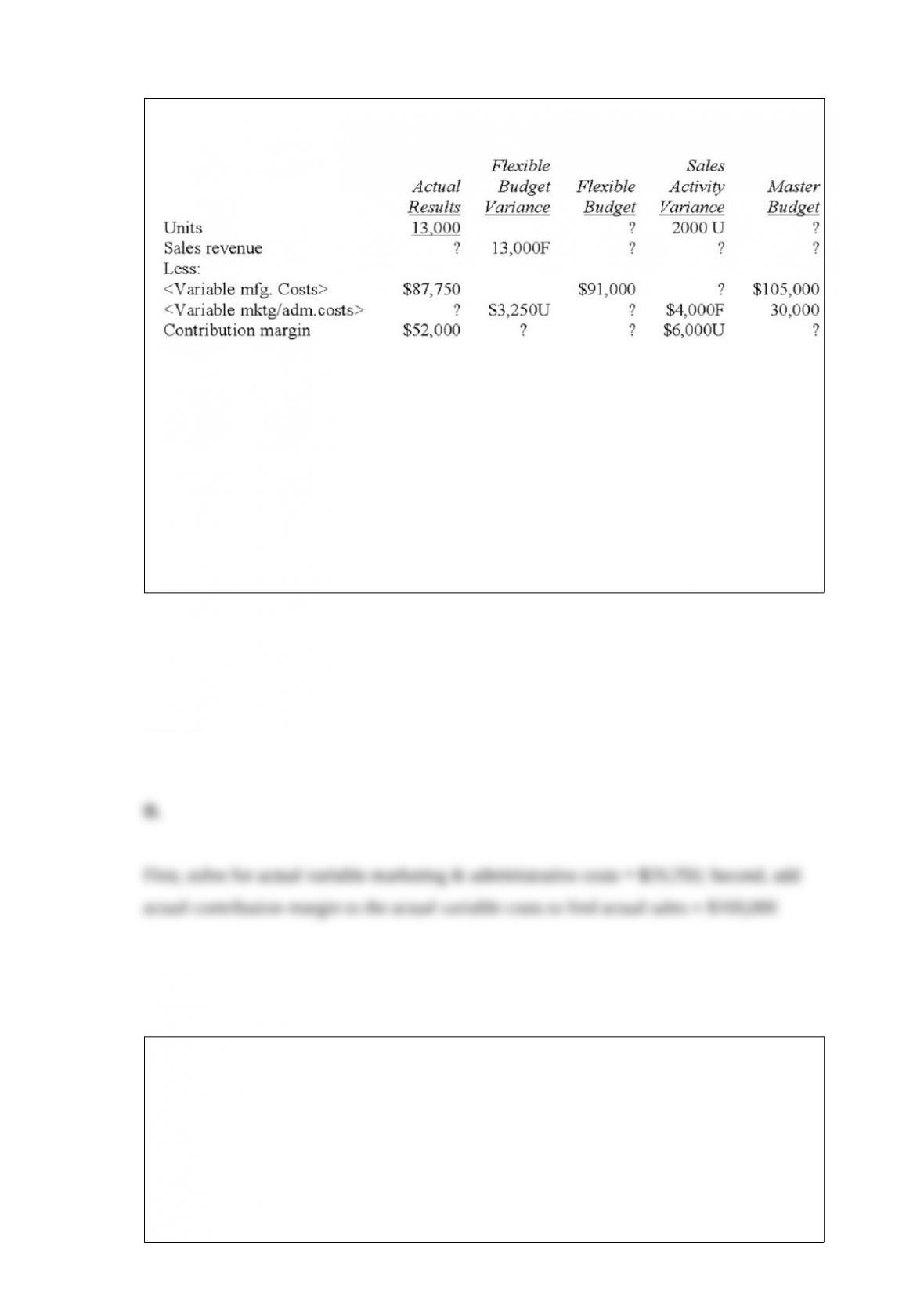
What is the actual sales revenue?
A. $156,000.
B. $169,000.
C. $180,000.
D. $191,000.
Answer:
Which of the following statements is (are) false?
(A) Operations costing accounts for material costs like job costing and conversion costs
like process costing.
(B) An automobile manufacturer is more likely to use an operations costing system than
a process costing system.
A. A only.
B. B only.
C. Both A and B.
D. Neither A nor B.
Answer:
The degree to which a good or service meets specifications is called:
A. conformance to specifications.
B. customer quality demands.
C. a conformance cost.
D. a compliance cost.
Answer:

Products with a relatively minor sales value are called
A. scrap.
B. spoilage.
C. by-products.
D. main products.
Answer:
Operating leverage refers to the extent to which an organization’s cost structure is made
up of:
A. differential costs.
B. opportunity costs.
C. fixed costs.
D. relevant costs.
E. product costs.
Answer: