Walker’s Manufacturing began its operations on January 1 of the current year. Walker
produced 10,000 units during the year, sold 8,000 units at an average cost of $22 per
unit, and had 2,000 units in ending inventory. Variable production cost were $14 per
unit, variable selling expenses were $2 per unit, fixed overhead totaled $12,000, and
fixed selling and administrative expenses totaled $30,000. Under absorption costing,
what was Walker’s ending inventory on the balance sheet?
a. $8,000
b. $28,000
c. $30,000
d. $30,400
The difference between the actual cost of variable overhead items and the amount of
variable overhead cost that is expected to be incurred at the actual level of activity base
experienced is the
a. The variable overhead materials variance.
b. The manufacturing overhead expense variance.
c. The variable overhead efficiency variance.
d. The variable overhead spending variance.
One of the primary products of the operations planning stage will likely be a
a.Projected income statement.
b.Pro forma balance sheet.
c.Budget.
d.None of these answer choices are correct.
Which of the following types of cost is not related to inventory?
a. Direct material
b. Indirect labor
c. Product costs
d. Period costs
Rivers Industries produces and sells electronic sound equipment. The company has
production capacity of 20,000 units and currently production schedule is for 18,000
units. Each unit has a selling price of $25, variable product cost of $15, and variable
selling cost of $2. Another division wishes to purchase 500 units. If Rivers sells the
units to the other division, it will avoid $1 of the variable selling costs. What is the
minimum transfer price that will maximize corporate profits?
a. $25
b. $17
c. $16
d. $15
Saira, Inc. is planning to sell 800,000 units for $1.50 per unit. The contribution margin
ratio is 20%. If Saira will break even at this level of sales, what are the fixed costs?
a. $240,000
b. $560,000
c. $800,000
d. $960,000
If the beginning balance in Raw Materials Inventory is $5,000, the ending balance is
$3,500, and $60,000 was the amount transferred to Work in Process Inventory, what is
the amount of materials purchased during the period?
a. $58,500
b. $60,000
c. $61,500
d. $68,500
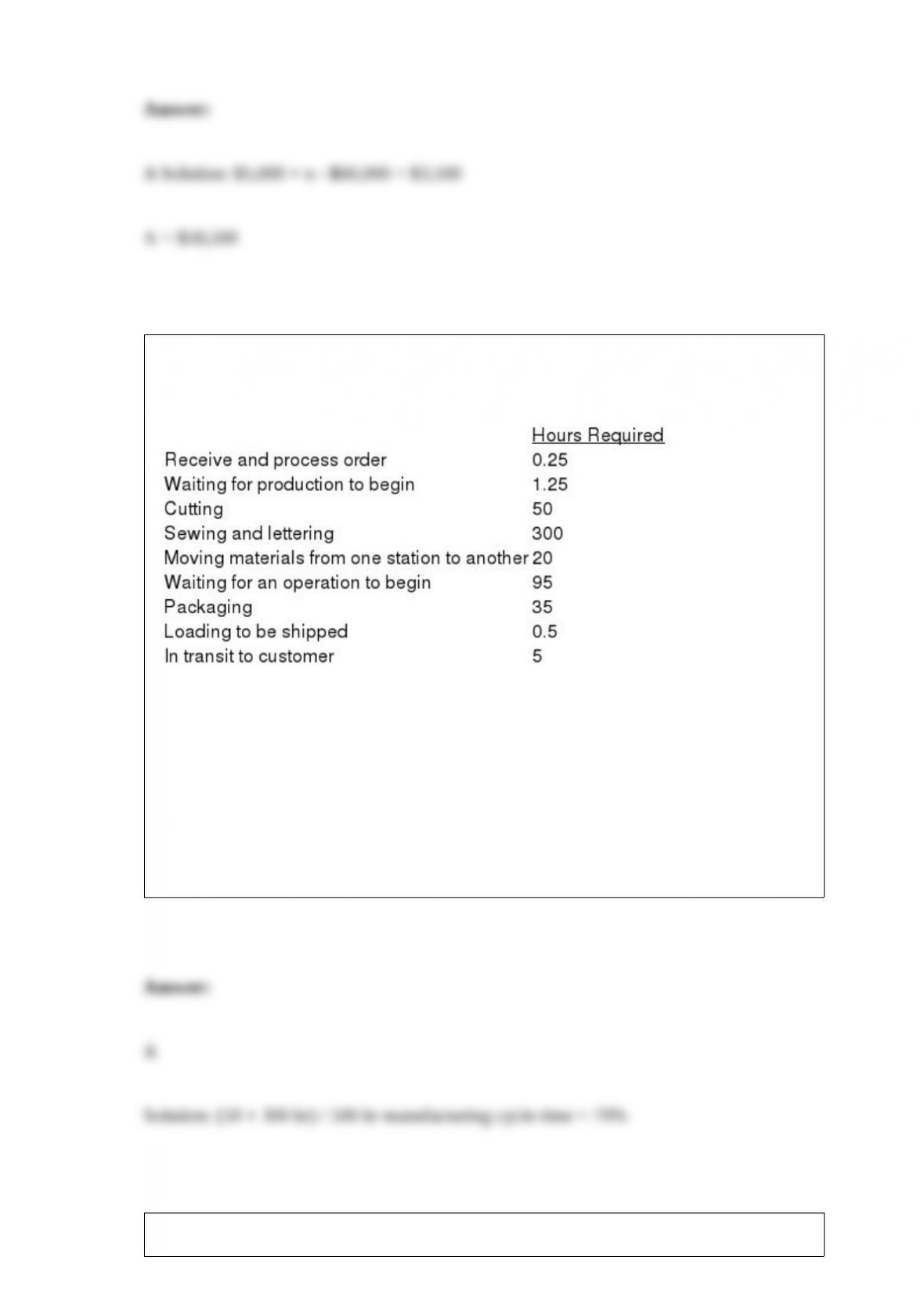
On January 4th, Stevens Manufacturing received an order for 30 uniforms. The
following information pertained to that order.
Calculate the manufacturing cycle efficiency.
a. 70%
b. 60%
c. 69%
d. 10%
Those activities that create the product the customer wants to buy are referred to as
a. Profitability activities.
b. Manufacturing burden.
c. Value-added activities.
d. Period costs.
Which of the following is not used in the calculation of the accounting rate of return?
a. Additional revenues generated by the investment
b. All additional operating expenses
c. Amount of the initial investment
d. Present value of an annuity factor.