Which of the following best describes the relationship between revenue and retained
earnings?
A. Revenue increases net income, which in turn increases retained earnings.
B. Revenue represents a cash receipt; retained earnings is an element of stockholders’
equity.
C. Revenue represents the price of goods sold or services rendered; retained earnings
represents cash available for paying dividends.
D. Retained earnings is equal to assets minus expenses.
Responsibility income statement
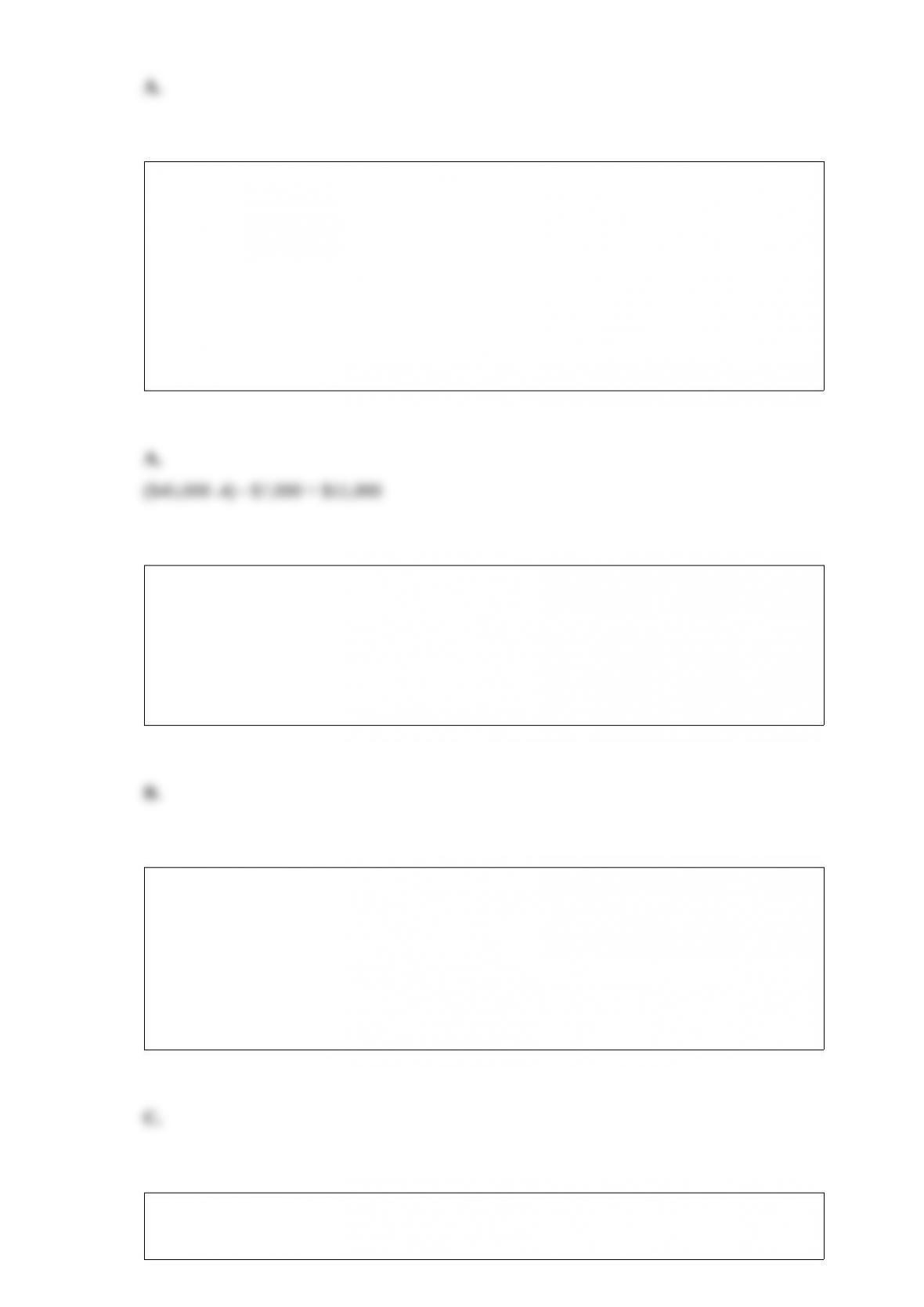
Classico’s Pizza, a chain of pizza parlors, views each branch location as an investment
center. The local branch reported the following results for the current year:
Compute the following measures for this investment center:
(a) Contribution margin: $_______________
(b) Contribution margin ratio: _______________%
(c) Responsibility margin: $_______________
(d) Increase in annual responsibility margin that would be expected to result from a
10% increase in sales volume: $_______________
The “bottom line” in a statement of cash flows shows:
A. The cash (including cash equivalents) on the balance sheet at the end of the period.
B. Net increase or decrease in cash during the period.
C. Net income, computed by the cash basis of accounting.
D. Net cash flow from operating activities.
Montclair Company earns an average contribution margin ratio of 40% on its sales. The
local store manager estimates that he can increase monthly sales volume by $45,000 by
spending an additional $7,000 per month for direct mail advertising. Compute the
monthly increase in operating income if the manager’s estimate about the increased
sales volume is accurate.
A. $11,000.
B. $23,000.
C. $16,000.
D. $18,000.
Which of the following companies would be more likely to use a perpetual inventory
system?
A. Corner deli.
B. Home Depot.
C. James Dean, CPA.
D. A manufacturer of custom sailboats.
Land is purchased by making a cash down payment of $40,000 and signing a note
payable for the balance of $130,000. The journal entry to record this transaction in the
accounting records of the purchaser includes:
A. A credit to Land for $40,000.
B. A debit to Cash for $40,000.
C. A debit to Land for $170,000.
D. A debit to Note Payable for $130,000.
Accounting terminology
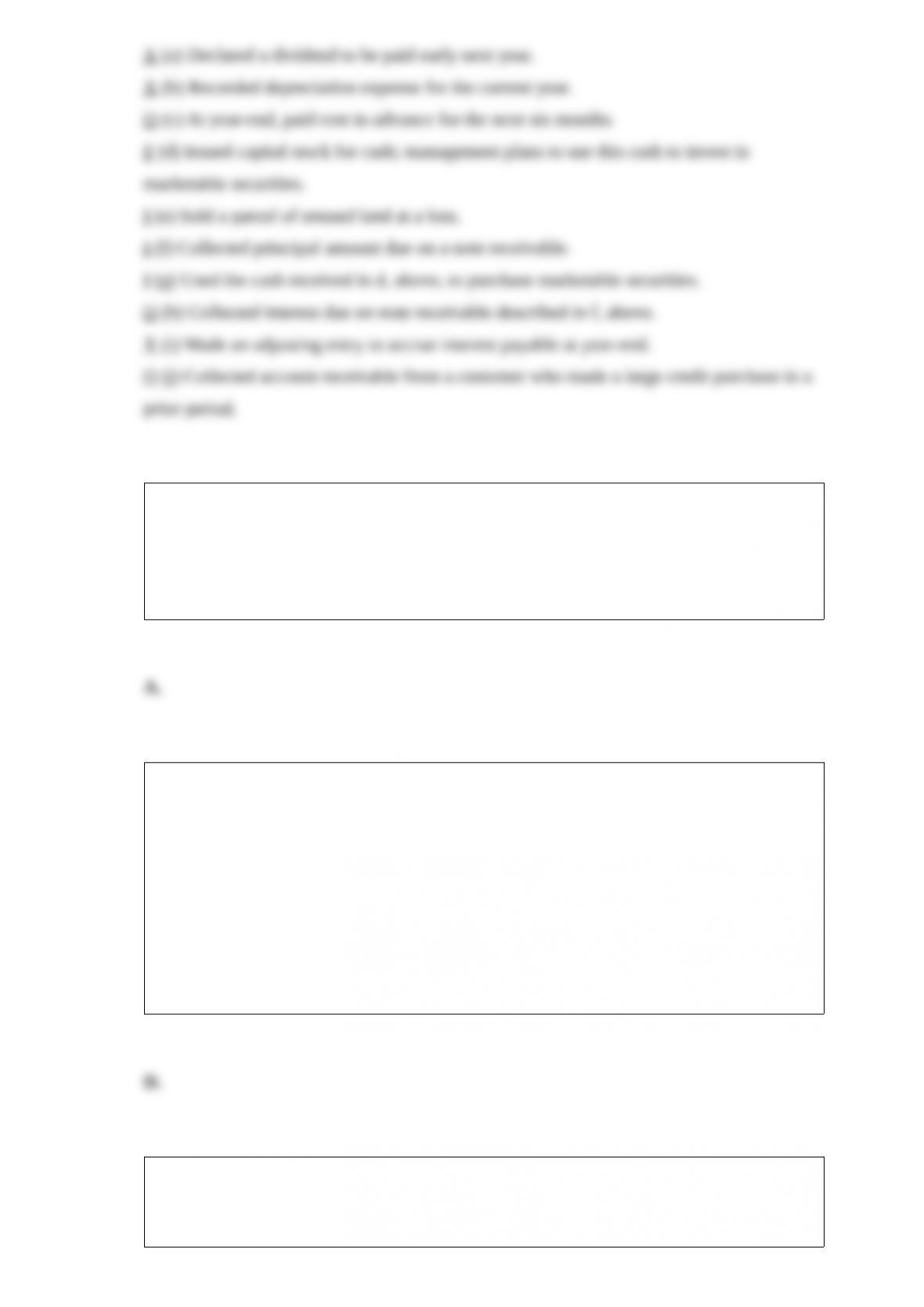
Listed below are nine technical accounting terms introduced or emphasized in this
chapter:
Each of the following statements may (or may not) describe one of these technical
terms. In the space provided below each statement, indicate the accounting term
described, or answer “None” if the statement does not correctly describe any of the
terms.
_____ (a) The balance remaining in the Manufacturing Overhead account when the
overhead application rate used during the period is too low.
_____ (b) The account credited as component parts are transferred into production.
_____ (c) A schedule used to accumulate manufacturing costs and to determine the unit
costs associated with a specific customer’s order.
_____ (d) The inventory account credited when the cost of goods sold is recorded.
_____ (e) The type of cost accounting system most likely used by an oil refinery
engaged in the continuous production of petroleum products.
_____ (f) The inventory account debited when manufacturing cost accounts (such as
Direct Labor or Materials Inventory) are credited.
_____ (g) The type of cost accounting system likely to be used by a machine shop that
manufactures items to the specifications provided by its customers.
Classification of cash flows
Indicate how each of the following events should be classified in a statement of cash
flows for the current calendar year. Use the following code: O = operating activities, I =
investing activities, and F = financing activities
Assume this company uses the direct method. If the event does not involve a cash flow
that should be included in the statement of cash flows, use an X.
____ (a) Declared a dividend to be paid early next year.
____ (b) Recorded depreciation expense for the current year.
____ (c) At year-end, paid rent in advance for the next six months.
____ (d) Issued capital stock for cash; management plans to use this cash to invest in
marketable securities.
____ (e) Sold a parcel of unused land at a loss.
____ (f) Collected principal amount due on a note receivable.
____ (g) Used the cash received in d, above, to purchase marketable securities.
____ (h) Collected interest due on note receivable described in f, above.
____ (i) Made an adjusting entry to accrue interest payable at year-end.
____ (j) Collected account receivable from a customer who made a large credit
purchase in a prior period.
The term net identifiable assets means:
A. All assets minus all liabilities.
B. All assets except goodwill, plus all liabilities.
C. All assets except intangibles, minus all liabilities.
D. All fixed assets less liabilities.
Anthony loaned $2,000 to Cleopatra for one year at 10% interest, all due at maturity.
He insisted the terms of the transaction be formalized in a promissory note. In this
situation:
A. The maturity value of the note is $2,000.
B. Anthony is considered the maker of the note and records the note as an asset in his
accounting records.
C. Anthony is considered the maker of the note and records the note as a liability in his
accounting records.
D. Cleopatra is considered the maker of the note and records the note as a liability in
her accounting records.
In the general ledger, a separate “account” is maintained for each:
A. Type of asset and liability and for each element of owners’ equity.
B. Business transaction.
C. Business day.
D. Journal entry.
Income statement classifications
Simon Hardware and Garfunkel Foods are sole proprietorships with similar amounts of
total assets. Also, both businesses earn similar amounts of revenue, incur similar
amounts of operating expenses, and report similar net incomes. However, Simon has a
higher cost of goods sold, while Garfunkel Foods has higher interest expense.
Indicate which of these companies has the higher (a) gross profit rate, and (b) return on
assets. In each case, explain the reasons for each answer.
A cash budget is affected directly by each of the following except:
A. A capital expenditures budget.
B. A sales forecast.
C. A manufacturing cost budget.
D. A budgeted income statement.
If total assets equal $345,000 and total owners’ equity equal $120,000, then total
liabilities must equal:
A. $465,000.
B. $225,000.
C. $120,000.
D. Cannot be determined from the information given.
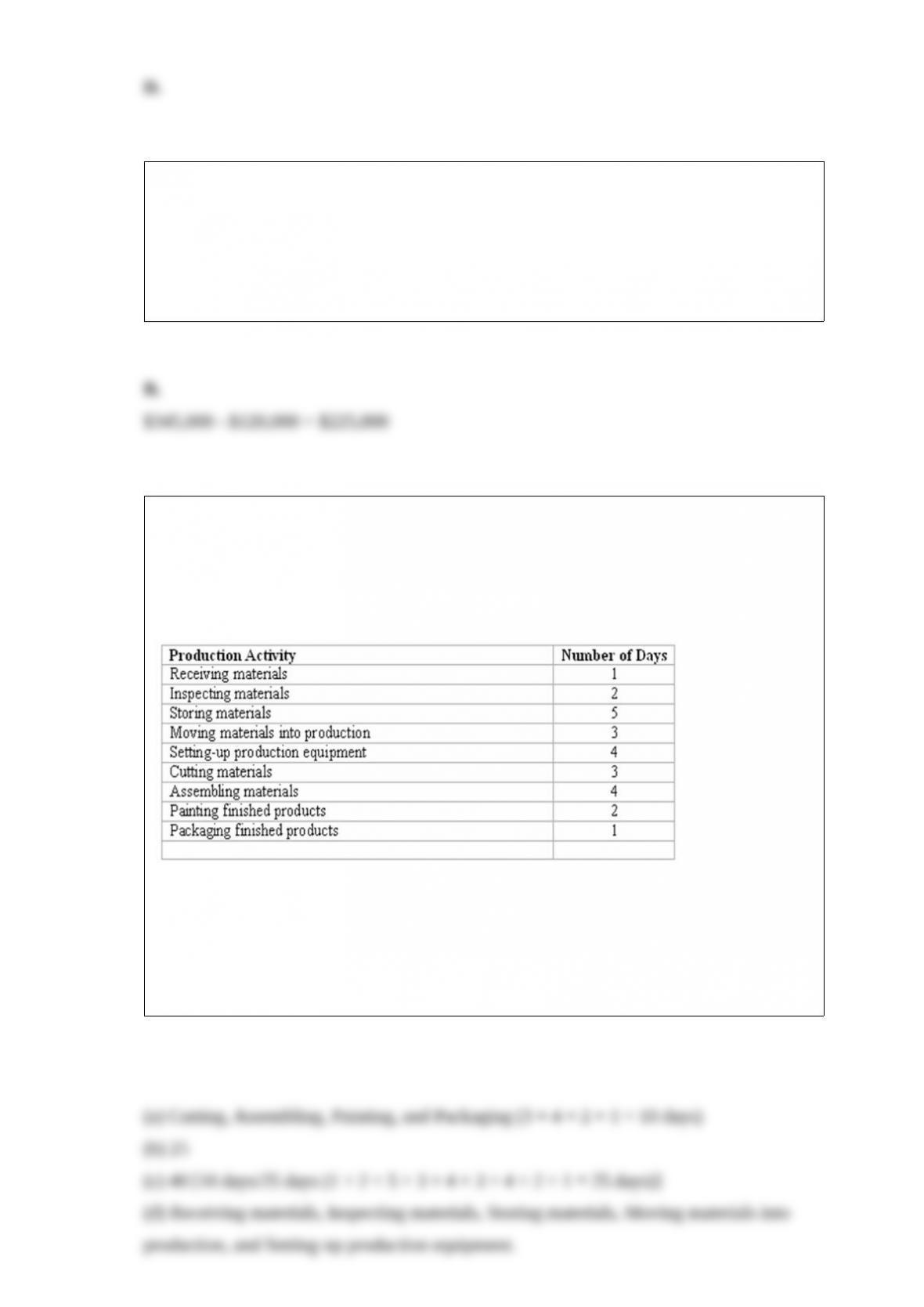
JIT systems’ manufacturing efficiency ratio
Methodical Corporation is considering the implementation of a JIT inventory system.
The company recently analyzed its cycle time to determine the average number of days
spent in each activity of its production process. A summary of the analysis is shown
below:
(a) Methodical’s value-added production activities include:
________________________.
(b) Methodical’s total cycle time is __________ days.
(c) Methodical’s manufacturing efficiency ratio is __________%.
(d) Which activities might be reduced or eliminated should Methodical implement a JIT
system?
The Retained Earnings statement is based upon which of the following relationships?
A. Retained Earnings – Net Income – Dividends.
B. Retained Earnings – Net Income + Dividends.
C. Retained Earnings + Net Income + Dividends.
D. Retained Earnings + Net Income – Dividends.
The Piazza Company has working capital of $540,000 and current assets of $810,000.
The current ratio is:
A. 0.67.
B. 1.50.
C. 2.00.
D. 3.00.
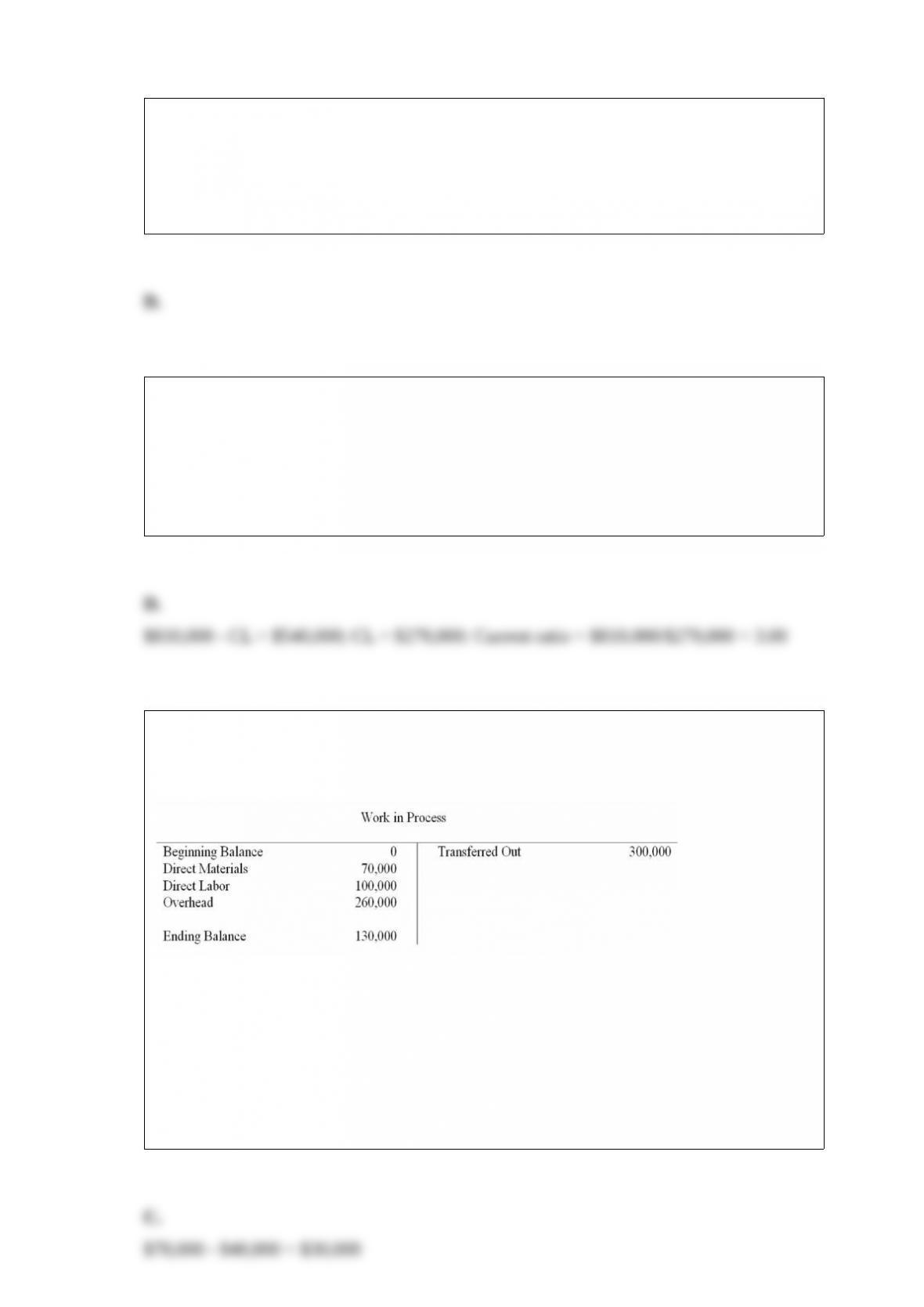
Capri Boat Corporation uses a job order cost system and applies overhead based on a
percentage of direct labor cost. Cost flows through the Work in Process Inventory
account during March are given below:
Only Job #007 was still in process at the end of March and this job had been charged
with $40,000 in direct materials cost.
Refer to the information above. The amount of direct materials cost charged to
completed jobs during March was:
A. $20,000.
B. $50,000.
C. $30,000.
D. Some other amount.

The Victor Corporation has been incurring favorable overhead volume variances in
each of the last several months. These persistent favorable variances indicate:
A. Victor’s management is unusually efficient.
B. The overhead application rate should be revised upward.
C. Monthly output is consistently under budget.
D. Monthly output is consistently over that budgeted.
Which of the following items would be included in the discontinued operations section
of the income statement?
A. Income or loss from operating the segment prior to its disposal.
B. The gain or loss on disposal of the segment.
C. Both the income or loss from operating the segment prior to its disposal, and the gain
or loss on disposal of the segment.
D. Only losses and not gains on the disposal of a segment.
Fisher Corporation invested $320,000 cash in available-for-sale marketable securities in
early December. On December 31, the quoted market price for these securities is
$337,000. Which of the following statements is correct?
A. Fisher’s December income statement includes a $17,000 gain on investments.
B. If Fisher sells these investments on January 2 for $300,000, it will report a loss of
$37,000.
C. Fisher’s December 31 balance sheet reports marketable securities at $320,000 and an
unrealized holding gain on investments of $17,000.
D. Fisher’s December 31 balance sheet reports marketable securities at $337,000 and an
unrealized holding gain on investments of $17,000.
The Abrams Corporation incurred the following quality costs for the year ending
December 31, 2015:
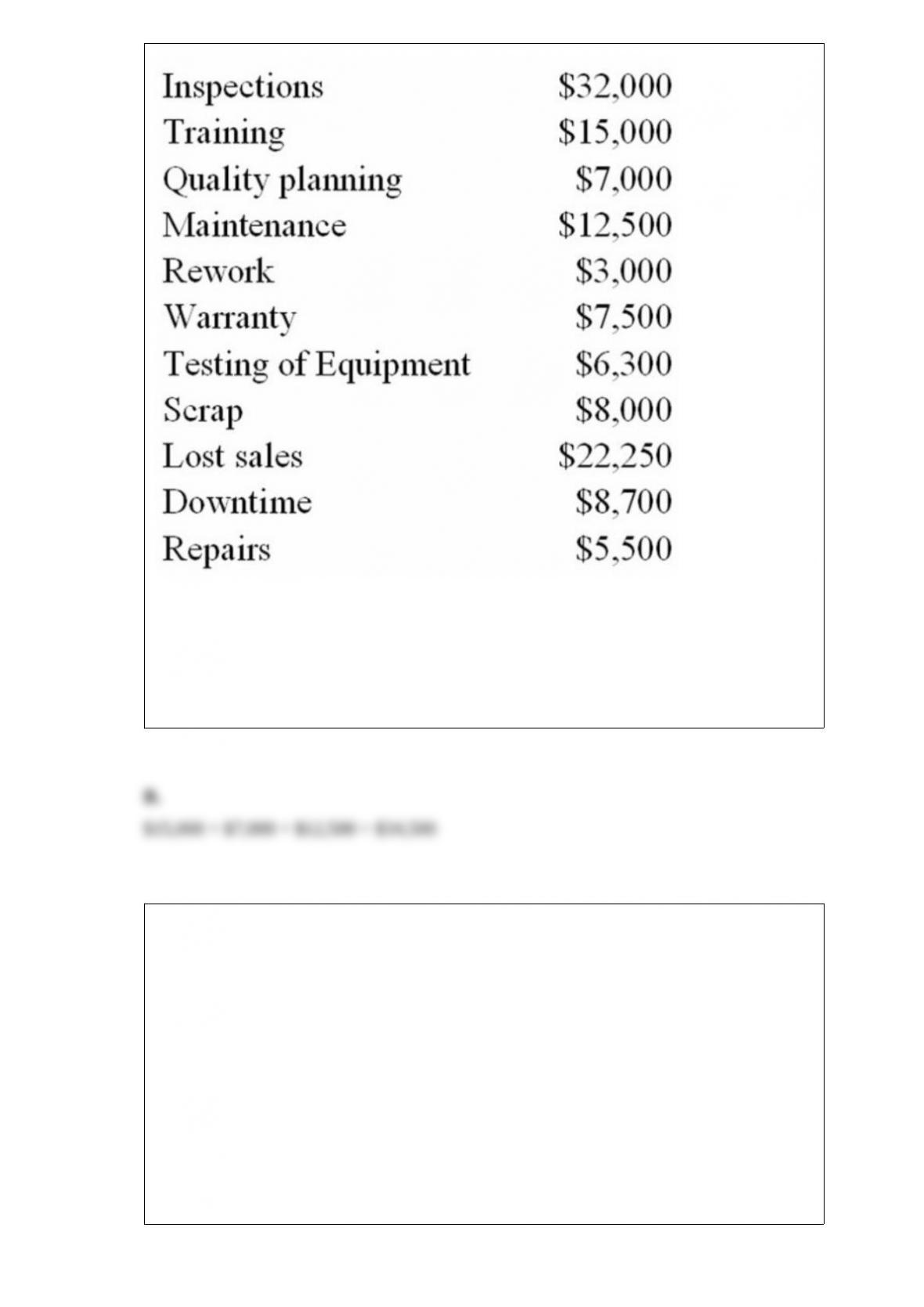
Refer to the information above. What are the total prevention costs for the Abrams
Corporation?
A. $38,300.
B. $34,500.
C. $19,700.
D. $35,250.
General Chemical Company (GCC) manufactures two products as part of a joint
process: A1 and B1. Joint costs up to the split-off point total $22,000. The joint costs
are allocated to A1 and B1 in proportion to their relative sales values. At the split-off
point, product A1 can be sold for $42,000, whereas product B1 can be sold for $63,000.
Product A1 can be processed further to make product A2, at an incremental cost of
$38,000. A2 can be sold for $85,000. Product B1 can be processed further to make
product B2, at an incremental cost of $48,000. B2 can be sold for $95,000.
Refer to the information above. The net change in operating income resulting from a
decision to manufacture product B2 is:
A. $6,000 (decrease).
B. $16,000 (decrease).
C. $48,000 (decrease).
D. $48,000 (increase).
The application of the matching principle to depreciation of plant and equipment can
best be described as:
A. The matching of the book value of an asset with its market value.
B. Offsetting the revenue of an accounting period with the estimated decline in market
value of plant and equipment during the accounting period.
C. Offsetting revenue of an accounting period with the portion of the cost of plant and
equipment estimated to have been used up during the accounting period.
D. The matching of the depreciation expense reported in the income statement for an
accounting period with the accumulated depreciation reported in the balance sheet.
Burns Industries currently manufactures and sells 20,000 power saws per month,
although it has the capacity to produce 35,000 units per month. At the
20,000-unit-per-month level of production, the per-unit cost is $65, consisting of $40 in
variable costs and $25 in fixed costs. Burns sells its saws to retail stores for $80 each.
Allen Distributors has offered to purchase 5,000 saws per month at a reduced price.
Burns can manufacture these additional units with no change in its present level of
fixed manufacturing costs.
Refer to the information above. Burns decides to accept the special order for 5,000 units
from Allen at a unit sales price that will add $100,000 per month to its operating
income. The unit price Burns charging Allen is:
A. $20.80.
B. $60.00.
C. $62.50.
D. $55.00.
Refer to the information above. A statement of cash flows for February, would report
net cash flows from operating activities of:
A. $4,000.
B. $35,600.
C. $53,600.
D. $96,600.
The placing of direct materials into the production process is recorded by an entry
crediting:
A. Materials Expense.
B. Raw Materials Inventory.
C. Work in Process Inventory.
D. Finished Goods Inventory.
The board of directors’ primary functions include all of the following except:
A. Hiring corporate officers.
B. Setting officers’ salaries.
C. Declaring dividends.
D. Transacting corporate business.
If current assets are $110,000 and current liabilities are $50,000, working capital will
be:
A. 45.5%.
B. 2:2.
C. $60,000.
D. $160,000.
Which of the following situations is impossible?
A. Book value is greater than residual value.
B. Book value is equal to the residual value.
C. Book value is less than residual value.
D. Book value is less than the original cost.
Which of the following statements about a periodic inventory system is not correct?
A. These systems are used primarily by small businesses with manual accounting
systems.
B. The system does not include an up-to-date inventory ledger.
C. The balance in the Inventory account remains unchanged until the end of the period.
D. The Cost of Goods Sold account is updated as sales transactions occur.
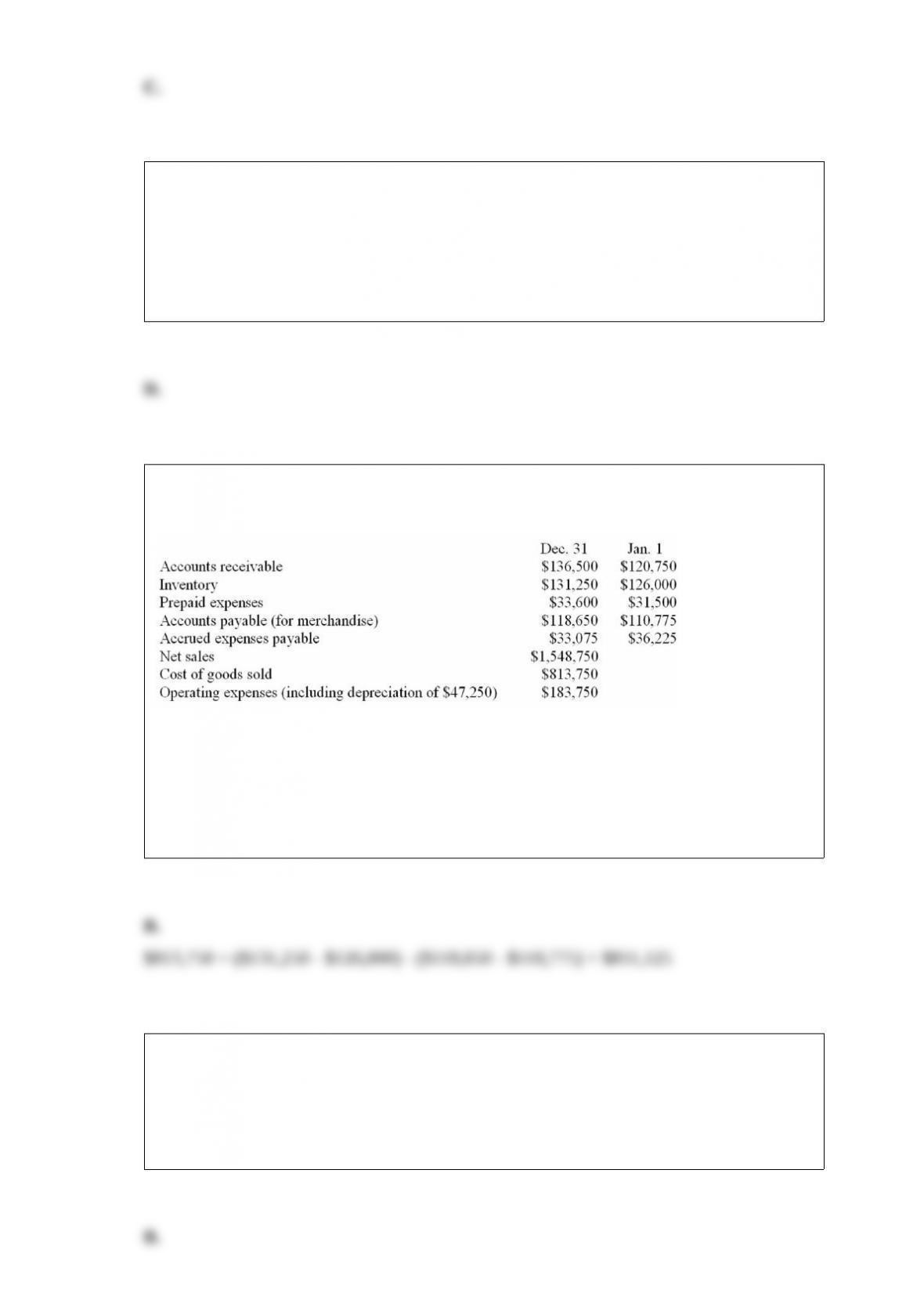
The financial statements of York, Inc., provide the following information for the current
year:
Refer to the information above. Compute the amount of cash payments for purchases of
merchandise during the current year.
A. $813,750.
B. $811,125.
C. $819,000.
D. $1,078,875.
Establishing international accounting standards is the responsibility of:
A. AICPA.
B. IASB.
C. SEC.
D. AAA.
An example of a contra-asset account is:
A. Depreciation Expense.
B. Accumulated Depreciation.
C. Prepaid expenses.
D. Unearned revenue.
Process costing system-determining unit costs
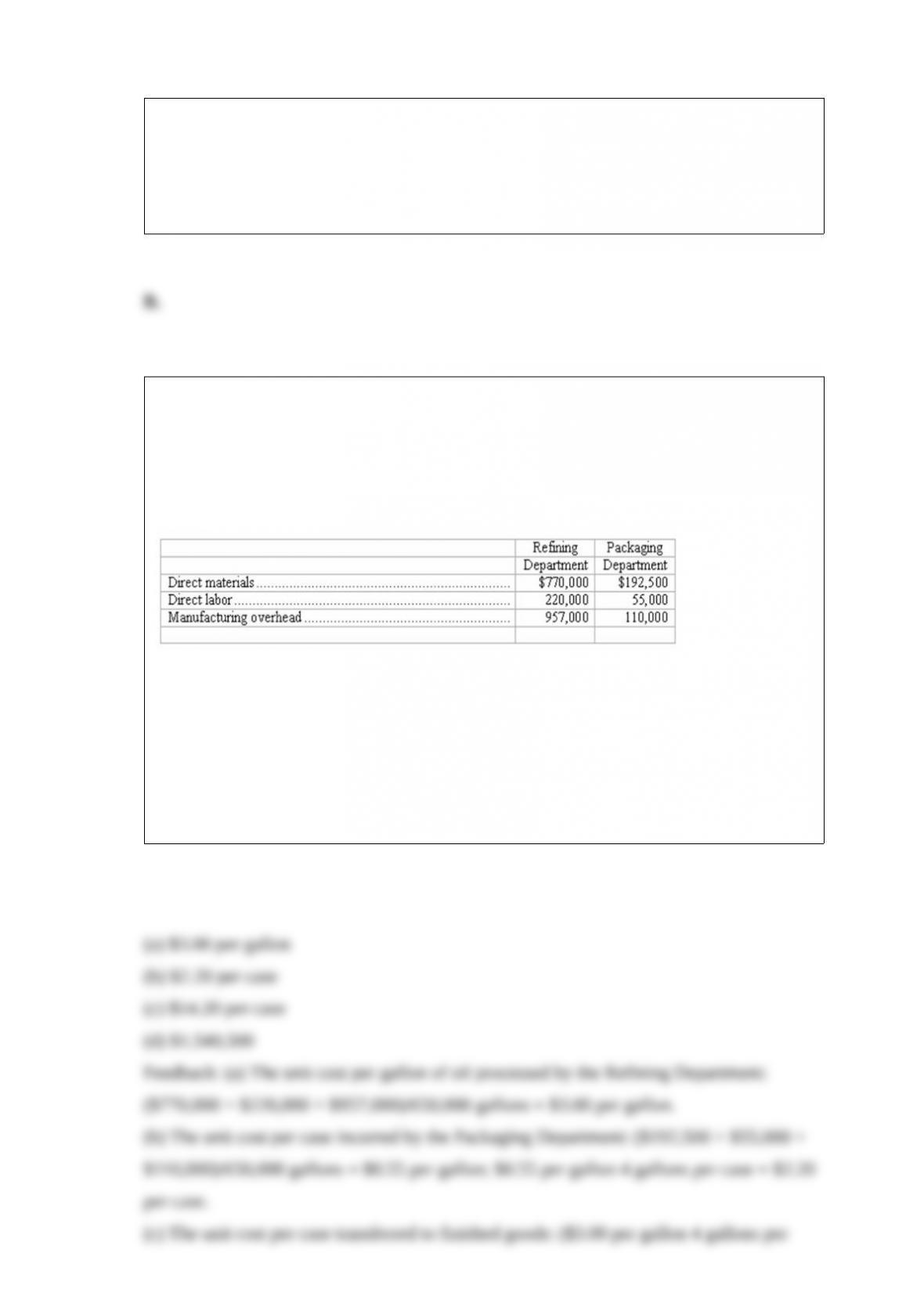
Houston Oil Company uses a process costing system with two departments: (a) a
Refining Department and (b) a Packaging Department. During June, its first month of
operations, the company manufactured and sold 650,000 gallons of motor oil,
generating total revenue of $3,845,000. The company incurred the following
manufacturing costs in June:
(a) How much was the unit cost per gallon of oil processed by the Refining Department
in June?
(b) If each case of oil contains four gallons, how much was the unit cost per case
incurred by the Packaging Department in June?
(c) How much was the unit cost per case transferred to finished goods in June? (Round
your final answer to one decimal place.)
(d) How much total gross profit was generated by the company in June? (Do not round
intermediate calculations)