
Department E had 4,000 units in Work in Process that were 40% completed at the
beginning of the period at a cost of $12,500. 14,000 units of direct materials were added
during the period at a cost of $28,700. 15,000 units were completed during the period,
and 3,000 units were 75% completed at the end of the period. All materials are added at
the beginning of the process. Direct labor was $32,450 and factory overhead was
$18,710. The number of equivalent units of production for the period for conversion if
the first-in, first-out method is used to cost inventories was:
A.15,650
B.14,850
C.14,150
D.14,650
Answer:
Contribution margin is:
A.the excess of sales revenue over variable cost
B.another term for volume in the “cost-volume-profit” analysis
C.profit
D.the same as sales revenue
Answer:
The present value index is computed using which of the following formulas?
A.Amount to be invested/Average rate of return
B.Total present value of net cash flow/Amount to be invested
C.Total present value of net cash flow/Average rate of return
D.Amount to be invested/Total present value of net cash flow
Answer:
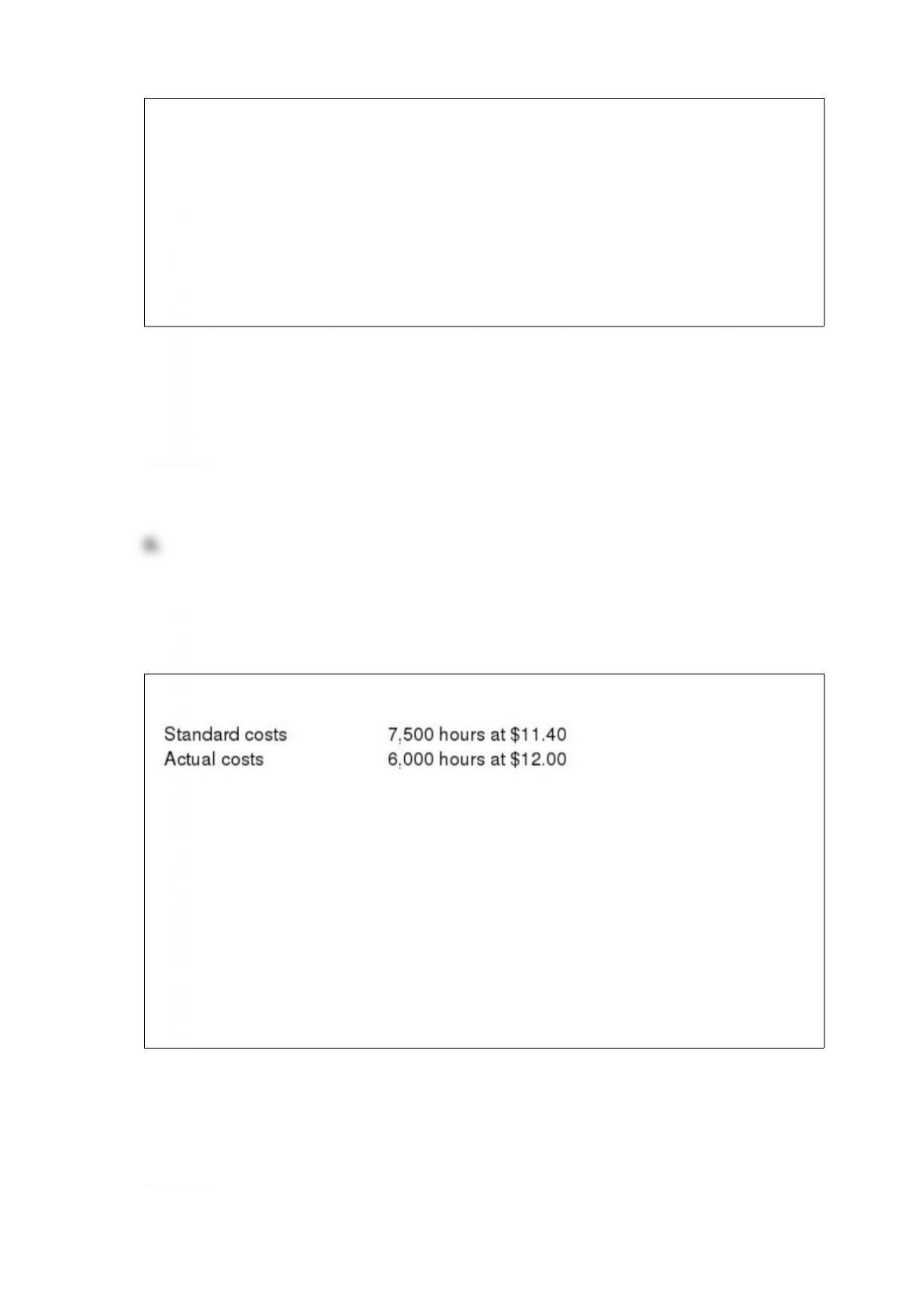
The following data relate to direct labor costs for the current period:
What is the direct labor time variance?
A.$ 4,500 favorable
B.$18,000 unfavorable
C.$ 3,600 favorable
D.$17,100 favorable
Answer:

The Lucy Corporation purchased and used 129,000 board feet of lumber in production,
at a total cost of $1,548,000. Original production had been budgeted for 22,000 units
with a standard material quantity of 5.7 board feet per unit and a standard price of $12
per board foot. Actual production was 23,500 units.
Compute the material price variance.
A.0
B.59,400U
C.59,400F
D.6,000U
Answer:
When referring to a note receivable or promissory note
A.the maker is the party to whom the money is due.
B.the note is not considered a formal credit instrument.
C.the note cannot be factored to another party.
D.the note may be used to settle an accounts receivable.
Answer:

Which account is not classified as a selling expense?
A.Sales Salaries
B.Freight-Out
C.Freight-In
D.Advertising Expense
Answer:
Work in process inventory on December 31, 2011, is $44,000. Work in process
inventory increased by 60% during 2011. Cost of goods manufactured for 2011
amounts to $275,000. What are the total manufacturing costs incurred in 2011?
A.$291,500
B.$302,000
C.$275,750
D.$233,750
Answer:

Ruben Company purchased $100,000 of Evans Company bonds at 100 plus $1,500 in
accrued interest. The bond interest rate is 8% and interest is paid semi-annually. The
journal entry to record the receipt of interest on the next interest payment date would
be:
A.Debit: Cash $4,000; Credit: Interest Revenue $4,000
B.Debit: Cash $4,000; Credit: Interest Receivable $4,000
C.Debit: Cash $4,000; Credit: Interest Receivable $1,500 and Interest Revenue $2,500
D.Debit: Cash $2,500; Credit: Interest Revenue $2,500
Answer:
Gladstorm Enterprises sells a product for $60 per unit. The variable cost is $20 per unit,
while fixed costs are $85,000. Determine the (a) break-even point in sales units, and (b)
break-even point in sales units if the selling price increased to $80 per unit. Round your
answer to the nearest whole number.
Answer:
Planning for capital expenditures is necessary for all of the following reasons except:
A.machinery and other fixed assets wear out
B.expansion may be necessary to meet increased demand
C.amounts spent for office equipment may be immaterial
D.fixed assets may fall below minimum standards of efficiency
Answer:
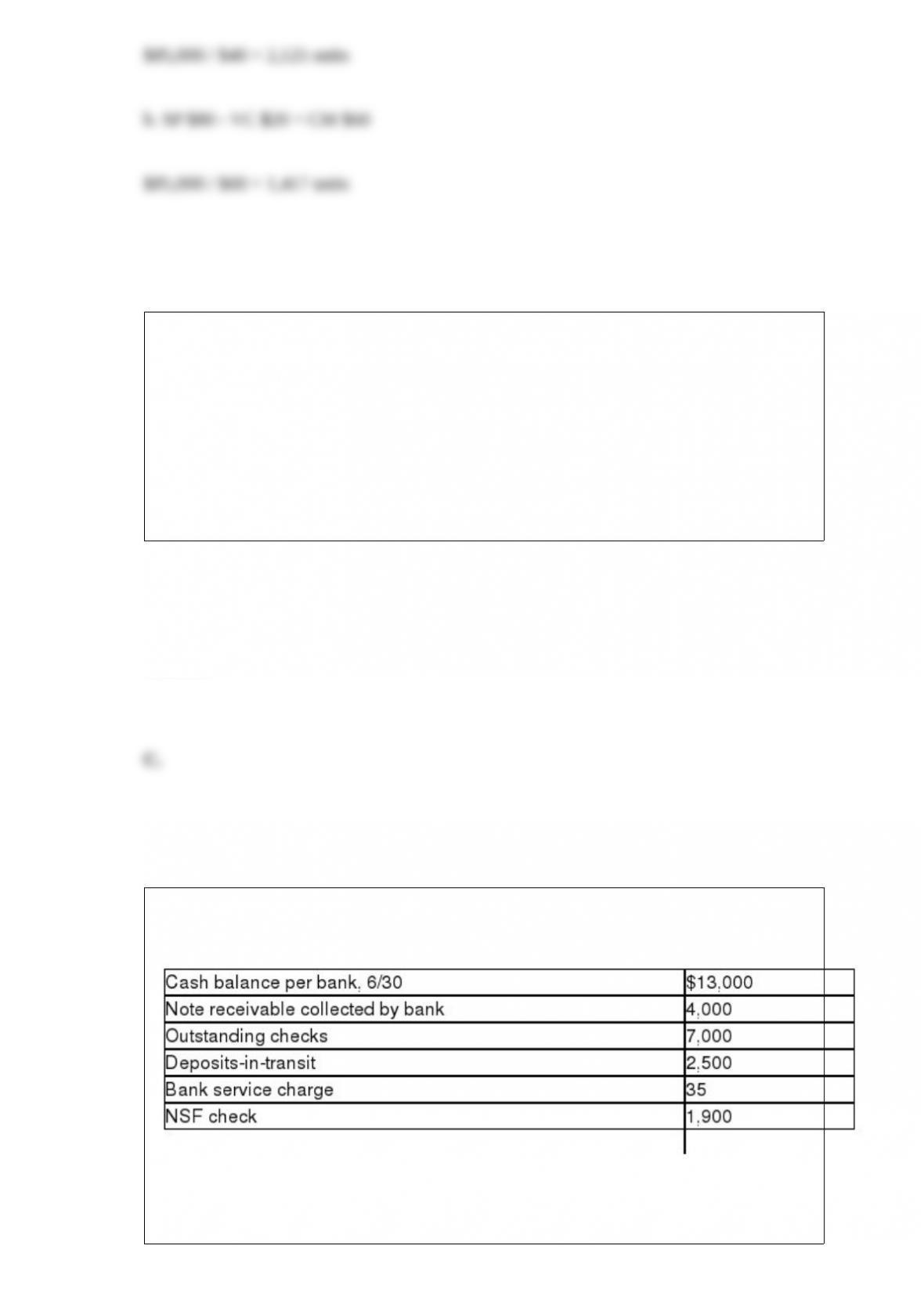
Jamison Company developed the following reconciling information in preparing its
June bank reconciliation:
Using the above information, determine the cash balance per books (before
adjustments) for the Jamison Company.

A.$8,065
B.$10,565
C.$15,065
D.$6,435
Answer:
Accounts Receivable Turnover measures
A.how frequently during the year the accounts receivable are converted to cash
B.the number of days of accounts receivable outstanding
C.the fair market value of accounts receivable
D.the efficiency of the accounts payable function
Answer:
The following procedures were recently implemented at the Pampered Pets, Inc. For
each procedure, indicate whether the internal control over cash represents (1) a strength
or (2) a weakness. If it is a weakness, please explain why.
(a) At the end of the day, cash register clerks are required to use their own funds to
make up any cash shortages in their registers.
(b) At the end of the day, an accounting clerk compares the duplicate copy of the daily
cash deposit slip with the deposit receipt obtained from the bank.
(c) After necessary approvals have been obtained for the payment of a voucher, the
treasurer signs and mails the check. The treasurer then stamps the voucher and
supporting documentation as paid and returns the voucher and supporting
documentation to the accounts payable clerk for filing.
(d) Along with the petty cash expense receipts for postage, office supplies, etc., several
post-dated employee checks are in the petty cash fund.
Answer:
Which of the following is the correct formula to calculate the predetermined factory

overhead rate?
A.Estimated total factory overhead costs divided by estimated activity base.
B.Actual total factory overhead costs divided by estimated activity base.
C.Estimated total factory overhead costs divided by actual activity base.
D.Actual total factory overhead costs divided by actual activity base.
Answer:
On January 1, 2014, the Baker Corporation issued 10% bonds with a face value of
$50,000. The bonds are sold for $46,000. The bonds pay interest semiannually on June
30 and December 31 and the maturity date is December 31, 2023. Baker records
straight-line amortization of the bond discount. The bond interest expense for the year
ended December 31, 2014, is
A.$5,000
B.$5,200
C.$5,800
D.$5,400
Answer:

If fixed costs are $46,800, the unit selling price is $42, and the unit variable costs are
$24, what is the break-even sales (unit ) if the variable costs are decreased by $2?
A.2,127
B.1,114
C.2,340
D.1,950
Answer:
What pricing concept considers the price that other providers charge for the same
product?
A.Demand-based concept
B.Total cost concept
C.Cost-plus concept
D.Competition-based concept
Answer:

Which of the following would most likely be a period cost?
A.Depreciation on factory lunchroom furniture.
B.Salary of telephone receptionist in the sales office.
C.Salary of a security guard for the factory parking lot.
D.Computer chips used by a computer manufacturer.
Answer:
Which of the following would be deducted from the balance per books on a bank
reconciliation?
A.Service charges
B.Outstanding checks
C.Deposits in transit
D.Notes collected by the bank
Answer:
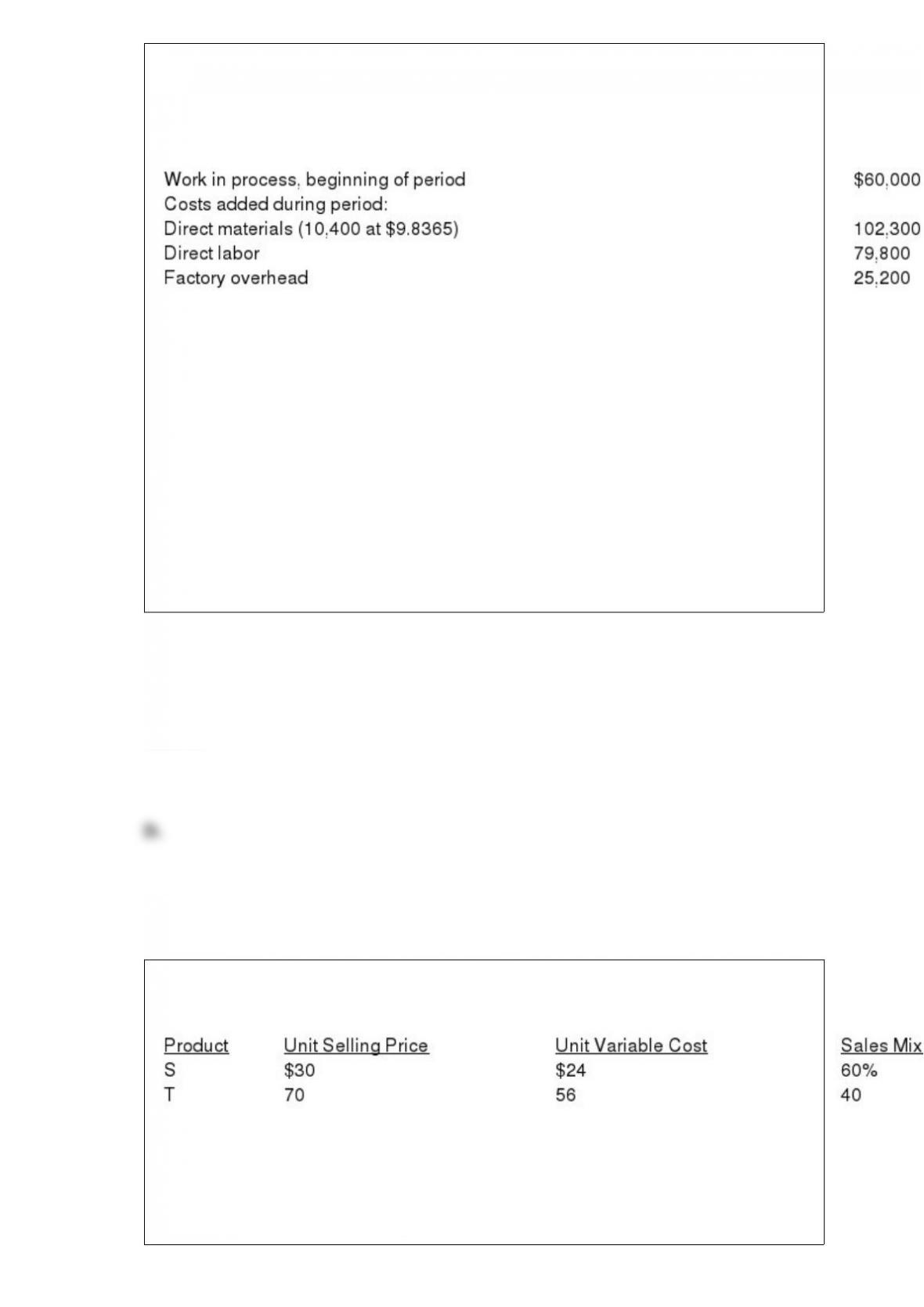
Department G had 3,600 units, 40% completed at the beginning of the period, 12,000
units were completed during the period, 2,000 units were one-fifth completed at the end
of the period, and the following manufacturing costs were debited to the departmental
work in process account during the period:
Assuming that all direct materials are placed in process at the beginning of production
and that the first-in, first-out method of inventory costing is used, what is the material
and conversion cost per unit (to the nearest penny), respectively.
A.$5.94 and $5.86
B.$5.94 and $6.38
C.$8.00 and $8.68
D.$9.84 and $9.58
Answer:
Silver River Company sells Products S and T and has made the following estimates for
the coming year:
Fixed costs are estimated at $202,400. Determine (a) the estimated sales in units of the
overall product necessary to reach the break-even point for the coming year, (b) the
estimated number of units of each product necessary to be sold to reach the break-even
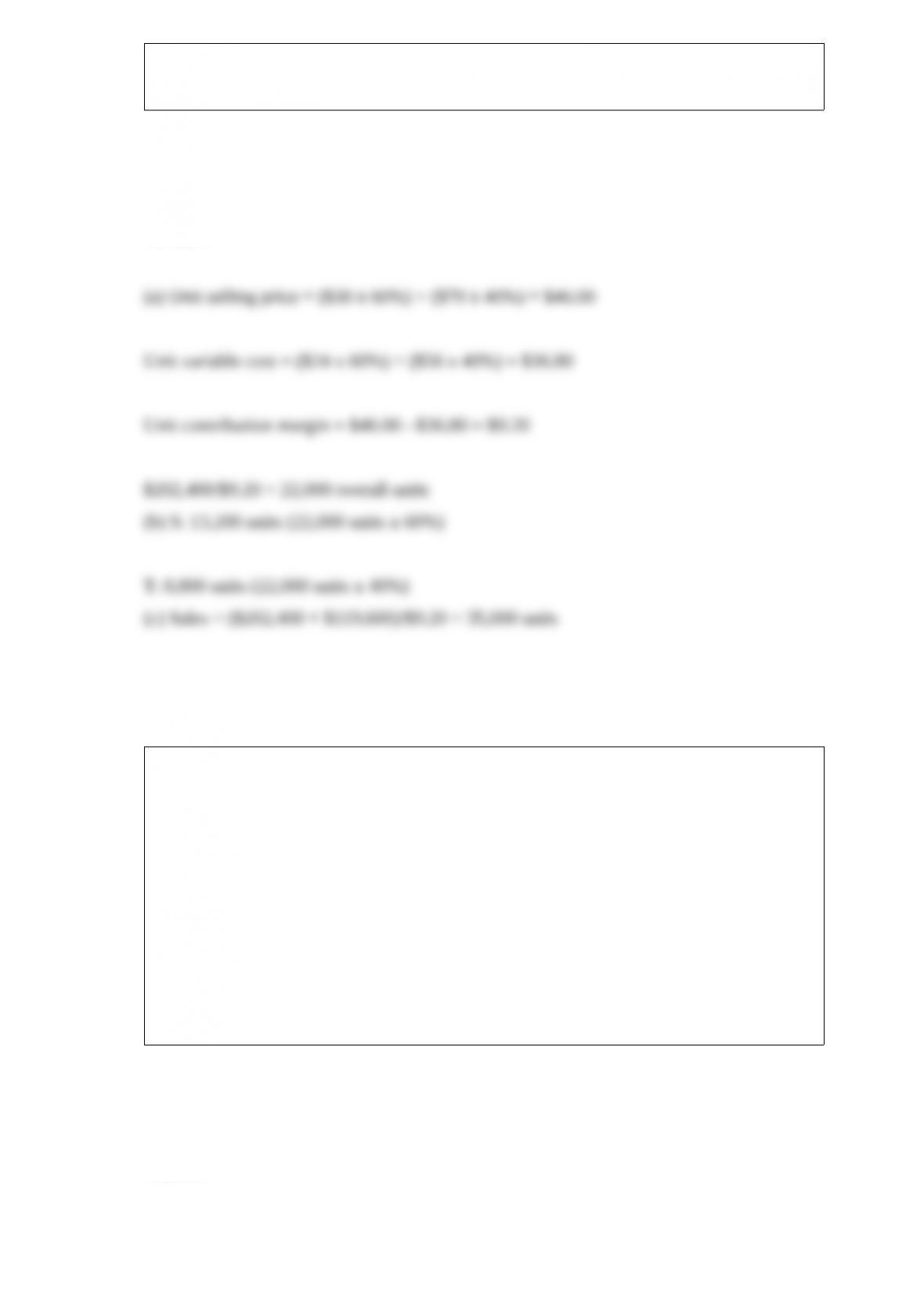
point for the coming year, and (c) the estimated sales in units of the overall product
necessary to realize an operating income of $119,600 for the coming year.
Answer:
Teri, Doug, and Brian are partners with capital balances of $20,000, $30,000, and
$50,000 respectively. They share income in the ratio of 3:2:1. Income Summary with a
debit balance of $30,000 is closed to the capital accounts. Doug withdraws from the
partnership. How much cash does he get upon withdrawal?
A.$30,000
B.$20,000
C.$40,000
D.$24,000
Answer:

On April 1, 2011, Albert Company purchased $50,000 of Tetter Company’s 12% bonds
at 100 plus accrued interest of $2,000. On June 30, 2011, Albert received its first
semiannual interest. On February 1, 2012, Albert sold $40,000 of the bonds at 103 plus
accrued interest. The journal entry Albert will record on April 1, 2011 for the purchase
of the bonds will include:
A.a credit to Interest Payable for $2,000.
B.a debit to Investments – Tetter Company for $52,000.
C.a debit for Cash of $50,000.
D.a debit to Investments – Tetter Company for $50,000.
Answer:
Super Security Company manufacturers home alarms. Currently it is manufacturing one
of its components at a variable cost of $45 and fixed costs of $15 per unit. An outside
provider of this component has offered to sell Safe Security the component for $50.
Determine the best plan and calculate the savings.
A.$5 savings per unit – Manufacture
B.$5 savings per unit – Purchase
C.$10 savings per unit – Manufacture
D.$15 savings per unit – Purchase

Answer:
Cash dividends of $45,000 were declared during the year. Cash dividends payable were
$10,000 at the beginning of the year and $15,000 at the end of the year. The amount of
cash for the payment of dividends during the year is
A.$50,000
B.$40,000
C.$55,000
D.$35,000
Answer:
Managerial accounting information includes both historical and estimated data.
Answer:
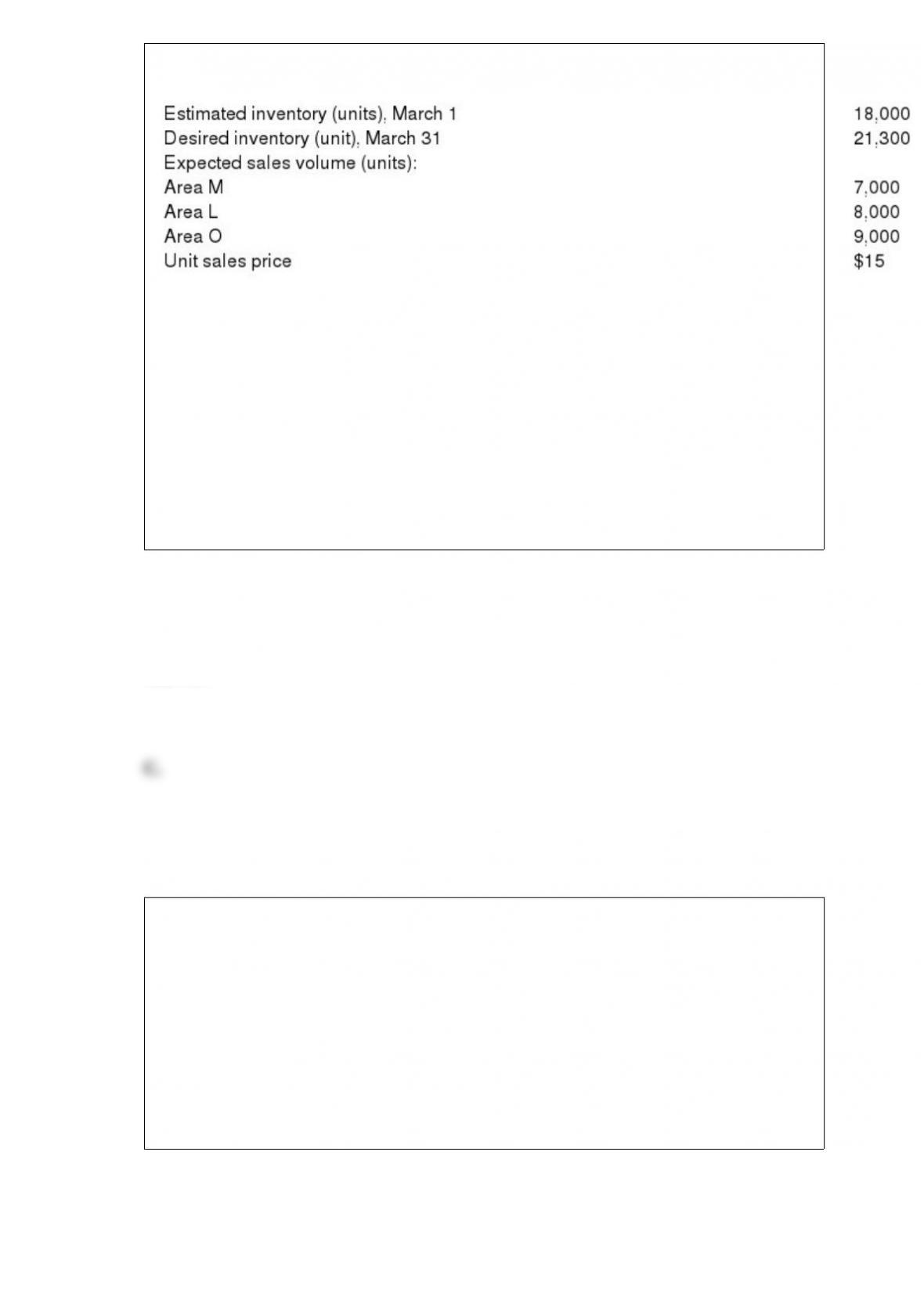
Production and sales estimates for March for the Robin Co. are as follows:
The number of units expected to be manufactured in March is:
A.24,000
B.27,000
C.27,300
D.21,300
Answer:
How does receiving a bill to be paid next month for services received affect the
accounting equation?
A.assets decrease; owner’s equity decreases
B.assets increase; liabilities increase
C.liabilities increase; owner’s equity increases
D.liabilities increase; owner’s equity decreases

Answer:
The Clydesdale Company has sales of $4,500,000. It also has invested assets of
$2,000,000 and operating expenses of $3,600,000. The company has established a
minimum rate of return of 7%.
What is Clydesdale Company’s investment turnover?
A.1.80
B.2.25
C.1.25
D.1.4
Answer: