
Which of the following equations can be used to compute a labor price variance? (A =
Actual; S = Standard; H = Hour; P = Price)
A. (AH × AP) – (AH × SP)
B. (AH × SP) – (SH × SP)
C. (AH × AP) – (SH × SP)
D. (SH × SP) – (SH × SP)
You are considering an investment in Frontier Airlines stock and wish to assess the
firm’s earnings performance. All of the following ratios can be used to assess
profitability except:
A. Average days to collect receivables.
B. Asset turnover.
C. Return on investment.
D. Net margin.
Budgeted sales commissions would appear on the:
A. selling, general and administrative budget and pro forma income statement
B. selling, general and administrative budget and pro forma balance sheet
C. sales budget and pro forma balance sheet

D. sales budget and pro forma income statement
Wu Company incurred $40,000 of fixed cost and $50,000 of variable cost when 4,000
units of product were made and sold.
If the company’s volume doubles, the company’s total cost will:
A. stay the same.
B. double as well.
C. increase but will not double.
D. decrease.
The only difference between the cash flow statement prepared under the indirect
method as opposed to the direct method is the manner in which the:
A. cash flows from financing activities is presented.
B. schedule of non-cash items is presented.
C. cash flows from investing activities is presented.
D. cash flows from operating activities is presented.

Which ratio measures the percentage of company’s assets that are financed by debt?
A. Debt to assets ratio
B. Asset turnover
C. Debt to equity
D. Return on investment
Nguyen Company has an opportunity to purchase an asset that will cost the company
$36,000. The asset is expected to add $12,000 per year to the company’s net income.
Assuming the asset has a five-year useful life and zero salvage value, the unadjusted
rate of return based on the average investment will be:
A. 60%.
B. 33%.
C. 15%.
D. none of these answers is correct.
Frank Company experienced an event that affected its financial statements as indicated

below:
Which of the following transactions caused the indicated effects?
A. Completed units were sold.
B. Units were completed and moved to finished goods.
C. The cost of units sold was recorded.
D. None of these.
A modern cost allocation process that employs multiple cost drivers is:
A. activity-based costing.
B. contribution costing.
C. process costing.
D. job order costing.
Preston Manufacturing is working on two housing projects. Overhead is applied on the
basis of direct labor hours. At the beginning of the year, the company estimated that
overhead would be $64,000 and 10,000 direct labor hours would be worked. Both
projects were started and completed in the current accounting period. The following
transactions were completed during the period:
(a) Used $10,000 of direct material on Project I and $6,800 of direct material on Project
II.
(b) Labor costs for the two jobs amounted to the following: Project I, $24,000 (2,000
hours); Project II, $44,000 (6,000 hours).
(c) Project II was sold during the period for $120,000.
The amount of estimated overhead applied to work in process inventory for the period
equals (Do not round your intermediate calculation):
A. $51,200.
B. $64,000.
C. $54,400.
D. $44,000.
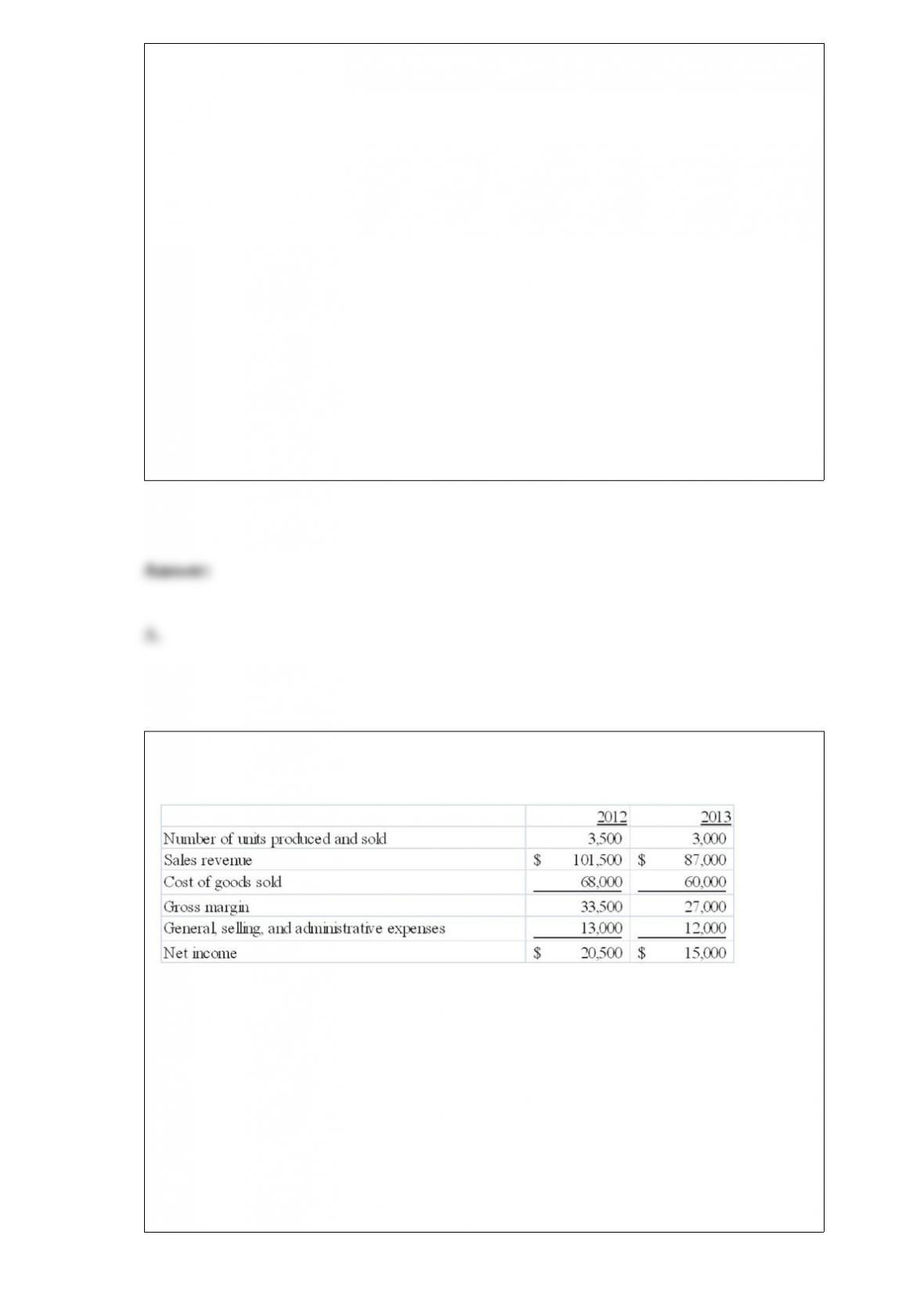
The following income statements are provided for Li Company’s last two years of
operation:
Assuming that cost behavior did not change over the two year period, what is the
amount of the company’s variable cost of goods sold per unit?
A. $12.00 per unit
B. $16.00 per unit
C. $22.00 per unit
D. None of these

All of the following are features of managerial accounting except:
A. information is provided primarily to insiders such as managers.
B. information includes economic and non-financial data as well as financial data.
C. information is characterized by objectivity, reliability, consistency, and accuracy.
D. information is reported continuously with a present or future orientation.
Which of the following costs should not be recorded as an expense?
A. Insurance on factory building
B. Sales commissions
C. Product shipping costs
D. Product advertising
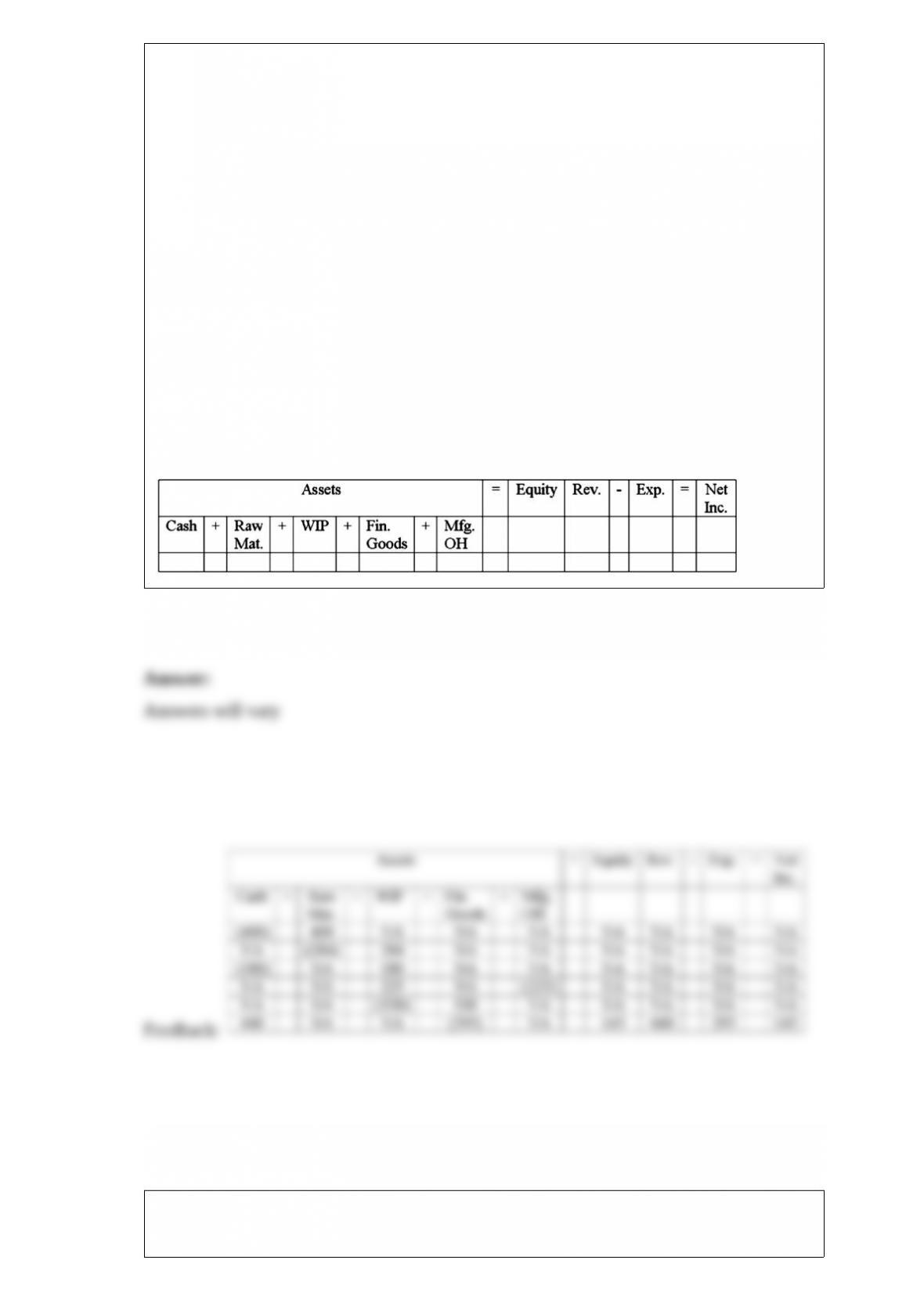
Jiminez Company engaged in the following transactions during May 2014:
1. Purchased raw materials for cash, $400
2. Used raw materials to begin jobs, $284
3. Paid wages of production employees, $180
4. Applied overhead at rate of $1.25 per direct labor dollar
5. Completed job that had cost $320
6. Sold for $440 cash, goods that had cost $295 to complete
Required:
Use the horizontal statements model provided to indicate how each of these events
affected Juarez’s financial statements. Show dollar amounts of increases and decreases.
If an item is not affected by a transaction, indicate by writing NA.
Mr. J’s Bagels invested in a new oven for $14,000. The oven reduced the amount of
time for baking which increased production and sales for five years by the following
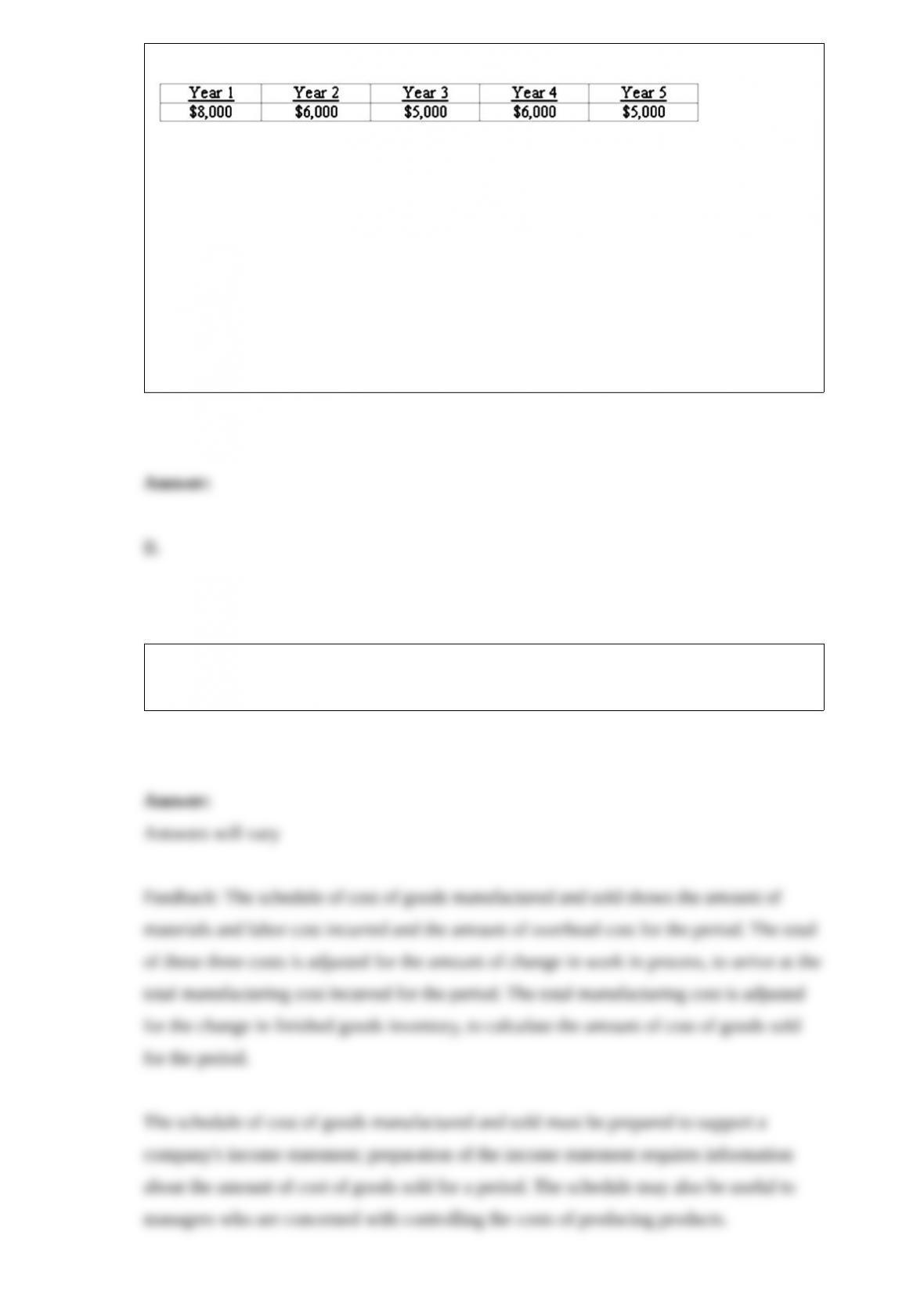
amounts of cash inflows:
Using the averaging method, the payback period for the investment in the oven would
be:
A. 5.0 years.
B. 2.3 years.
C. 2.0 years.
D. 0.5 years.
Describe the schedule of cost of goods manufactured and sold. What information does it
include, and how is it used?
What cost driver would you use to allocate indirect materials to products?
What is the reinvestment assumption, and how does the assumption affect capital
investment analyses?
Indicate whether each of the following statements is true or false.
The difference between the actual fixed costs and budgeted fixed costs is the spending
variance.
For fixed costs, there is no flexible budget variance.
Companies generally do not calculate a volume variance for fixed overhead costs.
The volume variance is the difference between budgeted fixed cost and the applied
fixed cost for the period.
If the amount of fixed overhead applied to production is greater than the budgeted fixed
overhead, the result is an unfavorable overhead volume variance.
Burgess Corporation is considering purchasing equipment that costs $235,000. The
equipment has an estimated useful life of 5 years and no salvage value. Burgess
believes that the annual cash inflows from using the equipment will be $65,000.
Required:
1) Calculate the net present value of the equipment assuming that Burgess’s cost of
capital is 12%. Is the equipment an acceptable investment?
2) Calculate the net present value of the equipment assuming that Burgess’s cost of
capital is 10%. Is the equipment an acceptable investment?
3) Based on your results to parts 1) and 2), estimate the internal rate of return for the
investment in the equipment.