
Multiple products make using financial models more complex. To deal with this,
managers can do which of the following?
A.assume that all products have the same contribution margin.
B.assume that a particular product mix does not change.
C.treat each product line as a separate entity.
D.All of the answers are correct.
If a company’s sales price per unit is $100, variable costs per unit are $60, and fixed
costs for the year are $600,000. How many units must the company sell to break even?
A.36,000
B.22,500
C.15,000
D.9,000
The stage of processing when two or more products are separated from the processing
of a common input in the forest products, oil and gas, chemicals and mining industries
is called a
A.point of no return.
B.separation point.
C.splitoff point.
D.breakout point.
Multiple products make using financial models more complex. To deal with this,
managers can do which of the following?
A.assume that all products have the same contribution margin.
B.use contribution margin as a measure of volume.
C.assume a weighted-average sales volume.
D.All of the answers are correct.
Variable manufacturing overhead costs such as power are considered to be which of the
following?
A.a semivariable, or mixed, cost having both variable and fixed components.
B.a variable cost with variable components, only.
C.a fixed cost with fixed components, only.
D.all of the above

All of the following are true regarding integrated information systems except:
A.Accounting and other databases can be integrated with numerous applications such as
managing the supply chain, making general ledger entries, and reporting to top
management.
B.Integrated information systems imply that accountants no longer control a particular
information domain.
C.Accountants are no longer the source of accounting information because managers
and staff can directly access accounting information in integrated information systems.
D.Because accountants are no longer needed in an integrated information system
environment, they typically do not serve on cross-functional teams.
What provides rewards to managers for upside company stock performance but no
out-of-pocket penalty for downside company stock performance, yet gives the manager
an orientation to how well the company’s stock is doing?
A.Stock rights
B.Stock options
C.Stock warrants
D.Stock dividends

Because tax rates are different in different countries, companies have incentives to set
transfer prices that will
A.increase revenues in low-tax countries and increase costs in high-tax countries.
B.increase costs in low-tax countries and increase revenues in high-tax countries.
C.decrease costs in high-tax countries and decrease revenues in low-tax countries.
D.None of the answers is correct.
Which of the following would be a means of dealing with a production bottleneck?
A.Reduce the number of units produced by the machine or process constituting the
bottleneck.
B.Reduce the number of workers assigned to bottleneck machines or processes.
C.Increase the number of workers assigned to bottleneck machines or processes.
D.Reduce the number of defective units produced by the machine or process
constituting the bottleneck.
Java Gourmet Coffee
Java Gourmet Coffee reports the following data for April 2010 where 200,000 pounds
of roasted gourmet coffee beans were actually produced (note: standard costs do not
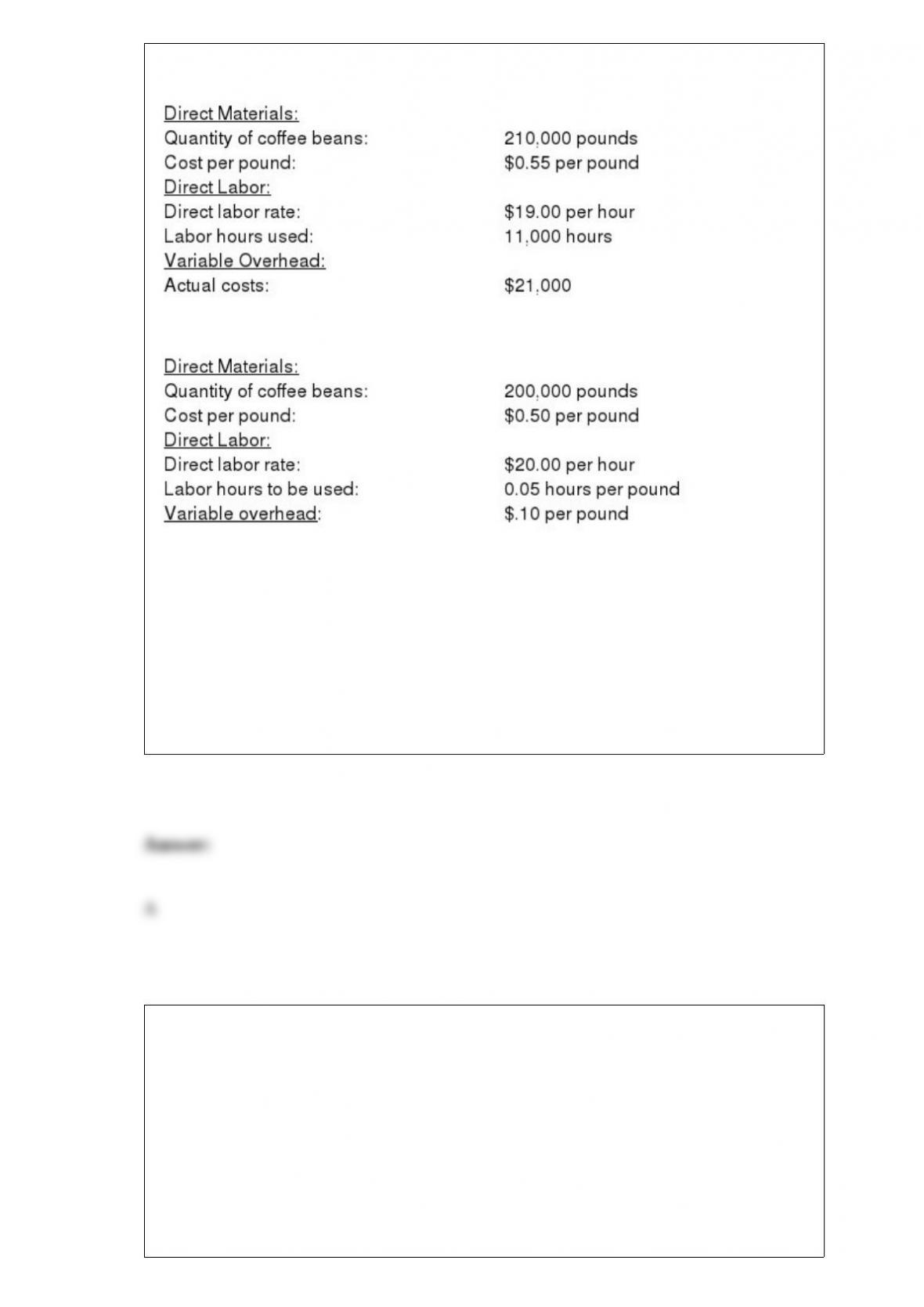
allow for any wastage), Actual:
Standard:
Refer to Java Gourmet Coffee. Calculate the total direct materials variance.
A.$15,500 U
B.$10,500 U
C.$15,500 F
D.$10,500 F
Which of the following areunderlying assumptions of cost-volume-profit analysis?
A.Fixed costs will not change over a wide range of activity and variable costs are
strictly variable.
B.All costs can be classified either as a fixed or variable cost and behave linearly.
C.Sales prices do not change in the relevant range and the sales mix must remain
constant.

D.All of the answers are correct.
Which of the following costs relate to warranty repairs, product liability costs,
marketing costs, and lost sales?
A.prevention costs.
B.appraisal costs.
C.internal failure costs.
D.external failure costs.
Just-in-time is
A.a method of managing production by which the firm attempts to produce each item
only as needed for the next step in the production process.
B.a method of managing purchasing by which the firm attempts to time purchases so
that items arrive just in time for sale.
C.a practice that can reduce inventory levels to virtually zero.
D.All of the answers are correct.