
When using differential analysis to determine when to add or drop parts of operations,
if the differential revenue from the sale of a product is less than the differential costs
required to provide the product for sale, then
A.the product generates losses and the firm should discontinue its production.
B.the product generates losses and the firm should continue its production.
C.the product generates profits and the firm should discontinue its production.
D.the product generates profits and the firm should continue its production.
Managers are often correct that the company would benefit from advanced
manufacturing technology. However, the present value of future cash flows analysis
usually results in a negative net present value for the investment because of the
A.hurdle rate being set too high and there is a bias toward incremental projects.
B.uncertainty about operating cash flows.
C.exclusion of benefits that are difficult to quantify.
D.all of the above.
Which of the following costs are capacity-sustaining activities in the product cost
hierarchy?
A.Product specification.
B.Building depreciation and rent.
C.Product testing.
D.Machine setups.
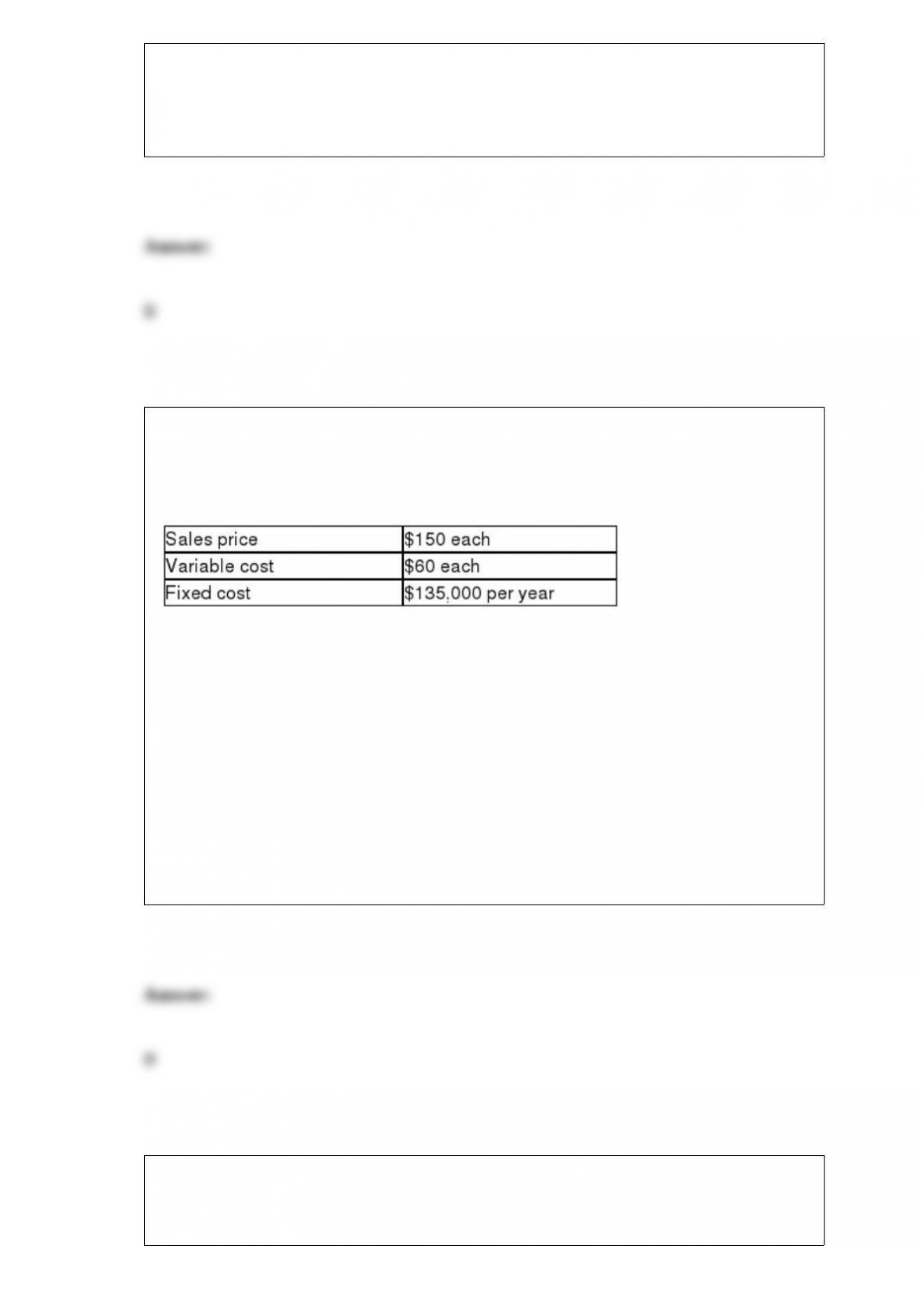
Shenandoah Company
Shenandoah Company is considering the introduction of a new product with the
following price and cost characteristics
The company expects to sell 2,000 units for the year.
Refer to Shenandoah Company. Calculate the break-even point in units if the sales price
decreased by 20%.
A.1,500
B.2,250
C. 2,000
D. 1,000
Effective incentive compensation plans must induce individual behavior compatible
with increasing the firm’s wealth. Deferred compensation is given for

A.short-term performance.
B.long-term incentive.
C.particular actions or extraordinary performance.
D.None of the answers is correct.
Which of the following statements is correct concerning break-even time?
A.Break-even time is the length of time required to recover the investment made in
new-product development.
B.Break-even time ignores all cash flows after the break-even time has been identified.
C.Break-even time does not consider strategic and nonfinancial reasons for product
development.
D.All of the answers are correct.
Which overhead allocation method allocates service department costs with
consideration of services rendered to other service departments?
A.step method.
B.direct method.
C.net realizable value method.
D.physical measures method.
Most companies report which of the following variances?
A.Each type of material.
B.Each category of labor.
C.Major cost components of variable overhead.
D.All of the above.
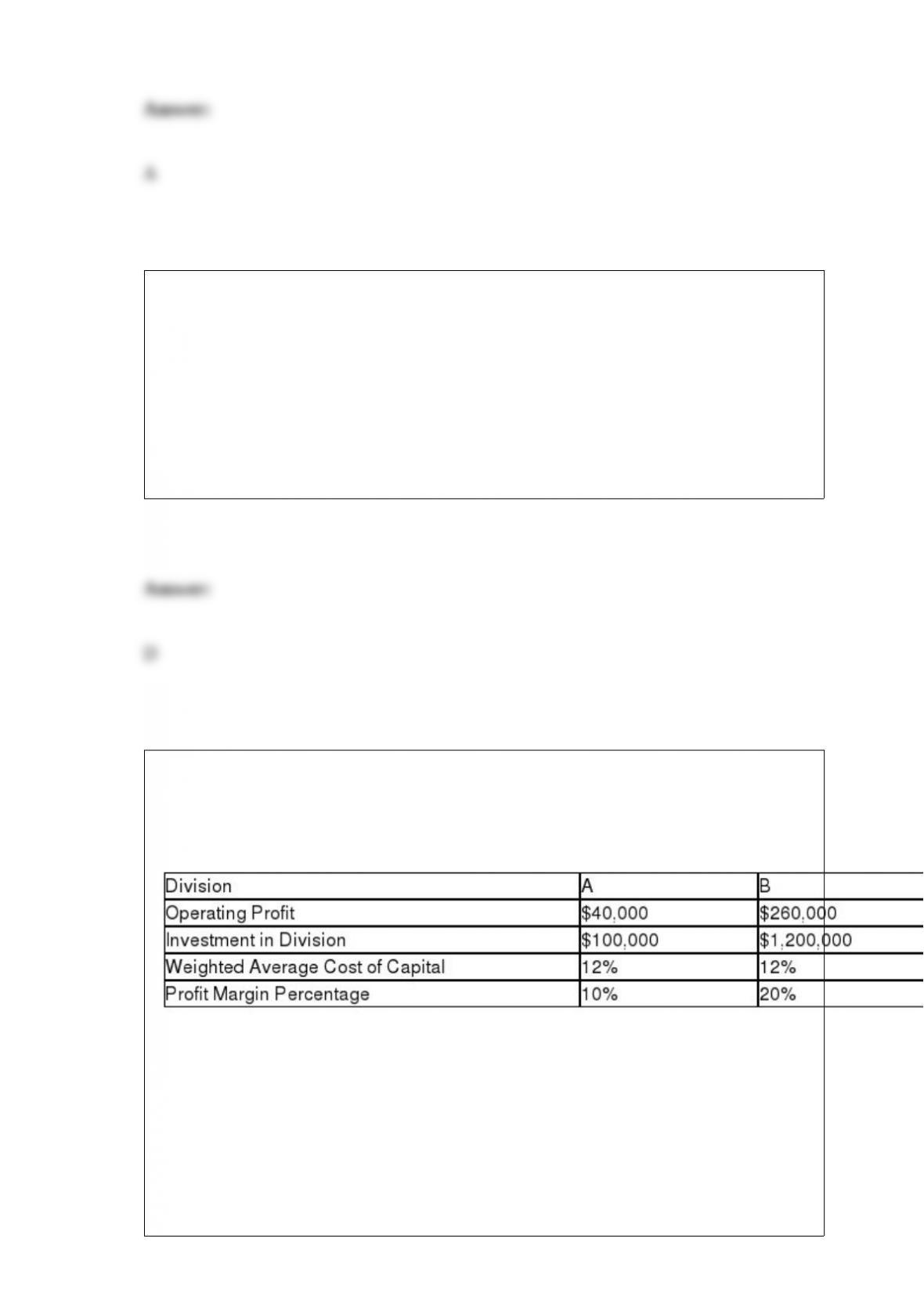
Correll Company
Correll Company has two divisions, A and B. Information for each division is as
follows:
Refer to Correll Company. What is EVA for Division A?
A.$40,000
B.$25,000
C.$15,000
D.$28,000
Responsibility accounting is widely used by many companies.
(A) Define responsibility accounting.
(B) Discuss the advantages a company attains through the use of responsibility
accounting.
(C) Describe how the use of responsibility accounting is advantageous to the managers
of the company.

What does the learning curve function show?
A.The amount of time required to perform a task goes up per unit as the number of
units increases.
B.The amount of time required to perform a task goes up per unit as the number of units
decreases.
C.The amount of time required to perform a task goes down per unit as the number of
units increases.
D.The amount of time required to perform a task goes down per unit as the number of
units decreases.
Total costs that vary with activity levels in the short run are known as:
A.fixed costs.
B.variable costs.
C.sunk costs.

D.opportunity costs.