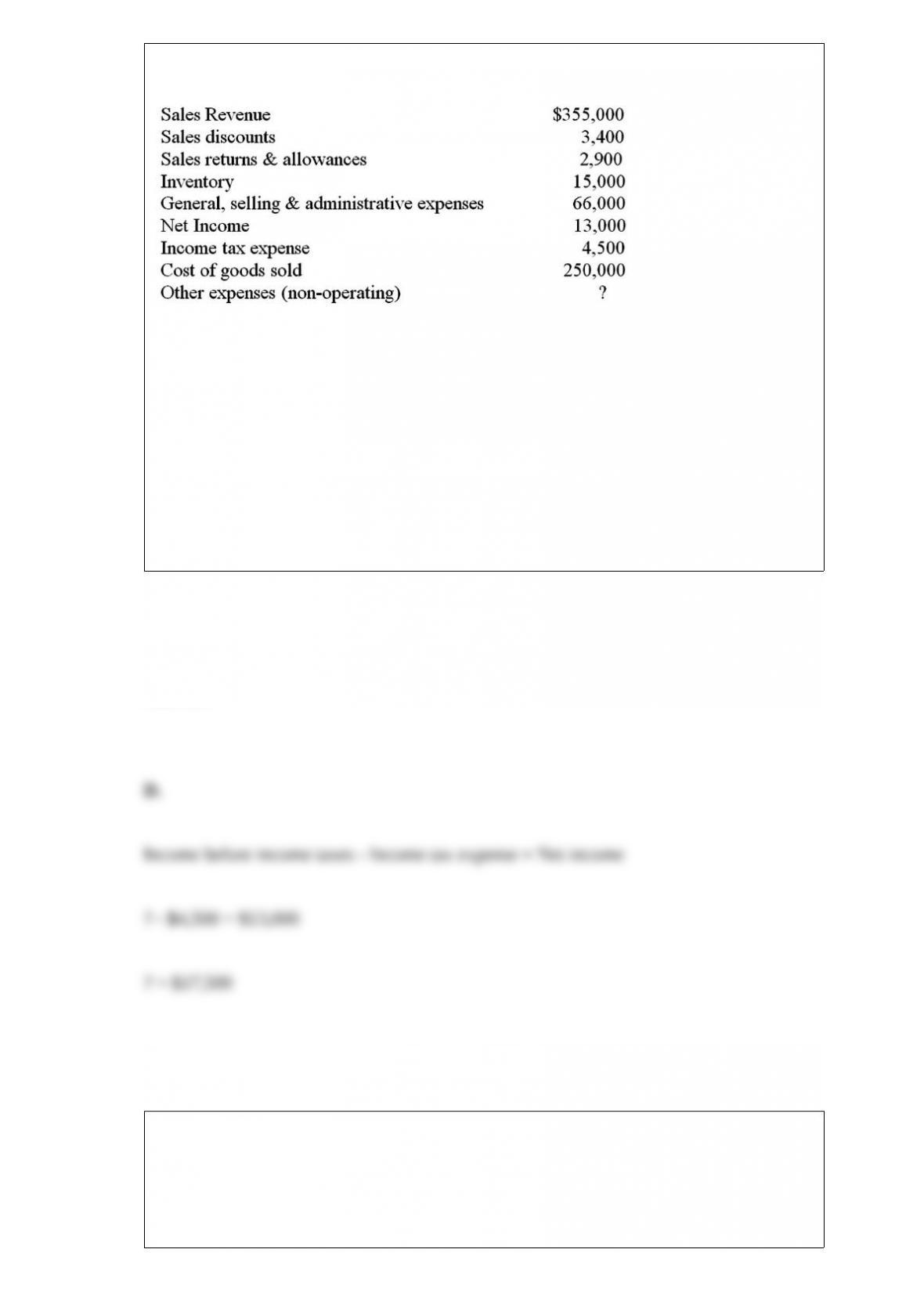
A company reported the following:
Use the above information to answer the following question. What is the amount of
income before income taxes?
A. $9,500
B. $32,700
C. $13,000
D. $17,500
Answer:
Starbellies Tattoo Parlor LLC is completing the accounting process for its year ended
12/31/14. The transactions for the year have been journalized and posted. Information
for adjusting entries appears below.
a. The supplies account shows a balance of $900. A count of supplies revealed $400 on
hand at 12/31/14.
b. A one-year insurance policy was purchased for $1,200 on 12/1/14. It was recorded as
Prepaid Insurance at that time.
c. Office equipment depreciates at a rate of $1,000 per year. The equipment has been
owned all year.
d. A client paid $10,000 in advance for services to be rendered later, which was
recorded as unearned revenue. Of this amount, 30% was earned as of 12/31/14.
e. Employees earn $5,000 for a 5-day work week. December 31, 2014 falls on a
Tuesday.
f. Starbellies has completed $500 of work for which it has neither received cash nor
billed the client.
A) For each of the adjusting items (a-f) prepare the adjusting journal entry that would
be required at 12/31/14.
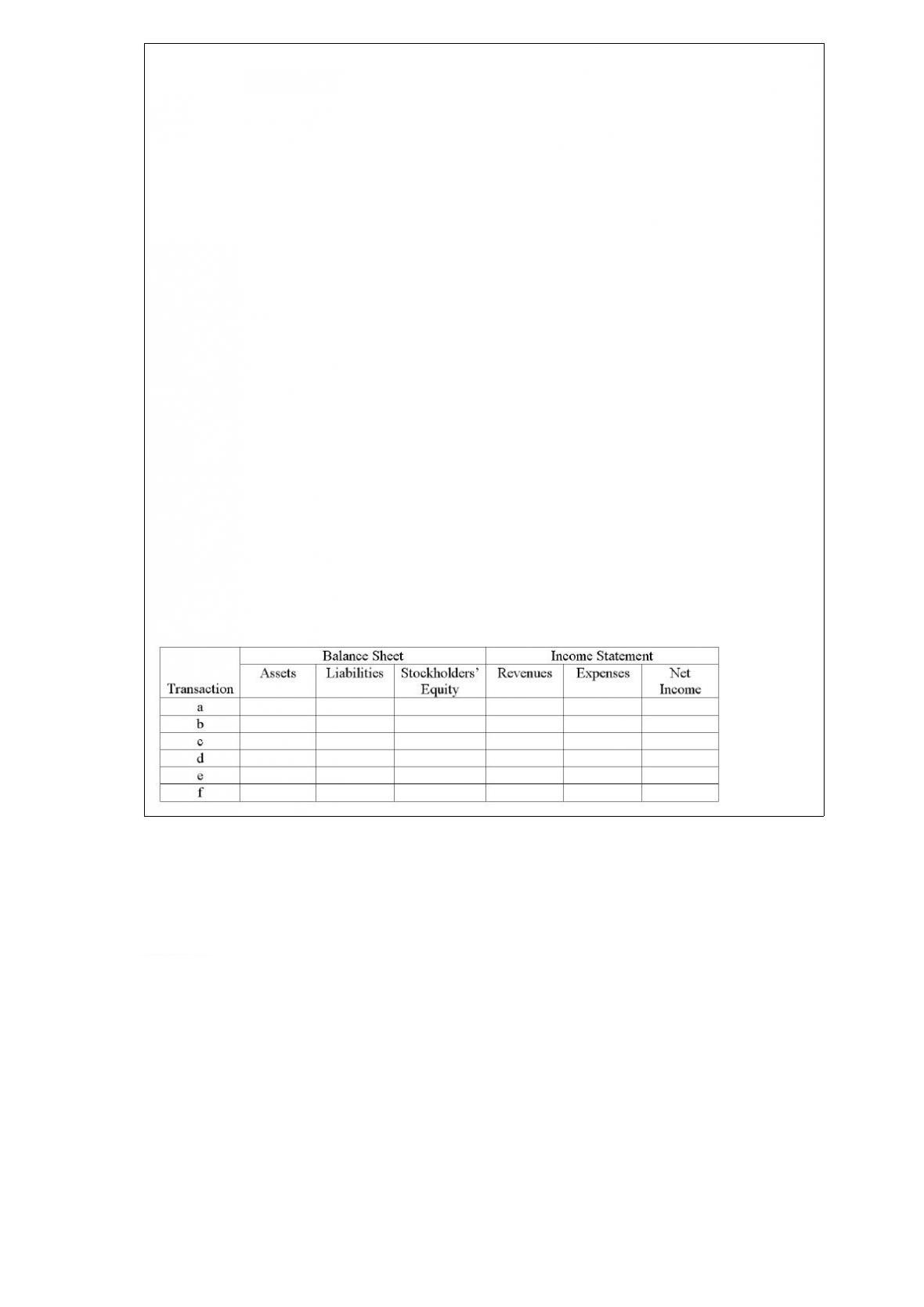
B) For each of the adjusting items (a-f) indicate the amount and the direction of effects
of the adjusting journal entry on the elements of the balance sheet and income
statement.
Using the following format, indicate + for increase, – for decrease, and NE for no effect.
Answer:
When calculating a ratio that uses period data and point-in-time data, analysts typically
use the:
A. average value for the period data.
B. starting point for the point-in-time data.
C. ending point for the period data.
D. average value for the point-in-time data.
Answer:
Current liabilities are expected to be
A. converted to cash within one year.
B. settled within one year.
C. used in the business within one year.
D. acquired within one year.
Answer:
A stock dividend:
A. is accounted for like a stock split.
B. will reduce stockholders’ equity like a cash dividend does.
C. will not change any of the accounts within stockholders’ equity.
D. will reduce retained earnings like a cash dividend does.

Answer:
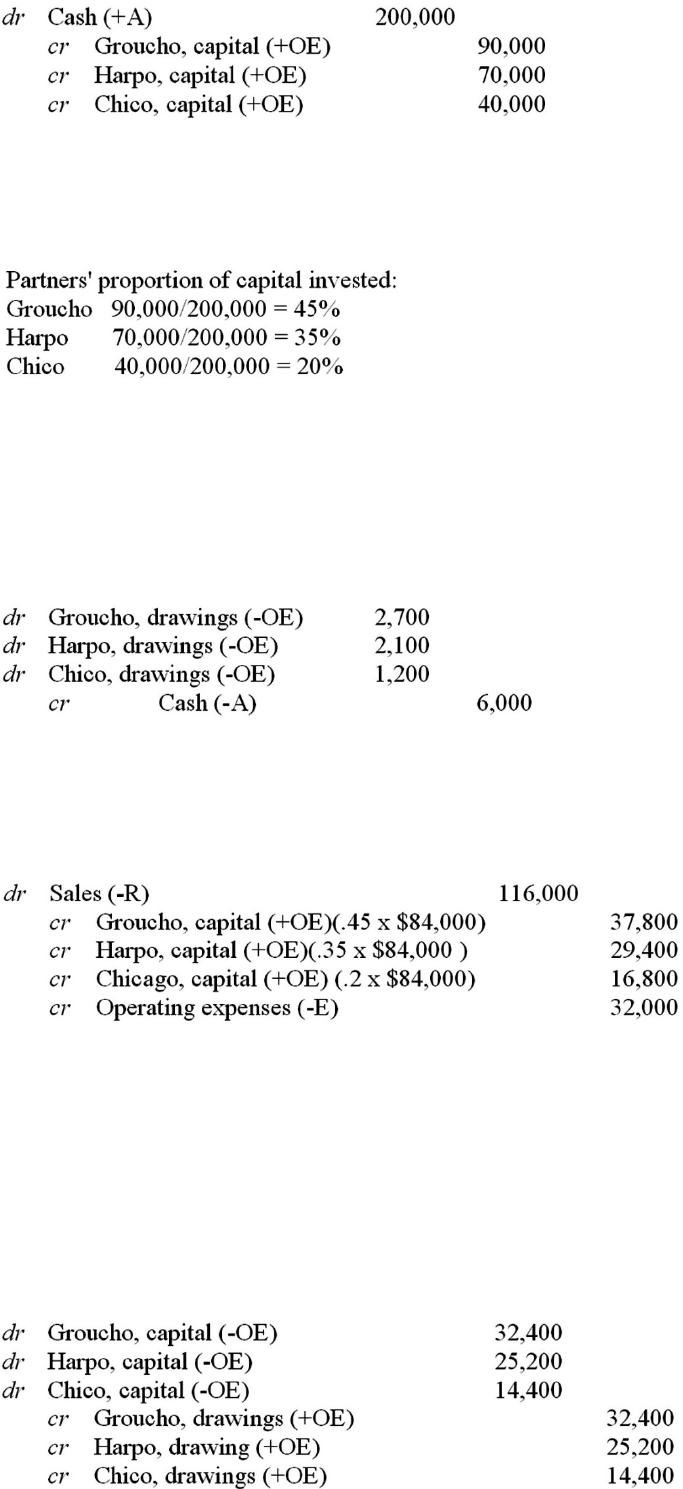
Groucho, Harpo and Chico go into partnership on January 1, 2014. Groucho contributes
$90,000, Harpo $70,000, and Chico $40,000 to a business called Marx Brothers’
Partnership. On a monthly basis, each partner is allocated income and is allowed to
receive cash from the business in proportion to the capital they provided. Groucho
receives $2,700 cash per month.
a. Prepare the journal entry for the initial investment.
b. Prepare the journal entry that would be made in one month for the monthly
distribution.
c. Prepare the journal entry for the allocation of an annual net income of $84,000. For
purposes of this journal entry, assume sales were $116,000 and that all expenses
(totaling $32,000) were recorded in a single account called operating expenses.
d. Prepare the journal entry for the closing of the drawings accounts at the end of the
year.
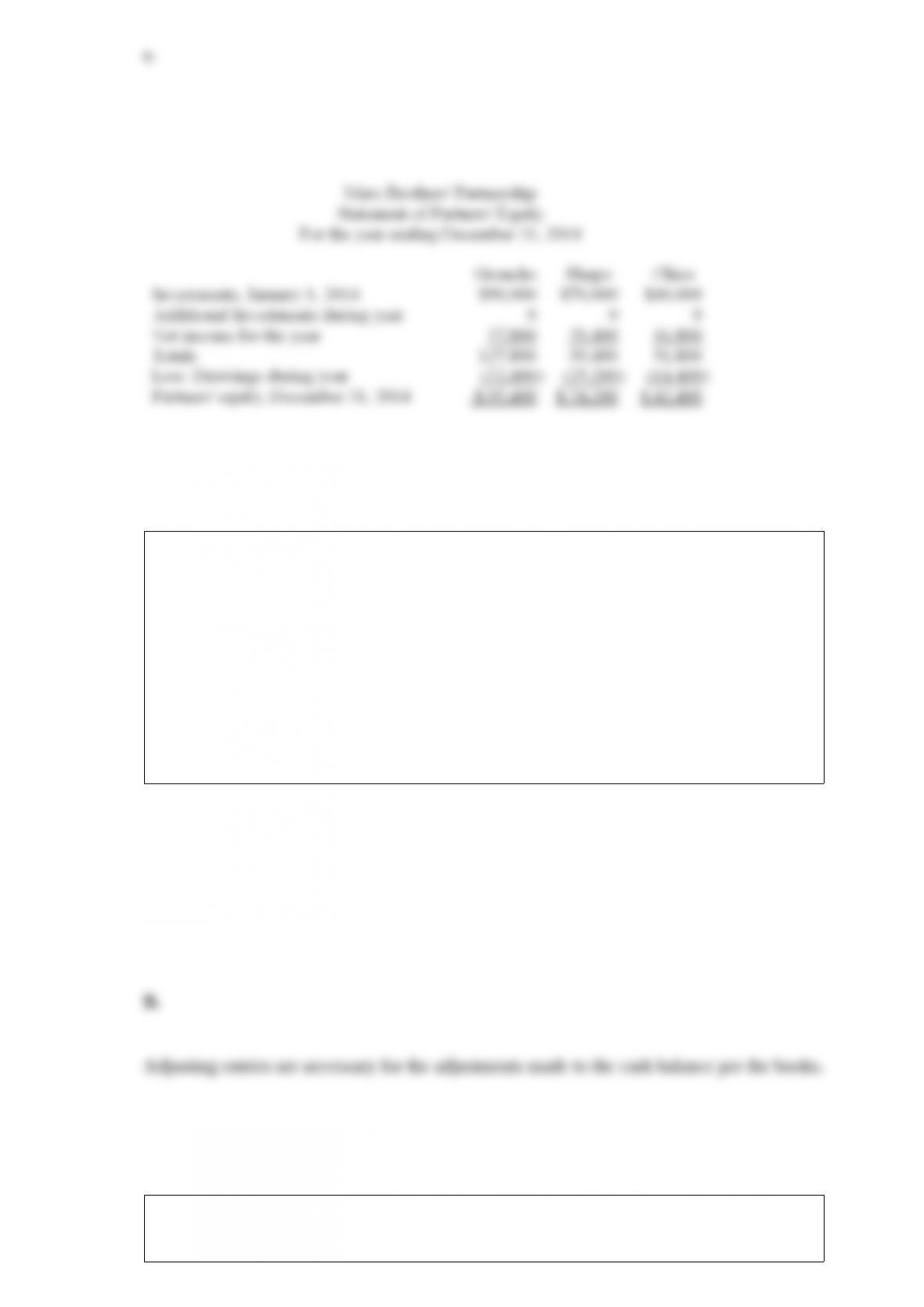
e. Prepare a Statement of Partners’ Equity (assume no additional investments made).
Answer:
All of the following bank reconciliation items would result in an adjusting journal entry
on the company’s books except:
A. interest earned.
B. deposits in transit.
C. service charge.
D. a customer’s check returned NSF.
Answer:
Your company has 100 units in inventory, purchased at $16 per unit, that could be
replaced for $14.

A. The company should credit cost of goods sold for $200.
B. The company should debit cost of goods sold for $1,400.
C. The company should credit inventory for $200.
D. The company should debit inventory for $1,400.
Answer:
Which of the following is performed last at the end of the year?
A. Prepare adjusting entries.
B. Prepare an adjusted trial balance.
C. Prepare closing journal entries.
D. Prepare a post-closing trial balance.
Answer:

In January 2013, a new consulting firm recorded the following transactions:
1. Issued stock to investors for $20,000 cash.
2. Purchased $5,000 of equipment, paying 20% in cash and giving a promissory note
for the balance.
3. Received $9,000 in cash for consulting services performed in January.
4. Bought $1,500 of supplies on account; all of the supplies were used in January.
5. Provided consulting services for clients and billed them $16,000.
6. Paid $750 toward the supplies purchased in #4.
7. Paid $3,000 to employees for work performed in January.
8. Received a bill for rent and utilities for January of $3,400.
What is the amount to be reported as total liabilities on the balance sheet at the end of
January?
A. $4,750
B. $4,150
C. $8,150
D. $8,500
Answer:

Match the term and the definition. There are more definitions than terms.
_____ 1/ unearned revenue
_____ 2/ expenditure
_____ 3/ revenue recognition principle
_____ 4/ accrual basis
_____ 5/ time period assumption
_____ 6/ expense
_____ 7/ net income
A. To reduce the recorded value of an asset to better reflect its ANSWER: TRUE
market value.
B. Any outlay of money by a company for any purpose.
C. The practice of dividing the life of the business into months and years.
D. The concept that revenue and expenses should be recorded at the time received or
paid.
E. The concept that revenue should be recorded when earned, not necessarily when
payment is received.
F. Revenues should be recorded when they are earned and expenses when they are
incurred.
G. Total revenue minus total expenses.
H. Any use or sacrifice of a company’s resources to generate revenue.
I. The increase in value of financial assets held by a company.
J. Payments received for goods that have not yet been delivered or services that have
not yet been performed.
K. The concept that a company should record revenue during the same period as
expenses.

Answer:
Jim’s Gymnastics Training’s operations for the month of October are summarized as
follows:
– Provided $5,000 of training to students.
– Received $8,000 cash from studentsof which $4,000 is for training provided in
October (as billed above), $1,000 is for training to be provided in November, and
$3,000 is for training provided in September.
– Paid September’s gym rental bill of $1,000. Received October’s bill of $1,500 but did
not pay.
Calculate the following:
a) Net Income for October using the cash basis of accounting.
b) Net Income for October using the accrual basis of accounting.
Answer:

One of the main reasons that companies release early summaries of financial statements
in press releases is:
A. they do not have to conform to GAAP.
B. this allows them to delay the release of financial statements.
C. it makes information available to external users in a more timely manner.
D. they do not have to match the financial statements.
Answer:
The Rainbow House Painting Company has been contracted to strip, repair, prime and
paint a house for $3,600 to be paid in installments as phases of the work are completed.
Rainbow should recognize the revenue when
A. the work begins.
B. the first payment is received.
C. half of the work is complete and half of the payments have been received.
D. the work is complete.
Answer:
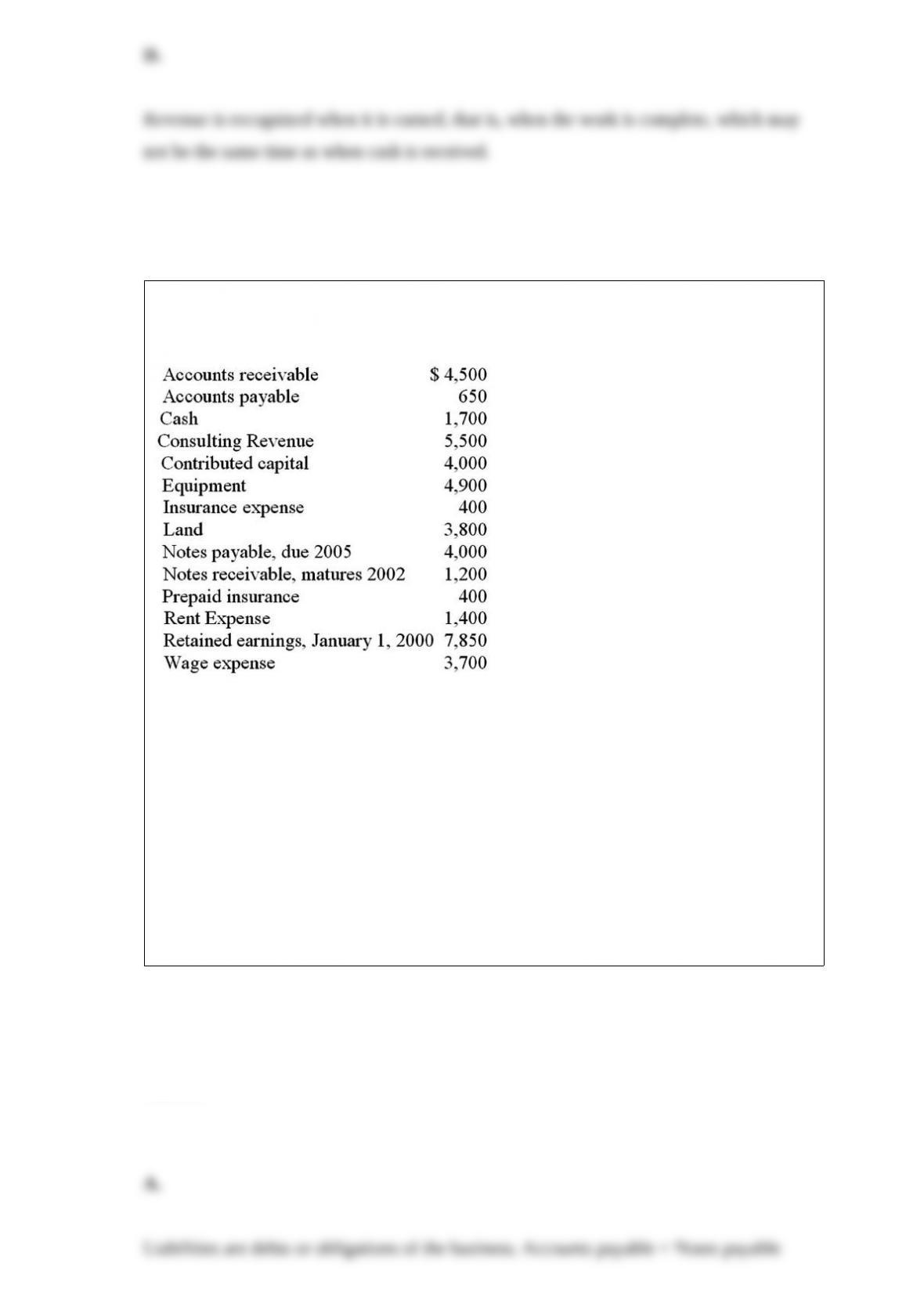
All accounts have normal balances.
What is the amount of the total liabilities at December 31?
A. $4,650
B. $8,650
C. $5,700
D. $9,700
Answer:
Which of the following practices would not be considered ethical?
A. Failing to record an expense even though cash has been paid.
B. Recording 31 days of sales in April.
C. Using the cash basis of accounting.
D. Adjusting the accounts after a trial balance has been prepared.
Answer:
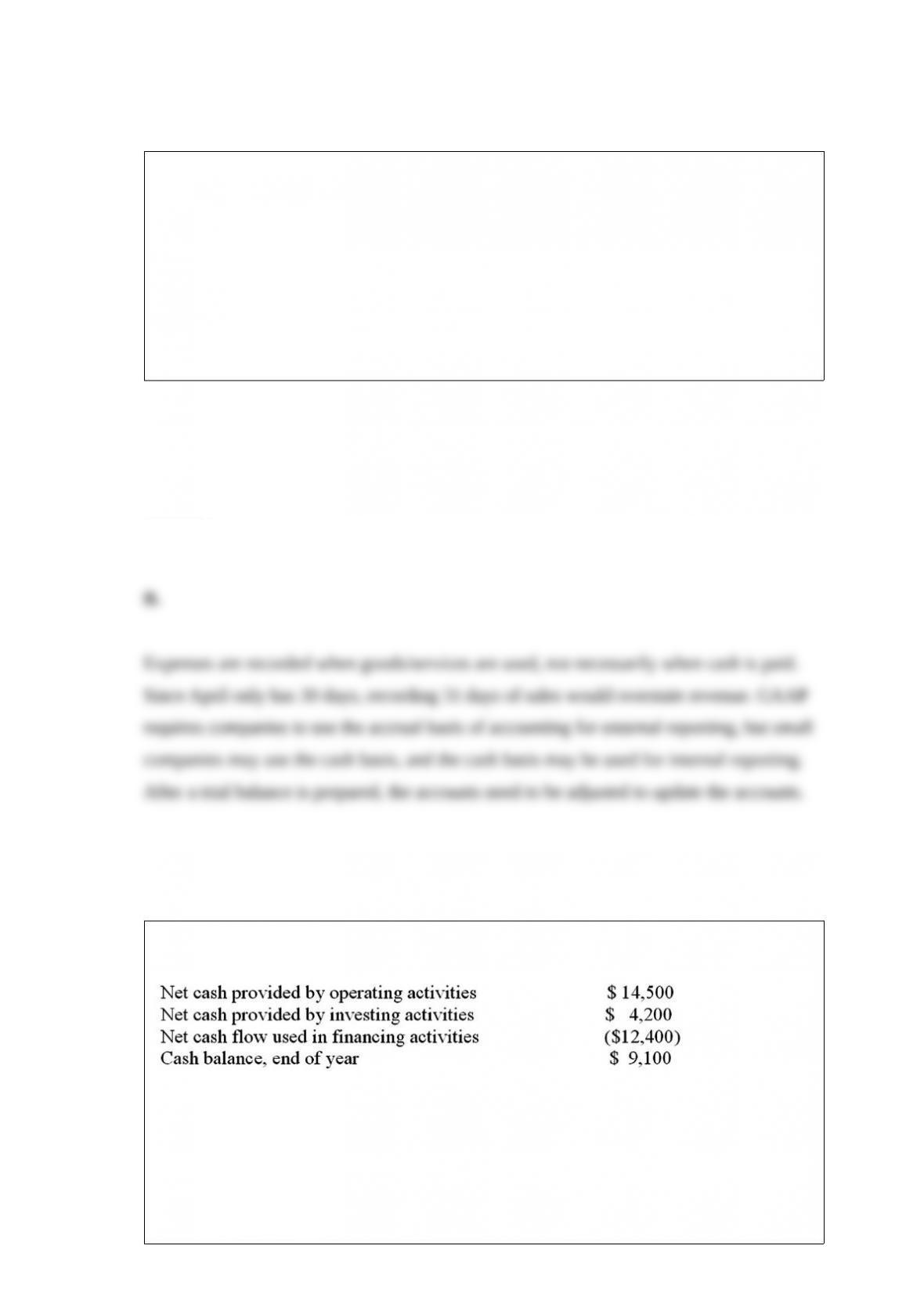
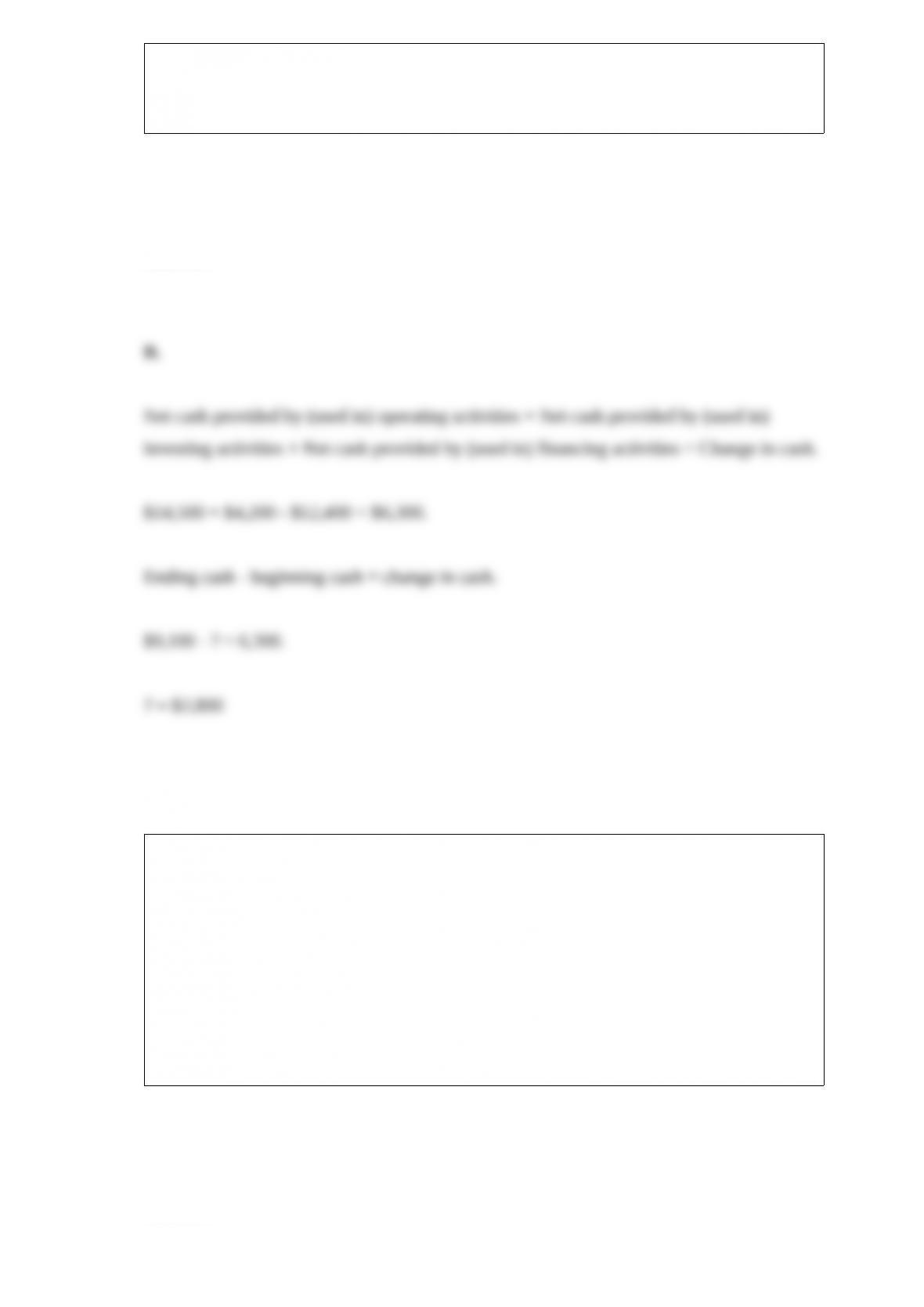
A corporation prepared its statement of cash flows for the year. The following
information is taken from that statement:
What is the cash balance at the beginning of the year?
A. $5,600
B. $2,800
C. $6,300
D. $15,400
Answer:
A customer purchased $1,500 of services on credit two months ago and has just paid the
bill. The receipt of the payment from the customer is recorded as a
A. debit to Cash and a credit to Accounts Receivable.
B. debit to Cash and a credit to Accounts Payable.
C. debit to Cash and a credit to Revenue.
D. debit to Purchases and a credit to Cash.
Answer:
The Grass is Greener Corporation provides $6,000 worth of lawn care on account
during the month. Experience suggests that about 2% of net credit sales will not be
collected. According to the revenue recognition principle and the matching principle,
the company should:
A. record an estimate of bad debt expense in the same period as the lawn care is
provided.
B. not report the sales revenue until it collects payment.
C. increase the value of its liabilities with an adjustment.
D. wait until the accounts are determined to be uncollectible before making an entry for
bad debt expense.
Answer:
On January 1, 2014, a company has assets of $16 billion and stockholders’ equity of $8
billion. On January 1, 2015, the same company has assets of $20 billion and
stockholders’ equity of $9 billion. During 2014, the company had total sales revenue of
$9 billion and total expenses of $7 billion.

The company’s asset turnover ratio for 2014 is:
A. 2.5
B. 0.5
C. 0.45
D. 0.1
Answer:
Every financial statement should have “who, what, and when” in its heading. These are:
A. the name of the person preparing the statement, the type of financial statement, and
when the financial statement was reported to the SEC.
B. the name of the person preparing the statement, the name of the company, and the
date the statement was prepared.
C. the name of the company, the type of financial statement, and the time period or date
from which the data were taken.
D. the name of the company, the purpose of the statement, and when the financial
statement was reported to the IRS.
Answer:
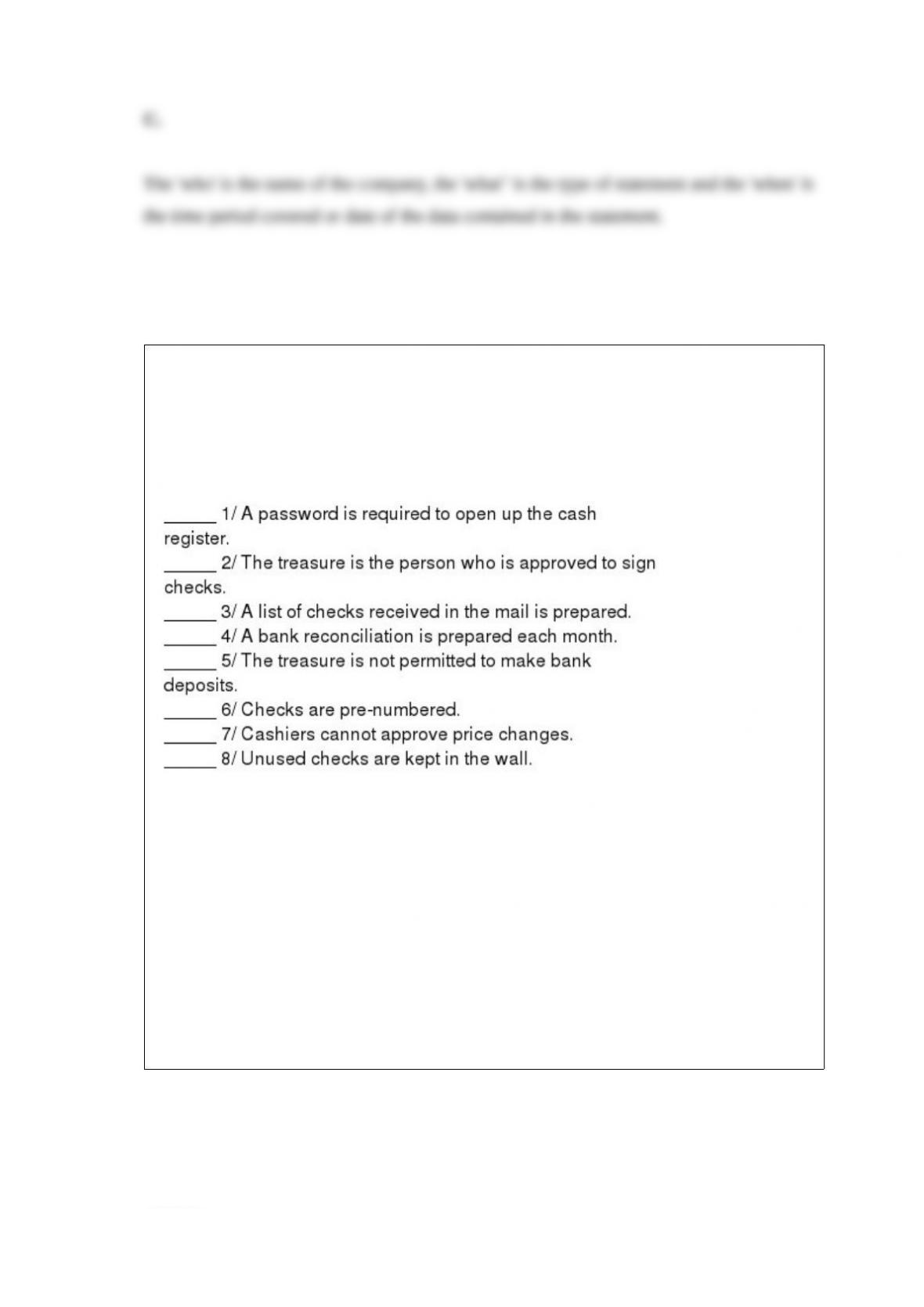
For each of the following cash activities, choose the appropriate letter to match the
activity with the internal control principle to which it relates. Each internal control
principle may be used more than once.
Activity
Internal Control Principle
A. Establish responsibility
B. Segregate duties
C. Restrict access
D. Document procedures
E. Independently verify
Answer:
If accounts receivable has a beginning balance of $4,210 and an ending balance of
$3,495, and collections on account were $9,600, how much were credit sales?
A. $8,885
B. $17,305
C. $10,315
D. $1,895
Answer:
Which of the following items would be reported on a statement of cash flows using the
indirect method, but not on a statement prepared using the direct method?
A. Cash paid for dividends.
B. Cash received from stock issuances.
C. Depreciation expense.
D. Cash paid for purchase of treasury stock.
Answer:
The purpose of a statement of retained earnings is to:
A. estimate the current value of a company’s assets.
B. report how the profits of a company have been distributed to stockholders or retained
in the business.
C. show where the cash is flowing into and out of a company.
D. explain the specific revenues and expenses arising during the period.
Answer:
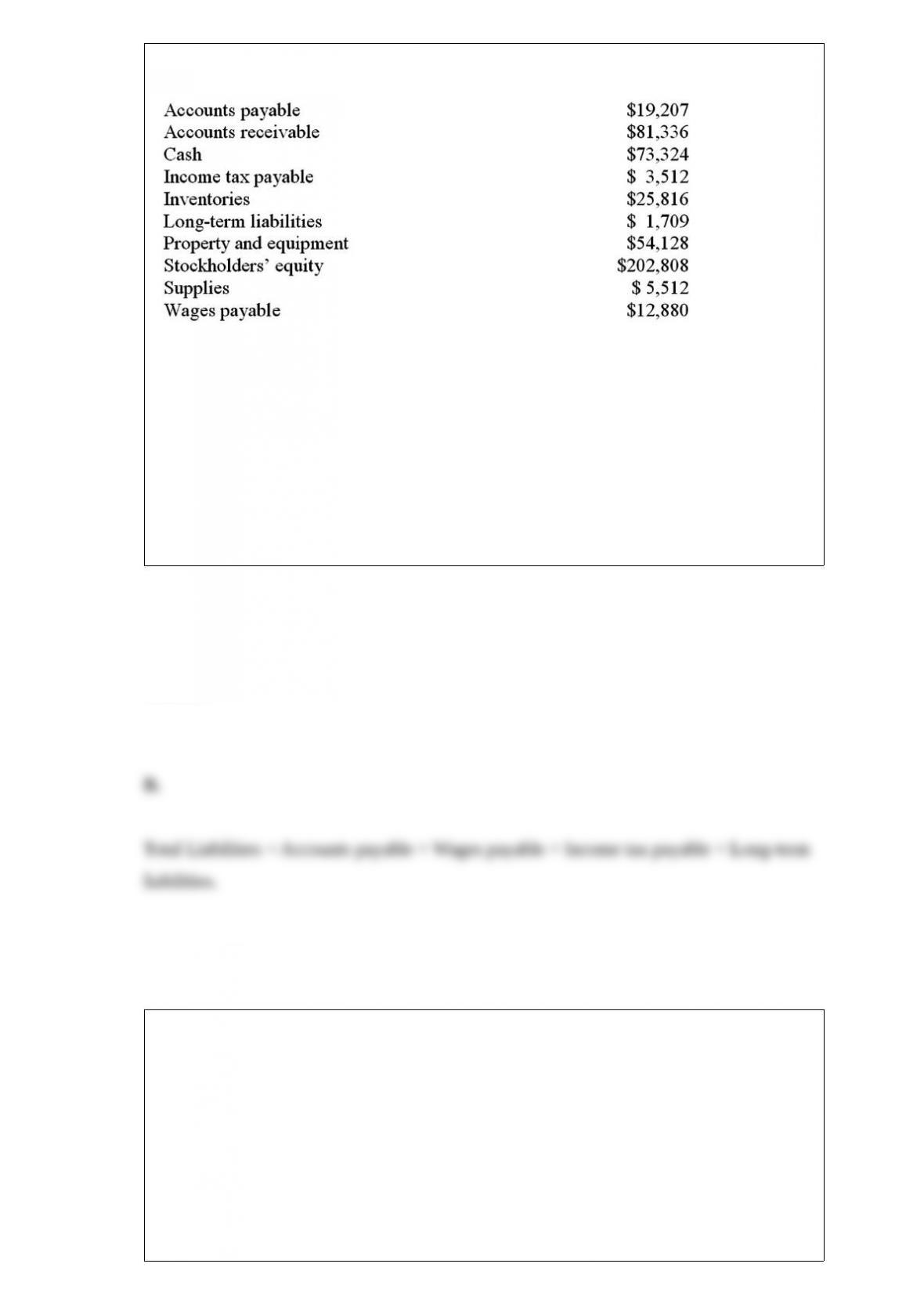
A company reported the following in its recent balance sheet:
What is the amount of Total Liabilities on the Balance Sheet?
A. $240,116
B. $37,308
C. $35,599
D. $20,916
Answer:
A credit of $500 to Equipment was mistakenly credited to Revenue. What is the effect
of this error?
A. Equipment is understated and Revenue is understated.
B. Equipment is overstated and Revenue is overstated.
C. Equipment is overstated and Revenue is understated.
D. Equipment is understated and Revenue is overstated.
Answer:
For a merchandiser, inventory turnover refers to how many times:
A. during the period the company replaces its raw materials inventory.
B. the company buys and sells its inventory of goods.
C. the company produces and delivers its inventory of goods to customers.
D. the company orders merchandise.
Answer:
Which of the following statements is FALSE?
A. A transaction is an exchange or event that has a direct and measurable financial
effect.
B. Every transaction has at least 2 effects.
C. Current assets are economic resources to be used or turned into cash within one year.
D. Notes payable is the account debited when money is borrowed from a bank using a
promissory note.
Answer:
When a customer returns for credit a defective product it had purchased, the seller
would record the transaction using which of the following accounts?
A. Purchase Returns and Allowances
B. Sales Returns and Allowances
C. Sales
D. Sales Discounts
Answer: