
Compensating balances represent:
a. Funds in a bank account that can’t be spent.
b. Balances in a payroll checking account.
c. Accounts that are subject to bank service charges.
d. Accounts on which banks pay interest, e.g., NOW accounts.
When we take into account the dilutive effect of convertible securities in the
calculation of EPS, the method used is called the:
a. Treasury stock method.
b. If converted method.
c. Optional method.
d. Dilution method.
Below are excerpts from time value of money tables for the 8% rate.
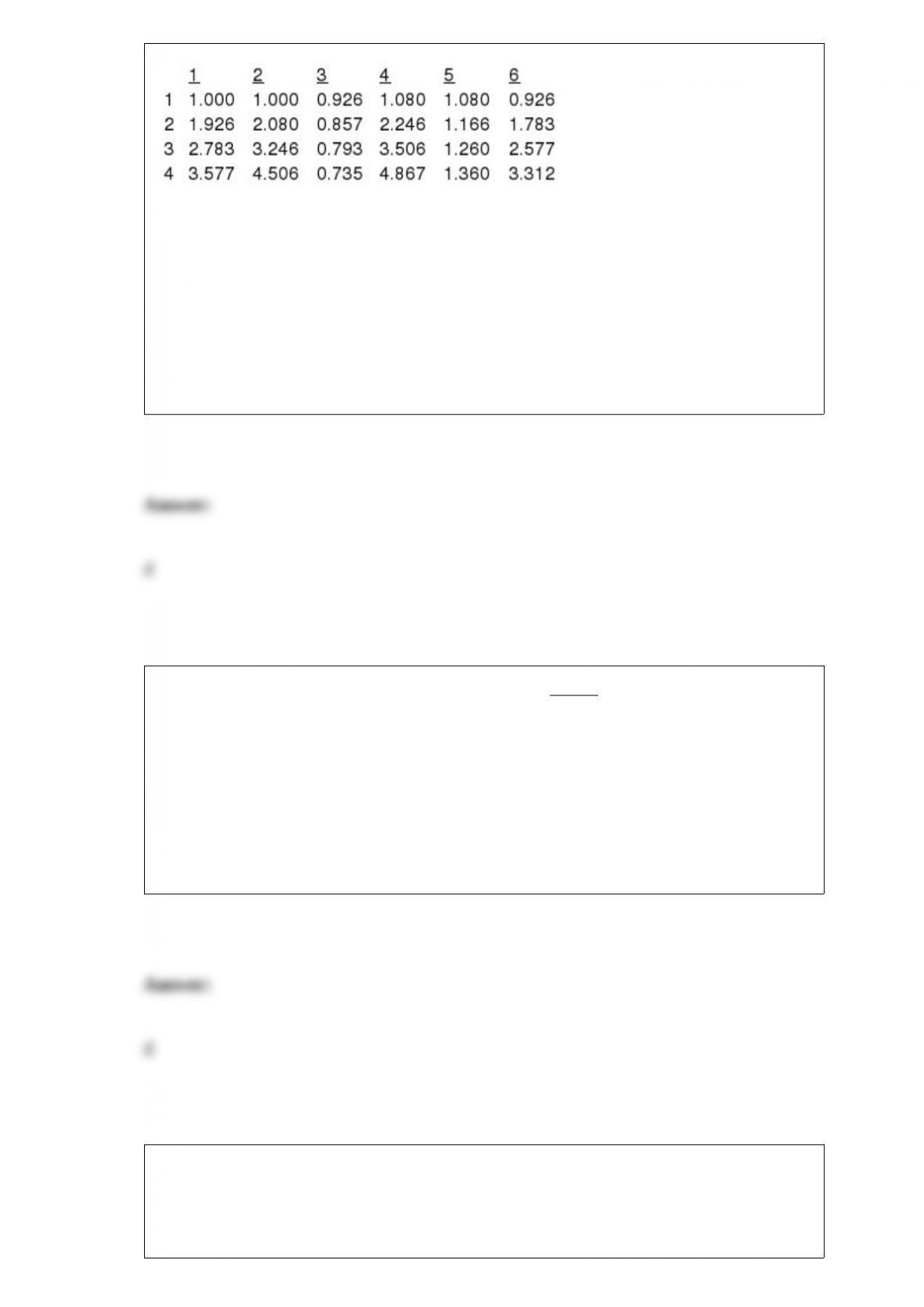
Column 4 is an interest table for the:
a. Present value of an ordinary annuity of 1.
b. Future value of an ordinary annuity of 1.
c. Present value of an annuity due of 1.
d. Future value of an annuity due of 1.
All of the following may qualify as cash equivalents except:
a. Money market accounts.
b. Certificates of deposit.
c. U.S. Treasury bills.
d. Newly issued corporate bonds.
On October 1, 2016, Justine Company purchased equipment from Napa Inc. in
exchange for a noninterest-bearing note payable in five equal annual payments of
$500,000, beginning Oct 1, 2017. Similar borrowings have carried an 11% interest rate.
The equipment would be recorded at:

a. $2,500,000.
b. $2,225,000.
c. $1,847,950.
d. $2,115,270.
On July 1, Wiggins Associates enters into a contract to provide consulting services to
Pennsylvania University (PU). The contract is anticipated to last four months and is
intended to achieve significant cost savings at the university. The contract stipulates that
PU will pay Wiggins $25,000 at the end of each month, and, if total cost savings reach a
specific target, PU will pay an additional $20,000 to Wiggins at the end of the contract.
Wiggins estimates a 75% chance that cost savings will reach the target.
Assume that Wiggins estimates uncertain consideration as the most likely amount.
Required: Do the following for Wiggins:
a. Prepare the journal entry on July 31 to record the first month of revenue under the
contract.
b. Assuming total cost savings exceed the target, prepare the journal entry, if any, on
October 31 to record receipt of the $20,000 bonus (ignore the normal October payment
of $25,000).
c. Assuming total cost savings do not reach the target, prepare the journal entry, if any,
on October 31 to record failure to receive the $20,000 bonus (ignore the normal
October payment of $25,000).
When the equity method of accounting for investments is used by the investor, the
investment account is increased when:
a. A cash dividend is received from the investee.
b. The investee reports net income for the year.
c. The investor records additional depreciation related to the investment.
d. The investee reports a net loss for the year.

The acid-test ratio is also known as the:
a. Current ratio.
b. Debt to equity ratio.
c. Times interest earned ratio.
d. Quick ratio.
On September 1, 2016, Sam’s Shoe Co. issued $350,000 of 8% bonds. The bonds pay
interest semiannually on January 1 and July 1 of each year. The bonds were sold at the
face amount. How much cash did Sam’s receive upon sale of the bonds?
a. $378,000.
b. $364,000.
c. $354,667
d. $350,000.
A magazine publisher collects one year in advance for subscription revenue. In the year
of providing the magazines to customers, the company would record:
a. An increase in a deferred tax asset.
b. A decrease in a deferred tax asset.
c. An increase in a deferred tax liability.
d. A decrease in a deferred tax liability.
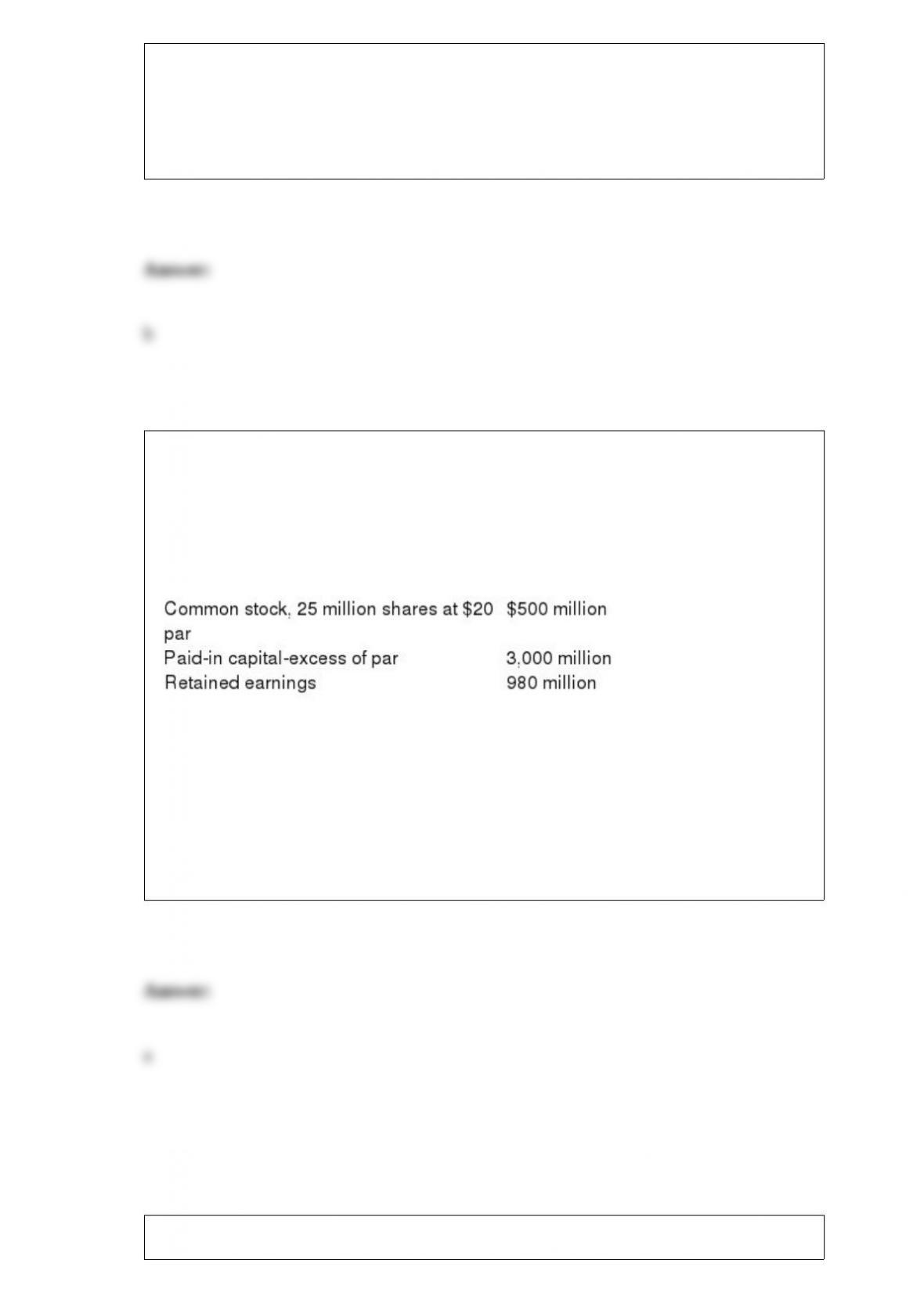
Despot declared a property dividend to give marketable securities to its common
stockholders. The securities had cost Despot $7 million and currently have a fair value
of $16 million. Which of the following would be included in recording the property
dividend declaration?
The 12/31/2016 balance sheet of Despot Inc. included the following:
a. Increase in a liability for $16 million.
b. Decrease in retained earnings for $7 million.
c. Decrease in marketable securities by $16 million.
d. All of these answer choices are correct.
The effect of a change in tax rates:

a. Results in a prior period adjustment.
b. Is allocated between discontinued operations and continuing operations.
c. Is reported separately after discontinued operations.
d. Is reflected in income from continuing operations.
Consider the following:
I. Present value of vested benefits at present pay levels.
II. Present value of nonvested benefits at present pay levels.
III. Present value of additional benefits related to projected pay increases.
Which of the above constitutes the accumulated benefit obligation?
a. I & II.
b. I, II, III.
c. II & III.
d. II only.
When the amount of interest receivable decreases during an accounting period:
a. Accrual-basis interest revenues exceed cash collections from borrowers.
b. Accrual-basis net income exceeds cash-basis net income.
c. Accrual-basis interest revenues are less than cash collections from borrowers.
d. Accrual-basis net income is less than cash-basis net income.
The following information pertains to Havana Corporation’s defined benefit pension
plan:
At the end of 2016, Havana contributed $696 thousand to the pension fund and benefit
payments of $624 thousand were made to retirees. The expected rate of return on plan
assets was 10%, and the actuary’s discount rate is 8%. There were no changes in
actuarial estimates and assumptions regarding the PBO.
What is Havana’s 2016 gain or loss on plan assets?
a. $115.2 thousand.
b. $160.8 thousand.
c. $276 thousand.
d. None of these answer choices is correct.

Calistoga Produce estimates bad debt expense at ½% of credit sales. The company
reported accounts receivable and allowance for uncollectible accounts of $471,000 and
$1,650, respectively, at December 31, 2015. During 2016, Calistoga’s credit sales and
collections were $315,000 and $319,000, respectively, and $1,720 in accounts
receivable were written off. Calistoga’s adjusted allowance for uncollectible accounts at
December 31, 2016, is:
a. $1,575.
b. $1,505.
c. $1,650.
d. $1,720.

In a periodic inventory system, the cost of purchases is debited to:
a. Purchases.
b. Cost of goods sold.
c. Inventory.
d. Accounts payable.
When a transfer is made between cash and cash equivalents with no gain or loss, how is
the transaction treated in the statement of cash flows?
a. It is included as an operating activity.
b. It is included as a noncash financing activity.
c. It is included as an investing activity.
d. It is not reported.

Assume that all compensation expense from the stock options granted by Wilson
already has been recorded. Further assume that 200,000 options expire in 2021 without
being exercised. The journal entry to record this would include:
Wilson Inc. developed a business strategy that uses stock options as a major
compensation incentive for its top executives. On January 1, 2016, 20 million options
were granted, each giving the executive owning them the right to acquire five $1 par
common shares. The exercise price is the market price on the grant date-$10 per share.
Options vest on January 1, 2020. They cannot be exercised before that date and will
expire on December 31, 2022. The fair value of the 20 million options, estimated by an
appropriate option pricing model, is $40 per option. Ignore income tax.
a. Debit to paid-in capital-stock options for $8 million.
b. A debit to common stock for $5 million.
c. A debit to paid-in capital-expiration of stock options for $8 million.
d. None of these answer choices is correct.
Green Company overstated its inventory by $50 million at the end of 2016. The
discovery of this error during 2017, before adjusting or closing entries, would require:
a. An increase in retained earnings.
b. A prospective adjustment in the 2017 income statement.
c. A debit to inventory of $50 million.
d. None of these answer choices above.
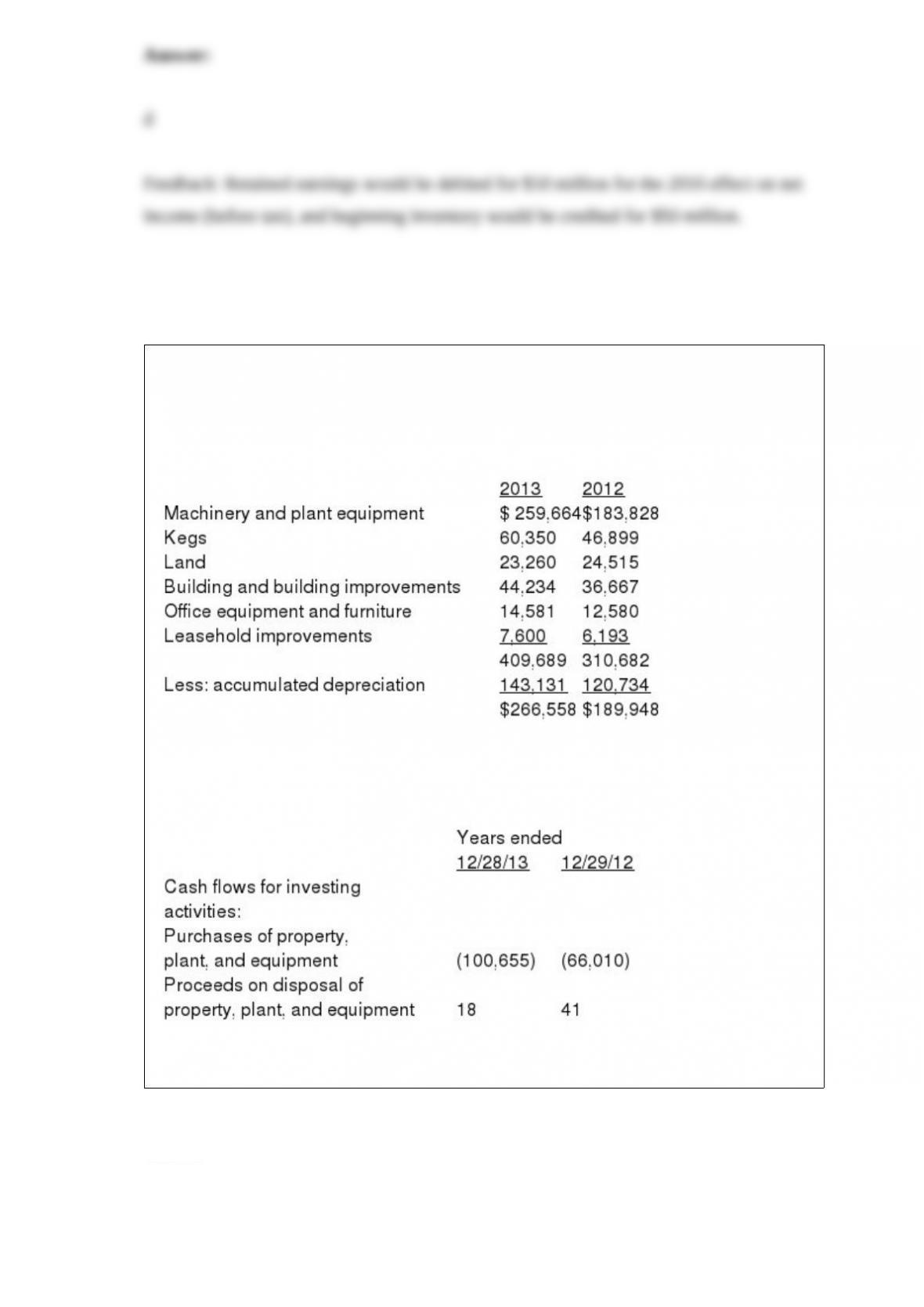
In its 2013 annual report to shareholders, Boston Beer Company, Inc. included the
following in a disclosure note: E. Property, Plant and Equipment Property, plant and
equipment for the years ended December 28, 2013, and December 29, 2012, consisted
of the following ($ in thousands):
The Company recorded depreciation related to these assets of $23,565 thousand in the
2013 fiscal year. Also, Boston Beer reported the following information in the annual
report ($ in thousands):
Show the journal entry to record Boston Beer’s sale of property, plant and equipment
during 2013.
On December 1, 2016, General Mole borrowed $400,000 at 12% interest and pledged
$500,000 in accounts receivable as collateral. Additionally, General Mole was charged a
finance fee equal to 1% of the accounts receivable assigned. At the end of December,
$300,000 of the assigned receivables were collected and remitted to the lender along
with accrued interest.
Required:
Prepare journal entries to record the borrowing, the assignment of receivables, the
collection on the receivables, and the recognition of interest expense.
For each of the following situations, state whether you agree or disagree with the
financial reporting practice employed, and briefly explain the reason for your answer.
1> Cantor Corporation’s accountant increased the book value of a patent from its
original cost of $1 million to its recently appraised value of $6 million.
2> Stanton Corporation paid for the personal travel of its chief financial officer and

charged travel expense.
3> At the end of its 2016 fiscal year, Dower, Inc., received an order from a customer for
$60,000. The merchandise will ship early in 2017. Because the sale was made to a
long-time customer and the invoice was paid in 2016, the controller recorded the sale in
2016.
4> In the middle of its 2016 fiscal year, Sanguinetti, Inc. paid $12,000 to its insurance
company for one-year comprehensive insurance coverage. Sanguinetti recorded the
entire expenditure as an expense in 2016.
5> The Churchill Pharmaceutical Company included a note in its financial statements
that described a pending lawsuit against the company.
6> The Daily Corporation, a company whose securities are publicly traded, prepares
monthly, quarterly, and annual financial statements for internal use but disseminates to
external users only the annual financial statements.
What are the changes in accounting principle that require the prospective approach?
Liquidated Corporation had a dollar-value LIFO (DVL) inventory of $800,000 at the
beginning of the current year when it adopted DVL. Its year-end inventory at year-end
prices was $850,000. The index for the current year was 1.08.
Required:
Compute the DVL inventory (rounded) to be reported at the end of the year.
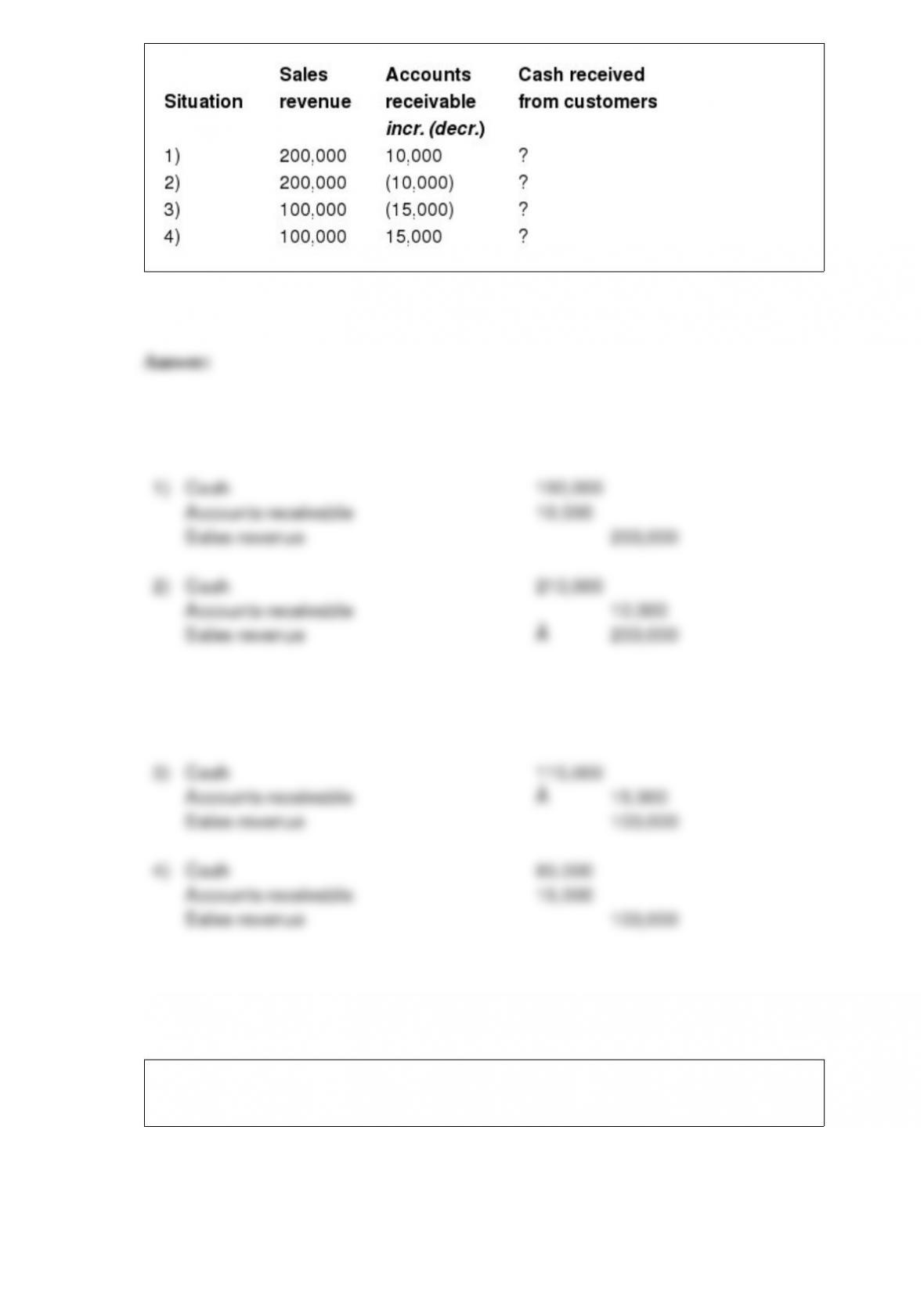
Prepare the summary entries necessary to determine the amount of cash received from
customers for each of the four independent situations below.
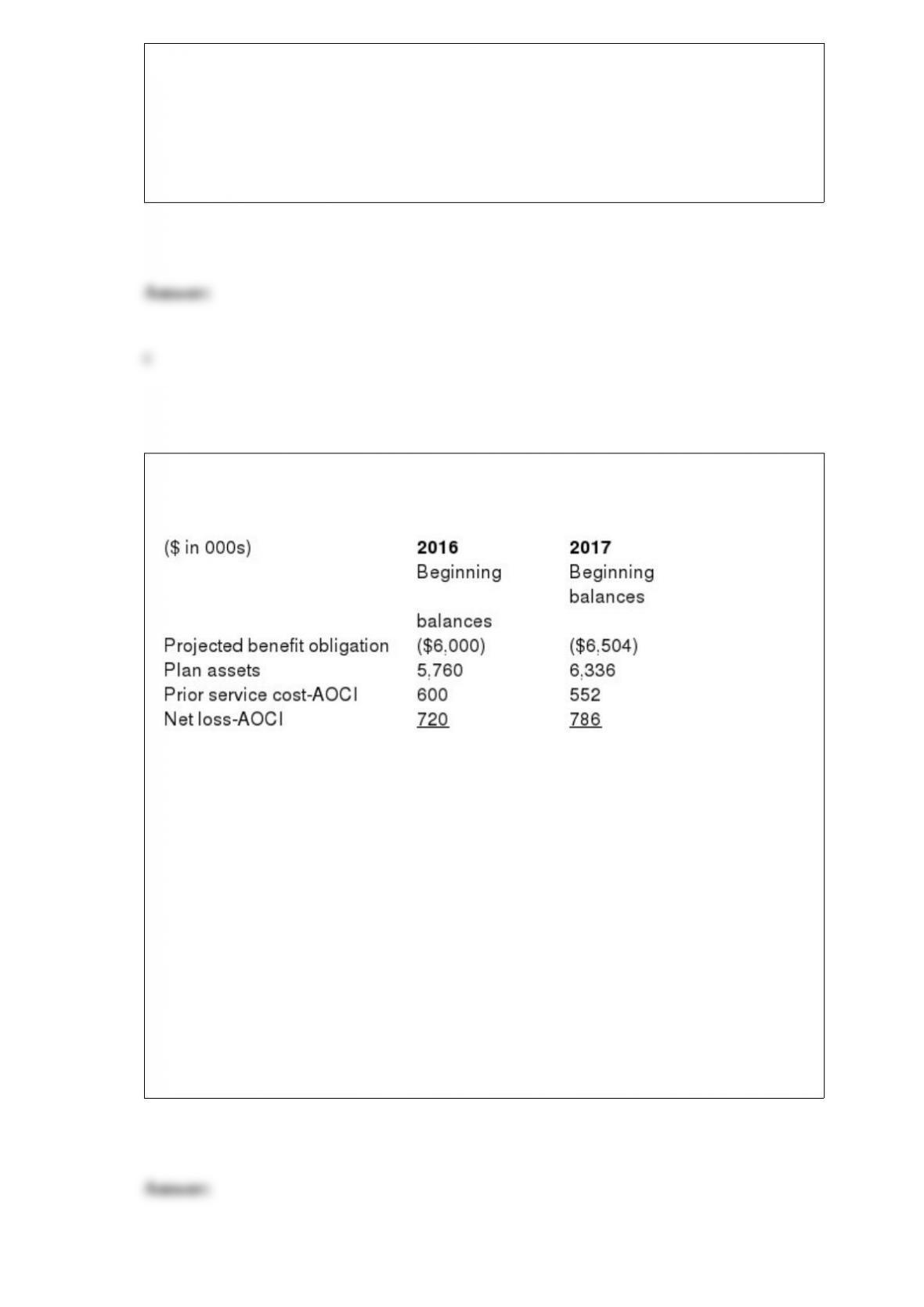
The following information relates to Hatami Company’s defined benefit pension plan
during the current reporting year:
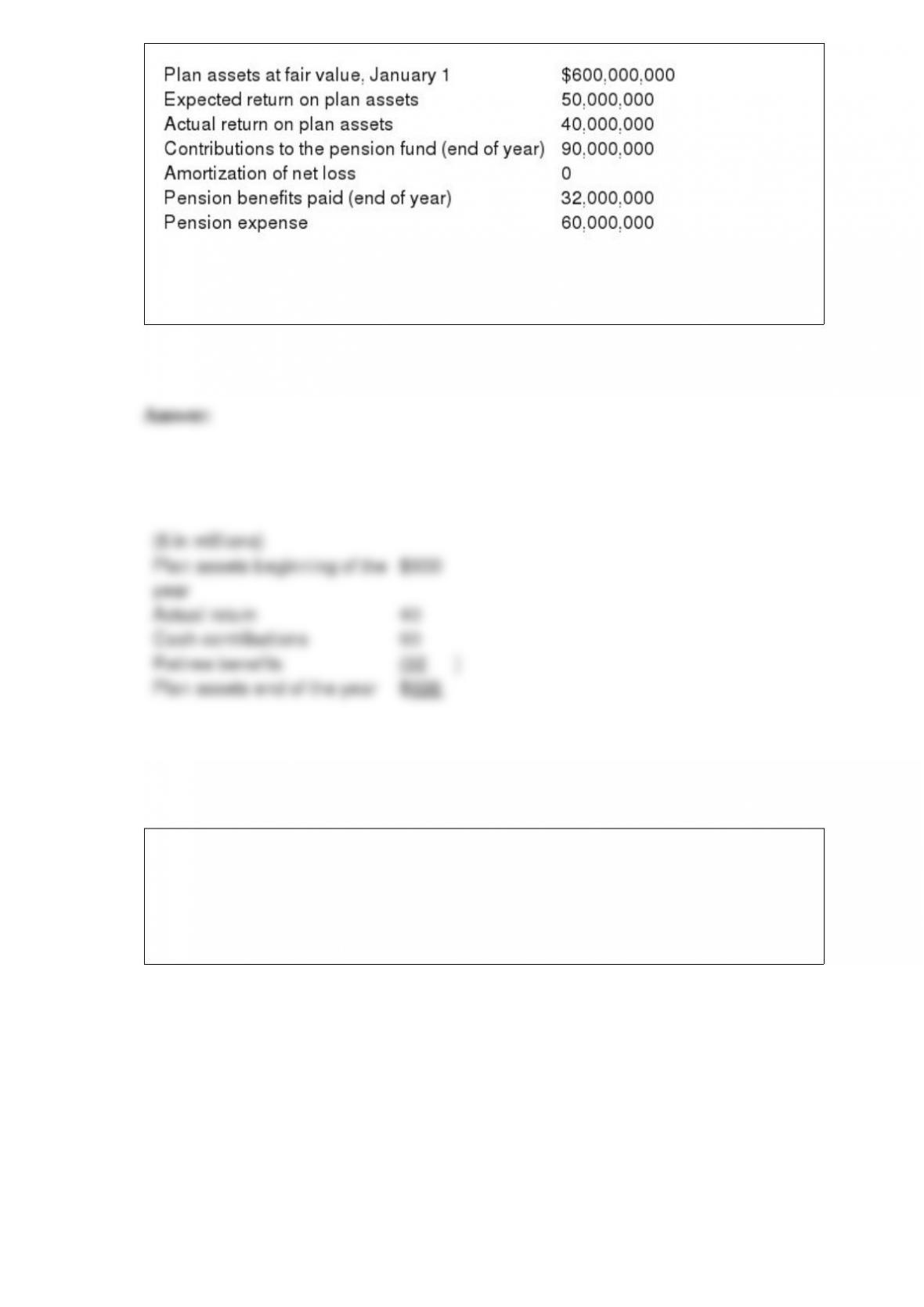
Required:
Determine the balance of pension plan assets at fair value on December 31.
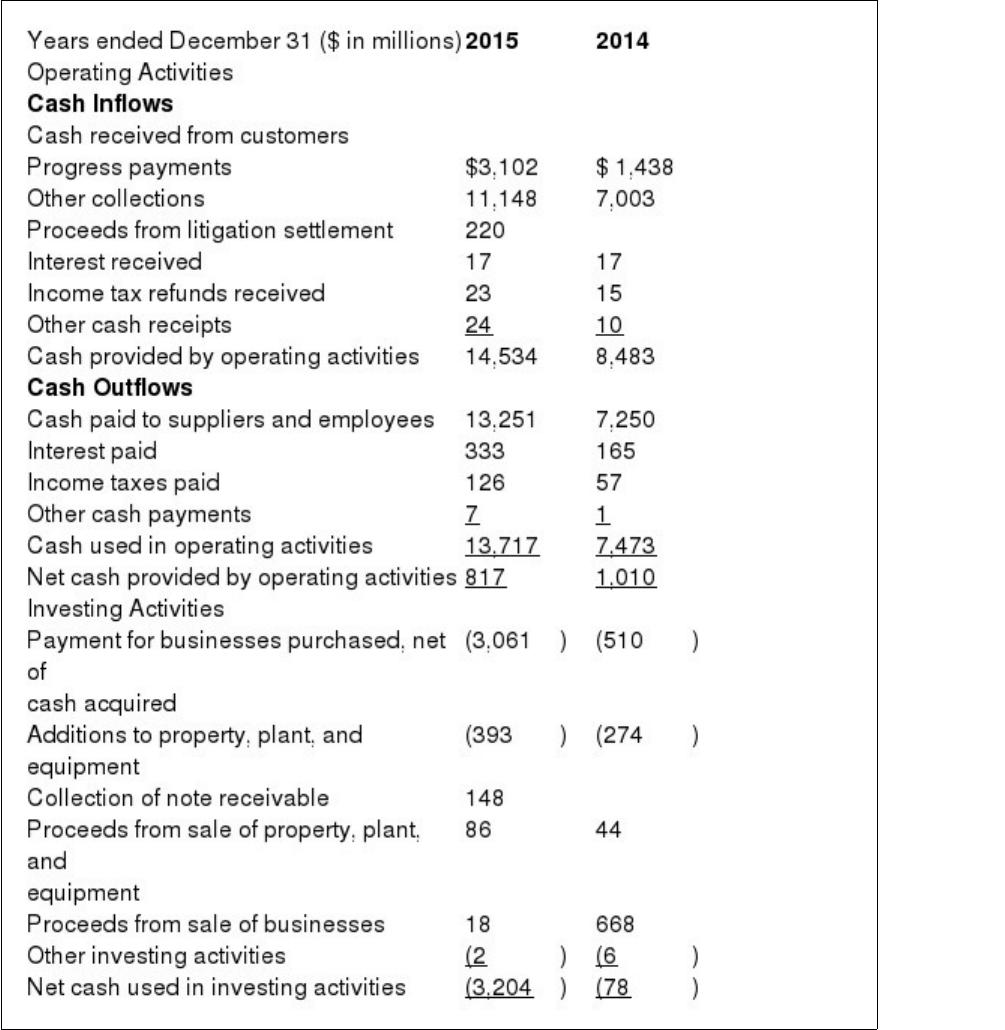
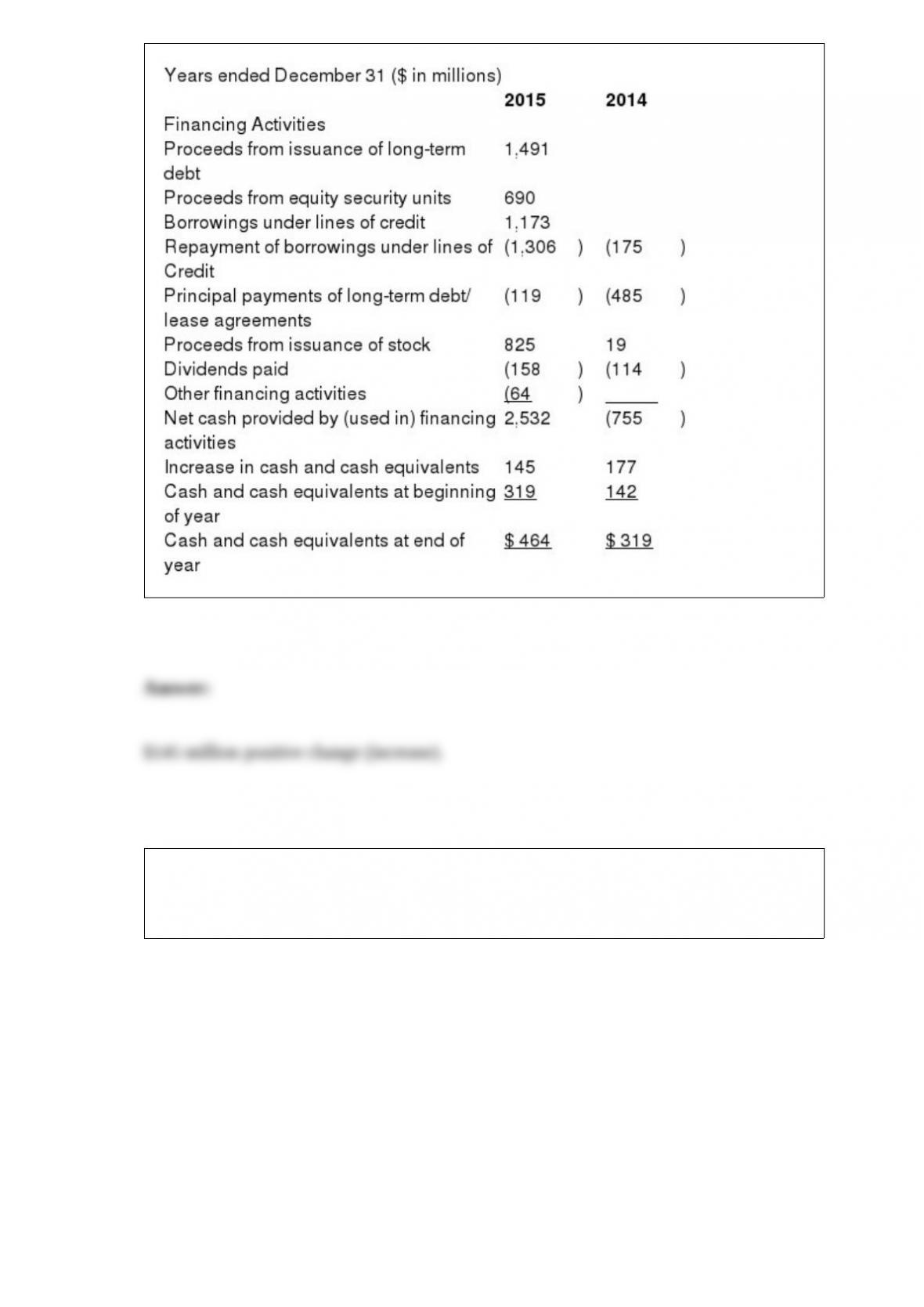
What was the net change in cash and cash equivalents experienced by Henchman & Co.
during 2015? Was it positive or negative?
In its 2015 Annual Report to Shareholders, Henchman & Co. provided the following
Statement of Cash Flows:
Orpheum Productions has a noncontributory, defined benefit pension plan. On
December 31, 2016 (the end of Orpheum’s fiscal year), the following pension-related
data were available:
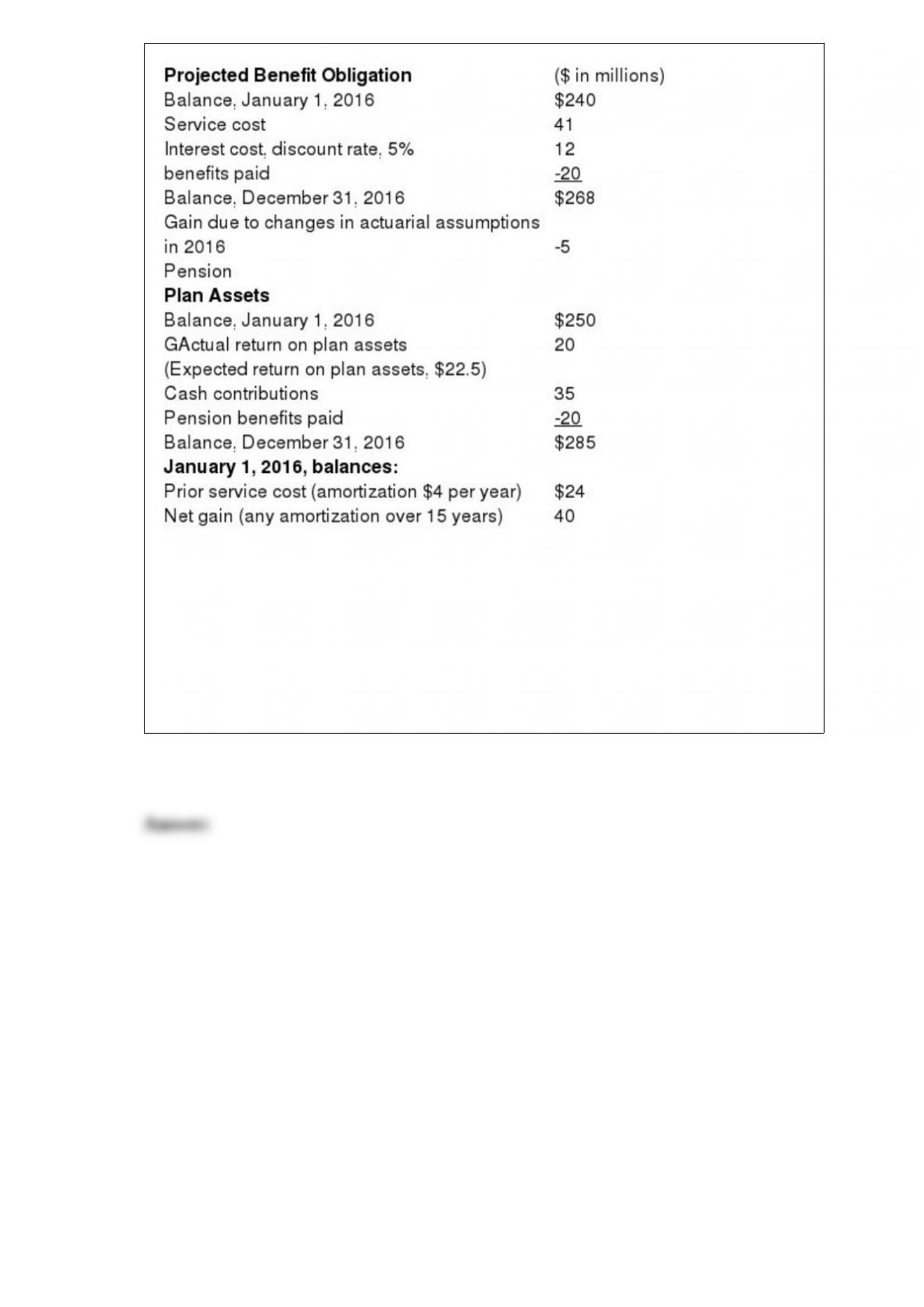
Required:
1) Prepare the 2016 journal entry to record pension expense.
2) Prepare the 2016 journal entry to record the contribution to plan assets.
3) Prepare the journal entries to record any 2016 gains and losses.
The Fitzgerald Company maintains a checking account at the Bank of the North. The
bank provides a bank statement along with canceled checks on the last day of each
month. The October 31, 2016, bank statement included the following information:
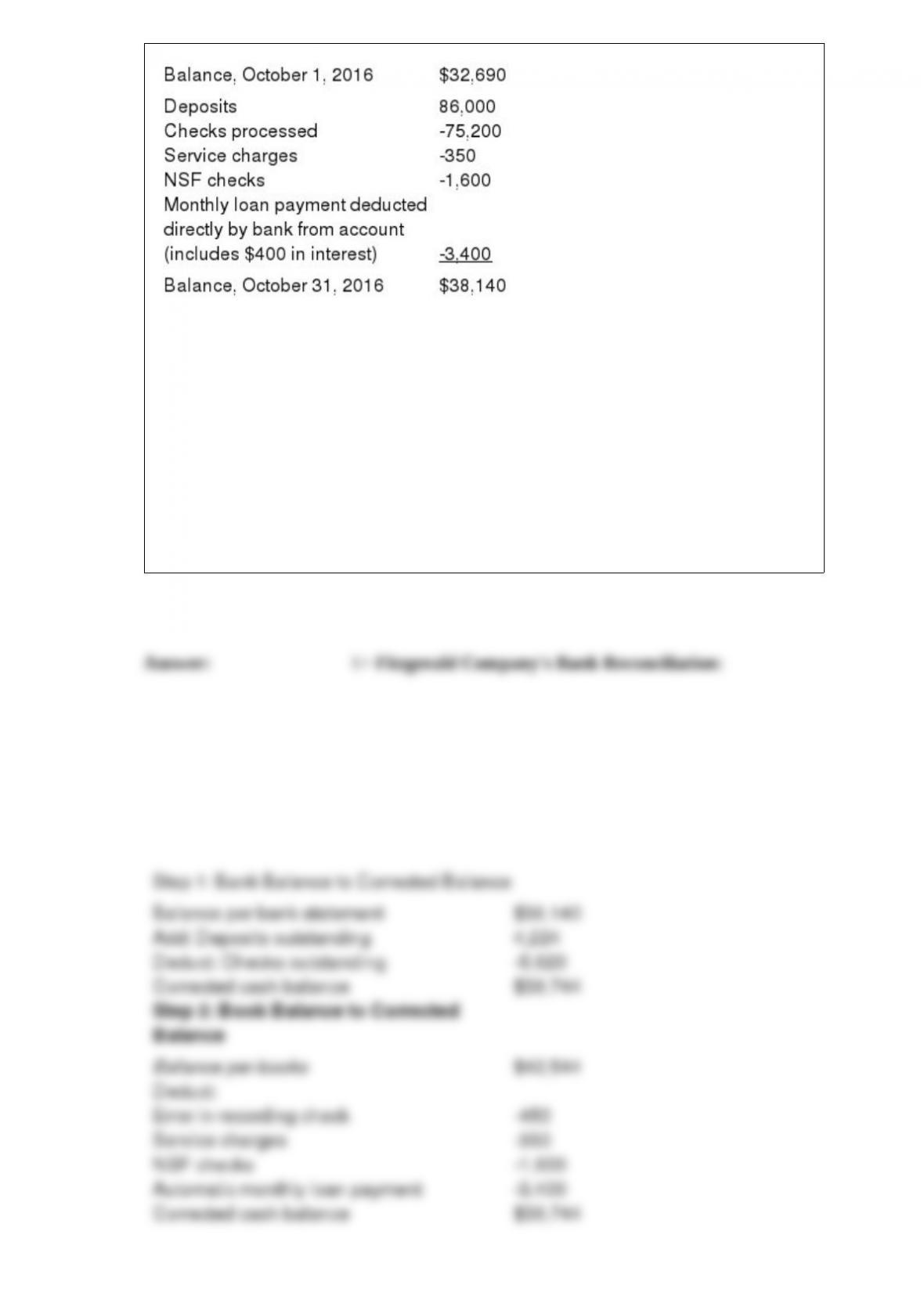
The company’s general ledger cash (checking) account had a balance of $42,544 at the
end of October. Deposits outstanding totaled $4,224, and all checks written by the
company were processed by the bank except for those totaling $5,620. In addition, a
check for $500 for the purchase of office furniture was incorrectly recorded by the
company as a $50 disbursement. The bank correctly processed the check during
October. Required:
1> Prepare a bank reconciliation for the month of October.
2> Prepare the necessary journal entries at the end of October to adjust the general
ledger cash account.