1) Indicate whether each of the following statements is true or false.
1>The required rate of return on a capital investment is also referred to as the hurdle
rate or discount rate
2>The return on investment measures the compensation a company expects to receive
from investing in capital assets
3>Most companies use their cost of capital as the minimum return on investment
required from capital investments
4>The further into the future a cash receipt is expected to occur, the higher is its present
value
5>The present value of a dollar to be received in the future is less than a dollar. The
higher the required rate of return, the lower the present value will be
2) Indicate whether each of the following statements is true or false.
1>When actual sales revenue exceeds the expected revenue, a company has a favorable
sales variance
2>A cost variance is considered to be unfavorable when actual costs are less than
standard costs
3>A company can calculate variances for both revenues and costs
4>Flexible budgets can be used for both planning and performance evaluation
5>A variance is a difference between an expected amount and a standard amount
3) On December 31, 2012, the Grant Corporation estimated that $2,000 of its
receivables might not be collected. On that date, the balance of Accounts Receivable
was $76,000. On February 1, 2013, Grant wrote off a delinquent account from a
customer. Grant uses the allowance method of accounting for uncollectible accounts.
Indicate whether each of the following statements is true or false.
1>The write-off entry on February 1, 2013 had no effect on Grant’s total assets
2>The write-off entry on February 1, 2013 decreased net income for 2013
3>The net realizable value of accounts receivable (after the appropriate adjusting entry
on December 31, 2012) was $76,000
4>The entry to write off the account on February 1, 2013 included recognition of
Uncollectible Accounts Expense
5>The adjusting entry on December 31, 2012 had no effect on Grant’s total assets
4) Indicate whether each of the following statements is true or false.
1>Some long-term loans have variable interest rates
2>Cash for acquiring machinery or buildings is often obtained by issuing long-term
debt
3>Short-term notes payable normally mature within a year
4>Installment notes payable usually have terms of 2-5 years
5>Most businesses finance part of their activities with long-term debt
5) How does the quick ratio differ from the current ratio?
6) Explain the significance of a high price-earnings ratio.
7) Indicate whether each of the following statements is true or false.
1>A predetermined overhead rate is calculated by dividing costs by volume, using a
measure of volume such as direct labor hours or direct materials cost
2>Accounting reports at the end of the fiscal year are based on estimated costs rather
than actual costs
3>A predetermined overhead rate is calculated using actual cost and volume data
4>A predetermined overhead rate may be used to allocate overhead costs when volume
varies during the year
5>A company may need to allocate overhead costs to products to make pricing
decisions for the products
8) Indicate whether each of the following statements about product costs is true or false.
1>Product costs that can be easily traced to units of product are overhead costs
2>Manufacturing overhead costs are assigned to products through a process of cost
allocation
3>Factory utilities and rent on manufacturing facilities are manufacturing overhead
costs
4>General, selling, and administrative costs are usually treated as product costs
5>Product costs are divided between the income statement and the balance sheet
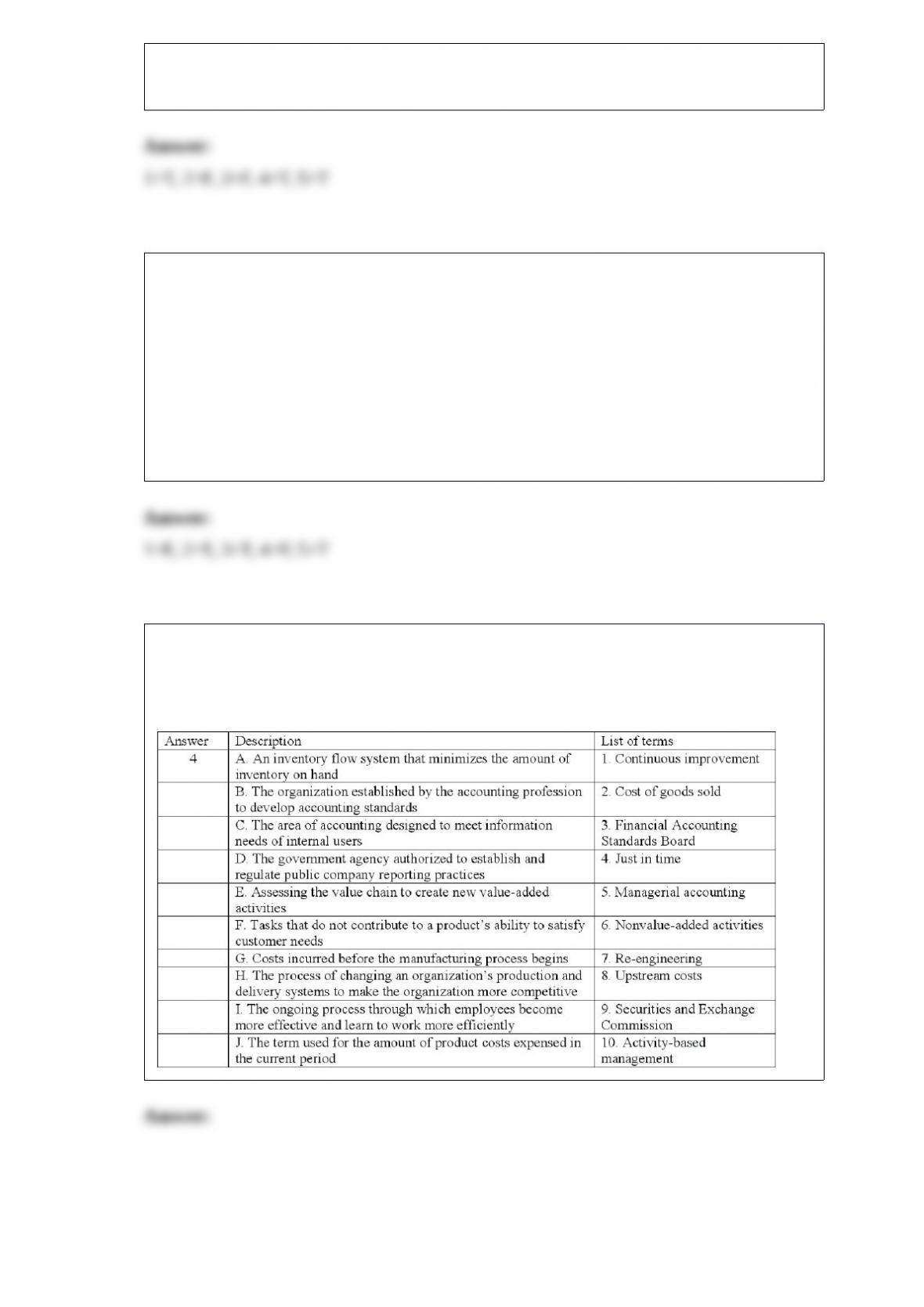
9) Matching. Select the term from the list provided that best matches each of the
following descriptions. The first is done for you.