When preparing the statement of cash flows using the indirect method, gains from
financing activities are added to net income to arrive at cash flows from operating
activities.
When the budget being used is a static budget, the difference between actual results and
budgeted results is referred to as ‘œbudget slack’.
Discretionary fixed costs are fixed costs that cannot be changed over the short run.

When a direct labor worker performs indirect labor activities, the worker will charge the
time to a particular activity, not to a particular job.
Those assets that are expected to provide economic benefits for several years are called
capital assets.
One way for managers to get an estimate of customer profitability is to allocate
expenses to customers through activity-based costing.
Long-term planning is often referred to as strategic planning.
The accounting rate of return differs from the internal rate of return and the payback
period in that the accounting rate of return does not focus on cash flows.
Managerial accounting information is always prepared by the controller or cost
accountant.
A harvest strategy focuses on short-term profits and cash, even at the expense of market
share.
Most companies use the direct method to prepare the statement of cash flows.
Once the cash flows and discount rate have been determined, calculate the present value
of each cash flow by multiplying each one by the appropriate present value factor.
For the product differentiation strategy, companies will want information on quality,
such as defect rates, percentage of on-time deliveries, and customer satisfaction.
When a company accepts an outsourcing offer, managers must take specific action to
eliminate the internal costs.

The difference between absorption and variable costing is the timing difference in the
expensing of fixed overhead costs.
Jody Jewelry manufactures jewelry. In October Jody is planning to make 500 rings, 400
bracelets, and 210 pendants. Each ring requires 3 ounces of gold and 2 semi-precious
stones. Each bracelet requires 4 ounces of gold and 4 semi-precious stones. Each
pendant requires 3.5 ounces of gold and 1 semi-precious stone. The company can
purchase the 10k gold it uses in its manufacturing for $215 an ounce, and can purchase
a lot of 100 semi-precious stones for $3,080. What is the standard cost for direct
materials per pendant?
a. $245.80
b. $783.30
c. $752.50
d. $3,295.00
To focus on the facts that make a difference in their decisions, managers need to know
how to eliminate
a. Avoidable costs.
b. Non-value added activities.
c. Irrelevant information.
d. All of these answer choices are correct.
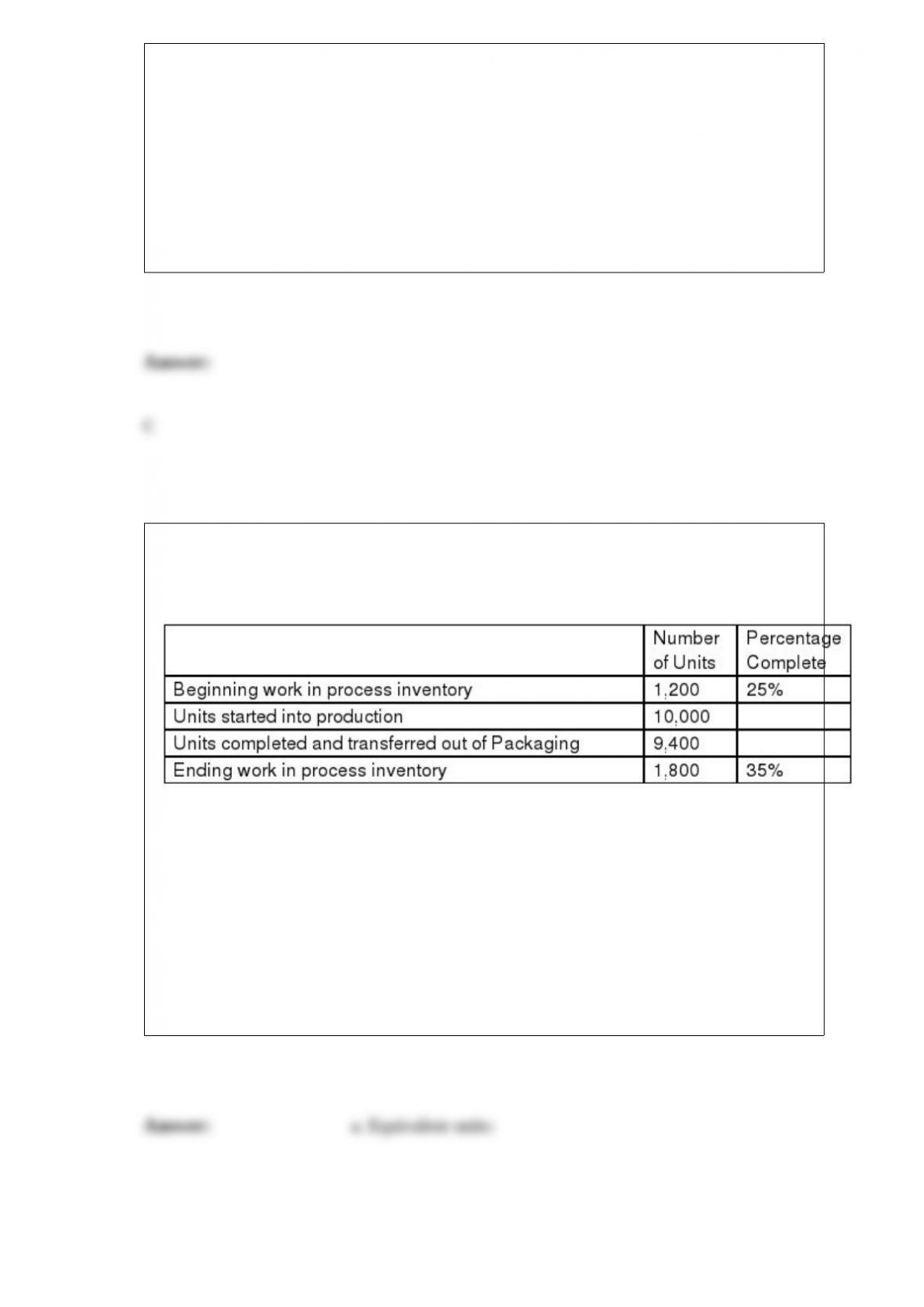
Stewart Manufacturing uses a process costing system. Information regarding units
processed and processing costs for the Packaging Department for the most recent period
are given below:
The beginning work in process had processing costs of $10,000. During the month, an
additional $290,000 in processing costs were incurred. Materials and conversion costs
are incurred at the same rate.
Required:
a. What are the equivalent units for processing costs for the Packaging Department for
the month?
b. What is the cost per equivalent unit for the month?
An imposed budget
a. Tends to elicit more commitment to the budget from employees since they have had
some input into its creation.
b. Begins at the lowest levels of management and filters up through the organization.
c. Is the least efficient method of budget preparation.
d. Involves the fewest number of people in the budgeting process.
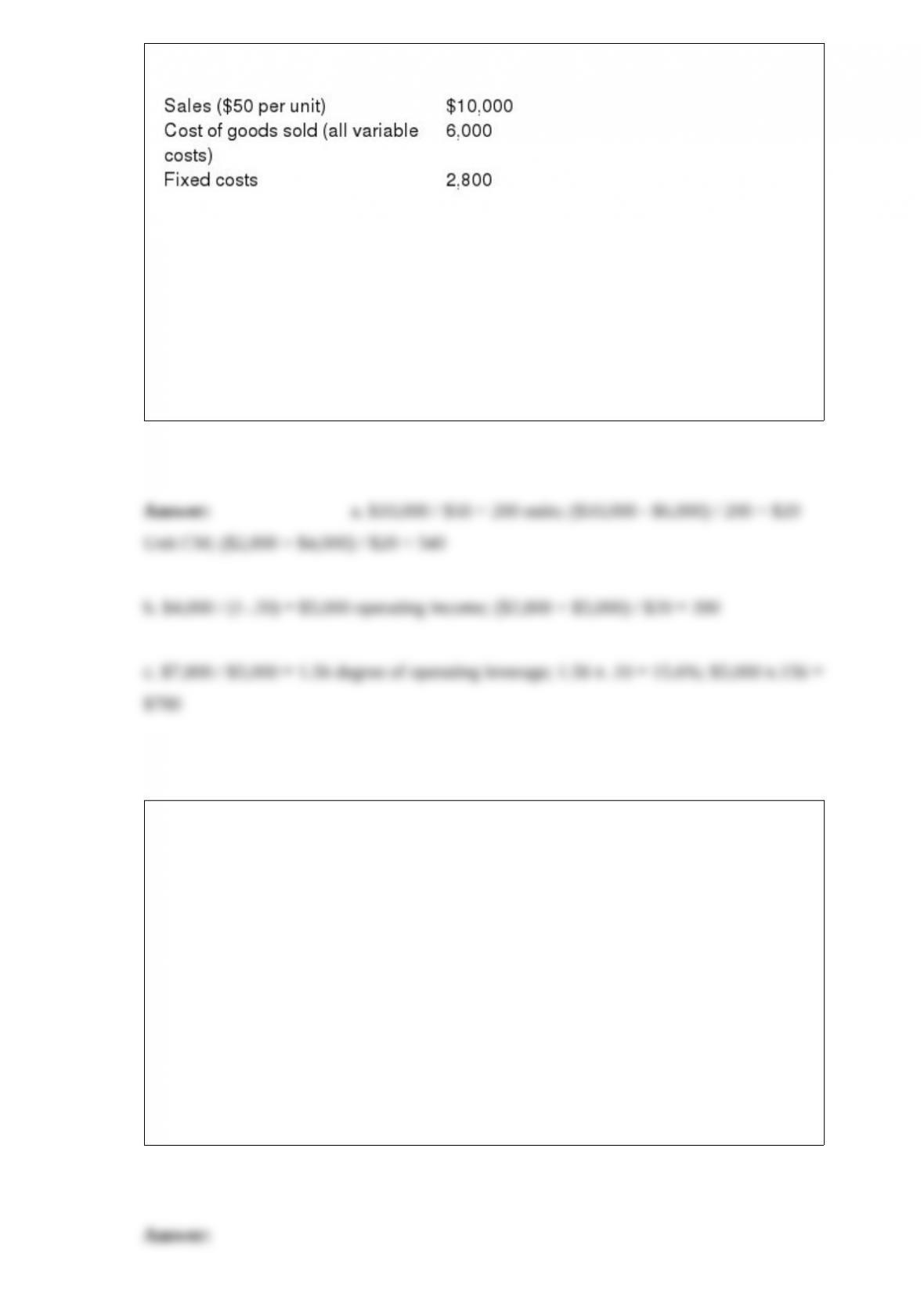
Use the information provided below to answer the following questions:
Required:
a. How many units would the company need to sell to earn $4,000 in operating income?
b. How many units would the company need to sell to earn $4,000 in net income if the
tax rate is 20%?
c. By how much would operating income change from part (b) with a 10% increase in
units sold?
Walker’s Manufacturing began its operations on January 1 of the current year. Walker
produced 10,000 units during the year, sold 8,000 units at an average cost of $22 per
unit, and had 2,000 units in ending inventory. Variable production costs were $14 per
unit, variable selling expenses were $2 per unit, fixed overhead totaled $12,000, and
fixed selling and administrative expenses totaled $30,000. Under absorption costing,
what was Walker’s operating income?
a. ($26,000)
b. $6,000
c. $8,400
d. $10,000

Since internal users have access to all the underlying data used for managerial
accounting reports,
a.They can create reports that suit their particular decision making needs.
b.There is no need to use financial data in making decisions.
c.Both they can create reports that suit their particular decision making needs and there
is no need to use financial data in making decisions.
d.Neither they can create reports that suit their particular decision making needs nor
there is no need to use financial data in making decisions.
The supply chain ‘s goal is to
a.To get the right product to the right location
b.To get the product in the right quantities at the right time
c.To get the product produced at the right cost
d.All of these answer choices are correct.
Which of the following is a use of the materials purchases budget?
a. It helps managers minimize the resources invested in inventory.
b. It helps managers plan the quantity and timing of purchases of material.
c. It helps ensure the adequate level of inventory.
d. All of these answer choices are correct.
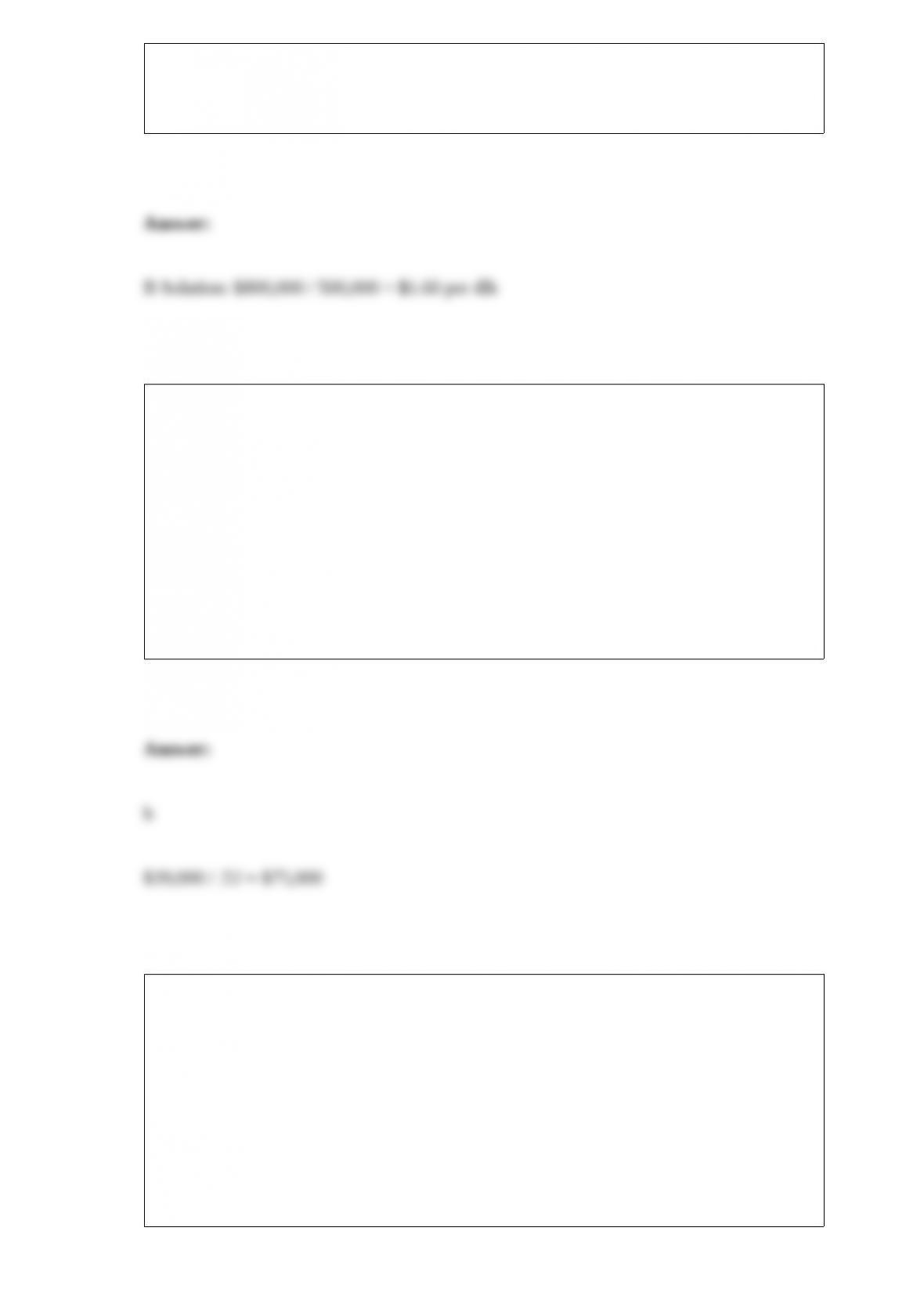
Stone Cliff Company manufactures custom-order furniture. During 2013, actual
manufacturing overhead totaled $720,000. Based on the 2013 results, and projected
production for 2014, management prepared the 2014 budget and estimated that
manufacturing overhead would total $800,000. The estimated number of direct labor
hours for 2014 is 500,000, and the estimated amount of direct labor cost is $1,000,000.
The company plans to use direct labor hours as the basis to allocate overhead to jobs.
During May and June 2014, employees worked on the following four jobs:
What is the predetermined overhead rate that Stone Cliff will use to allocate overhead
during 2014?
a. $.80 per direct labor hour.
b. $1.60 per direct labor hour.
c. $1.44 per direct labor hour.
d. $.72 per direct labor hour.
Nomad Company sells camera bags. The company purchases the bags from its supplier
for $12 a bag and sells them to electronics stores for $25 a bag. Nomad’s fixed costs are
$39,000. What is Nomad’s breakeven point in sales dollars?
a. $30,000
b. $75,000
c. $81,250
d. $97,500
Which of the following accounts is similar to the Inventory account of a merchandising
company?
a. Raw Materials Inventory
b. Work in Process Inventory
c. Finished Goods Inventory
d. Manufacturing Overhead
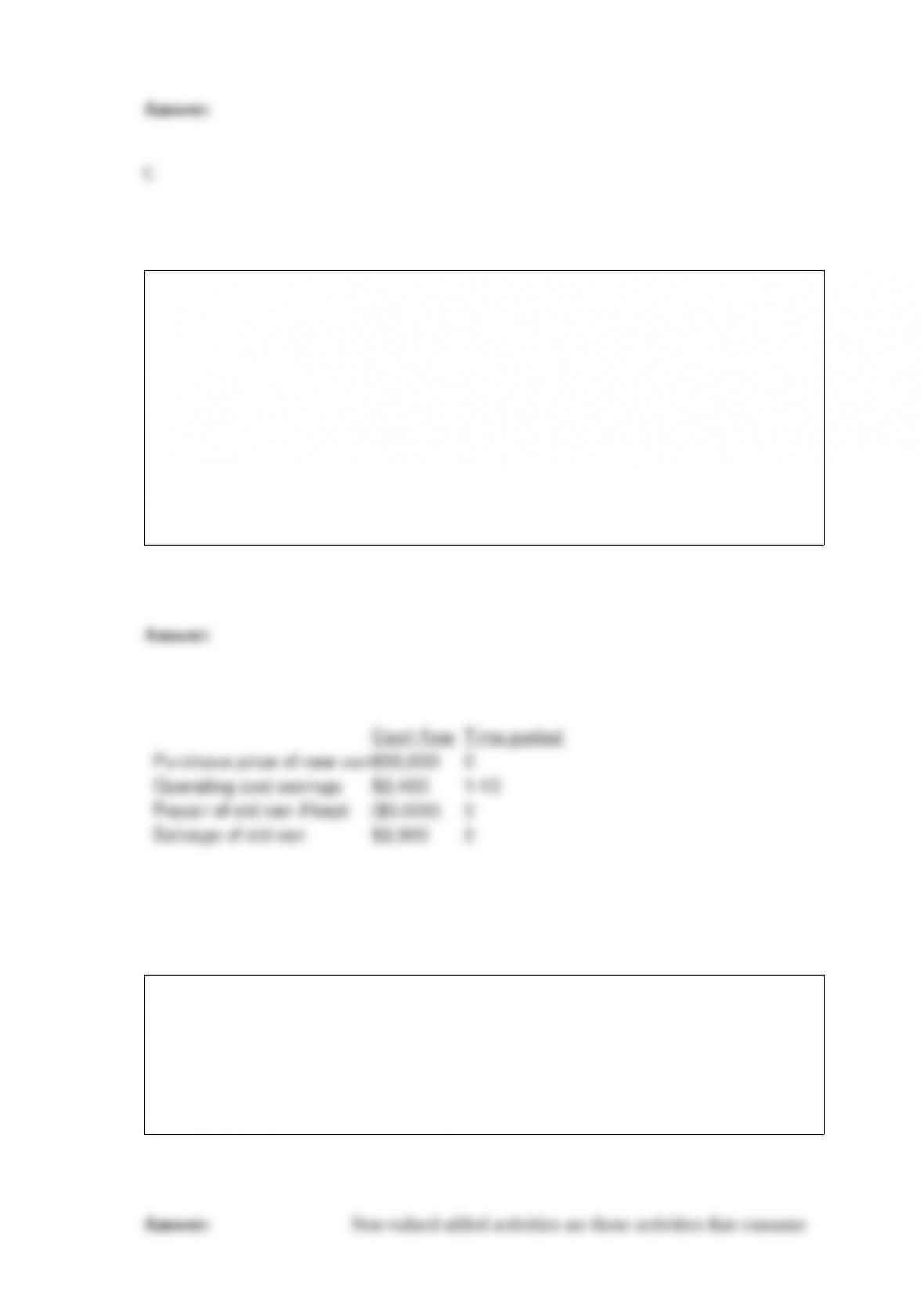
Friendly Freddie’s Furniture Store uses an 8-year old van to deliver furniture to
customers within a 50-mile radius of the store. The van has an original cost of $22,000.
It costs $1,000 each month to operate the van. Unfortunately, the van was in an accident
last week and it will cost $5,000 for repairs. Freddie has found a new van that will cost
$35,000. Freddie expects to get 10 years use from the new van and estimates that the
operating costs will be $800 each month. Freddie can sell his old van as is for $2,500.
Required:
Identify the amount and timing of the cash flows relevant to Friendly Freddie’s decision
to replace the van.
You have been hired by a company that is transitioning from a traditional method of
product costing to an activity-based costing method. You are assigned to a team that has
the responsibility of classifying activities as value-added or non-value-added. One of
the team members does not understand the purpose of classifying activities. Define
valued-added and non-value added costs for your team member and give an example of
each and explain how non-value added activities affect product cost
Assume your friend is watching you prepare the Master Budget as part of your
accounting homework. She notices that The Sales Budget affects both the Budgeted
Income Statement and the Cash Budget, but not by the same amount. Explain why the
effect is not the same on the two budgets.
The DuPont Model decomposes the original ROI formula into two components: margin
and asset turnover.
The degree of operating leverage is calculated as the contribution margin divided by the
sales revenue.