1) If external markets exist, then market-based transfer prices are the most appropriate.
2) An organization’s code of ethics should not be integrated into the management
accounting and control system design.
3) Planning variances are the focus of cost control.
4) Information is never neutral; just the act of measuring and reporting information
affects the individuals involved.
5) Management accounting measures can provide advance warnings of problems.
6) For decision-making, differential costs assist in choosing between alternatives.
7) The financial perspective addresses which processes must we excel at to meet our
customer and shareholder expectations.
8) A recent survey conducted by the American Management Association showed that
the monitoring of company employees is decreasing due to privacy issues.
9) Breakeven time measures the length of time from the project’s beginning until the
product has been introduced and generated enough profit to pay back the investment
originally made in its development
10) A cost may be relevant for one decision, but not relevant for a different decision.
11) Zero-based budgeting requires that proponents of discretionary expenditures justify
these outlays for each budgeting period.
12) Even when the ABC project is initiated from the finance group, a multifunctional
project team should be formed.
13) Salespersons’ incentives that set minimum quotas and commissions based on sales
revenue, and tie bonuses and rewards to achieving sales revenues above a stretch target
contribute to unprofitable customer relationships.
14) The usual starting point in budgeting is to make a forecast of production.
15) A well-designed management accounting and control system should focus strictly
on long-term quantitative performance measures.
16) Many costs of marketing, selling, and distribution expenses are incurred not to
support individual products or product lines, but rather to support customers, market
segments or distribution channels.
17) These questions refer to flexible budget variance formulas with the following
descriptions for the variables: A = Actual; P = Price; Q = Quantity; S = Standard.
The best label for the formula (AQ – SQ) SP is the:
A) materials quantity variance
B) materials price variance
C) total cost variance for materials
D) labor wage rate variance
18) The following information pertains to the October operating budget for Flockhart
Corporation.
Budgeted sales for October $100,000 and November $200,000.
Collections for sales are 60% in the month of sale and 40% the next month.
Gross margin is 30% of sales.
Administrative costs are $10,000 each month.
Beginning accounts receivable (October 1) $20,000.
Beginning inventory (October 1) $14,000.
Beginning accounts payable (October 1) $60,000. (All from inventory purchases.)
Purchases are paid in full the following month.
Desired ending inventory is 20% of next month’s cost of goods sold (COGS).
No loans are outstanding on October 1
For October, budgeted cash payments for purchases are:
A) $14,000
B) $60,000
C) $70,000
D) None of the above is correct
19) Which of the following best represents the Plan step in the Plan-Do-Check-Act
(PDCA) cycle?
A) Take actions to lower costs, change resource allocations, improve the quality, cycle
time and flexibility of processes, modify the product mix, change customer
relationships, and redesign and introduce new products
B) Measure and monitor ongoing performance and take short-term actions based on the
measured performance
C) Define the organization’s purpose and select the focus and scope of its strategy
D) Implement the chosen course of action
20) One goal of ________ is to design costs out of products in the research,
development, and engineering stage.
A) cost-plus pricing
B) target costing
C) Kaizen costing
D) traditional costing
21) The normal cost of overhead activities includes:
A) costs of resources committed to the particular activity
B) amounts for additional overtime payments
C) allowances for idle time
D) All of the above are correct
22) One goal of ________ is to design costs out of products in the research,
development, and engineering stage.
A) cost-plus pricing
B) target costing
C) Kaizen costing
D) traditional costing
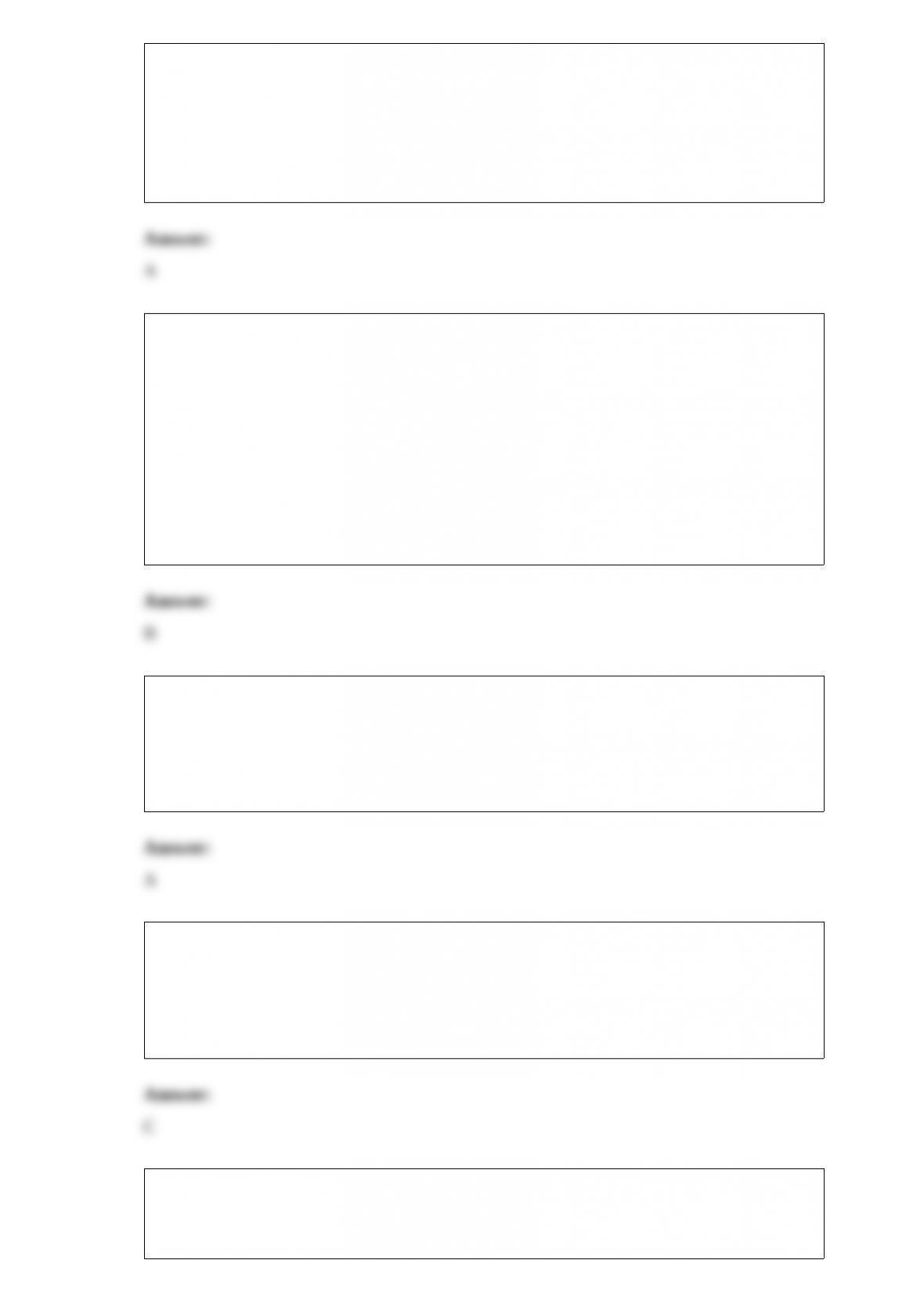
23) Melodee’s Preserves currently makes jams and jellies and a variety of decorative
jars used for packaging. An outside supplier has offered to supply all of the needed
decorative jars. For this make-or-buy decision, a cost analysis revealed the following
avoidable unit costs for the decorative jars:
The maximum price that Melodee’s Preserves should be willing to pay for the
decorative jars is:
A) $0.28 per jar
B) $0.38 per jar
C) $0.72 per jar
D) $1.00 per jar
24) ________ starts with the estimated product costs and next adds the expected profit
margin.
A) Cost-plus pricing
B) Target costing
C) Kaizen costing
D) Standard costing
25) Dakota Corporation plans to grow by offering a hand held application, the Pocket
Analyst 2, which is superior and unique from the competition. Dakota believes that
putting additional resources into R&D and staying ahead of the competition with
technological innovations is critical to implementing its strategy.
To further Dakota’s strategy, measures on the Balanced Scorecard would MOST likely
include:
A) shorter cycle times
B) manufacturing quality
C) yield
D) lowest cost supplier
26) Segment margin includes:
A) all costs traceable to the segment
B) the segment’s share of allocated corporate costs
C) the segment’s share of allocated unavoidable costs
D) All of the above are correct
27) Undercosting of a product is MOST likely to result from:
A) misallocating direct labor costs
B) underpricing the product
C) overcosting another product
D) understating total product costs
28) The break-even point in units decreases if the:
A) flexible (variable) cost per unit increases
B) total capacity-related (fixed) costs decrease
C) contribution margin per unit decreases
D) selling price per unit decreases
29) To become a strategy-focused organization:
A) monthly management meetings should focus on variances between actual
performance and what was planned
B) the budgeting process must protect long-term initiatives from the pressures to deliver
short-term performance
C) scorecards and priorities should be updated annually when preparing next year’s
budget
D) All of the above are correct
30) Advantages of the time-driven ABC model include all of the following except:
A) cost-driver rates change when there has been a shift in the efficiency of the activity
B) cost-driver rates can be easily updated
C) complex assumptions reflect the manufacturing environment
D) data used are easily observed
31) In general, it was not until the 1970s that management accounting systems:
A) were improved because of demands by the FASB and the SEC
B) stagnated and proved inadequate
C) started to develop innovations in costing and performance-measurement systems due
to intense pressure from overseas competitors
D) started to address the decision-making needs of managers
32) If process perspective measure from the Balanced Scorecard was shorter cycle
times, then a driver from the learning and growth perspective would MOST likely be to:
A) lower cost of acquiring materials
B) achieve just-in-time supplier capability
C) offer a complete product line
D) expand product offerings
33) All of the following are true of responsibility centers EXCEPT that they:
A) operate like a small business
B) promote the interests of the larger organization
C) coordinate activities with other responsibility centers
D) are best used in a centralized organization
34) The first modern industry to develop and use large quantities of financial statistics
to assess and monitor organizational performance was:
A) steel companies
B) lumber companies
C) the railroads
D) automobile companies
35) A favorable efficiency variance for direct labor indicates that:
A) a lower wage rate than expected was paid for direct labor
B) a higher wage rate than expected was paid for direct labor
C) less direct labor hours were used during production than expected for actual output
D) more direct labor hours were used during production than expected for actual output
36) The use of unit-related measures to assign overhead costs is more likely to:
A) undercost high-volume products
B) undercost specialty low-volume products
C) undercost complex products
D) undercost specialty low-volume and complex products
37) Historically, service companies have:
A) operated in less competitive environments than manufacturing companies
B) enjoyed global customer demand
C) used management accounting information in much the same way as manufacturing
companies
D) competed by managing costs to provide the best service at the lowest price
38) In which order are the following developed?
A = Production planB = Materials purchasing plan
C = Demand forecastD = Sales plan
A) first to last: A, B, C, D
B) first to last: C, D, A, B
C) first to last: D, C, B, A
D) first to last: C, A, D, B
39) The characteristic of a management accounting and control system that allows
employees to customize applications for local decisions is referred to as being:
A) timely
B) flexible
C) accurate
D) in control
40) The whale curve:
A) graphs sales verses customers
B) graphs profits verses customers
C) graphs the 80/20 rule
D) finds that 80% of costs are generated by 20% of the customers
41) To discover where to make improvements in productivity, managers might do all of
the following EXCEPT:
A) calculate the ratio of output over input
B) compare return on sales to a competitor’s return on sales
C) use trend analysis
D) compare the asset turnover ratio for this accounting period to an industry norm
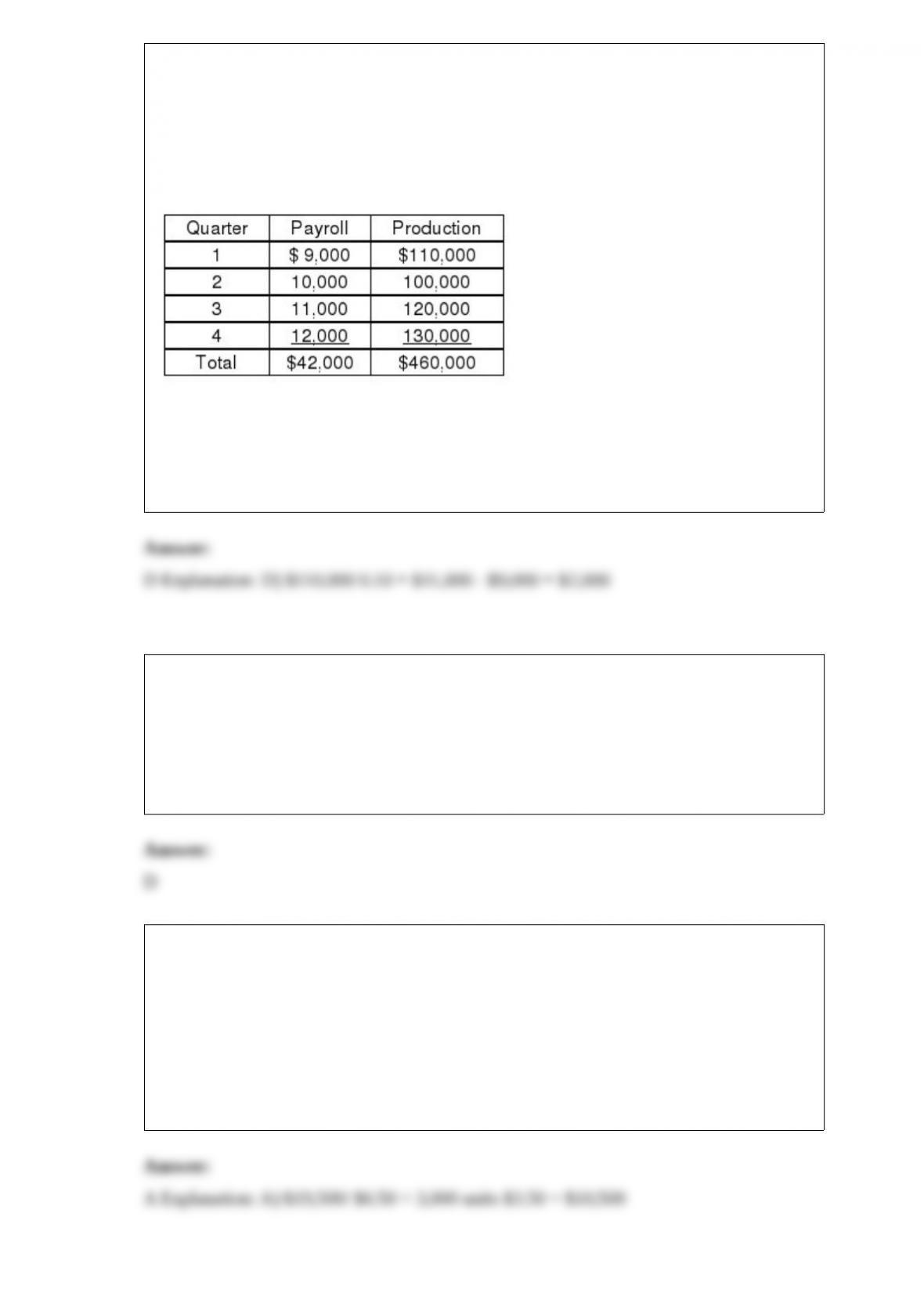
42) Aero Company has implemented a gain sharing compensation plan for its
production employees. The plan is a Scanlon plan and the base period payroll costs are
$10,000. The value of production in the base period was $100,000. The plan calls for
labor savings to be added to, or excess labor costs to be deducted from, the bonus pool
each quarter. The payroll costs and value of production in each quarter of the current
year were:
The labor savings for Quarter 1 are:
A) ($2,000)
B) ($1,000)
C) $1,000
D) $2,000
43) ________ refers to the amount of effort the employee expends on a job or specific
task.
A) Direction
B) Persistence
C) Duration
D) Intensity
44) Sanchez & Ryan, Inc, sells a single product. This year, 20,000 units were sold
resulting in $130,000 of sales revenue, $60,000 of variable costs, and $17,500 of fixed
costs.
If sales increase by $19,500 in a year, profits will increase by:
A) $10,500
B) $17,500
C) $19,500
D) $35,000
45) The quality movement was pioneered by:
A) Eli Whitney
B) Henry Ford
C) Edwards Deming
D) Frederick Taylor
46) The MOST likely result of decentralization is to give local-division managers the
responsibility for:
A) evaluating strategic goals
B) allocating joint costs
C) operating decisions
D) financial control
47) Concerns about Kaizen costing include:
A) radical process improvements
B) excessive pressures are put on employees
C) focus is on the overall system
D) grace periods may be granted
48) All of the following are criticisms of stock options used in compensation plans
EXCEPT:
A) organizations have been too generous in rewarding stock options
B) stock options rely on internal measures
C) stock option’s value may reflect many factors beyond the employee’s control
D) the option’s price is often too close to the market price at issuance
49) Describe the pricing waterfall.
50) Describe some of the drawbacks of using the operating budget as a control device.
51) Explain when a manager would use cost-volume-profit analysis.
52) Xenon Company incurred $1,000,000 in research and development costs over an 18
month period to develop product X1. Sales of product X1 begin at the end of the 18
month period. Sales price of product X1 is $20 per unit; variable costs are $8 per unit;
fixed costs are $140,000 per month. Sales volume is projected to be 20,000 units per
month. Calculate the breakeven time for product X1.

53)