Which data flow diagram (DFD) symbol is portrayed by two parallel lines?
a. data flow
b. data store
c. external entity
d. internal entity or process
The following is a jumbled list of the activities suggested in this text for drafting data
flow diagrams (DFDs) for an existing system:
The best sequence for undertaking these activities is:
a. I, II, V, III, IV
b. I, V, III, II, IV
c. II, I, III, V, IV
d. II, IV, III, I, V
Regarding internal control systems:
a. ultimate ownership of the system should rest with the board of directors.
b. a properly implemented system can be expected to provide 100 percent assurance
that the organization will meet its objectives.
c. both a. and b.
d. neither a. not b.
Which of the following data stores would you least expect to see in the Purchasing
Process –
a. inventory master data
b. vendor master data
c. purchase order master data
d. cash receipts event data
The sequence of steps in identifying relationships in a model is:
a. evaluate entities as pairs, identify user existing and desired information, evaluate
each entity to determine if there is any need for two occurrences of the same entity type
to be linked
b. identify user’s existing and desired information, evaluate entities as pairs, evaluate
each entity to determine if there is any need for two occurrences of the same entity type
to be linked
c. evaluate entities as pairs, evaluate each entity to determine if there is any need for
two occurrences of the same entity type to be linked, identify user existing and desired
information
d. evaluate each entity to determine if there is any need for two occurrences of the same
entity type to be linked, evaluate entities as pairs, identify user existing and desired
information
Which of the following is NOT a business processes element?
a. Business operations
b. Events processing
c. Management decision making
d. Technology
Which of the following commands allow us to join data across multiple tables to link
specific pieces of information that are of interest?
a. Select
b. Project
c. Join
d. Display
Suggesting items to Internet customers based on their buying patterns
a. is from the collection and analysis of customer purchase data
b. is known as ‘shop at one location”
c. has increased sellers’ inventory levels
d. all of the above
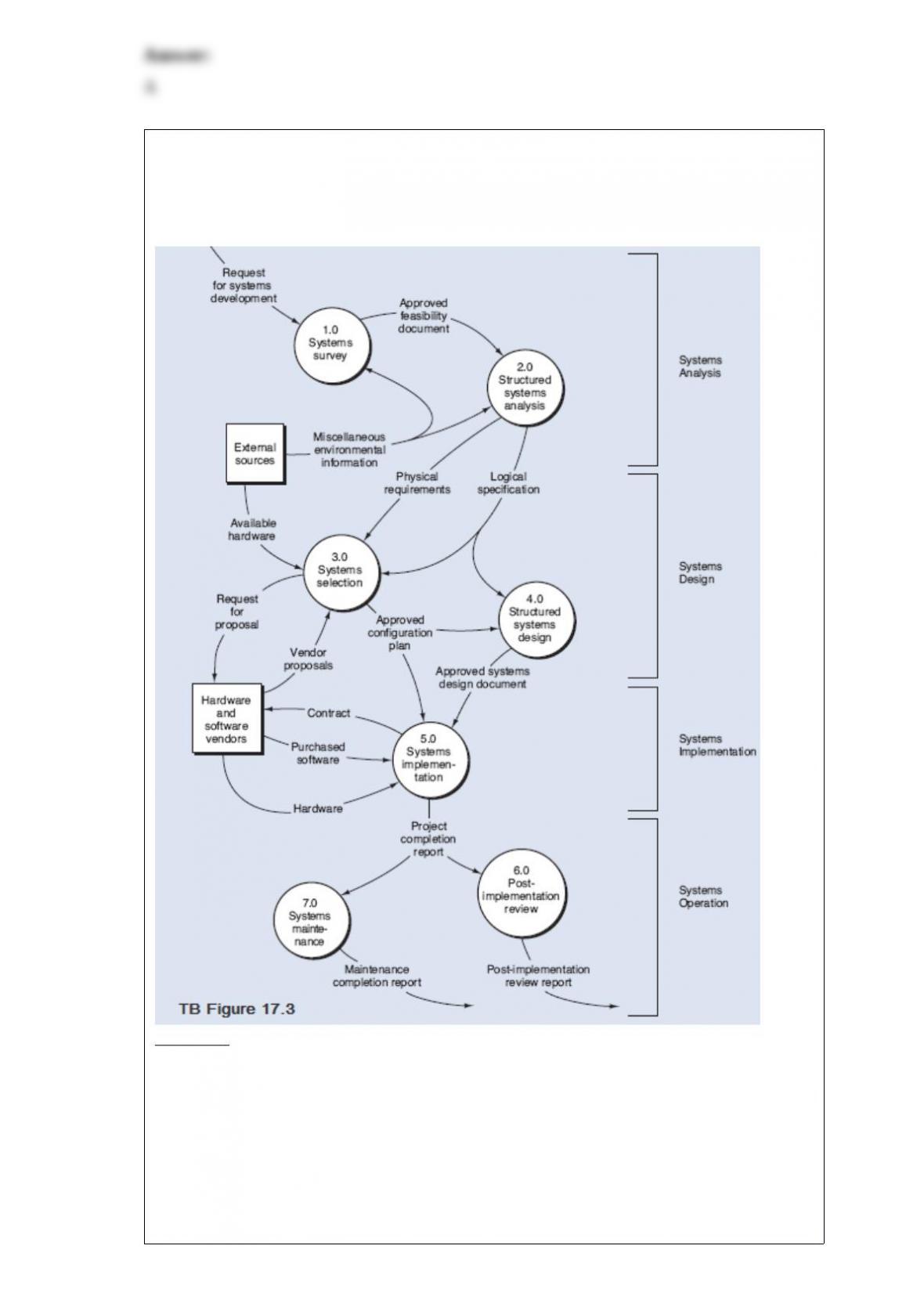
TB Figure 17.3 is taken from the text figure showing the systems selection task and
documents.
Required:
Explode bubble 3.0 Systems Selection into a
Process bubbles
3.1 Prepare requests for proposal
3.2 Evaluate vendor proposals
3.3 Assess software plan
3.4 Complete configuration plan

External entities
External sources
Hardware/ software vendors
Data flows
Approved configuration plan
Available hardware
Available hardware
Logical specification
Physical requirements
Physical requirements
Request for proposal
Software specifications
Suggested hardware resources
Vendor proposals
According to the COSO Fraudulent Financial Reporting 1998- 2007 update:
a. The most common fraud scheme used was improper revenue recognition.
b. Most companies engaged in fraudulent activities were able to recover and resume
operations.
c. CEO’s and CFO’s were named by the SEC for involvement in approximately 50% of
fraud cases.
d. All of the above.
In the Purchasing Process –
a. order goods and services
b. receive goods and services
c. determine requirements
d. none of the above
The AICPA has identified all but which of the following as assurance services?
a. consulting
b. information systems reliability
c. electronic commerce
d. All of these are assurance services identified by the
The control plan tickler file of payments due, is directed primarily at which of the
following control goals?
a. update completeness
b. input validity
c. input accuracy
d. input completeness
Limitations of the general ledger approach include the following:
a. combining of financial and non–financial information
b. purging of detailed event level data
c. use of a chart of accounts
d. inability to conform to GAAP
The enterprise system might help purchase office equipment by
a. connecting directly to the enterprise system of the equipment vendor
b. verifying that appropriate approvals have been obtained
c. providing an electronic order form
d. all of the above

Match the terms in the left column below with the definitions in the right column by
placing the letter next to the term in the blank space next to the definition.
Term Definition
A. Push manufacturing
B. Throughput time
C. Parts master
D. Master production schedule (MPS)
E. Available to promise planning
F. Pull manufacturing
G. Bill of materials (BOM)
H. Work center master
I. Routing master
J. Capable to promise planning
1. The time it takes from when authorization is made for goods to be produced to when
the goods are completed.
2. The accumulation of the data on current inventories, sales commitments, and planned
production to determine whether the production of finished goods will be sufficient to
commit to additional sales orders.
3. A listing of all the subassemblies, parts, and raw materials that go into a parent
assembly showing the quantity of each that is required to make an assembly.
4. Describes stations available for producing products, including information such as
the machine available at the station, its capacity, its maintenance requirements, labor
needs to operate it, and so on.
5. The accumulation of the data on current inventories, sales commitments, planned
production and excess production capacity, or other planned production capacity that
could be quickly converted to production of the desired finished goods necessary to
fulfill a sales order request.
6. Process for which the sales forecast drives the production plan, and goods are
produced in large batches.
7. Specifies the operations necessary to complete a subassembly or finished good and
the sequence of these operations.
8. A statement of specific production goals developed from forecasts of demand, actual
sales orders, or inventory information.
9. Lists the detailed specifications for each raw materials item.
10. This process is initiated as individual sales orders are received and theoretically
each job consists of a “batch” of one unit.
The three logical components of a business process are the _____________________
process, the ____________ process and the ____________process.
The flowchart below is the accounts payable/cash disbursements process presented in
Chapter 13, but with certain items omitted. In the flowchart, each omission is indicated
by a capital letter (A through I). Jumbled lists of the omitted items are as follows:
Hiring employees, purchasing inventory and collecting cash from customers are all
components of _________ ______________.
The __________ of information must be evaluated in relation to the purpose to be
served (decision making).
The flowchart below is the accounts payable/cash disbursements process presented in
Chapter 13, but with certain items omitted. In the flowchart, each omission is indicated
by a capital letter (A through I). Jumbled lists of the omitted items are as follows:
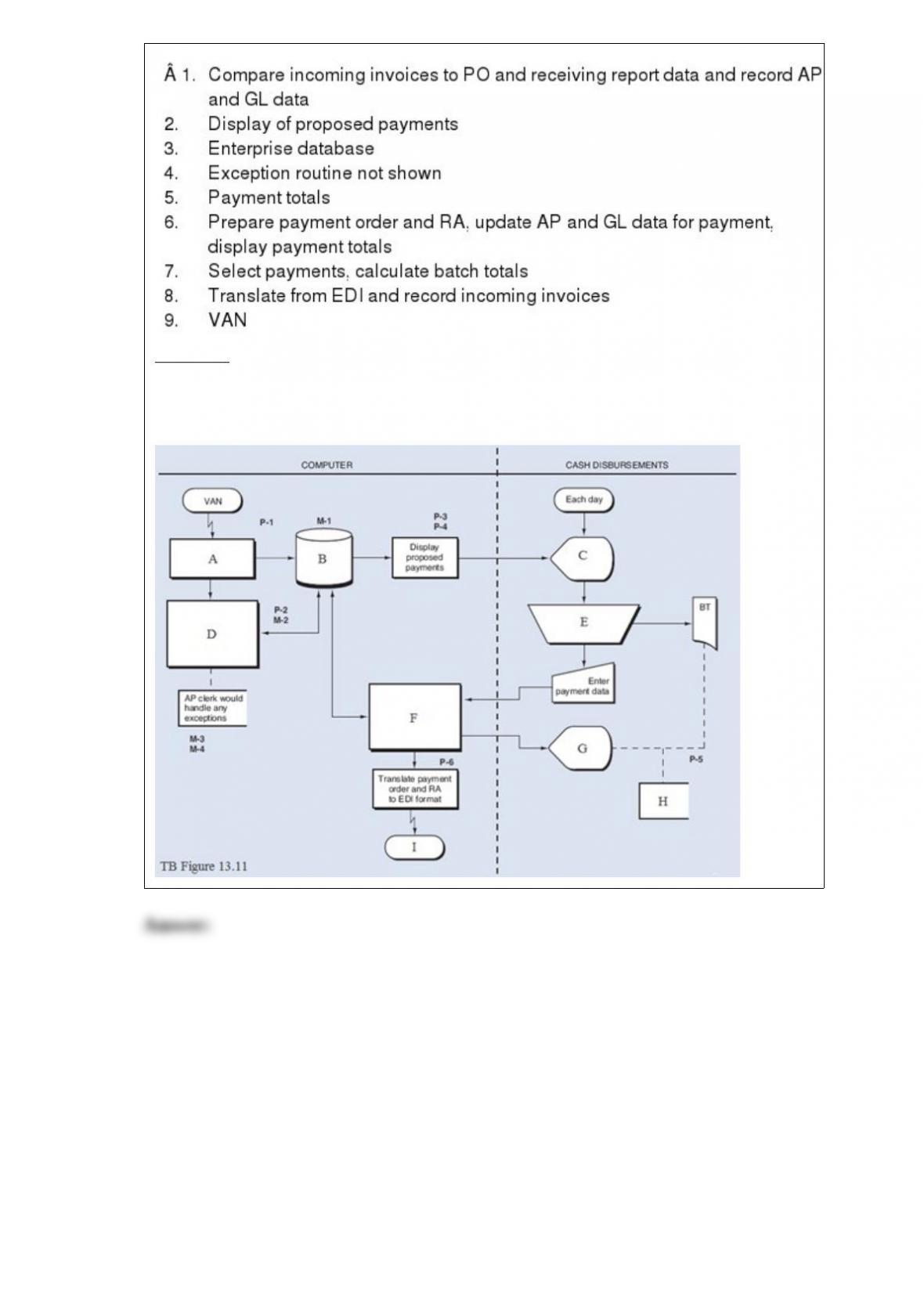
Required:
Complete the flowchart TB Figure 13.11 by placing one of the numbers, 1 through 9
from the above lists, to match the letters showing the missing items.
As a user of an AIS an accountant may be called upon to participate in the AIS design
process.