Faithful representation is a characteristic of external financial reporting that means:
A) the financial reports of a business are assumed to include the results of only that
business’s activities.
B) financial information can be compared across businesses because similar accounting
methods are applied.
C) the results of business activities are reported using an appropriate monetary unit.
D) financial information depicts the economic substance of business activities.
If Sales are $850,000 and the beginning and ending balances of Accounts Receivable
are $43,000 and $48,000, respectively, the cash collected from customers is:
A) $850,000.
B) $802,000.
C) $845,000.
D) $855,000.
Your store buys ice cream at a cost of $1.50 a half gallon and sells it for $4 a half
gallon. Selling, general, and administrative expenses are $0.75 per half gallon. Which
of the following statements is correct?
A) Your gross profit per half gallon is $2.50.
B) Your gross profit per half gallon is $1.75.
C) The difference between the selling price and the cost is recorded in the gross profit
account.
D) The difference between the selling price and the cost is recorded in the Net Profit
account.
Companies A and B both report net income growth of 12% per year. Company A has a
receivables turnover ratio of 5.6, which is lower last year. Company B has a receivables
turnover ratio of 11.3, which is higher than last year. All other things being equal:
A) Company A is more effectively managing its receivables.
B) Company B is more effectively managing its receivables.
C) Company A’s days to collect is lower than Company B’s in both years.
D) Company B’s days to collect increased.
All of the following would be classified as current on a classified balance sheet except:
A) Common Stock
B) Cash
C) Accounts Payable
D) Supplies
When you identify outstanding checks in performing a bank reconciliation, you must:
A) deduct the amount of the outstanding checks from the balance per books.
B) deduct the amount of the outstanding checks from the balance per bank.
C) add the amount of the outstanding checks to the balance per books.
D) add the amount of the outstanding checks to the balance per bank.
Obligations due to be paid within one year or the company’s operating cycle, whichever
is longer, are classified as:
A) current assets.
B) current liabilities.
C) earned revenues.
D) noncurrent liabilities.
Assume a company uses the indirect method to prepare its statement of cash flows. If
Inventory decreases and Unearned Revenue increases during an accounting period,
what does the company do with the changes in these accounts to calculate cash flows
from operating activities?
A) Both are added to net income.
B) The change in inventory is added to net income; the change in unearned revenue is
subtracted.
C) Both are subtracted from net income.
D) The change in unearned revenue is added to net income; the change in inventory is
subtracted.
Negative operating cash flow may indicate all of the following except:
A) the company may not be able to replace property, plant and equipment.
B) stockholders may not receive a dividend.
C) the company may be in the introductory phase of its life cycle.
D) the company did not earn a profit from its core business activity.
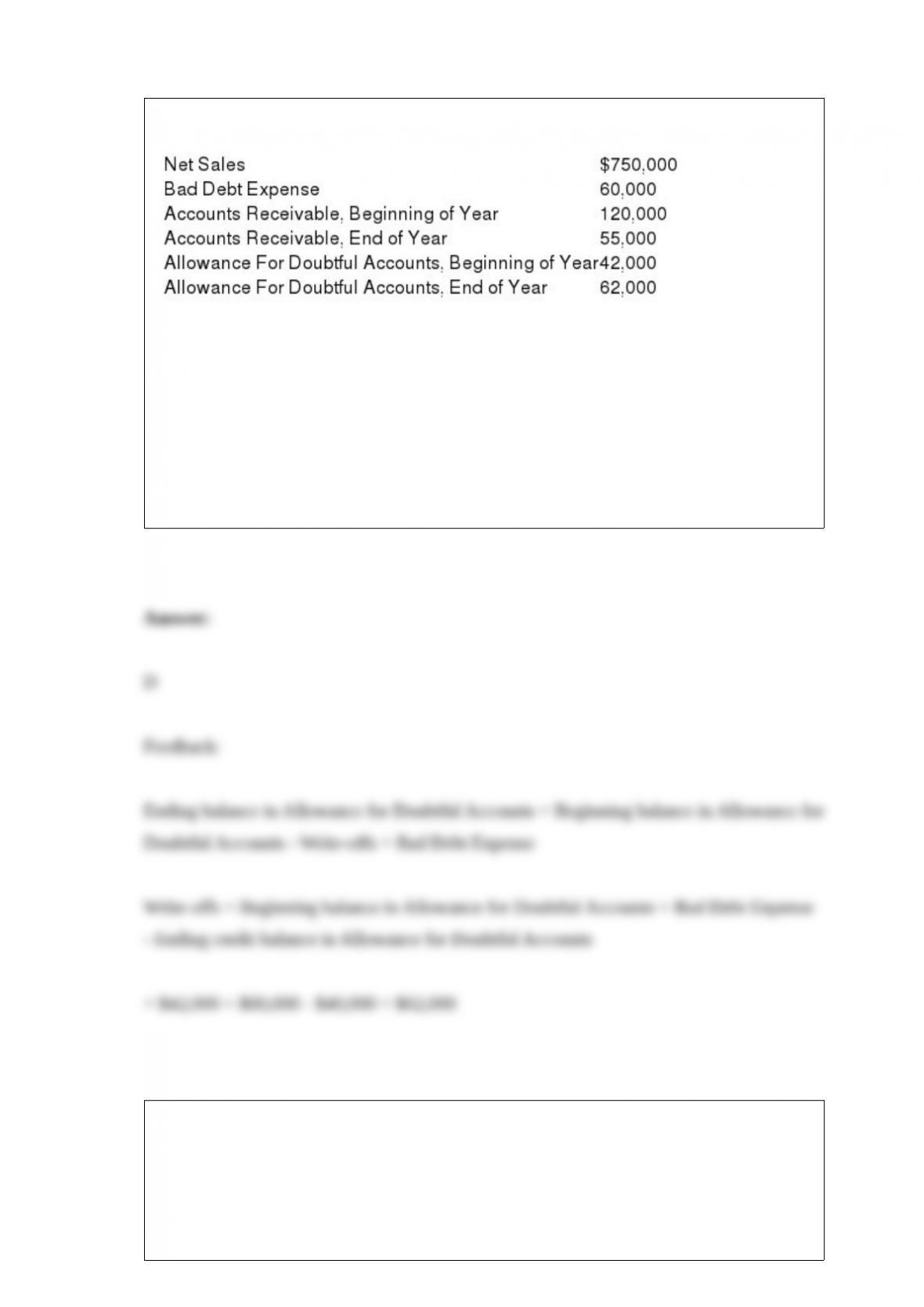
Labrador Inc. has the following information available for the current year:
What was the amount of write-offs during the year?
A) $62,000
B) $0
C) $55,000
D) $40,000
If a company’s gross salaries and wages are $12,000, and it withholds $1,800 for
income taxes and $800 for FICA taxes, the journal entry to record the employees’ pay
should include a:
A) debit to Salaries and Wages Expense for $9,400.
B) debit to Salaries and Wages Payable for $9,400.
C) credit to Salaries and Wages Payable for $12,000.
D) credit to Salaries and Wages Payable for $9,400.
A truck costing $12,000, which has Accumulated Depreciation of $9,000, was sold for
$2,000 cash. The entry to record this event would include a:
A) gain of $1,000.
B) loss of $1,000.
C) credit to the Vehicles account for $3,000.
D) credit to Accumulated Depreciation for $9,000.
Two years ago, your company bought $40,000 in bonds from another company. This
month, it sold half of those bonds for $20,640 and purchased the common stock of
another company for $1,000. On the statement of cash flows for this accounting period,
your company would report a net cash:
A) outflow of $19,640 from investing activities.
B) inflow of $19,640 from investing activities.
C) inflow of $20,640 from investing activities.
D) outflow of $20,640 from investing activities.
Which one of the following is not likely to be a consequence of fraudulent financial
reporting?
A) The company’s stock price drops once the fraud is discovered.
B) Innocent accountants who work for the company’s CPA firm lose their jobs.
C) Creditors recover 100% of amounts owed to them.

D) Employees lose their retirement savings.
On a bank reconciliation, the amount of an unrecorded bank service charge is
A) added to the bank balance of cash.
B) added to the company ‘s balance of cash.
C) deducted from the bank balance of cash.
D) deducted from the company ‘s balance of cash.
A company issued 10-year, 7% bonds with a face value of $100,000. The company
received $97,947 for the bonds. Using the straight-line method of amortization, the
amount of interest expense for the first interest period is:
A) $7,000.00
B) $7,205.30
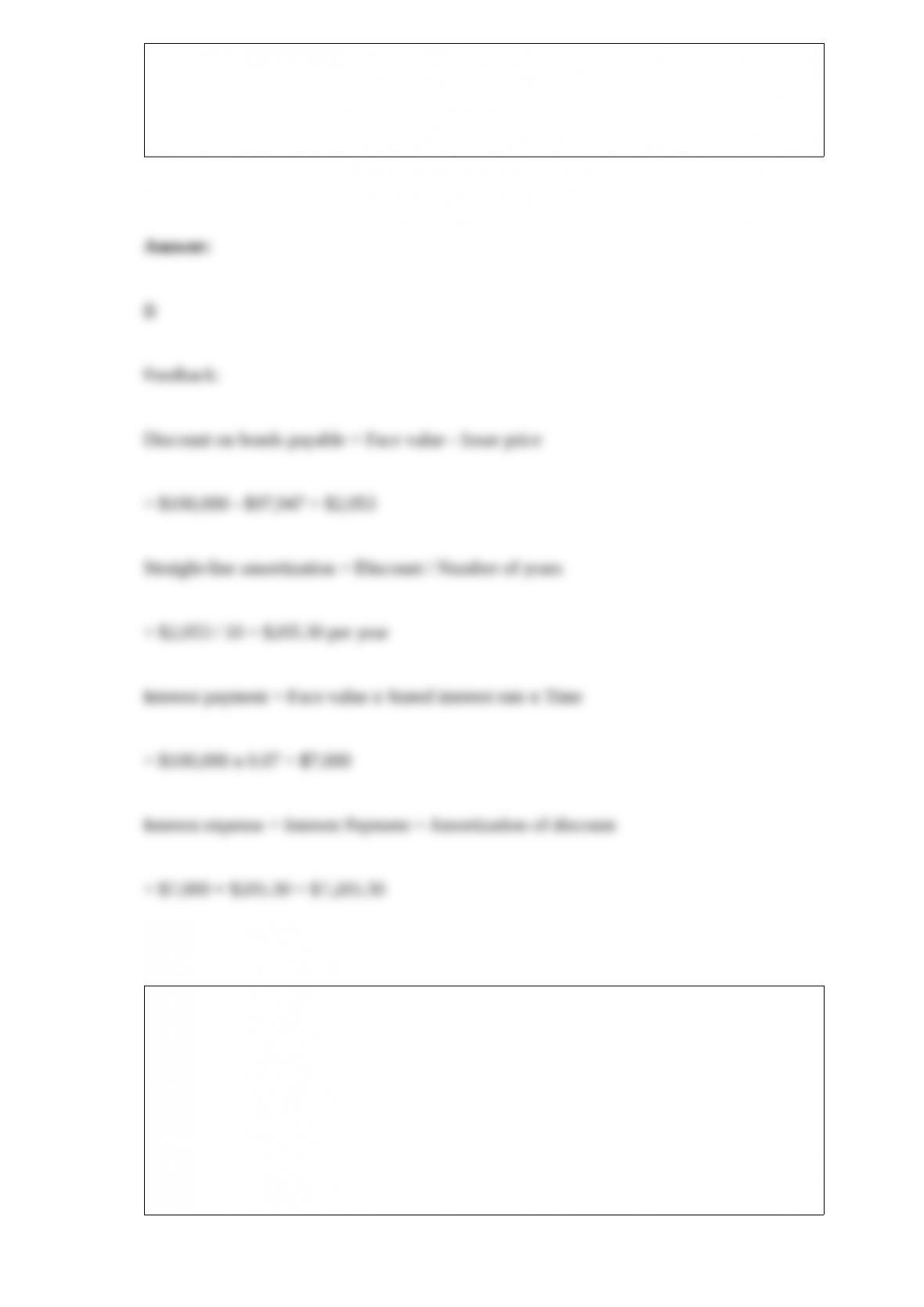
C) $6,794.70
D) $2,053.00
Which of the following would not represent a financing activity?
A) Paying dividends to stockholders.
B) An investment of capital by the owners.
C) Borrowing money from a bank to purchase new equipment.
D) Buying supplies on account.