Accumulated depreciation is shown on the balance sheet as a subtraction from the cost
of an asset.
An unadjusted trial balance is a listing of accounts prepared before adjustments are
recorded.
Individual transactions in the Sales Journal are regularly posted to customer accounts in
the Accounts Payable ledger.
The matching principle requires that accrued interest on outstanding accounts
receivable be recorded at the end of an accounting period.

Risks involved in e-commerce include: credit card theft, computer viruses and
impersonation.
Current assets and current liabilities are expected to be used up or come due within one
year or the company’s operating cycle.
Companies must follow both the matching principle and the materiality principle when
considering the use of the direct write-off method.
An account balance is the difference between the increases and decreases recorded in an
account.
External business transactions are transactions between the business entity and some
other (outside) party.
Small differences between cash sales and the amounts on the cash register are directly
debited or credited to the cash account.
When preparing the financial statements, management can choose the inventory cost
flow assumption it will use for a particular year in order to impact the reported net
income.

Limited liability is a key consideration as to why corporations can raise resources from
shareholders.
Account balances in the General Ledger and the subsidiary ledgers are tested for
accuracy after posting is complete.
If obsolete or damaged goods can be sold, they will be included in inventory at their net
realizable value if it is less than cost.
Closing entries are needed at the end of the fiscal period to close all ledger accounts.
Credit cards do not remove the risk of bad debts to the business accepting payment by
credit card.
Compaq had net sales of $10,500 million. Its average account receivables were $1,750
million. Its accounts receivable turnover was 6.
Installment accounts receivable is another name for aging accounts receivable.

A periodic inventory system requires updating the inventory account at the beginning of
an accounting period.
Liabilities represent non-owner financing.
Adjusting entries are made after the preparation of financial statements.
A promissory note is a written promise to pay a specified amount of money either on
demand or at a definite future date.
Merchandise inventory is included in the Plant and Equipment section of the balance
sheet.
Failure to record depreciation expense will overstate the asset and understate the
expense.
A ledger is a type of account.

In applying the faithful representation principle, an accountant should choose the most
realistic value available, so that the inventory value is not overstated.
TechCom received a $1,000, 90-day, 10% note receivable from Danny Outlaw. The
journal entry to record the note includes a debit to notes receivable.
If a company purchases land, paying part with cash and issuing a note payable for the
balance, the journal entry to record this transaction will include a debit to Cash.
Before an adjusting entry for accrued salaries is made, the amount in Salaries Expense
is understated and the amount in Salaries Payable is also understated.
Enterprise-application software packages keep the programs that manage a company’s
vital operations.
The acid-test ratio is a more accurate measure of a company’s liquidity than the current
ratio.
The Sales Journal is used for:
A. Recording credit purchases.
B. Recording credit sales.

C. Recording cash sales.
D. Recording cash purchases.
E. Recording both credit sales and cash sales.
An accounting procedure that (1) estimates and reports bad debt expense from credit
sales during the period of the sales and (2) reports accounts receivable at the amount of
cash inflow that is expected from their collection is the:
A. Allowance method of accounting for bad debts.
B. Aging of accounts receivable.
C. Adjustment method for uncollectible debts.
D. Direct write-off method of accounting for bad debts.
E. Cash basis method of accounting for bad debts.
The main purpose of adjusting entries is to:
A. Record external transactions and events.
B. Record internal transactions and events.
C. Recognize revenues received during the period.
D. Recognize expenses paid during the period.

E. Adjust assets to their market value.
The recording of financial transactions either manually or electronically is called:
A. Accounting.
B. Bookkeeping.
C. Preparing financial statements.
D. Auditing.
E. Systems design.
A business activity that does not involve an exchange of economic consideration
between two parties is called a(n):
A. Withdrawal.
B. Account receivable.
C. Business transaction.
D. Business event.
E. Equity transaction.

If the balance of the Allowance for Doubtful Accounts account exceeds the amount of a
bad debt being written off, the entry to record the write-off against the allowance
account results in:
A. No effect on the expenses of the current period.
B. A reduction in current assets.
C. A reduction in owner’s equity.
D. An increase in the expenses of the current period.
E. A reduction in current liabilities.
A record of all accounts used by a business is called a:
A. Journal.
B. Book of original entry.
C. General Journal.
D. Trial balance.
E. Ledger.

A place or location within an accounting system in which the increases and decreases in
a specific asset, liability, or equity item is recorded and stored is called a(n):
A. Journal.
B. Ledger.
C. Trial balance.
D. Account.
E. Chart of accounts.
Banking activities include:
A. Bank accounts.
B. Bank deposits.
C. Chequing.
D. Electronic funds transfer.
E. All of these answers are correct.
Cash consists of:
A. Postage stamps.
B. Coins, currency, and chequing accounts.

C. IOUs.
D. Certificates of deposit.
E. Coins, currency, chequing accounts, and certificates of deposit.
Which ratio measures the portion of net sales that is gross profit?
A. Gross margin ratio.
B. Net sales ratio.
C. Gross profit ratio.
D. Gross margin ratio and gross profit ratio
E. All of these answers are correct
For a prepaid expense, the adjusting entry would:
A. Result in a debit to an expense account and a credit to an asset account.
B. Cause a prepaid expense to be overstated and liabilities to be understated.
C. Result in a credit to an expense account and a debit to an asset account.
D. Result in a debit to a liability account and a credit to an asset account.
E. Decrease cash.
Internal control procedures:
A. Eliminate the risk of loss.
B. Include policies and procedures to safeguard assets.
C. Prevent unavoidable losses.
D. Both eliminate the risk of loss and include policies and procedures to safeguard
assets.
E. All of these answers are correct.
Under the alternative method for accounting for prepaid expenses, which of the
following pairs of journal entry formats is correct?
A.
B.
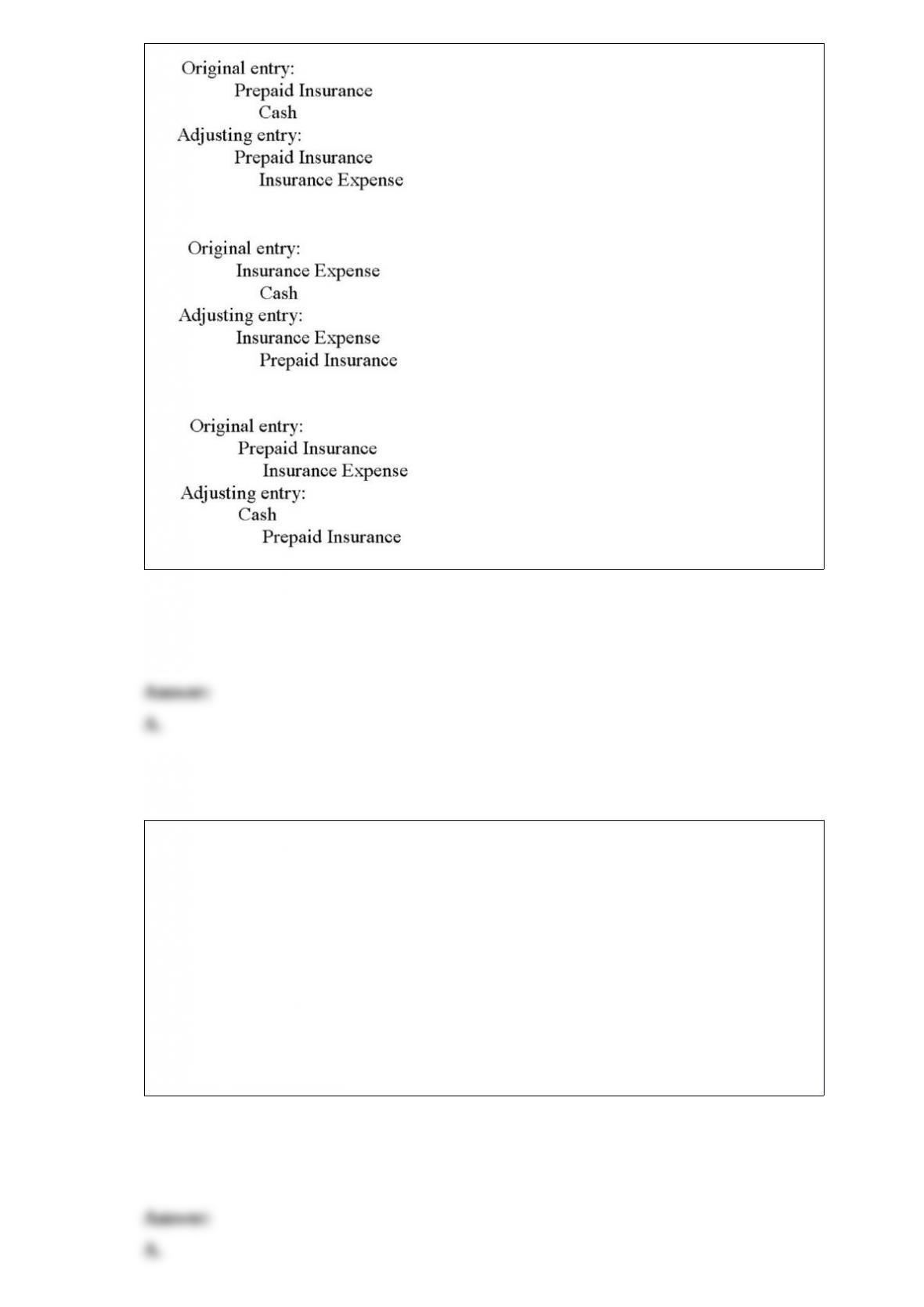
C.
D.
E.
Z-Mart had $43 in missing petty cash receipts. The correct procedure is to:
A. Debit Cash Over and Short for $43.
B. Credit Cash Over and Short for $43.
C. Debit Petty Cash for $43.
D. Credit Petty Cash for $43.
E. Credit Cash for $43.

The process of copying journal information to the ledger is called:
A. Double-entering.
B. Posting.
C. An internal business transaction.
D. Journalizing.
E. An external business transaction.
If a parcel of land is offered for sale at $45,000, is assessed for tax purposes at $20,000,
is considered by its purchasers to be worth $36,000, and is purchased for $34,000, the
land should be recorded in the purchaser’s books at:
A. $20,000.
B. $34,000.
C. $36,000.
D. $45,000.
E. $54,000.
To calculate the total cost of a merchandise purchase, the invoice account must be
adjusted for which of the following?
A. Any discounts given to a purchaser by a supplier.
B. Any returns and allowances received from a supplier.
C. Any freight costs paid by a purchaser.
D. Any taxes or other costs necessary to make the goods ready for sale.
E. All of these answers are correct.
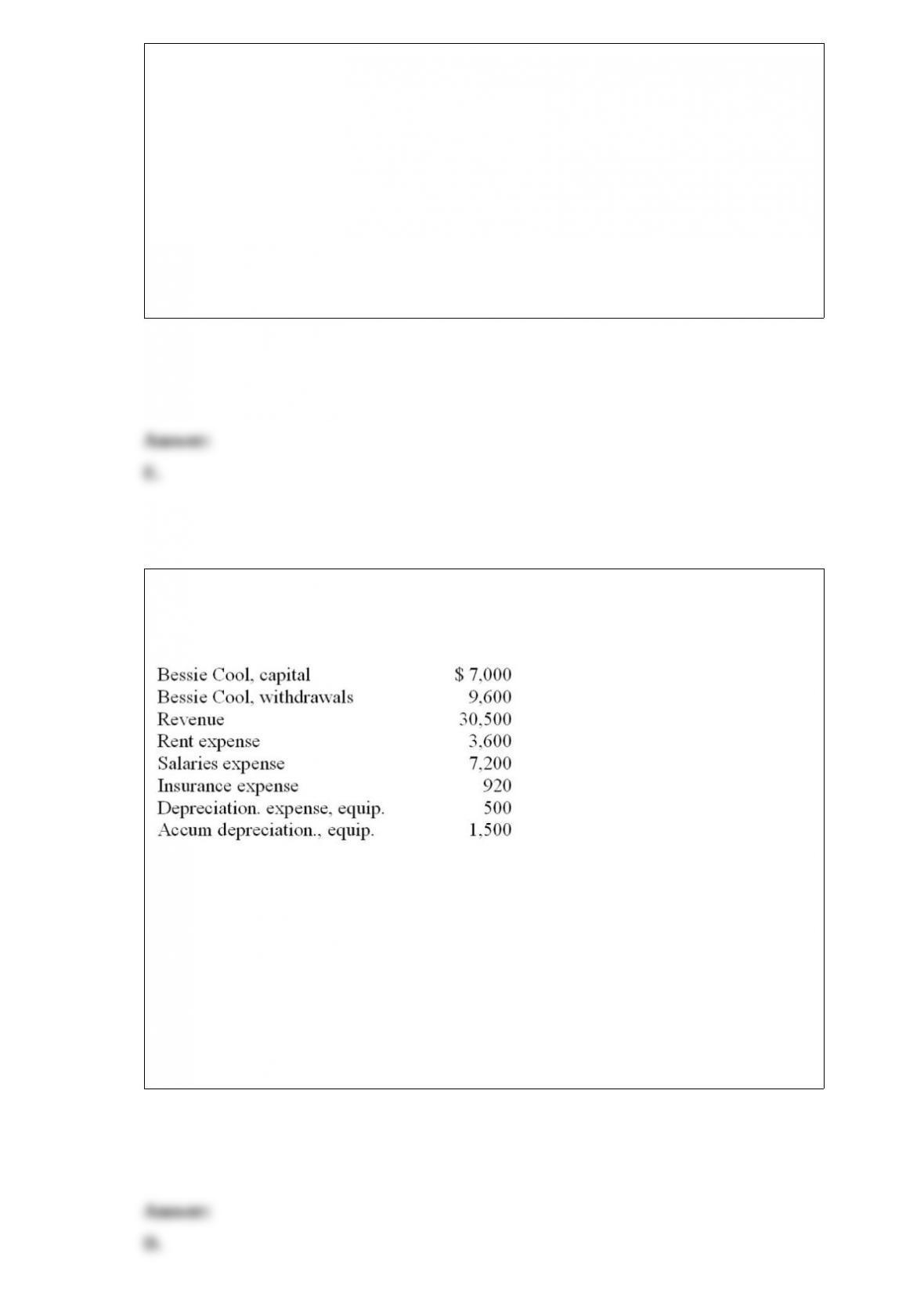
Given the following accounts and their adjusted balances before closing entries are
posted, what amount will be posted to Bessie Cool, Capital in the process of closing the
Income Summary account? Assume all accounts have normal balances.
A. $7,180 credit.
B. $16,780 debit.
C. $16,780 credit.
D. $18,280 credit.
E. $23,780 credit.

Z-Mart purchased $5,000 worth of merchandise on credit. Transportation costs were an
additional $100, paid cash to the cartage company on delivery. Z-Mart returned $275
worth of merchandise and paid the invoice on time, and took a 2% purchase discount.
The amount of this payment was:
A. $3,600.50
B. $3,725.00
C. $3,993.50
D. $4,630.50
E. $4,728.50
The financial statement that shows the beginning balance of equity, the changes in
equity that resulted from new investments by the owner, net income (or net loss),
withdrawals, and the ending balance of equity is the:
A. Statement of financial position.
B. Statement of cash flows.
C. Balance sheet.
D. Income statement.
E. Statement of changes in equity.

An Accounts Receivable ledger is:
A. A subsidiary ledger that contains an account for each credit customer.
B. A list of the balances of all the accounts in the Accounts Receivable ledger that is
added to show the total amount of accounts receivable outstanding.
C. A book of original entry that is designed and used for recording only a specified type
of transaction.
D. The ledger that contains the financial statement accounts of a business.
E. A subsidiary ledger that contains a separate account for each party that grants credit
on account to the entity.
The adjusting entry to record the earned but unpaid salaries of employees at the end of
the accounting period is:
A. Debit Unpaid Salaries and credit Salaries Payable.
B. Debit Salaries Payable and credit Salaries Expense.
C. Debit Salaries Expense and credit Cash.
D. Debit Salaries Expense and credit Salaries Payable.
E. Debit Cash and credit Salaries Expense.
Career opportunities in accounting include:

A. Budgeting.
B. Auditing.
C. Cost accounting.
D. Management consulting.
E. All of these answers are correct.
Outdoors Unlimited has the following transactions. Match each transaction with the
appropriate journal.
(a) Sales Journal
(b) Purchases Journal
(c) Cash Receipts Journal
(d) Cash Disbursements Journal
(e) General Journal
______ (1) Borrowed $5,000 from the bank.
______ (2) A customer returned a $250 item purchased on account.
______ (3) Purchased merchandise on account, $2,700.
______ (4) Purchased a display rack on account for $4,700.
______ (5) Paid $65,000 in wages and salaries.
______ (6) Paid a utility bill for $3,400.
______ (7) Purchased $1,590 of store supplies on account.
______ (8) Recorded depreciation on store equipment of $4,000.
______ (9) Returned defective inventory purchased on account, $2,900.
______ (10) Recorded cash sales of $14,700.
Another name for temporary accounts is:
A. Real accounts.
B. Contra accounts.
C. Accrued accounts.
D. Balance column accounts.
E. Nominal accounts.
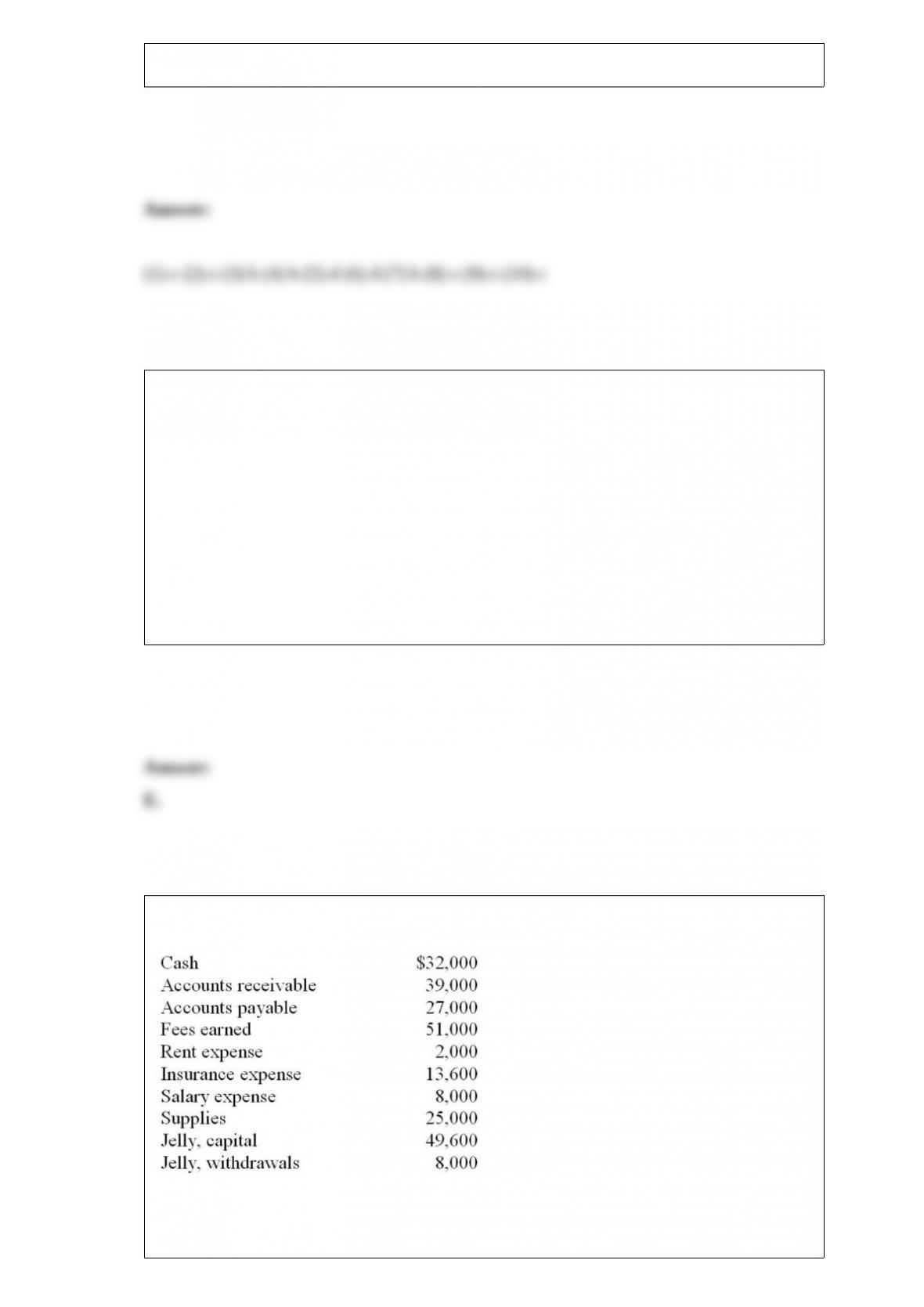
Jelly’s Grocery Store showed the following account balances at the end of 2015:
If all of the accounts have normal balances, what are the totals for the trial balance?

A. $86,000.
B. $119,600.
C. $127,600.
D. $186,600.
E. $255,500.
Merchandise inventory:
A. Is a capital asset.
B. Is a current asset.
C. Can include supplies.
D. Is a type of long term investment.
E. Is an expense.
Select the appropriate financial statement for each of the following accounts.
(a) Income statement
(b) Statement of changes in equity
(c) Balance sheet

(d) Statement of cash flows
_____ (1) Cash
_____ (2) Withdrawals
_____ (3) Notes payable
_____ (4) Fees earned
_____ (5) John Jay, capital
_____ (6) Accounts receivable
_____ (7) Prepaid Rent
_____ (8) Supplies Expense
An audit:
A. Is required for every business.
B. Is an independent review of an organization’s accounting systems and records.
C. Is performed to add credibility to the financial statements.
D. Is only performed for companies with computerized accounting systems.
E. Is an independent review of an organization’s accounting systems and records and is
performed to add credibility to the financial statements.
A(n) _______________ inventory system requires updating the inventory account at
the end of a period.
List the three types of activities reported on the statement of cash flows.
Blu Lightning Co. paid its employees $2,000 in cash for two weeks’ wages. Enter the
appropriate amounts into the accounting equation format.
On December 14, 2015, Kinsmen Company received $7,700 for consulting services that
will be performed in January 2016. Prepare a general journal entry to record the receipt.
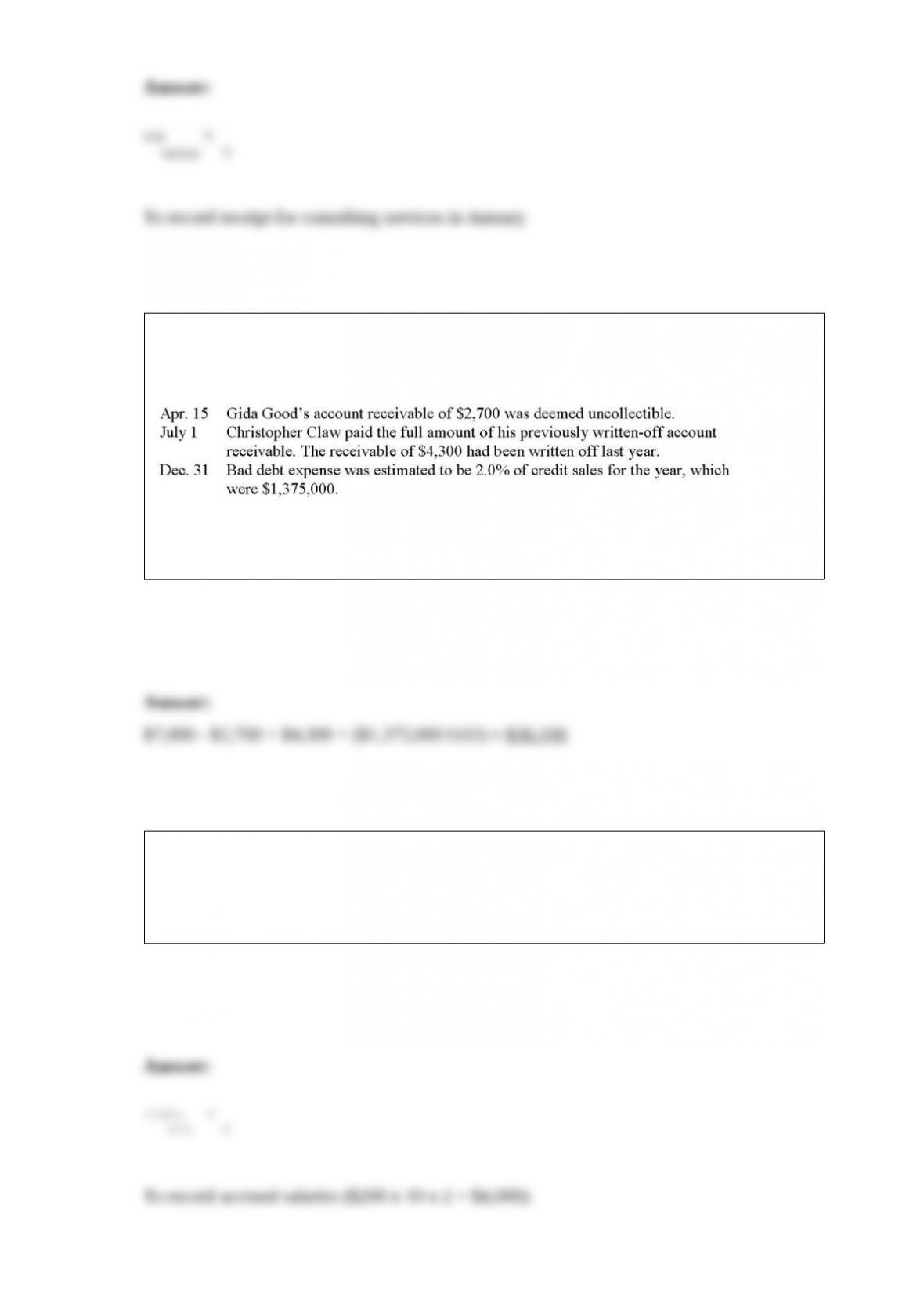
Copper Company had a January 1, current year, balance in Allowance for Doubtful
Accounts of $7,000 credit. The following events required journal entries during the
current year:
What amount of allowance for doubtful accounts should appear in the December 31,
current year, balance sheet?
Noble Company has 10 employees who are each paid $200 per day for a 5-day
workweek. The employees are paid every Friday. This year the accounting period ends
on Tuesday. What is the December 31 adjusting journal entry Noble Company should
make to accrue salaries owing?
Identify the types of adjusting entries and explain the purpose of each type.
Match the following types of accounts with each of the following transactions.
Explain how the materiality principle can be used to justify the direct write-off method.

Bandu Company’s accounts with the increases or decreases that occurred during this
year are as follows:
Except for net income, an investment of $4,000, and a withdrawal of $12,000, no other
items affected the capital account during the year. Using the balance sheet equation,
calculate net income for this year.