
1) peavys net cash provided by investing activities for 2013 was
a.$316,000
b.$416,000
c.$476,000
d.$636,000
2) ermler corporation has $1,800,000 of short-term debt it expects to retire with
proceeds from the sale of 50,000 shares of common stock. if the stock is sold for $20
per share subsequent to the balance sheet date, but before the balance sheet is issued,
what amount of short-term debt could be excluded from current liabilities?
a.$1,000,000
b.$1,800,000
c.$800,000
d.$0
3) sun inc assigns $3,000,000 of its accounts receivables as collateral for a $1 million
8% loan with a bank. sun inc. also pays a finance fee of 1% on the transaction upfront.
what would be recorded as a gain (loss) on the transfer of receivables?
a.loss of $30,000
b.loss of $240,000
c.loss of $270,000
d.$0
4) which of the following is a characteristic of a current liability but not a long-term
liability?
a.unavoidable obligation
b.present obligation that entails settlement by probable future transfer or use of cash,
goods, or services
c.liquidation is reasonably expected to require use of existing resources classified as
current assets or create other current liabilities
d.transaction or other event creating the liability has already occurred
5) on january 3, 2012, moss co. acquires $400,000 of adam companys 10-year, 10%
bonds at a price of $425,672 to yield 9%. interest is payable each december 31. the
bonds are classified as held-to-maturity.
assuming that moss co. uses the effective-interest method, what is the amount of
interest revenue that would be recognized in 2013 related to these bonds?
a.$40,000
b.$42,568
c.$38,312
d.$38,160
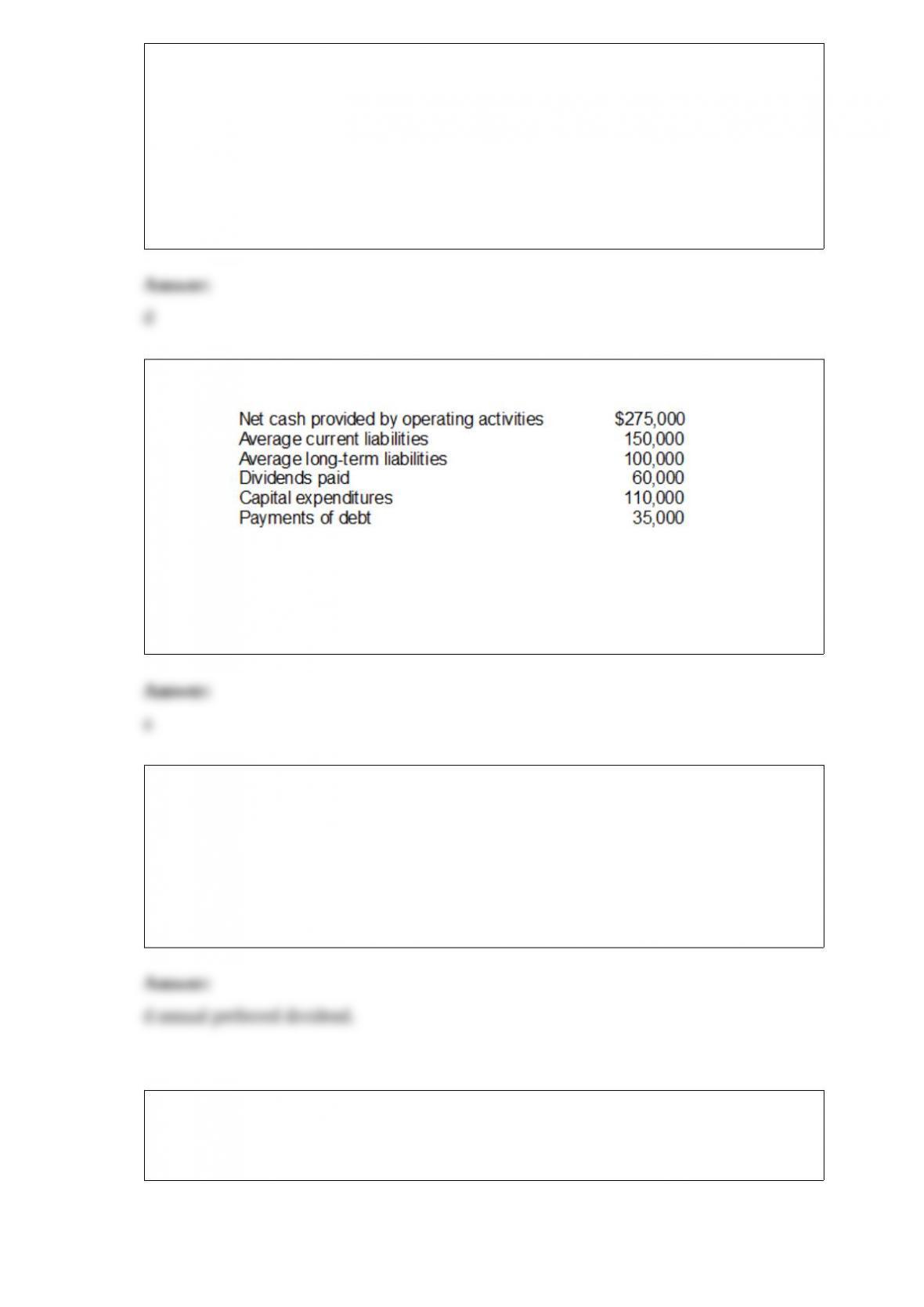
6) pedigo corporation reports the following information:
pedigos cash debt coverage ratio is
a.1.10
b.1.83
c.2.75
d.2.50
7) in computing earnings per share for a simple capital structure, if the preferred stock
is cumulative, the amount that should be deducted as an adjustment to the numerator
(earnings) is the
a.preferred dividends in arrears
b.preferred dividends in arrears times (one minus the income tax rate)
c.annual preferred dividend times (one minus the income tax rate)
d.none of these
8) barton company uses a periodic inventory system. on january 1, 2012, barton
company had 600 units of inventory on hand at a cost of $8 per unit. during 2012,
barton made the following inventory purchases.
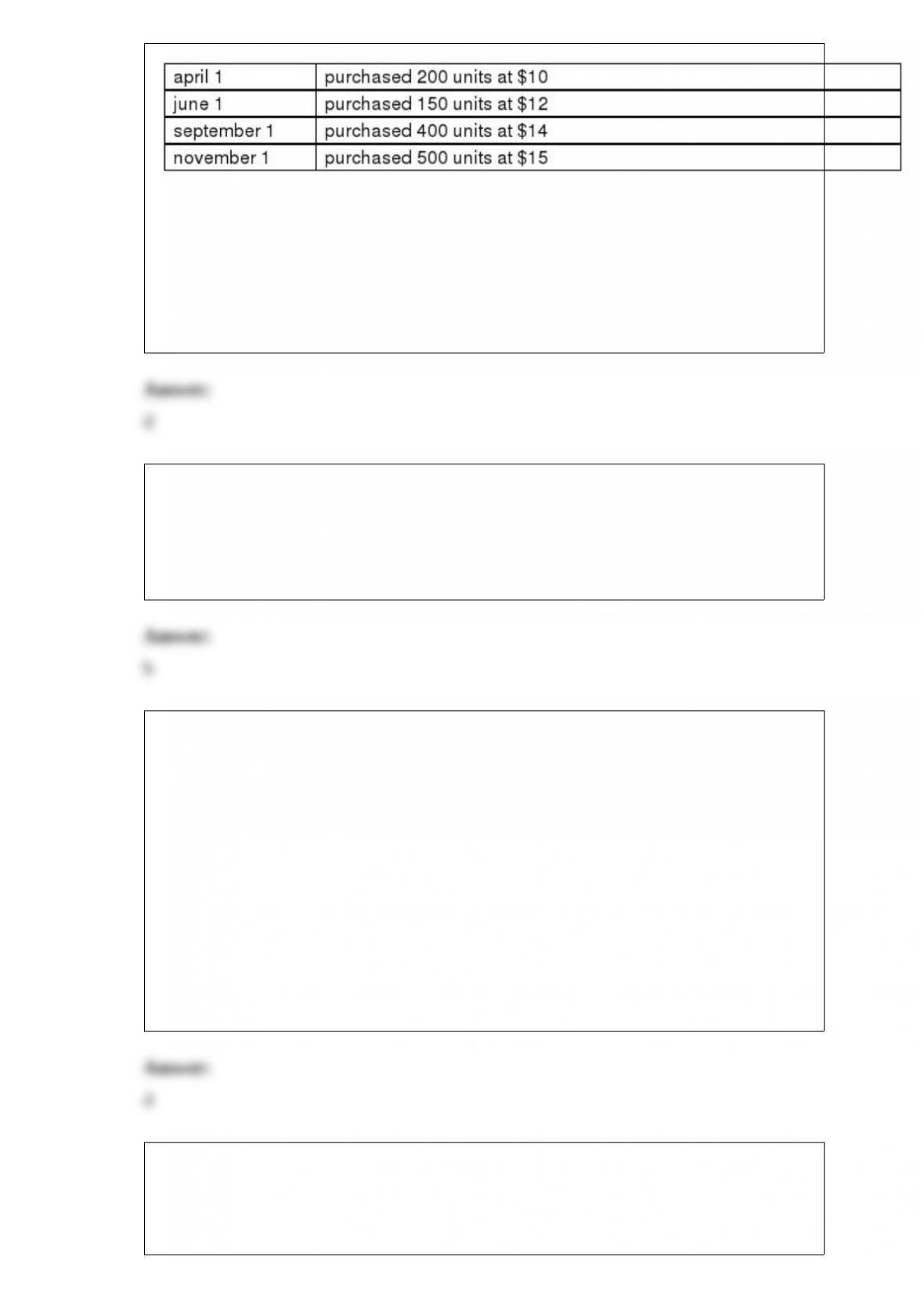
assume barton company sold 1,150 units of inventory during 2012.
if you assume that barton follows ifrs and uses the fifo method, what is the ending
inventory and cost of goods sold, respectively?
a.ending inventory = $5,800; cost of goods sold = $15,900
b.ending inventory = $8,260; cost of goods sold = $13,440
c.ending inventory = $8,211; cost of goods sold = $13,489
d.ending inventory = $10,300; cost of goods sold = $11,400
9) a feature common to both stock splits and stock dividends is
a.a transfer to earned capital of a corporation
b.that there is no effect on total stockholders’ equity
c.an increase in total liabilities of a corporation
d.a reduction in the contributed capital of a corporation
10) on january 1, 2013, ritter company granted stock options to officers and key
employees for the purchase of 20,000 shares of the company’s $1 par common stock at
$20 per share as additional compensation for services to be rendered over the next three
years. the options are exercisable during a five-year period beginning january 1, 2016
by grantees still employed by ritter. the black-scholes option pricing model determines
total compensation expense to be $180,000. the market price of common stock was $26
per share at the date of grant. the journal entry to record the compensation expense
related to these options for 2013 would include a credit to the paid-in capitalstock
options account for
a.$0
b.$36,000
c.$40,000
d.$60,000
11) for each of the following items, indicate the type of accounting change and how
each is recognized in the accounting records in the current year.
(a)change from straight-line method of depreciation to sum-of-the-years’-digits
(b)change from the cash basis to accrual basis of accounting
(c)change from fifo to lifo method for inventory valuation purposes (retrospective
application impractical)
(d)change from presentation of statements of individual companies to presentation of
consolidated statements
(e)change due to failure to record depreciation in a previous period
(f)change in the realizability of certain receivables
(g)change from lifo to fifo method for inventory valuation purposes