Inventory observation must be observed if inventory is one of the major assets listed on
the balance sheet.
The accounts payable department reconciles the vendor invoice, purchase order, and
receiving report prior to approving the payment to the vendor.
The goal of sustainability auditing is to help managers discharge their management
responsibilities and improve profitability.
A derivative instrument is designed to remove risk of adverse price movements from a
transaction.

An expert in detecting and investigating fraud is a certified fraud investigator.
To ensure an internal auditor’s independence it is preferable for the internal auditor to
report directly to the audit committee.
A confirmation procedure scheduled on the year-end date with a large sample of
customer account balances is necessary if tests of controls reveal control weaknesses.
Dividends received from stock investments can be verified by examing the company’s
cash receipts journal.
At the completion of the physical inventory, the auditors should inspect the inventory
area to ensure that all inventory has been counted.
Auditors should inspect the “unmatched receiving report” file to determine whether the
liability for the receipt of goods has been recorded.
Under the Single Audit Act of 1984, CPAs and the GAO auditors coordinate their audits
such that the government entity receives a ‘single audit.”

If the risk of material misstatement is assessed as high, it is likely that additional
substantive procedures will be required.
The Single Audit Act of 1984 requires the auditors of the financial statements to include
a paragraph in the audit report on the appropriate spending of money received through
government grants.
Items held on consignment with another company should not be included in a
company’s inventory.
Sales of capital stock and debt financing transactions usually are authorized by Cheif
financial officer.
Auditors are concerned about internal control strengths and weaknesses; fraud
investigators are mostly concerned about fraud weaknesses.
A price list master file contains the product unit prices that are used for billing
customers.
In order to check for unrecorded loans in the finance and investment cycle, auditors
should search for large cash transactions in the cash receipts journal.
Bank confirmation requests should only include balances for cash accounts.
The receiving department receives a “blind” copy of the purchase order which does not
include the vendor’s name and address.
A CUSIP number is used to identify loans taken from a bank.
Inventory that is not used to produce finished goods should be accounted for as scrap
inventory.
Bill of ladings for goods shipped from a vendor to the purchasing company should
always include the company’s purchase order number.
Auditors are responsible for establishing key measures in order to evaluate the
efficiency, economy, and program outputs.
All companies use a registrar to keep track of stock certificates issued and outstanding.

Acquisition and expenditure activities include (1) purchasing goods and services, (2)
receiving the goods or services, (3) recording the asset or expense and related liability,
and (4) depreciating assets purchased.
A comparison of the prior year’s sales forecast with actual sales may provide an
indication of slow moving inventory.
Internal auditing is an independent, objective assurance and consulting activity
designed to provide and opinion on the fair presentation of financial information.
The auditors’ ‘search for unrecorded liabilities” should emphasize payments made
shortly after the end of the year.
When stock is used in exchange for tangible assets, the auditor should inspect the assets
to ensure the assets exist.
Purchases are requisitioned by a purchasing department that seeks the best prices and
quality.
Paychecks should be written to a payroll bank account that is used only for payroll.

Cost accounting is responsible for reconciling inventory usage with production.
The board of directors authorizes and executes all investment purchases and sales.
An indenture is the written agreement between the bond issuer and the bondholder.
The counting of stock certificates held by the company must be done after the balance

sheet date to ensure the investments exist at the balance sheet date.
The auditors must be present when instructions are given to company personnel for
conducting the physical inventory.
The most significant inherent risk in the fianc and investment cycle is the proper
presentation of items on the balance sheet.
Which of the following steps in the sampling process is ordinarily performed last?
A. Determine the objective of sampling.
B. Measure sample items.
C. Evaluate the sample results.

D. Define the characteristic of interest.
Which of the following steps should an auditor perform first to determine the existence
of related parties?
A. Examine invoices, contracts, and purchasing orders.
B. Request a list of related parties from management.
C. Review the company’s business structure.
D. Review proxy and other materials filed with the SEC.
Your organization has selected you to develop an internal audit activity. Your approach
will most likely be to hire
A. internal auditors each of whom possess the skills required to handle all engagements.
B. inexperienced personnel and train them the way the organization wants them trained.
C. degreed accountants because most internal audit work is accounting related.
D. internal auditors who collectively have the knowledge and skills needed to perform
the responsibilities of the internal audit activities.

Which of the following would be the most likely situation in which an auditor would
use variables sampling?
A. Comparing the recorded balance in accounts receivable to expected balances or
prior-years’ balances
B. Selecting customer balances in accounts receivable for confirmation
C. Evaluating sales invoices for evidence of authorization by client personnel
D. Mathematically evaluating the client’s provision for the allowance for doubtful
accounts
As a result of tests of controls, an auditor assessed control risk too low and decreased
the effectiveness of her substantive procedures. This assessment occurred because the
true deviation rate in the population was
A. less than the risk of overreliance, based on the auditor’s sample.
B. less than the deviation rate in the auditor’s sample.
C. greater than the risk of overreliance, based on the auditor’s sample.
D. greater than the deviation rate in the auditor’s sample.

An auditor is most likely to use statistical sampling under which of the following
situations?
A. Random numbers can be associated with population items.
B. Strictly defensible results based on mathematics are not necessary.
C. The auditor has a very good knowledge of the population.
D. The population is very diverse with some segments especially prone to misstatement.
The auditor looked at a bank statement received and held by the client. What kind of
audit procedure would this be considered?
A. Recalculation
B. Physical observation
C. Confirmation
D. Examination of documents
To which group can a CPA provide audit documentation without being subpoenaed and
without the client’s consent?
A. The IRS
B. The FASB
C. Another CPA firm performing a peer review

D. Another CPA firm considering the purchase of the auditing firm
The initial development of auditing standards was in response to
A. a scandal involving embezzlement that was not detected during an audit
engagement.
B. auditors’ concerns that all components of the financial statements were not being
verified.
C. independent inquiries of the public accounting profession made by the SEC.
D. requests by companies for greater assurance with respect to the auditors’ ability to
detect financial statement misstatements.
Audit documentation often includes a client-prepared, aged trial balance of accounts
receivable as of the balance sheet date. The audit team uses this aging primarily to
A. evaluate internal control over credit sales.
B. test the accuracy of recorded charge sales.
C. estimate credit losses.
D. verify the existence of the recorded receivables.

Which of the following statements best describes nonstatistical sampling?
A. Nonstatistical sampling does not allow the auditor to measure the exposure to
sampling risk.
B. Nonstatistical sampling only selects very large dollar items for examination.
C. Nonstatistical sampling should be used only in situations in which the auditor
anticipates issuing a qualified or adverse opinion on the client’s financial statements.
D. Nonstatistical sampling should be used when the auditor selects a substantive audit
approach.
Which of the following auditing procedures probably would provide the most reliable
evidence concerning the entity’s assertion of rights and obligations related to
inventories?
A. Trace test counts noted during the entity’s physical count to the entity’s
summarization of quantities.
B. Inspect agreements to determine whether any inventory is pledged as collateral or
subject to any liens.
C. Select the last few shipping documents used before the physical count and determine
whether the shipments were recorded as sales.
D. Inspect the open purchase order file for significant commitments that should be
considered for disclosure.

With respect to the use of attributes sampling, in which of the following steps would
nonstatistical sampling and statistical sampling differ?
A. Option A
B. Option B
C. Option C
D. Option D
Which of the following does not have a direct relationship with sample size?
A. Expected population deviation rate
B. Population size
C. Risk of assessing control risk too low
D. All of the above have a direct relationship with sample size
According to the ethical standards of the profession, which of the following acts is
generally prohibited?

A. Issuing a modified report explaining a failure to follow a governmental regulatory
agency’s standards when conducting an attest service for a client
B. Revealing confidential client information during a quality review of a professional
practice by a team from the state CPA society
C. Accepting a contingent fee for representing a client in an examination of the client’s
federal tax return by an IRS agent
D. Retaining client records after an engagement is terminated prior to completion and
the client has demanded their return
In a common law action against auditors, lack of privity is a viable defense if the
plaintiff
A. is the client’s creditor who sues auditors for ordinary negligence.
B. can prove gross negligence by auditors that amounts to a reckless disregard for the
truth.
C. is the auditors’ client.
D. bases the action upon fraud.
Which of the following activities performed by a department supervisor most likely
would help in the prevention or detection of a payroll fraud?
A. Distributing paychecks directly to department store employees

B. Setting the pay rate for departmental employees
C. Hiring employees and authorizing them to be added to payroll
D. Approving a summary of hours each employee worked during the pay period
When considering the results of an attributes sampling application, the auditor
compares which of the following two measures?
A. Upper limit rate of deviation; sample rate of deviation
B. Tolerable rate of deviation; sample rate of deviation
C. Expected rate of deviation; upper limit rate of deviation
D. Upper limit rate of deviation; tolerable rate of deviation
Which of the following is not true with respect to the use of nonstatistical sampling?
A. The use of nonstatistical sampling generally results in a smaller sample size.
B. The use of nonstatistical sampling is permissible under generally accepted auditing
standards.
C. Auditors may use block and haphazard selection methods when using nonstatistical
sampling.
D. The use of nonstatistical sampling does not permit the auditor to control exposure to
the risk of overreliance.

Which of the following procedures is ordinarily performed by an accountant in a
compilation engagement of a nonpublic entity?
A. Reading the financial statements to consider whether they are free of obvious
mistakes in the application of accounting principles
B. Obtaining written representations from management indicating that the compiled
financial statements will not be used to obtain credit
C. Making inquiries of management concerning actions taken at meetings of the
stockholders and the board of directors
D. Applying analytical procedures designed to corroborate management’s assertions that
are embodied in the financial statement components
Favorite Soda Company distributes beverages in the Portland, Oregon area. Which of
the following would be the test to determine that shipments made were actual sales?
A. Trace bills of lading to the sales journal.
B. Vouch entries made in the sales journal to the bills of lading.
C. Trace entries in the sales journal to accounts receivable subsidiary ledger.
D. Vouch bills of lading to the customer order documents.

Which of the following is not true with respect to the use of monetary unit sampling
(MUS)?
A. MUS selects individual dollars from an account balance for verification.
B. Compared to classical variables sampling, MUS allows the auditors to more
effectively control their exposure to sampling risk.
C. MUS estimates the extent of misstatement in an account balance or class of
transactions.
D. MUS provides the auditor with a more conservative estimate of the misstatement
than classical variables sampling.
The “obtaining an understanding” work phase (Phase 1) of internal control evaluation
would not give auditors an overall acquaintance with the client’s
A. control environment.
B. information and communication system.
C. control activity effectiveness.
D. monitoring activities.

Why is the auditor more concerned with controlling the exposure to the risk of incorrect
acceptance than with the risk of incorrect rejection?
A. Only the risk of incorrect acceptance results in an incorrect decision by the auditor.
B. The risk of incorrect rejection is not related to the auditor’s substantive procedures.
C. The risk of incorrect rejection can be controlled by performing substantive
procedures during the interim period.
D. The risk of incorrect acceptance may ultimately result in the auditor incorrectly
issuing an unmodified opinion on the client’s financial statements.
Which of the following procedures would an auditor most likely perform in planning a
financial statement audit?
A. Inquiring of the client’s legal counsel concerning pending litigation
B. Comparing the financial statements to anticipated results
C. Examining computer-generated exception reports to verify the effectiveness of
internal controls
D. Searching for unauthorized transactions that may aid in detecting unrecorded
liabilities
What is the auditor’s normal course of action if a “logical unit” is selected twice in
monetary unit sampling?
A. The auditor should count the logical unit as a single selection and proceed as normal.

B. The auditor should count the logical unit as two selections and proceed as normal.
C. The auditor should not include the logical unit as a selection, since the dollar amount
of this unit is excessively large.
D. The auditor should replicate the sample using an alternative random start.
Below are statements or examples related to audit sampling applications. Indicate, using
the correct letter, which concept is most closely associated with the statement or
example. Each concept may be related to more than one statement or example.
A. Statistical sampling.
B. Nonstatistical sampling.
C. Sampling risk.
D. Nonsampling risk.
___ 1. Jones, CPA, selected a sample and evaluated the results of her sample using the
laws of probability.
___ 2. Wilson, CPA, checked to see if any signature was in the credit approval box on a
sample of sales orders rather than looking for only authorized signatures.
___ 3. Based on a statistical sample, Jackson, CPA, concluded the client’s control was
functioning effectively when the deviation rate in the population was actually
unacceptable.
___ 4. Barnum, CPA, selected all invoices over $1,000 and all invoices recorded on the
15th of each month for his sample.
___ 5. When a client could not produce an invoice for a sample selected by the auditor,
the auditor accepted the client’s assurance that the invoice contained the appropriate
approval.

When independent stock transfer agents are not employed and the corporation issues its
own stock and maintains stock records, canceled stock certificates should
A. be defaced to prevent reissuance and attached to their corresponding stubs.
B. not be defaced but be segregated from other stock certificates and retained in a
canceled certificates file.
C. be destroyed to prevent fraudulent reissuance.
D. be defaced and sent to the secretary of state.
What are the advantages and limitations derived from using computer-assisted audit
techniques (CAATs) packages?
The advantages of computer-assisted audit techniques (CAATs) packages:
a. Original programming is not required.
b. The required programming is easy.
c. Training time to use the programming is short.

Mike is the controller at Huskie Supply Company. Huskie Supply has an investment
account with DT National Brokerage. Mike is authorized to call the broker and initiate
trades on behalf of the company. Mike’s son goes to MEU (Most Expensive University)
and Mike has a CD with the money for this year’s tuition. MEU changed the tuition due
date such that the tuition came due 30 days before Mike’s CD matured. Mike would
lose a large amount of interest if he cashed in the CD early, and a loan from the bank
was not possible (Mike is already over extended), and interest on a credit card advance
would be 28%.
Mike authorized DT National Brokerage to sell one of the company’s investments and
send the check to his attention at the company. Mike paid the tuition and 30 days later,
when the CD came due Mike repurchased the investment with the broker. In fact, the
stock had dropped $3 and mike made a profit of $900.
A) Define the internal control weakness that allowed the situation to exist – if any;
B) One (and only one) specific internal controls that should be in place to prevent or
detect the problem; and.
C) One (and only one) test of control audit procedure.
D) One (and only one) substantive audit procedure that may detect the situation
described.
Consider each item separately – no credit will be given for generic controls (e.g.
policies and procedures; separation of duties (without specifics); discuss with
management.

In testing the existence assertion for an asset, an auditor ordinarily works from the
A. financial statements to the potentially unrecorded items.
B. potentially unrecorded items to the financial statement.
C. accounting records to the supporting evidence.
D. supporting evidence to the accounting records.
Julie works in accounts payable. Her job is to prepare the voucher package and submit
the completed voucher to the treasurer’s office for payment. When the voucher is paid
by the Treasurer’s department it is returned to Julie (without the check) for filing.
The company receives invoices from Mona’s Office Supply. When Julie receives the
voucher package back from the Treasurer, Julie scans the invoice from Mona’s Office
Supply and changes the address so that a duplicate payment is sent to a Mail Boxes Etc.
store where Julie rents a mail box under the name Mini’s Official Supplies. With the
slightly altered invoice (no other changes are made), Julie submits the voucher package
a second time. Julie also has a bank account with the name Mini’s Official Supplies.
When Julie receives the check for Mona’s Office Supply, Julie deposits it in her Mini’s
Official Supplies bank account and then used an ATM card to withdraw the cash.
A) Define the internal control weakness that allowed the situation to exist – if any;
B) One (and only one) specific internal controls that should be in place to prevent or
detect the problem; and
C) One (and only one) test of control audit procedure.
D) One (and only one) substantive audit procedure that may detect the situation
described.
No credit will be given for generic controls (e.g. policies and procedures; separation of
duties without specifics; discuss with management). Be specific

Which of the following statements is true regarding classical variables sampling?
A. A very small dollar account has the same probability of being selected for
examination as a very large dollar account.
B. The determination of sample size requires to auditors to consider a smaller number
of factors than are considered under MUS.
C. Classical variables sampling should be used when the auditor has greater concerns
for overstatement (rather than understatement) errors.
D. The sampling unit is defined as each individual dollar in the account under
examination.
Which of the following steps is NOT required in performing a compliance attestation
engagement?
A. Assess planning materiality
B. Assess inherent risk
C. Confirm restrictions with applicable third-parties
D. Consider subsequent events
The ___________________ is the federal law that established uniform requirements for
audits of federal financial assistance provided to _________ and _________
governments.
Explain the different opinions that auditors can issue for an entity’s internal control over
financial reporting.
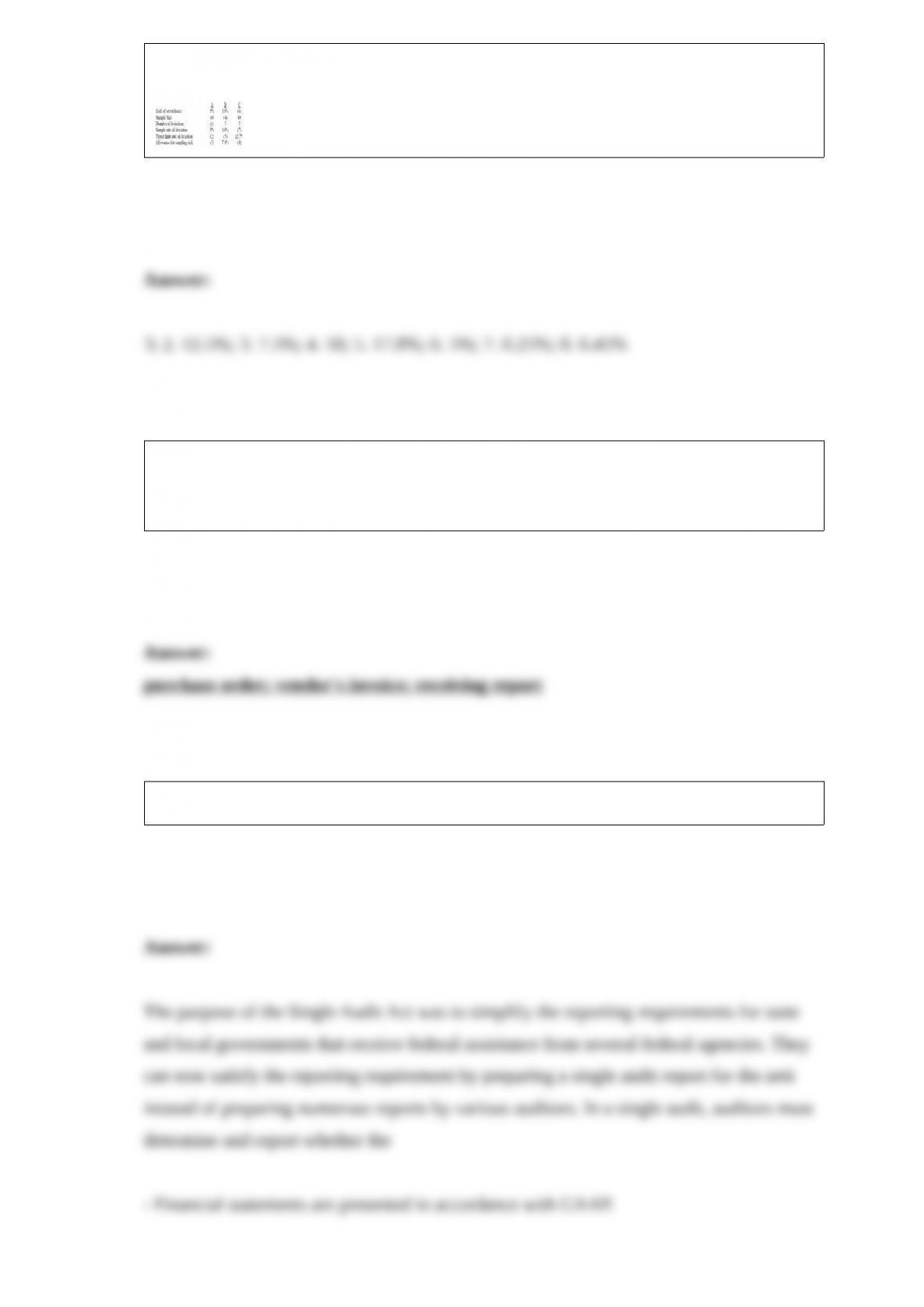
Using the appropriate sampling tables, identify the missing data for each of the
following independent attributes sampling applications.
When the _________________________________,
______________________________ and _________________________ are in hand,
the accountants can record the accounts payable.
Explain briefly the purpose and requirements under the Single Audit Act.
The overall production starts with production planning, which usually is based on a
_______________________________________.
Donna Prima, CPA, was engaged to review the unaudited financial statements of
Rooster Restaurants Inc., a nonpublic company. During her review, Donna found that
Rooster had not capitalized leases as required by GAAP. The result was so material, that
Donna modified the standard review report to state that “the financial statements are not
in conformity with GAAP.”
Is Donna’s report in accordance with professional standards? If not, what should she
have done under the circumstances? Explain.
The physical observation procedures for inventory are principally designed to audit for
the balance assertions of ____________________________,
____________________________, and ____________________________.
What are the differences between the American Accounting Association and AICPA
definitions and objectives of auditing?