The sales volume variance reflects
a. How efficiently the company operated in producing a given level of sales.
b. How effectively the company reached its strategic goals.
c. A different volume of products than that specified in the static budget.
d. All of these answer choices are correct.
On a common-size balance sheet, common stock is shown as a percentage of
a. Total liabilities.
b. Total assets.
c. Current liabilities.
d. Total stockholders’ equity.
The variable overhead efficiency variance is calculated as
a. Actual cost – (actual quantity x standard price).
b. Actual cost – (standard quantity x standard price).
c. Standard price – (actual quantity x standard quantity).
d. Actual results minus flexible budget amount.
Which of the following is not an administrative expense?
a. Controller’s salary
b. Depreciation on office equipment
c. Fixed overhead
d. All of these answer choices are administrative expenses
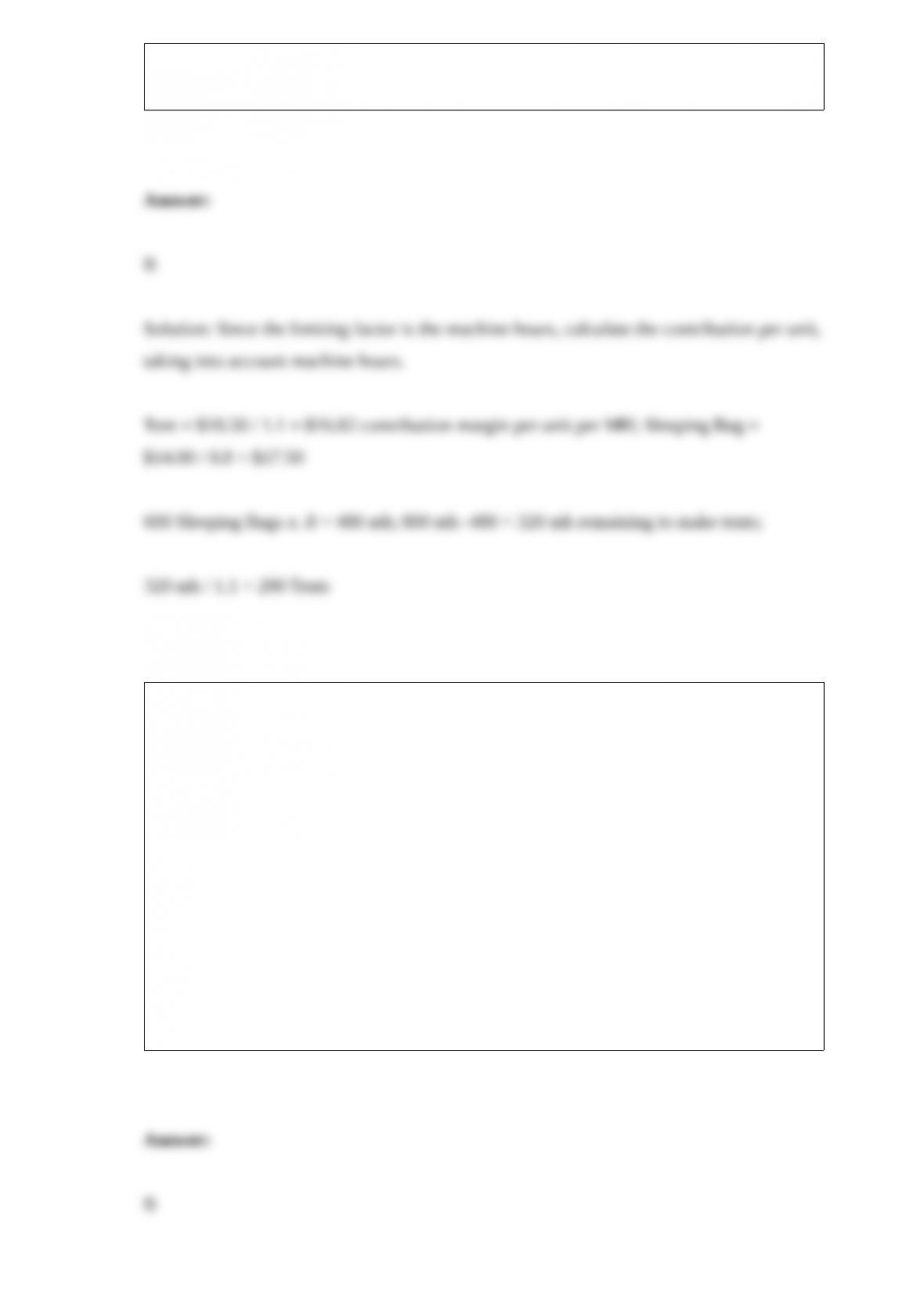
Mallory Manufacturing produces thermal tents and sleeping bags. The company ‘s
products are in high demand due to the quality and durability of the products. Mallory
estimates it could sell 600 tents per month and 600 sleeping bags per month. Following
is information for each of these products:
Mallory has 800 machine hours available each month. In order to maximize the
company ‘s total contribution margin, how should Mallory allocate its production
capacity between the tents and sleeping bags (if necessary, round partial units down to
the next nearest full unit)?
a. 1,000 Sleeping Bags and 0 Tents.
b. 600 Sleeping Bags and 290 Tents.
c. 600 Tents and 175 Sleeping Bags.
d. 727 Tents and 0 Sleeping Bags.
Melrose Manufacturing produces gourmet blackberry preserves. Melrose based its
current year budget on a production level of 540,000 jars of preserves using ½ hour
direct labor time for each jar (which includes hand-sorting and trimming the berries).
Total budgeted variable overhead for the year was $1,242,000. During the year, Melrose
used 280,000 direct labor hours to produce 550,000 jars of blackberry preserves. Actual
variable overhead for the year was $1,246,000. What is Melrose’s flexible budget
variable overhead variance?
a. $27,000 unfavorable
b. $19,000 favorable
c. $4,000 unfavorable
d. $23,000 unfavorable
Which of the following is a measure that relates to the learning and growth perspective?
a. Earnings per share
b. Response time to customer request
c. Revenue per employee
d. Market share
Which of the following accounts does not appear on the Balance Sheet?
a. Cost of Goods Sold
b. Raw Materials
c. Work in Process
d. Finished Goods
To identify a variance without indicating whether it is favorable (f) or unfavorable (u)
does not indicate
a. The impact of the variance on operating income.
b. The amount of the variance.
c. Whether the amount relates to price or quantity.
d. None of these answer choices are correct.
The cost of goods manufactured
a. Is always the same as the total direct costs.
b. Is recorded as a debit to the Cash or Accounts Receivable account.
c. Is recorded as a debit to the Finished Goods Inventory account.
d. Is also referred to as the cost of goods sold.
Kevin Jarvis is the controller of Bitterroot Industries. Kevin prepared the following
budgeted income statement at various levels of sales. After careful review of the
budgeted income statements, and after discussions with the sales and production
managers, the CEO determines that the best alternative is to base the budget on a sales
volume of 30,000 units.
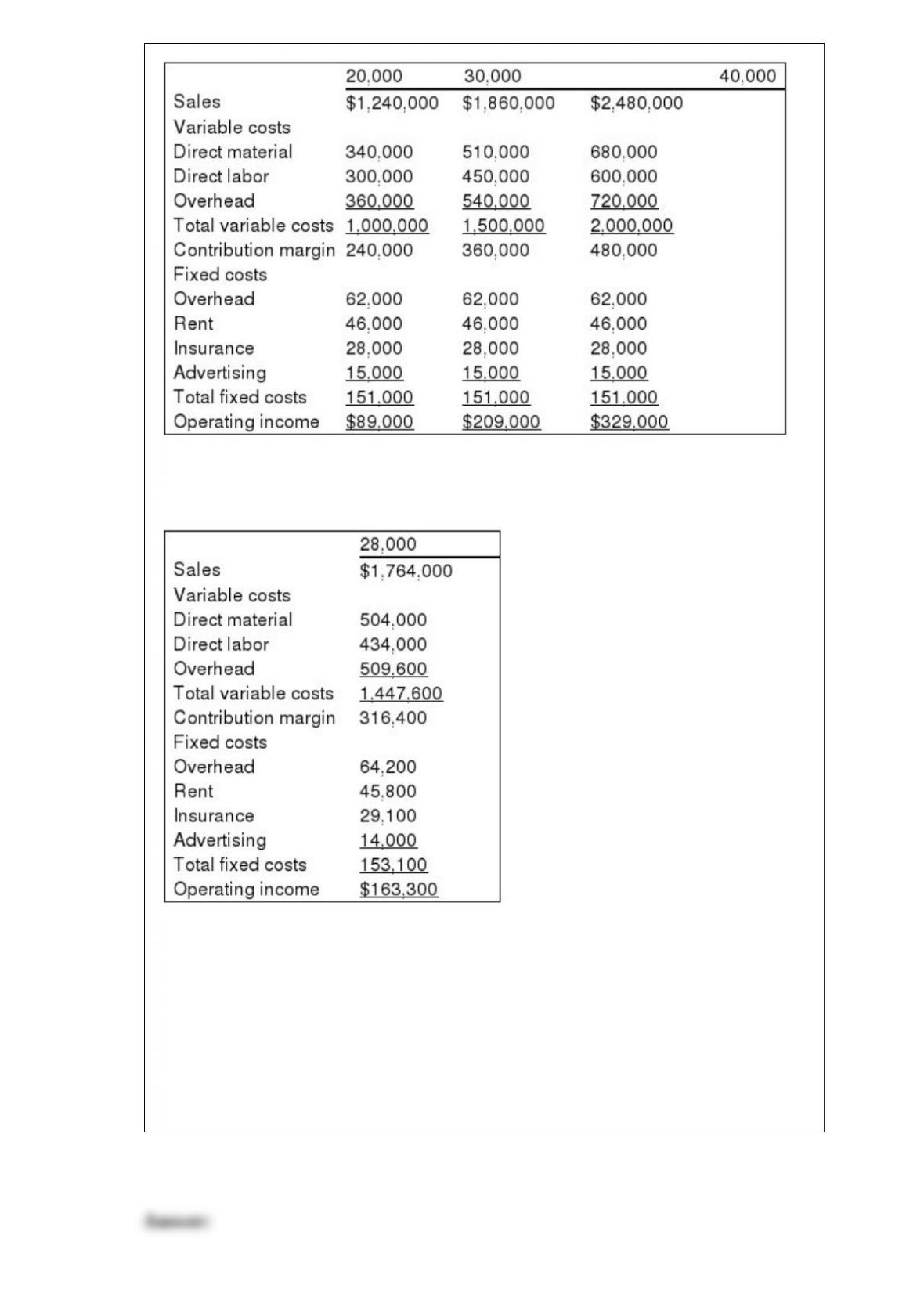
Actual results for the year were 28,000 units, reflected in the following income
statement:
What is the flexible budget variance for direct material?
a. $28,000 favorable
b. $28,000 unfavorable
c. $6,000 favorable
d. $34,000 unfavorable