Which of the following changes should be accounted for using the retrospective
approach?A. A change in the estimated useful life of a depreciable asset.
B. A change from straight-line to double-declining-balance depreciation.
C. A change from percentage-of-completion to the completed contract method.
D. A change to LIFO from FIFO inventory costing.
Answer:
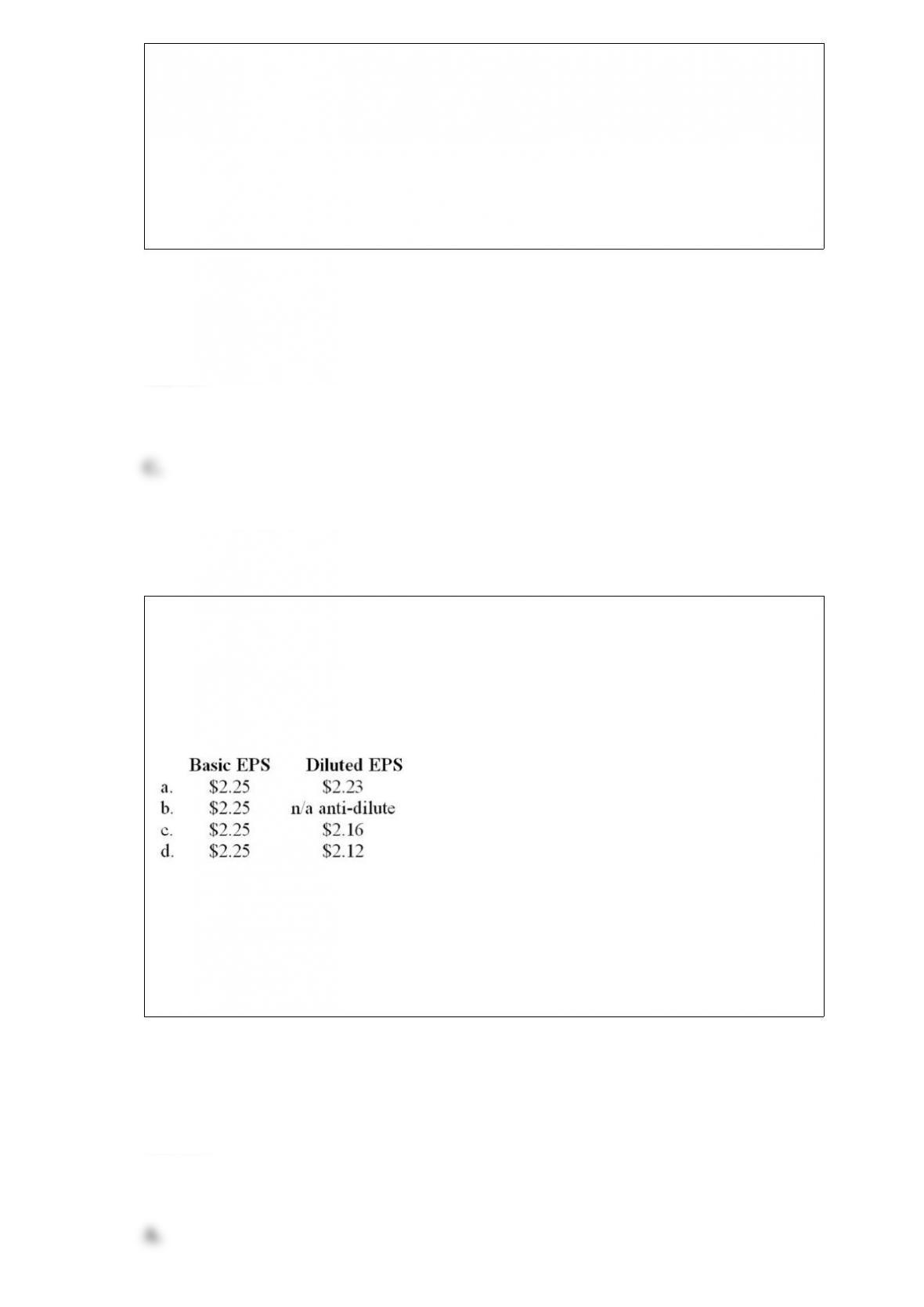
Jet Corporation had 8 million shares of common stock outstanding during the current
calendar year. On July 1, Jet issued ten thousand $1,000 face value, convertible bonds.
Each bond is convertible into 50 shares of common stock. The bonds were issued at
face amount and pay interest quarterly for 20 years. They have a stated rate of 12%. Jet
had income before tax of $30 million and a net income of $18 million. Jet would report
the following EPS data (rounded):
A. Option a
B. Option b
C. Option c
D. Option d
Answer:

Captain Cook Cereal includes one coupon in each package of Granola that it sells and
offers a puzzle in exchange for $2.00 and three coupons. The puzzles cost Captain Cook
$3.50 each. Experience indicates that 20% of the coupons eventually will be redeemed.
During the last month of 2013, the first month of the offer, Captain Cook sold 6 million
boxes of Granola and 900,000 of the coupons were redeemed. What amount should
Captain Cook report as a liability for coupons on its December 31, 2013, balance sheet?
A. $0.
B. $150,000.
C. $300,000.
D. $450,000.
Answer:

On June 1, 2013, Dirty Harry Co. borrowed cash by issuing a 6-month
noninterest-bearing note with a maturity value of $500,000 and a discount rate of 6%.
Assuming straight-line amortization of the discount, what is the carrying value of the
note as of September 30, 2013? A. $525,000.
B. $300,000.
C. $495,000.
D. $475,000.
Answer:
Getaway Travel Company reported net income for 2013 in the amount of $50,000.
During 2013, Getaway declared and paid $2,000 in cash dividends on its
nonconvertible preferred stock. Getaway also paid $10,000 cash dividends on its
common stock. Getaway had 40,000 common shares outstanding from January 1 until
10,000 new shares were sold for cash on July 1, 2013. A 2-for-1 stock split was granted
on July 5, 2013. What is the 2013 basic earnings per share (rounded)? A. $.42.
B. $.47.
C. $.53.
D. $.56.
Answer:

Under International Financial Reporting Standards, development expenditures are: A.
Expensed in the period incurred.
B. Expensed in the period they are determined to be unsuccessful.
C. Capitalized if certain criteria are met.
D. None of the above is correct.
Answer:
A statement of comprehensive income does not include: A. Gains from the return on
pension assets exceeding expectations.
B. Gains and losses on unsold held-to-maturity securities.
C. Losses from the return on pension assets falling short of expectations.
D. Prior service cost.
Answer:

To raise funds for operations, Trifecta Corporation sold its building on January 1, 2013,
to a transportation company for $1,000,000 and immediately leased the building back.
The lease is for a 10-year period ending December 31, 2022, at which time ownership
of the building will revert to Trifecta. The building has a carrying amount of $800,000
(original cost $2,000,000). The lease requires Trifecta to make payments of $176,984 to
the transportation company each December 31. The building had a total original useful
life of 30 years with no residual value and is being depreciated on a straight-line basis.
The lease has an implicit rate of 12%.
Required:
1) Prepare the appropriate entries for Trifecta on (a) January 1, 2013, to record the
sale-leaseback and (b) December 31, 2013, to record necessary adjustments.
2) Show how Trifecta’s December 31, 2013, balance sheet and income statement would
reflect the sale-leaseback.
Answer:
Average accumulated expenditures: A. Is an approximation of the average debt a firm
would have outstanding if it financed all construction through debt.
B. Is computed as a simple average if all construction expenditures are made at the end
of the period.
C. Are irrelevant if the company’s total outstanding debt is less than total costs of
construction.
D. All of the above are true statements.
Answer:
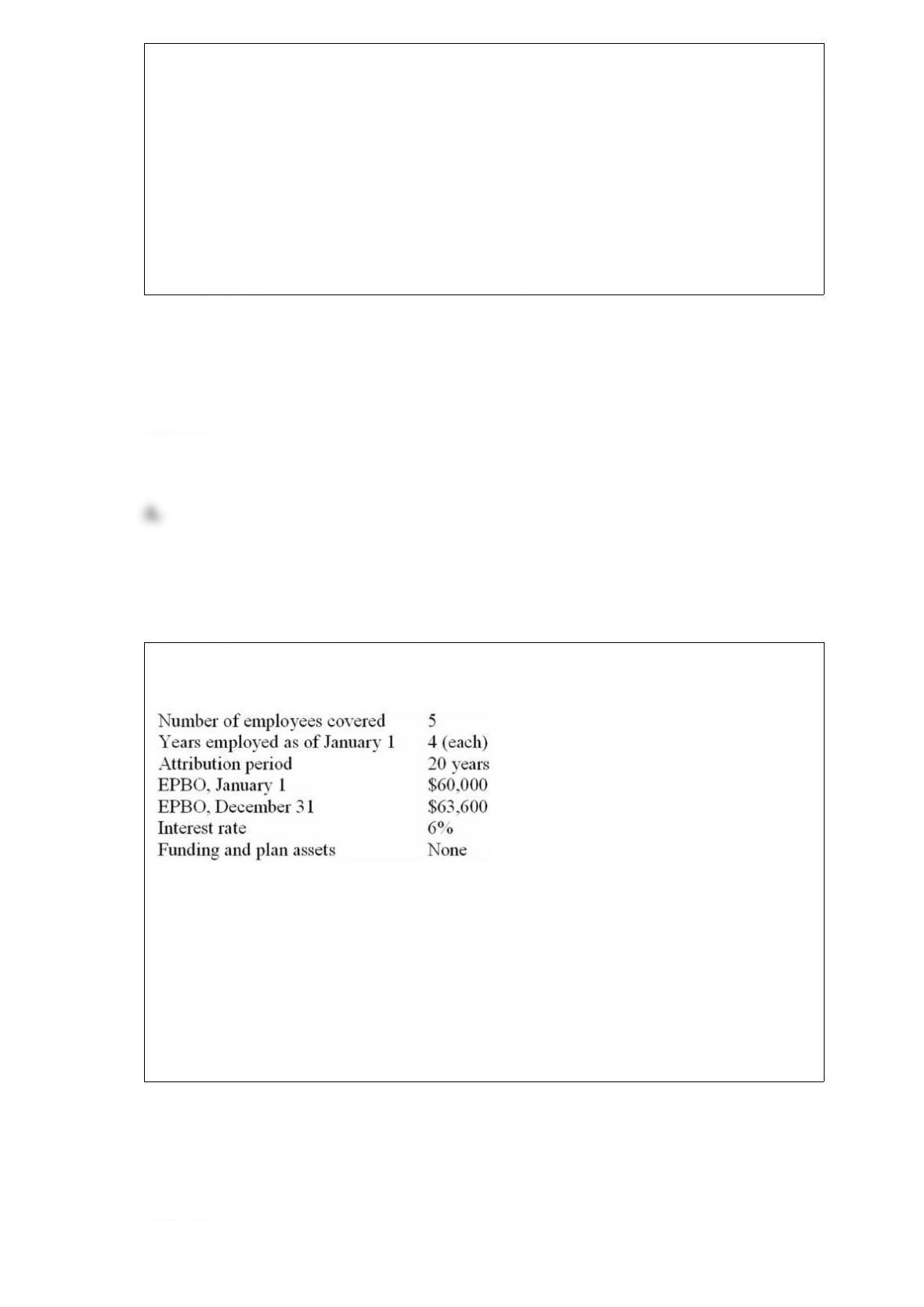
The following data are for Guava Company’s retiree health care plan for the current
calendar year.
What is the service cost to be included in the current year’s postretirement benefit
expense? A. $3,000.
B. $3,180.
C. $3,200.
D. $4,000.
Answer:

The following facts apply to TinyPart Toy Company’s pending litigation as of
December 31, 2013:
a. TinyPart is defending against a lawsuit and believes there is a 51% chance it will lose
in court. If it loses, TinyPart estimates that damages will be $100,000.
b. TinyPart is defending against another lawsuit for which management believes it is
virtually certain to lose in court. If it loses the lawsuit, management estimates damages
will fall somewhere in the range of $30,000 to $50,000, with each amount in that range
equally likely to occur.
c. TinyPart is defending against another lawsuit that is identical to item (b), but the
relevant losses will only occur far into the future. The present values of the endpoints of
the range are $15,000 and $25,000. TinyPart’s management believes the effects of time
value of money on these amounts are material, but also believes the timing of these
amounts is uncertain.
d. TinyPart is defending against a fourth lawsuit and believes there is only a 25%
chance it will lose in court. If TinyPart loses, it believes damages will fall somewhere in
the range of $35,000 to $40,000, with each amount in that range equally likely to occur.
Indicate how TinyPart would disclose or account for the lawsuit described in part (c)
under U.S. GAAP and under IFRS in the financial statements for the year ended
December 31, 2013.
Answer:

At December 31, 2012, Mallory, Inc., reported in its balance sheet a net loss of $12
million related to its postretirement benefit plan. The actuary for Mallory at the end of
2013 increased her estimate of future health care costs. Mallory’s entry to record the
effect of this change will include: A. A debit to Loss-OCI and a credit to APBO.
B. A debit to APBO and a credit to Loss-OCI.
C. A debit to Postretirement benefit expense and a credit to APBO.
D. A debit to Postretirement benefit expense and a credit to Loss-OCI.
Answer:
Bonds were issued at a discount. In the bond amortization schedule: A. The interest
expense is less with each successive interest payment.
B. The total effective interest over the term to maturity is equal to the amount of the
discount plus the total cash interest paid.
C. The outstanding balance (book value) of the bonds declines eventually to face value.
D. The reduction in the discount is less with each successive interest payment.
Answer:

Archie Co. purchased a framing machine for $45,000 on January 1, 2013. The machine
is expected to have a four-year life, with a residual value of $5,000 at the end of four
years.
Using the straight-line method, depreciation for 2014 and book value at December 31,
2014, would be: A. $10,000 and $20,000.
B. $10,000 and $25,000.
C. $11,250 and $17,500.
D. $11,250 and $22,500.
Answer:
The valuation allowance account that is used in conjunction with deferred taxes relates:
A. Only to deferred tax liabilities.
B. To both deferred tax assets and liabilities.
C. Only to deferred tax assets.
D. Only to income taxes receivable due to net operating loss carrybacks.
Answer:

TMC issued $50 million of its 12% bonds on April 1, 2013, at 98 plus accrued interest.
The bonds are dated January 1, 2013, and mature on December 31, 2032. Interest is
payable semiannually on June 30 and December 31. What amount did TMC receive
from the bond issuance? A. $50.5 million.
B. $51.5 million.
C. $49.0 million.
D. $49.5 million.
Answer:
The allowance for uncollectible accounts is a: A. Deferred charge to expense.
B. Contra asset account.
C. Deferred revenue account.
D. Quasi-liability account.
Answer:
Porite Company recognizes revenue in the period in which it records an asset for the
related account receivable, rather than in the period in which the account receivable is
collected in cash. Porite’s practice is an example of: A.Cash basis accounting.
B.Accrual accounting.
C.The matching principle.
D.Economic entity.
Answer:
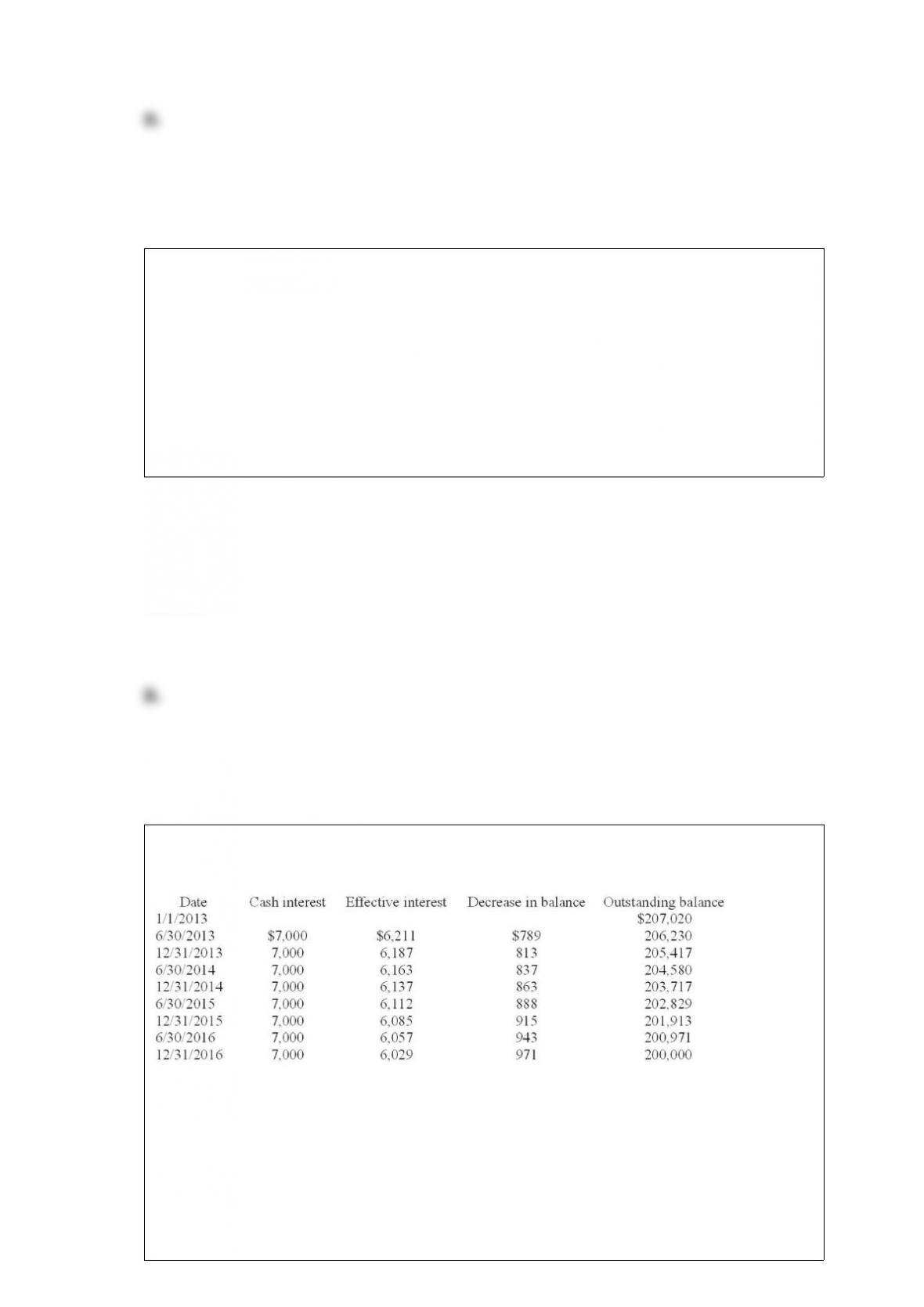
Lopez Plastics Co. (LPC) issued callable bonds on January 1, 2013. LPC’s accountant
has projected the following amortization schedule from issuance until maturity:
LPC calls the bonds at 103 immediately after the interest payment on 12/31/2014 and
retires them. What gain or loss, if any, would LPC record on this date? A. No gain or
loss
B. $3,717 gain
C. $6,000 loss

D. $2,283 loss
Answer:
“VSOE” is necessary to separately recognize revenue in multiple-element contracts for:
A. All service contracts.
B. All product contracts.
C. All contracts that involve at least one non-software element.
D. Software contracts.
Answer:
Technoid Inc. sells computer systems. Technoid leases computers to Lone Star
Company on January 1, 2013. The manufacturing cost of the computers was $12
million.
This noncancelable lease had the following terms:

– Lease payments: $2,466,754 semiannually; first payment at January 1, 2013;
remaining payments at June 30 and December 31 each year through June 30, 2017.
– Lease term: five years (10 semiannual payments).
– No residual value; no bargain purchase option.
– Economic life of equipment: five years.
– Implicit interest rate and lessee’s incremental borrowing rate: 5% semiannually.
– Fair value of the computers at January 1, 2013: $20 million.
Collectibility of the rental payments is reasonably assured, and there are no lessor costs
yet to be incurred.
Technoid would account for this as: A. A capital lease.
B. A direct financing lease.
C. A sales-type lease.
D. An operating lease.
Answer:
Cash flows from investing activities do not include: A. Proceeds from issuing bonds.
B. Payment for the purchase of equipment.
C. Proceeds from the sale of marketable securities.
D. Cash outflows from acquiring land.

Answer:
On July 10, 2013, Johnson Corporation signed a purchase commitment to purchase
inventory for $200,000 on or before February 15, 2014. The company’s fiscal year-end
is December 31. The contract was exercised on February 1, 2014, and the inventory was
purchased for cash at the contract price. On the purchase date of February 1, the market
price of the inventory was $210,000. The market price of the inventory on December
31, 2013, was $180,000. The company uses a perpetual inventory system.
How much loss on purchase commitment will Johnson recognize in 2013? A. $10,000.
B. $20,000.
C. $30,000.
D. None.
Answer:
If a company’s deferred tax asset is not reduced by a valuation allowance, the company
believes it is: A. Probable that sufficient taxable income will be generated in future
years to realize the full tax benefit.
B. Probable that sufficient financial income will be generated in future years to realize
the full tax benefit.
C. More likely than not that sufficient taxable income will be generated in future years

to realize the full tax benefit.
D. More likely than not that sufficient financial income will be generated in future
years to realize the full tax benefit.
Answer:
In a periodic inventory system, the cost of purchases is debited to: A. Purchases.
B. Cost of goods sold.
C. Inventory.
D. Accounts payable.
Answer:
The effect of a change in tax rates: A. Results in a prior period adjustment.
B. Is allocated between discontinued operations and continuing operations.
C. Is reported separately after extraordinary items.
D. Is reflected in income from continuing operations.

Answer:
Accounts receivable are normally reported at the:A. Present value of future cash
receipts.
B. Current value plus accrued interest.
C. Expected amount to be received.
D. Current value less expected collection costs.
Answer:
In the operating activities section of the statement of cash flows, we start with net
income: A. In the direct method.
B. In the indirect method.
C. In both the direct and the indirect methods.
D. In neither the direct nor the indirect methods.

Answer:
Basic earnings per share ignores: A. All potential common shares.
B. Some potential common shares, but not others.
C. Dividends declared on noncumulative preferred stock.
D. Stock splits.
Answer:
When the amount of interest receivable decreases during an accounting period: A.
Accrual-basis interest revenues exceed cash collections from borrowers.
B. Accrual-basis net income exceeds cash-basis net income.
C. Accrual-basis interest revenues are less than cash collections from borrowers.
D. Accrual-basis net income is less than cash-basis net income.
Answer: