
1) which of the following would not be considered a cost pool?
a.inventory manager
b.revenue
c.engineering department
d.direct materials cost
2) which of the following statements concerning value chain analysis is false?
a.the goal of value chain analysis is to find areas where a company can either add value
or reduce cost
b.the value chain focuses on the entire production process, as well as the sale of the
product and service after the sale
c.if a company cannot compete in a specific area of the value chain, it might consider
the option of outsourcing that portion of the value chain to someone who can perform it
better
d.throughout most industries, the most successful firms are the ones that operate within
the entire value chain, thereby overseeing every aspect of the value chain for the
customer
3) extending the length of a time period in cost estimation will result in:
a.fewer recording lags or cut-off errors
b.confounding data
c.increasing the explanatory power of the data
d.better results because more data is being used
e.more recording lags or cut-off errors
4) which of the following would not likely be a perspective of a balanced scorecard for
a consumer products retailer?
a.learning and innovation
b.internal processes
c.financial performance
d.customer satisfaction
e.research and development

5) the cost of sales visits is a:
a.customer unit-level cost
b.customer batch-level cost
c.customer-sustaining cost
d.distribution-channel cost
e.sales-sustaining cost
6) which one of the following is a budgeting approach that explicitly demands
continuous improvement and that incorporates expected improvements in the resultant
budget?
a.flexible budgeting
b.time-driven activity-based budgeting (tdabb)
c.activity-based budgeting (abb)
d.kaizen budgeting
e.zero-base budgeting (zbb)
7) if a budgeted activity base is used as the base in cost allocation, each department’s
cost allocation will be predictable, and not influenced by the:
a.actual total cost
b.change in activity
c.variations from budget
d.errors in calculations
e.actual usage in other departments
8) in keeping with the current trend of increased strategic planning, how have
management accountants changed their use of life-cycle costing?
a.they have now shifted their focus from r&d costs to marketing and promotion costs
b.they have turned from a sole focus on manufacturing costs to a much wider outlook,
taking into account costs from the entire product life-cycle
c.they stopped looking at the entire life-cycle, and now focus their attention on product
design costs
d.accountants don’t use life-cycle costing, that task is left for the operations manager
9) the financial critical success factor of profitability can be measured by:
a.community service activities
b.customer returns and complaints
c.number of product defects
d.number of design changes
e.earnings from operations
10) the time equation is used in abc to:
a.track the implementation of the abc system
b.assess the amount of time required for each activity, in determining the application
rate
c.incorporate complexities in the application of abc
d.plan for the implementation of an abc system
e.none of the above
11) the p-value measures:
a.the probability that the regression equation is reliable
b.the statistical significance of the dependent variable
c.the risk that a particular independent variable has only a chance relationship to the
dependent variable
d.the confidence range around the regression prediction
12) condor airplane company has built a new model jet aircraft which it intends to sell
to high net worth clients. this aircraft required 25,000 hours to complete. condor
believes an incremental unit-time learning model with an 82% learning curve best
reflects the company’s production efficiency. condor just received a contract to make
fifteen identical aircraft. what will be the expected unit time for the sixteenth aircraft?
a.20,500.00
b.16,810.00
c.13,784.20
d.11,303.04
13) in an activity-based costing system, overhead costs are divided into separate:
a.cost objects
b.activity cost pools
c.resource consumption and activity consumption cost drivers
d.product-line cost pools
e.plantwide or departmental cost pools
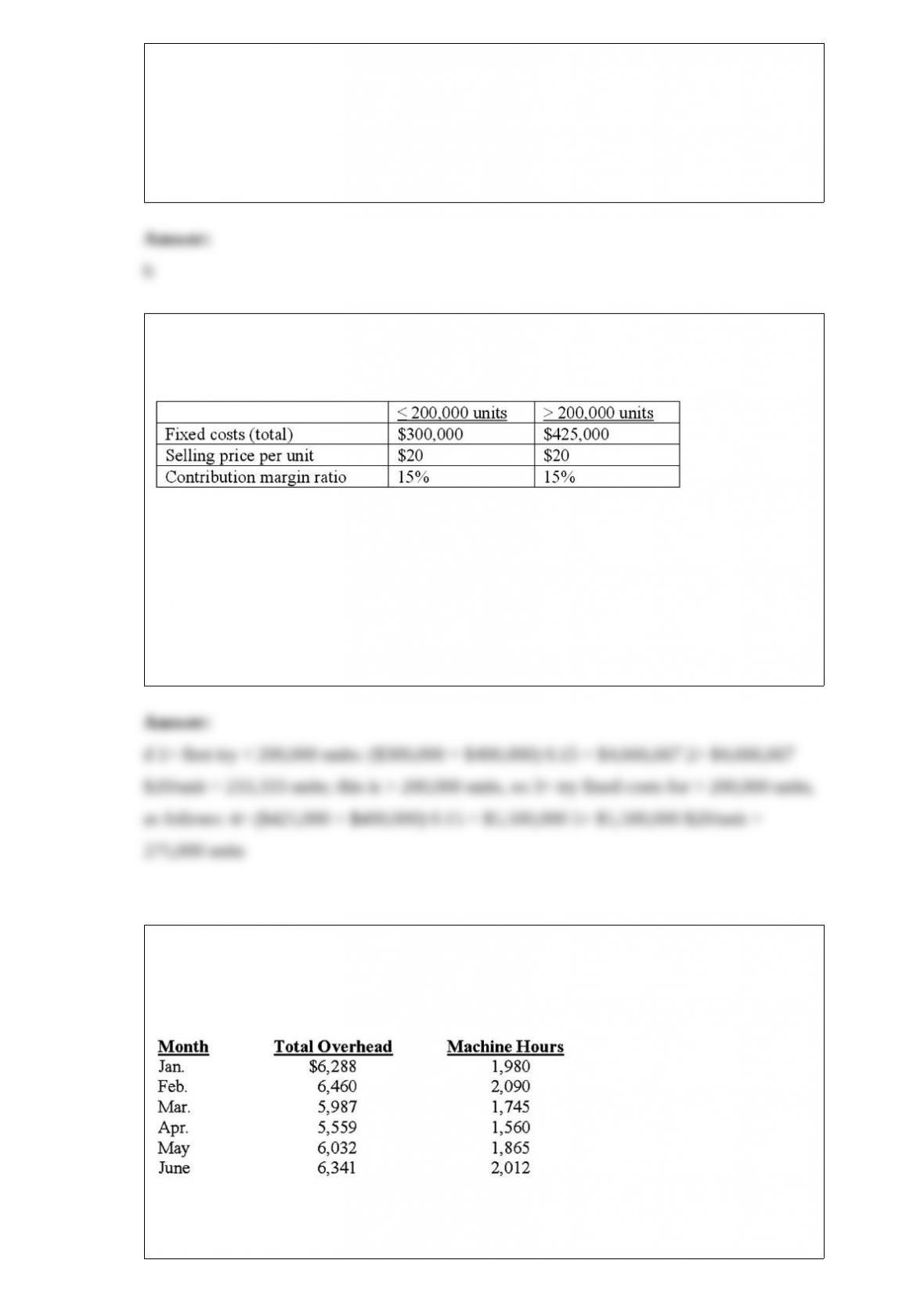
14) jch sports plans to market a new product for the upcoming college season. costs
associated with the new product, at two different volume ranges, are as follows:
how many units must be sold in order to reach a before-tax income on the product of
$400,000?
a.148,333
b.385,000
c.313,000
d.275,000
e.233,333
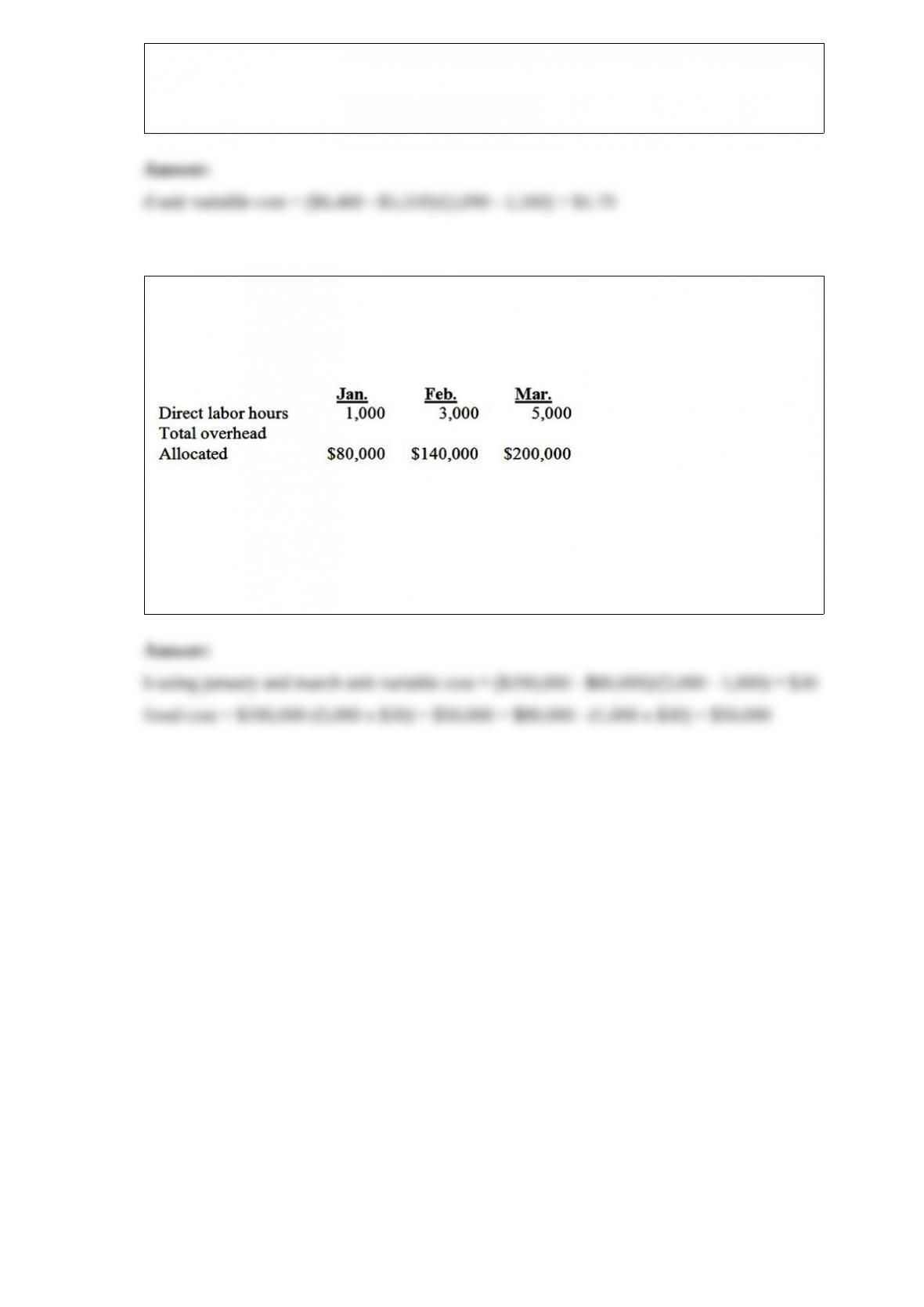
15) audio zone co. needs to prepare pro forma financial statements for the next fiscal
year. to do so, the company must forecast its total overhead cost. the actual machine
hours and total overhead cost are presented below for the past six months.
using the high-low method, unit variable overhead cost is calculated to be:
a.$1.40
b.$1.50
c.$1.60
d.$1.70
e.$1.80
16) a company allocates its variable factory overhead based on direct labor hours.
during the past three months, the actual direct labor hours and the total factory overhead
allocated were as follows:
based upon this information, monthly fixed factory overhead was:
a.$30,000
b.$50,000
c.$46,667
d.$33,333