
At the end of the period, the balance remaining in work in process is reported on the
balance sheet.
Manufacturing companies use a predetermined overhead rate; such rates are not used by
service companies.
The most useful cost driver for allocating a particular cost is the one with the strongest
cause-and-effect relationship.
The sales volume variance is favorable if actual sales volume is higher than the
budgeted.
The differences between the standard and actual amounts are called variances.

The cash budget is not the same as the pro forma cash flow statement.
The goal in allocating a cost to cost objects is to achieve a rational allocation.
The amount of revenue a company recognizes on the income statement normally differs
from the amount of cash collected from customers.
For many managerial decisions (such as outsourcing and special order decisions),
unit-level costs are avoidable costs.

Mary must decide between two alternatives for the weekend: babysitting or yard work.
If she babysits, she will receive $40 and will incur $15 in transportation costs. If she
does yard work, she will receive $40 and will incur $3 in lawn mower gas and oil costs
and $5 in transportation costs. The payment she would receive for the jobs is relevant in
deciding which alternative to select.
Assuming a company uses a markup equal to 25% of cost, the cost of a product that
sells for $100 is $75.
In most cases, the production manager should be held accountable for fixed cost
volume variances.
Because Fenwick Company has significant swings in its monthly production, the best
way to allocate its plant manager’s $58,000 annual salary is to allocate 1/12th of the cost
each month.

A dollar to be received in the future is subject to the effects of risk and inflation.
Two methods of computing equivalent whole units are the LIFO and the weighted
average methods.
Sunk costs are sometimes relevant for decision-making purposes.
Which of the following is a valid reason for using variable costing?
A. Fixed production cost should be ignored when costing units of inventory since it is
not essential to the production process.
B. Absorption costing recognizes fixed costs as expense regardless of volume of
production.
C. Absorption costing may motivate managers to overproduce in order to increase
profits.
D. Under variable costing managers can increase profitability by increasing the volume
of production.

If a company experiences an increase in rent expense, the total cost line on the
cost-volume-profit graph will:
A. shift upward, and the break-even point will shift downward.
B. shift upward, and the break-even point will also shift upward.
C. shift upward and have a steeper slope, and the break-even point will also shift
upward.
D. shift upward and have a flatter slope, and the break-even point will be unchanged.
Which of the following is a difference between a static and a flexible budget?
A. Static budgets use the same fixed cost amounts, whereas flexible budgets change the
amount of fixed costs at different levels of activity.
B. Static budgets are based on the same per unit variable amount, whereas flexible
budgets are based on multiple per unit variable amounts.
C. Static budgets are based on single estimate of volume, whereas flexible budgets
show estimated costs and revenues at a variety of activity levels.
D. None of these answers is correct.
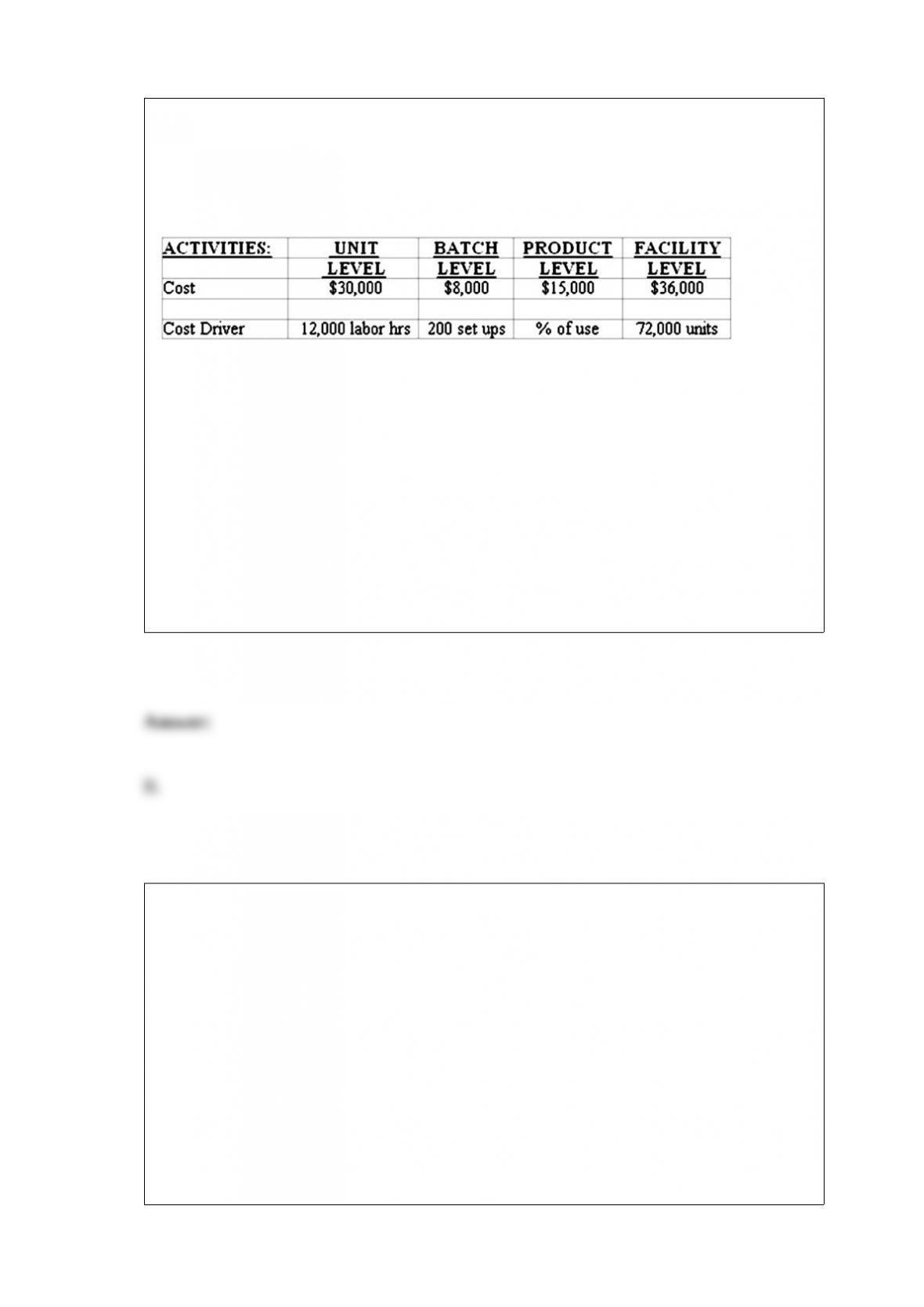
Valpar Company produces several lines of laundry hampers. The factory is highly
automated and uses an activity-based costing system to allocate overhead costs to its
various products. During the upcoming period the company expects to produce 72,000
units. The costs and cost drivers associated with four activity cost pools are given
below:
Production of 20,000 units of its popular foldable hamper required 3,000 labor hours,
75 setups, and consumed one-third of the product sustaining activities. What amount of
unit-level costs will be allocated to the product?
A. $2,500
B. $7,500
C. $5,000
D. $6,000
The Boyle Company estimated that April sales would be 150,000 units with an average
selling price of $6.00. Actual sales for April were 149,000 units and average selling
price was $6.12.
The sales revenue flexible budget variance was:
A. $6,120 favorable.
B. $6,000 unfavorable.
C. $17,880 favorable.
D. $17,880 unfavorable.

Pickard Company pays its sales staff a base salary of $4,500 a month plus a $3.00
commission for each product sold. If a salesperson sells 800 units of product in January,
the employee would be paid:
A. $6,900
B. $4,500
C. $2,300
D. $2,700
The Juarez Corporation was started on January 1, 2014. The company incurred the
following transactions during the year (Assume all transactions involve cash):
1) Acquired $1,000 of capital from the owners.
2) Purchased $400 of direct raw materials.
3) Used $300 of these direct raw materials in the production process.
4) Paid production workers $400 cash.
5) Paid $200 for manufacturing overhead (applied and actual overhead are the same).
6) Started and completed 200 units of inventory.
7) Sold 50 units at a price of $6 each.
8) Paid $40 for selling and administrative expenses.
The amount of cost of goods manufactured would be:
A. $1,000.
B. $900.
C. $800.
D. $600.
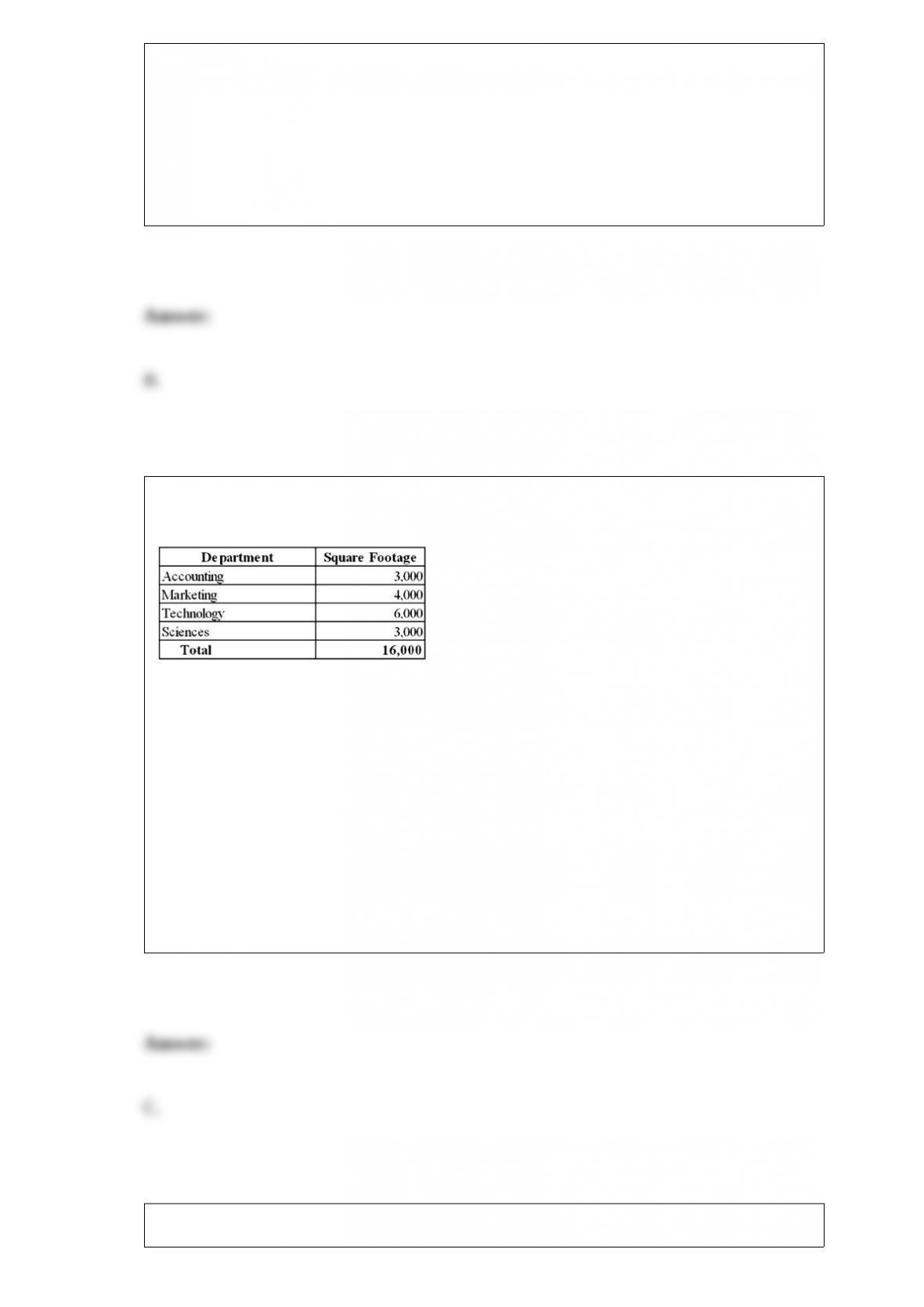
Alleghany Community College operates four departments. The square footage used by
each department is shown below.
Alleghany’s annual building rental cost is $320,000.
What amount of rent expense that should be allocated to the Technology Department?
A. $60,000
B. $80,000
C. $120,000
D. $192,000
The following balance sheet information is provided for Gaynor Company:
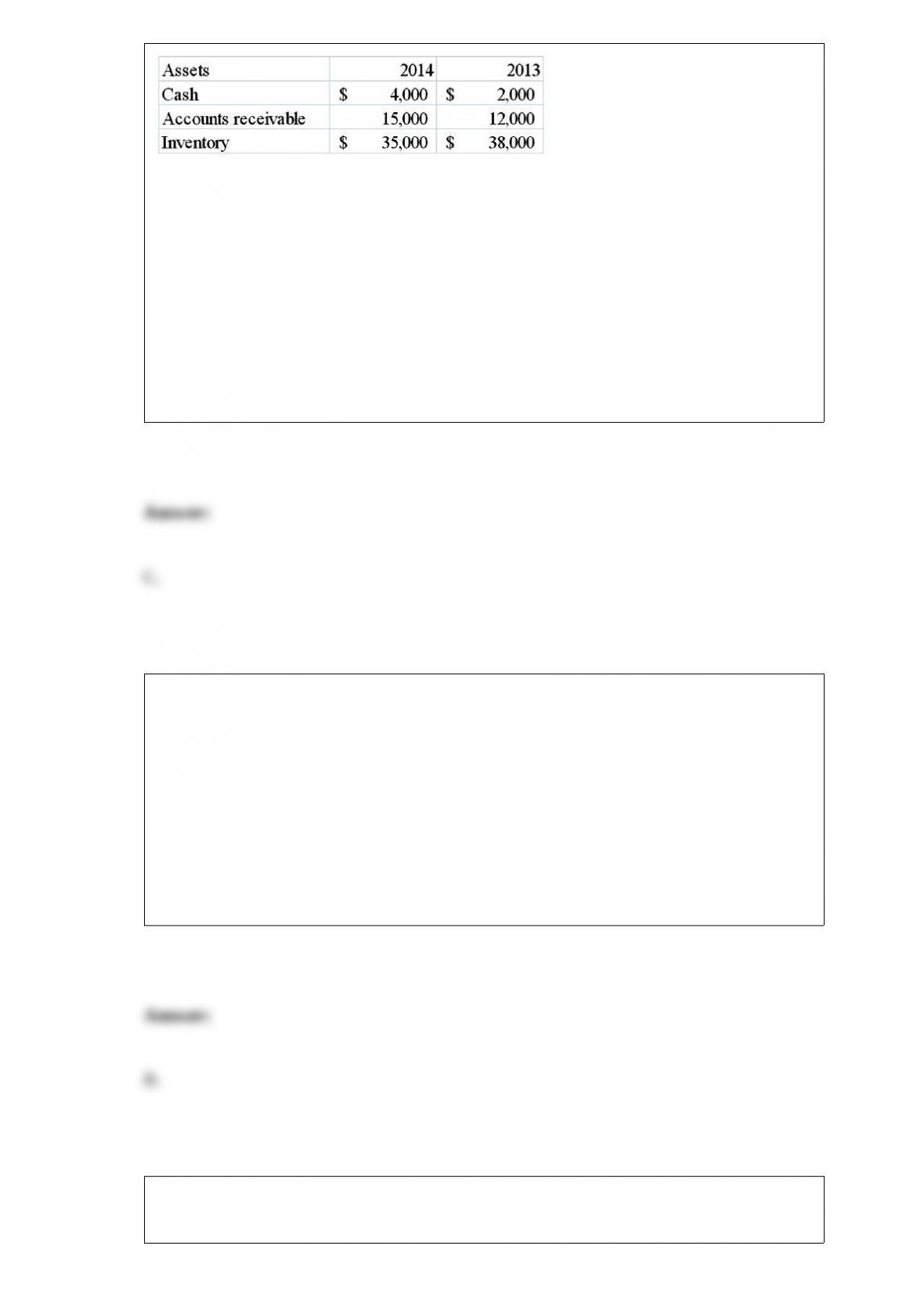
Assuming 2014 cost of goods sold is $153,300, what is the company’s inventory
turnover?
A. 4.0 times
B. 4.4 times
C. 4.2 times
D. None of these answers is correct.
Camden Company sets the selling price for its product by adding a markup to the
product’s variable manufacturing costs. This approach to pricing is referred to as:
A. cost-plus pricing
B. target pricing
C. target costing
D. contribution margin-based pricing
Martinez Company sells one product that has a sales price of $20 per unit, variable
costs of $8 per unit, and total fixed costs of $200,000, what is the contribution margin

ratio?
A. 40%
B. 60%
C. 50%
D. 66%
The excess of a product’s selling price over its variable costs is referred to as:
A. gross profit
B. gross margin
C. contribution margin
D. manufacturing margin
For a capital investment project to be acceptable, it must generate a rate of return:
A. less than the hurdle rate.
B. equal to or greater than the cost of capital.
C. equal to the conversion rate.
D. none of these answers is correct.

Theresa is considering starting a small business. She plans to purchase equipment
costing $145,000. Rent on the building used by the business will be $26,000 per year
while other operating costs will total $30,000 per year. A market research specialist
estimates that Theresa’s annual sales from the business will amount to $80,000. Theresa
plans to operate the business for 6 years. Disregarding the effects of taxes, what will be
the amount of annual net cash flow generated by the business?
A. $24,000
B. $56,000
C. $80,000
D. None of these answers is correct.
Select the correct formula for computing equivalent whole units under the weighted
average approach.
A. Equivalent whole units = units transferred
B. Equivalent whole units = units transferred + (ending inventory units × percentage
complete)
C. Equivalent whole units = units transferred + ending inventory units
D. Equivalent whole units = (units transferred + ending inventory units) × percentage
complete
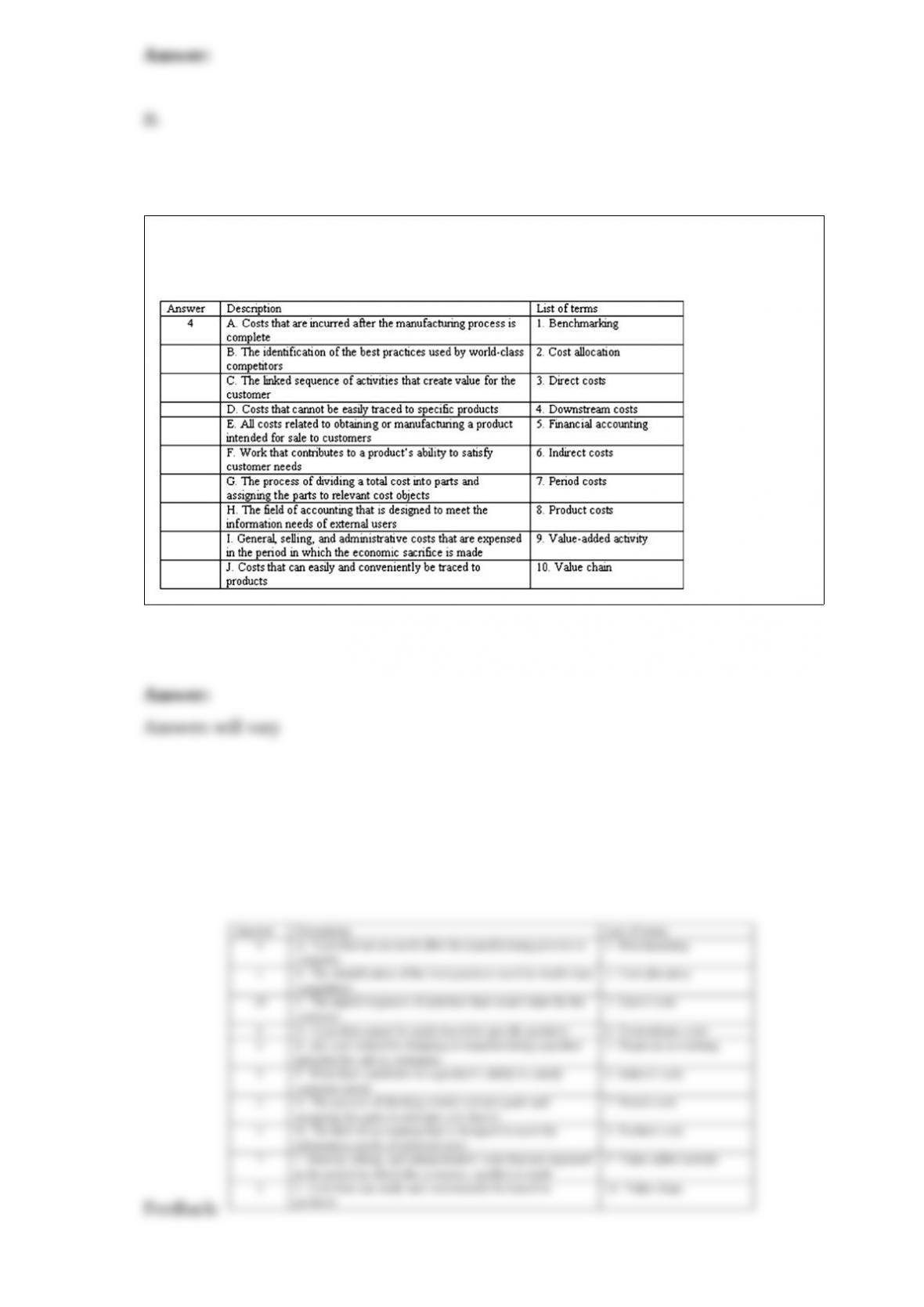
Select the term from the list provided that best matches each of the following
descriptions. The first is done for you.
Describe how a flexible budget is useful in planning for an organization.
Indicate whether each of the following statements is true or false:
A postaudit should be conducted at the time a capital investment is purchased.
The postaudit of a capital investment project should be made using the same analytical
technique that was used in deciding to make the investment.
The purpose of postaudits is to improve a company’s capital investment decision
process.
The postaudit process uses expected cash flows and the company’s cost of capital.
Making good estimates of future cash flows is important in making capital investment
decisions.
What are upstream costs? What upstream costs would be incurred by a company that
produces and sells computer software programs?
Indicate whether each of the following statements is true or false.
When unequal cash inflows are expected from a capital investment, the payback period
can be calculated by accumulating incremental cash inflows or by using average annual
cash inflows.
The unadjusted rate of return is also called the simple rate of return.
The unadjusted rate of return can be calculated as average increase in cash inflows
divided by net cost of the original investment.
The unadjusted rate of return does not take the time value of money into account.
The unadjusted rate of return should be calculated using the initial cost of the
investment, rather than the average invested capital.