
Standard costs are comprised of two elements:
A. the quantity of input and the cost per unit of input.
B. the quality of input and the cost per unit of input.
C. the quantity of input and the cost per unit of output.
D. the quality of input and the cost per unit of output.
The current assets of most companies are usually made up of:
A. assets that are currently used in the operations of the company.
B. cash and assets expected to be converted to cash within a year.
C. a very small proportion (less than 10%) of the total assets of the entity.
D. cash, marketable securities, and accounts and notes receivable.
Ariel, Inc., issued $60 million face amount of 9% bonds when market interest rates
were 9.30% for bonds of similar risk and other characteristics.
(a.) How much interest will be paid annually on these bonds?
(b.) Will the bonds be issued at a premium or discount? Explain your answer.
(c.) Will the annual interest expense on these bonds be more than, equal to, or less than,
the amount of interest paid each year? Explain your answer.
(a.) $60,000,000 * .09 = $5,400,000 interest paid annually.
(b.) The bonds were issued at a discount because market interest rates were more than
the coupon rate when the bonds were issued. Investors would not be willing to pay the
full face amount for bonds offering a lower than market rate of interest.

The total variance for any particular cost component is referred to as the:
A. price variance.
B. efficiency variance.
C. budget variance.
D. none of the above.
Preferred stock is used much less than long-term debt in the capital structure of most
industrial and merchandising companies principally because:
A. the preferred stock dividend requirement is a fixed claim against income, but interest
on long-term debt is not a fixed amount.
B. preferred stock has a fixed liquidation or redemption value, but long-term debt does
not have a fixed maturity value.
C. preferred stock may be convertible to common stock, but long-term debt cannot be
convertible.
D. for income tax purposes, dividends paid on preferred stock are not deductible, but
interest on long-term debt is deductible.
When the high-low method of estimating a cost behavior pattern is used:
A. cost and volume data must be reviewed for outliers.
B. the direct result of the high-low calculations is the fixed expense amount.
C. the highest and lowest sales price and volume amounts are used in the calculation.
D. the resulting cost formula will explain total cost accurately for every value between
the high and low volumes.
Volunteer, Inc. is in the process of liquidating and going out of business. The firm has
$69,820 in cash, inventory totaling $214,000, accounts receivable of $144,000, plant
and equipment with a $384,000 book value, and total liabilities of $614,000. It is
estimated that the inventory can be disposed of in a liquidation sale for 75% of its cost,
all but 15% of the accounts receivable can be collected, and plant and equipment can be
sold for $420,000.
(a.) Calculate the amount of cash that would be available to the stockholders if the
accounts receivable are collected, the other assets are sold as described, and the
liabilities are paid in full.
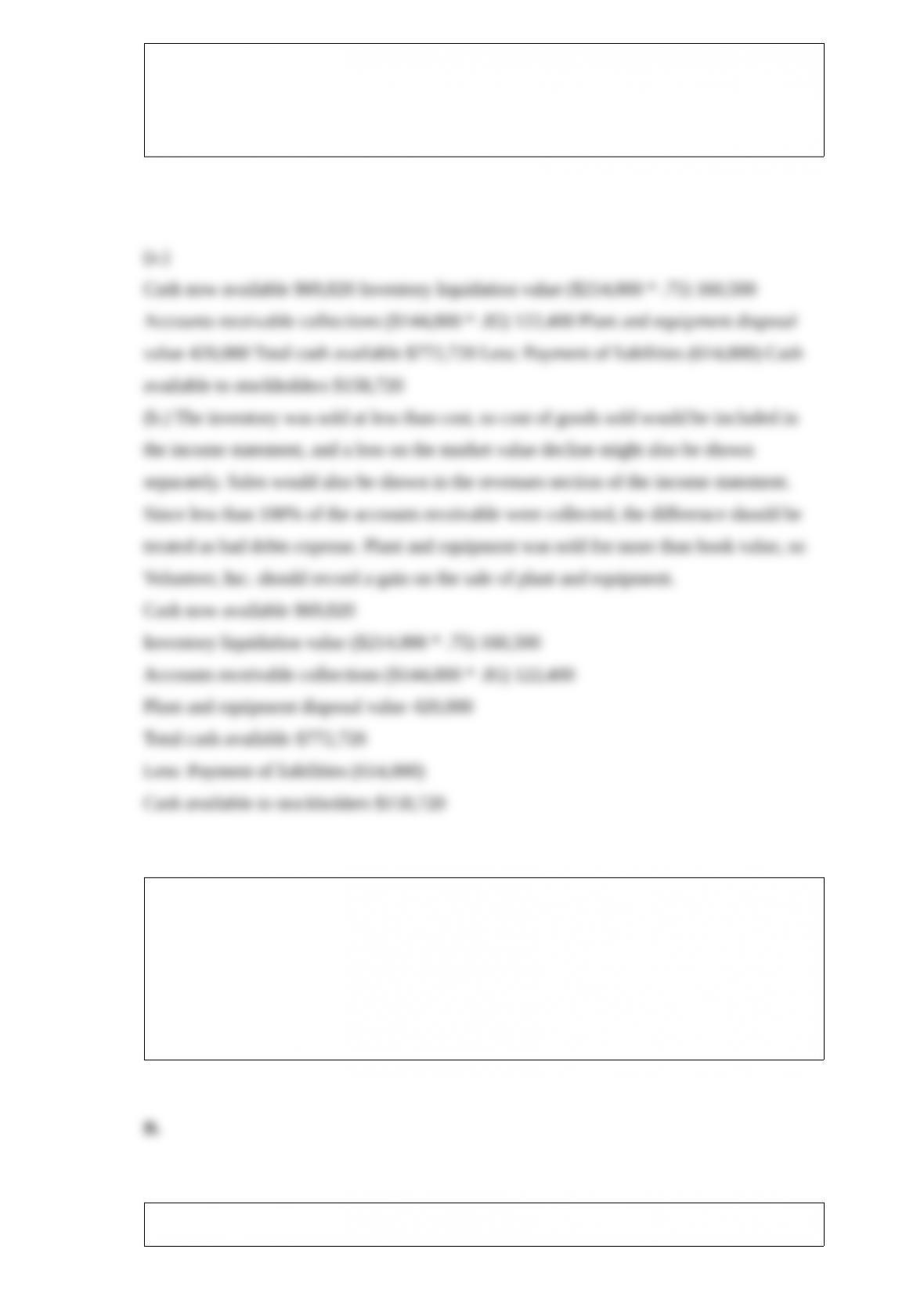
(b.) Describe how the difference between book value and liquidation value would be
treated on the final income statement for Volunteer, Inc. with respect to the following
assets: inventory, accounts receivable, and plant and equipment. What income statement
accounts would be affected when these assets are sold or collected as described above?
For capital budgeting decisions, the use of present value analysis significantly improves
management decision making, however:
A. other quantitative techniques may be even more insightful.
B. most decisions are significantly influenced by top management’s values and
experiences.
C. the accounting rate of return technique in usually more dependable.
D. a relevant cost analysis should always be used in close decisions.
Which activity of the management planning and control process occurs in each phase of

the cycle?
A. planning.
B. managing.
C. controlling.
D. decision making.
When an uncollectible account receivable is written off against the allowance for bad
debts:
A. total current assets decrease and expenses increase.
B. total current assets are not affected.
C. total current assets decrease and expenses decrease.
D. current assets decrease and expenses are not affected.
Bonner’s, Inc. borrowed $36,000 for 4 months on a discount basis. The lender used an
interest rate of 8% to calculate the discount. The amount of cash Bonner’s, Inc. actually
had available to use from this loan was:
A. $33.120
B. $35,040
C. $36,000
D. $36,960
The ethical concept of integrity means that an individual must:
A. sign a pledge to abide by all laws and regulations.
B. report to a supervisor any violation of the code of conduct of her company that is
observed.
C. read, understand, and agree to follow all provisions of her employer’s code of
conduct.
D. attempt to be honest and forthright in dealings and communications with others.

If variable costs are 35% of sales and sales increase by $50,000 this month because of a
special promotion, by how much will contribution margin increase?
A. $17,500.
B. $25,500.
C. $32,500.
D. $50,000.
The purpose of the income statement is to show the:
A. change in the fair value of the assets from the prior income statement.
B. market value per share of stock at the date of the statement.
C. revenues collected during the period covered by the statement.
D. net income or net loss for the period covered by the statement.
Depreciation on the office equipment would appear in which of the following budgets?
A. production budget.
B. manufacturing overhead budget.
C. operating expense budget.
D. cash budget.
The purpose of reporting Current Maturities of Long-Term debt is to:
A. report any portion of a long-term borrowing that is to be paid in the upcoming
accounting period as a current liability.
B. reclassify a portion of debt from the noncurrent section of the balance sheet to the
current section of the balance sheet.
C. properly classify liabilities.
D. all of the above.
For most firms, the cost of capital is probably in the range of:
A. the prime rate, plus or minus 2 percentage points.
B. less than 10%.
C. between 10% and 20%.
D. more than 20%.
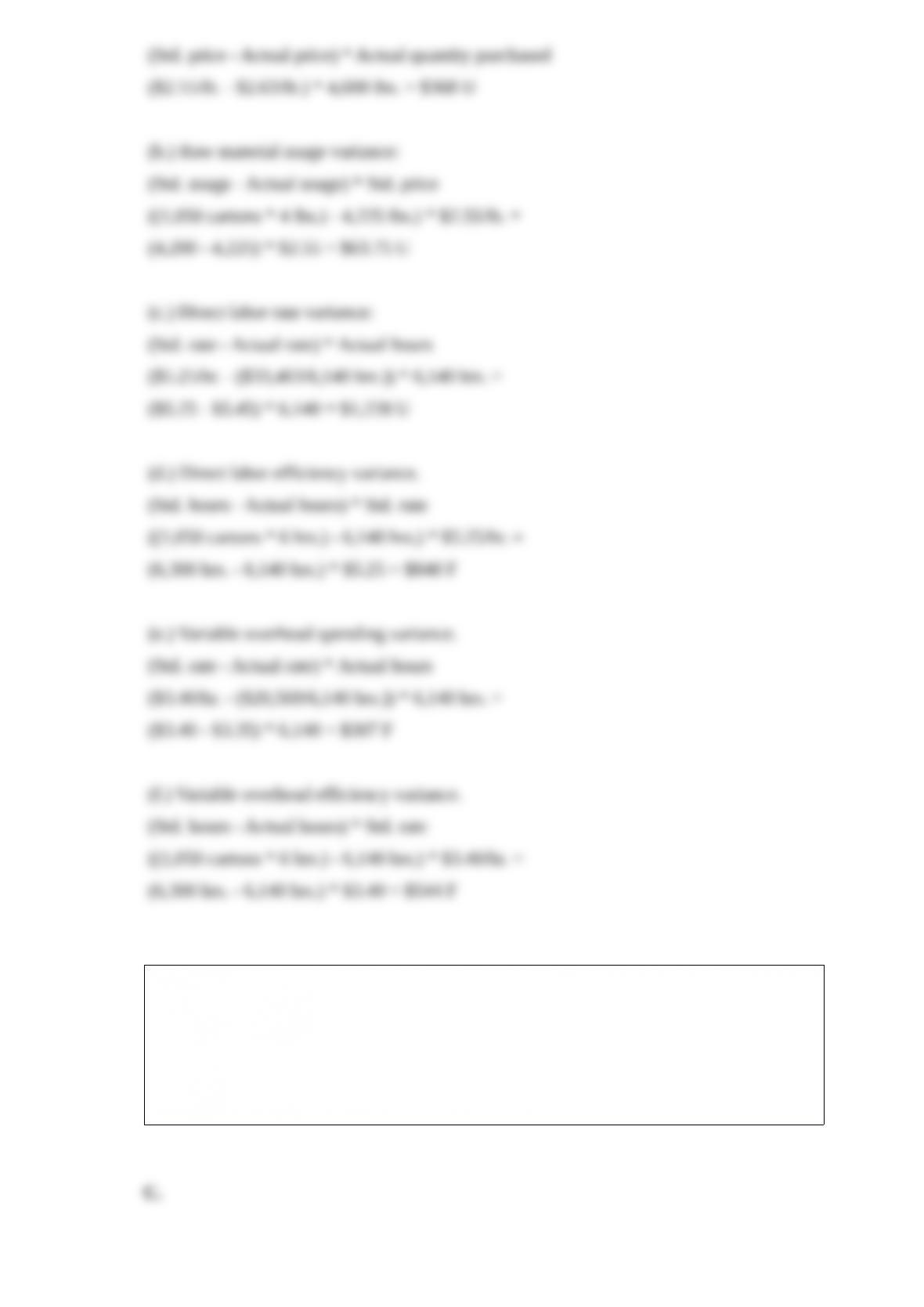
The standards for one carton of Wonder Wax are:
During the week ended December 4, the following activity took place:
• 4,600 lbs. of raw material were purchased for inventory at a cost of $2.63 per pound;
• 1,050 cartons of finished product were produced;
• 4,225 lbs. of raw material were used;
• 6,140 labor hours were worked at a total cost of $33,463;
• $20,569 actual variable overhead costs were incurred.
Calculate each of the following variances:
(a.) Price variance for raw materials purchased.
(b.) Raw materials usage variance.
(c.) Direct labor rate variance.
(d.) Direct labor efficiency variance.
(e.) Variable overhead spending variance.
(f.) Variable overhead efficiency variance.
The use of activity-based costing information to support the decision-making process is
known as:
A. value chain analysis.
B. cost distortion analysis.
C. activity-based management.
D. cost-based management.
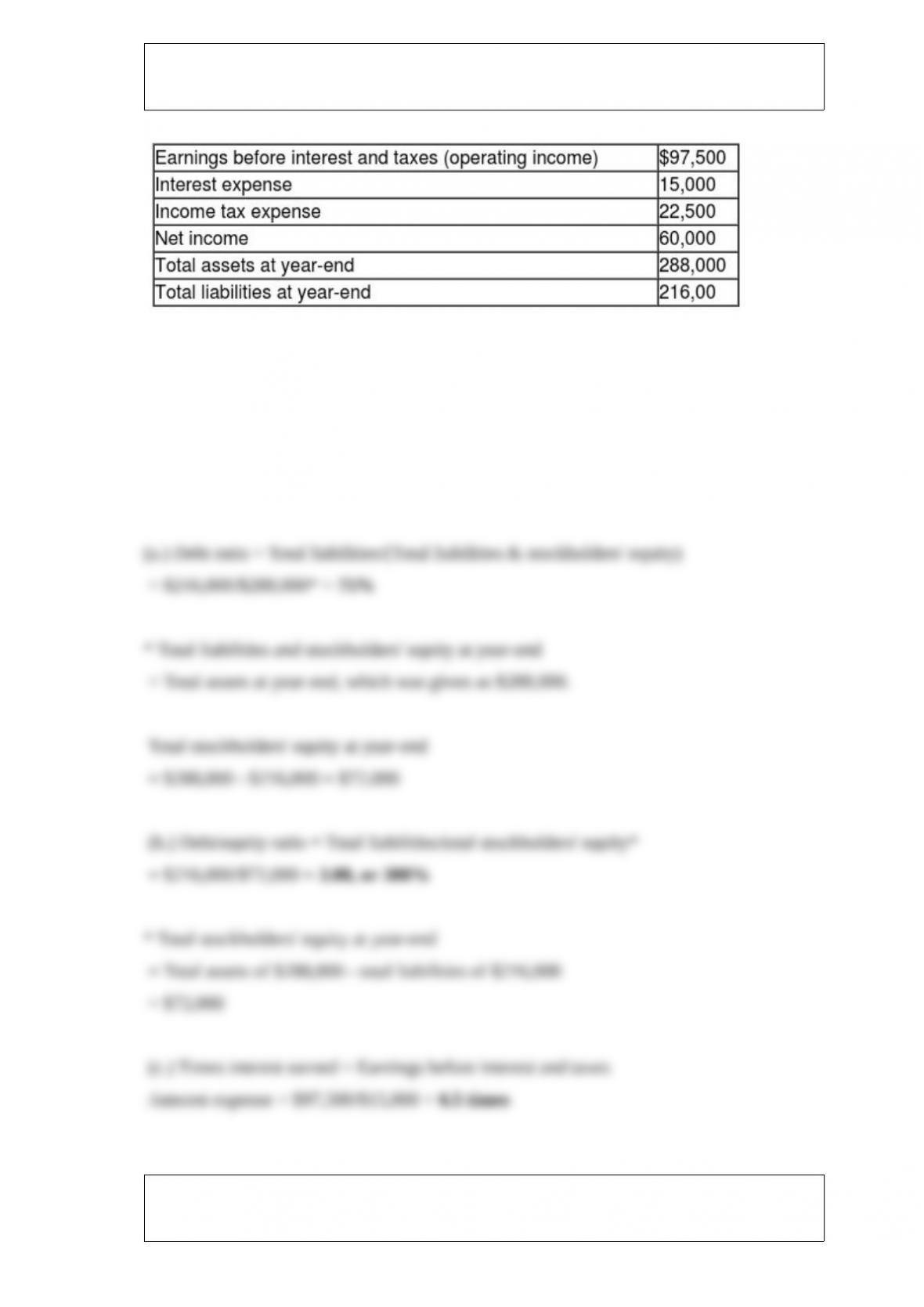
The following information was available for the year ended December 31, 2016:
Required:
(a.) Calculate the debt ratio at December 31, 2016.
(b.) Calculate the debt/equity ratio at December 31, 2016.
(c.) Calculate the times interest earned for the year ended December 31, 2016.
If a firm sells treasury stock for more than its cost:
A. a gain is recognized in the income statement.

B. retained earnings is increased.
C. additional paid-in capital is increased.
D. total stockholders’ equity does not change.
Which of the following statements concerning the accounting for leases is not true?
A. The economic impact of a capital lease isn’t really any different from buying the
asset outright and signing a note payable that will be paid off, with interest, over the life
of the asset.
B. At the inception of a capital lease, the lessee’s total assets and total stockholders’
equity are both increased for the present value of the lease payments to be made over
the life of the lease.
C. Assets rented under an operating lease are not reflected on the lessee’s balance sheet,
and the rent expense involved is reported in the income statement as an operating
expense.
D. A capital lease results in the lessee assuming virtually all the benefits and risks of
ownership of the leased asset.
A balanced scorecard framework is integrated through four key perspectives. The
presentation of these key perspectives on a balanced scorecard from the lowest level
perspective to the highest level perspectives is:
A. customer, financial, internal business process, learning and growth.
B. financial, customer, learning and growth, internal business process.
C. learning and growth, internal business process, customer, financial.
D. internal business process, learning and growth, customer financial.
The declaration date pertains to:
A. The date used to determine who receives dividends.
B. The date on which the board of directors declares it’s going to liquidate the firm.
C. The date on which the board of directors declares a dividend.
D. The date a dividend is paid.

Which of the following inventory accounting systems has been made much more
feasible as a result of computer systems developments?
A. Periodic.
B. Physical.
C. Perpetual.
D. Just-in-time.
The term “cost” means:
A. the price paid for a raw material.
B. the wage paid to a worker.
C. the price charged by an entity for its services.
D. all of the above.
___________ budgets are generally more expensive to maintain than single-period
budgets because more time and effort is required in their preparation.
A. Zero-based
B. Continuous
C. Discretionary
D. Production
An audit conducted in accordance with generally accepted auditing standards includes
each of the following except:
A. examination, on a test basis, of evidence supporting the amounts and disclosures in
the financial statements.
B. evaluation of the efficiency and effectiveness of management.
C. assessment of the accounting principles used and significant estimates made by
management.
D. planning and performance of the audit to obtain reasonable assurance that the
financial statements are free of material misstatements.
The balance sheet equation can be represented by:
A. Assets = Liabilities + Stockholders’ Equity
B. Assets – Liabilities = Stockholders’ Equity
C. Net Assets = Stockholders’ Equity
D. All of the above.
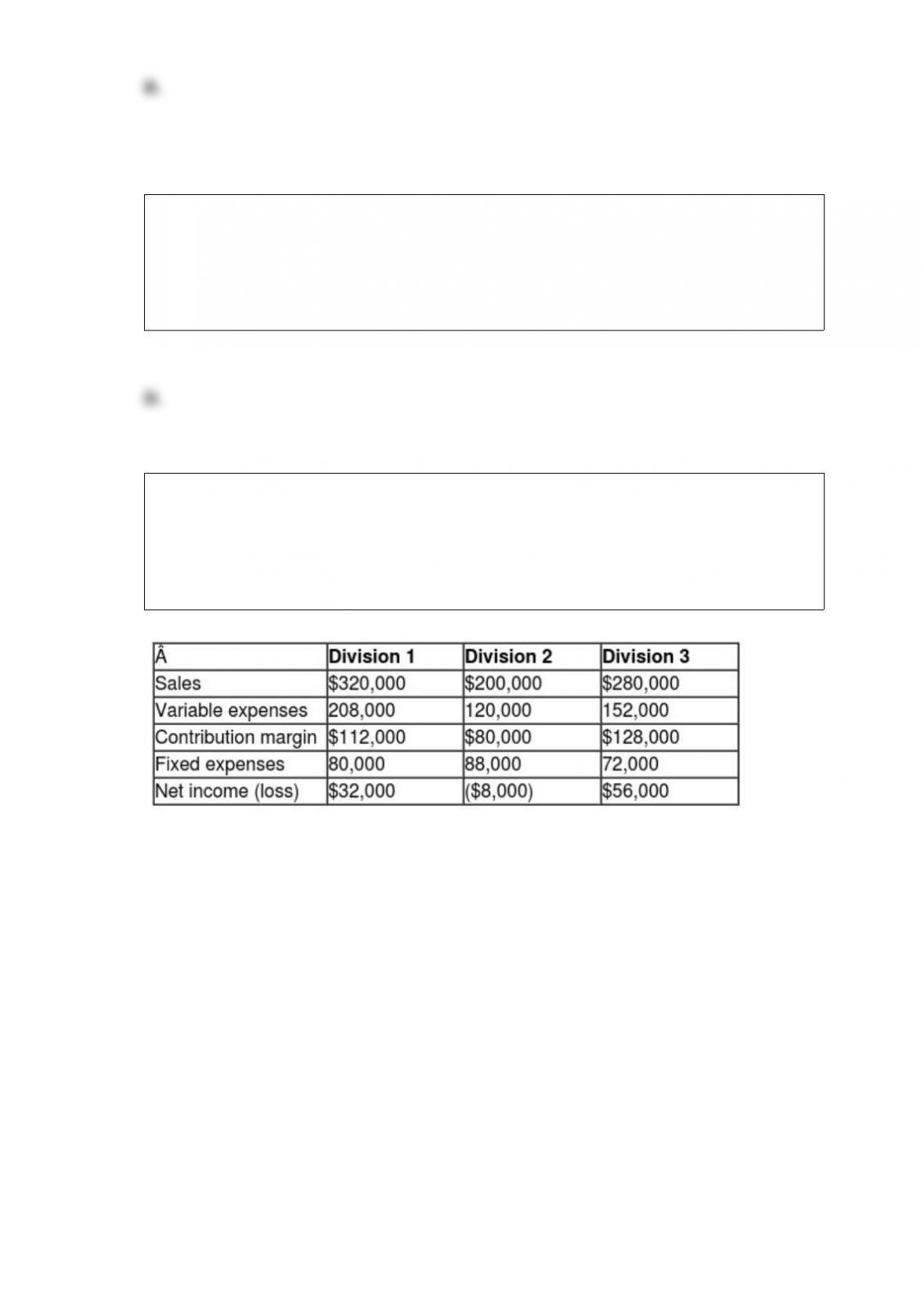
Niangua Co. is divided into three segments and is interested in preparing a segmented
income statement in order to better understand the operating performance of each
segment. Fixed expenses in each division currently include an allocation of general
corporate expenses equal to 20% of the division’s sales.
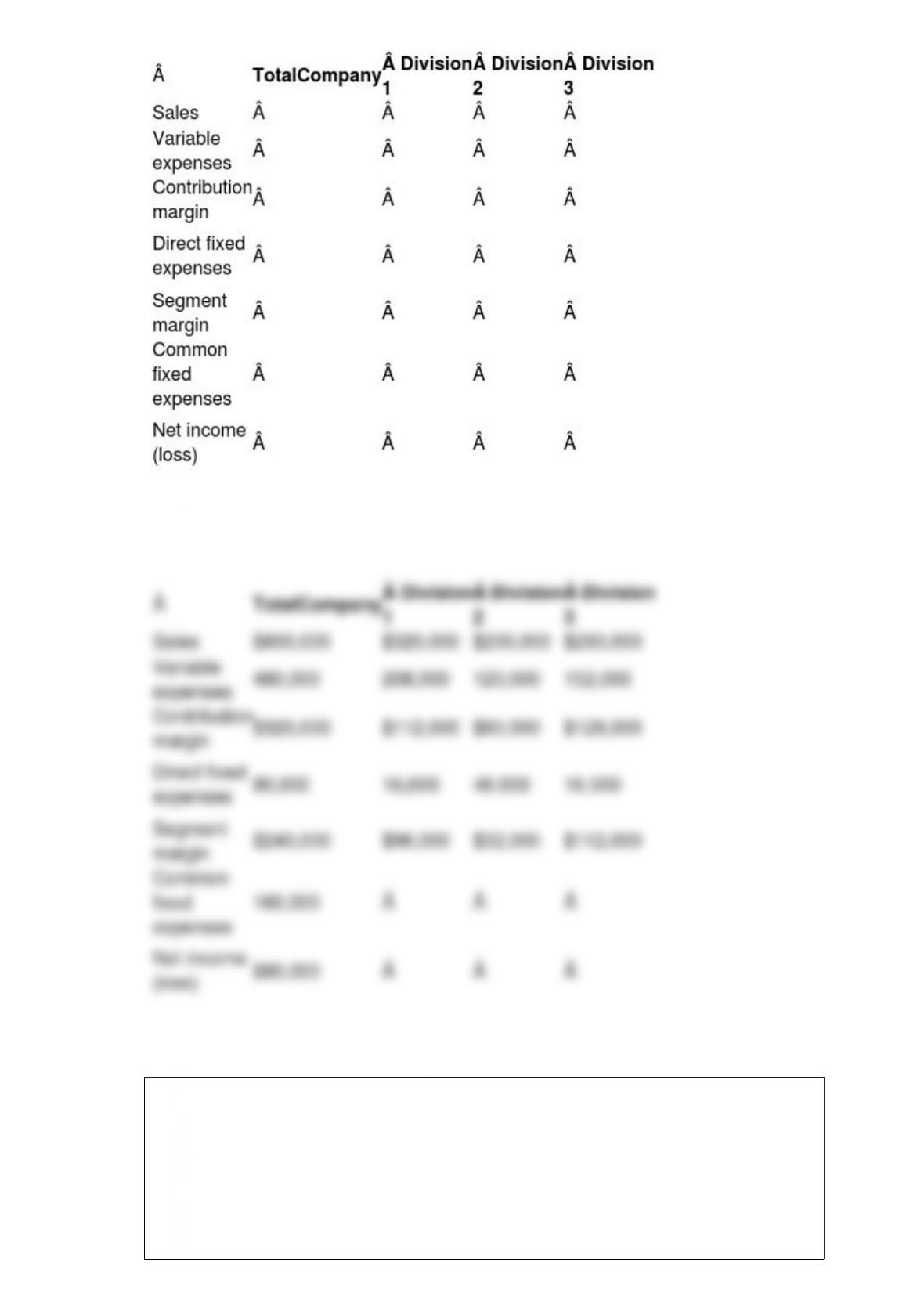
(a.) Complete the following segmented income statement for Niangua Co.
The following information is from ABC Company’s general ledger: Beginning and
ending inventories, respectively, for raw materials were $16,000 and $20,000 and for
work in process were $40,000 and $44,000. Raw material purchases and direct labor
costs incurred were $72,000 each, and manufacturing overhead applied amounted to
$40,000. Determine the total cost of goods manufactured during the period.
A. $176,000.
B. $180,000.

C. $184,000.
D. $220,000.
When a stock dividend is declared and issued:
A. total paid-in capital does not change.
B. total stockholders’ equity does not change.
C. retained earnings is normally decreased by the par value of the shares issued in the
dividend.
D. total paid-in capital is decreased by the market value of the shares issued in the
dividend.
Erca, Inc. produces automobile bumpers. Overhead is applied on the basis of machine
hours required for cutting and fabricating. A predetermined overhead application rate of
$15.00 per machine hour was established for 2016.
(a.) If 9,000 machine hours were expected to be used during 2016, how much overhead
was expected to be incurred?
(b.) Actual overhead incurred during 2016 totaled $135,000, and 9,200 machine hours
were used during 2016. Calculate the amount of over- or underapplied overhead for
2016.
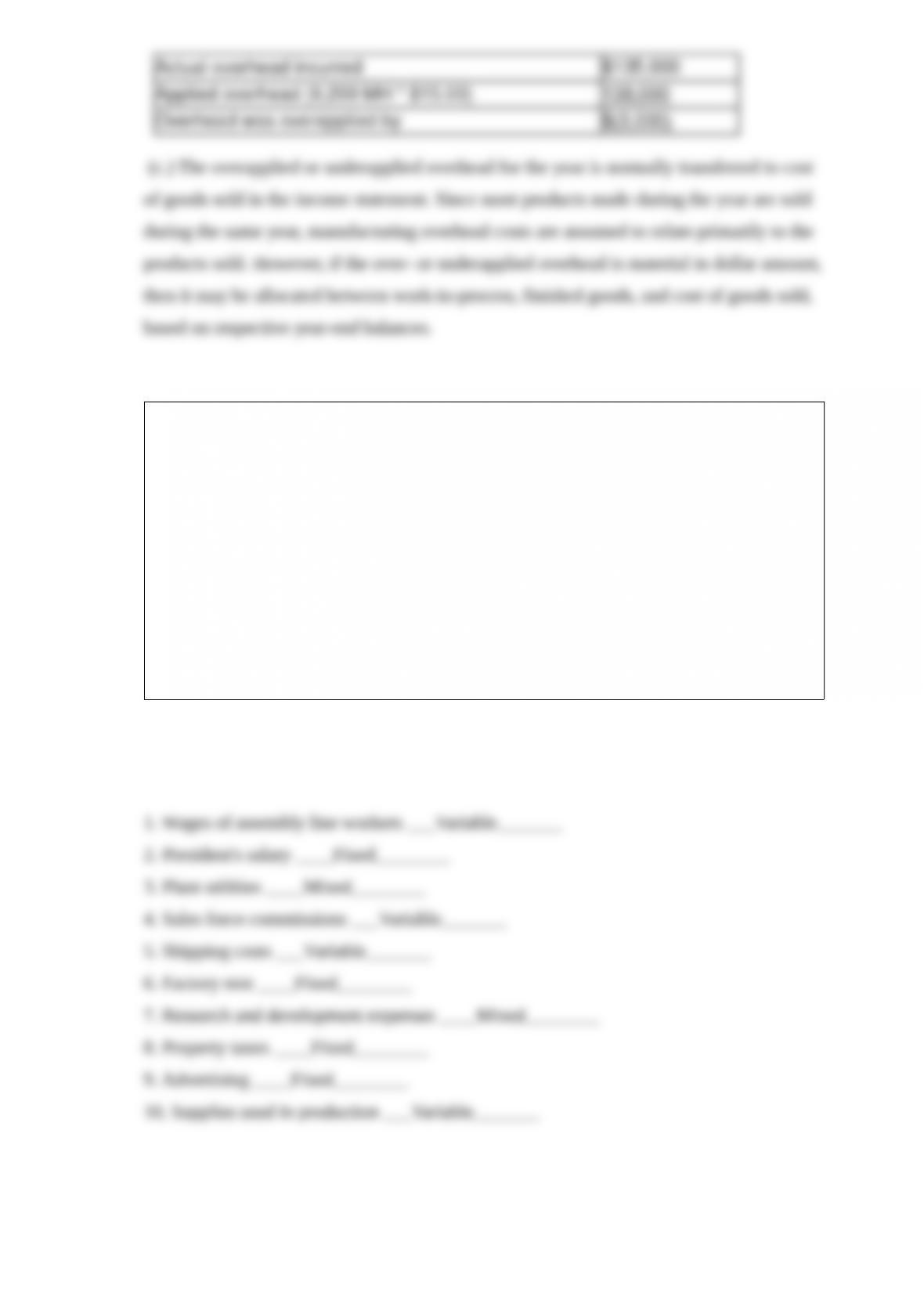
(c.) Explain the accounting necessary for the over- or underapplied overhead for the
year.
For each of the following costs, identify the cost behavior as variable, mixed, or fixed:
1. Wages of assembly line workers _________________
2. President’s salary _________________
3. Plant utilities _________________
4. Sales force commissions _________________
5. Shipping costs _________________
6. Factory rent _________________
7. Research and development expenses _________________
8. Property taxes _________________
9. Advertising _________________
10. Supplies used in production _________________
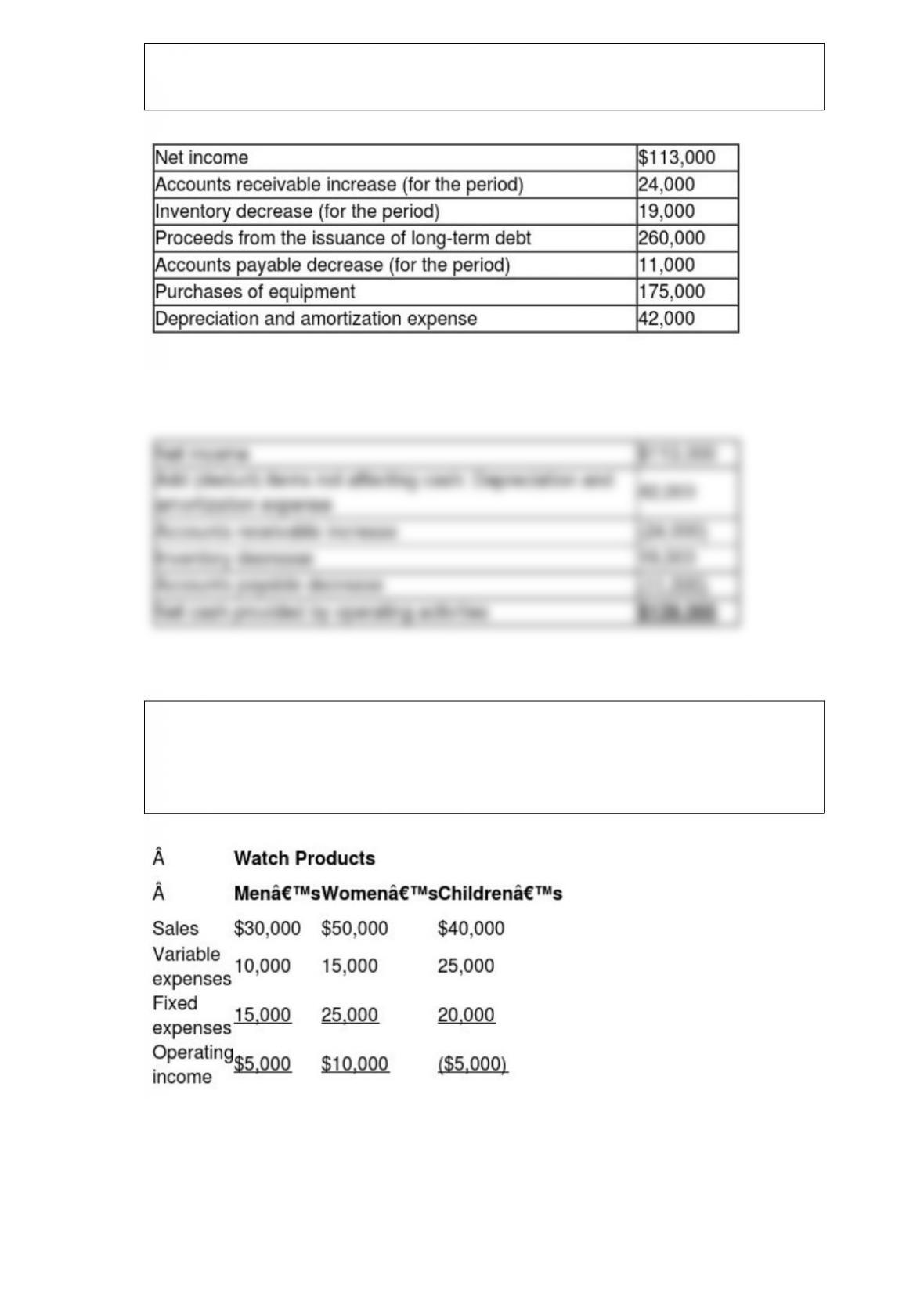
Use the appropriate information from the data provided below to calculate the net cash
provided (used) by operating activities for the period.
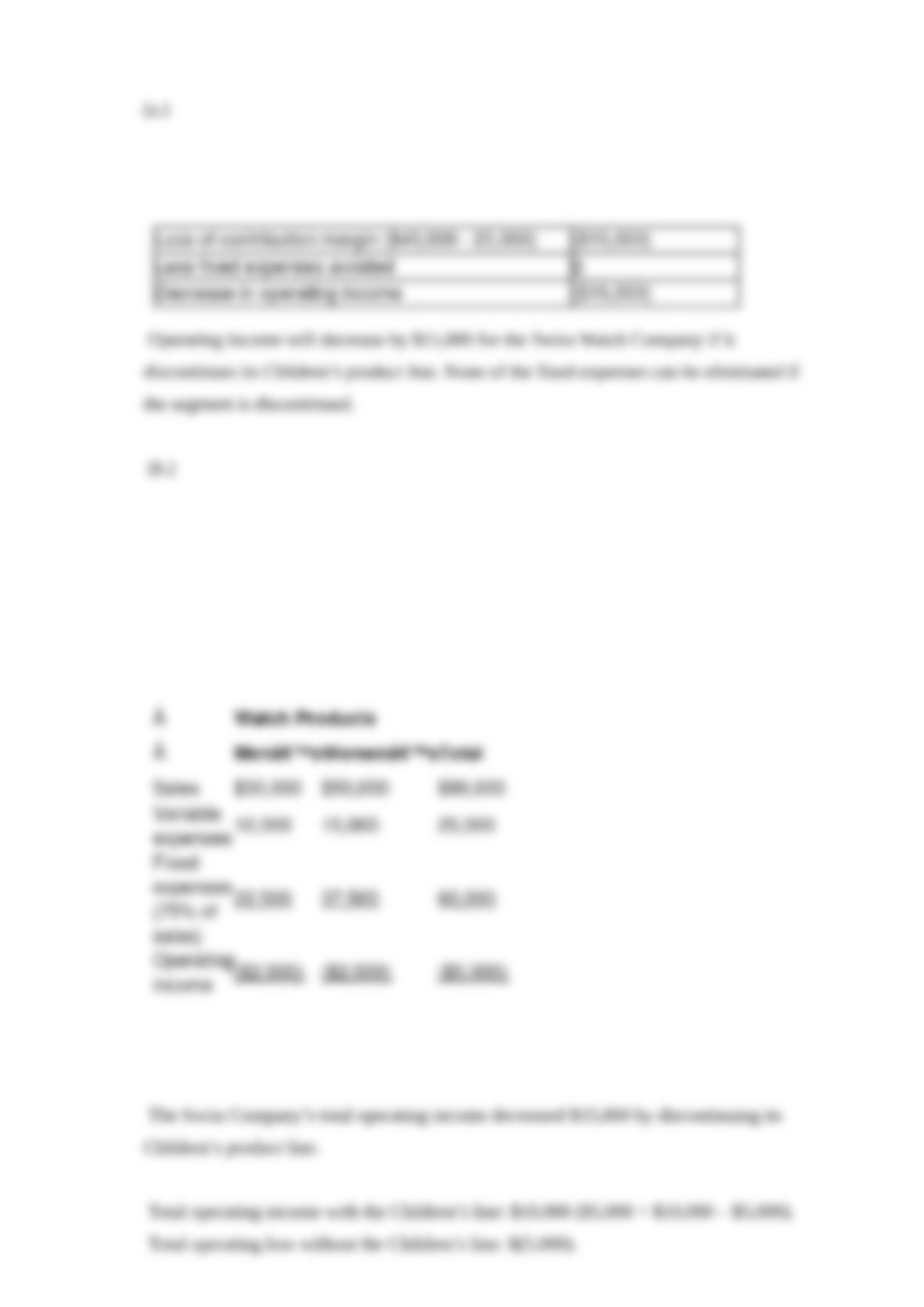
The following product line information is for the Swiss Watch Company. The company
is considering dropping its Children’s product line due to poor operating income
performance. Fixed expenses are allocated to each product line based on sales revenue.
(a.) Calculate the effect on the Swiss Company’s operating income if the Children’s watch
product line is discontinued. Comment on your analysis.
(b.) Assume that Swiss Company discontinues its Children’s product line. Calculate the
total operating income for the Swiss Company.
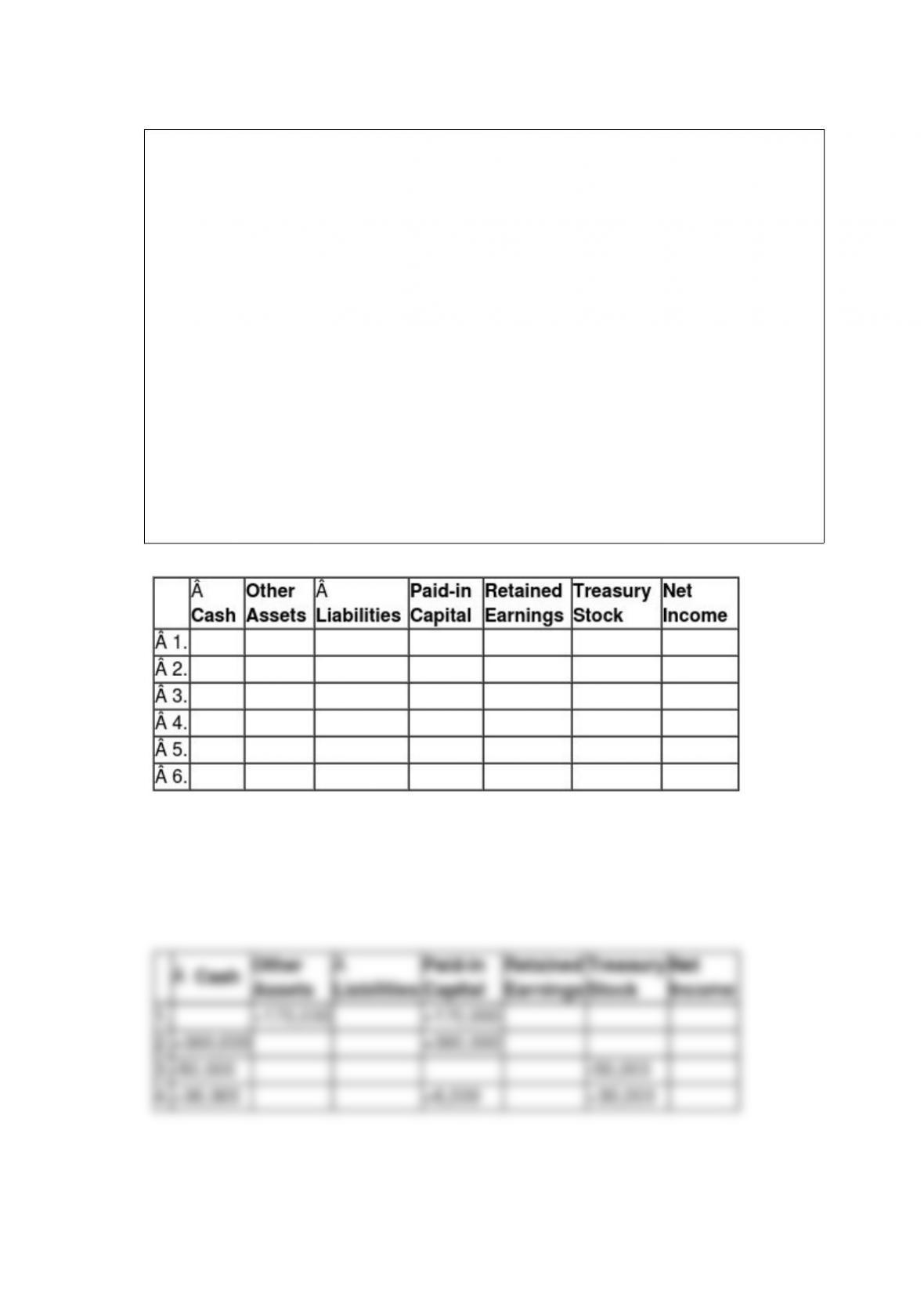
Using the column headings provided below, show the effect, if any, of the transaction
on each financial statement category by indicating whether it is an addition (+) or
subtraction (-) and by showing the amount in the appropriate column. For the treasury
stock column, show the effects, if any, of the transaction on total stockholders’ equity.
Do not show items that affect net income in the retained earnings column. You should
assume that the transactions occurred in the chronological sequence as indicated.
(1.) Issued 2,400 shares of $60 par value preferred stock in exchange for land and an
existing building that had appraised values of $70,000 and $100,000, respectively.
(2.) Issued 15,000 shares of $10 par value common stock for $24 per share.
(3.) Purchased 2,000 shares of common stock for the treasury at $25 per share.
(4.) Sold 1,200 shares of the treasury stock purchased in transaction #3 for $30 per
share.
(5.) Declared a cash dividend of $1.40 per share on the common stock outstanding, to
be paid early next year.
(6.) Split the common stock 2-for-1.
Joe’s Garage, Inc., purchased a used vehicle lift, brake tester, and wheel aligning
equipment for a lump-sum price of $16,000 from a bankrupt competitor. Appraised
values were as follows: vehicle lift, $20,000; brake tester, $4,000; and wheel aligner,
$6,000.
Required:
What cost should be recorded for the wheel aligner?
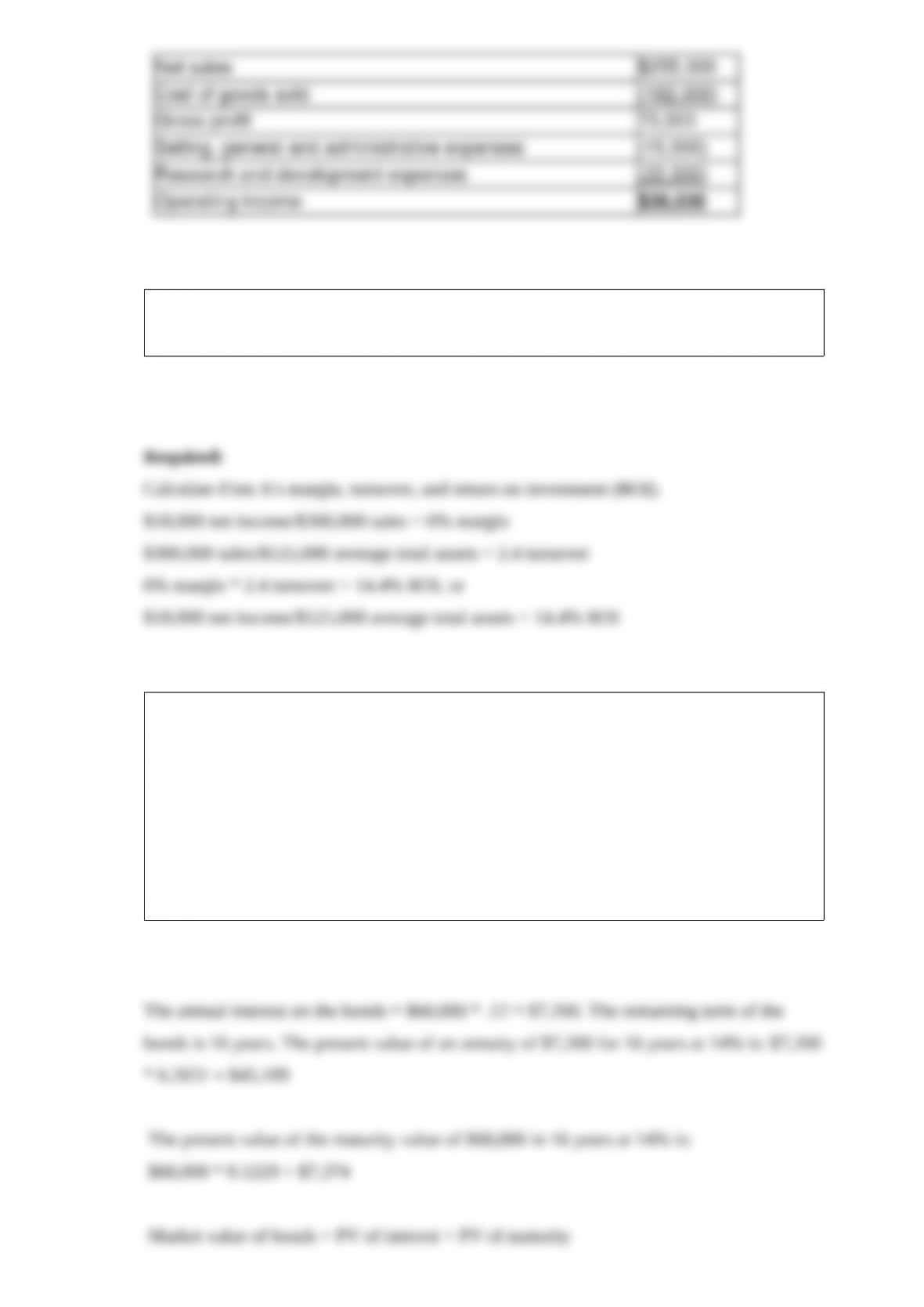
Use the appropriate information from the data provided below to calculate operating
income for the year ended December 31, 2017.
Firm X has net income of $18,000, sales of $300,000, and average total assets of
$125,000.
On April 15, 2017, Melissa purchased $60,000 of Verbecke Co.’s 12%, 20-year bonds at
face amount, with interest being paid on December 31 each year. Verbecke Co. has paid
interest due on the bonds regularly. On April 15, 2021, market interest rates had risen to
14% and Melissa is considering selling the bonds.
Required:
Using the present value tables in Chapter 6 of the textbook, calculate the market value
of Melissa’s bonds on April 15, 2021.
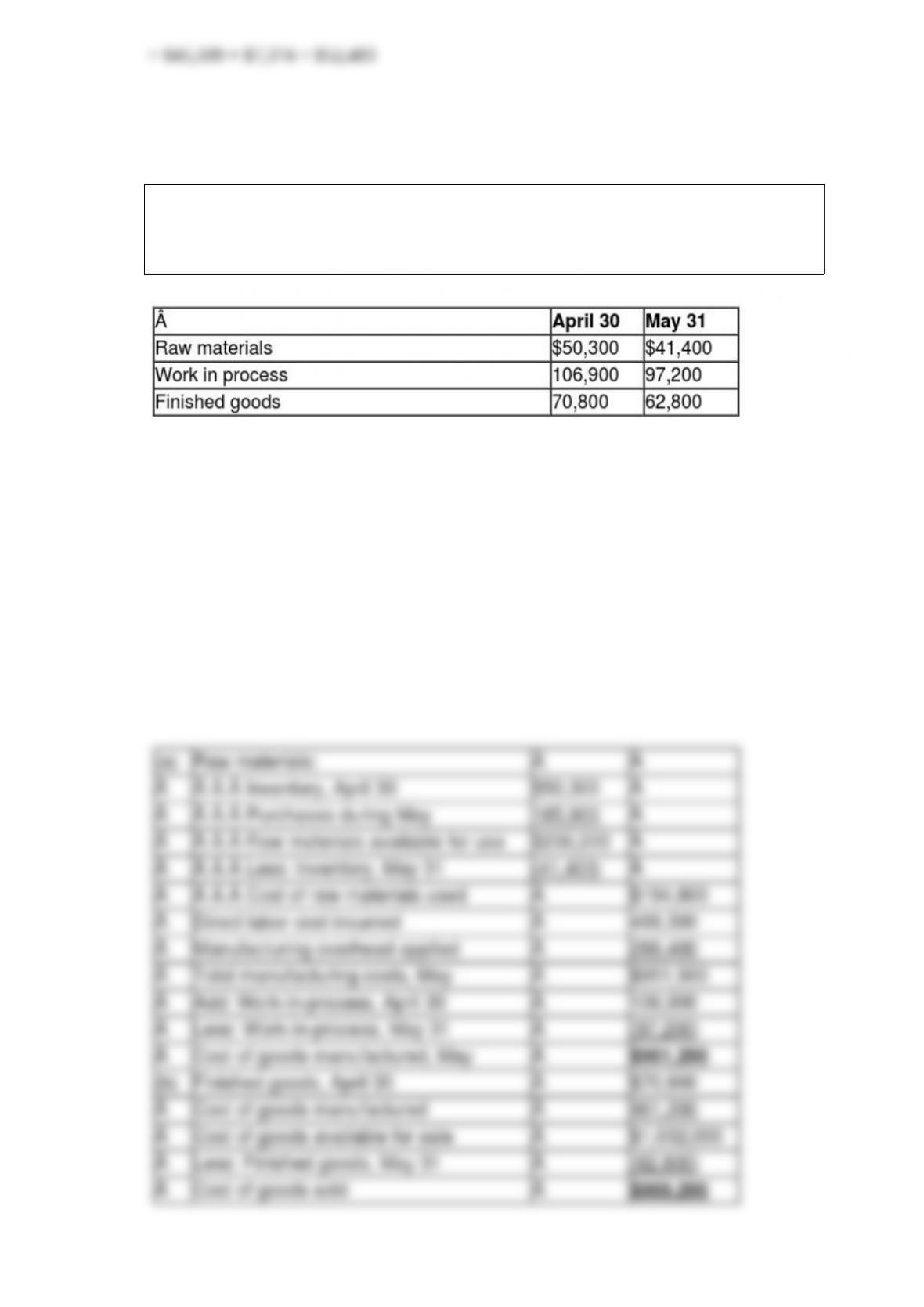
The following are beginning and ending inventories of ABC Company for the month of
May:
Raw materials purchased during the month of May totaled $185,900. Direct labor costs
incurred totaled $468,300 for the month. Actual and applied manufacturing overhead costs
for May totaled $282,600 and $288,400, respectively. Over/underapplied overhead is
written off to cost of goods sold at the end of the year in December.
(a) Calculate the cost of goods manufactured for May.
(b) Calculate the cost of goods sold for May.
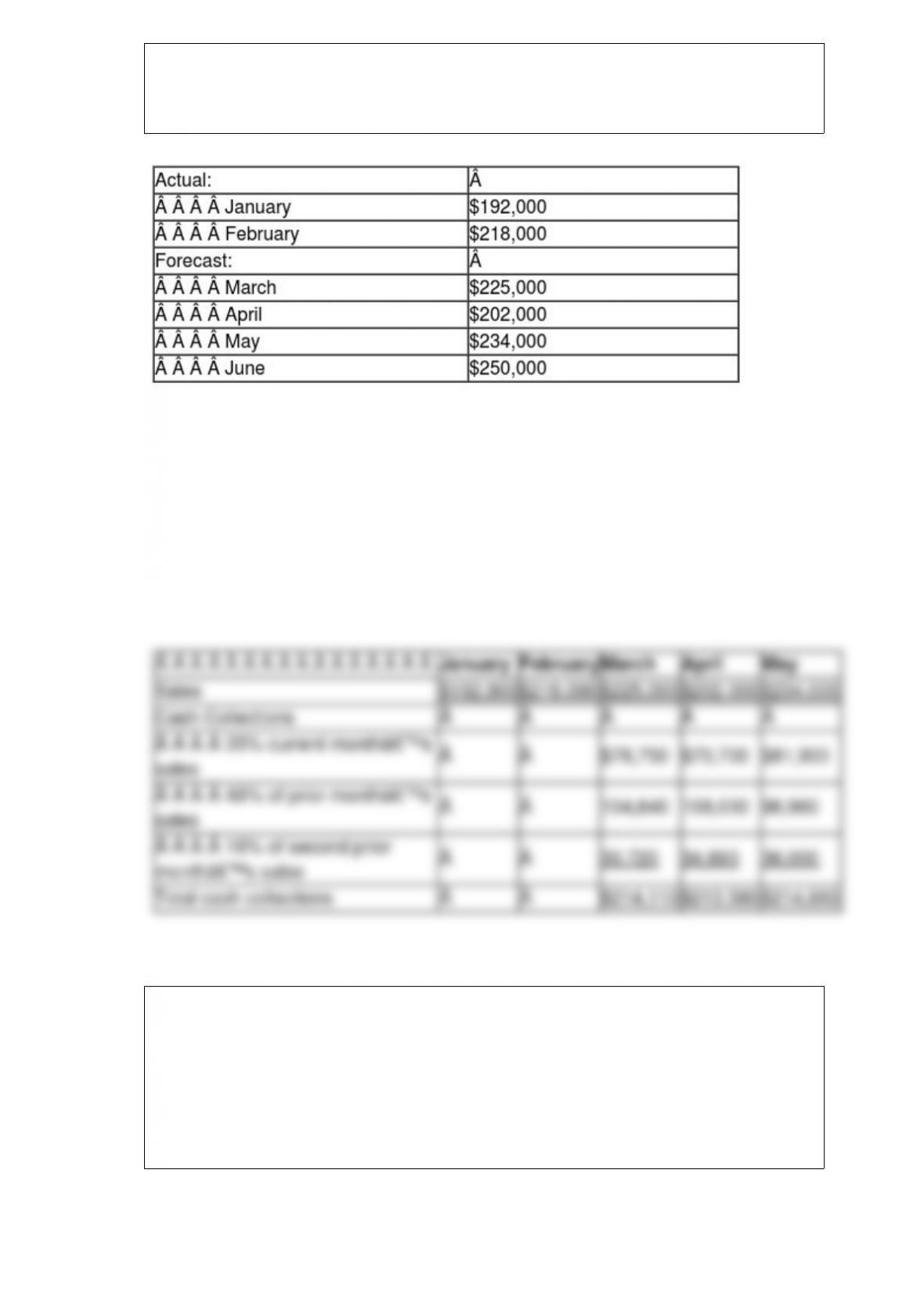
Dominic’s, Inc. had actual sales for January and February and forecasted sales for
March, April, May, and June as follows:
Based on company experience, it is estimated that 35 percent of a month’s sales are
collected in the month of sale, 48 percent in the month following the sale, and 16 percent
in the second month following the sale.
Calculate the estimated cash collections for March, April, and May.
Gwinnett Park Co.reported net income of $253,300 for its fiscal year ended September
30, 2017. At the beginning of that year, 150,000 shares of common stock were
outstanding. On February 1, 2017, an additional 30,000 shares were issues. On
September 1, 2017, 12,000 shares were purchased as treasury stock. During the year,
the company paid the annual dividend on 7,000 shares of its 8%, $60 par value
preferred stock that were outstanding during the entire fiscal year. Calculate the basic
earnings per share of common stock for the year ended September 30, 2017.
a. If the beginning balance of the Inventory account and the cost of items purchased or
made during the period are correct, but an error resulted in understating the firm’s
ending inventory balance by $12,000, how would the firm’s cost of goods sold be
affected?
b. If management wanted to overstate net income, would ending inventory be
understated or overstated? Explain your answer.
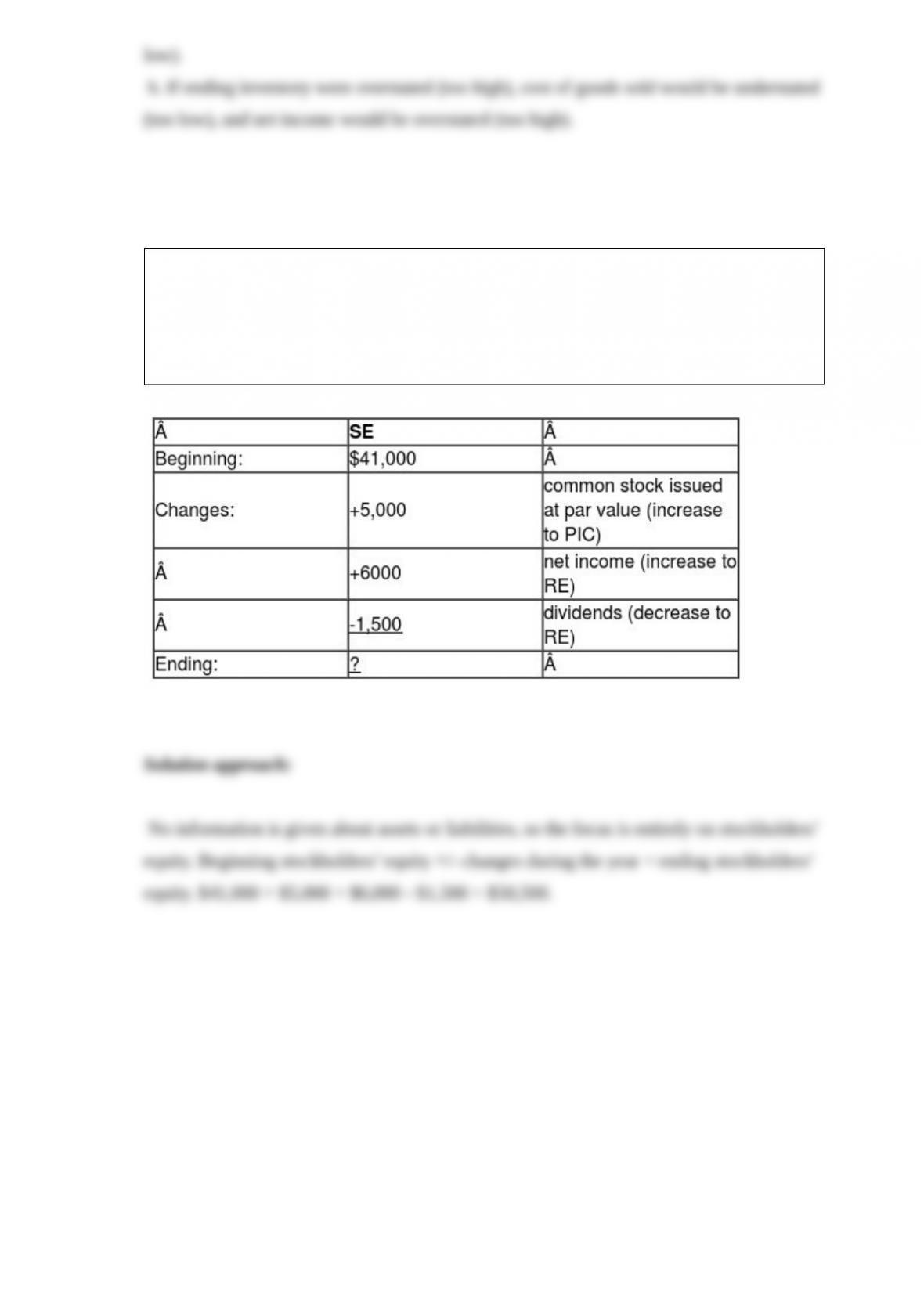
Stockholders’ equity totaled $41,000 at the beginning of the year. During the year, net
income was $6,000, dividends of $1,500 were declared and paid, and $5,000 of
common stock was issued at par value.
Required:
Calculate total stockholders’ equity at the end of the year.