
When using the internal rate of return to evaluate investment alternatives, which rate
would analysts specify?
A.hurdle rate.
B.Federal funds rate.
C.prime interest rate.
D.time-adjusted rate.
Which of the following statements is true if a company overstates the ending balance
of inventory?
A.Cost of Goods Sold and profits will be overstated and Gross Margin will be
understated.
B.Cost of Goods Sold, Gross Margin, and profits will be understated.
C.Cost of Goods Sold, Gross Margin, and profits will be overstated.
D.Cost of Goods Sold will be understated, Gross Margin and profits will be overstated.
When the number of units manufactured increases, the most significant change in
average unit cost will be reflected as
A.an increase in the nonvariable component.
B.a decrease in the variable component.

C.a decrease in the nonvariable component.
D.an increase in the variable component.
Which of the following lists presents the accounts in the order in which product costs
flow?
A.Work in Process Inventory, Finished Goods Inventory, Cost of Goods Sold, Raw
Materials Inventory
B.Raw Materials Inventory, Work in Process Inventory, Finished Goods Inventory, Cost
of Goods Sold
C.Cost of Goods Sold, Work in Process Inventory, Raw Materials Inventory,
Finished Goods Inventory
D.Raw Materials Inventory, Finished Goods Inventory, Work in Process Inventory, Cost
of Goods Sold
Planning capital expenditures involves which of the following?
A.making the capital budget decision.
B.identifying opportunities for capital expenditures.
C.identifying alternative options.
D.all of the above.
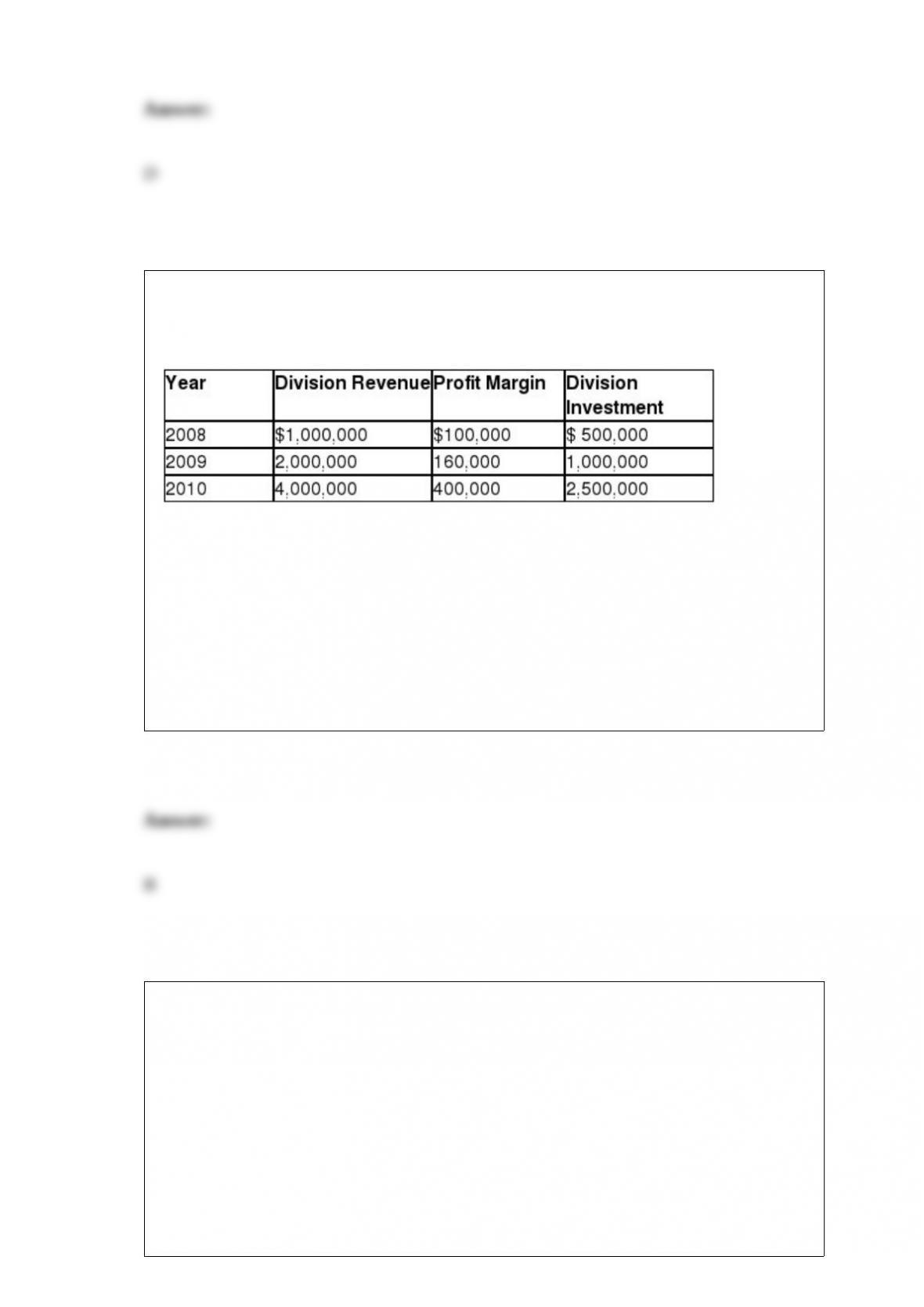
Framing Division
The Framing Division had the following data:
Refer to the Framing Division. What is the return on investment for Year 2010?
A.10%.
B.16%.
C.20%.
D.24%.
Which statement is true concerning the expectancy view of motivation?
A.The expectancy view of motivation focuses on the relationships between principals
and agents.
B.The expectancy view of motivation recommends providing a high probability that
behaving as the organization wishes will lead to desirable rewards.
C.The expectancy view of motivation looks for way to encourage agents to act in the
interests of principals.

D.None of the answers is correct.
Which statement is true concerning variable manufacturing overhead costs?
A.Variable manufacturing costs vary with units produced.
B.Variable manufacturing costs such as indirect labor and supplies are considered to be
batch-level activities.
C.Variable manufacturing costs such as power are considered to be a true variable cost.
D.all of the above
BLUE Company
BLUE Company needs 10,000 units of a certain part to be used in production. If BLUE
buys the part from RED Company instead of making it, BLUE could not use the present
facilities for another manufacturing activity. Sixty percent (60%) of the fixed overhead
applied will continue regardless of what decision is made.
The following quantitative information is available regarding the situation presented:
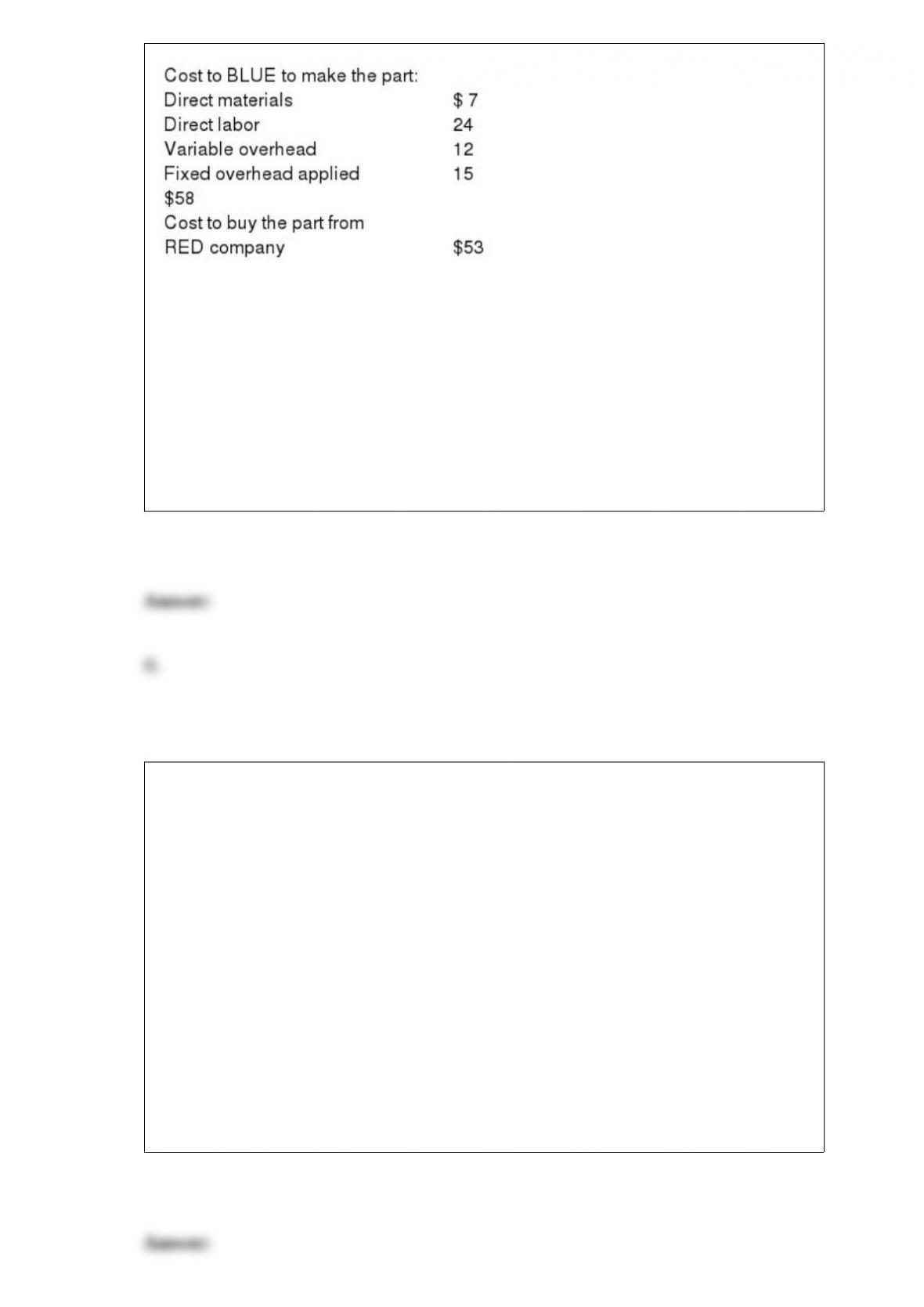
Refer to BLUE Company. In deciding whether to make or buy the part, BLUE’ s total
relevant cost to make the part is
A.$352,000.
B.$490,000.
C.$540,000.
D.$580,000.
Peters Retail, Inc.
Peters Retail, Inc. utilizes 8,000 square feet of floor space in departments A, B, and C.
Rental of $30,000 is incurred annually for this space. Department A occupied 1,000
square feet, Department B occupied 3,000 square feet, and Department C occupied
4,000 square feet.
Refer to Peters Retail, Inc. How much of the rent expense is allocated to Department A?
A.$30,000
B.$15,000
C.$11,250
D.$ 3,750

In what way(s) do managers make cost-benefit decisions as to the use of activity
analysis or traditional costing methods?
A.They reject activity analysis and stay with the simpler traditional method.
B.They use activity-based costing because they want information that will help them be
competitive.
C.They use activity-based costing as a special analysis, but not as an ongoing
information system.
D.All of the answers are correct.
The expectancy view of motivation recommends providing which of the following?
A.cash rewards for all employees.
B.extended vacation time during periods of high growth.
C.encouragement for agents to act in the interests of principals.
D.A high probability that behaving as the organization wishes will lead to the rewards.