If a company chooses to spread overapplied or underapplied overhead to all the
accounts that contain applied overhead, which of the following is not a step in the
process?
a. Add the ending balances in all the accounts.
b. Calculate the percentage of each to the total.
c. Multiply each percentage by the underapplied or overapplied amount.
d. All of these answer choices are steps in the process.
Which of the following activities would be classified as non-value-added in the
manufacture of sports jackets?
a. Machine setup
b. Cutting
c. Sewing
d. Lettering
Many small businesses hire a local CPA firm to process their payroll. This is an
example of
a. Transfer pricing.
b. Offshoring.
c. Offsourcing.
d. Outsourcing.
In June, Indigo Manufacturing purchased 6,000 gallons of blue dye used to produce
stone-washed denim clothing. The price per gallon was $1.24 and the company used
5,400 gallons of the dye during the month. The standard price for the dye is $1.26.
What is the materials price variance for Indigo for June?
a. $120 unfavorable
b. $120 favorable
c. $108 favorable
d. $108 unfavorable
Which of the following would be considered a source of cash on the statement of cash
flows?
a. Purchase of equipment
b. Receipt of interest income
c. Payments of accounts payable invoices
d. Payment of dividends to stockholders
A company can increase its throughput by which of the following actions?
a. Increasing sales
b. Decreasing costs.
c. Either by increasing sales or decreasing costs.
d. Neither by increasing sales nor by decreasing costs.
The calculations are the easy part of a horizontal analysis, the challenge is
a. gathering the data.
b. interpreting the results.
c. both gathering the data and interpreting the results.
d. Neither gathering the data nor interpreting the results.
The difference in standard price and standard cost of direct material is that
a. Standard price is the amount to produce one unit of product; standard cost is the
amount paid to obtain one unit of material from a vendor
b. Standard price is the amount paid to obtain one unit of material from a vendor;
standard cost is the amount to produce one unit of product.
c. Standard price is the amount added to work in process as material is put into
production; standard cost is the amount to produce one unit of product.
d. Standard price is the amount to produce one unit of product; standard cost is the
amount added to work in process as material is put into production.
Normally, managers will not see many fixed overhead spending variances because
a. Many fixed costs are contracted for or known ahead of time.
b. Fixed costs vary in proportion to activity, so differences do not normally arise.
c. Most fixed costs are allocated (such as depreciation), so no differences occur.
d. None of these answer choices are correct.
Raw Materials Inventory decreases when
a. Materials are purchased.
b. Materials are used.
c. Materials are transferred to Finished Goods Inventory.
d. Goods are sold.
Costs such as rent and the production manager ‘s salary are examples of which type of
cost?
a. Non-differential costs
b. Allocated product costs
c. Sunk costs
d. Relevant costs
Which of the following statements related to ethical behavior is not a correct statement?
a.The spirit of the law is more important than the letter of the law.
b.Moral values and codes are more important than rules and policies.
c.A person is considered to uphold ethical business practices as long as he or she
complies with the law.
d.All of these answer choices are not correct statements.
The last step in the preparation of activity-based costing data is to
a. Determine the cost pool resources.
b. Determine the activity driver.
c. Allocate cost to products.
d. Calculate the unit product cost.
The cost accumulation method required by generally accepted accounting principles is
referred to as
a. Full costing
b. Absorption
c. Either full costing or absorption
d. Neither full costing nor absorption
The easiest way to dispose of variances at the end of the period is to
a. Ignore the variances as they will cancel out during the following period.
b. Close the variances to raw materials inventory.
c. Close the variances to the appropriate raw materials inventory, work in process
inventory, and finished goods inventory accounts.
d. Close the variances to the cost of goods sold account.
Judy Blue, CEO of the clothing store All Blue, is planning to open a new store in
Manhattan. She plans to purchase a small storefront for $5,250,000 which has a
remaining useful life of 15 years. She plans to hire 2 part-time sales clerks and will pay
each of them $34,000 per year in wages and other benefits. Judy expects that revenues
will average $86,000 per month and other monthly operating costs will run $13,200.
What is the accounting rate of return for the Manhattan store?
a. 15.3%
b. 8.7%
c. 10%
d. 1.1%
Chute Company ‘s Extract division has collected the following information:
Normal selling price $2.90 per bottle
Variable product costs 1.25 per bottle
Fixed product costs .50 per bottle
Variable selling and administrative costs .25 per bottle
Production capacity 1,500,000 bottles
Assuming that the division has excess capacity of 300,000 and the Baked Goods
division wants to buy 250,000 bottles, the minimum transfer price would be
a. $2.90
b. $2.00
c. $1.50
d. $1.15
When managers talk about cost behavior, they are referring to the way in which total
costs change in response to changes of the level of activity. List the four common cost
behavior patterns that serve as the foundation for cost-volume-profit analysis and give
an example of each.
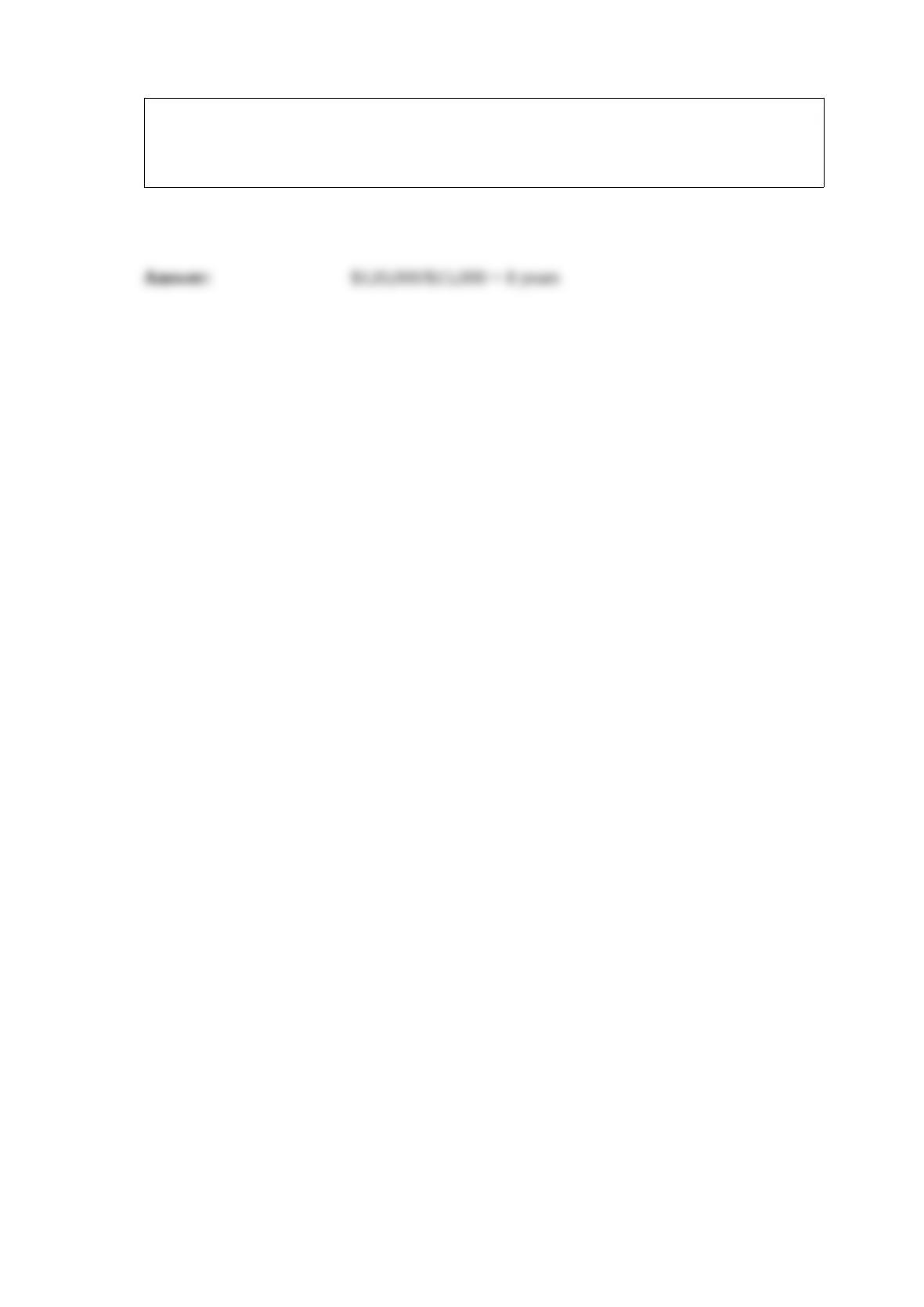
Marple Industries is evaluating a capital project with a net initial investment of
$120,000. The project is expected to generate net cash inflows of $15,000 each year.
Calculate the payback period for the project.