To do an audit, it is necessary to have information in a verifiable form and some criteria
by which the auditor can evaluate the information.
Required:
A) What information and criteria would a public accounting firm use when auditing a
company’s financial statements?
B) What information and criteria would a Canada Revenue Agency auditor use when
auditing that same company’s tax return?
C) What information and criteria would an internal auditor use when performing an
operational audit to evaluate whether the company’s computerized payroll processing
system is operating efficiently and effectively?
Internal controls can never be regarded as completely effective. Even if systems
personnel could design an ideal system, its effectiveness depends on the
A) adequacy of the computer system.
B) proper implementation by management.
C) ability of the internal audit staff to maintain it.
D) competency and dependability of the people using it.

Enron and Equity Funding are companies that suffered from large frauds by corporate
management. One important lesson with respect to such cases is that
A) when a company does really well financially it is important to suspect that such
results are always inflated.
B) an investigation of the integrity of management is an important part of deciding
upon the extent of audit work.
C) securities and exchange commissions expect auditors to be perfect in their
assessment of management.
D) partners and staff should cooperate in preparing working papers that prove the
accuracy of the financial statements.
Three conditions for fraud are referred to as the “fraud triangle.” One of the sides of this
triangle is incentives or pressures. The other two sides are
A) opportunities, a desire to meet debt repayment obligations.
B) opportunities, attitudes or rationalizations.
C) attitudes or rationalizations, the need to maintain stock prices.
D) the need to maintain stock prices and meet debt repayment obligations.

Which one of the following audit procedures is a dual-purpose test?
A) Conduct analytical review to determine the reasonableness of the bad debt
allowance.
B) Examine credit limit changes for authorization.
C) Calculate the accuracy of the accounts receivable aging.
D) Observe error message when incorrect customer number is entered.
Which of the following components of an engagement letter would apply to both a
review engagement and a compilation engagement?
A) negative assurance will be provided, so there is no assurance that fraud will be
detected
B) no assurance will be provided, since only mathematical accuracy will be verified
C) procedures used during the engagement will be limited to analytical review and
inquiry
D) a statement that an audit is not to be performed and that no opinion will be expressed

Who is responsible for developing financial statement audit and assurance standards in
Canada?
A) AASB (Auditing and Assurance Standards Board)
B) Standards staff at the CICA (Canadian Institute of Chartered Accountants)
C) National accounting bodies such as CGA Canada
D) The accounting firms who conduct financial statement audits
Auditing should be done by a qualified
A) chartered accountant.
B) certified management accountant.
C) competent and independent person.
D) professional accountant.
IFRS, ASPE and ASNPO require that related party transactions be disclosed. Gregorio

Limited has a materiality threshold of $50,000. Which of the following standards apply
to the disclosure of related party transactions for Gregorio Limited? Disclose
A) all transactions that are greater than the current year’s materiality.
B) all related party transactions, even those below materiality.
C) those related party transactions that relate to officers or directors of the corporation.
D) those related party transactions that could affect the decisions of a user.
The audit procedures for the subsequent events review can be divided into two
categories: (1) procedures normally integrated as a part of the verification of year-end
account balances, and (2) those performed specifically for the purpose of discovering
subsequent events. Which of the following procedures are in category 1?
A) Make inquiries of client regarding contingent liabilities.
B) Obtain a letter of representation written by client.
C) Examine subsequent period sales and purchases transactions to determine whether
the cutoff is accurate.
D) Review the minute book to determine the existence of any transaction related to year
1.
Your PA firm has just obtained a new client and you have been assigned the task of

preparing the knowledge of business section of the file. Which of the following best
describes the process of gathering the knowledge of business for a client?
A) discussing processes and business objectives with company employees
B) gathering information about the industry and regulatory environment
C) understanding the client’s business, industry, and regulatory environment
D) examining the legal expenses file for possible regulatory infractions
One of the ways to prevent the use of fictitious suppliers to steal company funds is by
A) having adequate network access controls to prevent unauthorized access to
transaction files.
B) ensuring that accounts payable programs are available only in source code.
C) having software automatically check for duplicate invoice numbers before payment.
D) having authorized personnel carefully scrutinize documentation supporting
payments.
Which of the following areas is considered to have a high risk of fraud in the retail
industry?
A) point-of-sale sales

B) customer refunds
C) credit sales
D) completeness of payroll
Since the audit of accounts payable generally takes a considerable amount of audit time,
effective internal controls, properly tested, can significantly reduce audit costs by
reducing
A) tests of controls.
B) confirmations.
C) tests of details of balances.
D) analytical procedures.
Many PAs prepare tax returns for individuals and for corporations. Under what
circumstances is liability insurance required to cover the preparation of tax returns?
When
A) the PA is a member of a professional accounting association.
B) any number of tax returns are prepared, including no charge tax returns.

C) fees are being charged and more than a handful of returns are being prepared.
D) the bulk of the PA’s income comes from preparing tax returns.
Which of the following is an advantage of a review engagement as compared to an
audit engagement? For the review engagement
A) information risk is reduced more than for an audit.
B) the documentation to be provided by the client is greater.
C) the financial statements assessed will have more detail.
D) it requires considerably less work, so is less costly.
A procedure designed to test for dollar errors or irregularities directly affecting the
correctness of financial statement balances is a
A) substantive test.
B) analytical test.
C) test of controls.
D) definition of dollar-unit sampling.

The audit objective to determine that notes payable in the schedule exist is verified by
the tests of balances procedure to
A) foot the notes payable list.
B) confirm notes payable.
C) recalculate interest expense.
D) examine the balance sheet for proper disclosure of noncurrent portions.
What type of audit test is a proof of cash?
A) Test of control
B) Test of details
C) Dual-purpose
D) Analytical review

The most reliable evidence from confirmations is obtained when they are sent
A) several months before the year-end, so the auditor will have adequate time to
perform alternate procedures if they are required.
B) at various times throughout the year to different sections of the sample, so that the
entire sample is representative of account balances scattered throughout the year.
C) as close to the balance sheet date as possible.
D) at various times throughout the year to the same group in the sample, so that the
sample will not have a time bias.
During the audit engagement, the primary auditor may rely on other individuals, such as
specialists, other auditors and internal auditors (secondary auditors). The primary way
to defend the auditor against negligence should such other individuals conduct poor
quality work is whether the
A) other individuals were professionals with recognized credentials.
B) primary auditor conducted sufficient quality control work with respect to the
secondary auditor.
C) secondary auditor had ever been sued before.
D) the appropriate level of materiality had been used during the conduct of the
engagement.

Which of the following ultimately determines the specific audit procedures necessary to
provide an auditor with a reasonable basis for the expression of an opinion?
A) the audit program
B) the auditor’s professional judgment
C) generally accepted auditing standards
D) the auditor’s working papers
A document prepared for shipment of the goods sold using a trucking company is called
the
A) sales order.
B) bill of lading.
C) sales invoice.
D) customer order.
Which of the following controls could help to prevent unauthorized overtime?
A) review by payroll supervisor of a report that lists all employees whose wage rate
does not match the permanent file

B) print a gap report for all employees who have not submitted their time reports for the
current pay period
C) review by payroll supervisor of a report that lists all employees working more than
44 hours per week
D) have a calculation check for payroll calculations (gross pay less deductions = net
pay)
The underlying reason for a high level of professional conduct, such as exemplified in a
code of conduct, for any profession is
A) the need for public confidence in the quality of service of the profession.
B) that it provides a safeguard to keep unscrupulous people out.
C) that it is required by federal legislation.
D) that it allows licensing agencies to have a yardstick to measure deficient
performance.
The decision of how many items to test must be made by the auditor for each audit
procedure. The sample size for any given procedure
A) will be the same if the same level of assurance is required.
B) must cover the entire period under audit.

C) is focused on high dollar items only.
D) is likely to vary from audit to audit.
The correct cutoff and valuation of accrued salaries and wages
A) is to calculate the exact hours of pay that were earned in the current period and paid
in a subsequent period.
B) is to compute an approximate proportion of the wages that were earned in the current
period and use that amount as the accrual.
C) allows the client to choose between A and B above each year.
D) depends on company policy and whether it is consistently followed.
Management assertions are
A) directly related to auditing standards.
B) directly related to accounting standards.
C) indirectly related to auditing standards.
D) indirectly related to accounting standards.

A major type of assurance service performed by large public accounting firms is
A) audit.
B) review.
C) compilation.
D) management consulting.
The two primary classes of transactions in the sales and collection cycle are
A) sales and sales returns.
B) sales and sales discounts.
C) sales and accounts receivable.
D) sales and cash receipts.
A) State the five specific transaction-related audit objectives for cash receipts and
describe one common test of controls for each objective.
B) Discuss what is meant by proof of cash receipts and explain its purpose.
Chong Manufacturing Limited (CML) is a small manufacturer that supplies parts to the
automotive industry. CML deals primarily with second tier companies, and does not
deal with the car manufacturers directly. Last year, CML was required to implement

EDI (electronic data interchange), otherwise two of its major customers would have
taken their business elsewhere.
The installation was provided by Simon’s Computer Company, a local computer store
with expertise in EDI. One of CML’s customers, Delta Parts Limited, also sent a
purchasing agent to CML to help train staff at CML in the use of EDI and to walk
through the first few transactions with CML accounting personnel to ensure that they
could use the system effectively.
A typical EDI sale is processed as follows:
Delta sends a purchase order to CML, which is received via the internet into an EDI
in-basket. CML empties the EDI in-basket using its EDI software every hour, and the
EDI software edits the purchase order for completeness and obvious errors. If there are
no problems, then the purchase order is printed out and used by CML to process the
order.
Once the order has been processed, CML prepares its shipping documentation and
invoice using its normal packaged accounting software. The shipping document and the
electronic invoice are transferred to the EDI software and placed in an EDI out-basket.
Accounting staff transmit the contents of the EDI out-basket to their customer (e.g.
Delta).
Once Delta receives the electronic shipping documents and electronic invoices, it will
transfer the funds electronically to CML’s bank account to pay for the goods delivered.
This means that CML receives payment much faster than when invoices were mailed to
customers.
Required:
A) What is the impact of the new EDI system on the audit engagement?
B) List some controls that should be included in the new EDI system.
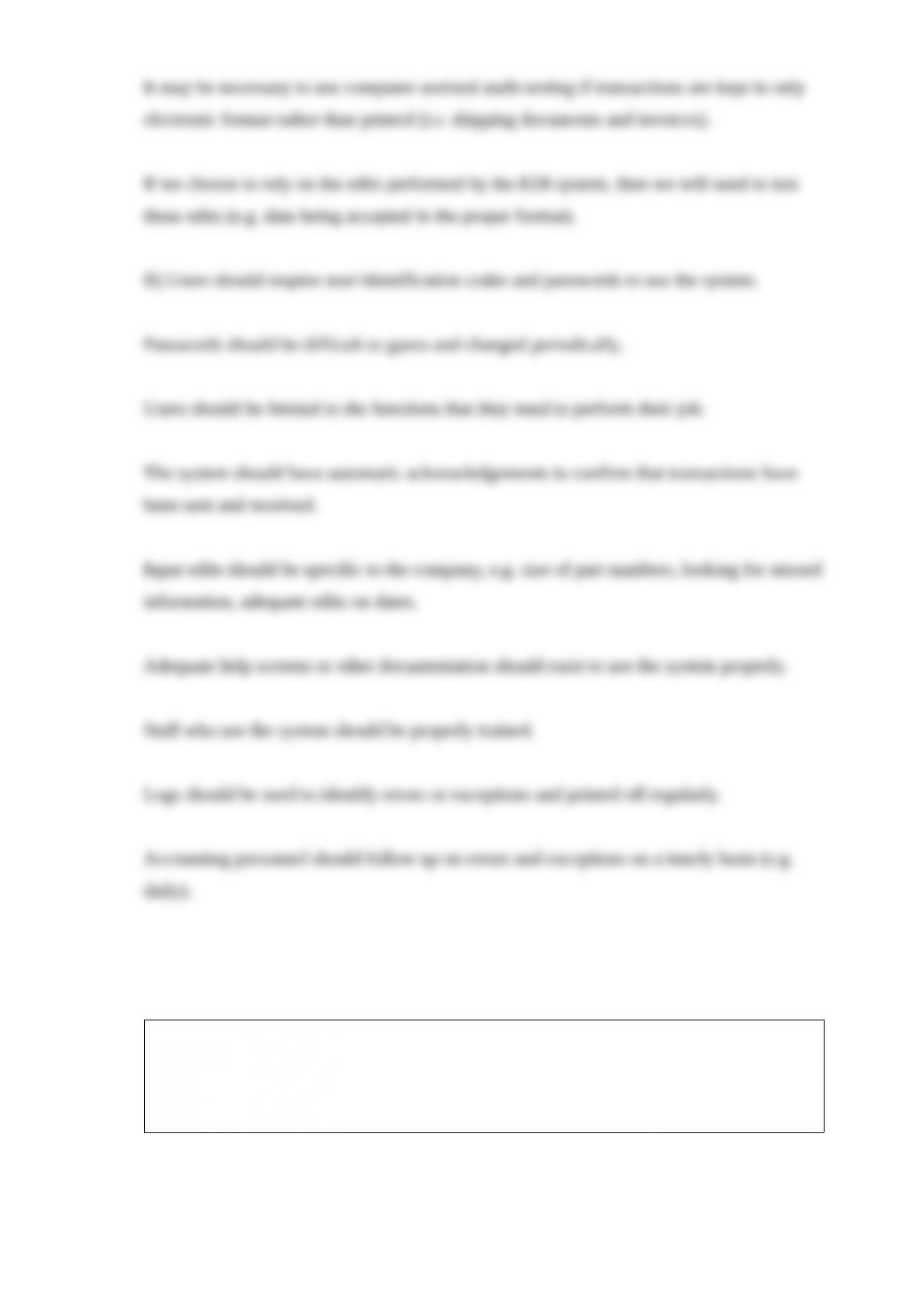
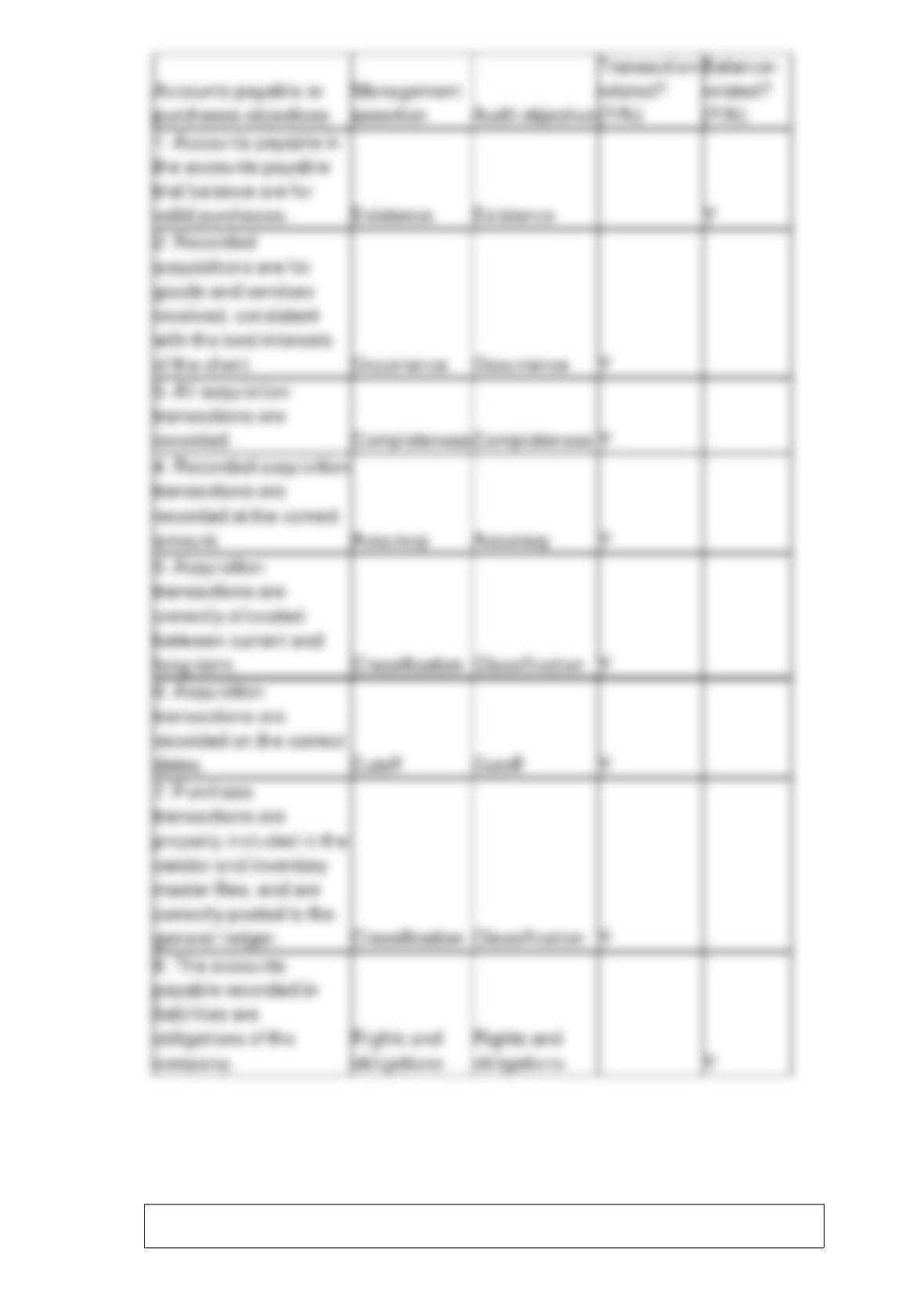
In the following table, there are listed common audit objectives for accounts payable or
purchases. For each procedure, list the management assertion, and the related general
audit objective. State whether the audit objective is transaction-related or
balance-related.
Define “attest engagements.”
Discuss the purpose of a management letter.
Discuss the key internal controls related to the disposal of manufacturing equipment.
There are five conditions that must be met before an auditor can issue a standard
unqualified report. Discuss each of these five conditions.
The controller who had been with Bianca Limited for six years was fired last month,
allegedly for pocketing cash. Unfortunately, there was a fire in the accounting
department the week before he was fired, destroying the accounting records, including
the computer equipment and current backup disks.
The only records available for the current year is a copy of the computer system that is
a month old. There are also disks for the year ends going back three years. These were
at the president’s home, the place where the company kept archival records.
Required:
Explain how this situation might affect the audit process.
What are inventory price tests and inventory compilation tests? Provide an example of
each.

You have been working on the audit of Big Insurance Company for several years now.
There are about 5,000 employees working at the company in various positions.
Your audit partner has indicated that this year, the firm will be implementing computer
assisted audit techniques (CAATs), using generalized audit software. The information
systems audit specialist will be assisting the audit team with the implementation of
these tests. She wants you to provide a draft list of CAATs that could assist with the
coming year’s audit of payroll.
The company uses mainframe computing systems. You need to assume that the typical
payroll information is available on computer files, i.e. employee number, employee
name, social insurance number, department code, payment type code (salaried or
hourly), time worked, wage rate, gross pay, deductions (by type), net pay, and cheque
number.
Required:
Prepare a list of potential computer assisted audit techniques that could be prepared for
the payroll audit. Identify the audit objective to which they relate, and indicate if any
manual procedures are required to supplement the suggested CAAT.
State the six functions that make up the inventory and distribution cycle and, for each
function, identify the related documents and/or records that would be used by a
manufacturing company.
Discuss the ways the accounting profession and society encourage public accountants to
conduct themselves in a professional manner; i.e., the factors that influence the ethical
conduct of audit practitioners.
Describe the professional standards that must be followed when undertaking a
compilation engagement as specified by the CICA Handbook.
Explain four different variations that could occur in unqualified audit reports. For each
variation, state how the auditor’s report is affected and provide an example.
Besides the search for contingent liabilities and the review for subsequent events, the
auditor has four important final evidence accumulation responsibilities, all of which are
required by current professional auditing standards. Discuss each of these four
responsibilities.
Identify and define the seven methods of audit evidence collection. Which two types of
evidence are the most expensive? Which three types of evidence are the least
expensive? Which type of evidence would be most persuasive when testing the
existence objective for long-term assets?
Identify and describe each of the three parts to the Code of Professional Conduct. Also
discuss which parts are officially enforceable and which are not.
First Global is a public company. You are currently performing the audit of the owner’s
equity section and you have been asked to write a short memo about the control
weaknesses you have identified and the potential risk attached to each weakness.
First Global is a public company since March of the current year as it underwent an IPO
during the year. The corporation has been implementing various controls with regards
to keeping records of the company, but it is still a growing company, and Sasha, the
equity accountant, has been having a tough time learning all the new regulations,
keeping the records up to date and ensuring that the dividend payments are made on
time.
First Global issued 2 classes of shares in the IPO. Class A shares with 10 votes were
issued to the Truman family so they could retain control and Class B shares with 1 vote
each were issued to the general public. When you reviewed the accounting records, you
noticed that they contained only one account for capital stocks.
“This is really confusing! I’ve sat in on three audit planning meetings so far, and each
one has gone differently. I’ve been responsible for the sales section each time. Sure the
risks are all different, but in the first one I’m supposed to do flowcharts and detailed
narrative for the sales systems, in the second one I’m supposed to use the firm’s
computerized system to answer detailed questions, and in the last one the partner only
wants a brief description of the system in narrative form – no more than one page, he
said.”
Required:
Explain why it may be necessary to do different types of documentation to support an
understanding of internal controls, in the context of risks and evidence mix.
Outline the three performance standards of CICA Handbook section 5025, “Standards
for Assurance Engagements.”
Discuss the overall objectives of the audit of notes payable.