
1) A depreciable asset has an estimated 15% salvage value. At the end of its estimated
useful life, the accumulated depreciation would equal the original cost of the asset
under which of the following depreciation methods?
Straight-lineProductive Output
a.YesNo
b.YesYes
c.No Yes
d.NoNo
2) Pisa, Inc. leased equipment from Tower Company under a four-year lease requiring
equal annual payments of $172,076, with the first payment due at lease inception. The
lease does not transfer ownership, nor is there a bargain purchase option. The
equipment has a 4-year useful life and no salvage value. Pisa, Inc.s incremental
borrowing rate is 10% and the rate implicit in the lease (which is known by Pisa, Inc.) is
8%. Assuming that this lease is properly classified as a capital lease, what is the amount
of interest expense recorded by Pisa, Inc. in the first year of the assets life?
PV Annuity DuePV Ordinary Annuity
8%, 4 periods 3.57710 3.31213
10%, 4 periods 3.48685 3.16986
a.$0
b.$49,241
c.$35,477
d.$45,596
3) Which of the following is considered research and development costs?
a.Planned search or critical investigation aimed at discovery of new knowledge
b.Research costs incurred under contract with another company
c.Commissions to sales staff marketing a new product
d.Cost of marketing research to promote a new product
4) For each of the following items, indicate the type of accounting change and how
each is recognized in the accounting records in the current year.
(a)Change from straight-line method of depreciation to sum-of-the-years’-digits
(b)Change from the cash basis to accrual basis of accounting
(c)Change from FIFO to LIFO method for inventory valuation purposes (retrospective
application impractical)
(d)Change from presentation of statements of individual companies to presentation of
consolidated statements
(e)Change due to failure to record depreciation in a previous period
(f)Change in the realizability of certain receivables
(g)Change from LIFO to FIFO method for inventory valuation purposes
5) The allowance for doubtful accounts, which appears as a deduction from accounts
receivable on a balance sheet and which is based on an estimate of bad debts, is an
application of the
a.consistency characteristic
b.expense recognition principle
c.materiality quality
d.revenue recognition principle
6) On June 30, 2015, Falk Co. sold equipment to an unaffiliated company for
$1,000,000. The equipment had a book value of $900,000 and a remaining useful life of
10 years. That same day, Falk leased back the equipment at $10,000 per month for 5
years with no option to renew the lease or repurchase the equipment. Falks rent expense
for this equipment for the year ended December 31, 2015, should be
a.$240,000
b.$60,000
c.$100,000
d.$80,000

7) At December 31, 2015, Jeter Corporation had the following equity securities that
were purchased during 2015, its first year of operation:
FairUnrealized
Cost ValueGain (Loss)
Trading Securities:
SecurityA$ 85,000$ 60,000$(25,000)
B 15,000 20,000 5,000
Totals$100,000$ 80,000$(20,000)
Available-for-Sale Securities:
SecurityY$ 70,000$ 80,000$ 10,000
Z 85,000 55,000 (30,000)
Totals$155,000$135,000$(20,000)
All market declines are considered temporary. Fair value adjustments at December 31,
2015 should be established with a corresponding charge against
IncomeStockholders Equity
a.$40,000$ 0
b.$25,000$30,000
c.$20,000$20,000
d.$20,000$ 0
8) Cooper Construction Company had a contract starting April 2015, to construct a
$18,000,000 building that is expected to be completed in September 2017, at an
estimated cost of $16,500,000. At the end of 2015, the costs to date were $7,590,000
and the estimated total costs to complete had not changed. The progress billings during
2015 were $3,600,000 and the cash collected during 2015 was 2,400,000.
At December 31, 2015 Cooper would report Construction in Process in the amount of:
a.$690,000
b.$7,590,000
c.$8,280,000
d.$7,080,000
9) In recent year Cey Corporation had net income of $500,000, interest expense of
$100,000, and a times interest earned ratio of 9. What was Cey Corporation’s income
before taxes for the year?
a.$1,000,000
b.$900,000
c.$800,000
d.None of these answers are correct.

10) Ferguson Company has the following cumulative taxable temporary differences:
12/31/1512/31/14
$2,700,000$1,920,000
The tax rate enacted for 2015 is 40%, while the tax rate enacted for future years is 30%.
Taxable income for 2015 is $4,800,000 and there are no permanent differences.
Ferguson’s pretax financial income for 2015 is
a.$7,500,000
b.$5,580,000
c.$4,020,000
d.$2,100,000
11) Xanthe Corporation had the following transactions occur in the current year:
1>Cash sale of merchandise inventory.
2>Sale of delivery truck at book value.
3>Sale of Xanthe common stock for cash.
4>Issuance of a note payable to a bank for cash.
5>Sale of a security held as an available-for-sale investment.
6>Collection of loan receivable.
How many of the above items will appear as a cash inflow from investing activities on
a statement of cash flows for the current year?
a.Five items
b.Four items
c.Three items
d.Two items
12) Which one of the following disclosures should be made in the equity section of the
balance sheet, rather than in the notes to the financial statements?
a.Dividend preferences
b.Liquidation preferences
c.Call prices
d.Conversion or exercise prices
13) Barton Company uses a periodic inventory system. On January 1, 2014, Barton
Company had 1,200 units of inventory on hand at a cost of $8 per unit. During 2014,
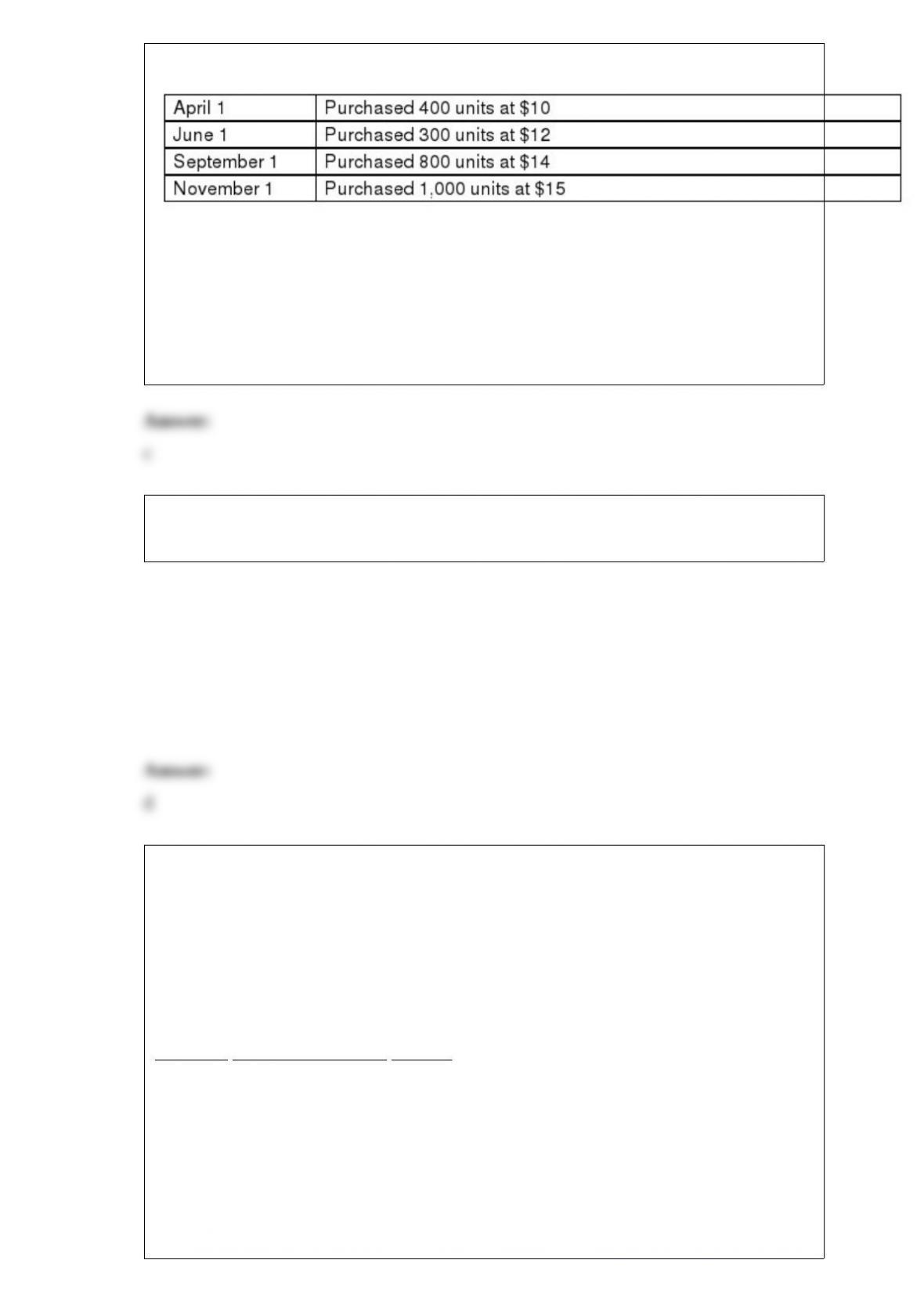
Barton made the following inventory purchases.
Assume Barton Company sold 2,300 units of inventory during 2014 .
If you assume that Barton follows IFRS and uses the Average-cost method, what is the
ending inventory and cost of goods sold, respectively?
a.Ending inventory = $11,600; Cost of Goods Sold = $31,800
b.Ending inventory = $16,520; Cost of Goods Sold = $26,880
c.Ending inventory = $16,422; Cost of Goods Sold = $26,978
d.Ending inventory = $20,600; Cost of Goods Sold = $22,800
14) The most significant current source of generally accepted accounting principles is
the
a.AICPA
b.SEC
c.APB
d.FASB
15) Gage Co. purchases land and constructs a service station and car wash for a total of
$360,000. At January 2, 2014, when construction is completed, the facility and land on
which it was constructed are sold to a major oil company for $400,000 and immediately
leased from the oil company by Gage. Fair value of the land at time of the sale was
$40,000. The lease is a 10-year, noncancelable lease. Gage uses straight-line
depreciation for its other various business holdings. The economic life of the facility is
15 years with zero salvage value. Title to the facility and land will pass to Gage at
termination of the lease. A partial amortization schedule for this lease is as follows:
Payments InterestAmortization Balance
Jan. 2, 2014$400,000.00
Dec. 31, 2014$65,098.13$40,000.00$25,098.13374,901.87
Dec. 31, 201565,098.1337,490.1927,607.94347,293.93
Dec. 31, 201665,098.1334,729.3930,368.74316,925.19
What is the discount rate implicit in the amortization schedule presented above?
a.12%
b.10%
c.8%

d.6%
16) On January 1, 2014, Kline Company decided to begin accumulating a fund for asset
replacement five years later. The company plans to make five annual deposits of
$50,000 at 9% each January 1 beginning in 2014 . What will be the balance in the fund,
on January 1, 2019 (one year after the last deposit)? The following 9% interest factors
may be used.
Present Value ofFuture Value of
Ordinary AnnuityOrdinary Annuity
4 periods3.23974.5731
5 periods3.88975.9847
6 periods4.48597.5233
a.$326,165
b.$299,235
c.$272,500
d.$250,000