
With activity-based costing, the goal is to
a. Develop a product cost that captures the amount of each resource consumed by the
activities performed to produce a specific product.
b. Develop a product cost that allocates manufacturing overhead to each resource
consumed by the activities performed to a group of similar products.
c. Develop a product cost that eliminates all waste such as machine down time and
defective products.
d. None of these answer choices are correct..
One thing that is missing from GAAP-based segment reporting is a breakdown of
a. Product and period costs.
b. Cost of goods sold and operating costs.
c. Variable and fixed costs.
d. Gross margin and net income.
Finished Goods Inventory decreases by the
a. Cost of goods manufactured.
b. Overhead applied.
c. Cost of selling the product.

d. Cost of goods sold.
Which of the following items would most likely differ on the Cash Budget and the
Budgeted Income Statement?
a. Rent expense
b. Research and development expense
c. Sales Commissions expense
d. Depreciation expense
The return on assets ratio measures
a. How well current assets are used to provide cash for the purchase of long-term assets.
b. How well a company’s assets create sales revenue.
c. How well a company manages its assets.
d. How well assets have been employed in conducting the business.

Which of the following is not a reason that managers use activity-based costing
information?
a. Pricing decisions
b. Distribution channel profitability decisions
c. Product costing
d. All of these answer choices are reasons that managers use activity-based costing
information
Companies that mass-produce similar products or employ a continuous production
process typically use which of the following costing systems?
a. Job order
b. Process
c. Accumulation
d. Variable
The 2013 and 2014 partial balance sheets for Ottoman Manufacturing Company appear
below:
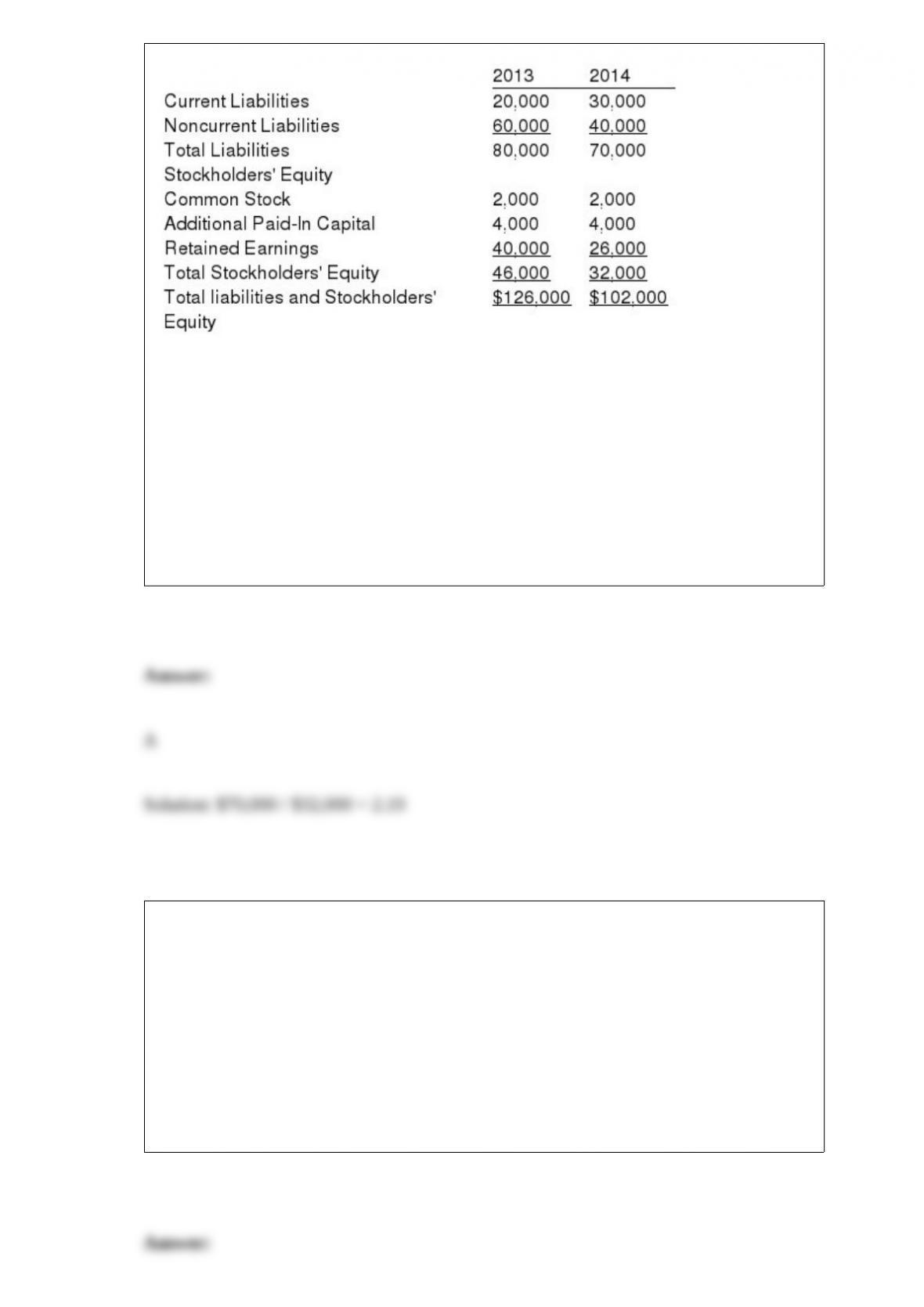
What is the debt-to-equity ratio for 2014?
a. 2.19
b. 1.80
c. 1.25
d. 0.46
To determine the present value of any future amount, you need to know all of the
following except?
a. The interest rate
b. The future amount to be received
c. Screening rate
d. When the future amount will be received

When using a standard costing system, which of the following should be recorded when
direct materials are transferred to the production floor?
a. Debit raw materials inventory for the actual amount at the standard price and credit
work in process for the actual amount at the standard price
b. Debit raw materials inventory for the standard amount at the standard price and credit
work in process for the actual amount at the actual price with a debit or credit to direct
material quantity variance
c. Credit raw materials inventory for the standard amount at the standard price and debit
work in process for the standard amount at the actual price with a debit or credit to
direct material quantity variance
d. Credit raw materials inventory for the actual amount at the standard price and debit
work in process for the standard amount at the standard price with a debit or credit to
direct material quantity variance
Which of the following is the most unbiased transfer price?
a. Market-based price
b. Cost-based price
c. Negotiated price
d. Intercompany relay price

Revenues a customer generates less cost of goods associated with those revenues and
the selling expenses allocated based on the customer-specific selling activities is
referred to as
a. Customer revenue margin
b. Times revenue earned per customer
c. Customer profit margin
d. Customer net profit
The best measures relate to corporate strategy and SMART. Which of the following is
not a component of SMART?
a. Tangible
b. Measurable
c. Relevant
d. Specific
Which of the following would be a likely activity driver for product design?
a. Number of product lines

b. Number of direct labor hours
c. Number of machine hours
d. Number of batches
When using the balanced scorecard to monitor performance, the financial perspective
answers which of the following questions?
a. Are we developing employees and providing technologies that facilitate change and
improvement?
b. Are we creating products and hiring employees with skills to create product and
deliver them in a timely manner?
c. How do investors see us?
d. Are we growing in a manner to be competitive in the industry?
Since external users of financial statements have no way to verify the reported
information
a.They cannot make informed decisions from financial information.
b.FASB provides consequences to companies who distribute false managerial
accounting reports to outsiders.
c.GAAP provides a level of protection or assurance that the reports will follow certain
standards.

d.None of these answer choices are correct.
An example of an organization-level activity is
a. Providing electricity to the factory to run the sewing machines.
b. Creating a pattern for a new line of dresses.
c. Renting factory space.
d. All of these answer choices are organization-level activities.
A dance studio is considering a plan to add ballroom dance to its offerings. Which of
the following is a relevant consideration in this decision?
a. Will the studio have to hire an additional instructor?
b. Will another class have to be dropped if ball room dancing is offered?
c. Is there a demand for ballroom dancing?
d. All of these answer choices are relevant considerations in the decision.
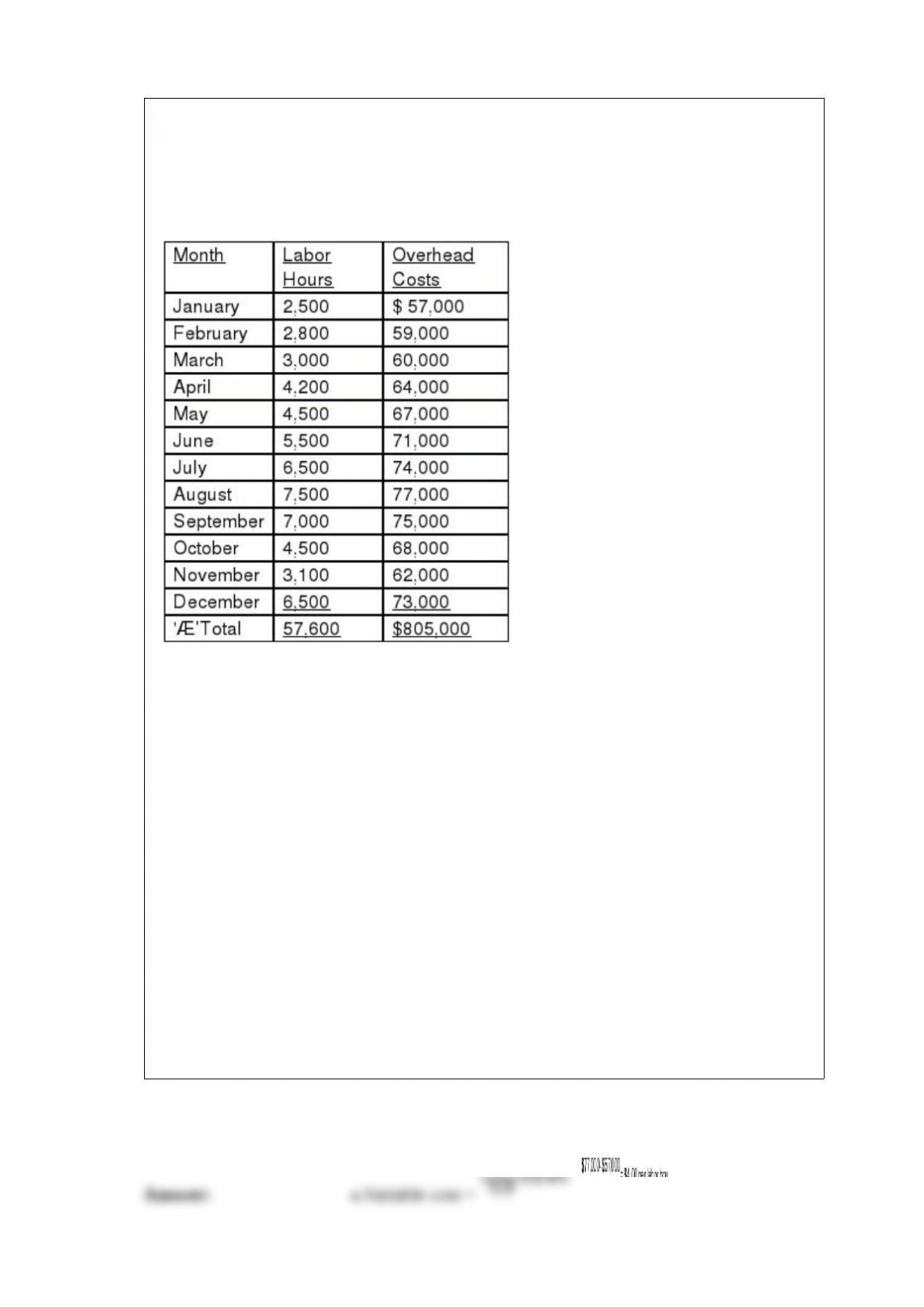
Bailey Jones owns a catering company that stages banquets and parties for both
individuals and companies. The business is seasonal, with heavy demand during the
summer months and year-end holidays and light demand at other times. Bailey has
gathered the following cost information from the past year:
Required:
a.Using the high-low method, compute the overhead cost per labor hour and the fixed
overhead cost per month.
b.Bailey has booked 2,800 labor hours for the coming month. How much overhead
should he expect to incur?
c.If Bailey books one more catering job for the month, requiring 200 labor hours, how
much additional overhead should he expect to incur?
d.Bailey recently attended a meeting of the local Chamber of Commerce, at which he
heard an accounting professor discuss regression analysis and its business applications.
After the meeting, Bailey enlisted the professor’s assistance in preparing a regression
analysis of the overhead data he collected. This analysis yielded an estimated fixed cost
of $48,000 per month and a variable cost of $4 per labor hour. Why do these estimates
differ from your high-low estimates, calculated in part (a)?