1) A multiple-step income statement format shows detailed computations of net sales
and other costs and expenses, and reports subtotals for various classes of items.
2) Liquidity refers to a company’s ability to pay its near-term obligations.
3) Sales variances allow managers to focus on sales mix as well as sales quantities.
4) A procedure called direct posting of sales invoices can substitute for the sales journal.
5) A partnership is an unincorporated association of two or more people to pursue a
business for profit as co-owners.
6) A sunk cost will change with a future course of action.
7) A cash coverage ratio of less than 1 indicates cash inadequacy to meet asset growth.
8) Total variable costs change proportionately with changes in output activity.
9) TechCom’s customer, RDA, paid off an $8,300 balance on its account receivable.
TechCom should record the transaction as a debit to Accounts Receivable-RDA and a
credit to Cash.
10) If goods are shipped FOB shipping point, the seller does not record revenue from
the sale until the goods arrive at their destination because the transaction is not
complete until that point.
11) The task of preparing a budget should be the sole task of the most important
department in an organization.
12) The percent change is computed by subtracting the analysis period amount from the
base period amount, dividing the result by the base period amount and multiplying that
result by 100.
13) On April 30, a three-year insurance policy was purchased for $18,000 with
coverage to begin immediately. What is the amount of insurance expense that would
appear on the company’s income statement for the year ended December 31?
A.$500
B.$4,000
C.$6,000
D.$14,000
E.$18,000
14) A company purchased a delivery van for $23,000 with a salvage value of $3,000 on
September 1, Year 1. It has an estimated useful life of 5 years. Using the straight-line
method, how much depreciation expense should the company recognize on December
31, Year 1?
A.$1,000
B.$1,333
C.$1,533
D.$4,000
E.$4,600
15) If a company mistakenly forgot to record depreciation on office equipment at the
end of an accounting period, the financial statements prepared at that time would show:
A.Assets overstated and equity understated
B.Assets and equity both understated
C.Assets overstated, net income understated, and equity overstated
D.Assets, net income, and equity understated
E.Assets, net income, and equity overstated
16) A company that has operated with a 30% average gross profit ratio for a number of
years had $100,000 in sales during the first quarter of this year. If it began the quarter
with $18,000 of inventory at cost and purchased $72,000 of inventory during the
quarter, its estimated ending inventory by the gross profit method is:
A.$30,000
B.$21,000
C.$20,000
D.$18,000
E.$27,000
17) The amount by which overhead incurred during a period exceeds the overhead
applied to jobs is:
A.Balanced overhead
B.Predetermined overhead
C.Actual overhead
D.Underapplied overhead
E.Overapplied overhead
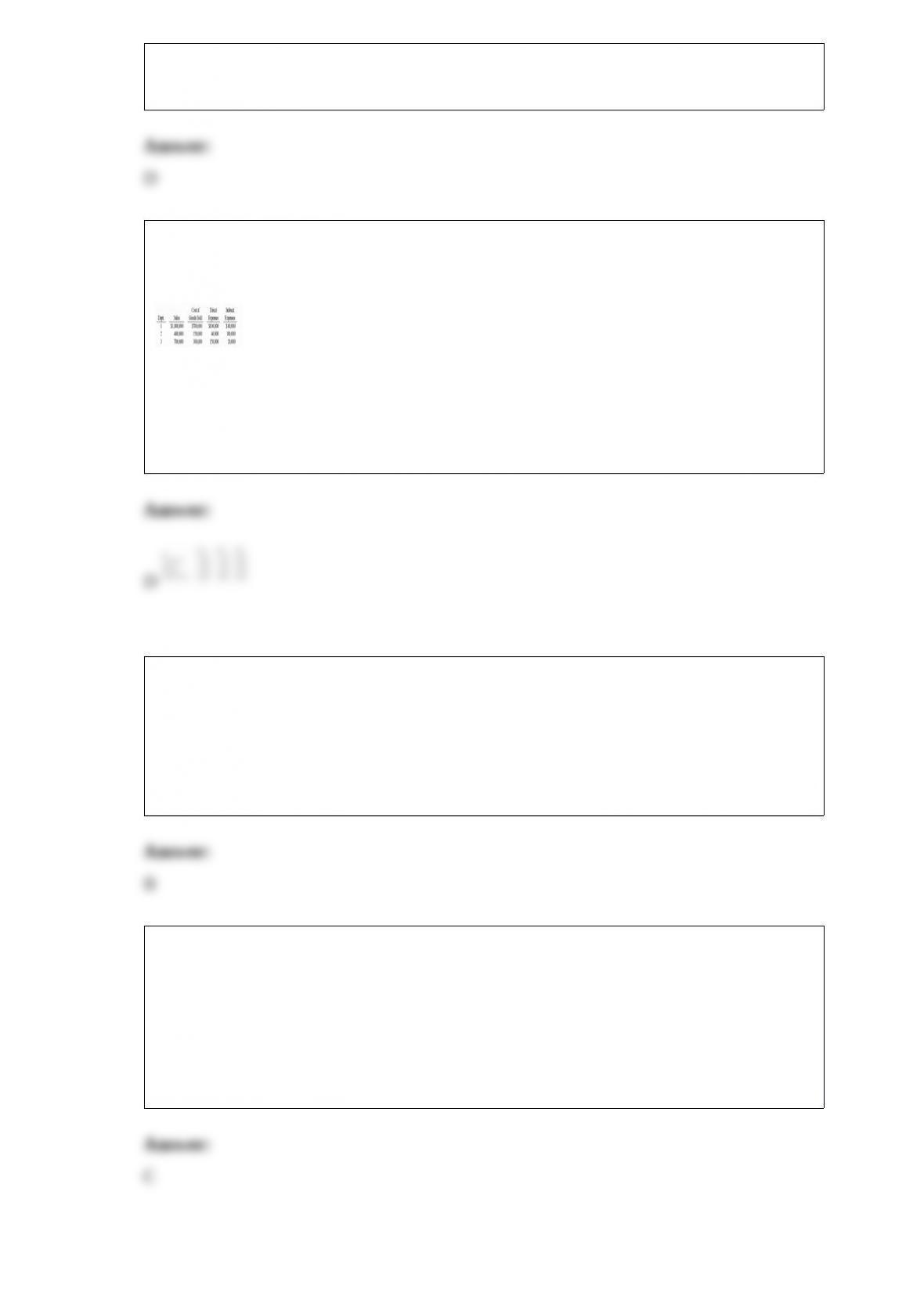
18) Mach Co. operates three production departments as profit centers. The following
information is available for its most recent year. Which department has the greatest
departmental contribution to overhead and what is the amount contributed?
A.Dept. 3; $400,000
B.Dept. 1; $1,000,000
C.Dept. 2; $100,000
D.Dept. 3; $250,000
E.Dept. 2; $150,000
19) The adjusting entry to record an accrued revenue is:
A.Increase an expense; increase a liability
B.Increase an asset; increase revenue
C.Decrease a liability; increase revenue
D.Increase an expense; decrease an asset
E.Increase an expense; decrease a liability
20) Which of the following represents the correct formula for calculating cycle time for
a manufacturer?
A.Process time + inspection time – move time – wait time
B.Process time – inspection time + move time + wait time
C.Process time + inspection time + move time + wait time
D.Process time – inspection time – move time – wait time
E.Process time + inspection time + move time – wait time
21) Match each of the following terms with the most appropriate definition.
1>Expenses A. The uncertainty about the expected return to be earned.
2>Financial accounting B. Area of accounting aimed at serving the decision making
needs of internal users.
3>Planning C. A financial ratio useful in evaluating management, analyzing and
forecasting profits, and planning activities.
4>Risk D. Creditor’s claims on a company’s assets.
5>Managerial accounting E. Costs of assets or services used to earn revenues.
6>Net income F. Defining the idea, goals, and actions of an organization.
7>Return on assets G. Area of accounting aimed at serving external users.
8>Liabilities H. The excess of revenue over expenses.
22) Docksider Boats uses a job order cost accounting system. During one month
Docksider purchased $153,000 of raw materials on credit; issued materials to
production of $164,000 of which $24,000 were indirect. Docksider incurred a factory
payroll of $95,000, paid in cash, of which $25,000 is classified as indirect labor.
Docksider uses a predetermined overhead application rate of 170% of direct labor cost.
The journal entry to record the application of factory overhead to production is:
A.Debit Goods in Process Inventory $55,800; credit Factory Overhead $55,800
B.Debit Goods in Process Inventory $161,500; credit Factory Overhead $161,500
C.Debit Goods in Process Inventory $119,000; credit Factory Overhead $119,000
D.Debit Factory Overhead $119,000; credit Goods in Process Inventory $119,000
E.Debit Goods in Process Inventory $95,000; credit Factory Payroll $95,000
23) A company borrowed $10,000 by signing a 180-day promissory note at 11%. The
maturity value of the note is:
A.$12,050
B.$12,275
C.$10,550
D.$12,825
E.$13,100
24) Source documents:
A.Are input devices
B.Provide the basic information processed by an accounting system
C.Cannot be electronic files
D.Store processed information for future use
E.Cannot be paper documents
25) Excalibur frequently has accrued expenses at the end of its fiscal year that should be
recorded for proper financial statement presentation. Excalibur pays on a weekly basis
and has $50,000 of accrued salaries incurred but not paid for June 30, its fiscal
year-end. This consists of one day’s accrued salaries for the week. Excalibur will pay its
employees $250,000 on July 4; the one day of accrued salaries and the remaining four
days for July salaries. Record the following entries:
(a) Accrual of the salaries on June 30.
(b) Payment of the salaries on July 4, assuming that Excalibur does not prepare
reversing entries.
(c) Assuming that Excalibur prepares reversing entries, reverse the adjusting entry made
on June 30.
(d) Assuming that Excalibur prepares reversing entries, payment of the salaries on July
4.
26) The Cash Over and Short account:
A.Is used to record a credit balance in the cash account
B.Is an income statement account used for recording the income effects of cash
overages and cash shortages from errors in making change and/or from errors in
processing petty cash transactions
C.Is not necessary in a computerized accounting system
D.Can never have a debit balance
E.Can never have a credit balance
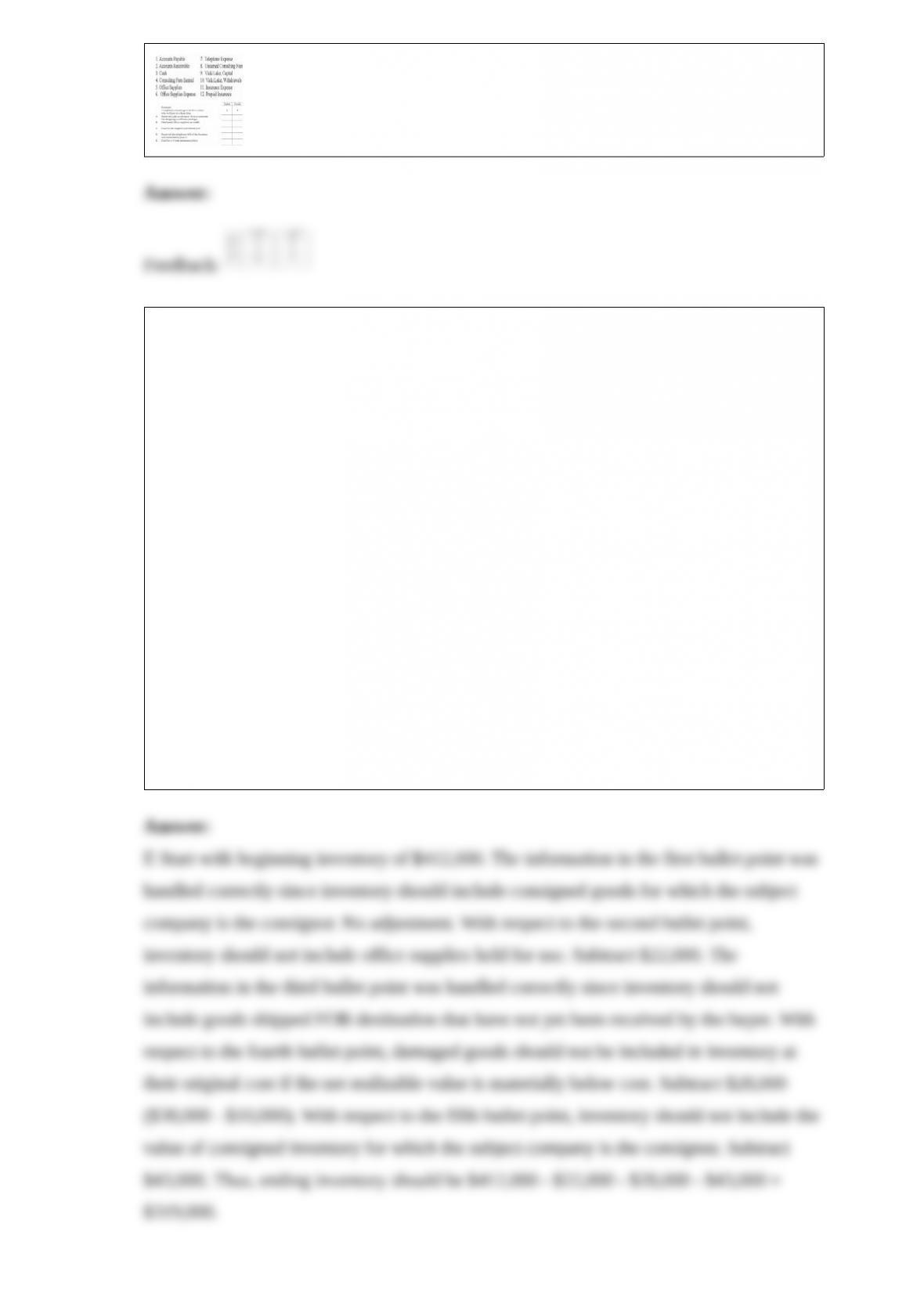
27) Vicki Lake is a computer consultant. Shown below are (a) several accounts in her
ledger with each account preceded by an identification number, and (b) several
transactions completed by Lake. Indicate the accounts debited and credited when
recording each transaction by placing the proper account identification numbers to the
right of each transaction.
28) Gotham Company reported a December 31 ending inventory balance of $412,000.
The following additional information is also available:
The ending inventory balance of $412,000 included $72,000 of consigned inventory for
which Gotham was the consignor.
The ending inventory balance of $412,000 included $22,000 of office supplies that were
stored in the warehouse and were to be used by the company’s supervisors and
managers during the coming year.
The ending inventory balance of $412,000 did not include goods costing $48,000 that
were purchased by Gotham on December 28 and shipped FOB destination on that date.
Gotham did not receive the goods until January 2 of the following year.
The ending inventory balance of $412,000 included damaged goods at their original
cost of $38,000. The net realizable value of the damaged goods was $10,000.
The ending inventory balance of $412,000 included $43,000 of consigned inventory for
which Gotham was the consignee.
Based on this information, the correct balance for ending inventory on December 31 is:
A.$247,000
B.$341,000
C.$362,000
D.$309,000
E.$319,000
29) Bard Manufacturing uses a job order cost accounting system. During one month
Bard purchased $198,000 of raw materials on credit; issued materials to production of
$195,000 of which $30,000 were indirect. Bard incurred a factory payroll of $150,000,
paid in cash, of which $40,000 is classified as indirect labor. Bard uses a predetermined
overhead application rate of 150% of direct labor cost. Bard’s beginning and ending
Goods in Process Inventory are $15,500 and $27,000 respectively. Compute the cost of
product transferred to Finished Goods Inventory:
A.$558,500
B.$440,000
C.$413,000
D.$428,500
E.$415,000
30) The accounting principle that requires accounting information to be based on actual
cost and requires assets and services to be recorded initially at the cash or
cash-equivalent amount given in exchange, is the:
A.Accounting equation
B.Cost principle
C.Going-concern assumption
D.Realization principle
E.Business entity assumption
31) A buyer failed to take advantage of the vendor’s credit terms of 2/15, n/45, but
instead paid the invoice in full at the end of 60 days. By not taking advantage of the
cash discount, the buyer lost the equivalent of ____________ annual interest on the
amount of the purchase.
A.12.2%
B.16.2%
C.18.9%
D.24.3%
E.24.5%
32) Comparative financial statements in which each individual financial statement
amount is expressed as a percentage of a base amount, and in which the base amount is
expressed as 100%, are called:
A.Comparative statements
B.Common-size comparative statements
C.General-purpose financial statements
D.Base line statements
E.Index statements
33) A company shows a $600 balance in Prepaid Insurance in the Unadjusted Trial
Balance columns of the work sheet. The Adjustments columns show expired insurance
of $200. This adjusting entry results in:
A.$200 decrease in net income
B.$200 increase in net income
C.$200 difference between the debit and credit columns of the Unadjusted Trial
Balance
D.$200 of prepaid insurance
E.An error in the financial statements
34) Obsolescence:
A.Occurs when an asset is at the end of its useful life
B.Refers to a plant asset that is no longer useful in producing goods and services with a
competitive advantage
C.Refers to the insufficient capacity of a company’s plant assets to meet the company’s
productive demands
D.Occurs when an asset’s salvage value is less than its replacement cost
E.Does not affect plant assets
35) Which of the following items is reported on the statement of cash flows under
financing activities?
A.Declaration of a cash dividend
B.Payment of a cash dividend
C.Declaration of a stock dividend
D.Payment of a stock dividend
E.Stock split
36) Match each of the following terms with the appropriate definitions.
1>Common-size financial statement A. Examination of financial data across time.
2>Solvency B. The application of analytical tools to general-purpose financial
statements and related data for making business decisions.
3>Vertical analysis C. The availability of resources to meet short-term obligations and
to efficiently generate revenues.
4>Profitability D. A statement with data for two or more successive accounting periods
placed in side-by-side columns, often with changes shown in dollar amounts and
percents.
5>Comparative financial statement E. A company’s ability to provide financial rewards
sufficient to attract and retain capital.
6>Market prospects F. A statement where each amount is expressed as a percent of a
base amount to reveal the relative importance of each financial statement item.
7>Equity ratio G. The comparison of a company’s financial condition and performance
to a base amount.
8>Financial statement analysis H. A company’s ability to generate positive market
expectations.
9>Liquidity and efficiency I. A company’s ability to generate future revenues and meet
long-term obligations.
10>Horizontal analysis J. The portion of total assets provided by equity, computed as
total equity divided by total assets.
37) Financial information for Omega Corporation is presented below. Calculate the
following ratios for 2012:
(a) Inventory turnover.
(b) Accounts receivable turnover.
(c) Return on total assets.
(d) Times interest earned.
(e) Total asset turnover.
38) FICA taxes include:
A.Social Security taxes
B.Charitable giving

C.Employee income taxes
D.Unemployment taxes
E.All of these
39) A corporation issued 300 shares of its $5 par value common stock in payment of a
$1,800 charge from its accountant for assistance in filing its charter with the state. The
entry to record this transaction will include:
A.A $1,800 credit to Common Stock
B.A $1,500 debit to Organization Expenses
C.A $300 credit to Paid-in Capital in Excess of Par Value, Common Stock
D.A $1,800 debit to Legal Expenses
E.A $1,800 credit to Cash
40) A company uses the FIFO method for inventory costing. During a period, a
production department had 20,000 units in beginning goods in process inventory which
were 40% complete; the department completed and transferred 165,000 units. At the
end of the period, 22,000 units were in the ending goods in process inventory and are
75% complete. All of these are with respect to labor. The production department had
labor costs in the beginning goods is process inventory of $99,000 and total labor costs
added during the period are $726,825. Compute the equivalent cost per unit for labor.
A.$4.40
B.$4.76
C.$4.19
D.$4.55
E.$4.61
41) Classify the following activities according to the appropriate section of the
statement of cash flows.
1>Investing activity A. Cash received from a one-time sale of used office equipment.
2>Financing activity B. Cash paid for withdrawals by owners.
3>Financing activity C. Cash received from customers.
4>Investing activity D. Cash received from owner contributions.
5>Operating activity E. Cash paid for utilities.
6>Operating activity F. Cash paid for a delivery van to be used in the business.
42) A company uses the weighted average method for inventory costing. During a
period, Department A finished and transferred 50,000 units to Department B. Also,
during the period, 10,000 units were started but brought only to a stage of being 3/5
completed. The number of equivalent units produced by Department A during the
period was:
A.44,000 units
B.50,000 units
C.54,000 units
D.56,000 units
E.60,000 units
43) Which of the following products is least likely to be produced in a process
manufacturing system?
A.Compact disks
B.Slacks for casual wear
C.Baseball hats
D.Calculators
E.Custom cabinets
44) Salta Company installs a manufacturing machine in its factory at the beginning of
the year at a cost of $87,000. The machine’s useful life is estimated to be 5 years, or
400,000 units of product, with a $7,000 salvage value. During its second year, the
machine produces 84,500 units of product. Determine the machines’ second year
depreciation under the units-of-production method.
A.$16,900
B.$16,000
C.$17,400
D.$18,379
E.$20,880
45) In the absence of a partnership agreement, the law says that income (and loss)
should be allocated based on:
A.A fractional basis
B.The ratio of capital investments
C.Salary allowances
D.Equal shares
E.Interest allowances
46) Cairo Co. uses the allowance method of accounting for uncollectible accounts.
Cairo Co. accepted a $5,000, 12%, 90-day note dated May 16, from Alexandria Co. in
exchange for its past-due account receivable. Make the necessary general journal
entries for Cairo Co. on May 16 and the August 14 maturity date, assuming that the:
a. Note is held until maturity and collected in full at that time.
b. Note is dishonored; the amount of the note and its interest are written off as
uncollectible.
47) A bonus may be paid:
A.By a new partner when the current value of a partnership is greater than the recorded
amounts of equity
B.By a withdrawing partner to remaining partners if the recorded value of the equity is
overstated
C.To a new partner with exceptional talents
D.By remaining partners to a withdrawing partner if the recorded equity is understated
E.All of these
48) The partnership agreement for Smith Wesson & Davis, a general partnership,
provided that profits be shared between the partners in the ratio of their financial
contributions to the partnership. Smith contributed $100,000, Wesson contributed
$60,000 and Davis contributed $20,000. In the partnership’s first year of operation, it
incurred a loss of $210,000. What amount of the partnership’s loss, rounded to the
nearest dollar, should be absorbed by Smith?
A.$70,000
B.$116,667
C.$23,333
D.$105,000
E.$52,500
49) Having external auditors test the company’s financial records and evaluate the
effectiveness of the internal control system is part of the internal control principle of
_______________________.
50)
___________________________ are investments in securities that management
intends to convert to cash within the longer of one year or the operating cycle, and are
readily convertible to cash.
51) On January 1, a company issues bonds with a par value of $300,000. The bonds
mature in 5 years, and pay 8% annual interest, payable each June 30 and December 31.
On the issue date, the market rate of interest for the bonds is 10%. Compute the price of
the bonds on their issue date. The following information is taken from present value
tables:
52) What are the ways that a new partner can be admitted to an existing partnership?
Explain how to account for the admission of the new partner under each of these
circumstances.
53) A company inadvertently produced 3,000 defective products. The product cost $15
each to be manufactured and normally sells for $35 each. A salvage company will
purchase the defective units as they are for $12 each. The production manager reports
that the defects can be corrected for $5 per unit, enabling the company to sell them at a
discounted price of $22.00. The repair operations would not affect other production
operations. Prepare an analysis that shows which action should be taken.
54) Define a note receivable and explain how to calculate the interest due on a
short-term note receivable.
55) A ____________ is a report explaining any differences between the checking
account balance according to the depositor’s records and the balance reported on the
bank statement.
56) _____________________ is a general term that refers to any shares issued to obtain
owner financing in a corporation.
57) After preparing an (unadjusted) trial balance at year-end, G. Chu of Chu Design
Company discovered the following errors:
1> Cash payment of the $225 telephone bill for December was recorded twice.
2> Cash payment of a note payable was recorded as a debit to Cash and a debit to Notes
Payable for $1,000.
3> A $900 cash withdrawal by the owner was recorded to the correct accounts as $90.
4> An additional investment of $5,000 cash by the owner was recorded as a debit to G.
Chu, Capital and a credit to Cash.
5> A credit purchase of office equipment for $1,800 was recorded as a debit to the
Office Equipment account with no offsetting credit entry.
Using the form below, indicate whether the error would cause the trial balance to be out
of balance by placing an X in either the yes or no column.
Would the error cause the trial balance to be out of balance?
Would the error cause the trial balance to be out of balance?
58) Explain the difference between cash and cash equivalents.