
The interest rate that is printed on the bond certificate is not referred to as the: A. Stated
rate.
B. Contract rate.
C. Nominal rate.
D. Effective rate.
Answer:
Listed below are five terms followed by a list of phrases that describe or characterize
each of the terms. Match each phrase with the most correct term. 1) Gross method
2) Net method
3) Lessee’s minimum lease payments
4) Lessor’s net investment
5) PV of bargain purchase option price
A. Deducted in lessor’s computation of rental payments
B. Periodic rent payments plus lessee-guaranteed residual value
C. PV of minimum lease payments plus PV of unguaranteed residual value
D. Lease payable equals PV of minimum lease payments
E. Lease receivable equals sum of minimum lease payments
Answer:

Listed below are five terms followed by a list of phrases that describe or characterize
each of the terms. Match each phrase with the correct term. 1)Provision for income tax
2)Transitory earnings
3)Taxable income
4)Intraperiod tax allocation
5)Prior period adjustment
A. Used as the base for computing taxes currently payable.
B. Associates tax with income statement items.
C. Made to correct a material error.
D. Also known as income tax expense.
E. From transactions or events that are not likely to occur in the foreseeable future.
Answer:
MSG Corporation issued $100,000 of 3-year, 6% bonds outstanding on December 31,
2012 for $106,000. MSG uses straight-line amortization. On May 1, 2013, $10,000 of
the bonds were retired at 112. How much, and what type of gain or loss, most likely
results from this retirement? A. $667 ordinary loss.
B. $667 extraordinary loss.
C. $667 ordinary gain.
D. $667 extraordinary gain.

Answer:
Which of the following is not a change in reporting entity? A. Reporting using
comparative financial statements for the first time.
B. Changing the companies that comprise a consolidated group.
C. Presenting consolidated financial statements for the first time.
D. All are changes in reporting entity.
Answer:
On June 30, 2013, Hardy Corporation issued $10 million of its 8% bonds for $9.2
million. The bonds were priced to yield 10%. The bonds are dated June 30, 2013, and
mature on June 30, 2020. Interest is payable semiannually on December 31 and July 1.
If the effective interest method is used, by how much should the bond discount be
reduced for the six months ended December 31, 2013? A. $32,000.
B. $40,000.
C. $46,000.

D. $60,000.
Answer:
Liquidity refers to: A. The amount of cash on hand at a given time.
B. The readiness of an asset to be converted to cash.
C. The period until cash is used and refinancing becomes necessary.
D. Financial leverage.
Answer:
In a recent annual report, Apple Computer reported the following in one of its
disclosure notes: “Warranty Expense: The Company provides currently for the
estimated cost for product warranties at the time the related revenue is recognized.”

This note exemplifies Apple’s use of: A.Conservatism.
B.The matching principle.
C.Realization principle.
D.Economic entity.
Answer:
The Claxton Company manufactures children’s toys and also has a division that makes
automobile parts. Due to a change in its strategic focus, the company sold the
automobile parts division. The division qualifies as a component of the entity according
to GAAP regarding disposal of long-lived assets. How should Claxton report the sale in
its 2013 income statement? A. Report it as an extraordinary item.
B. Report it as a discontinued operation, reported below income from continuing
operations.
C. Report the income or loss from operations of the division in discontinued operations
below continuing operations and the gain or loss from disposal in continuing
operations.
D. None of the above.
Answer:
B Company switched from the sum-of-the-years-digits depreciation method to
straight-line depreciation in 2013. The change affects machinery purchased at the
beginning of 2011 at a cost of $72,000. The machinery has an estimated life of five
years and an estimated residual value of $3,600. What is B’s 2013 depreciation
expense? A. $9,120.
B. $13,680.
C. $15,840.
D. $19,200.
Answer:
Listed below are account balances (in $ millions) taken from the records of Symphony
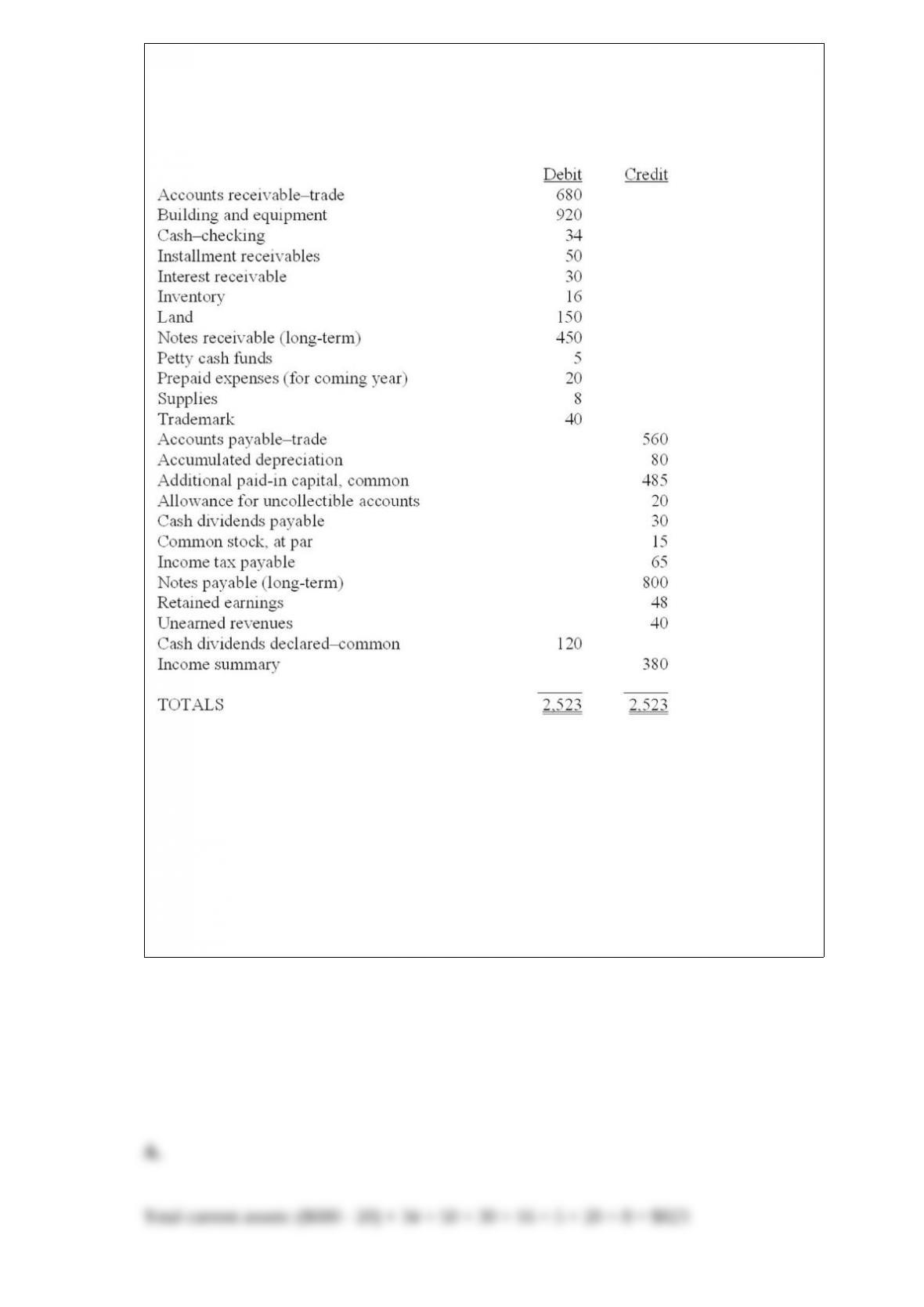
Stores. All of these are permanent accounts, except the last two that have yet to be
closed. The installment receivables are current. Symphony uses a perpetual inventory
system.
What would Symphony report as total current assets?
A. $823.
B. $838.
C. $843.
D. $1,696.
Answer:

When treasury stock is sold at an amount less than its cost, the sale is classified as: A. A
financing activity.
B. An operating activity.
C. A financing activity and an operating activity.
D. An investing activity.
Answer:
The following facts apply to TinyPart Toy Company’s pending litigation as of
December 31, 2013:
a. TinyPart is defending against a lawsuit and believes there is a 51% chance it will lose
in court. If it loses, TinyPart estimates that damages will be $100,000.
b. TinyPart is defending against another lawsuit for which management believes it is
virtually certain to lose in court. If it loses the lawsuit, management estimates damages
will fall somewhere in the range of $30,000 to $50,000, with each amount in that range
equally likely to occur.
c. TinyPart is defending against another lawsuit that is identical to item (b), but the
relevant losses will only occur far into the future. The present values of the endpoints of
the range are $15,000 and $25,000. TinyPart’s management believes the effects of time
value of money on these amounts are material, but also believes the timing of these
amounts is uncertain.
d. TinyPart is defending against a fourth lawsuit and believes there is only a 25%
chance it will lose in court. If TinyPart loses, it believes damages will fall somewhere in
the range of $35,000 to $40,000, with each amount in that range equally likely to occur.
Indicate how TinyPart would disclose or account for the lawsuit described in part (b)
under U.S. GAAP and under IFRS in the financial statements for the year ended
December 31, 2013.
Answer:
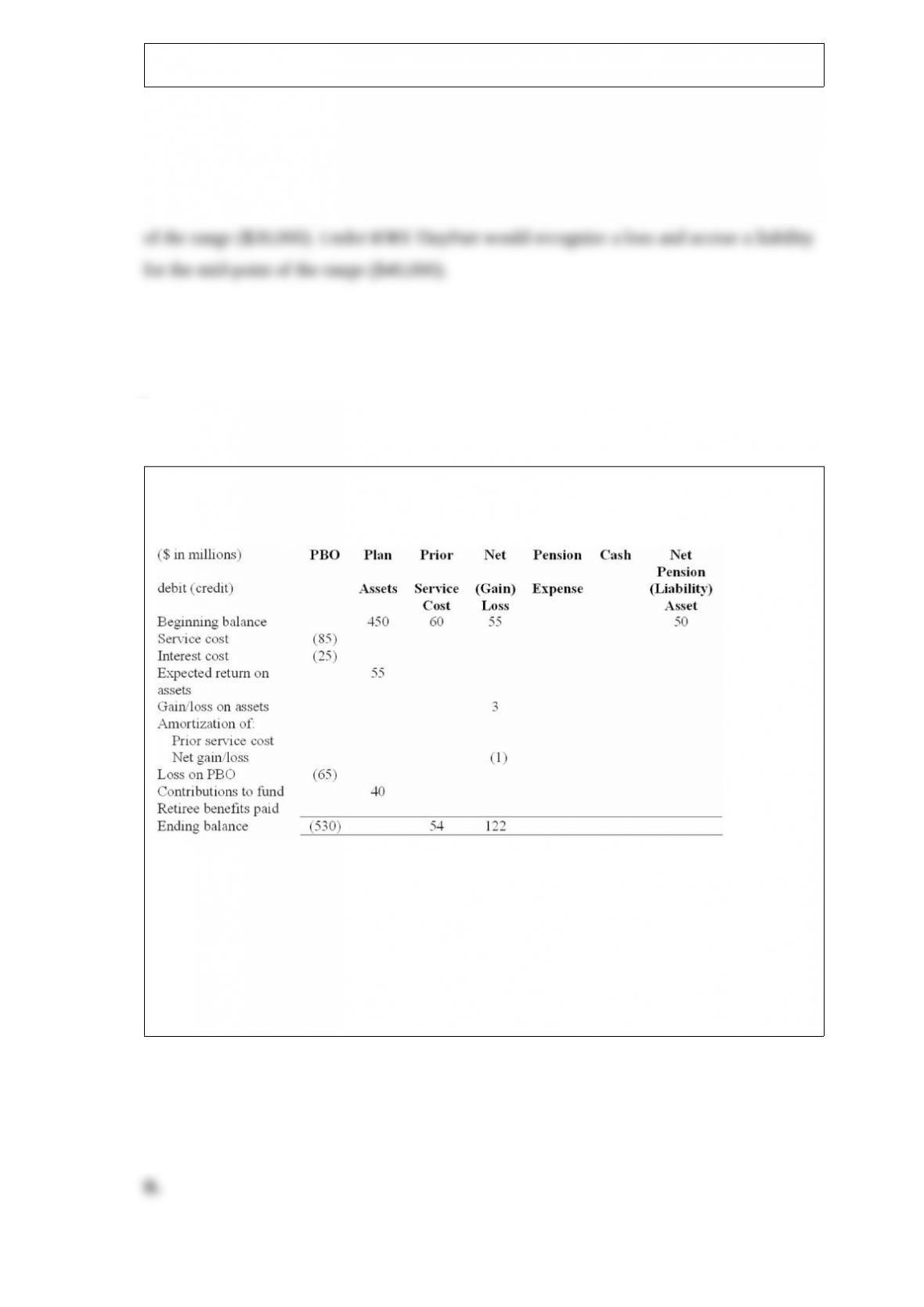
The following refers to the pension spreadsheet (columns have missing amounts) for
the current year for Pancho Villa Enterprises (PVE).
What was the PBO at the beginning of the year? A. $160.
B. $400.
C. $500.
D. $610.
Answer:

Cinnamon Buns Co. (CBC) started 2013 with $52,000 of merchandise on hand. During
2013, $280,000 in merchandise was purchased on account with credit terms of 2/10,
n/30. All discounts were taken. Purchases were all made f.o.b. shipping point. CBC paid
freight charges of $9,000. Merchandise with an invoice amount of $4,000 was returned
for credit. Cost of goods sold for the year was $316,000. CBC uses a perpetual
inventory system
What is cost of goods available for sale, assuming CBC uses the gross method? A.
$312,480.
B. $326,000.
C. $331,480.
D. $337,000.
Answer:
The FASB’s conceptual framework’s qualitative characteristics of accounting
information include: A.Full disclosure.

B.Relevance.
C.Going concern.
D.Historical cost.
Answer:
A loss on the sale of machinery should be reported in the statement of cash flows as: A.
An adjustment to net income under the indirect method.
B. An operating activity under the direct method.
C. An investing activity cash outflow.
D. A noncash investing activity.
Answer:
The capitalized cost of equipment excludes: A. Maintenance.
B. Sales tax.
C. Shipping.
D. Installation.
Answer:
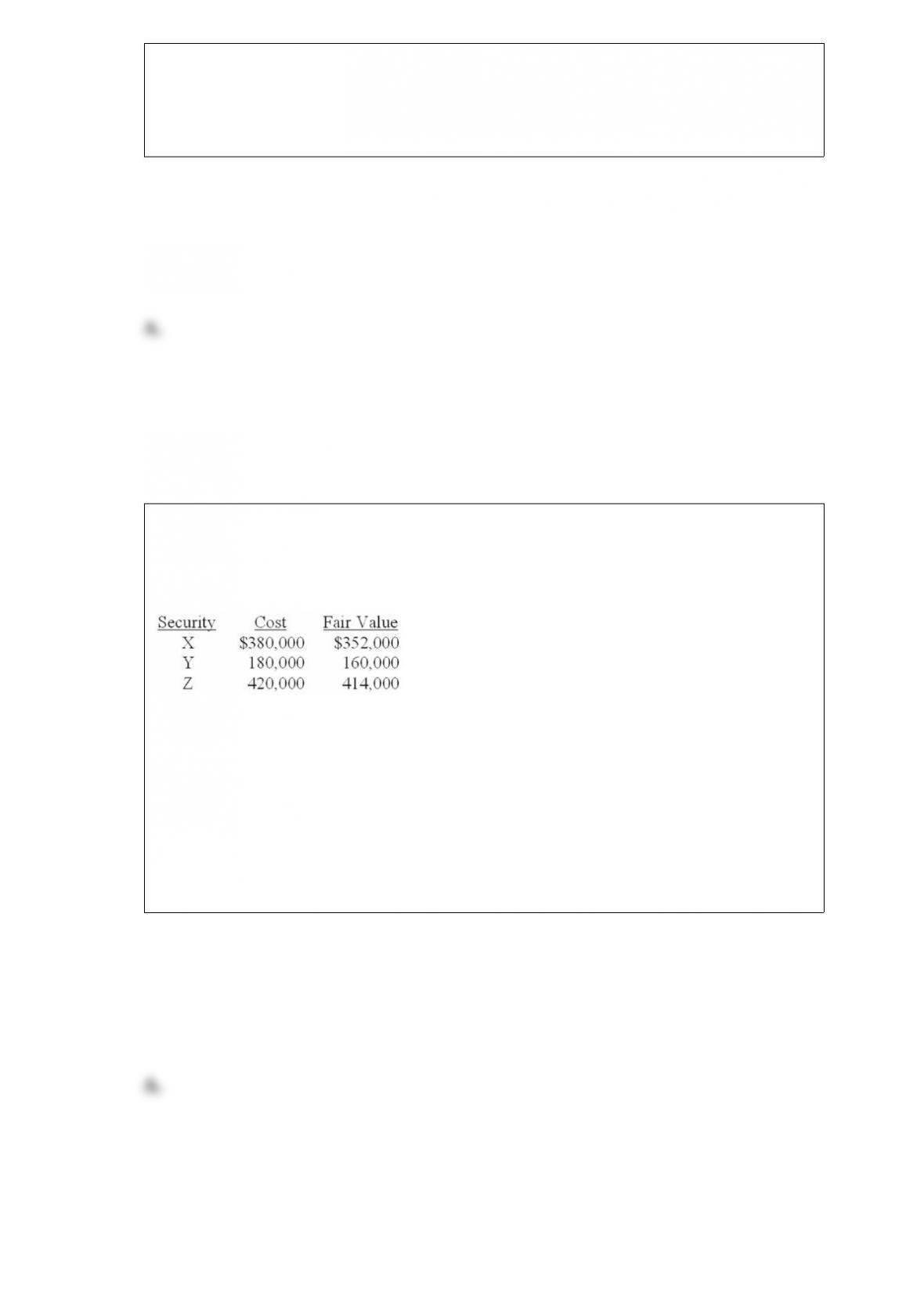
Hobson Company bought the securities listed below during 2012. These securities were
classified as trading securities. In its December 31, 2012, income statement Hobson
reported a net unrealized loss of $13,000 on these securities. Pertinent data at the end of
December 2013 is as follows:
What amount of loss on these securities should Hobson include in its income statement
for the year ended December 31, 2013? A. $41,000.
B. $54,000.
C. $13,000.
D. $0.
Answer:

On January 1, 2013, Packard Corporation leased equipment to Hewlitt Company. The
lease term is eight years. The first payment of $450,000 was made on January 1, 2013.
Remaining payments are made on December 31 each year, beginning with December
31, 2013. The equipment cost Packard Corporation $2,400,000. The present value of
the minimum lease payments is $2,640,000. The lease is appropriately classified as a
sales-type lease. Assuming the interest rate for this lease is 10%, what will be the
balance reported as a liability by Hewlitt in the December 31, 2014, balance sheet? A.
$1,950,000.
B. $1,509,000.
C. $1,959,000.
D. $1,704,900.
Answer:
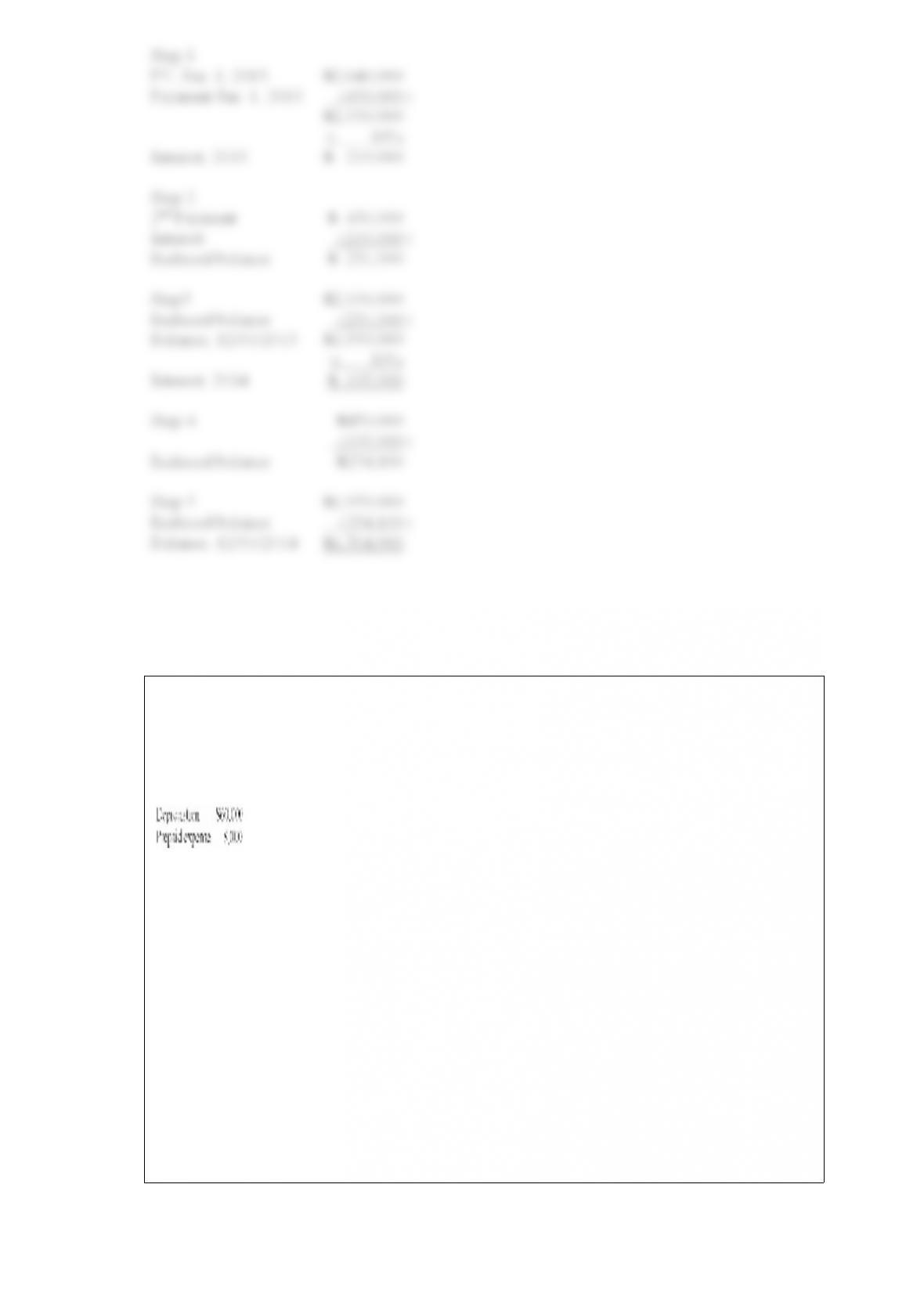
The information that follows pertains to Julia Company:
(a.) Temporary differences for the year 2013 are summarized below.
Expenses deducted in the tax return, but not included in the income statement:
Expenses reported in the income statement, but not deducted in the tax return:
Warranty expense 9,000
(b.) No temporary differences existed at the beginning of 2013.
(c.) Pretax accounting income was $67,000 and taxable income was $8,000 for 2013.
(d.) There were no permanent differences.
(e.) The tax rate is 30%.
Required:Prepare the journal entry to record the tax provision for 2013. Provide
supporting computations.

Answer:
Mann Co. is the lessor in a six-year lease beginning December 31, 2013. The agreement
specifies that Woo Corp. make equal annual lease payments on December 31 of each
year. Under the new ASU, in its 2014 income statement: A. Woo will report interest
expense and amortization expense.
B. Woo will report interest expense and accretion revenue.
C. Mann will report accretion expense and amortization expense.
D. Mann will report accretion expense and interest revenue.
Answer:
Gear Corporation had the following common stock record during the current calendar
year:
What is the number of shares to be used in computing basic EPS? A. 5,500,000.

B. 5,557,500.
C. 5,303,750.
D. 5,050,000.
Answer:
The basic principle used to value an asset acquired in a nonmonetary exchange is to
value it at: A. Fair value of the asset(s) given up.
B. The book value of the asset given plus any cash or other monetary consideration
received.
C. Fair value or book value, whichever is smaller.
D. Book value of the asset given.
Answer:
When selling property, plant, and equipment for cash: A. The seller recognizes a gain or
loss for the difference between the cash received and the fair value of the asset sold.

B. The seller recognizes a gain or loss for the difference between the cash received and
the book value of the asset sold.
C. The seller recognizes losses, but not gains.
D. None of the above.
Answer:
The Racquet Store (RS) sells franchise agreements in which it charges an up-front fee
of $50,000 for assistance in setting up a store, and then a monthly fee of $1,000 for
national advertising and administrative assistance. Steffi Hingis signs a franchise
agreement with RS.
Assume that Steffi signed a $50,000 installment note when she signed the franchise
agreement. RS has no experience estimating uncollectible accounts associated with
these sorts of notes. It can recognize: A. $50,000 of revenue when Steffi signs the
agreement.
B. $50,000 of revenue as soon as it has assisted Steffi in setting up the store.
C. Revenue under the installment method, starting when Steffi signs the agreement.
D. Revenue under the installment method, as soon as it has assisted Steffi in setting up
the store.
Answer:
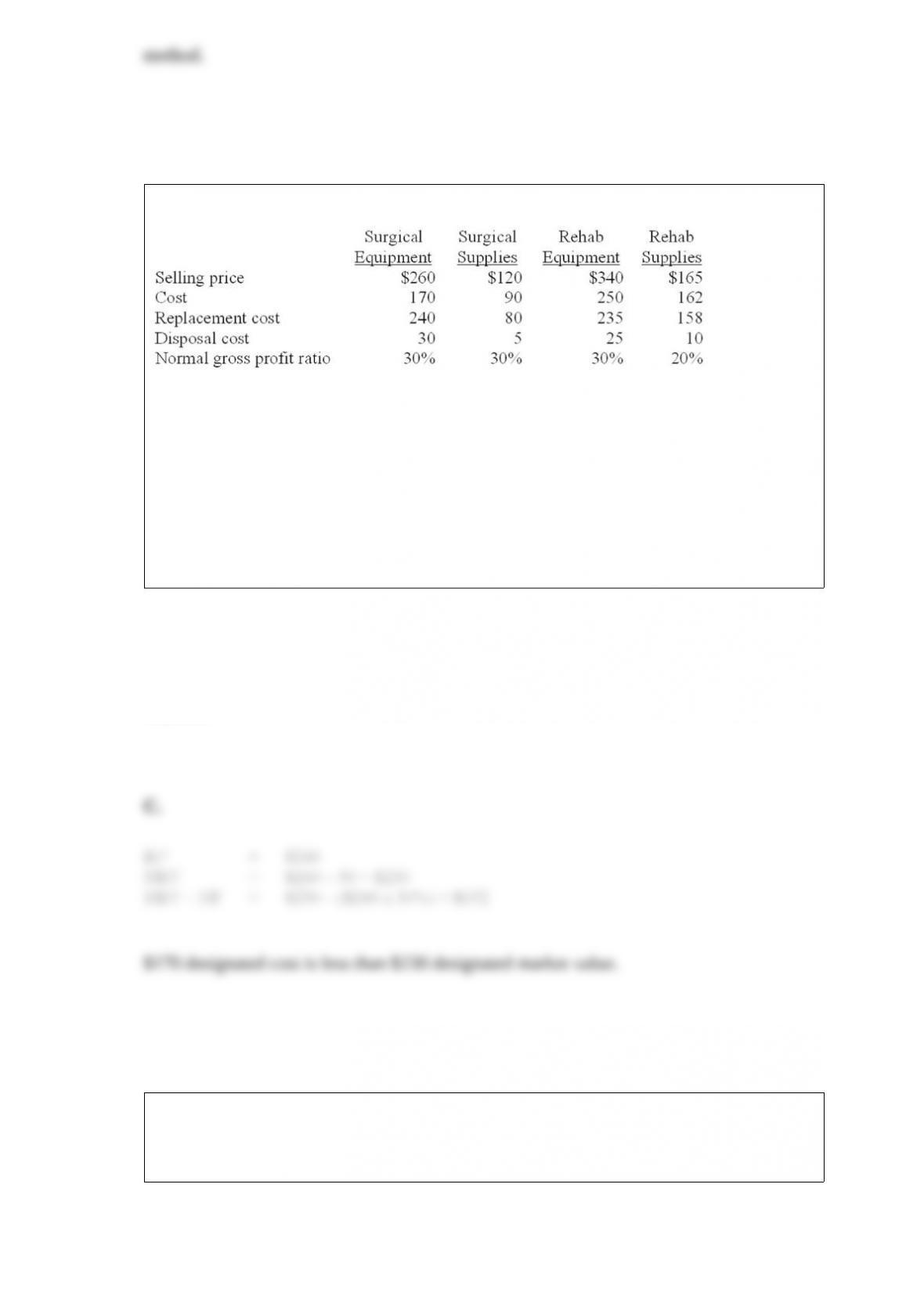
Data related to the inventories of Costco Medical Supply are presented below:
In applying the LCM rule, the inventory of surgical equipment would be valued at: A.
$230.
B. $240.
C. $170.
D. $152.
Answer:
Marilee’s Electronics uses a periodic inventory system and the average cost retail
method to estimate ending inventory and cost of goods sold. The following data is
available from the company records for the month of June 2013:
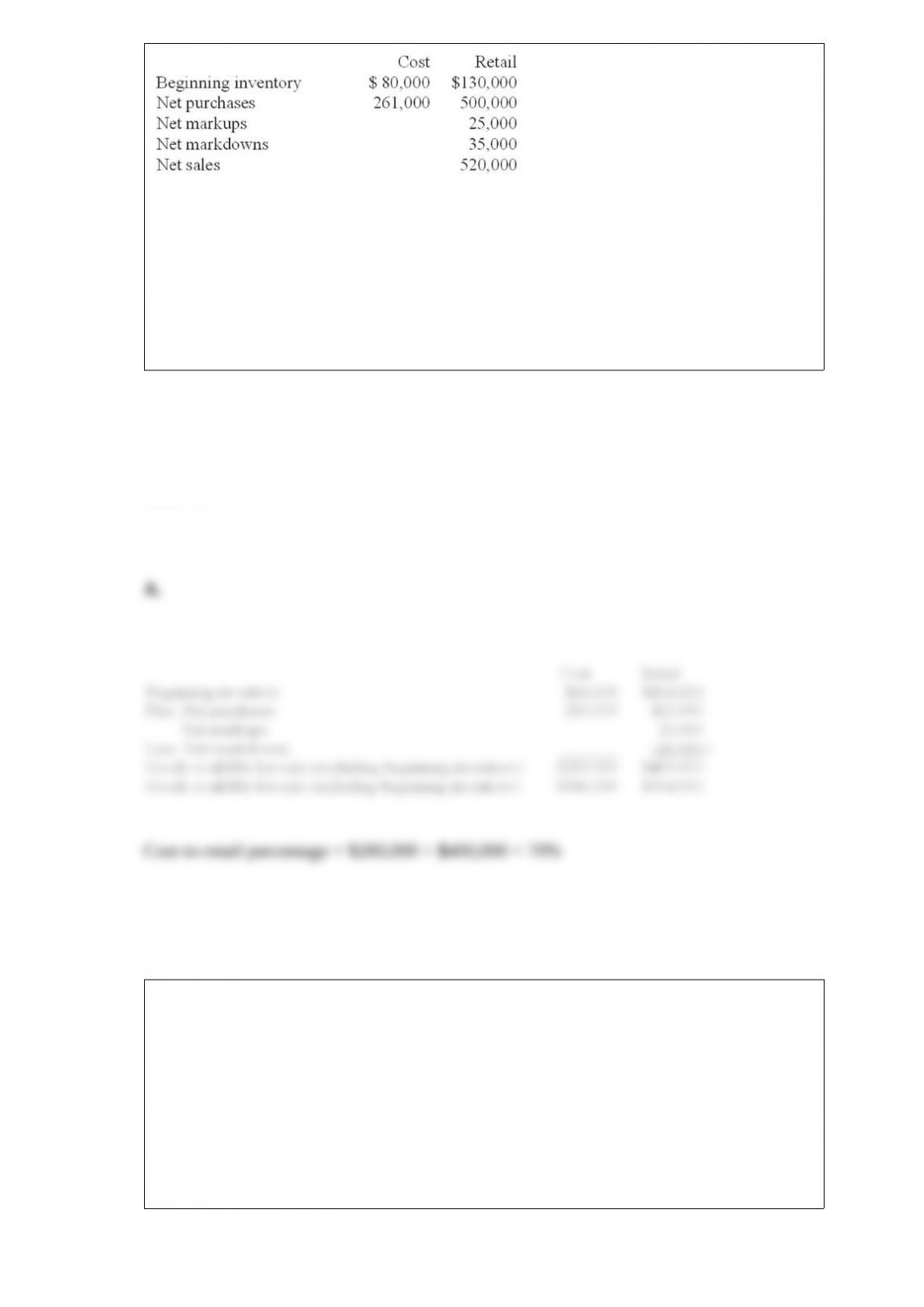
Current period cost-to-retail percentage is: A. 70.0%.
B. 68.7%.
C. 63.6%.
D. 63.5%.
Answer:
The balance sheets of Davidson Corporation reported net fixed assets of $320,000 at the
end of 2013. The fixed-asset turnover ratio for 2013 was 4.0, and sales for the year
totaled $1,480,000. Net fixed assets at the end of 2012 were: A. $470,000.
B. $370,000.
C. $420,000.
D. None of the above.

Answer:
Corporations are formed in accordance with: A. The Model Business Corporation Act.
B. Federal statutes.
C. The laws of individual states.
D. Federal trade commission regulations.
Answer:
Isaac Inc. began operations in January 2013. For certain of its property sales, Isaac
recognizes income in the period of sale for financial reporting purposes. However, for
income tax purposes, Isaac recognizes income when it collects cash from the buyer’s
installment payments.
In 2013, Isaac had $600 million in sales of this type. Scheduled collections for these
sales are as follows:

Assume that Isaac has a 30% income tax rate and that there were no other differences in
income for financial statement and tax purposes.
Ignoring operating expenses, what deferred tax liability would Isaac report in its
year-end 2013 balance sheet? A. $18 million
B. $162 million
C. $180 million
D. $540 million
Answer:
Research and development costs for projects other than software development should
be: A. Expensed in the period incurred.
B. Expensed in the period they are determined to be unsuccessful.
C. Deferred pending determination of success.
D. Expensed if unsuccessful, capitalized if successful.
Answer:

Which of the following financial statements is prepared as of a particular point in time
rather than for a period of time? A. Statement of cash flows.
B. Income statement.
C. Statement of shareholders’ equity.
D. Balance sheet.
Answer:
Which of the following is not a required disclosure for related-party transactions? A.
The nature of the relationship.
B. A description of the transactions.
C. The amounts due from or to related parties.
D. The impact of the transactions on current year’s income.
Answer:
Which of the following was not a criterion for revenue recognition in SAB 101? A.
Cash has been collected.

B. Collection is reasonably assured.
C. Persuasive evidence of an arrangement exists.
D. The seller’s price to the buyer is fixed or determinable.
Answer:
On June 30, 2013, Blue, Inc., leased a machine from Large Leasing Corporation. The
lease agreement calls for Blue to make semiannual lease payments of $281,453 over a
three-year lease term, payable each June 30 and December 31, with the first payment at
June 30, 2013. Blue’s incremental borrowing rate is 10%, the same rate Big uses to
calculate lease payment amounts. Depreciation is recorded on a straight-line basis at the
end of each fiscal year. Large constructed the machine at a cost of $1,250,000.
Required:
1) Determine the price at which Large is ‘selling” the machine (present value of the
lease payments) at June 30, 2013 (to the nearest $000).
2) What would be the pretax amounts related to the lease that Large would report in its
balance sheet at December 31, 2013?
3) What would be the pretax amounts related to the lease that Large would report in its
income statement for the year ended December 31, 2013?
Answer:
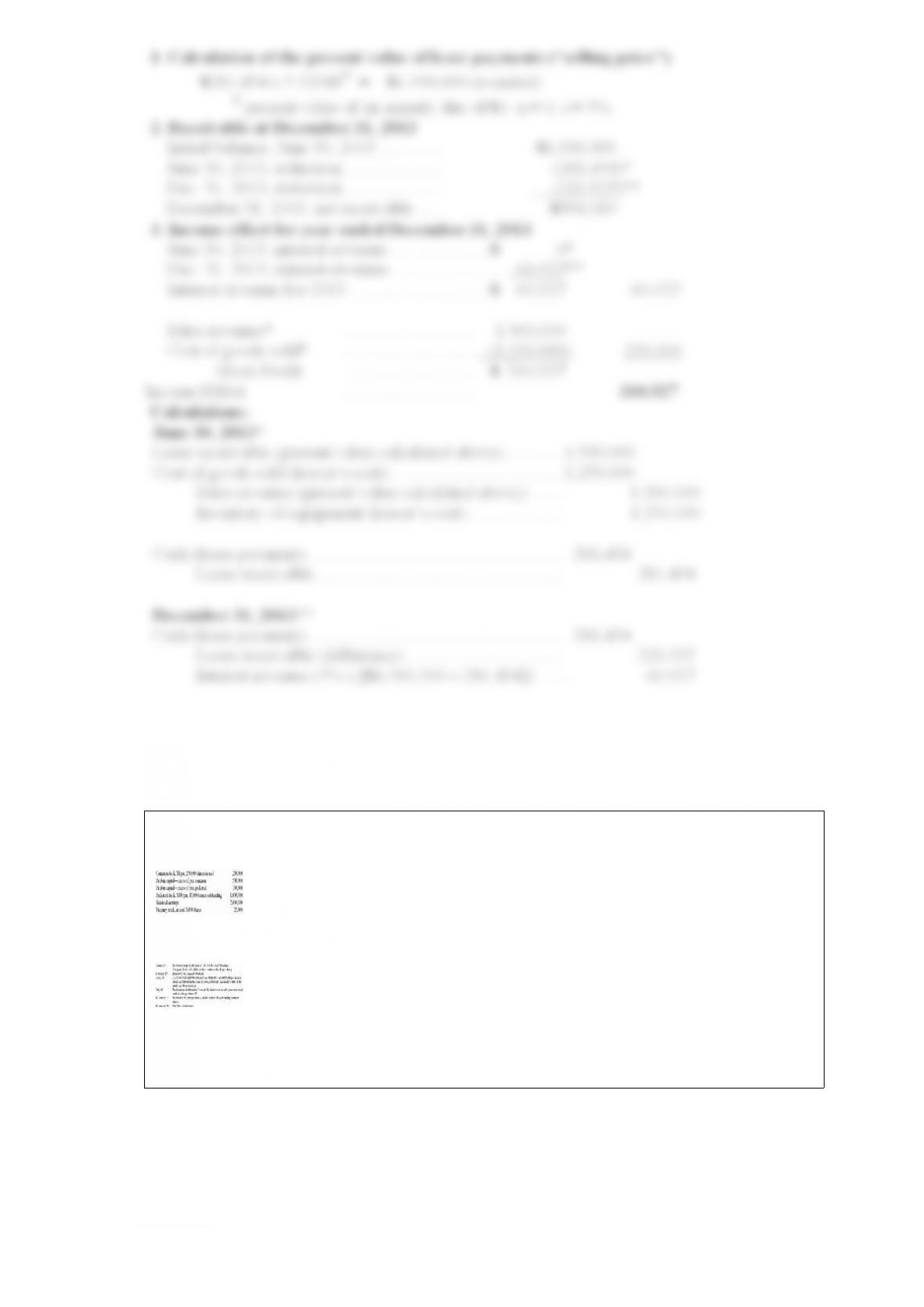
On January 1, 2013, Gerlach Inc. had the following account balances in its
shareholders’ equity accounts.
During 2013, Gerlach Inc. had several transactions relating to common stock.
Required:
Record the above transactions and events in journal entry format.
Answer:

Define the following:
1) Liabilities that are definite in amount.
2) Liabilities that must be estimated.
3) Liabilities that are contingent.
Answer:
What was most responsible for the positive cash flow from financing activities during
2012? What amount was received?
Answer:
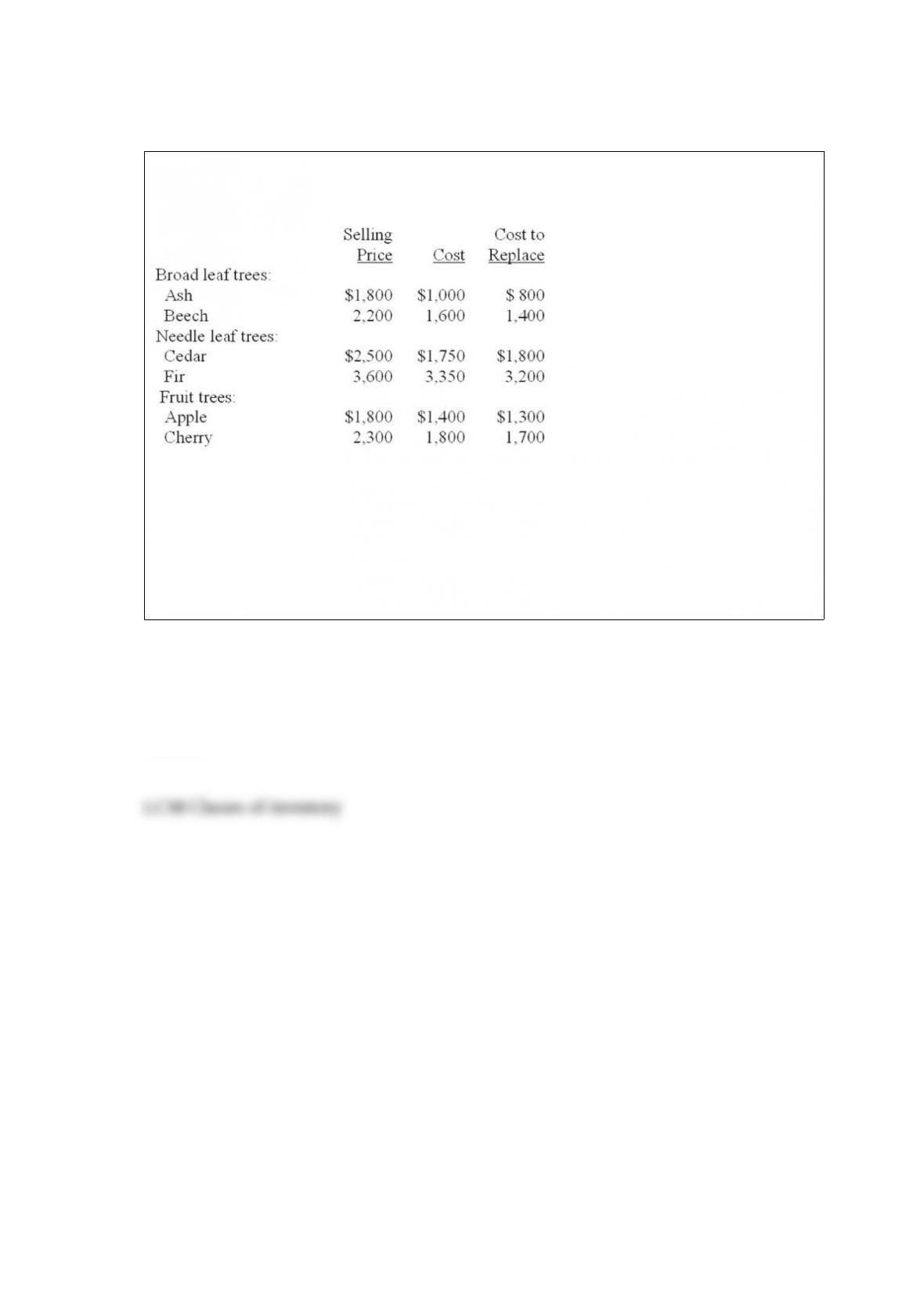
Novelli’s Nursery has developed the following data for lower-of-cost-or-market
valuation for its products:
The normal profit margin on all trees is 20% of selling price and disposal costs are 10%
of selling price.
Required:
Determine the balance sheet inventory carrying value assuming the LCM rule is applied
to classes of trees.
Answer:
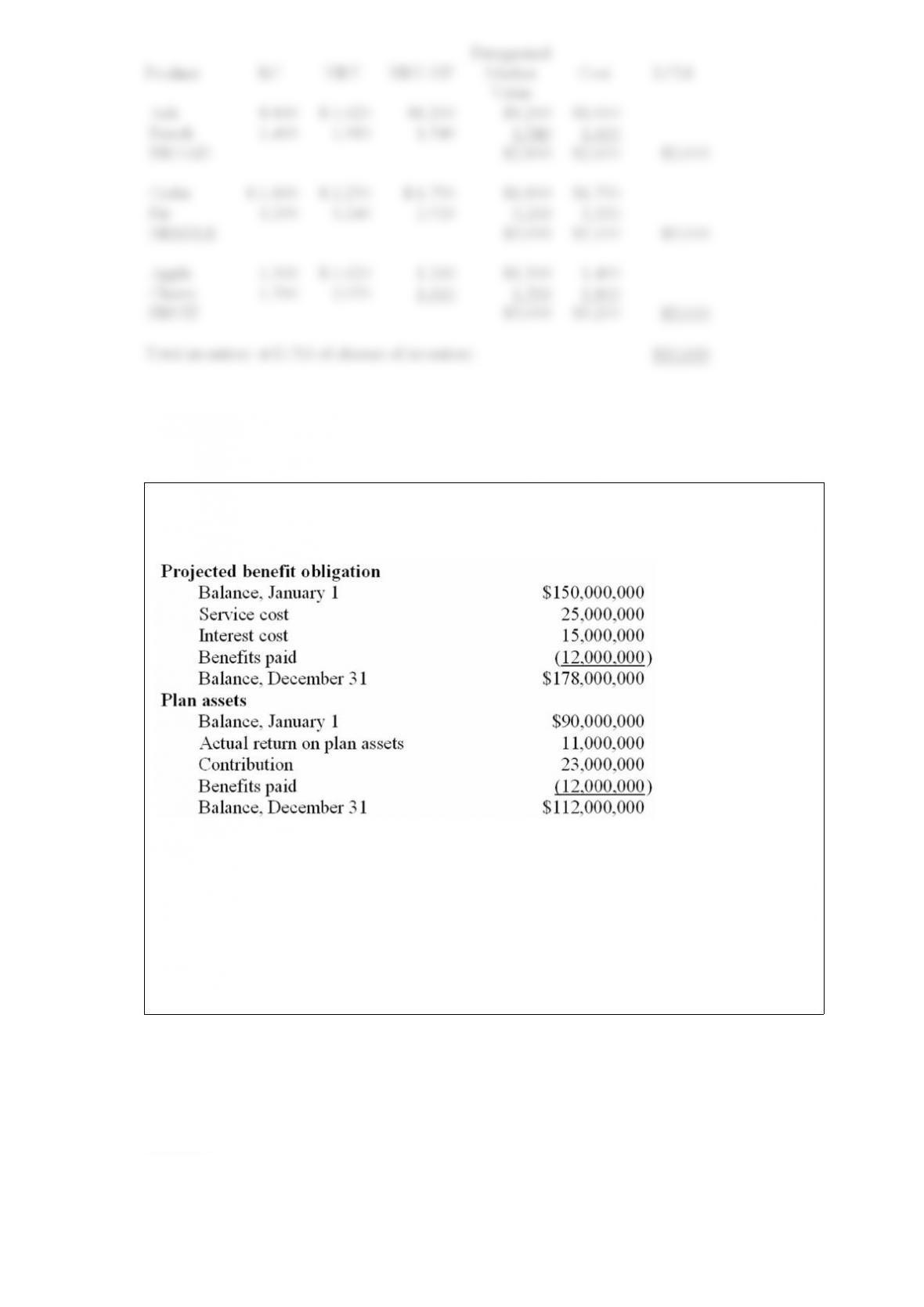
Burrito Corporation has a defined benefit pension plan. Burrito received the following
information for the current calendar year:
The expected long-term return on plan assets is 10%. There were no other relevant data
for the year.
Required:
1) Determine Burrito’s pension expense for the year.
2) Prepare the journal entries to record the pension expense and funding for the year.
Answer:
In its 2013 annual report to shareholders, Ank-Morpork Times Inc. included the
following disclosure:
Revenue Recognition
– Advertising revenue is recognized when advertisements are published, are broadcast,
or when placed on the Company’s websites, net of provisions for estimated rebates,
credit and rate adjustments and discounts.
– Circulation revenue includes single copy and home-delivery subscription revenue.
Single copy revenue is recognized based on date of publication, net of provisions for
related returns. Proceeds from home-delivery subscriptions and related costs,
principally agency commissions, are deferred at the time of sale and are recognized in
earnings on a pro rata basis over the terms of the subscriptions.
– Other revenue is recognized when the related service or product has been delivered.
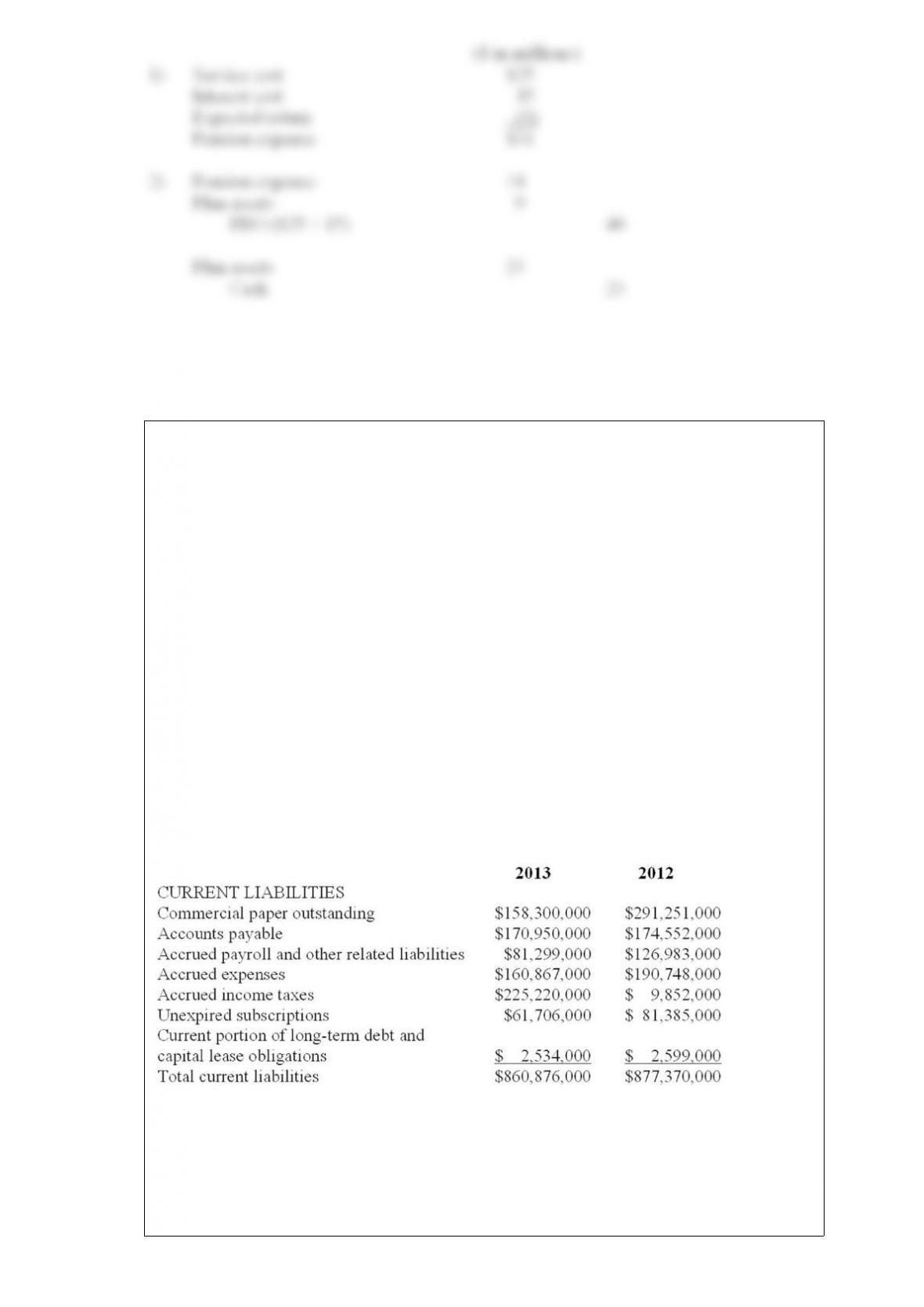
Also, the following information on its current liabilities was included in its comparative
balance sheets:
Required:
Assuming that Ank-Morpork Times Inc. collected $440,000,000 in cash for
home-delivery subscriptions during fiscal year 2013, what amount of revenue did it
recognize during 2013 from this source? Show the relevant T-account information to
support your answer.
Answer:
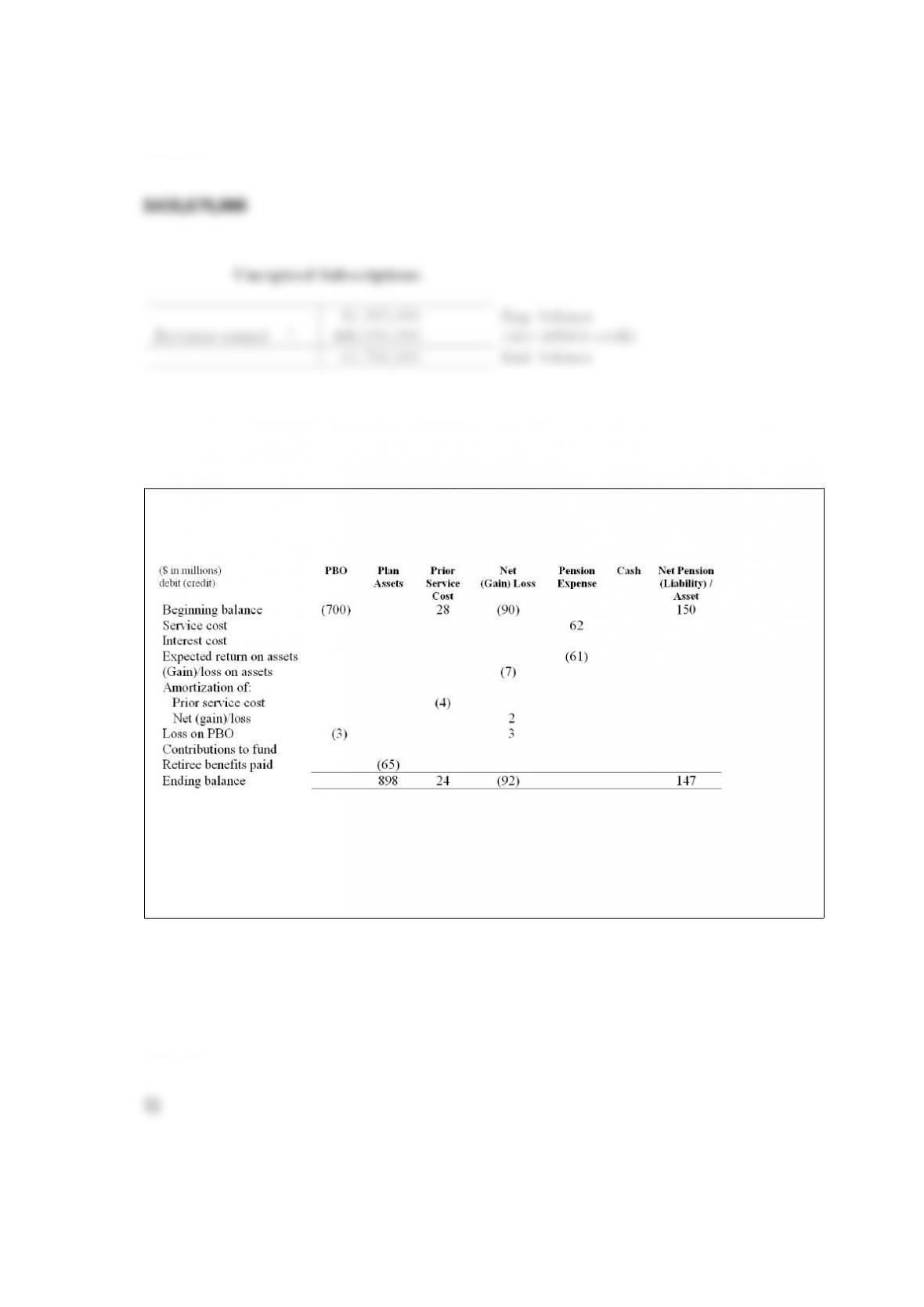
The following is an incomplete pension spreadsheet for the current year for Swiss Mist
Corporation.
Required:
1) Complete the pension spreadsheet.
2) Prepare the journal entry to record pension expense for the year.
Answer:
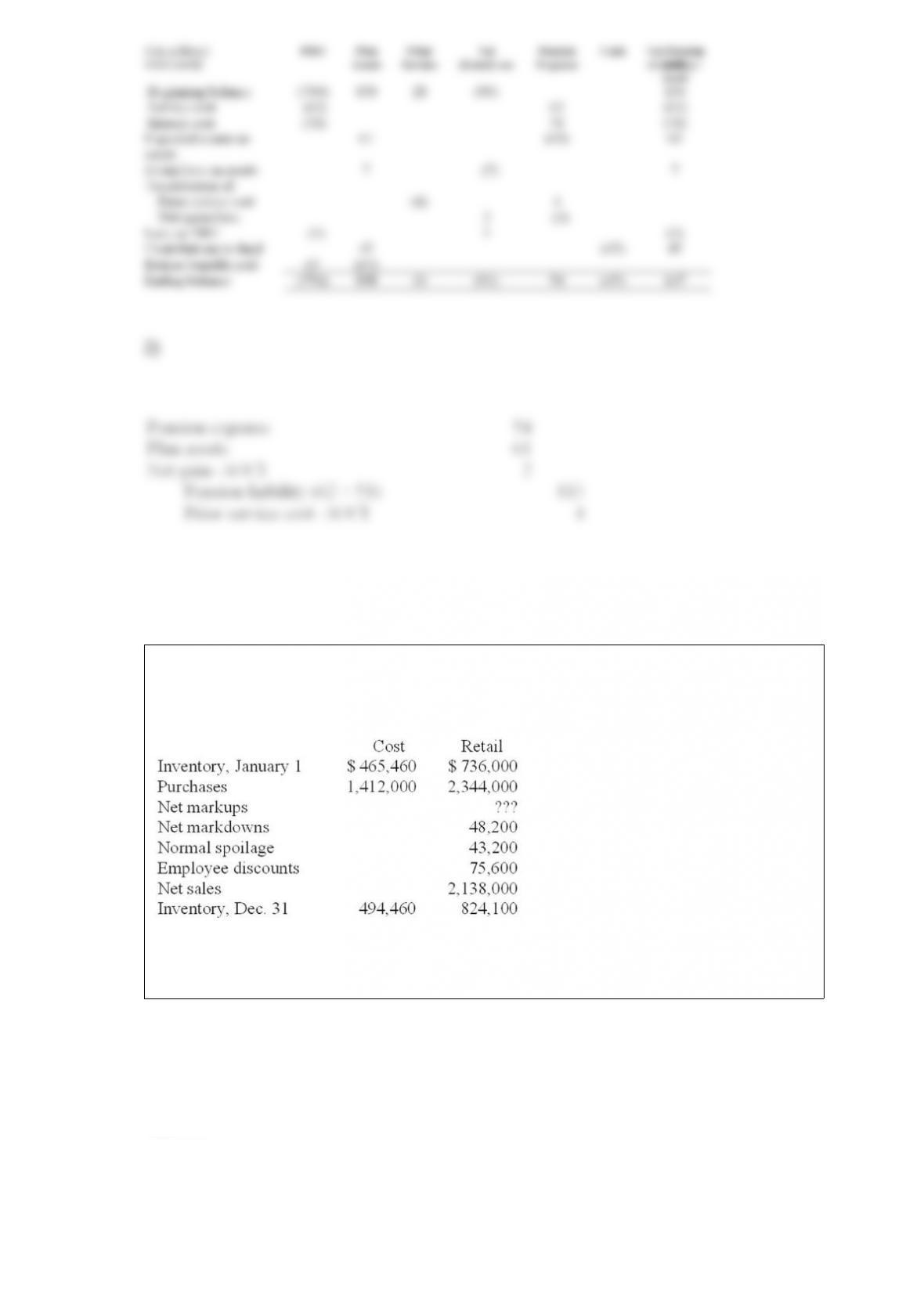
Cindy Lou Linens uses the conventional retail method to estimate its ending
inventories. The company records sales net of employee discounts. The following
partial data has been summarized for the year ended December 31, 2013:
Required:
Compute the net markups for Cindy Lou Linens during 2013.
Answer:

In its 2013 annual report to shareholders, Bare Sturns Group Inc. disclosed the
following:
On October 28, 2013, the Company issued $475,000,000 aggregate principal amount of
9-1/4% Senior Notes Due 2018 (“Senior Notes”) and $618,670,000 aggregate principal
amount at maturity of 10-1/4% Senior Discount Notes Due 2018 (“Senior Discount
Notes” and collectively the “Notes”) in a transaction not registered under the Securities
Act in reliance upon an exemption from the registration requirements of the Securities
Act. Gross proceeds from the offering amounted to $850,000,000. The discount on the
Senior Discount Notes is being accreted under the effective interest method.
Explain the last sentence of the disclosure to clarify what accounting was necessary and
why.
Answer:
Compare and contrast the way leases are classified between operating and finance
(capital) leases under U.S. GAAP and IFRS.
Answer:
Zeba Company granted 27 million of its no par common shares to executives, subject to
forfeiture if employment is terminated within three years. Zeba’s common shares have a
market price of $10 per share on January 1, 2012, the grant date.
Required:
When calculating diluted EPS at December 31, 2013, what will be the net increase in
the denominator of the EPS fraction if the market price of the common shares averaged
$10 during 2013?
Answer:
Lindy Company’s auditor discovered two errors. No errors were corrected during 2012.
The errors are described as follows:
(1) Merchandise costing $4,000 was sold to a customer for $9,000 on December 31,
2012, but it was recorded as a sale on January 2, 2013. The merchandise was properly
excluded from the 2012 ending inventory. Assume the periodic inventory system is
used.
(2) A machine with a five-year life was purchased on January 1, 2012. The machine
cost $20,000 and has no expected salvage value. No depreciation was taken in 2012 or
2013. Assume the straight-line method for depreciation.
Required:
Prepare appropriate journal entries (assume the 2013 books have not been closed).
Ignore income taxes.
Answer:
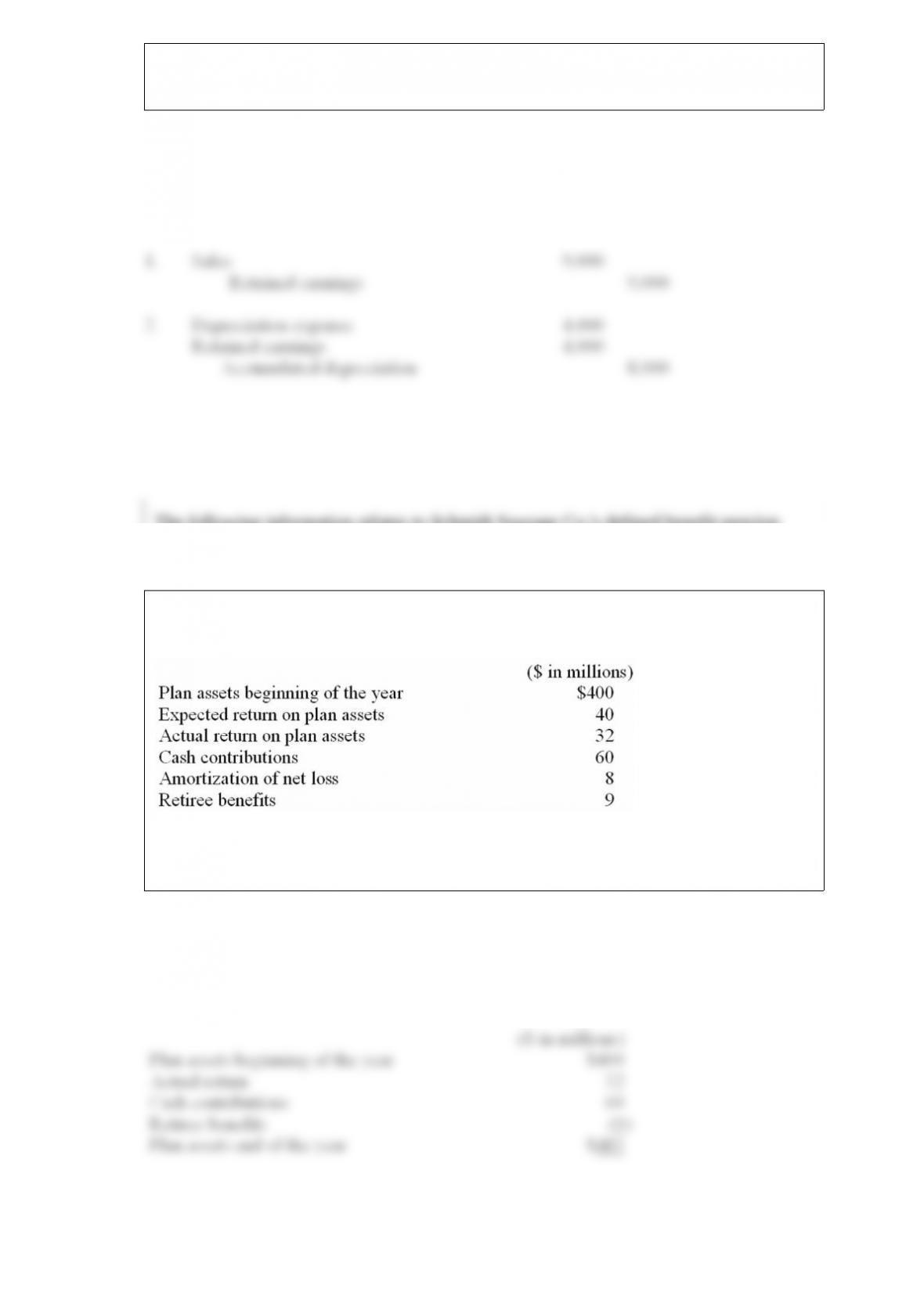
The following information relates to Schmidt Sausage Co.’s defined benefit pension
plan during the current reporting year:
Required:
Determine the amount of pension plan assets at fair value on December
Answer:
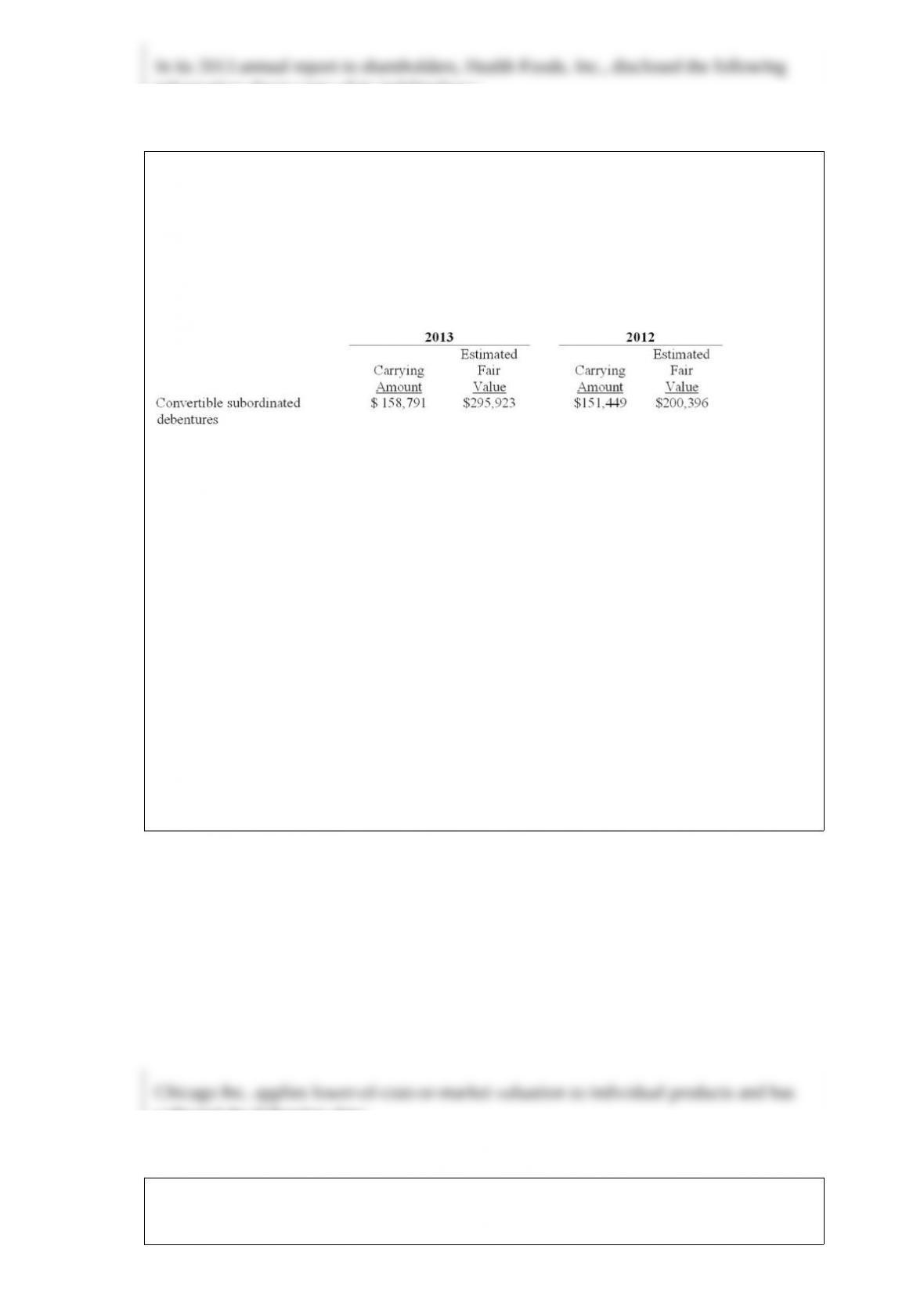
In its 2013 annual report to shareholders, Health Foods, Inc., disclosed the following
information about some of its indebtedness:
The fair value of convertible subordinated debentures is estimated using quoted market
prices. Carrying amounts and estimated fair values of our financial instruments other
than those for which carrying amounts approximate fair values as noted above are as
follows (in thousands)
In addition, the company disclosed the following:
We have outstanding zero coupon convertible subordinated debentures which had a
carrying amount of approximately $158.8 million and $151.4 million at September 26,
2013, and September 28, 2012, respectively. The debentures have an effective yield to
maturity of 5 percent and a principal amount at maturity on March 2, 2027, of
approximately $308.8 million. The debentures are convertible at the option of the
holder, at any time on or prior to maturity, unless previously redeemed or otherwise
purchased. The debentures have a conversion rate of 10.640 shares per $1,000 principal
amount at maturity, representing 3,285,632 shares. The debentures may be redeemed at
the option of the holder on March 2, 2017, or March 2, 2022, at the issue price plus
accrued original discount totaling approximately $188 million and $241 million,
respectively.
Required:
Why did the carrying amount of the debentures increase during fiscal year 2013?
Answer:
Chicago Inc. applies lower-of-cost-or-market valuation to individual products and has
collected the following data:
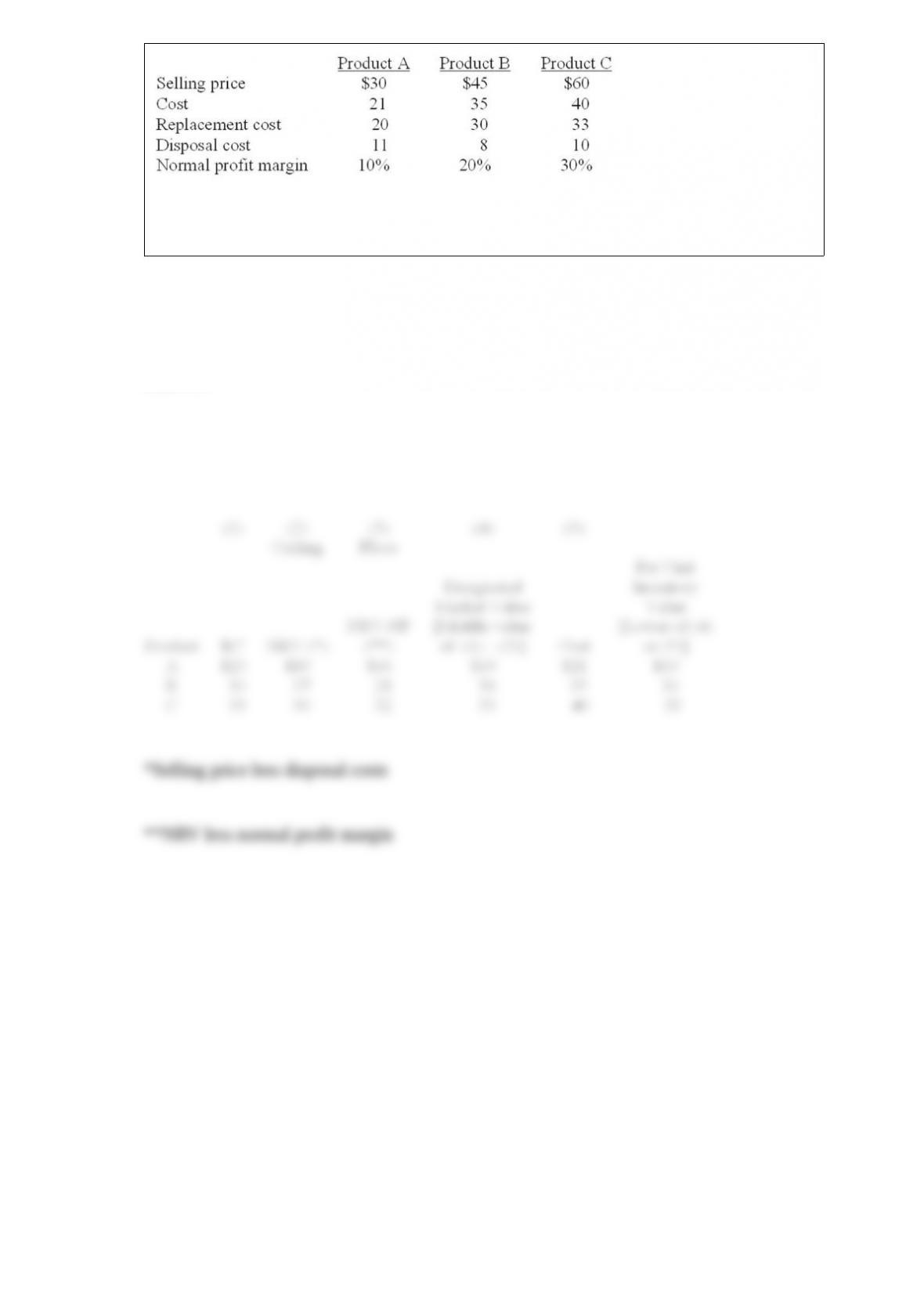
Required:
Determine the balance sheet inventory carrying value for Products A, B, and C.
Answer: