
For 2015, Wasabi Company has accounting revenues of $6,000. However, because of
temporary differences between tax and accounting, $1,000 of this is not subject to tax.
If expenses are $3,000 for both tax and accounting, and the tax rate is 40%, what is the
amount of tax payable to the IRS?
a. $ 400
b. $ 800
c. $1,200
d. $1,600
Identify which of the following would be recorded as external events, recorded as
internal events, or not recorded.
a. Internal event
b. External event
c. Not recordedThe company hires a new secretary.
The Dinho Corporation identified the following data when preparing their April bank
reconciliation:
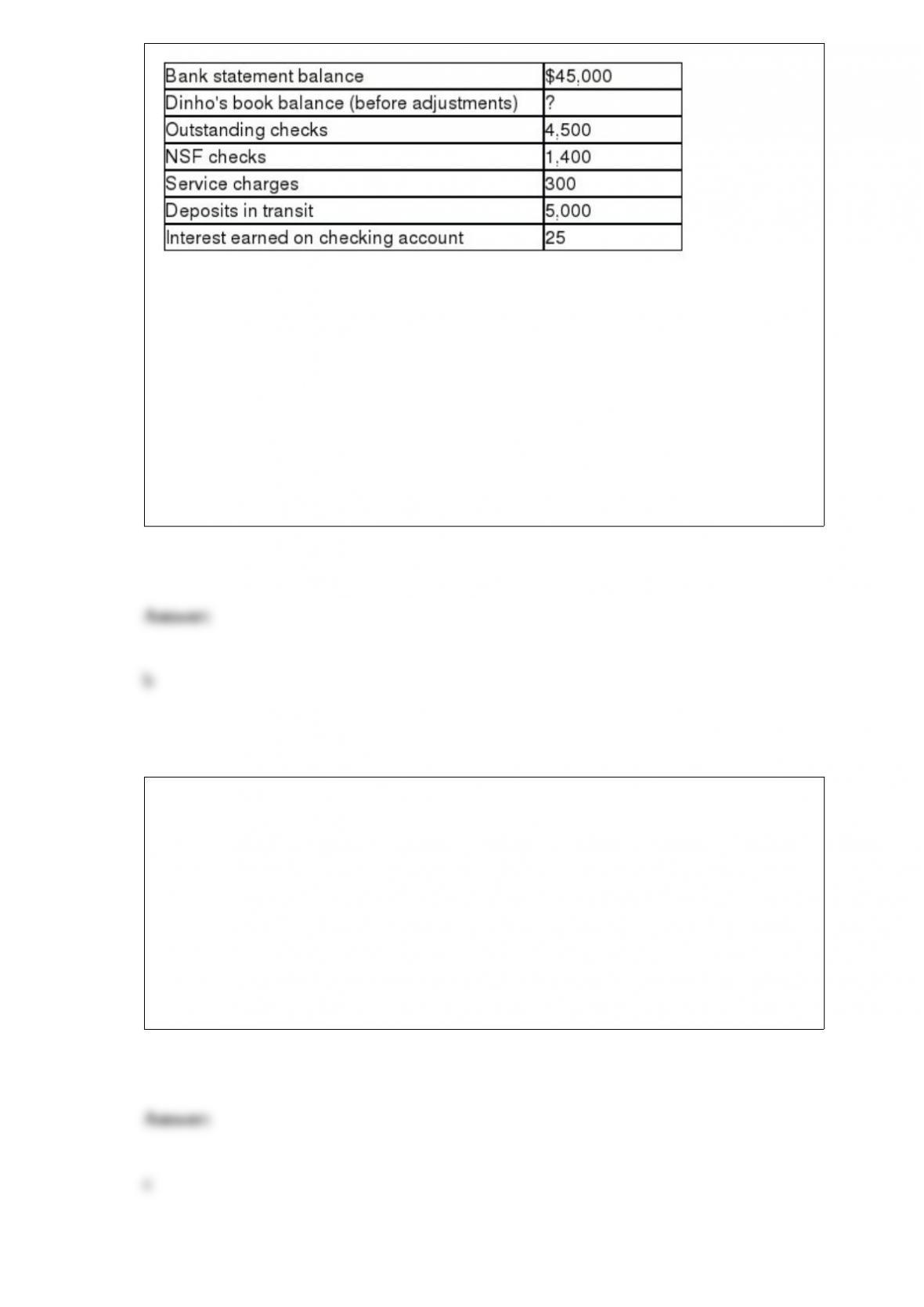
In addition, Dinho incorrectly recorded a deposit in its books in the amount of $1,000.
The correct amount was recorded by the bank as $1,200. What is the adjusted cash
balance at the end of April?
a. $44,300
b. $45,500
c. $45,000
d. $45,700
Which of the following is a five-member body that has the authority from Congress to
set standards for conducting audits?
a. FASB
b. SEC
c. PCAOB
d. AICPA

For each ratio listed, select whether an increase or decrease in the ratio is generally
considered to be better.
a. increase
b. decrease
Times interest earned ratio
The income statement of Hope Market, Inc. reported a gain from the sale of land. How
are the cash flow effects of this transaction reported on the statement of cash flows if
the direct method is used to prepare the Operating Activities category?
a. The entire proceeds from the sale of the land are reported as an investing activity.
b. The gain on the sale of land is reported in the Investing Activities category as a cash
flow from the sale of land.
c. The entire proceeds from the sale of the land are reported as an operating activity.
d. The cash received from the sale of land is reported in the financing activity category
as a cash flow from the sale of land.
Which of the following yields the return on assets ratio?
a. (return on common stockholders’ equity) x (asset turnover)
b. (return on sales) x (asset turnover)
c. (profit margin) x (return on sales)

d. (profit margin) x (asset turnover)
a. A receivable arising from the sale of goods or services with a verbal promise to pay.
b. A form used to categorize the various individual accounts receivable according to the
length of time each has been outstanding.
c. A method of estimating bad debts on the basis of either the net credit sales of the
period or the accounts receivable at the end of the period.
d. A measure of the number of times receivables are collected in a period.
e. The general ledger account that is supported by a subsidiary ledger.
f. A contra-asset account used to reduce accounts receivable to its net realizable value.
g. The detail for a number of individual items that collectively make up a single general
ledger account.
h. The recognition of bad debts expense at the point an account is written off as
uncollectible. Allowance for doubtful accounts
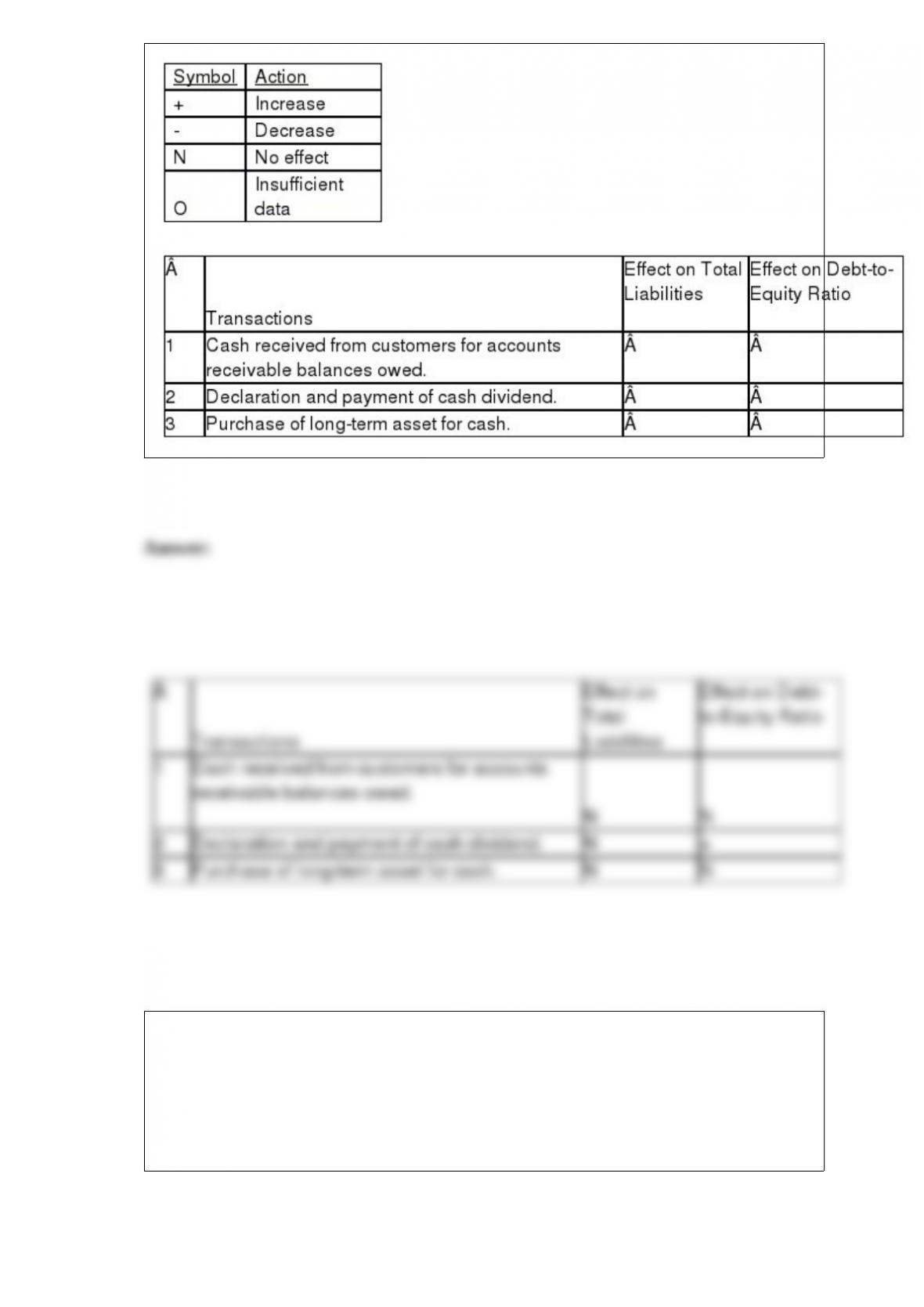
Show the effect of each of the transactions below on total liabilities and the
debt-to-equity ratio by using one of the following symbols in each box to complete the
table. If the numerator and denominator of a ratio both increase or both decrease by the
same amount, the effect of the event on the ratio is “insufficient data.”
The payee of a note recognizes a note receivable on the balance sheet and interest
revenue on its income statement.
a. True
b. False
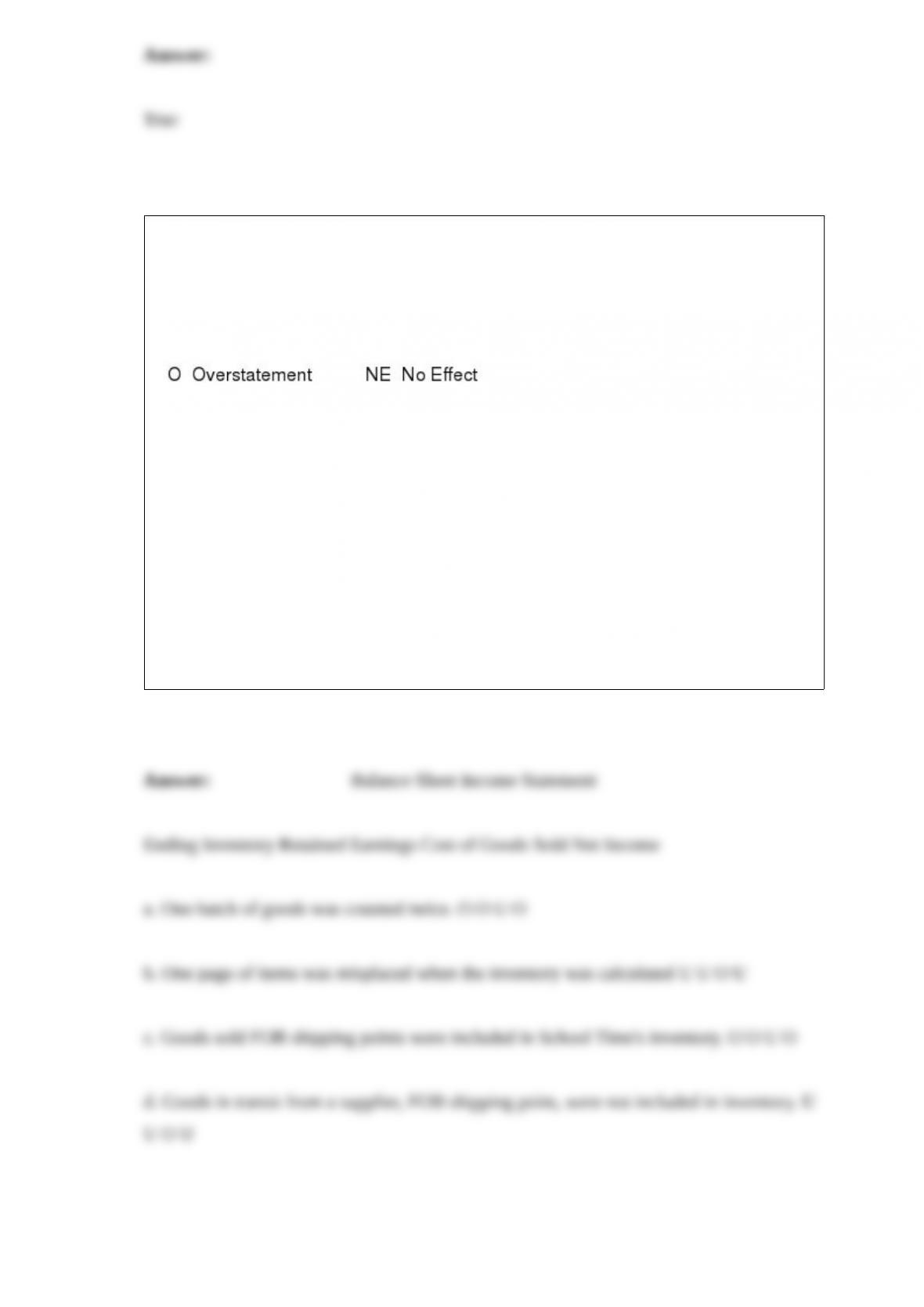
School Time Corp. completed a physical inventory at the end of 2014. A review of the
physical inventory procedures and records uncovered several errors that are described
below. In the columns provided, indicate the effect, if any, on the four financial
statement items listed. Use the following codes for your answers:
Balance Sheet Income Statement
Ending Inventory Retained Earnings Cost of Goods Sold Net Income
a. One batch of goods was counted twice.
b. One page of items was misplaced when the inventory was calculated
c. Goods sold FOB shipping point were included in School Time’s inventory.
d. Goods in transit from a supplier, FOB shipping point, were not included in inventory.

Payment is made for an electric bill which was received and recorded earlier. For this
transaction, identify the effect on the accounting equation.
a. Assets increase and liabilities increase.
b. Assets increase and stockholders’ equity increases.
c. Liabilities increase and stockholders’ equity decreases.
d. Liabilities decrease and assets decrease.
When using the indirect method, the gain from selling a long-term investment is
recognized in which of the following?
a. In the operating activity section and the investing activity section of the statement of
cash flows.
b. In the financing activity section of the statement of cash flows.
c. In the noncash investing or financing activity supplemental section of the statement
of cash flows.
d. Gains are not recognized in the statement of cash flows under the indirect method.
The current ratio is irrelevant in liquidity analysis for service companies because they
do not have inventories among their current assets
a. True
b. False

Match the terms to the definitions by selecting the letter of the term. Each term may be
used more than once or not at all.
a. cumulative feature
b. stock dividend
c. retired stock
d. retained earnings
e. callable feature
f. convertible feature
g. outstanding shares
h. treasury stock
i. participating feature
j. additional paid-in capital
Shares of stock that are repurchased and then discontinued by removing them from the
accounting records.
Which one of the approaches for the allowance method of accounting for bad debts
emphasizes the net realizable value of accounts receivable on the balance sheet?
a. The percentage of accounts receivable approach
b. The percentage of net credit sales approach
c. The direct write-off method
d. The uncollectible approach
Which of the following is true concerning a sole proprietorship?
a. It is a separate legal entity.
b. It may have more than one class of stock outstanding.
c. It is owned by one or more persons.
d. The separate entity concept applies.
Your supervisor asks you to compare the company’s results for the year, as measured by
various ratios, with one of the published surveys that arranges information by industry
classification. What difficulties might you encounter when making comparisons using
industry standards?
The cost of goods sold for Johnnie, Inc. totaled $1,305,000. Sales returns and purchase
returns were $3,000 and $4,000, respectively. Purchases totaled $1,300,000. Discounts
taken by Johnnie totaled $7,000, while discounts taken by customers totaled $5,000.
Beginning inventory was $90,000. Determine the amount of ending inventory to be
reported on Johnnie, Inc.’s balance sheet.
Utah Corp. Use the following selected data and additional information from the records
of Utah Corp. to answer the questions that follow. Balance Sheet Data
2016 2015
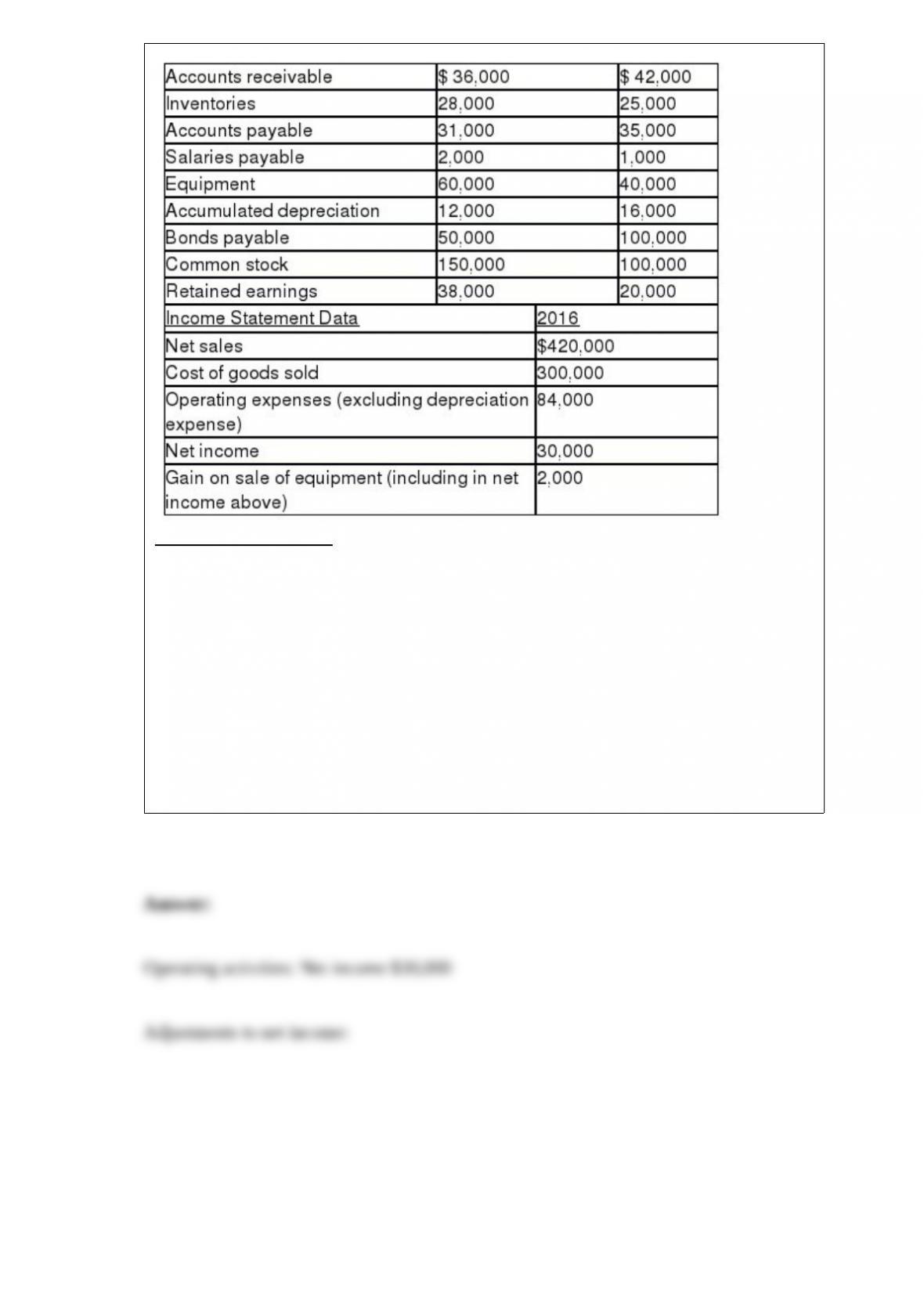
Additional information:
(1) Equipment with a cost of $15,000 and a book value of $3,000 was sold for $5,000
during 2016.
(2) Common stock was issued to retire bonds payable during 2016.
(3) The only items affecting retained earnings in 2016 were net income and dividends
declared and paid. Review the data for Utah Corp. REQUIRED:
Prepare the operating activities section of a statement of cash flows for Utah Corp. for
2016 if the indirect method is used to determine net cash flow from operating activities.
The 2015 income statement of Cigmar Enterprises shows operating revenues of
$120,500, selling expenses of $35,200, general and administrative expenses of $29,900,
interest expense of $1,500, and income tax expense of $10,520. Cigmar’s stockholders’
equity was $280,000 at the beginning of the year and $320,000 at the end of the year.
The company has 20,000 shares of stock outstanding at December 31, 2015.Compute
Cigmar’s profit margin. What other information would you need in order to comment on
whether this ratio is favorable?
Shoreville Corp.’s December 31, 2014, balance sheet reported current assets of
$260,000 and current liabilities of $200,000. The current ratio increased by 20% one
year later, on December 31, 2015. Current liabilities on this date were $280,000.
Determine current assets on December 31, 2015.
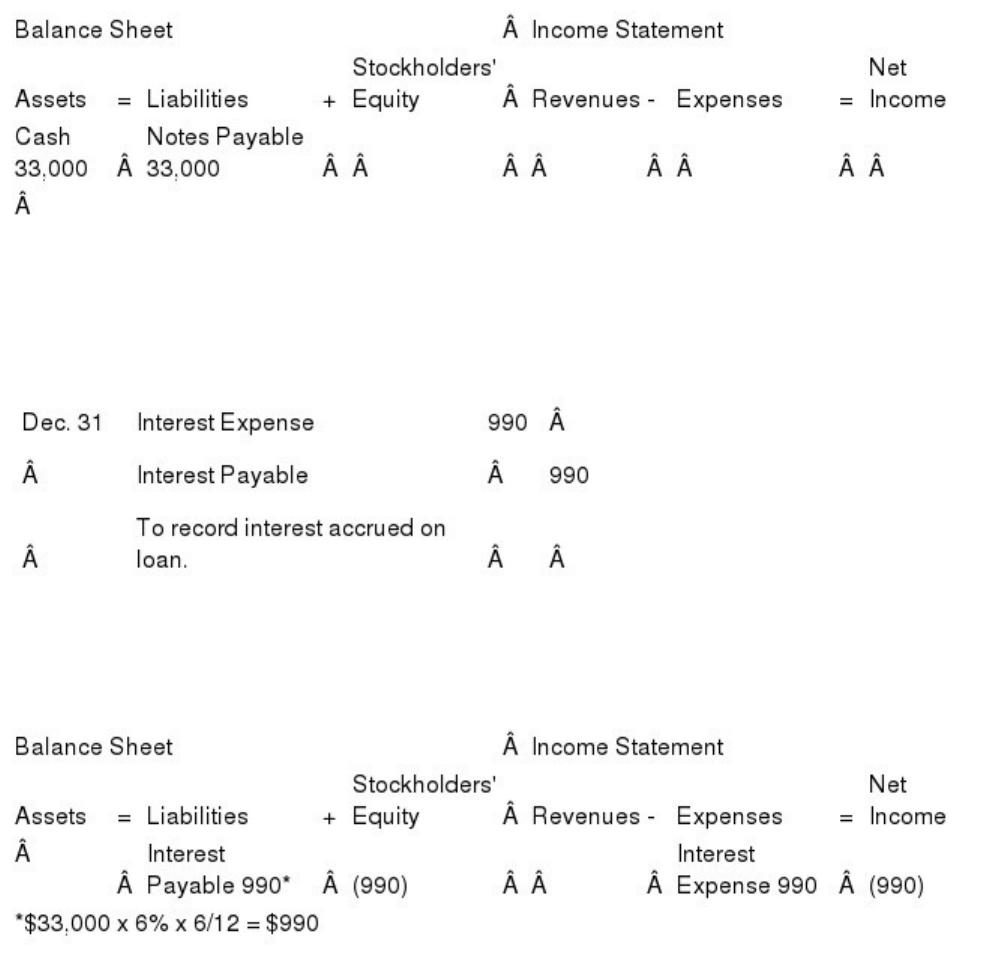
On July 1, 2015, Clayton Shop borrowed $33,000 from the bank. Clayton signed a
ten-month, 6% promissory note for the entire amount. Clayton uses a calendar year-end.
REQUIRED:
1> Prepare the journal entry on July 1, 2015 to record the issuance of the promissory
note.
2> Prepare any adjusting entries needed at year-end.
3> Prepare the journal entry on May 1, 2016 to record the payment of principal and
interest.
From an accounting perspective, what are source documents? Give examples of at least
three source documents.