If a pension plan is underfunded, the company has a net loss-OCI.
In a bank reconciliation, adjustments to the bank balance could include adding deposits
in transit and deducting bank service charges.
In accounting for operating leases, the lessor, rather than the lessee, will recognize
depreciation on the leased asset.
Income statements prepared according to both U.S. GAAP and International Financial
Reporting Standards require the separate reporting, as an extraordinary item, of material
gains and losses from events that are both unusual and infrequent.
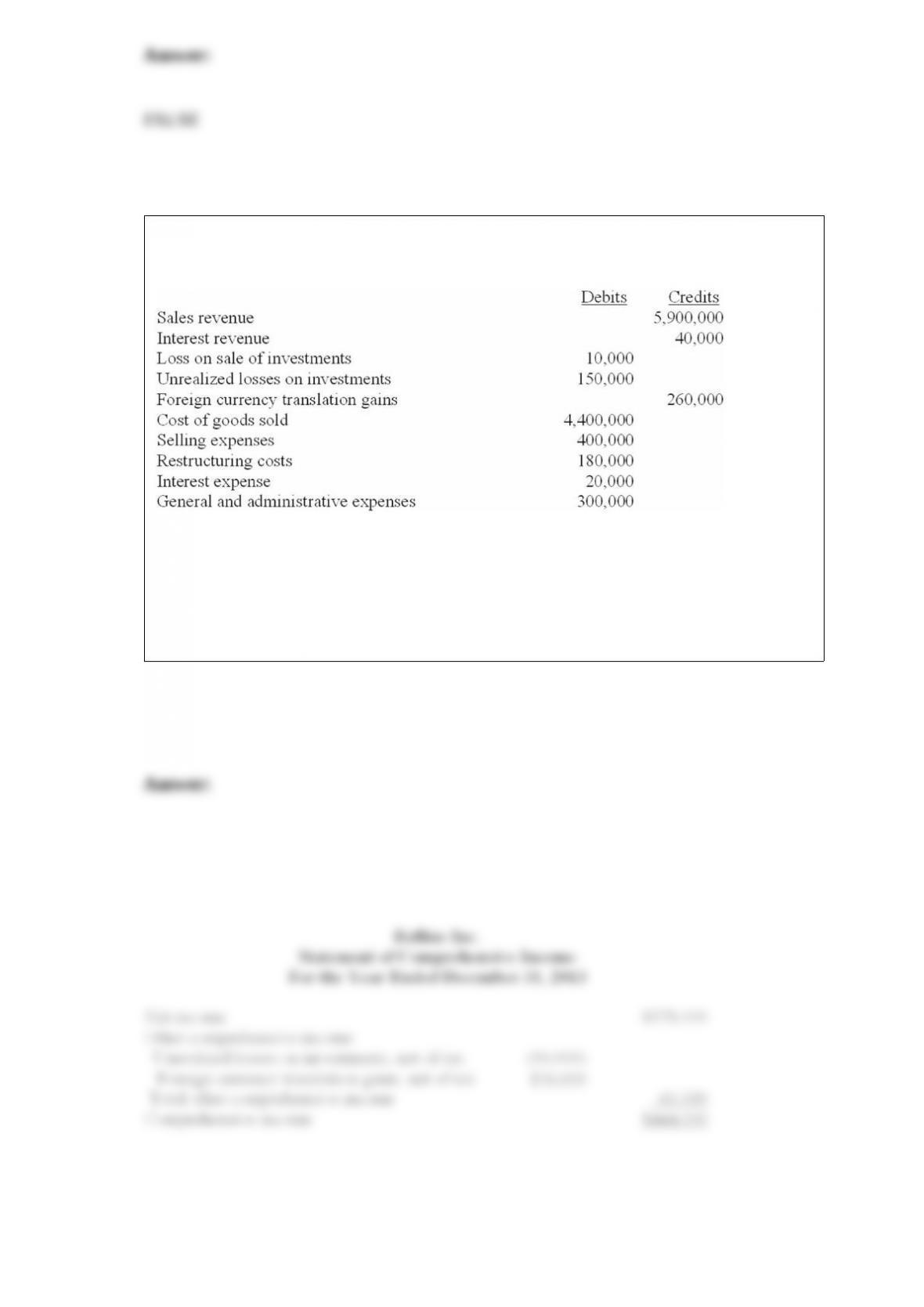
The trial balance of Rollins Inc. included the following accounts as of December 31,
2013:
Rollins had 100,000 shares of stock outstanding throughout the year. Income tax
expense has not yet been accrued. The effective tax rate is 40%.
Required:
Prepare a 2013 separate statement of comprehensive income for Rollins Inc.
No time-weighting of contingently issuable shares is required when computing basic
EPS.
Comprehensive income reports an expanded version of income to include certain types
of gains and losses not included in traditional income statements.
Paid-in capital is increased when bonds payable are issued with detachable stock
purchase warrants.
For a purchase commitment contained within a single fiscal year, if the market price is
less than the contract price, the purchase is recorded at the contract price.
Most, but not all, changes in accounting principle are reported using the retrospective
approach.
The closing process brings all temporary accounts to a zero balance and updates the
balance in the retained earnings account.
A temporary difference originates in one period and reverses, or turns around, in one or
more later periods.
Under IAS No. 39, transfers of debt investments out of the FVTPL category into AFS or
HTM are permitted under “rare circumstances.”
Routine transfers of debt and equity investments among the trading, available for sale,
and held to maturity portfolios need not be disclosed in the financial statements.
An implicit or imputed rate of interest must be used when long-term notes are issued at
a stated rate of interest that is materially different from the market rate of interest.
Cash dividends become a binding liability as of the record date.
Property, plant, and equipment includes machinery, equipment, and inventories.
Transactions that represent noncash investing and financing activities must be reported
in the statement of cash flows or in disclosure notes.
A customer advance produces a liability that is satisfied when the product or service is
provided.
Recognizing sales returns when they occur could result in an overstatement of income
in the period of the related sale.
The criterion of 75% of economic life for classifying a lease as a capital lease is
consistent with the basic premise that most of the risks and rewards of ownership occur
during the first 75% of an asset’s life.
Under IFRS, accounts receivable can be accounted for as “available for sale” if that
approach is elected upon initial recognition of the receivable.
The direct and indirect methods of reporting the statement of cash flows present
different information for investing and financing activities.
Use of the percentage-of-completion method is dependent on a firm’s ability to make
dependable forecasts of future costs.
Demolition costs to remove an old building from land purchased as a site for a new
building are considered part of the cost of the new building.
In addition to the criteria that must be met by the lessee, the lessor must meet additional
conditions for classification as a capital lease to satisfy the realization principle.
According to International Financial Reporting Standards, property, plant, and
equipment must be valued at cost less accumulated depreciation.
A company could improve its return on assets by increasing its income or by increasing
its total assets.
Long-term debt that is callable by the creditor in the upcoming year should be classified
as a current liability only if the debt is expected to be called.
Listed below are five terms followed by a list of phrases that describe or characterize
each of the terms. Match each phrase with the correct term. 1) Revenues
2) Gains
3) Comprehensive income
4) Losses
5) Assets
A. Net outflows from peripheral transactions.
B. Probable future economic benefits controlled by an entity.
C. Increases in equity from the sale of goods and/or services.
D. All changes in equity except owner transactions.
E. Results if an asset is sold for more than book value.
An OTT impairment for an equity investment is recognized in net income if fair value
declines below the investment’s cost and: A. The company has incurred noncredit
losses.
B. The company does not have the intent and ability to hold the investment until fair
value recovers.
C. The company lacks intent to hold the investment until fair value recovers.
D. The company has incurred credit losses.
Of the following, the most important objective for financial reporting is to provide
information useful for: A.Making decisions.
B.Determining taxable income.
C.Providing accountability.
D.Increasing future profits.
According to International Financial Reporting Standards, the level of testing for
goodwill impairment is the: A. Reporting unit.
B. Subsidiary companies.
C. Cash-generating unit.
D. None of the above.
In its 2012 Annual Report to Shareholders, Kinney Inc. reported the following
Consolidated Statement of Cash Flows:
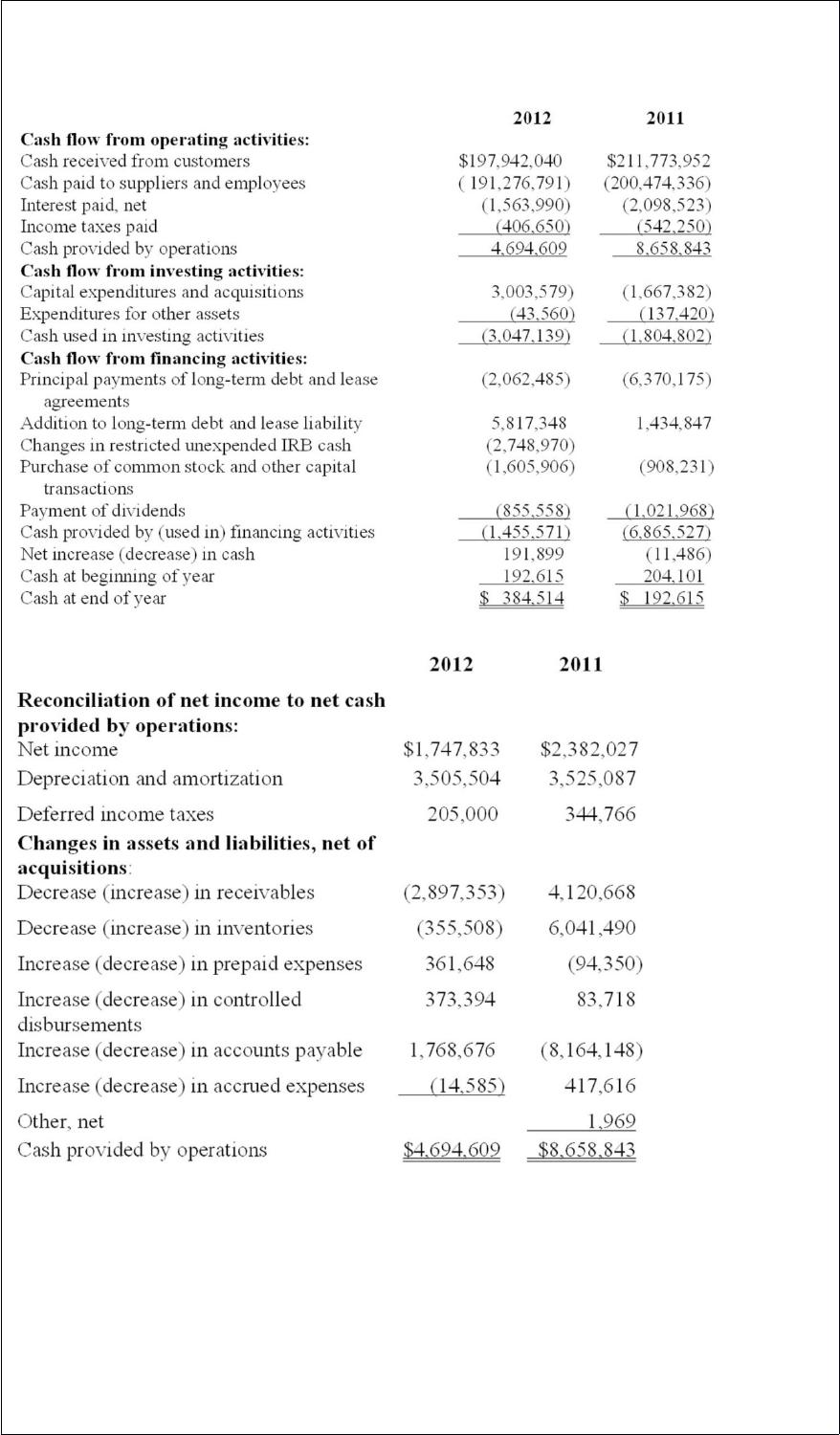
For the years ended December 31,
Kinney reported cost of goods sold of $168,114,150 in its fiscal 2012 income statement.
Assuming that Kinney uses accounts payable strictly for inventory purchases and that
all such purchases are on credit, how much cash did Kinney pay during the year for
inventories:
(a) To inventory suppliers?
(b) To employees?
Any dividend that is considered to be a liquidating dividend will: A. Reduce retained
earnings.
B. Reduce paid-in capital.
C. Increase paid-in capital.
D. Reduce the common stock account.
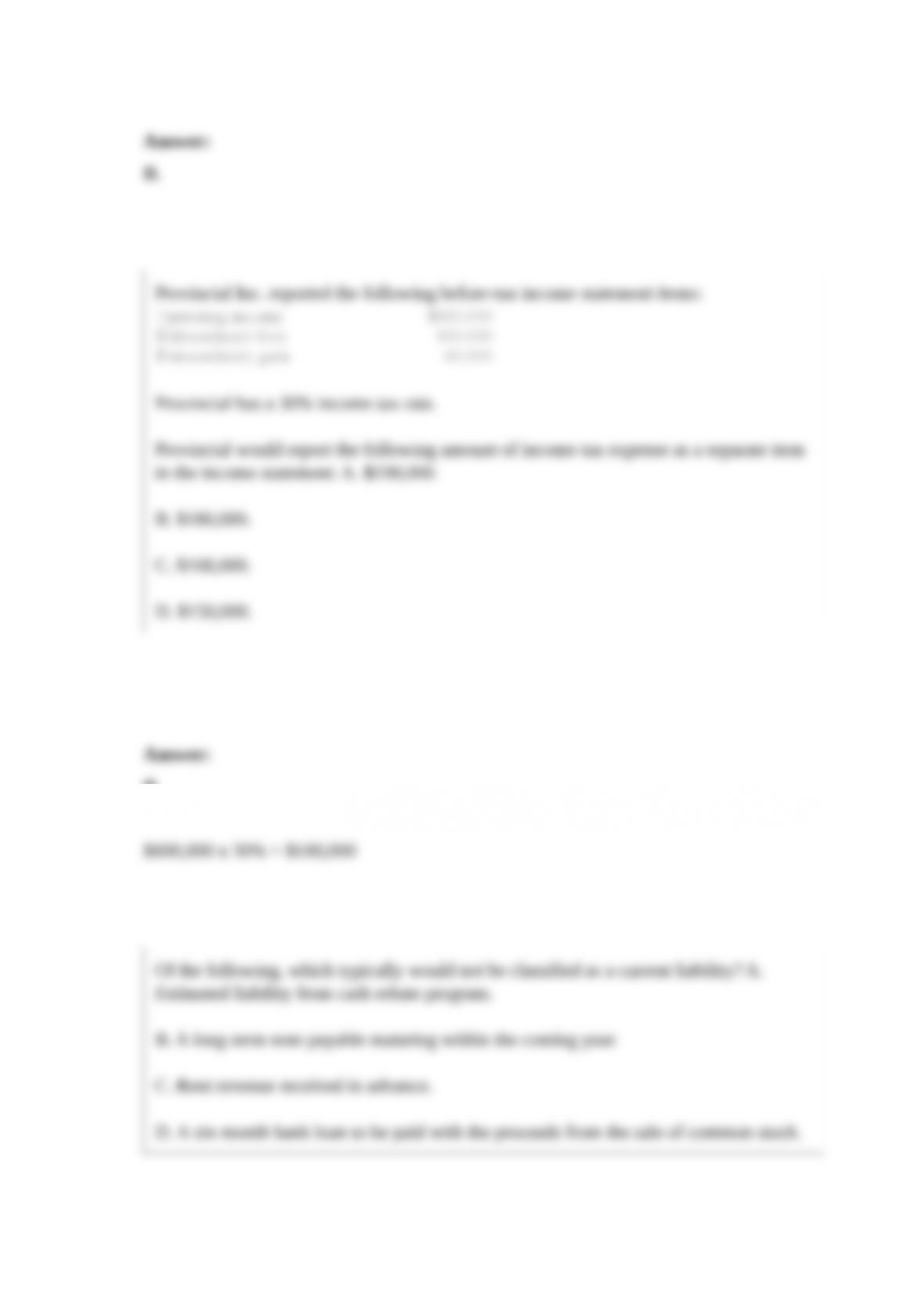
Provincial Inc. reported the following before-tax income statement items:
Provincial has a 30% income tax rate.
Provincial would report the following amount of income tax expense as a separate item
in the income statement: A. $198,000.
B. $180,000.
C. $168,000.
D. $150,000.
Of the following, which typically would not be classified as a current liability? A.
Estimated liability from cash rebate program.
B. A long-term note payable maturing within the coming year.
C. Rent revenue received in advance.
D. A six-month bank loan to be paid with the proceeds from the sale of common stock.
AMC issues a note in exchange for a machine with no stated interest rate. In accounting
for the transaction: A. The machine should be depreciated over the note’s term to
maturity.
B. If fair values of the note and machine are unavailable, the note should be recorded at
its present value, discounted at the market rate of interest.
C. Both the note and machine are recorded at the face amount of the note or the fair
value of the machine, whichever is more clearly determinable.
D. The note is recorded at its face amount unless the fair value of the machine is readily
available.
One of the four criteria for a capital lease specifies that the lease term be equal to or
greater than: A. 75% of the expected economic life of the leased property.
B. 90% of the expected economic life of the leased property.
C. 80% of the expected economic life of the leased property.
D. 50% of the expected economic life of the leased property.
Kellogg Company and its subsidiaries are engaged in the manufacture and marketing of
ready-to-eat cereal and convenience foods. In its annual report to shareholders, Kellogg
disclosed the following:
DISPOSITIONS
Last year, the Company sold certain assets and liabilities of the Lender’s Bagels
business to Aurora Foods Inc. for $275 million in cash. As a result of this transaction,
the Company recorded a pretax charge of $178.9 million ($119.3 million after tax or
$.29 per share). This charge included approximately $57 million for disposal of other
assets associated with the Lender’s business, which were not purchased by Aurora.
Disposal of these other assets was completed during the current year. The original
reserve of $57 million exceeded actual losses from asset sales and related disposal costs
by approximately $9 million. This amount was recorded as a credit to other income
(expense), net during the current year.
Required:
Explain how the Kellogg transactions described could be interpreted as an example of
earnings management.
Z Company has included in its consolidated financial statements this year a subsidiary
acquired several years ago that was appropriately excluded from consolidation last year.
This results in:A. An accounting change that should be reported prospectively.
B. A correction of an error.
C. An accounting change that should be reported by restating the financial statements of
all prior periods presented.
D. Neither an accounting change nor a correction of an error.
Cutter Enterprises purchased equipment for $72,000 on January 1, 2013. The equipment
is expected to have a five-year life and a residual value of $6,000.
Using the straight-line method, the book value at December 31, 2013, would be: A.
$57,600.
B. $51,600.
C. $58,800.
D. $52,800.
The conceptual framework’s recognition and measurement concepts recognize which of
the following as an assumption, rather than a principle? A.Going concern.
B.Historical cost.
C.Full disclosure.
D.Realization.
Listed below are five terms followed by a list of phrases that describe or characterize
each of the terms. Match each phrase with the correct term. 1)Income statement
approach
2)Interest-bearing note
3)Factoring with recourse
4)Direct write-off method
5)Internal control
A. Requires payment of principal plus interest
B. Recognizes bad debts when accounts become uncollectible
C. The risk of uncollectibility is retained by the seller
D. Includes separation of duties
E. Bad debt expense is a percentage of credit sales
Blue Co. can estimate the amount of loss that will occur if a foreign government
expropriates some of the company’s assets in that country. If the likelihood of
expropriation is remote, a loss contingency should be:A. Disclosed but not accrued as a
liability.
B. Disclosed and accrued as a liability.
C. Accrued as liability but not disclosed.
D. Neither accrued as a liability nor disclosed.
Gunk Goblin sells vacuums and just launched a policy where customers have the right
to return a vacuum during a three-year period following purchase. Gunk management
has no experience under this sort of policy and does not believe it can accurately
estimate returns. What is the longest period of time that Gunk may have to wait before
recognizing gross profit associated with one of these sales?A. No time delay, recognize
gross profit upon delivery.
B. Gunk should recognize gross profit as cash is received under the installment method.
C. Gunk should defer gross until costs are recovered under the cost recovery method.
D. Three years, after the right of return has expired.
When we assume conversion of convertible bonds, the numerator is increased by: A.
The amount of after-tax interest.
B. The gross amount of interest.
C. The weighted-average interest.
D. The amount of cash paid during the current year for interest.
Which of the following is not true about the fair value option? A. The fair value option
is irrevocable.
B. The fair value option must be elected for all shares of an investment in a particular
company.
C. Electing the fair value option for held-to-maturity investments simply reclassifies
those investments as trading securities.
D. All of the above are true.
Most corporate bonds are: A. Mortgage bonds.
B. Debenture bonds.
C. Secured bonds.
D. Collateral bonds.
In the balance sheet at the end of its first year of operations, Dinty Inc. reported an
allowance for uncollectible accounts of $82,000. During the year, Dinty wrote off
$32,000 of accounts receivable it had attempted to collect and failed. Credit sales for
the year were $2,200,000, and cash collections from credit customers totaled
$1,950,000.
What bad debt expense would Dinty report in its first-year income statement? A.
$50,000.
B. $82,000.
C. $114,000.
D. Can’t be determined from the given information.
Retrospective treatment of prior years’ financial statements is required when there is a
change from: A. Average cost to FIFO.
B. FIFO to average cost.
C. LIFO to average cost.
D. All of the above.
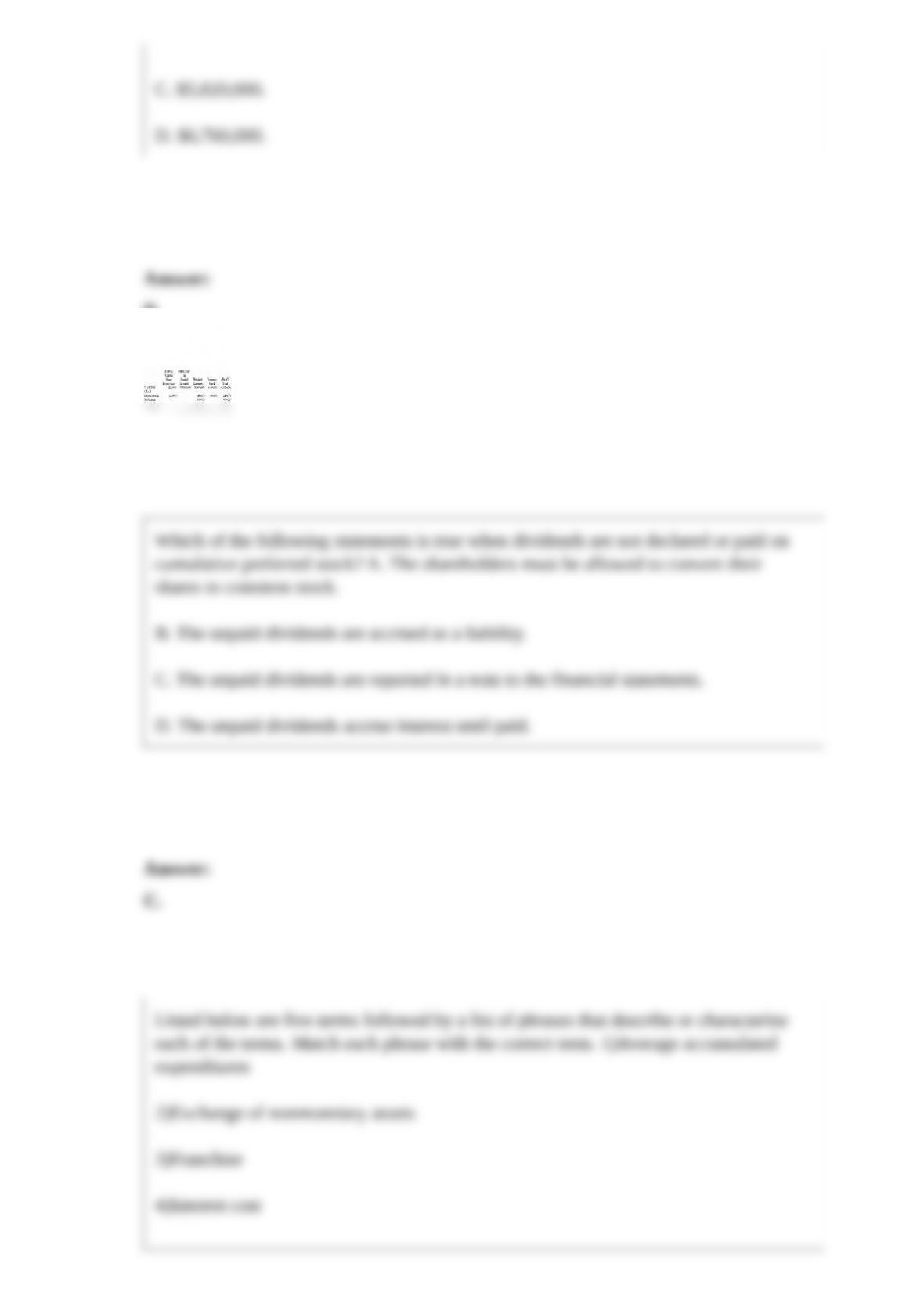
As of December 31, 2013, Warner Corporation reported the following:
During 2014, half of the treasury stock was resold for $240,000; net income was
$600,000; cash dividends declared were $1,500,000; and stock dividends declared were
$500,000.
What would shareholders’ equity be as of December 31, 2014? A. Amount is not shown.
B. $5,760,000.
C. $5,820,000.
D. $6,760,000.
Which of the following statements is true when dividends are not declared or paid on
cumulative preferred stock? A. The shareholders must be allowed to convert their
shares to common stock.
B. The unpaid dividends are accrued as a liability.
C. The unpaid dividends are reported in a note to the financial statements.
D. The unpaid dividends accrue interest until paid.
Listed below are five terms followed by a list of phrases that describe or characterize
each of the terms. Match each phrase with the correct term. 1)Average accumulated
expenditures
2)Exchange of nonmonetary assets
3)Franchise
4)Interest cost
5)Revenue-donation of asset
A. Approximation of average outstanding debt if all construction funds were borrowed
B. Account credited when assets are donated to a corporation
C. Asset received is measured at fair value
D. Both the total amount and the amount capitalized should be disclosed
E. Right granted to use a trademark or tradename within a geographic area
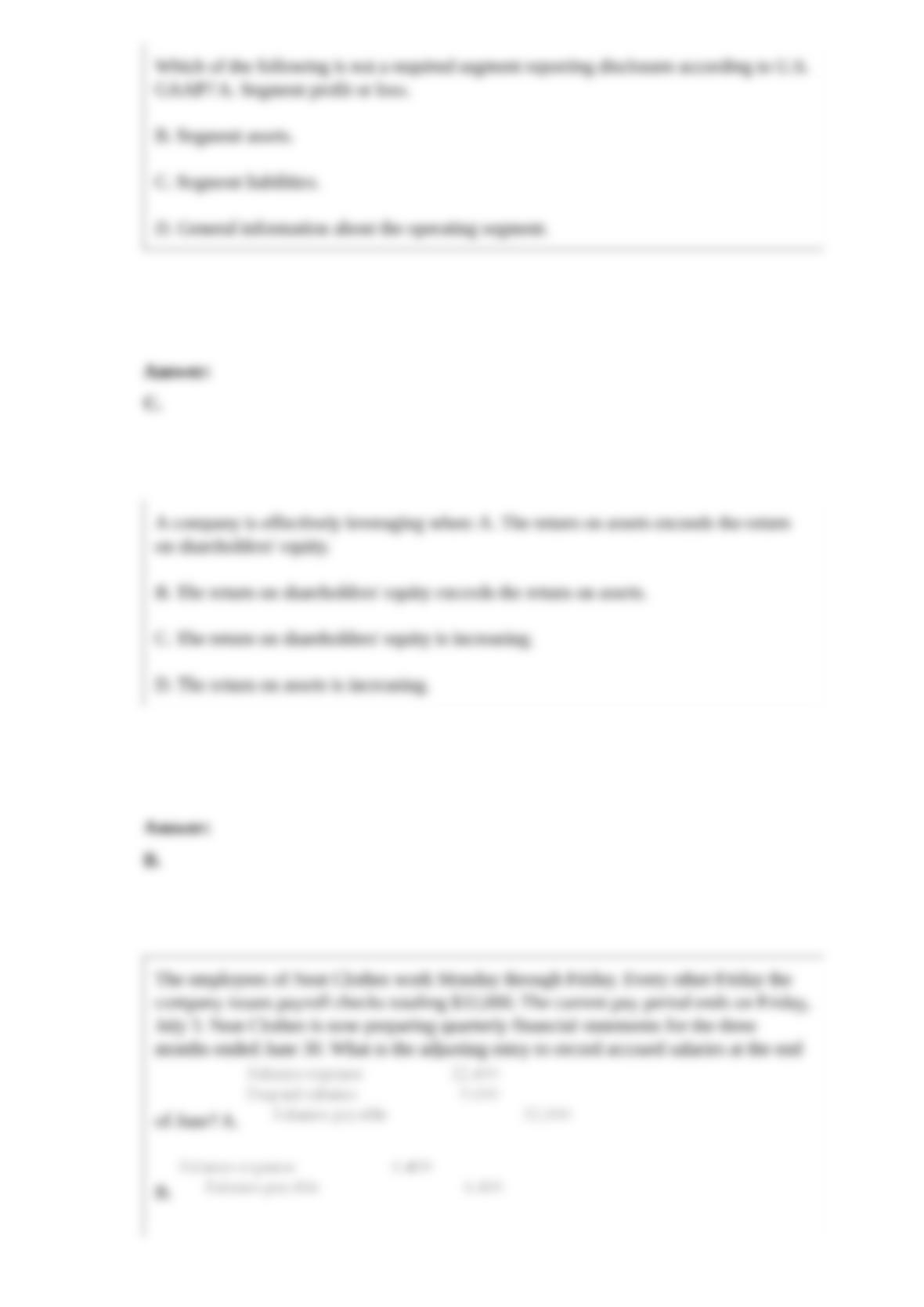
Sneed Corporation reported balances in the following accounts for the current year:
Income tax expense was $230 for the year. What was the amount paid for taxes? A.
$280.
B. $220.
C. $210.
D. $190.
Which of the following is not a required segment reporting disclosure according to U.S.
GAAP? A. Segment profit or loss.
B. Segment assets.
C. Segment liabilities.
D. General information about the operating segment.
A company is effectively leveraging when: A. The return on assets exceeds the return
on shareholders’ equity.
B. The return on shareholders’ equity exceeds the return on assets.
C. The return on shareholders’ equity is increasing.
D. The return on assets is increasing.
The employees of Neat Clothes work Monday through Friday. Every other Friday the
company issues payroll checks totaling $32,000. The current pay period ends on Friday,
July 3. Neat Clothes is now preparing quarterly financial statements for the three
months ended June 30. What is the adjusting entry to record accrued salaries at the end
of June? A.
B.
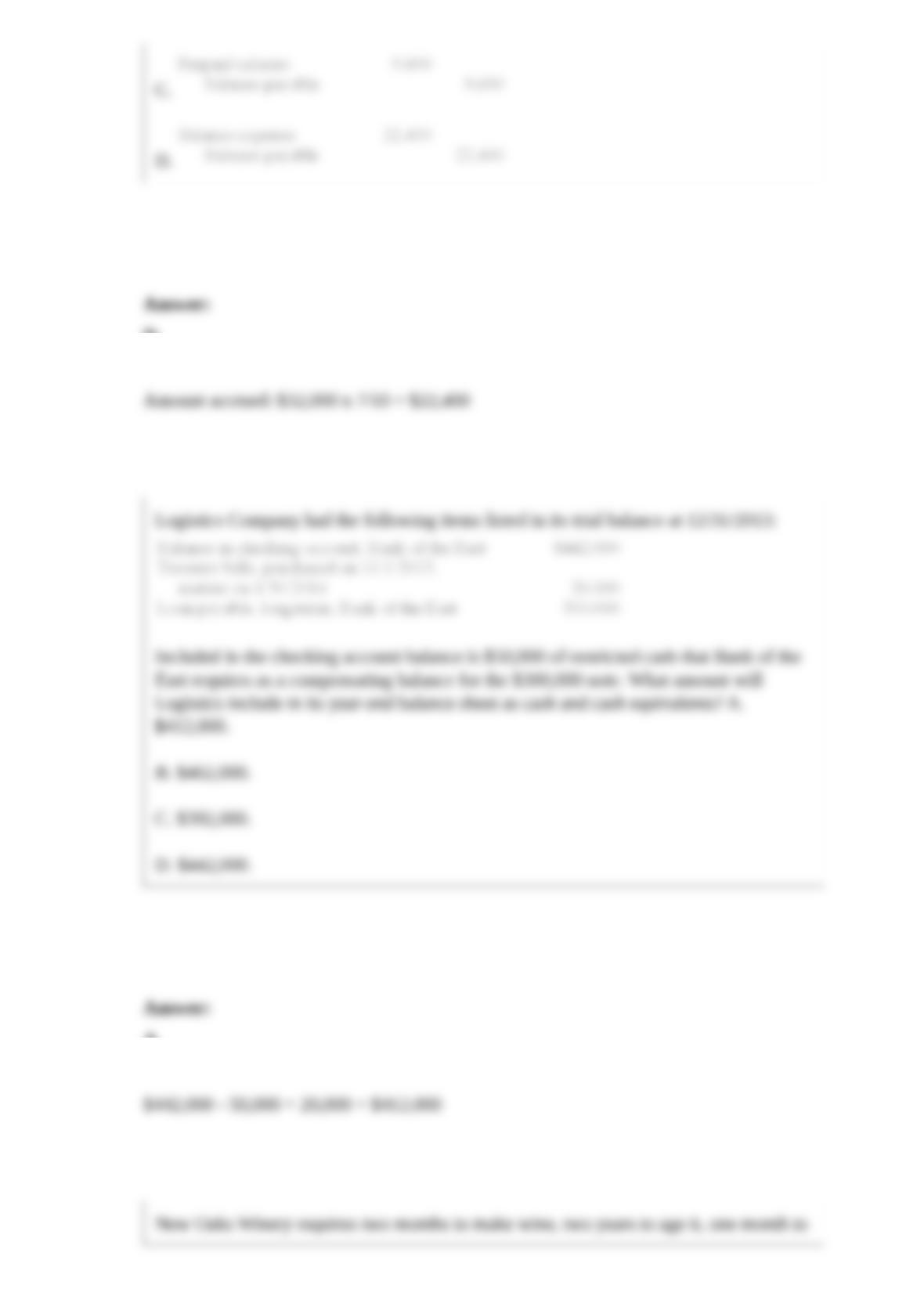
C.
D.
Logistics Company had the following items listed in its trial balance at 12/31/2013:
Included in the checking account balance is $50,000 of restricted cash that Bank of the
East requires as a compensating balance for the $300,000 note. What amount will
Logistics include in its year-end balance sheet as cash and cash equivalents? A.
$412,000.
B. $462,000.
C. $392,000.
D. $442,000.
New Oaks Winery requires two months to make wine, two years to age it, one month to
bottle it, two months to sell it, and one month to collect the receivable. Its operating
cycle is: A. Twelve months.
B. Thirty months.
C. Six months.
D. Three months.
Which of the following accounts are closed at the end of the accounting period? A.
Allowance for uncollectible accounts.
B. Unearned revenue.
C. Retained earnings.
D. Income tax expense.
Rice Industries owns a manufacturing plant in a foreign country. Political unrest in the
country indicates that Rice should investigate for possible impairment. Below is
information related to the plant’s assets ($ in millions):
The amount of impairment loss that Rice should recognize according to U.S. GAAP and
IFRS, respectively, is:
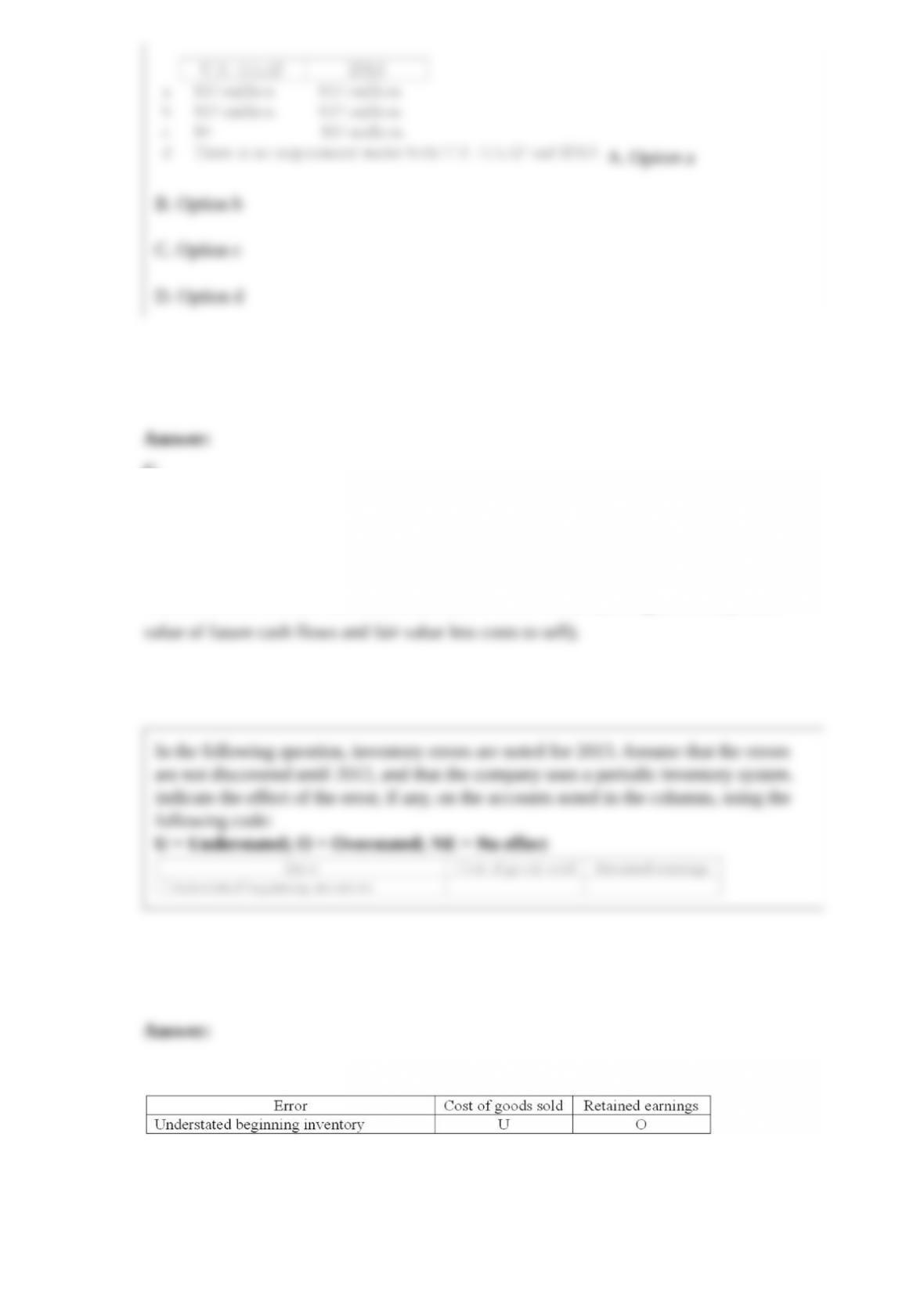
A. Option a
B. Option b
C. Option c
D. Option d
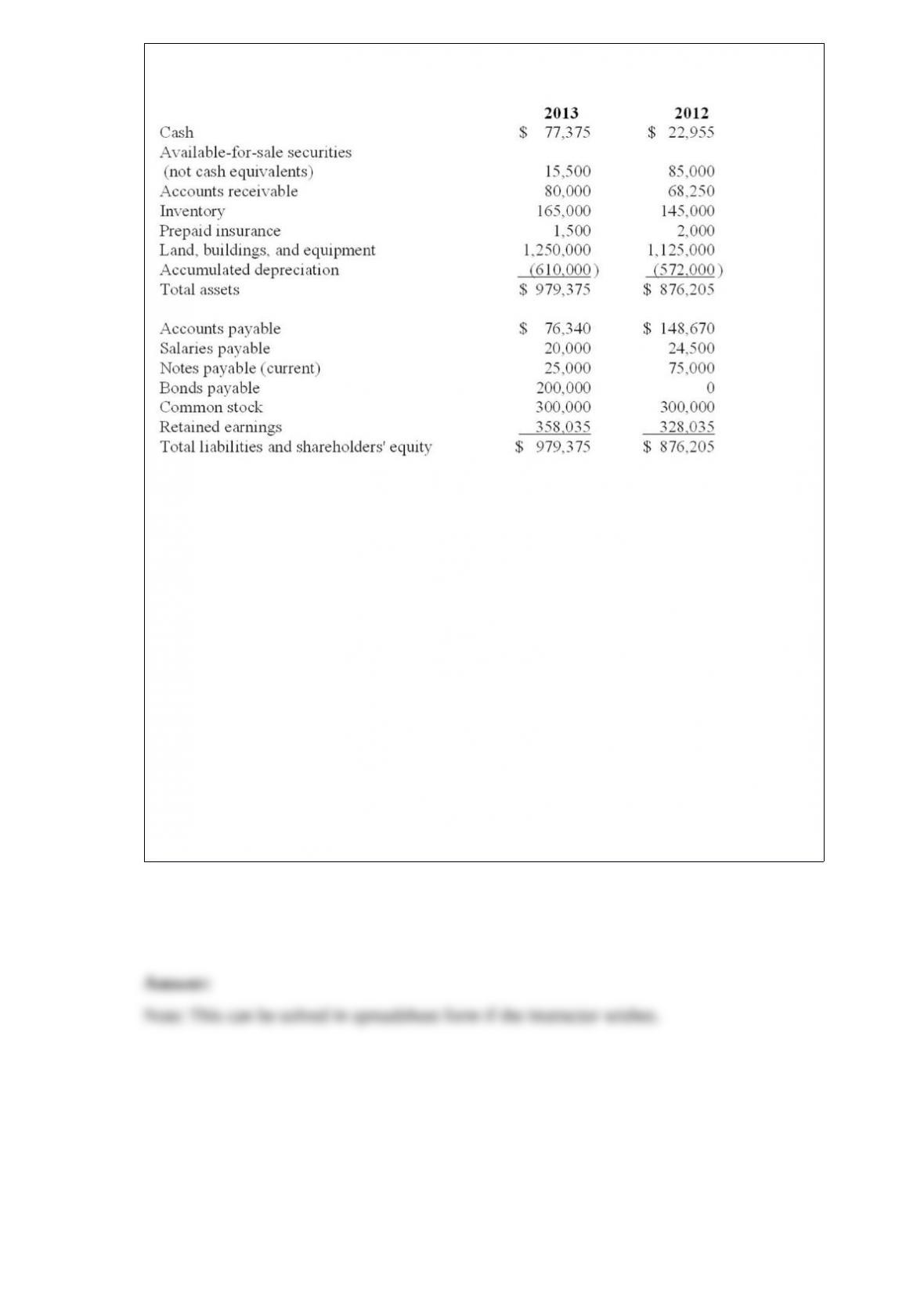
In the following question, inventory errors are noted for 2013. Assume that the errors
are not discovered until 2012, and that the company uses a periodic inventory system.
Indicate the effect of the error, if any, on the accounts noted in the columns, using the
following code:
U = Understated; O = Overstated; NE = No effect
Listed below are 5 terms followed by a list of phrases that describe or characterize the
terms. Match each phrase with the correct term. 1)Billings in excess of cost
2)SAB 101
3)Unearned revenue
4)Software revenue recognition
5)Long-term contract losses
•Always reported as a current liability.
•Uses vendor-specific objective evidence of fair values.
•Recognized immediately
•SEC guidelines on revenue recognition
•Revenue received but not recognized
•
On July 1, 2013, Silverwood Company purchased for cash 35% of the voting common
stock of Yellowstone Corporation. Both companies have a December 31 fiscal year-end.
Yellowstone Corporation, which is publicly traded on an organized stock exchange,
reported its net income for the year to Silverwood and paid a dividend to Silverwood
during the year.
Required:
How should Silverwood report the above information in its year-end income statement
and balance sheet? Discuss the rationale for your answer.
Use I = Increase, D = Decrease, or N = No effect, to indicate the effect on total
shareholders’ equity for each of the listed transactions.
____ Declaration of a property dividend.
____ Net income for the year.
____ Purchase of treasury stock at a cost greater than the original issue price.
____ Purchase of treasury stock at a cost less than the original issue price.
____ Issue common stock.
____ Resale of treasury stock.
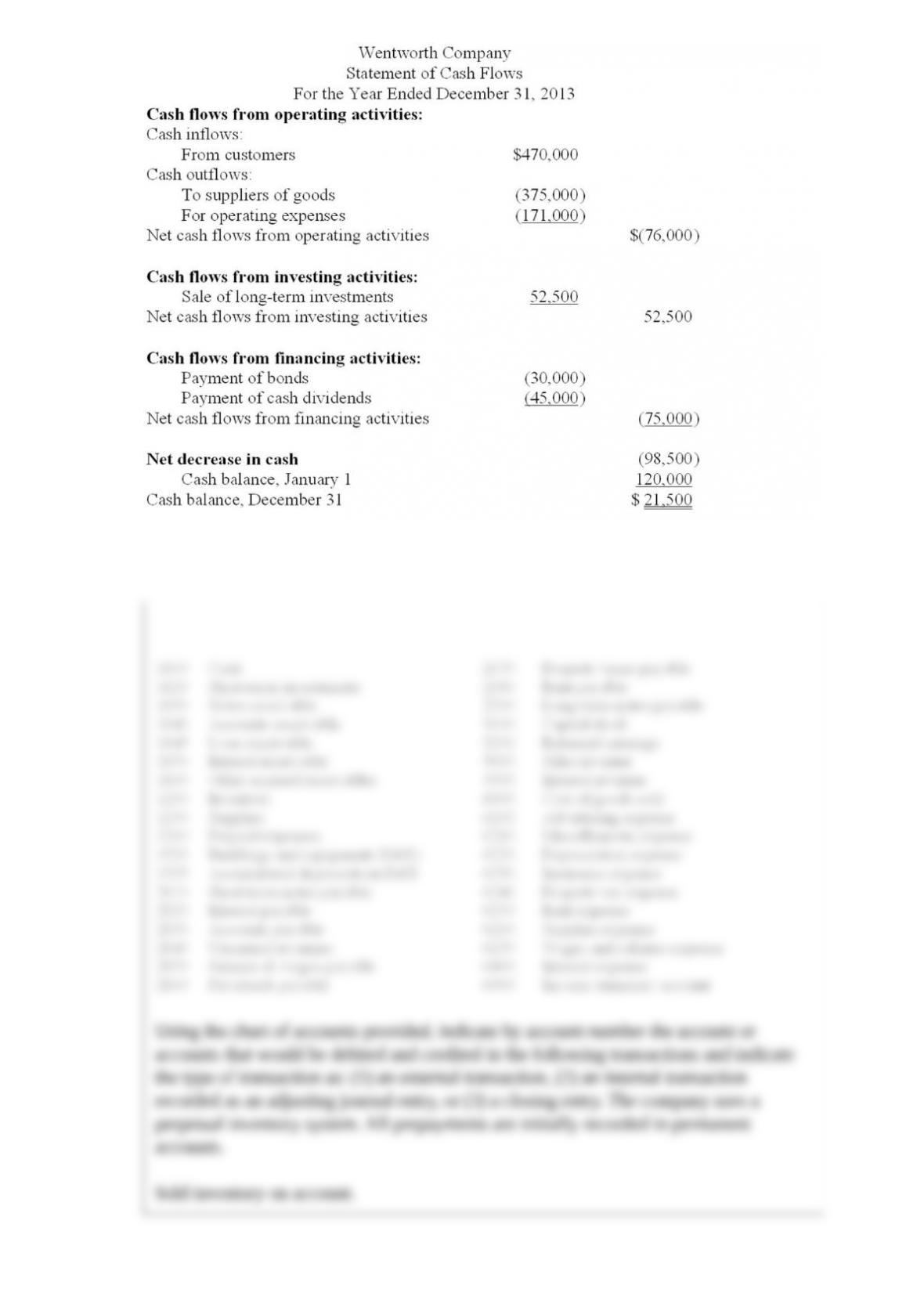
The following are comparative balance sheets and an income statement for Wentworth
Company.
Cash dividends of $45,000 were paid in 2013.
Required:
Prepare a statement of cash flows for 2013 using the direct method.
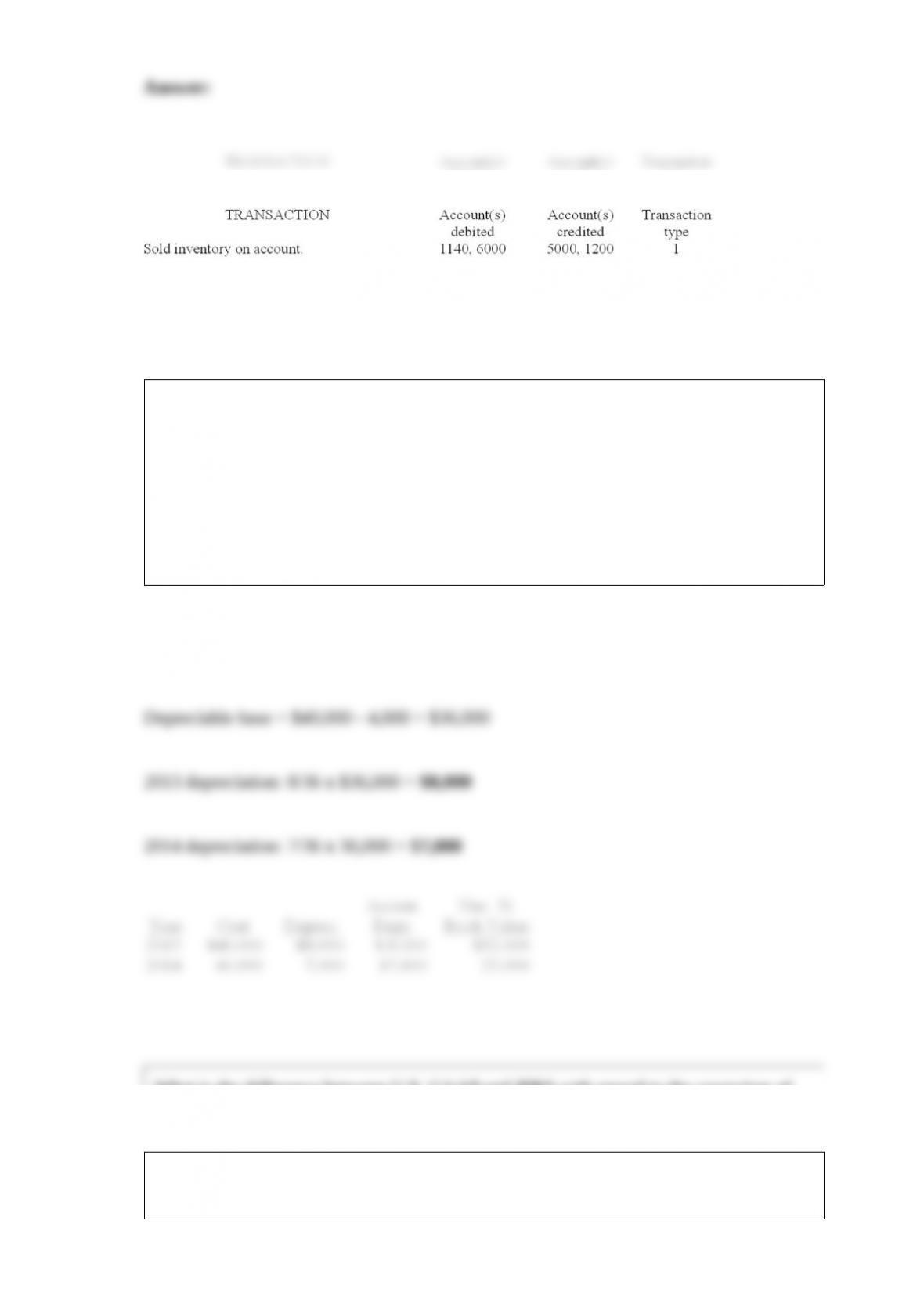
Using the chart of accounts provided, indicate by account number the account or
accounts that would be debited and credited in the following transactions and indicate
the type of transaction as: (1) an external transaction, (2) an internal transaction
recorded as an adjusting journal entry, or (3) a closing entry. The company uses a
perpetual inventory system. All prepayments are initially recorded in permanent
accounts.
Sold inventory on account.
What is the difference between U.S. GAAP and IFRS with regard to the correction of
accounting errors?
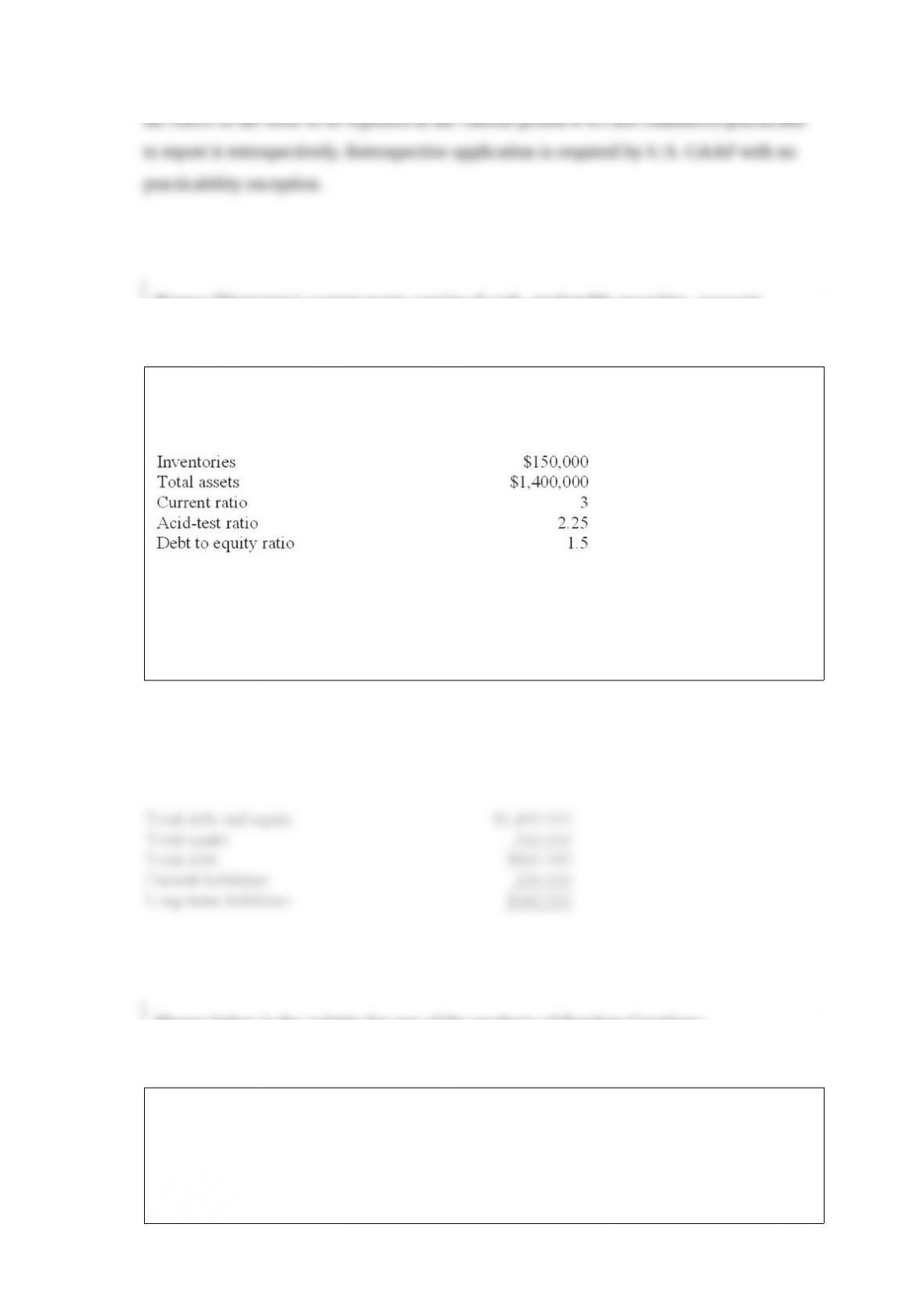
Bronco Electronics’ current assets consist of cash, marketable securities, accounts
receivable, and inventories. The following data were abstracted from a recent financial
statement:
Required:
Compute the following for Bronco:
Long-term liabilities
Shown below is the activity for one of the products of Random Creations:
January 1 balance, 80 units @ $50 $4,000
Purchases:
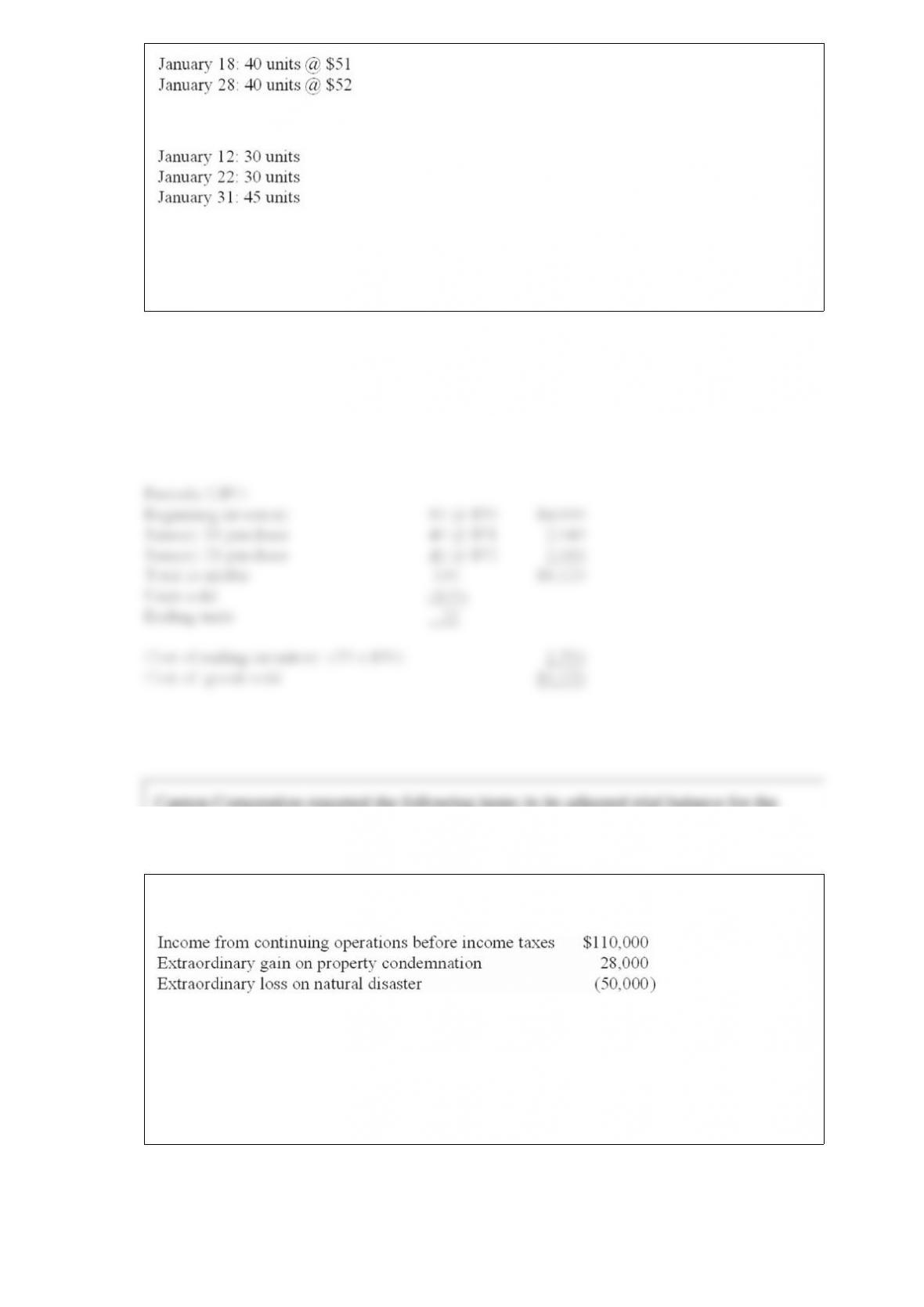
Sales:
Required:
Compute the January 31 ending inventory and cost of goods sold for January, assuming
Random Creations uses LIFO and a periodic inventory system.
Canton Corporation reported the following items in its adjusted trial balance for the
year ended December 31, 2013:
Canton is subject to a 30% tax rate.
Required:
Prepare the December 31, 2013, income statement for Canton Corporation, starting
with income from continuing operations before income taxes.
Briefly indicate at least two indicators that can be used to distinguish whether a seller is
a principal or an agent according to GAAP. Three indicators are:
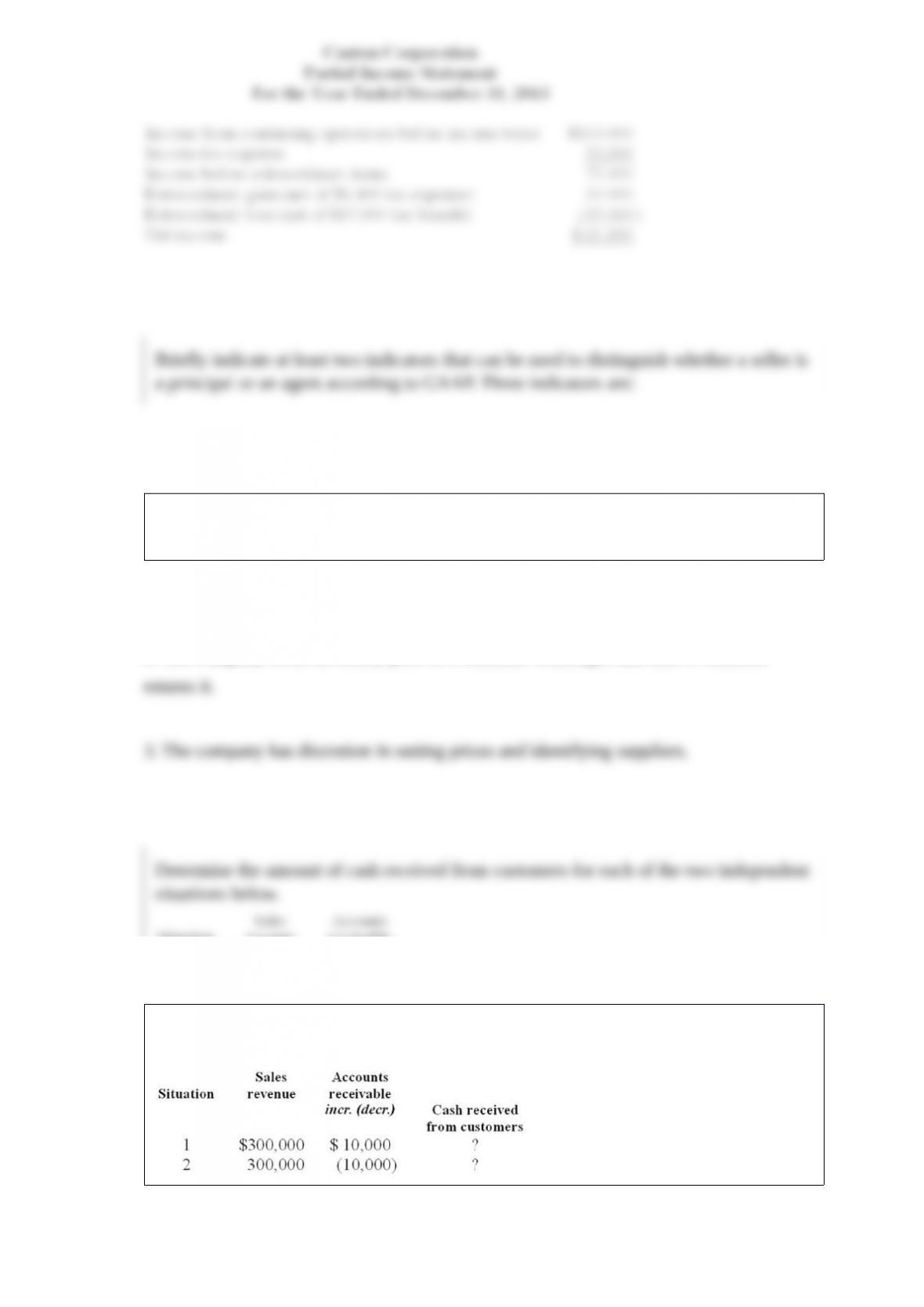
Determine the amount of cash received from customers for each of the two independent
situations below.