The components of an internal control system include control environment, risk
assessment, control activities, information and communication, and rationalization.
Under the indirect method, changes in current assets are used in determining cash flows
from operating activities and changes in current liabilities are used in determining cash
flows from financing activities.
Bonds allow a company to borrow large sums of money from many different investors.
In the United States, generally accepted accounting principles (GAAP) are established
by the PCAOB (Public Company Accounting Oversight Board).
All other things being equal, the higher the return on equity ratio, the better the
financial performance of the company.
GAAP does not allow cash basis accounting to be used in external financial reports.
If revenues are not growing faster than expenses, then net income will decrease.
An overstatement of ending inventory will cause an overstatement of assets and an
understatement of stockholders ‘ equity on the balance sheet.
A piece of equipment with a cost of $130,000 and accumulated depreciation of $85,000
is sold for $50,000 cash. The amount that should be reported as a cash inflow from
investing activities is:
A) $50,000.
B) $5,000.
C) $45,000.
D) $0; this transaction is a financing activity.
Which of the following statements is correct?
A) Stock splits and stock dividends both reduce the market price of a share, but only
stock splits reduce the par value of a share.
B) Stock splits and stock dividends both reduce the market price of a share and the par
value of a share.
C) Stock splits and stock dividends both reduce the market price of a share, but only
stock dividends reduce the par value of a share.
D) Stock splits and stock dividends both reduce the market price of a share and reduce
Retained Earnings.
Eaton Electronics uses a periodic inventory system. On March 31, Eaton has two
plasma TVs on hand at a cost of $1,500 each (serial numbers 11534892 and 11534894).
In April, the company purchases four more identical TVs from Toshiba for $1,450 each
(serial numbers 11542631 through 11542634). In May, the company purchases five
more identical TVs for $1,600 each (serial numbers 11550964 through 11550968). In
June, Eaton sells two of these TVs (serial numbers 11534894 and 11542631). There
were no additional purchases or sales during the remainder of the year.
Use the information above to answer the following question. Eaton Electronics uses the
weighted average method. What is the company ‘s weighted average cost per unit?
(Round the per unit cost to the nearest dollar.)
A) $1,500
B) $1,517
C) $1,527
D) $1,600
The ratio that measures how many times a company replenishes its inventory in a year
is the:
A) days to sell ratio.
B) receivables turnover ratio.
C) inventory turnover ratio.
D) days to collect ratio.
A company has long-lived tangible assets with a cost of $3.5 million; its Accumulated
Depreciation account has a balance of $1.1 million. Which of the following statements
is correct?
A) The book value of long-lived assets is $2.4 million.
B) The market value of long-lived assets is $3.5 million.
C) The carrying value of long-lived assets is $3.5 million.
D) The resale value of long-lived assets is $2.4 million.
Accumulated Depreciation is classified as a(n):
A) expense account.
B) contra-asset account.
C) liability account.
D) stockholders’ equity account.
All other things being equal, a company is better off when its receivable turnover ratio:
A) and its days-to-collect measure are both low.
B) is high and its days-to-collect measure is low.
C) and its days-to-collect measure are both high.
D) is low and its days-to-collect measure is high.
Which of the following would eventually cause Retained Earnings to decrease?
A) Receiving contributions from investors
B) Earning unearned revenue
C) Billing customers for services provided
D) Using up supplies
A company reported the following data:
Required:
Part a. Calculate the company’s inventory turnover for each of the three years. (Round
your answers to two decimal points.)
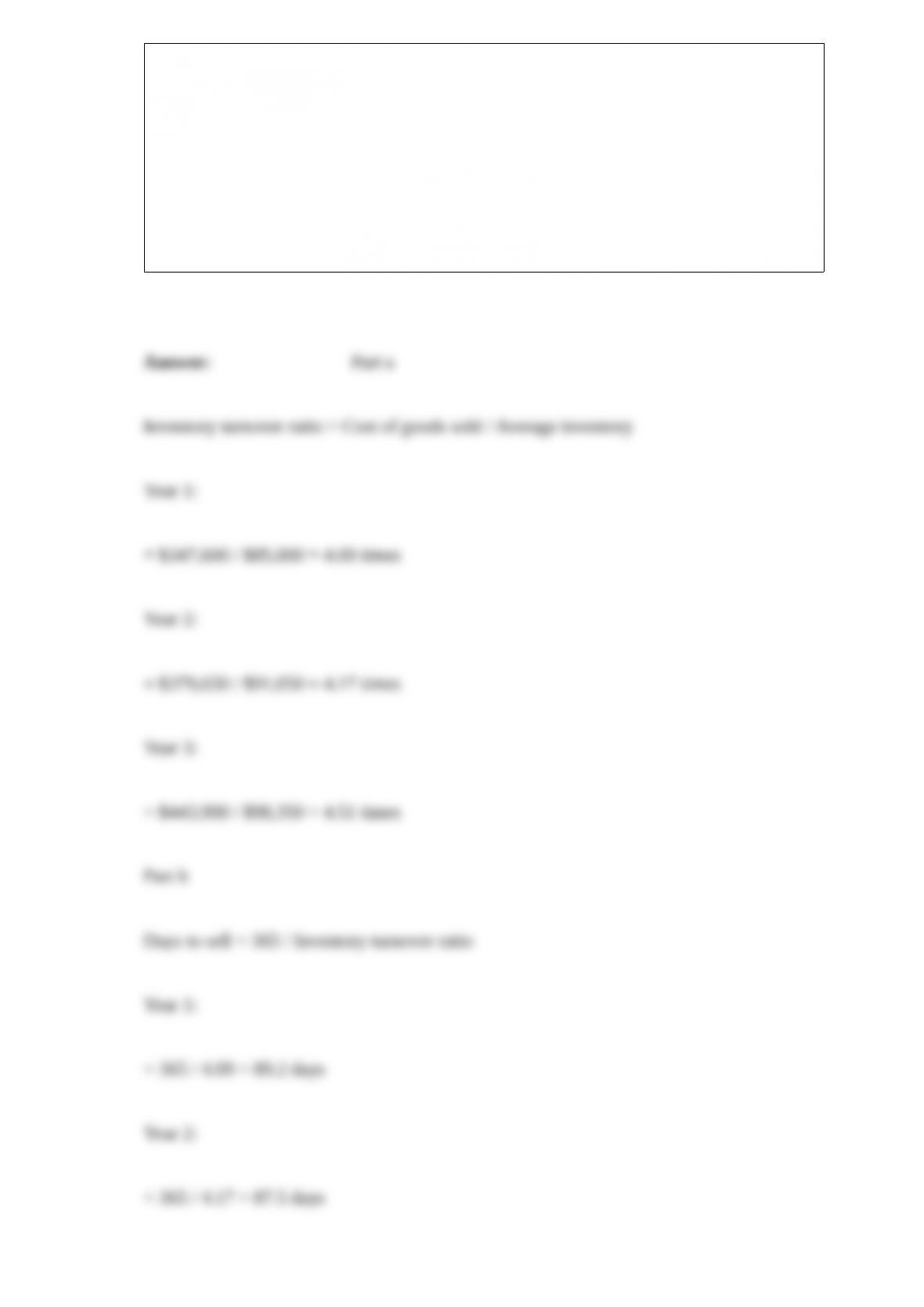
Part b. Calculate the days to sell for each of the three years. (Round your answers to
one decimal point.)
Part c. Comment on the company’s inventory turnover ratio by describing what it
measures, how the changes over the past three years can be interpreted, and what may
have caused those changes.
Part d. Comment on the company’s days to sell by describing what it measures and how
the changes over the past three years can be interpreted.
The Sweet Smell of Success Fragrance Company borrowed $60,000 from the bank to
be paid back in five years and used all of the money to purchase land for a new store.
Sweet Smell’s balance sheet would show this as:
A) $60,000 under Land and $60,000 under Notes Payable (long-term).
B) $60,000 under Depreciation Expense and $60,000 under Notes Payable (long-term).
C) $60,000 under Land and $60,000 under Notes Receivable (long-term).
D) $60,000 under Other Assets and $60,000 under Other Liabilities.
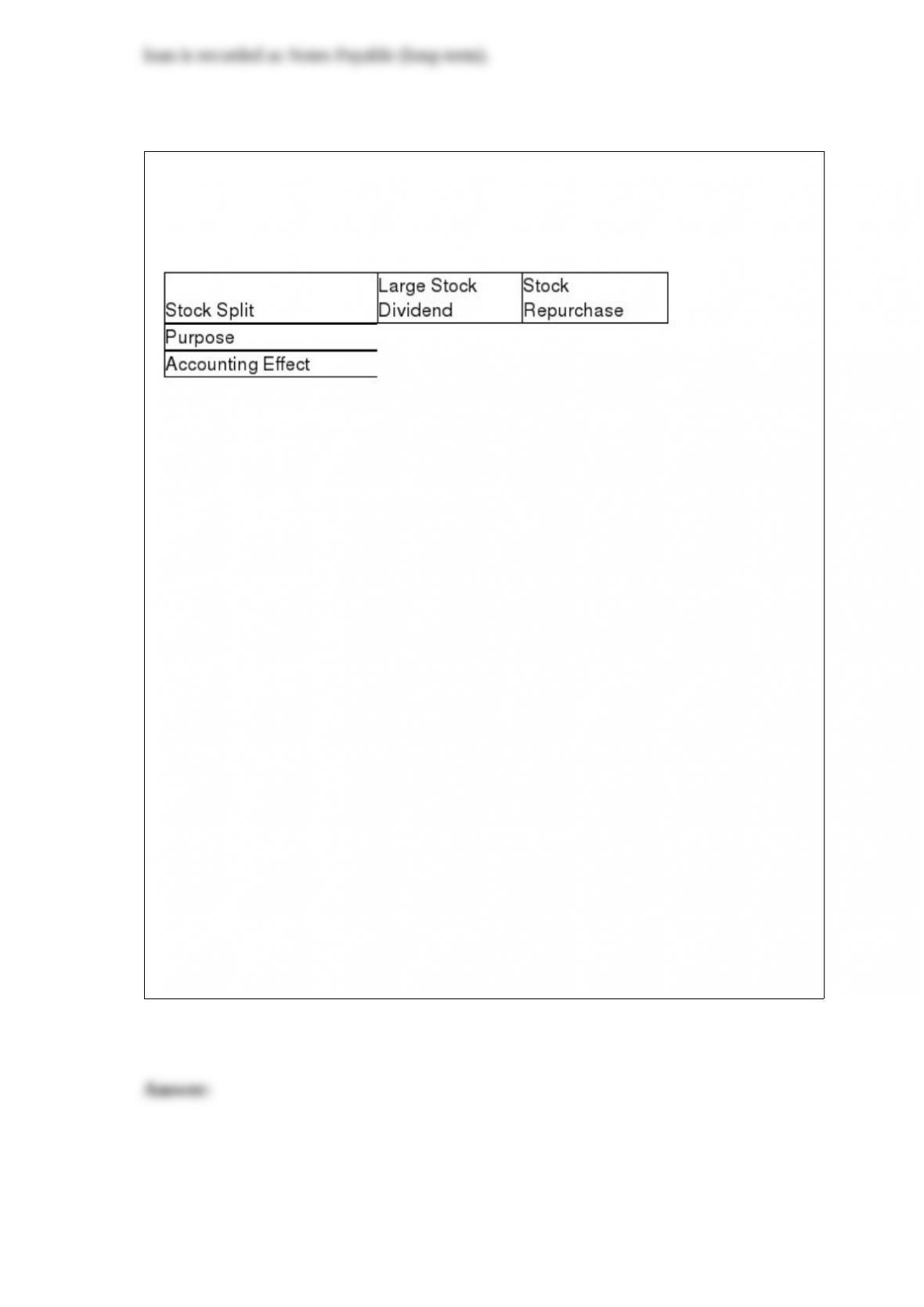
Choose the appropriate letter to match the description with the purpose and accounting
effect of the type of stock transaction. Some letters will appear in more than one column
and not all letters will necessarily be used. Some blanks will require more than one
letter.
A. To obtain shares to reissue to employees as part of employee stock purchase plans.
B. To increase the number of shares outstanding and decrease the per-share market
price while managing a company that you expect will struggle financially in the future.
C. To reduce the number of outstanding shares to increase per-share measures of
earnings.
D. To increase the number of shares outstanding and decrease the per-share market
price while signaling to financial statement users that the company expects significant
future earnings.
E. To obtain shares that can be reissued as payment for purchases of other companies.
F. To send a signal to investors that the company itself believes its own stock is worth
acquiring.
G. Reduces stockholders’ equity.
H. Changes par value per share.
I. Changes Additional Paid-in Capital account balance.
J. Reduces Retained Earnings.
K. Does not affect any of the account balances that comprise stockholders equity.
Which of the following statements most appropriately describes the purpose of
depreciating a long-lived tangible asset?
A) To indicate how the asset has physically deteriorated
B) To show that the asset will eventually and gradually become obsolete
C) To record that the asset’s market value declines over time
D) To match the cost of the asset to the period in which it generates revenue
A company issues $20 million in new stock. The company later uses this money to
acquire a building. What is the effect of these two transactions on the company ‘s
accounts?
A) Buildings increases and Common Stock increases.
B) Buildings increases and Common Stock decreases.
C) Cash increases, Buildings increases, and Common Stock increases.
D) Cash decreases, Buildings increases, and Common Stock decreases.
A company has outstanding 10 million shares of $2 par common stock and 1 million
shares of $4 par preferred stock. The preferred stock has an 8% dividend rate. The
board of directors declares $300,000 in total dividends for the year. Which of the
following is correct if the preferred stockholders have a cumulative dividend
preference?
A) Preferred stockholders will receive the entire $300,000 and they must also be paid
$20,000 before the end of the current accounting period; common stockholders will
receive nothing.
B) Preferred stockholders will receive $24,000 (or 8% of the total dividends); common
stockholders will receive the remaining $276,000 (or $300,000 – $24,000).
C) Preferred stockholders will receive the entire $300,000 and they must also be paid
the remaining $20,000 sometime in the future before common stockholders will receive
any dividends.
D) Preferred stockholders will receive the entire $300,000, but will receive nothing
more in the future relating to this dividend declaration; common stockholders will
receive nothing.
Which of the following statements about the lower of cost or market rule is not correct?
A) The lower of cost or market rule sometimes causes the book value of inventory to be
written down below cost, but will never cause the book value of inventory to be
increased above cost.
B) The amount of inventory write-down is an expense which most companies report as
cost of goods sold.
C) Lower of cost or market is an inventory cost method used to determine cost of goods
sold and ending inventory.
D) The lower of cost or market (LCM) rule results in reporting inventory
conservatively, at an amount that does not exceed its actual value.
Sinton Inc. uses a periodic inventory system. During the current year, its beginning
inventory was $5,200 and net purchases amounted to $24,600. At the end of the year,
after counting its inventory, the company determined that the dollar valuation of its
ending inventory was $4,100.
Required:
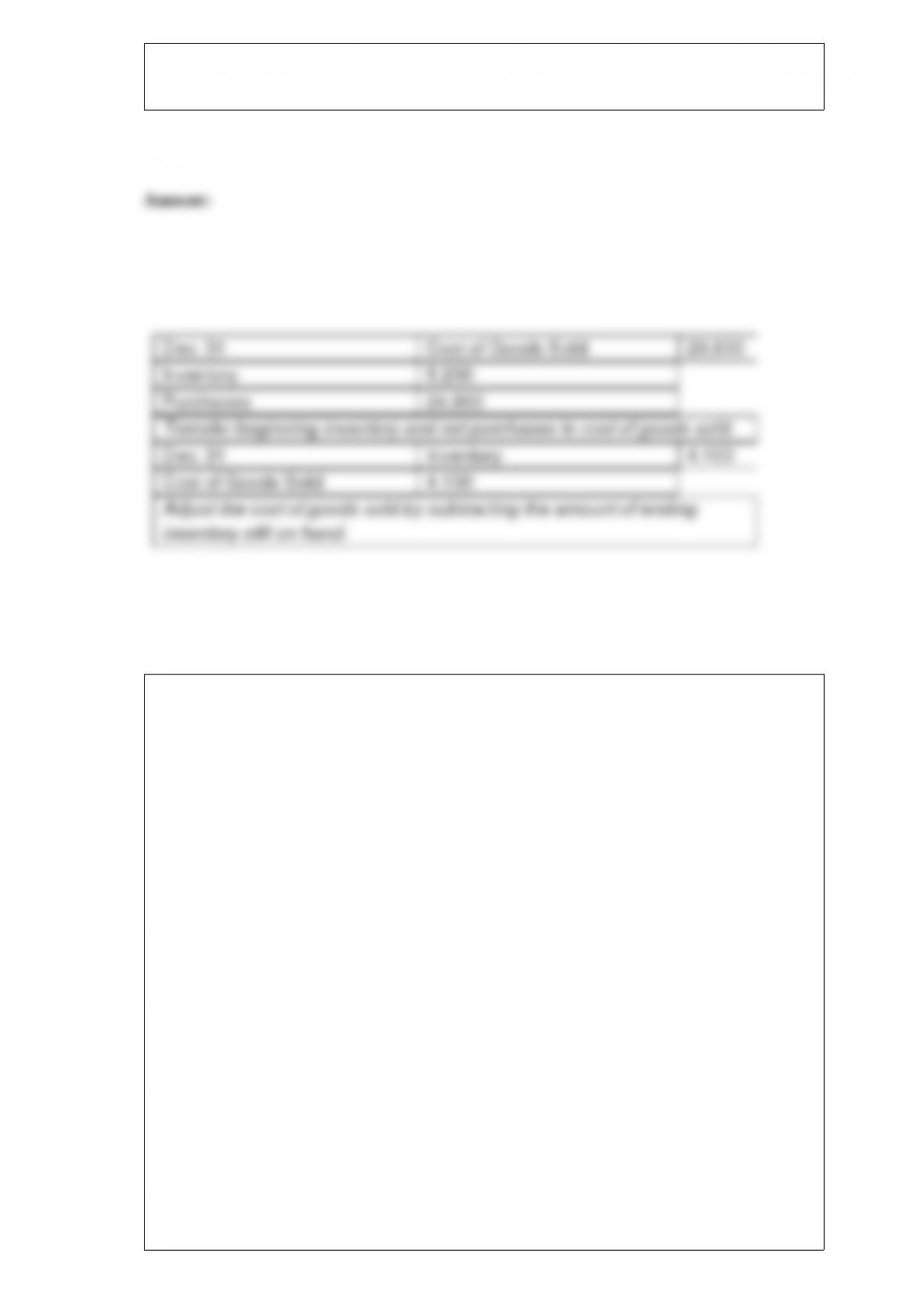
Prepare the two journal entries that will be recorded on Stinton’s books on the last day
of the year. Include explanations.
Match each account name with the category that it would be included under in
classified balance sheet.
ACCOUNT
______ (1) Equipment
______ (2) Common Stock
______ (3) Supplies
______ (4) Retained Earnings
______ (5) Accounts Receivable
______ (6) Accounts Payable
CATEGORY
CA – Current Asset
NCA – Noncurrent Asset
CL – Current Liability

NCL – Noncurrent Liability
SE – Stockholders’ Equity
Indicate whether the Inventory account is debited (Dr), credited (Cr), or neither (N)
when using a perpetual inventory system to record each of the following transactions:
1> _____ The company purchases $3,000 of goods intending to sell them to customers.
2> _____ The company returns $200 of damaged goods to the supplier.
3> _____ The company pays a shipping firm $685 to ship an order of goods from the
supplier to the company.
4> _____ The company receives a purchase discount for prompt payment to a supplier.
5> _____ Customers return $550 of goods in excellent condition to the company.
6> _____ The company sells $4,600 of goods to consumers.
7> _____ The company purchases $1,600 of supplies intending to use them internally.
9> _____ The company does a physical count and finds three items missing due to
shrinkage.
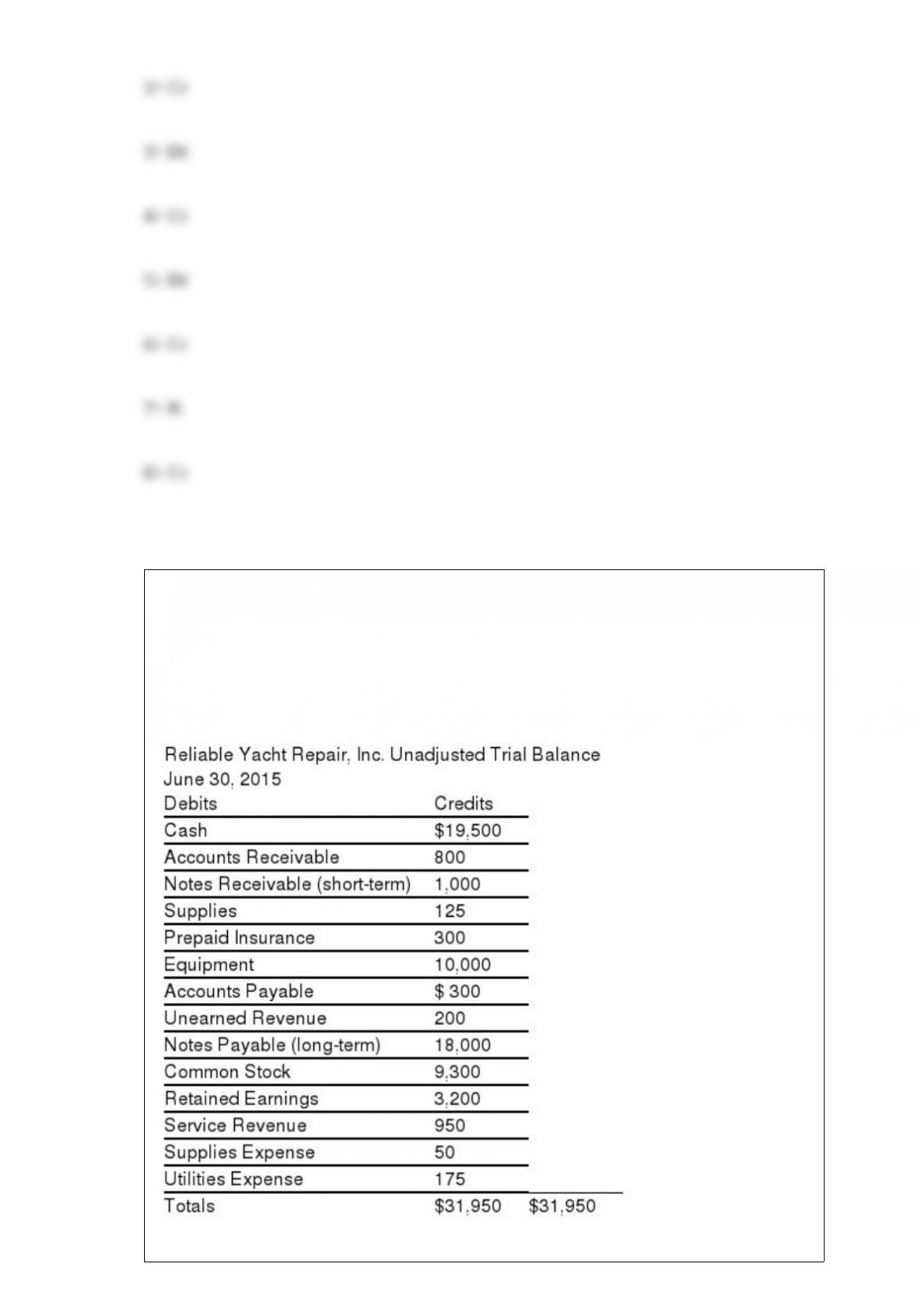
Lisa and Charlie operate a yacht maintenance service that they incorporated as Reliable
Yacht Repair, Inc. They recently talked to their banker about obtaining a loan. The
banker has requested their most recent financial statements prepared in accordance with
GAAP. Lisa and Charlie are unsure of how to proceed and ask you for advice. You
asked for their most recent unadjusted trial balance, which follows:
Required:
Review the unadjusted trial balance and identify the accounts that might require
adjustment at June 30, 2015. Then, describe what information you would need in order
to determine the nature and amount of the adjusting entry for each of the accounts
identified.
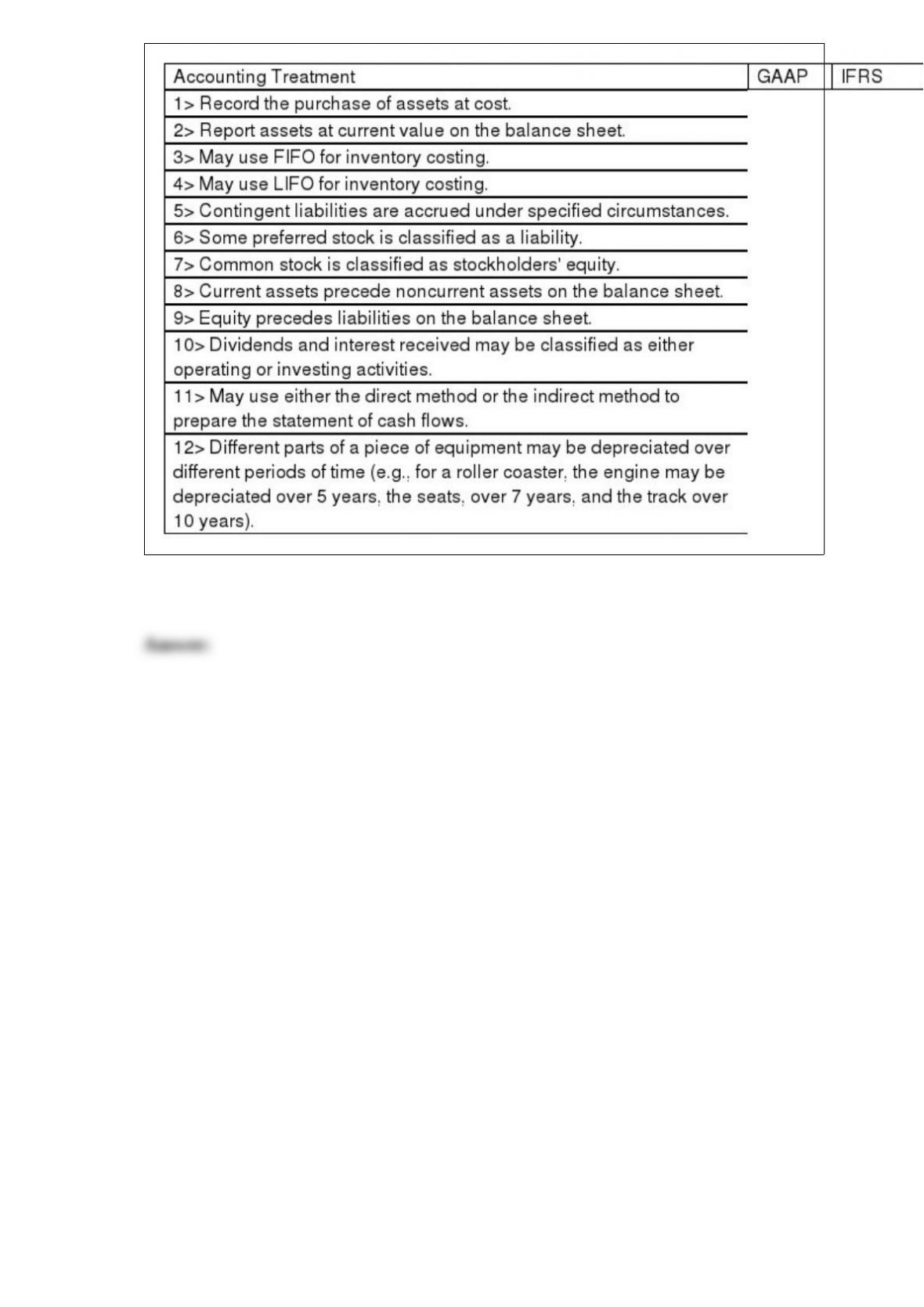
For each of the accounting treatments below, indicate whether it is followed in GAAP,
or IFRS, or both, by placing an “X” in the appropriate column(s).